
The External Environment The External Environment Environmental Uncertainty
- Slides: 26
The External Environment • The External Environment • Environmental Uncertainty • Adapting to Environmental Uncertainty • Framework for Organization Response to Uncertainty • Resource Dependence • Controlling Environmental Resources
The Environmental Domain • Organisation environment – as all elements that exist outside the boundary of the organization and have the potential to affect all or part of the organization • The environment of an organization can be understood by analyzing its domain within external sector. • Domain – is the chosen environmental field of action – defines the organization's niche and defines those external sector with which the organization will interact to accomplish its goals. • Sectors – the environment comprises several sectors or subdivisions of the external environment that contain similar elements. Business 5301
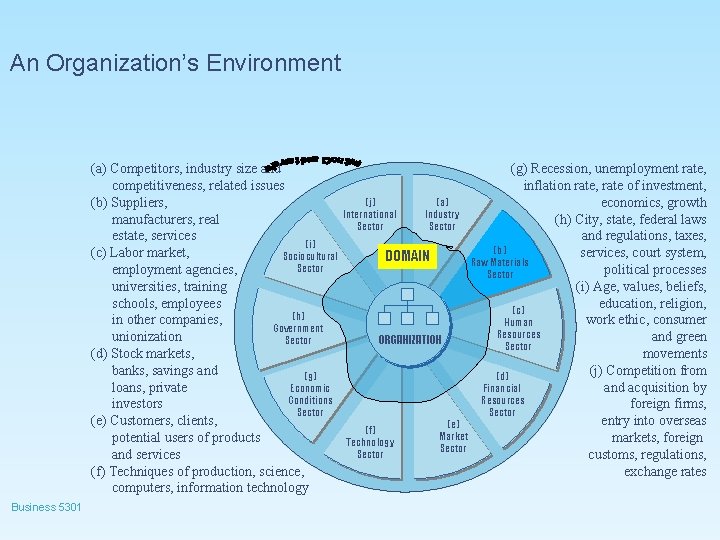
An Organization’s Environment (a) Competitors, industry size and competitiveness, related issues (b) Suppliers, manufacturers, real estate, services (i) (c) Labor market, Sociocultural Sector employment agencies, universities, training schools, employees (h) in other companies, Government unionization Sector (d) Stock markets, banks, savings and (g) loans, private Economic Conditions investors Sector (e) Customers, clients, potential users of products and services (f) Techniques of production, science, computers, information technology Business 5301 (g) Recession, unemployment rate, inflation rate, rate of investment, (j) (a) economics, growth International Industry (h) City, state, federal laws Sector and regulations, taxes, (b) services, court system, DOMAIN Raw Materials political processes Sector (i) Age, values, beliefs, education, religion, (c) work ethic, consumer Human Resources and green ORGANIZATION Sector movements (j) Competition from (d) and acquisition by Financial Resources foreign firms, Sector entry into overseas (e) (f) Market markets, foreign Technology Sector customs, regulations, exchange rates
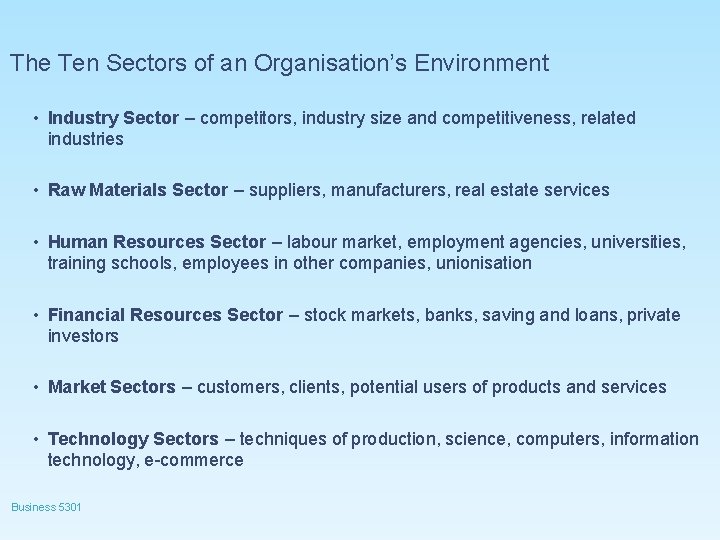
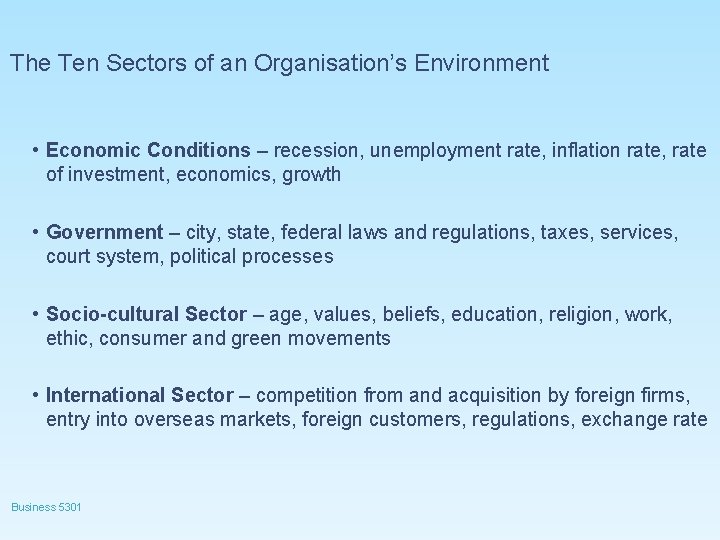
The Ten Sectors of an Organisation’s Environment • Industry Sector – competitors, industry size and competitiveness, related industries • Raw Materials Sector – suppliers, manufacturers, real estate services • Human Resources Sector – labour market, employment agencies, universities, training schools, employees in other companies, unionisation • Financial Resources Sector – stock markets, banks, saving and loans, private investors • Market Sectors – customers, clients, potential users of products and services • Technology Sectors – techniques of production, science, computers, information technology, e-commerce Business 5301
The Ten Sectors of an Organisation’s Environment • Economic Conditions – recession, unemployment rate, inflation rate, rate of investment, economics, growth • Government – city, state, federal laws and regulations, taxes, services, court system, political processes • Socio-cultural Sector – age, values, beliefs, education, religion, work, ethic, consumer and green movements • International Sector – competition from and acquisition by foreign firms, entry into overseas markets, foreign customers, regulations, exchange rate Business 5301
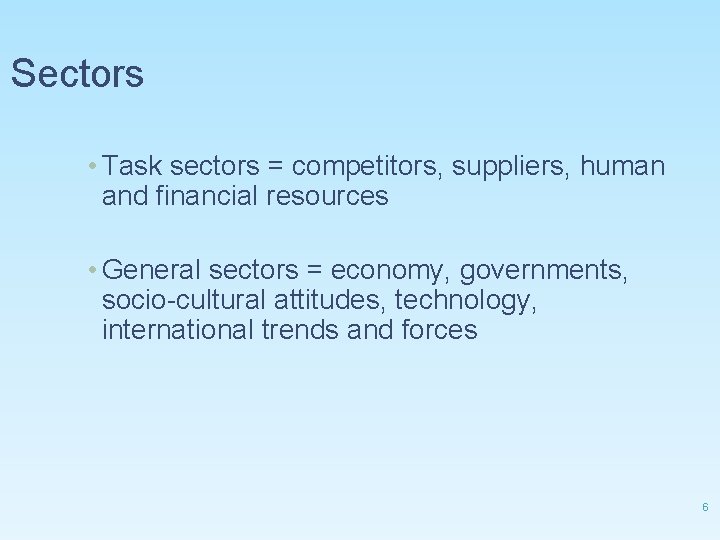
Sectors • Task sectors = competitors, suppliers, human and financial resources • General sectors = economy, governments, socio-cultural attitudes, technology, international trends and forces 6
General Environment • General environment – includes those sectors that may not have a direct impact on the daily operations of a firm but will indirectly influence it. • The general environment often includes the government, sociocultural, economic conditions, technology and financial resources sectors. Business 5301
Impact of General Sector • Can add to overall uncertainty • Has an impact on ability to predict and to perform risk analysis • Examples: (1) September 11, 2001 attacks and (2) 2008 market meltdown 8
Green Environment • Often overlooked in theories of the external environment • Managers are seeing the importance of greening their organizations now • Need to distinguish real greening from ‘green wash’ 9
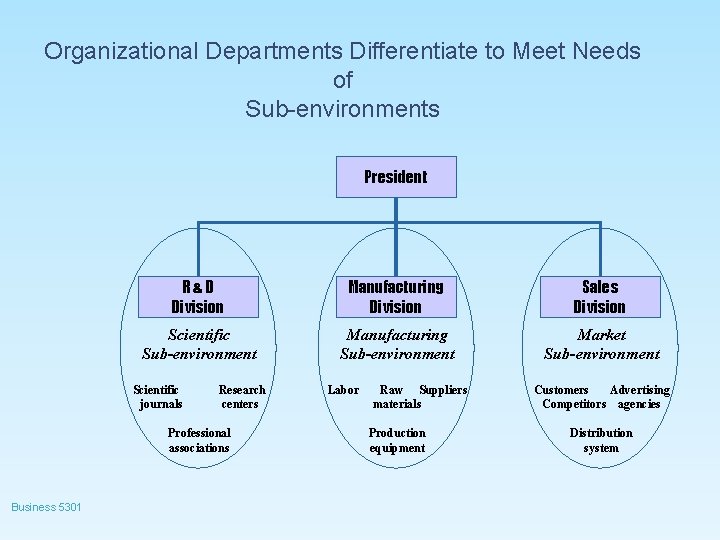
Organizational Departments Differentiate to Meet Needs of Sub-environments President R&D Division Manufacturing Division Sales Division Scientific Sub-environment Manufacturing Sub-environment Market Sub-environment Scientific journals Research centers Professional associations Business 5301 Labor Raw Suppliers materials Production equipment Customers Advertising Competitors agencies Distribution system
Environmental Uncertainty • The patterns and events occurring across environmental sectors can be described among several dimensions. Such as: • Stable vs. unstable • Homogeneous vs. Heterogeneous • Concentrated vs. Dispersed • Simple vs. Complex • Turbulence vs. Non-Turbulent • Resources available vs. Non-Resource Available Business 5301
Environmental Uncertainty • Two essential ways the environment influences organisations: (1) The need for information about the environment and (2) The need for resources from the environment (3) The organisation also is concerned with scarce material and financial resources with the need to ensure availability of resources • Each sector can be analysed relative to these three analytical categories Business 5301
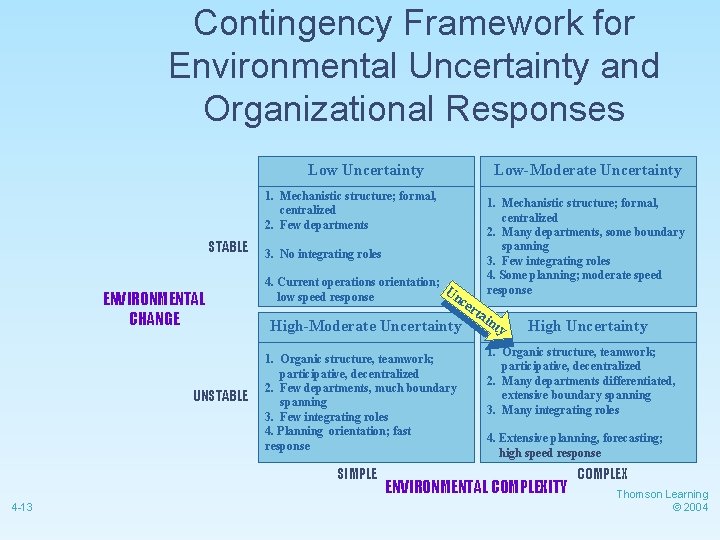
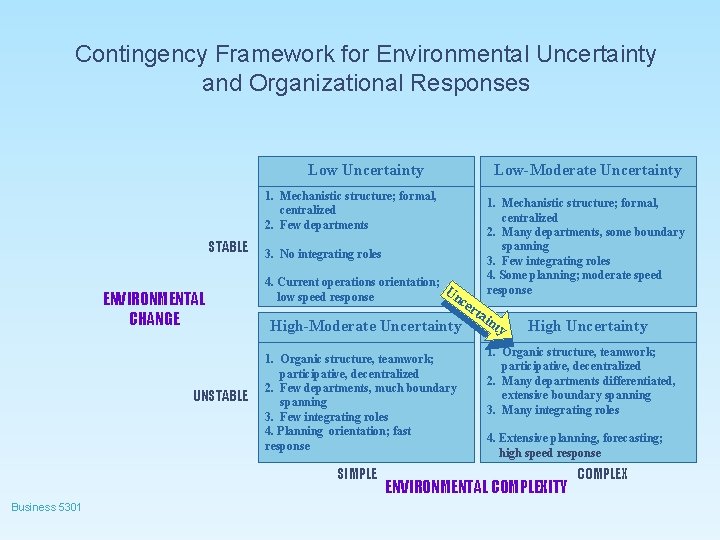
Contingency Framework for Environmental Uncertainty and Organizational Responses Low Uncertainty Low-Moderate Uncertainty 1. Mechanistic structure; formal, centralized 2. Few departments STABLE ENVIRONMENTAL CHANGE UNSTABLE 3. No integrating roles 4. Current operations orientation; Un low speed response ce r High-Moderate Uncertainty 1. Organic structure, teamwork; participative, decentralized 2. Few departments, much boundary spanning 3. Few integrating roles 4. Planning orientation; fast response SIMPLE 4 -13 1. Mechanistic structure; formal, centralized 2. Many departments, some boundary spanning 3. Few integrating roles 4. Some planning; moderate speed response ta in ty High Uncertainty 1. Organic structure, teamwork; participative, decentralized 2. Many departments differentiated, extensive boundary spanning 3. Many integrating roles 4. Extensive planning, forecasting; high speed response ENVIRONMENTAL COMPLEXITY COMPLEX Thomson Learning © 2004
Design Choices • In highly uncertain environments, organizations need to be organic in design • In relatively certain environments, organizations need to be mechanistic in design 14
Adapting to Environmental Uncertainty Positions and Departments • As the complexity in the external environment increases, so does the number of positions and departments within the organisation, which in turn increases internal complexity Buffering and Boundary Spanning • The traditional approach to coping with environmental uncertainty was to establish buffer departments. The buffer role is to absorb uncertainty from the environment. Example would be the purchasing department and the human resource department. Business 5301
Adapting to Environmental Uncertainty • Boundary-spanning roles – link and co-ordinate an organisation with key elements in the external environment. Boundary spanning is primarily concerned with the exchange of information to: (1) Detect and bring into the organisation about changes in the environment and (2) Send information into the environment that presents the organisation in a favourable light • Organisations have to keep in touch with what is going on in the environment so that managers can respond to market changes and other developments Business 5301
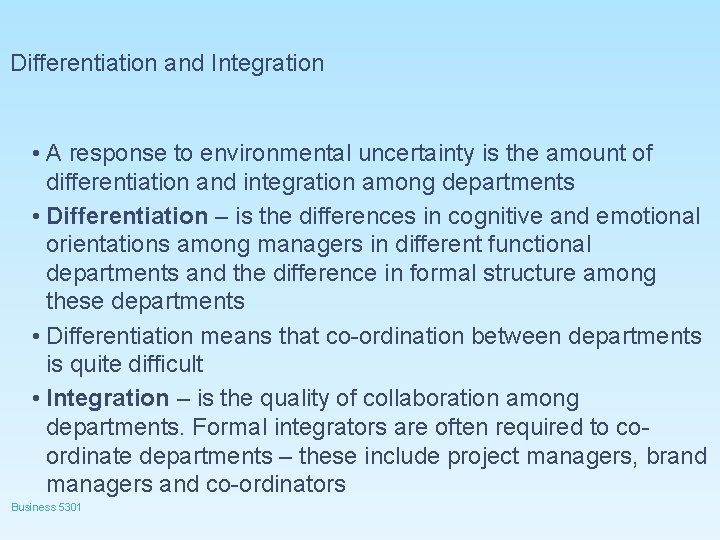
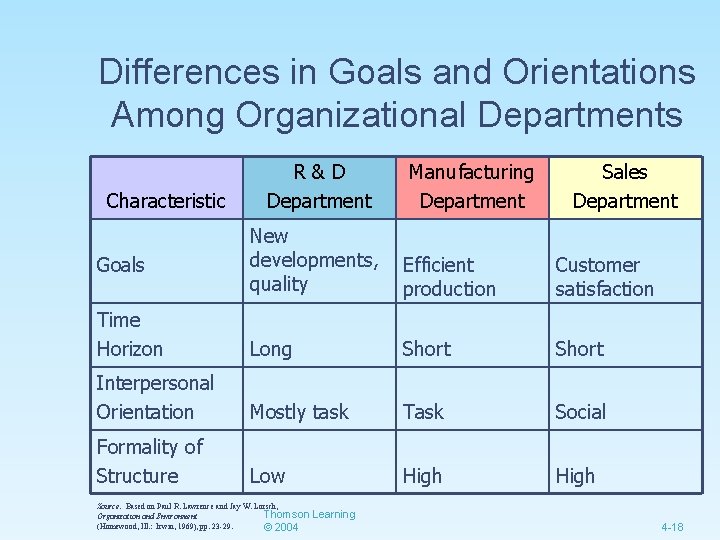
Differentiation and Integration • A response to environmental uncertainty is the amount of differentiation and integration among departments • Differentiation – is the differences in cognitive and emotional orientations among managers in different functional departments and the difference in formal structure among these departments • Differentiation means that co-ordination between departments is quite difficult • Integration – is the quality of collaboration among departments. Formal integrators are often required to coordinate departments – these include project managers, brand managers and co-ordinators Business 5301
Differences in Goals and Orientations Among Organizational Departments Characteristic R&D Department Manufacturing Department Sales Department New developments, quality Efficient production Customer satisfaction Time Horizon Long Short Interpersonal Orientation Mostly task Task Social Formality of Structure Low High Goals Source: Based on Paul R. Lawrence and Jay W. Lorsch, Thomson Organization and Environment (Homewood, Ill. : Irwin, 1969), pp. 23 -29. © 2004 Learning 4 -18
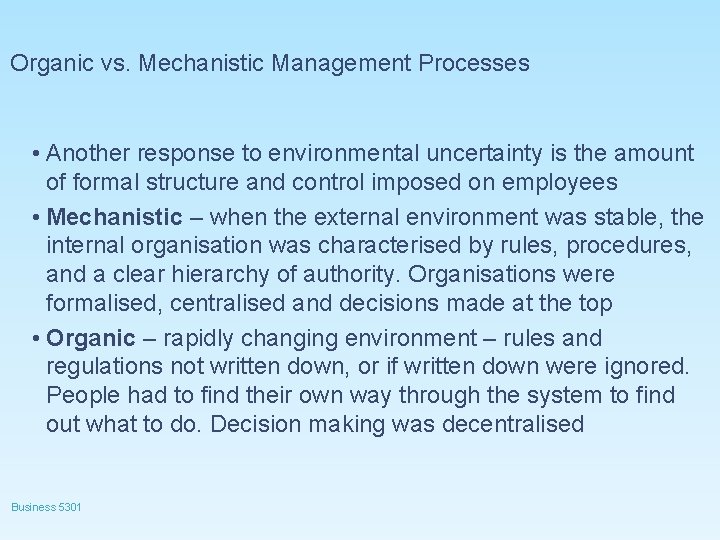
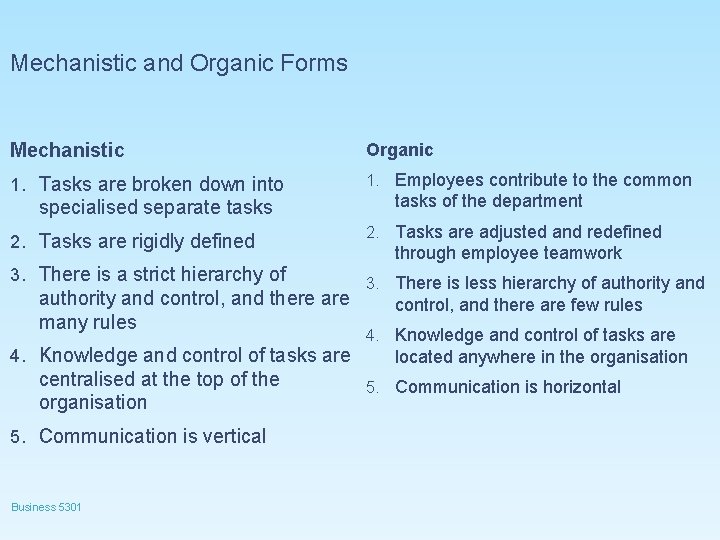
Organic vs. Mechanistic Management Processes • Another response to environmental uncertainty is the amount of formal structure and control imposed on employees • Mechanistic – when the external environment was stable, the internal organisation was characterised by rules, procedures, and a clear hierarchy of authority. Organisations were formalised, centralised and decisions made at the top • Organic – rapidly changing environment – rules and regulations not written down, or if written down were ignored. People had to find their own way through the system to find out what to do. Decision making was decentralised Business 5301
Mechanistic and Organic Forms Mechanistic Organic 1. Tasks are broken down into 1. Employees contribute to the common specialised separate tasks 2. Tasks are rigidly defined 3. There is a strict hierarchy of authority and control, and there are many rules 4. Knowledge and control of tasks are centralised at the top of the organisation 5. Communication is vertical Business 5301 tasks of the department 2. Tasks are adjusted and redefined through employee teamwork 3. There is less hierarchy of authority and control, and there are few rules 4. Knowledge and control of tasks are located anywhere in the organisation 5. Communication is horizontal
Contingency Framework for Environmental Uncertainty and Organizational Responses Low Uncertainty Low-Moderate Uncertainty 1. Mechanistic structure; formal, centralized 2. Few departments STABLE ENVIRONMENTAL CHANGE UNSTABLE 3. No integrating roles 4. Current operations orientation; Un low speed response ce r High-Moderate Uncertainty 1. Organic structure, teamwork; participative, decentralized 2. Few departments, much boundary spanning 3. Few integrating roles 4. Planning orientation; fast response SIMPLE Business 5301 1. Mechanistic structure; formal, centralized 2. Many departments, some boundary spanning 3. Few integrating roles 4. Some planning; moderate speed response ta in ty High Uncertainty 1. Organic structure, teamwork; participative, decentralized 2. Many departments differentiated, extensive boundary spanning 3. Many integrating roles 4. Extensive planning, forecasting; high speed response ENVIRONMENTAL COMPLEXITY COMPLEX
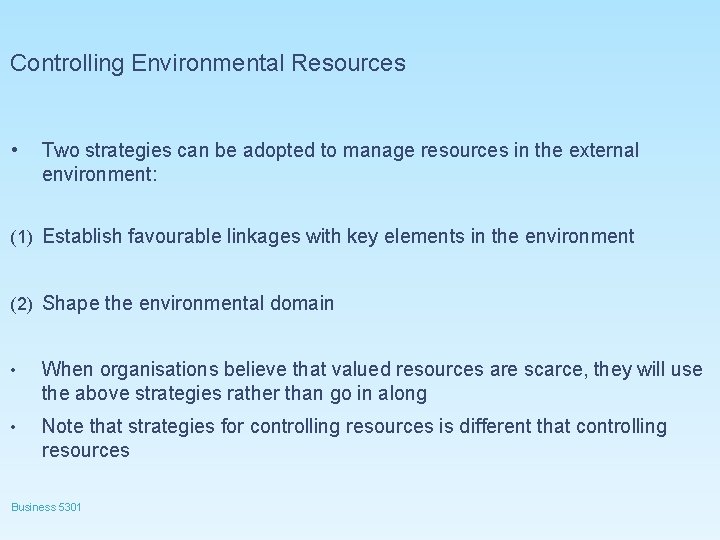
Controlling Environmental Resources • Two strategies can be adopted to manage resources in the external environment: (1) Establish favourable linkages with key elements in the environment (2) Shape the environmental domain • When organisations believe that valued resources are scarce, they will use the above strategies rather than go in along • Note that strategies for controlling resources is different that controlling resources Business 5301
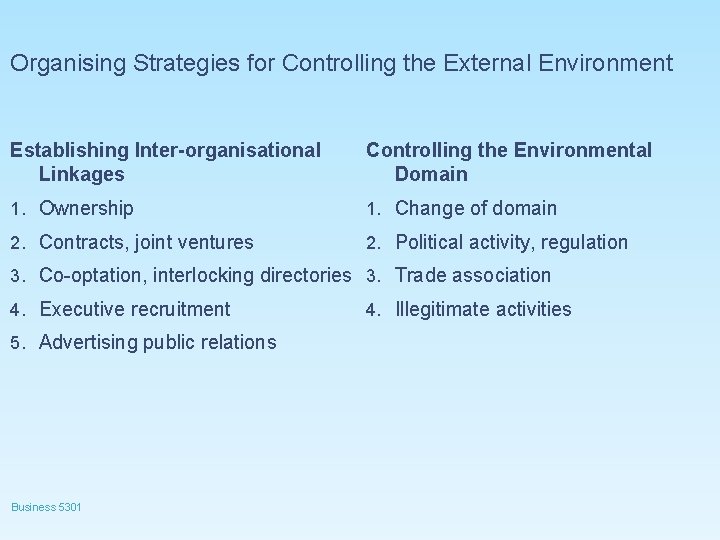
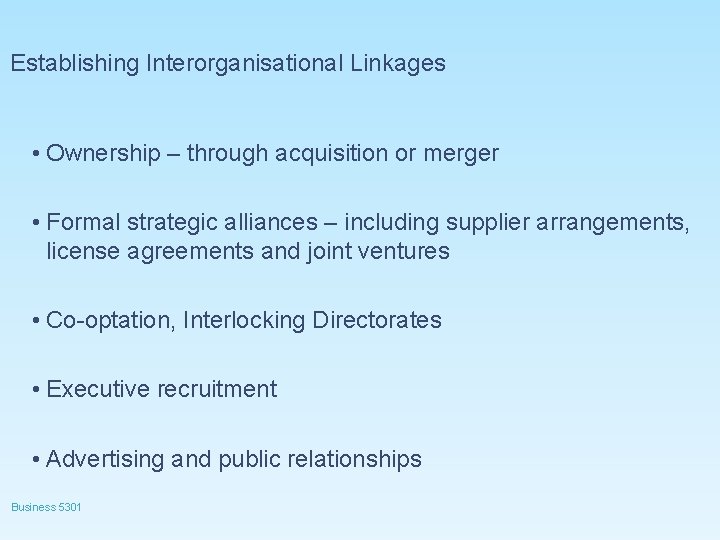
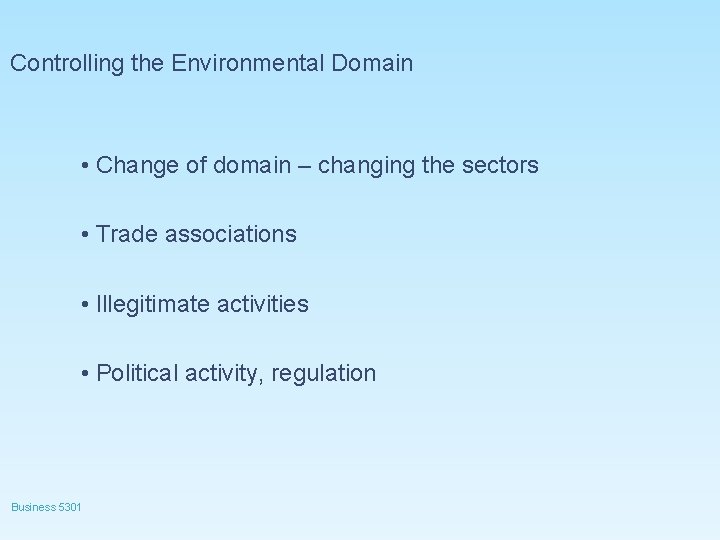
Organising Strategies for Controlling the External Environment Establishing Inter-organisational Linkages Controlling the Environmental Domain 1. Ownership 1. Change of domain 2. Contracts, joint ventures 2. Political activity, regulation 3. Co-optation, interlocking directories 3. Trade association 4. Executive recruitment 5. Advertising public relations Business 5301 4. Illegitimate activities
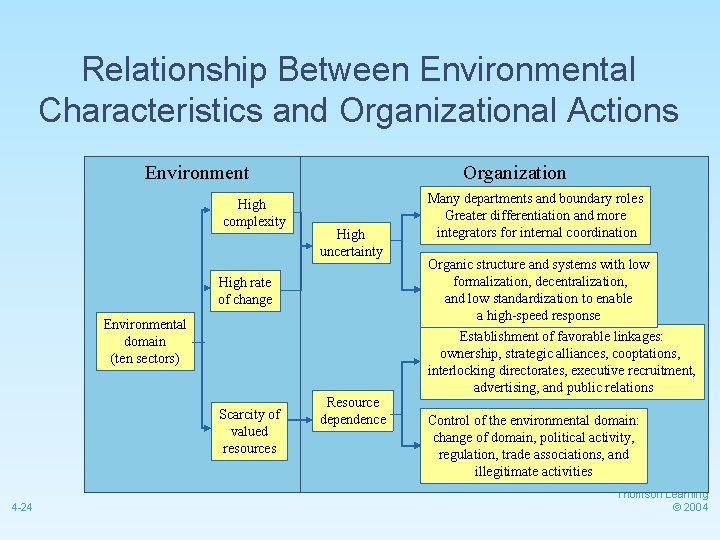
Relationship Between Environmental Characteristics and Organizational Actions Environment High complexity Organization High uncertainty High rate of change Environmental domain (ten sectors) Organic structure and systems with low formalization, decentralization, and low standardization to enable a high-speed response Establishment of favorable linkages: ownership, strategic alliances, cooptations, interlocking directorates, executive recruitment, advertising, and public relations Scarcity of valued resources 4 -24 Many departments and boundary roles Greater differentiation and more integrators for internal coordination Resource dependence Control of the environmental domain: change of domain, political activity, regulation, trade associations, and illegitimate activities Thomson Learning © 2004
Establishing Interorganisational Linkages • Ownership – through acquisition or merger • Formal strategic alliances – including supplier arrangements, license agreements and joint ventures • Co-optation, Interlocking Directorates • Executive recruitment • Advertising and public relationships Business 5301
Controlling the Environmental Domain • Change of domain – changing the sectors • Trade associations • Illegitimate activities • Political activity, regulation Business 5301