
The External Environment Opportunities Threats Industry Competition and
- Slides: 28
The External Environment: Opportunities, Threats, Industry Competition, and Competitor Analysis
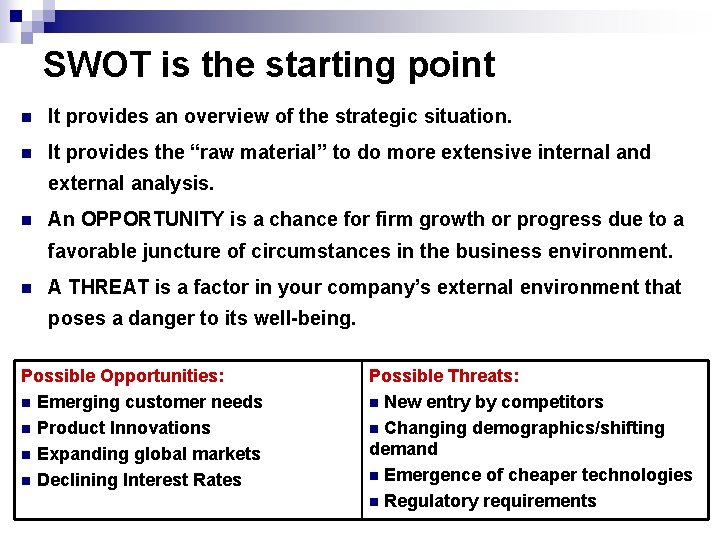
SWOT is the starting point n It provides an overview of the strategic situation. n It provides the “raw material” to do more extensive internal and external analysis. n An OPPORTUNITY is a chance for firm growth or progress due to a favorable juncture of circumstances in the business environment. n A THREAT is a factor in your company’s external environment that poses a danger to its well-being. Possible Opportunities: n Emerging customer needs n Product Innovations n Expanding global markets n Declining Interest Rates Possible Threats: n New entry by competitors n Changing demographics/shifting demand n Emergence of cheaper technologies n Regulatory requirements
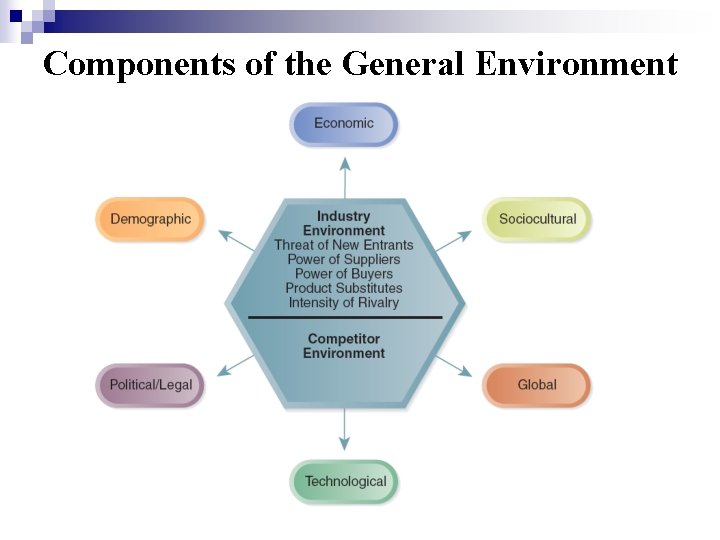
Components of the General Environment
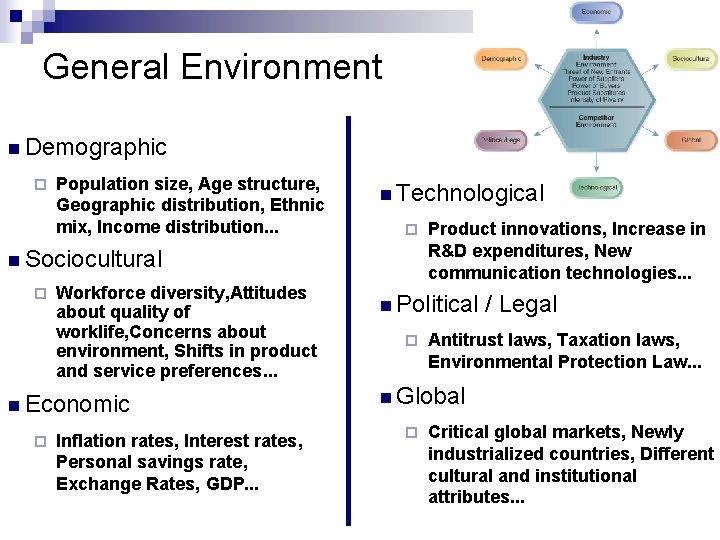
General Environment n Demographic ¨ Population size, Age structure, Geographic distribution, Ethnic mix, Income distribution. . . n Technological ¨ n Sociocultural ¨ Workforce diversity, Attitudes about quality of worklife, Concerns about environment, Shifts in product and service preferences. . . n Economic ¨ Inflation rates, Interest rates, Personal savings rate, Exchange Rates, GDP. . . Product innovations, Increase in R&D expenditures, New communication technologies. . . n Political ¨ / Legal Antitrust laws, Taxation laws, Environmental Protection Law. . . n Global ¨ Critical global markets, Newly industrialized countries, Different cultural and institutional attributes. . .
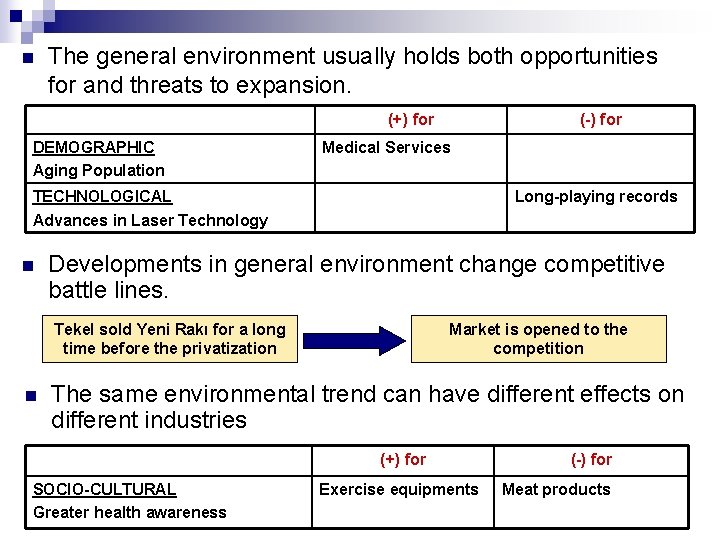
n The general environment usually holds both opportunities for and threats to expansion. (+) for DEMOGRAPHIC Aging Population (-) for Medical Services TECHNOLOGICAL Advances in Laser Technology n Long-playing records Developments in general environment change competitive battle lines. Tekel sold Yeni Rakı for a long time before the privatization n Market is opened to the competition The same environmental trend can have different effects on different industries (+) for SOCIO-CULTURAL Greater health awareness Exercise equipments (-) for Meat products
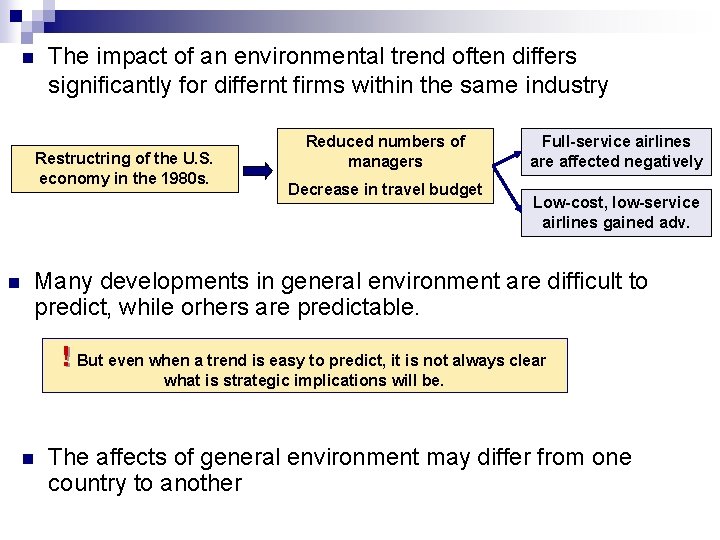
n The impact of an environmental trend often differs significantly for differnt firms within the same industry Restructring of the U. S. economy in the 1980 s. n Reduced numbers of managers Decrease in travel budget Full-service airlines are affected negatively Low-cost, low-service airlines gained adv. Many developments in general environment are difficult to predict, while orhers are predictable. ! But even when a trend is easy to predict, it is not always clear what is strategic implications will be. n The affects of general environment may differ from one country to another
Porter’s Five-Forces of Competition n. A set of factors that directly influences a company and its competitive actions and responses. n Interaction among these factors determine an industry’s profit potential and location of “profit pools”. n Need to understand which competitive factors have power, why they have power, and what you might be able to do about it to improve your own position.
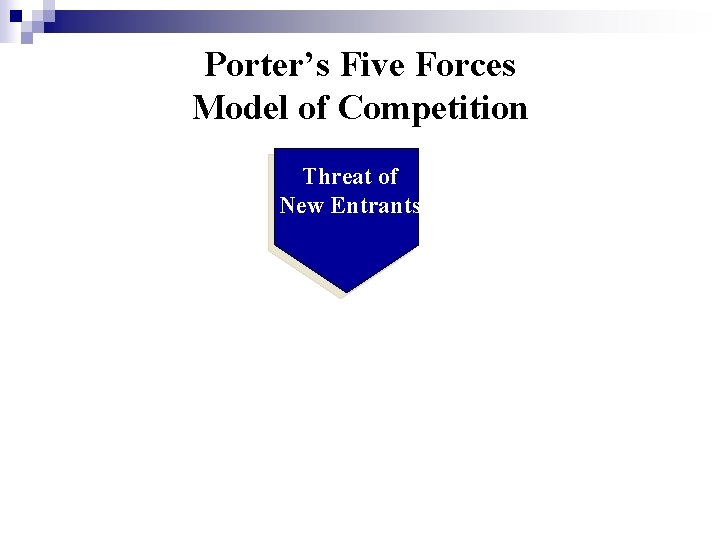
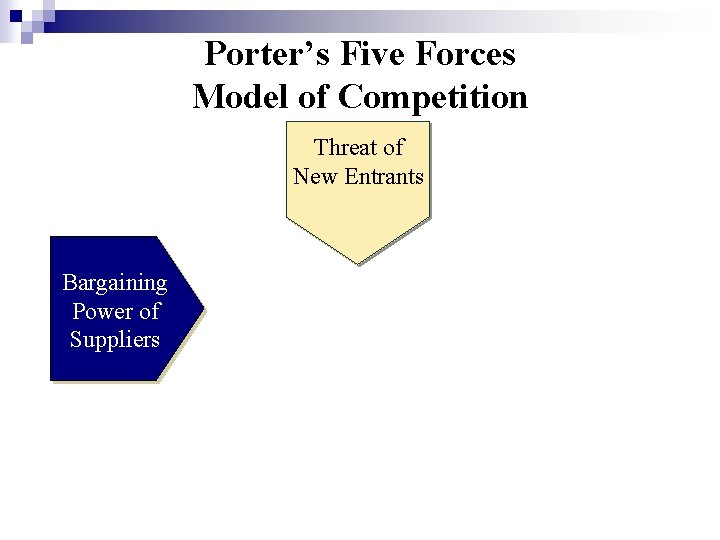
Porter’s Five Forces Model of Competition Threat of New Entrants
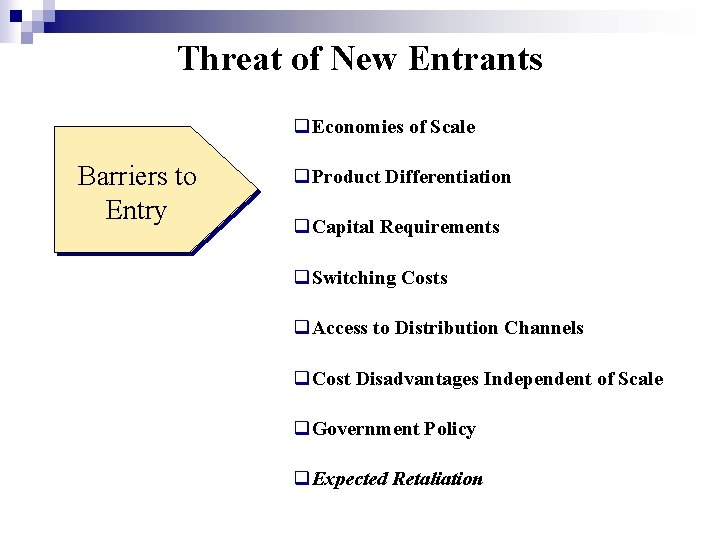
Threat of New Entrants q. Economies of Scale Barriers to Entry q. Product Differentiation q. Capital Requirements q. Switching Costs q. Access to Distribution Channels q. Cost Disadvantages Independent of Scale q. Government Policy q. Expected Retaliation
Porter’s Five Forces Model of Competition Threat of New Entrants Bargaining Power of Suppliers
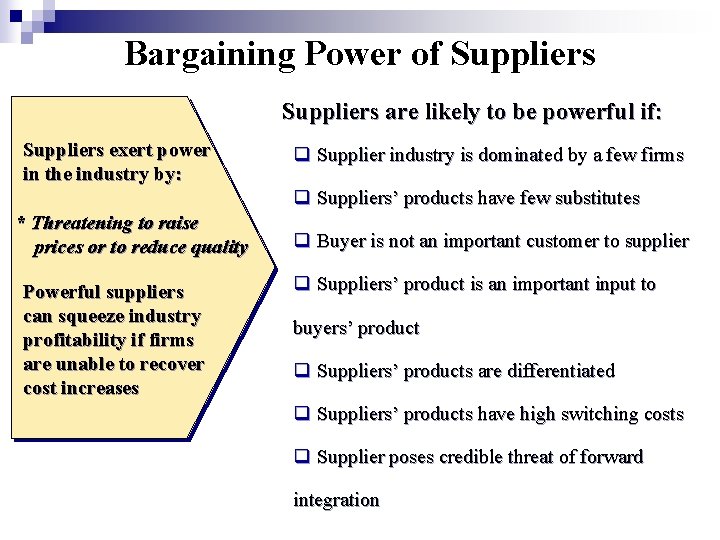
Bargaining Power of Suppliers are likely to be powerful if: Suppliers exert power in the industry by: q Supplier industry is dominated by a few firms q Suppliers’ products have few substitutes * Threatening to raise prices or to reduce quality Powerful suppliers can squeeze industry profitability if firms are unable to recover cost increases q Buyer is not an important customer to supplier q Suppliers’ product is an important input to buyers’ product q Suppliers’ products are differentiated q Suppliers’ products have high switching costs q Supplier poses credible threat of forward integration
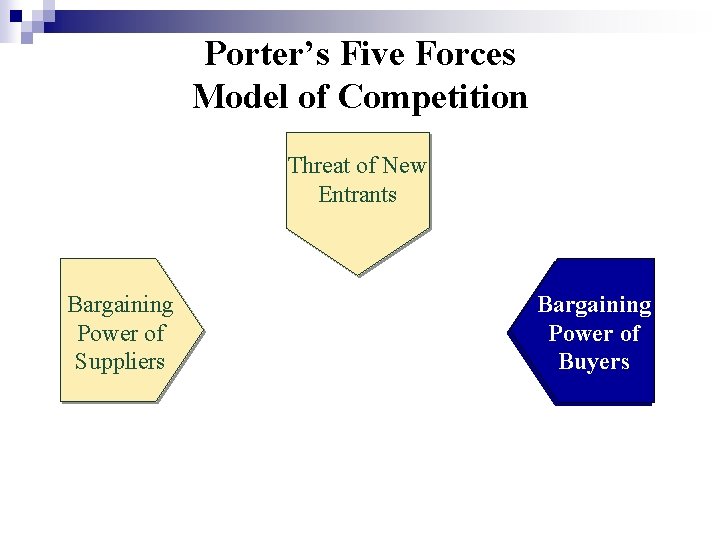
Porter’s Five Forces Model of Competition Threat of New Entrants Bargaining Power of Suppliers Bargaining Power of Buyers
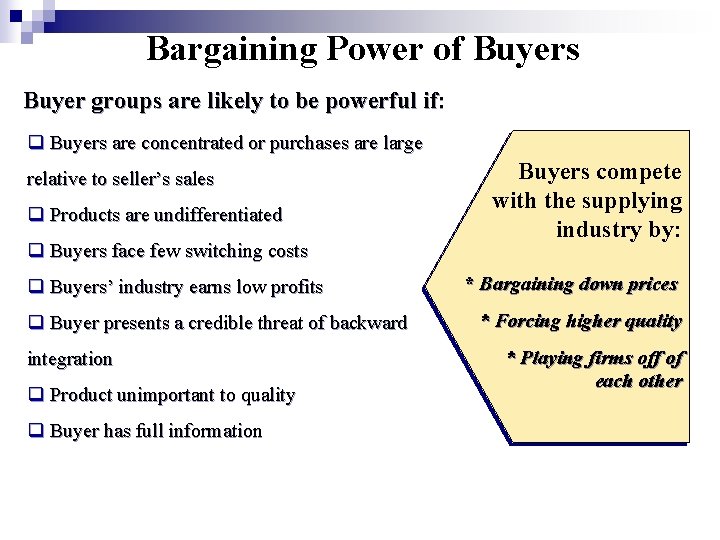
Bargaining Power of Buyers Buyer groups are likely to be powerful if: q Buyers are concentrated or purchases are large relative to seller’s sales q Products are undifferentiated q Buyers face few switching costs q Buyers’ industry earns low profits q Buyer presents a credible threat of backward integration q Product unimportant to quality q Buyer has full information Buyers compete with the supplying industry by: * Bargaining down prices * Forcing higher quality * Playing firms off of each other
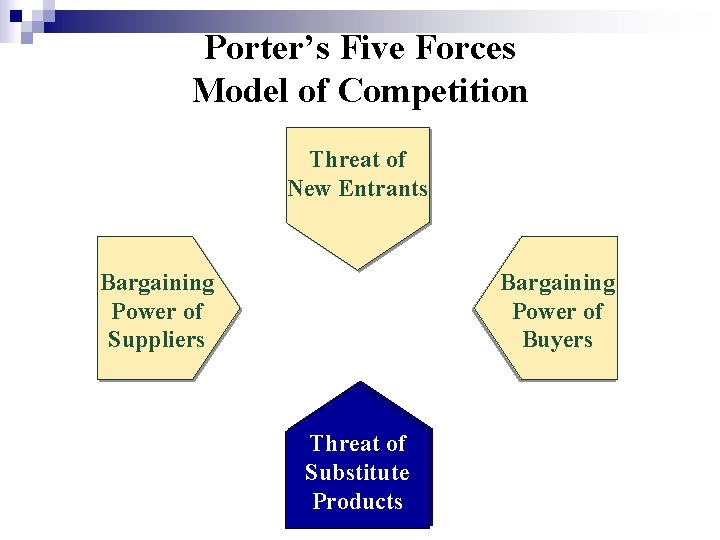
Porter’s Five Forces Model of Competition Threat of New Entrants Bargaining Power of Suppliers Bargaining Power of Buyers Threat of Substitute Products
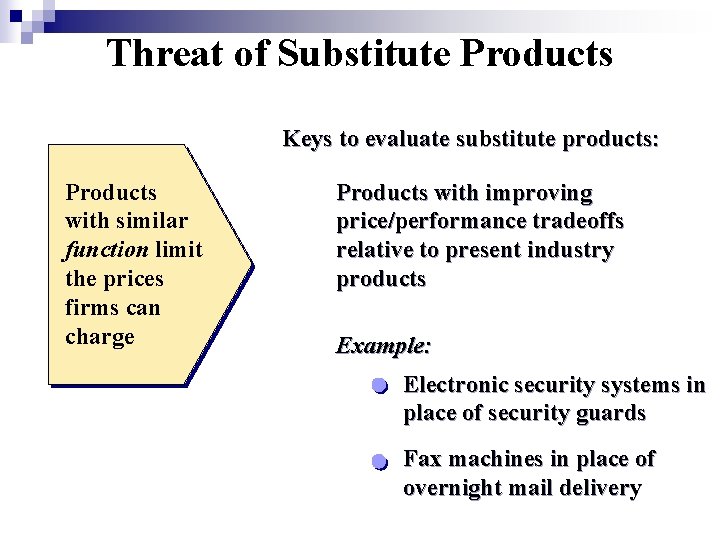
Threat of Substitute Products Keys to evaluate substitute products: Products with similar function limit the prices firms can charge Products with improving price/performance tradeoffs relative to present industry products Example: Electronic security systems in place of security guards Fax machines in place of overnight mail delivery
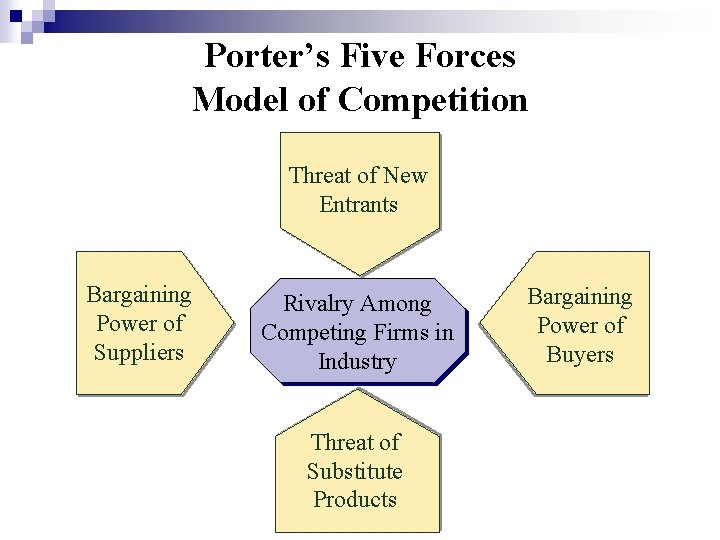
Porter’s Five Forces Model of Competition Threat of New Entrants Bargaining Power of Suppliers Rivalry Among Competing Firms in Industry Threat of Substitute Products Bargaining Power of Buyers
Rivalry Among Existing Competitors Cutthroat competition is more likely to occur when: q Numerous or equally balanced competitors q Slow growth industry q High fixed costs q High storage costs q Lack of differentiation or switching costs q Capacity added in large increments q High strategic stakes q High exit barriers
Five-Forces Analysis -- SO WHAT? n Consider how opportunities and threats may result from the five competitive forces. n Understand the strength of each competitive force, and underlying reasons for strength. n Select niches where forces are weaker, and profit pools are higher. n Build strategies that defend yourself against strong competitive forces. n Build strategies that influence the forces in your favor.
Strategic Groups Defined n. A set of firms emphasizing similar strategic dimensions and using similar strategies ¨ Internal competition between strategic group firms is greater than between firms outside that strategic group
Strategic Groups n Strategic Dimensions ¨ Extent of technological leadership ¨ Product ¨ Pricing quality policies ¨ Distribution ¨ Customer ¨ Target channels service markets ¨ Product breadth ¨ Geographical ¨ Extent coverage of diversification or vertical integration. . .
Strategic Group Maps A graphical depiction of rival firms, using two dimensions that reflect important aspects of their strategy and array the firms into groups. Work best in fragmented industries. Help show close (within group) rivals, crowded and open strategic positions; assist opportunity and threat interpretation (not all groups are affected equally).
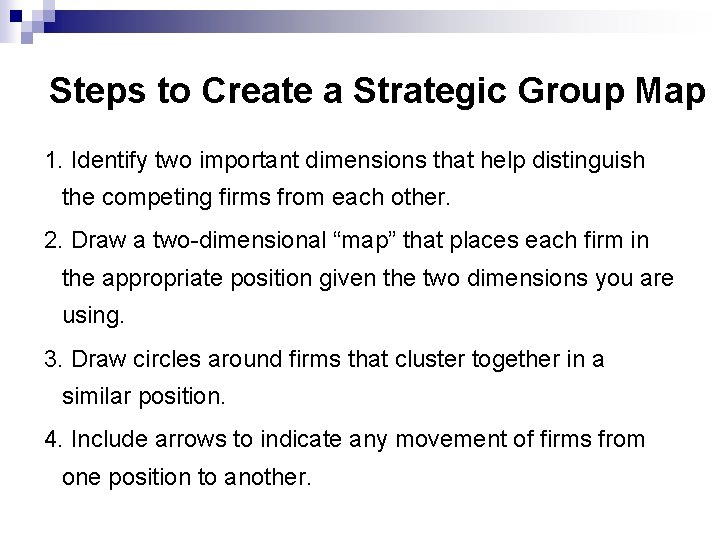
Steps to Create a Strategic Group Map 1. Identify two important dimensions that help distinguish the competing firms from each other. 2. Draw a two-dimensional “map” that places each firm in the appropriate position given the two dimensions you are using. 3. Draw circles around firms that cluster together in a similar position. 4. Include arrows to indicate any movement of firms from one position to another.
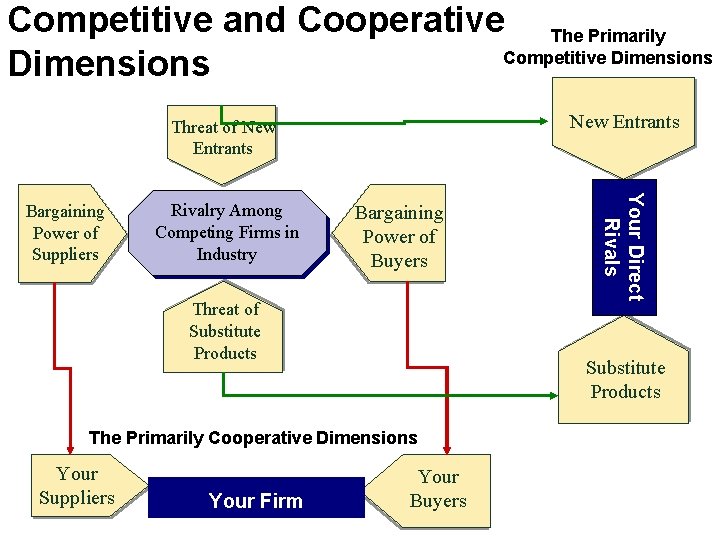
Competitive and Cooperative The Primarily Competitive Dimensions New Entrants Threat of New Entrants Rivalry Among Competing Firms in Industry Bargaining Power of Buyers Threat of Substitute Products The Primarily Cooperative Dimensions Your Suppliers Your Firm Your Direct Rivals Bargaining Power of Suppliers Your Buyers
Analyzing the External Environment n Environmental Scanning ¨ Gathering ¨ Sources n Intelligence of Competitive Intelligence Scenario Planning
Environmental Scanning The monitoring, evaluating, and disseminating of information from the external and internal environments to key people within the corporation AIM to avoid strategic surprise and ensure the long-term health of the firm. 25
Competitive Intelligence Information that is relavant to strategy formulation regarding the environmental context within which a firm competes Several Uses of Competitive Intelligence n Providing descriptions of the competitive environment (Guide for strategy formulation) n Challenging assumptions about the competitive environment n Forecasting future developments n Identifying and compensating the competitive weaknesses n Determinig the unsustainable strategies n Indentifying the guideline for adjustment to changing environment
Sources of Useful Competitive Intelligence Local newspapers n Government n Databases n Customers and suppliers n Competitors n
The Environment-Strategy Relationship n How the external environment shapes strategy? n How strategy can influence the external environment?