
The Exploration on the Pressure Response and Organizational

- Slides: 2
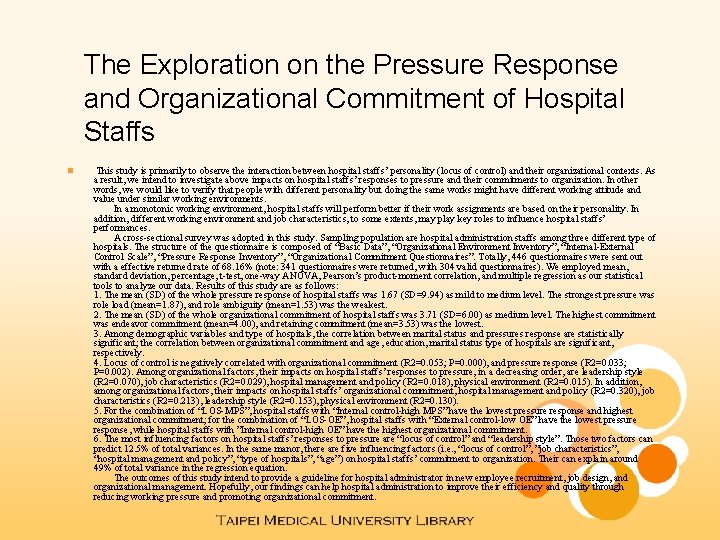
The Exploration on the Pressure Response and Organizational Commitment of Hospital Staffs n This study is primarily to observe the interaction between hospital staffs’ personality (locus of control) and their organizational contexts. As a result, we intend to investigate above impacts on hospital staffs’ responses to pressure and their commitments to organization. In other words, we would like to verify that people with different personality but doing the same works might have different working attitude and value under similar working environments. In a monotonic working environment, hospital staffs will perform better if their work assignments are based on their personality. In addition, different working environment and job characteristics, to some extents, may play key roles to influence hospital staffs’ performances. A cross-sectional survey was adopted in this study. Sampling population are hospital administration staffs among three different type of hospitals. The structure of the questionnaire is composed of “Basic Data”, “Organizational Environment Inventory”, “Internal-External Control Scale”, “Pressure Response Inventory”, “Organizational Commitment Questionnaires”. Totally, 446 questionnaires were sent out with a effective returned rate of 68. 16% (note: 341 questionnaires were returned, with 304 valid questionnaires). We employed mean, standard deviation, percentage, t-test, one-way ANOVA, Pearson’s product-moment correlation, and multiple regression as our statistical tools to analyze our data. Results of this study are as follows: 1. The mean (SD) of the whole pressure response of hospital staffs was 1. 67 (SD=9. 94) as mild to medium level. The strongest pressure was role load (mean=1. 87), and role ambiguity (mean=1. 53) was the weakest. 2. The mean (SD) of the whole organizational commitment of hospital staffs was 3. 71 (SD=6. 00) as medium level. The highest commitment was endeavor commitment (mean=4. 00), and retaining commitment (mean=3. 53) was the lowest. 3. Among demographic variables and type of hospitals, the correlation between marital status and pressures response are statistically significant; the correlation between organizational commitment and age, education, marital status type of hospitals are significant, respectively. 4. Locus of control is negatively correlated with organizational commitment (R 2=0. 053; P=0. 000), and pressure response (R 2=0. 033; P=0. 002). Among organizational factors, their impacts on hospital staffs’ responses to pressure, in a decreasing order, are leadership style (R 2=0. 070), job characteristics (R 2=0. 029), hospital management and policy (R 2=0. 018), physical environment (R 2=0. 015). In addition, among organizational factors, their impacts on hospital staffs’ organizational commitment, hospital management and policy (R 2=0. 320), job characteristics (R 2=0. 213), leadership style (R 2=0. 153), physical environment (R 2=0. 130). 5. For the combination of “LOS-MPS”, hospital staffs with “Internal control-high MPS” have the lowest pressure response and highest organizational commitment; for the combination of “LOS-OE”, hospital staffs with “External control-low OE” have the lowest pressure response, while hospital staffs with ”Internal control-high OE” have the highest organizational commitment. 6. The most influencing factors on hospital staffs’ responses to pressure are “locus of control” and “leadership style”. Those two factors can predict 12. 5% of total variances. In the same manor, there are five influencing factors (i. e. , “locus of control”, ”job characteristics”, “hospital management and policy”, “type of hospitals”, “age”) on hospital staffs’ commitment to organization. Their can explain around 49% of total variance in the regression equation. The outcomes of this study intend to provide a guideline for hospital administrator in new employee recruitment, job design, and organizational management. Hopefully, our findings can help hospital administration to improve their efficiency and quality through reducing working pressure and promoting organizational commitment.