
The explanation book Sue Palmer explanation text explains
The explanation book Sue Palmer
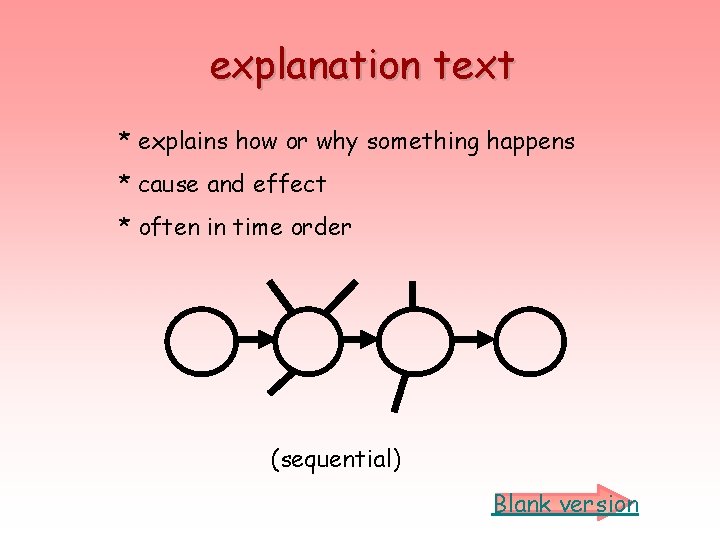
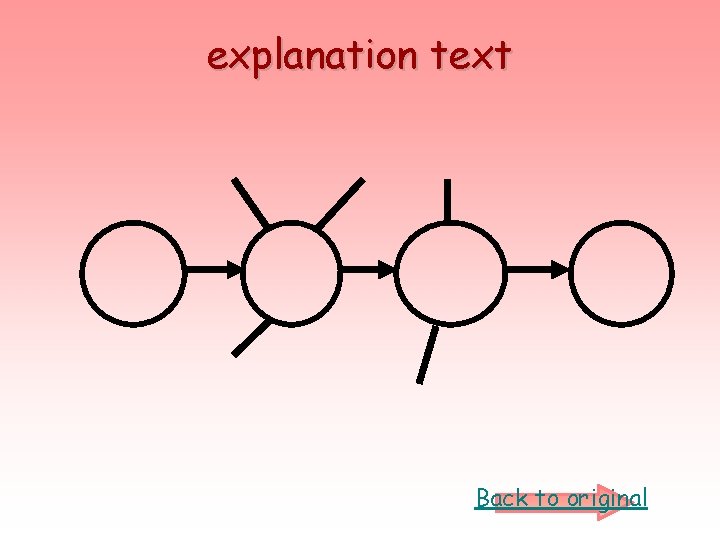
explanation text * explains how or why something happens * cause and effect * often in time order (sequential) Blank version
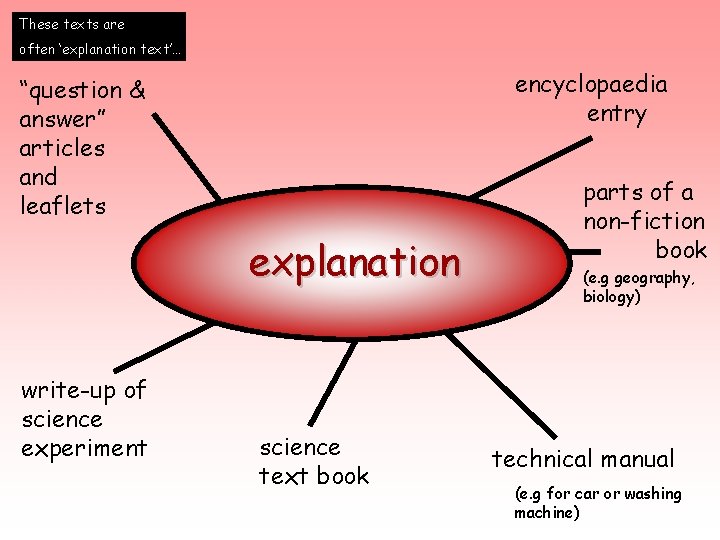
These texts are often ‘explanation text’… encyclopaedia entry “question & answer” articles and leaflets explanation write-up of science experiment science text book parts of a non-fiction book (e. g geography, biology) technical manual (e. g for car or washing machine)
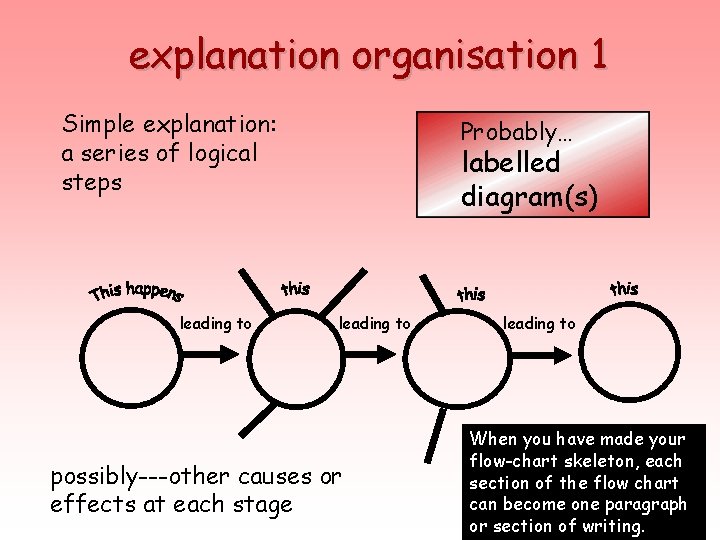
explanation organisation 1 Simple explanation: a series of logical steps leading to Probably… labelled diagram(s) leading to possibly---other causes or effects at each stage leading to When you have made your flow-chart skeleton, each section of the flow chart can become one paragraph or section of writing.
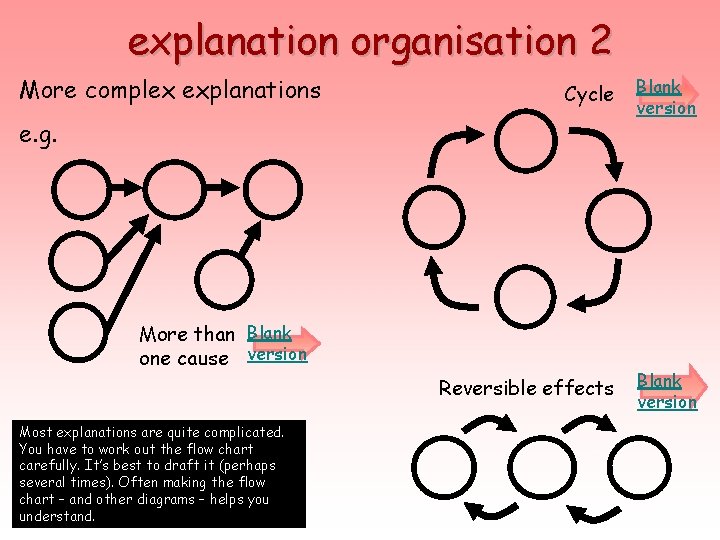
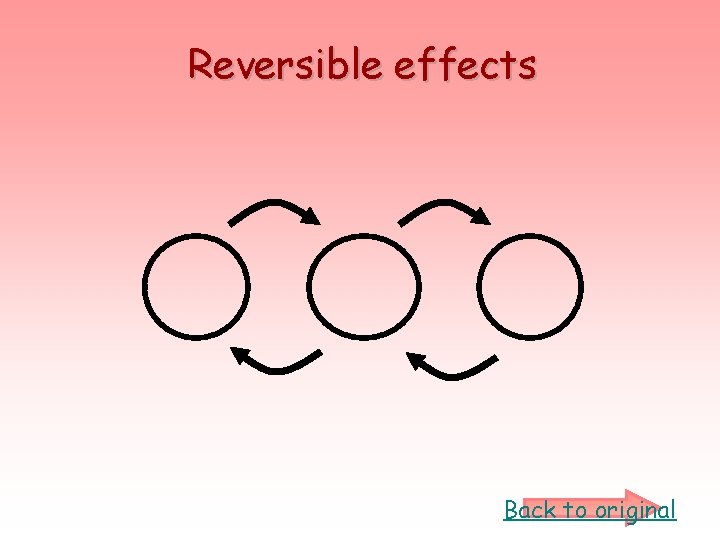
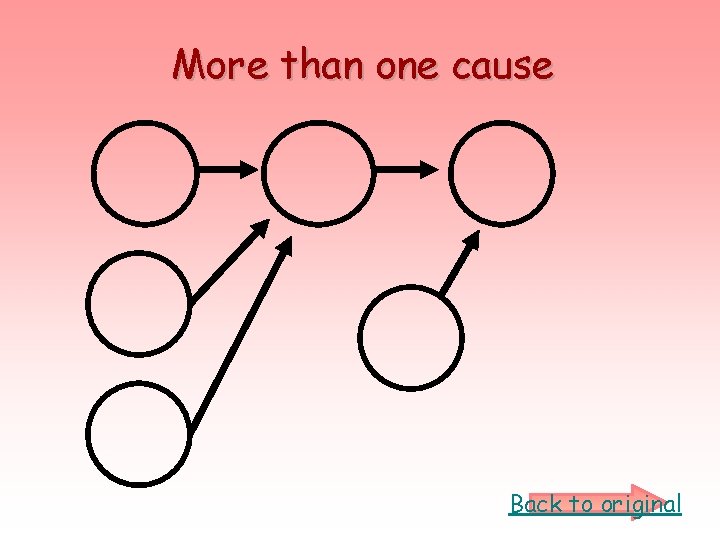
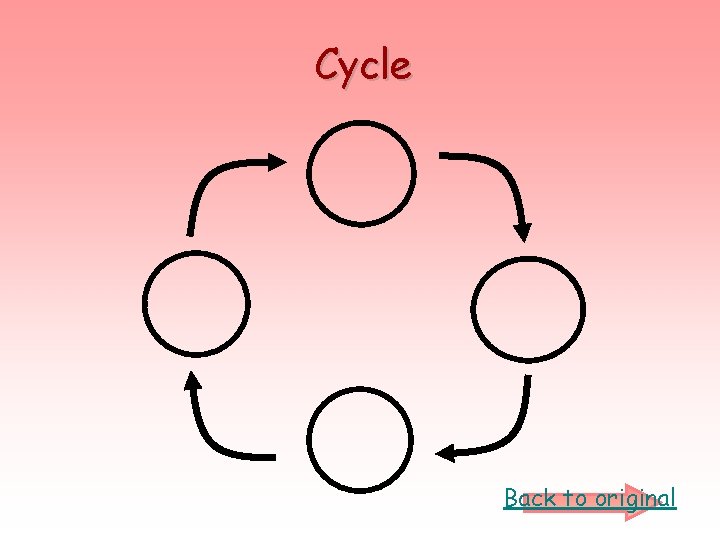
explanation organisation 2 More complex explanations Cycle Blank version Reversible effects Blank version e. g. More than Blank one cause version Most explanations are quite complicated. You have to work out the flow chart carefully. It’s best to draft it (perhaps several times). Often making the flow chart – and other diagrams – helps you understand.
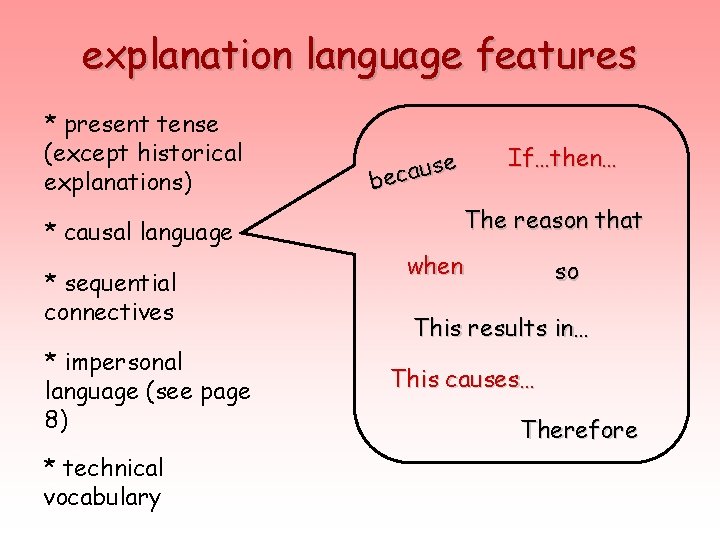
explanation language features * present tense (except historical explanations) * causal language * sequential connectives * impersonal language (see page 8) * technical vocabulary If…then… se u a c be The reason that when so This results in… This causes… Therefore
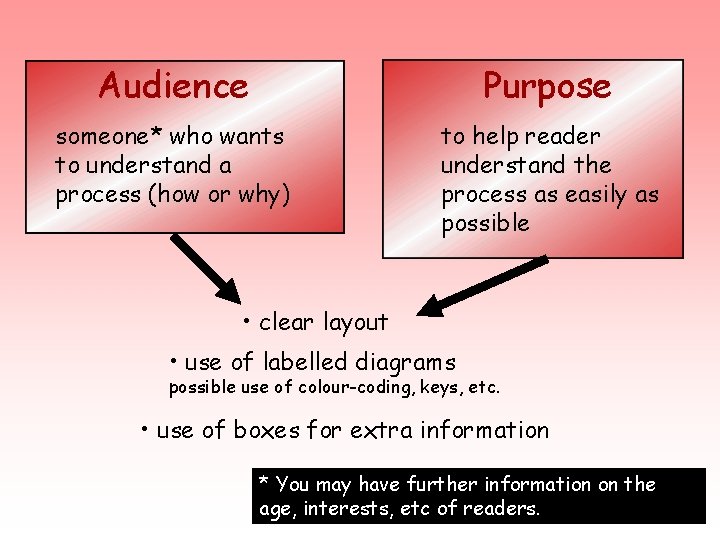
Audience Purpose someone* who wants to understand a process (how or why) to help reader understand the process as easily as possible • clear layout • use of labelled diagrams possible use of colour-coding, keys, etc. • use of boxes for extra information * You may have further information on the age, interests, etc of readers.
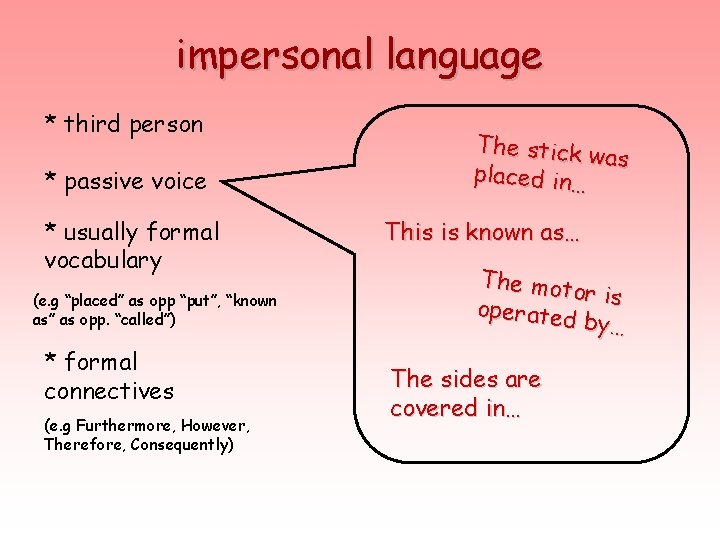
impersonal language * third person * passive voice * usually formal vocabulary (e. g “placed” as opp “put”, “known as” as opp. “called”) * formal connectives (e. g Furthermore, However, Therefore, Consequently) The stick w as placed in… This is known as… The moto ri operated s by… The sides are covered in…
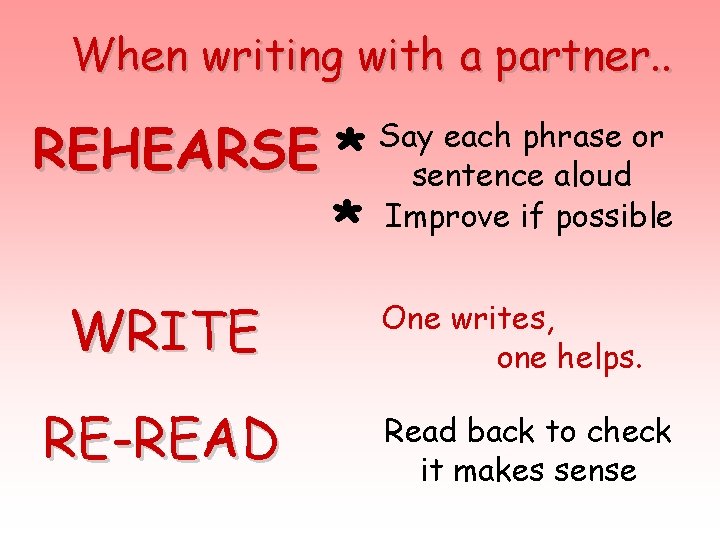
When writing with a partner. . REHEARSE * * WRITE RE-READ Say each phrase or sentence aloud Improve if possible One writes, one helps. Read back to check it makes sense
‘Skeleton’ blanks
explanation text Back to original
Reversible effects Back to original
More than one cause Back to original
Cycle Back to original
Alternative ‘skeleton’ note-taking frameworks
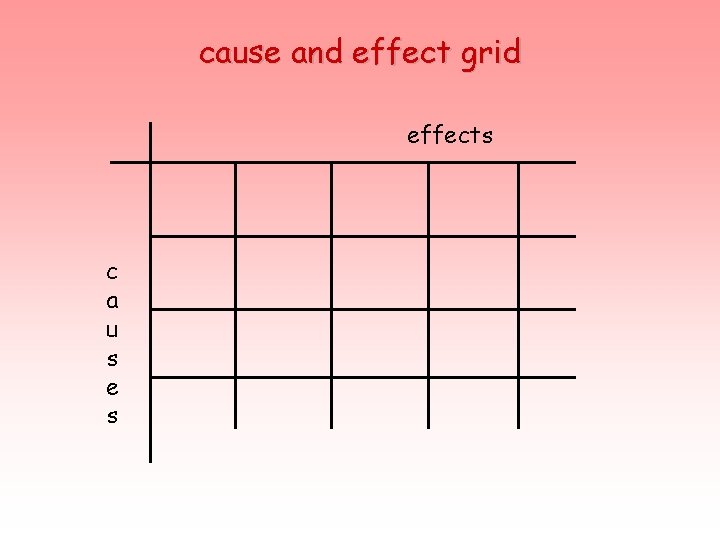
cause and effect grid effects c a u s e s
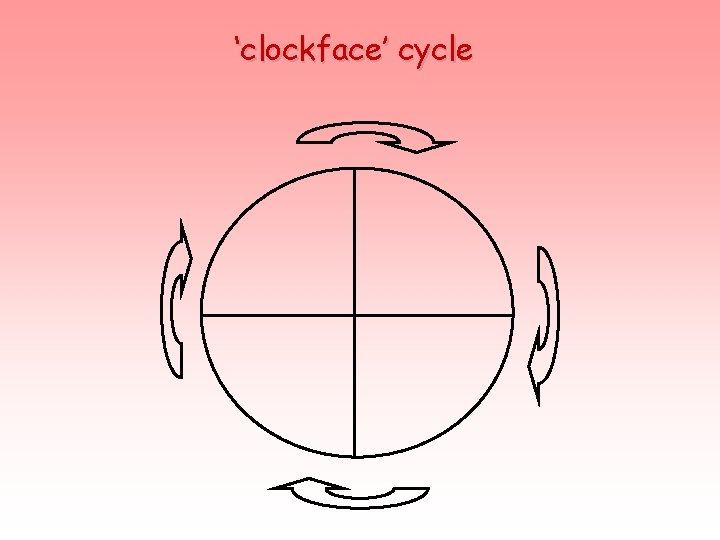
‘clockface’ cycle
* labelled diagram(s) (often with arrows) * sequence of pictures * cross-section
Examples of ‘skeletons’ in use Taken from ‘How to teach Writing Across the Curriculum’ (KS 1/2) by Sue Palmer, with many thanks to David Fulton Publishers
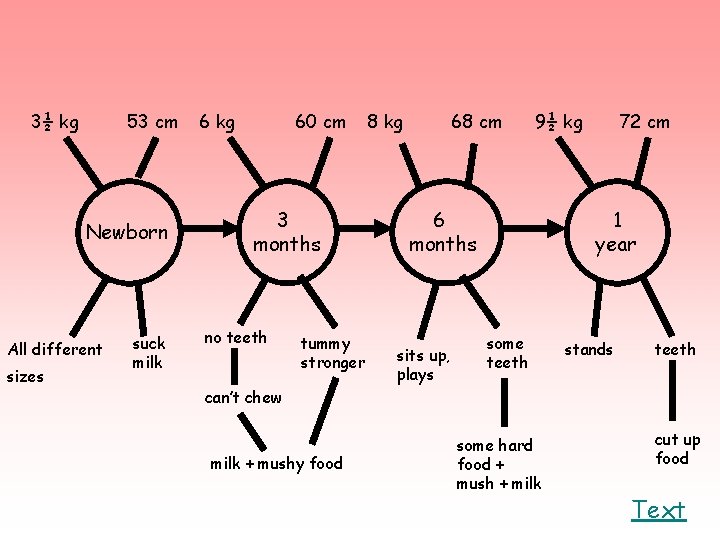
HOW DO BABIES GROW? Newborn babies are very small. Most of them weigh round about 3½ kilograms and are only about 53 centimetres from head to toe. Some are even smaller. However, soon after they are born, babies are ready to eat! Their food is milk, which they such from their mummy’s breast or from a bottle. The milk helps the baby grow, so by 3 months old it weighs about 6 kilograms and is around 60 centimetres long. Its tummy is growing stronger too. This means mum can give the baby some solid food as well as milk. The food is special mushy baby food because the baby does not have any teeth, so it cannot chew it yet. At 6 months old a baby is about 8 kilograms and 68 centimetres long. Its body is stronger now so it can sit up and play. Its little teeth are starting to come through. This means it can have some hard food like rusks as well as baby food and milk. By one year old, most babies weigh around 9½ kilograms and measure about 72 cms. They can stand up, and will soon start to walk. They usually have several teeth, so they can eat the same food as older children, as long as it is cut up small. As they eat more and more, they will grow heavier, taller and stronger. Skeleton
3½ kg 53 cm Newborn All different sizes suck milk 6 kg 60 cm 3 months no teeth tummy stronger 8 kg 68 cm 9½ kg 6 months sits up, plays 72 cm 1 year some teeth stands teeth can’t chew milk + mushy food some hard food + mush + milk cut up food Text
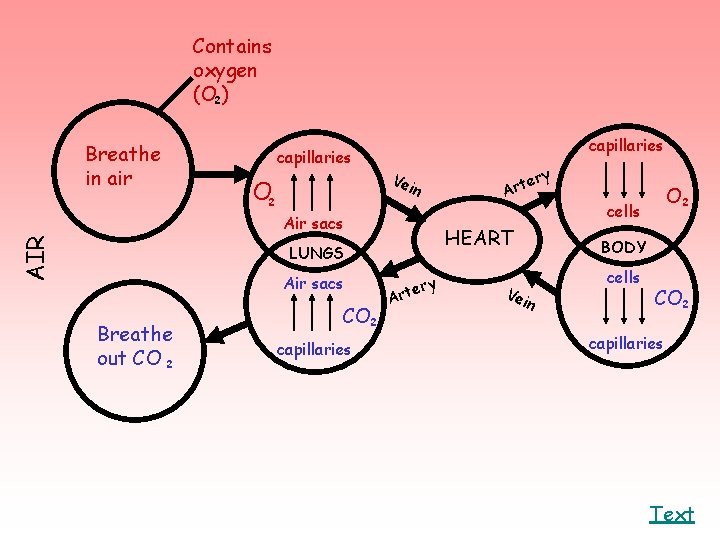
Why do people die if they stop breathing? In order to stay alive, human beings need a constant supply of oxygen (a gas found in the air) to all parts of the body. They also need to rid their bodies of a waste gas called carbon dioxide, which would otherwise poison them. These two gases are carried round the body in the blood. Veins carry blood to the heart and arteries carry blood away from the heart. Both veins and arteries divide into millions of tiny capillary blood vessels. Gases can move between the blood in the capillaries and tiny cells which make up the human body. When a human being breathes in, air goes into the lungs, which are like two spongy bags filled with millions of air sacs. Oxygen from the air passes through the sacs into the capillary blood vessels. The blood then carries the oxygen through a vein to the heart. The heart pumps this oxygen-carrying blood around the whole body through arteries which divide into capillaries to reach the body cells. Oxygen passes from the blood to the cells, and carbon dioxide (the waste gas) passes from the cells into the blood. Veins take this waste-carrying blood back to the heart, which pumps it back to the lungs. There the carbon dioxide passes into the air sacs. When the human being breathes out, the carbon dioxide is pushed back into the air. Breathing in and out is therefore essential because it ensures that life-giving oxygen is constantly replaced and poisonous carbon dioxide expelled. Skeleton
Contains oxygen (O ) ² Breathe in air capillaries O AIR ² capillaries Ve in Air sacs HEART LUNGS Air sacs Breathe out CO ² capillaries ry e Art ery t r A O ² cells BODY Ve cells in CO ² capillaries Text
- Slides: 23