
The experience of the 4 LHC experiments with
- Slides: 23
The experience of the 4 LHC experiments with LCG-1 F Harris (OXFORD/CERN) 25 Nov 2003 F Harris Experiments experience with LCG 1
Structure of talk (and sources of input) • For each LHC experiment – – Preparatory work accomplished prior to use of LCG-1 Description of tests (successes, problems, major issues) Comments on user documentation and support Brief statement of immediate future work and its relation to other work(e. g. DCs) and other grids + comments on manpower • Summary • Inputs for this talk – 4 experiment talks from internal review on Nov 17 http: //agenda. cern. ch/full. Agenda. php? ida=a 035728#s 2 – Extra information obtained since by mail and discussion – Overview talk on ‘grid production by LHC experiments’ of Nov 18 (link as above) 25 Nov 2003 F Harris Experiments experience with LCG 2
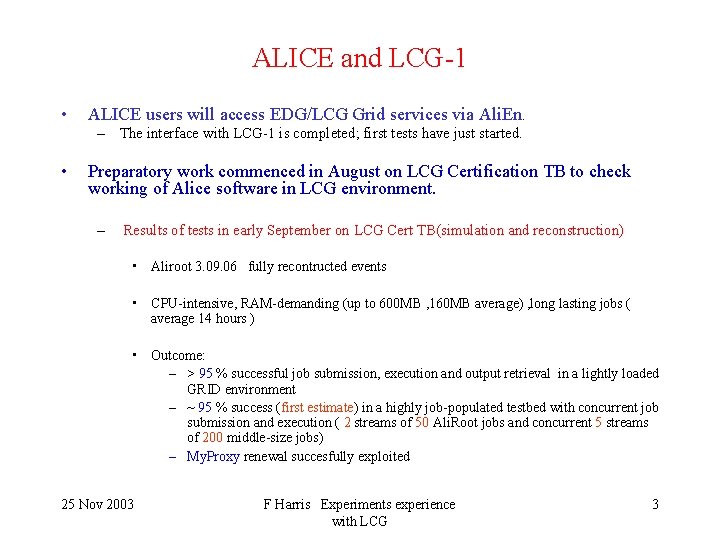
ALICE and LCG-1 • ALICE users will access EDG/LCG Grid services via Ali. En. – The interface with LCG-1 is completed; first tests have just started. • Preparatory work commenced in August on LCG Certification TB to check working of Alice software in LCG environment. – Results of tests in early September on LCG Cert TB(simulation and reconstruction) • Aliroot 3. 09. 06 fully recontructed events • CPU-intensive, RAM-demanding (up to 600 MB , 160 MB average) , long lasting jobs ( average 14 hours ) • Outcome: – > 95 % successful job submission, execution and output retrieval in a lightly loaded GRID environment – ~ 95 % success (first estimate) in a highly job-populated testbed with concurrent job submission and execution ( 2 streams of 50 Ali. Root jobs and concurrent 5 streams of 200 middle-size jobs) – My. Proxy renewal succesfully exploited 25 Nov 2003 F Harris Experiments experience with LCG 3
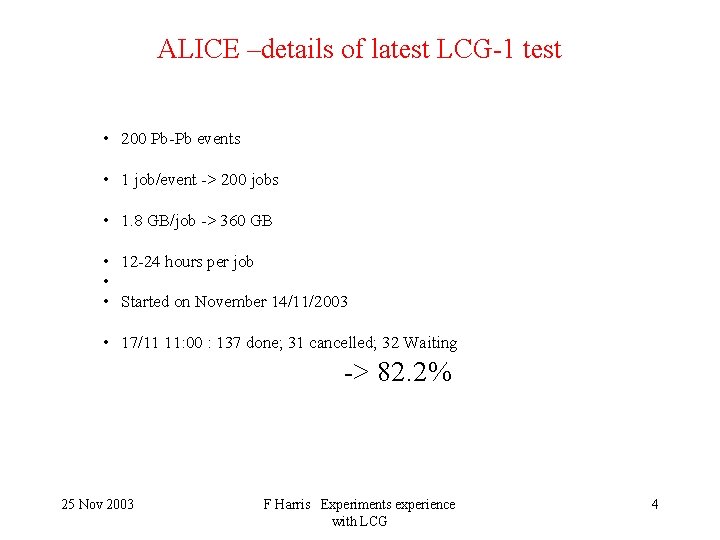
ALICE –details of latest LCG-1 test • 200 Pb-Pb events • 1 job/event -> 200 jobs • 1. 8 GB/job -> 360 GB • 12 -24 hours per job • • Started on November 14/11/2003 • 17/11 11: 00 : 137 done; 31 cancelled; 32 Waiting -> 82. 2% 25 Nov 2003 F Harris Experiments experience with LCG 4
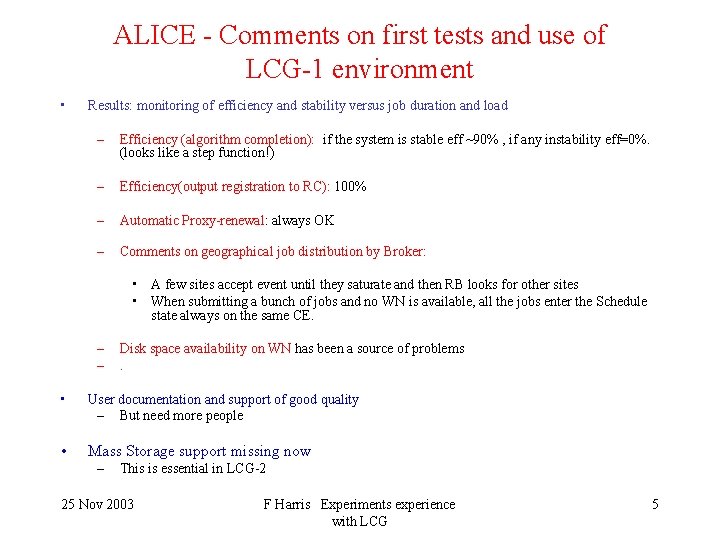
ALICE - Comments on first tests and use of LCG-1 environment • Results: monitoring of efficiency and stability versus job duration and load – Efficiency (algorithm completion): if the system is stable eff ~90% , if any instability eff=0%. (looks like a step function!) – Efficiency(output registration to RC): 100% – Automatic Proxy-renewal: always OK – Comments on geographical job distribution by Broker: • A few sites accept event until they saturate and then RB looks for other sites • When submitting a bunch of jobs and no WN is available, all the jobs enter the Schedule state always on the same CE. – – Disk space availability on WN has been a source of problems. • User documentation and support of good quality – But need more people • Mass Storage support missing now – This is essential in LCG-2 25 Nov 2003 F Harris Experiments experience with LCG 5
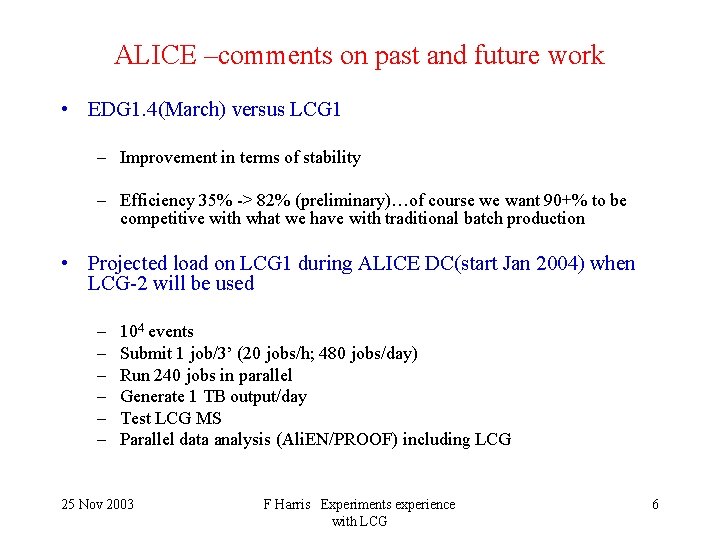
ALICE –comments on past and future work • EDG 1. 4(March) versus LCG 1 – Improvement in terms of stability – Efficiency 35% -> 82% (preliminary)…of course we want 90+% to be competitive with what we have with traditional batch production • Projected load on LCG 1 during ALICE DC(start Jan 2004) when LCG-2 will be used – – – 104 events Submit 1 job/3’ (20 jobs/h; 480 jobs/day) Run 240 jobs in parallel Generate 1 TB output/day Test LCG MS Parallel data analysis (Ali. EN/PROOF) including LCG 25 Nov 2003 F Harris Experiments experience with LCG 6
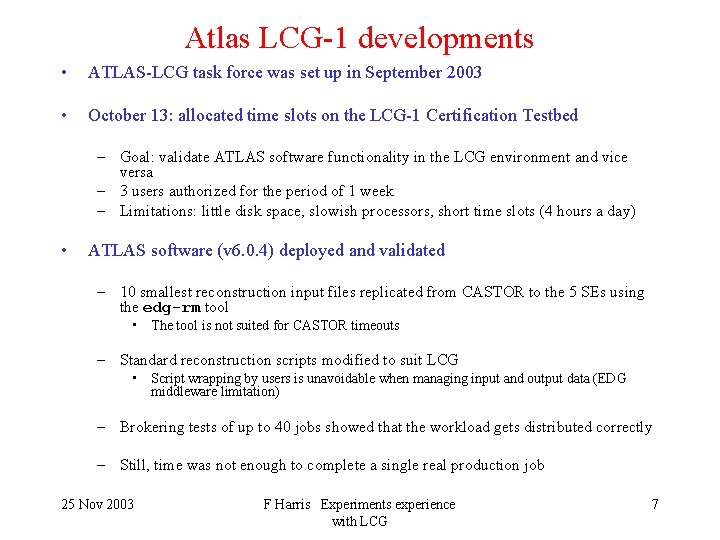
Atlas LCG-1 developments • ATLAS-LCG task force was set up in September 2003 • October 13: allocated time slots on the LCG-1 Certification Testbed – Goal: validate ATLAS software functionality in the LCG environment and vice versa – 3 users authorized for the period of 1 week – Limitations: little disk space, slowish processors, short time slots (4 hours a day) • ATLAS software (v 6. 0. 4) deployed and validated – 10 smallest reconstruction input files replicated from CASTOR to the 5 SEs using the edg-rm tool • The tool is not suited for CASTOR timeouts – Standard reconstruction scripts modified to suit LCG • Script wrapping by users is unavoidable when managing input and output data (EDG middleware limitation) – Brokering tests of up to 40 jobs showed that the workload gets distributed correctly – Still, time was not enough to complete a single real production job 25 Nov 2003 F Harris Experiments experience with LCG 7
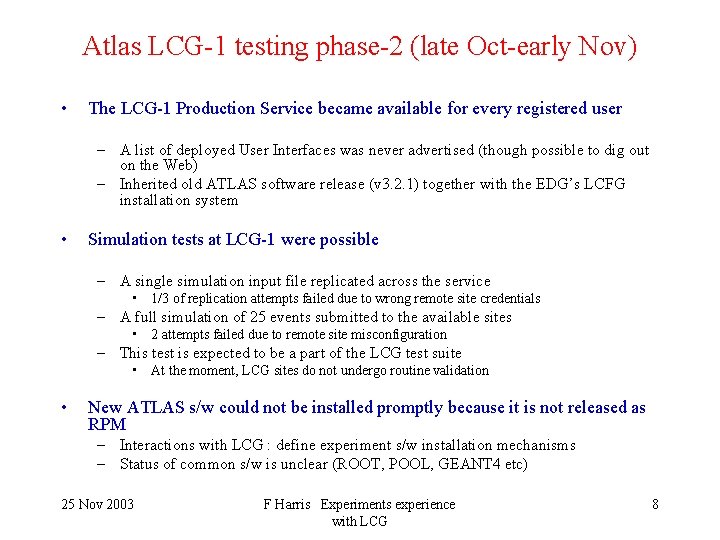
Atlas LCG-1 testing phase-2 (late Oct-early Nov) • The LCG-1 Production Service became available for every registered user – A list of deployed User Interfaces was never advertised (though possible to dig out on the Web) – Inherited old ATLAS software release (v 3. 2. 1) together with the EDG’s LCFG installation system • Simulation tests at LCG-1 were possible – A single simulation input file replicated across the service • 1/3 of replication attempts failed due to wrong remote site credentials – A full simulation of 25 events submitted to the available sites • 2 attempts failed due to remote site misconfiguration – This test is expected to be a part of the LCG test suite • At the moment, LCG sites do not undergo routine validation • New ATLAS s/w could not be installed promptly because it is not released as RPM – Interactions with LCG : define experiment s/w installation mechanisms – Status of common s/w is unclear (ROOT, POOL, GEANT 4 etc) 25 Nov 2003 F Harris Experiments experience with LCG 8
Atlas LCG-1 testing phase 3(Nov 10 to now…) • By November 10, a newer (not newest) ATLAS s/w release (v 6. 0. 4) was deployed at LCG-1 from tailored RPMs – PACMAN-mediated (non-RPM) software deployment is still in the testing state – Not all the sites authorize ATLAS users – 14 sites advertise ATLAS-6. 0. 4 – Reconstruction tests are possible • ATLAS s/w installation validated by a single-site simulation test • File replication from CASTOR test repeated – 4 sites failed the test due to site misconfiguration • Tests are ongoing 25 Nov 2003 F Harris Experiments experience with LCG 9
Atlas overview comments • Site configuration – – Sites are often mis-configured Need a clear picture of VO mappings to sites • Mass storage support is ESSENTIAL • Application s/w deployment – • The deployed middleware, as of today, does not provide the level of efficiency provided by existing production systems – – • Some services are not fully developed (data management system, VOMS), others are crashprone (WMS, Infosystem – from EDG) User interfaces are not user-friendly (wrapper scripts are unavoidable, non-intuitive naming and behavior) – very steep learning curve Manpower is a problem – • System-wide experiment s/w deployment is a BIG issue, especially when it comes to 3 d party s/w (e. g. , that developed by the LCG’s own Applications Area) Multi counting the same people for several functions (DCs +LCG testing + EDG evaluation+. . ) LCG are clearly committed to resource expansion, middleware stabilization and user satisfaction – – – ATLAS is confident it will provide reliable services by DC 2 EDG-based m/w has improved dramatically, but still imposes limitations There is good quality documentation and support - but need more people + tutorials and improved flow of information 25 Nov 2003 F Harris Experiments experience 10 with LCG
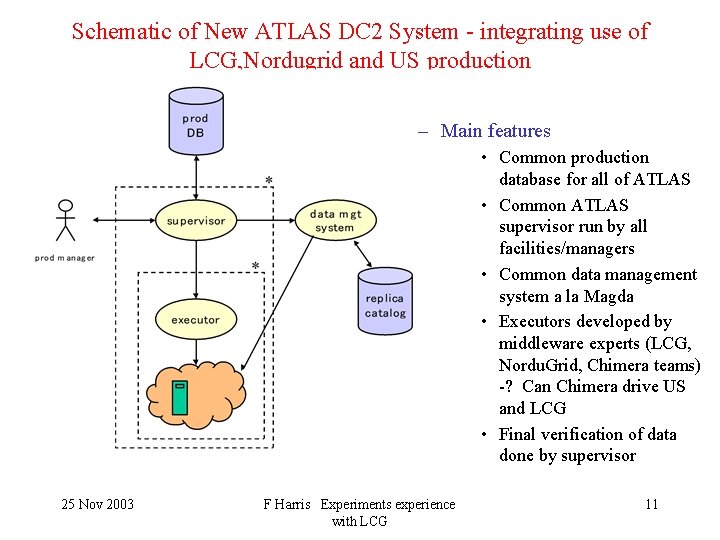
Schematic of New ATLAS DC 2 System - integrating use of LCG, Nordugrid and US production – Main features • Common production database for all of ATLAS • Common ATLAS supervisor run by all facilities/managers • Common data management system a la Magda • Executors developed by middleware experts (LCG, Nordu. Grid, Chimera teams) -? Can Chimera drive US and LCG • Final verification of data done by supervisor 25 Nov 2003 F Harris Experiments experience with LCG 11
preparatory work by CMS with ‘LCG-0’ – started in May • CMS/LCG-0 is a CMS-wide testbed based on the LCG pilot distribution (LCG-0), owned by CMS (joint CMS/LCG/Datatag effort) – Red Hat 7. 3 – Components from VDT 1. 1. 6 and EDG 1. 4. X – GLUE schemas and info providers (Data. TAG) – VOMS – RLS – Monitoring: Grid. ICE by Data. TAG – R-GMA (as BOSS transport layer for specific tests) • Currently configured as a CMS RC and producing data for PCP • 14 sites configured • Physics data produced – 500 K Pythia – 1. 5 M CMSIM • 2000 jobs 8 hr 6000 jobs 10 hr. Comments on performance – Had substantial improvements in efficiency compared to first EDG stress test – Networking and site configuration were problems, as was 1 st version of RLS 25 Nov 2003 F Harris Experiments experience with LCG 12
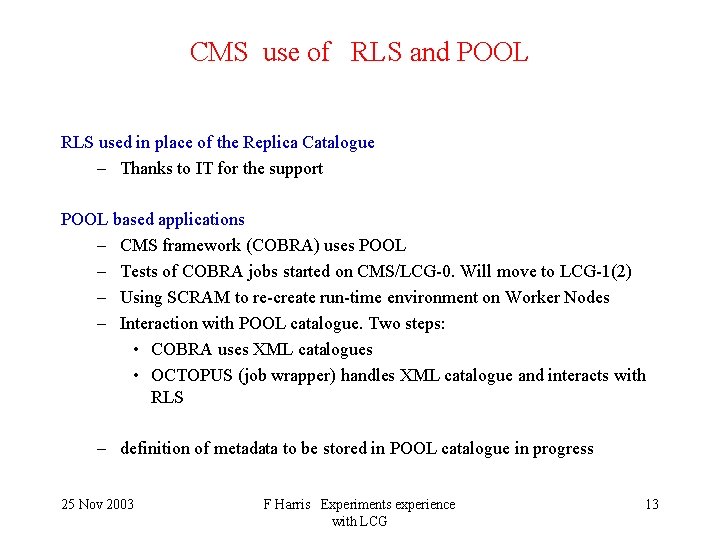
CMS use of RLS and POOL RLS used in place of the Replica Catalogue – Thanks to IT for the support POOL based applications – CMS framework (COBRA) uses POOL – Tests of COBRA jobs started on CMS/LCG-0. Will move to LCG-1(2) – Using SCRAM to re-create run-time environment on Worker Nodes – Interaction with POOL catalogue. Two steps: • COBRA uses XML catalogues • OCTOPUS (job wrapper) handles XML catalogue and interacts with RLS – definition of metadata to be stored in POOL catalogue in progress 25 Nov 2003 F Harris Experiments experience with LCG 13
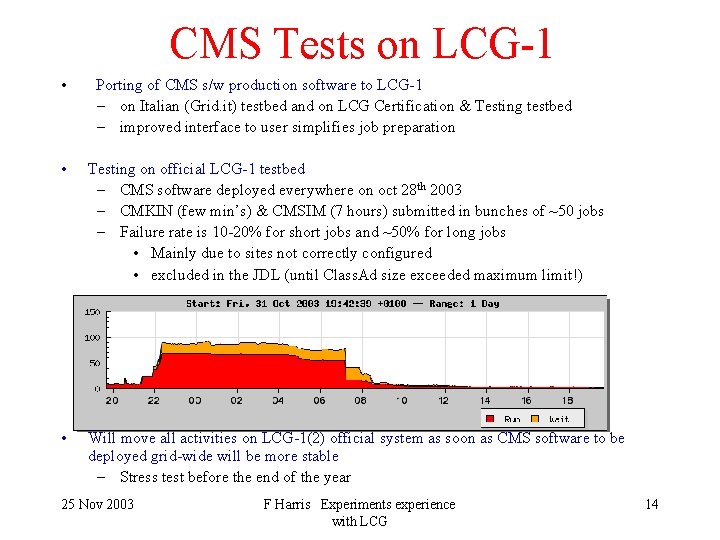
CMS Tests on LCG-1 • Porting of CMS s/w production software to LCG-1 – on Italian (Grid. it) testbed and on LCG Certification & Testing testbed – improved interface to user simplifies job preparation • Testing on official LCG-1 testbed – CMS software deployed everywhere on oct 28 th 2003 – CMKIN (few min’s) & CMSIM (7 hours) submitted in bunches of ~50 jobs – Failure rate is 10 -20% for short jobs and ~50% for long jobs • Mainly due to sites not correctly configured • excluded in the JDL (until Class. Ad size exceeded maximum limit!) • Will move all activities on LCG-1(2) official system as soon as CMS software to be deployed grid-wide will be more stable – Stress test before the end of the year 25 Nov 2003 F Harris Experiments experience with LCG 14
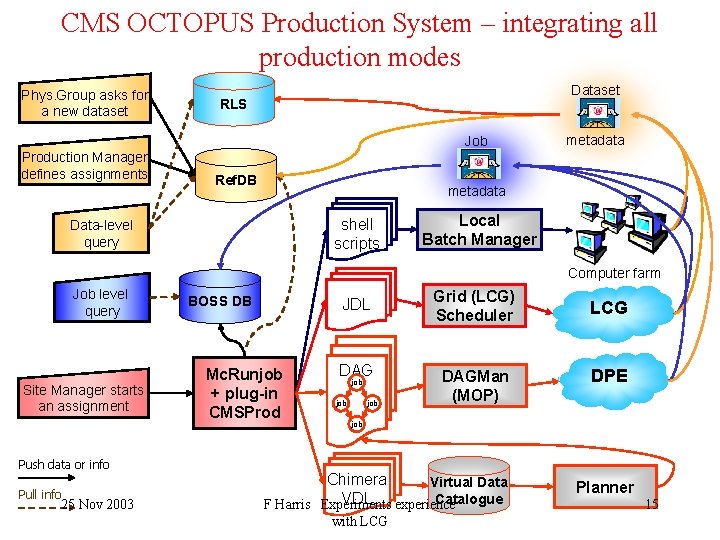
CMS OCTOPUS Production System – integrating all production modes Phys. Group asks for a new dataset Dataset RLS Job Production Manager defines assignments Ref. DB metadata shell scripts Data-level query Local Batch Manager Computer farm Job level query Site Manager starts an assignment Push data or info Pull info 25 Nov 2003 BOSS DB Mc. Runjob + plug-in CMSProd JDL Grid (LCG) Scheduler DAGMan (MOP) job job LCG DPE job Chimera Virtual Data Catalogue VDL experience F Harris Experiments with LCG Planner 15
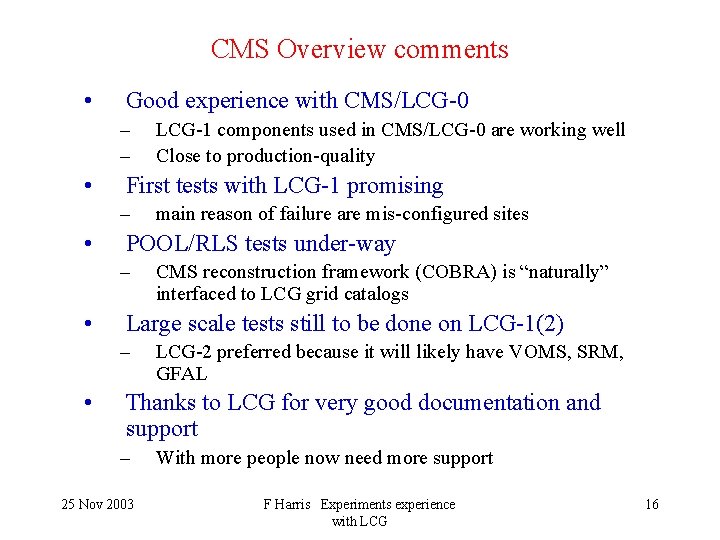
CMS Overview comments • Good experience with CMS/LCG-0 – – • First tests with LCG-1 promising – • CMS reconstruction framework (COBRA) is “naturally” interfaced to LCG grid catalogs Large scale tests still to be done on LCG-1(2) – • main reason of failure are mis-configured sites POOL/RLS tests under-way – • LCG-1 components used in CMS/LCG-0 are working well Close to production-quality LCG-2 preferred because it will likely have VOMS, SRM, GFAL Thanks to LCG for very good documentation and support – 25 Nov 2003 With more people now need more support F Harris Experiments experience with LCG 16
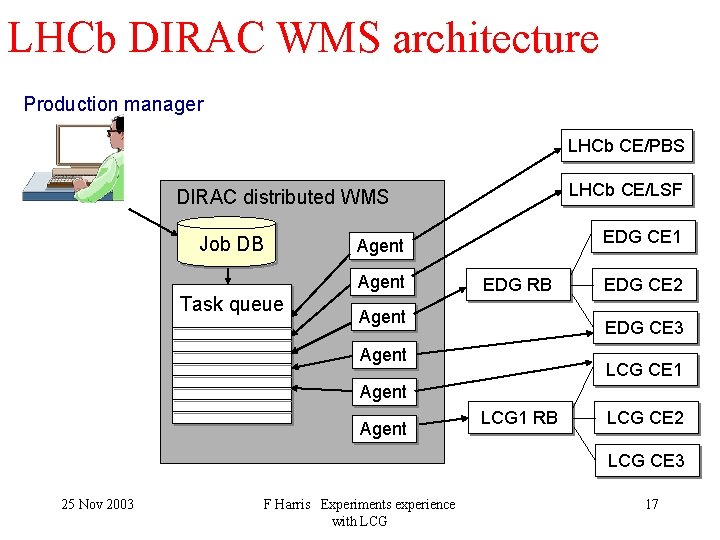
LHCb DIRAC WMS architecture Production manager LHCb CE/PBS LHCb CE/LSF DIRAC distributed WMS Job DB EDG CE 1 Agent Task queue EDG RB Agent EDG CE 2 EDG CE 3 Agent LCG CE 1 Agent LCG 1 RB LCG CE 2 LCG CE 3 25 Nov 2003 F Harris Experiments experience with LCG 17
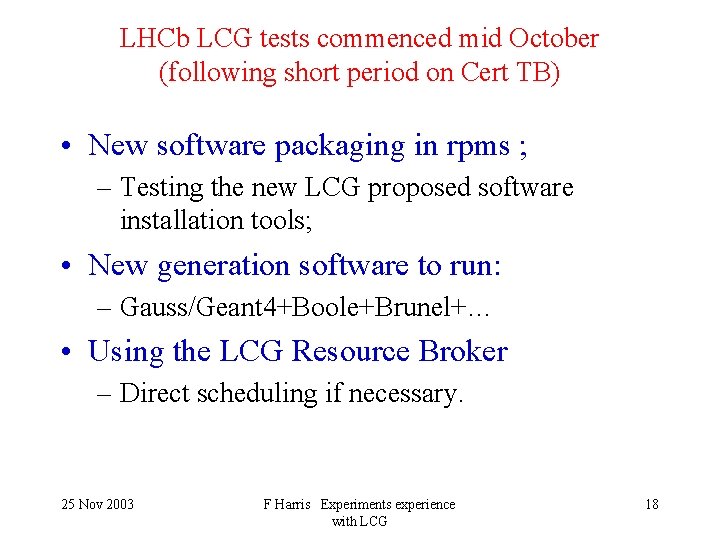
LHCb LCG tests commenced mid October (following short period on Cert TB) • New software packaging in rpms ; – Testing the new LCG proposed software installation tools; • New generation software to run: – Gauss/Geant 4+Boole+Brunel+… • Using the LCG Resource Broker – Direct scheduling if necessary. 25 Nov 2003 F Harris Experiments experience with LCG 18
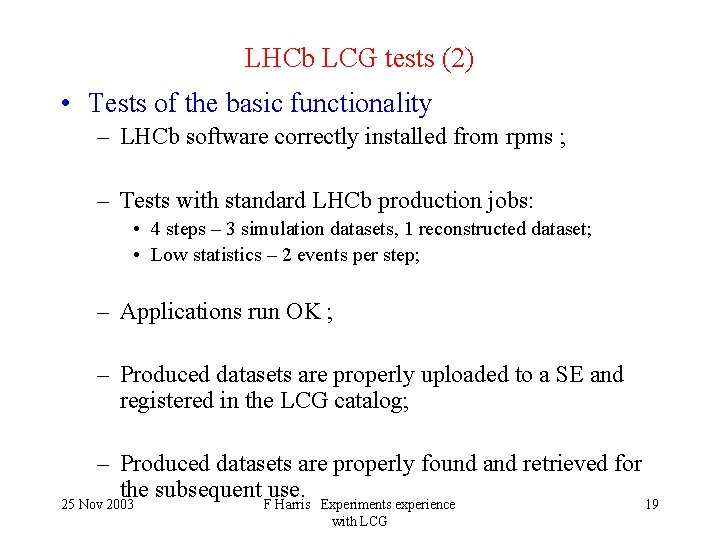
LHCb LCG tests (2) • Tests of the basic functionality – LHCb software correctly installed from rpms ; – Tests with standard LHCb production jobs: • 4 steps – 3 simulation datasets, 1 reconstructed dataset; • Low statistics – 2 events per step; – Applications run OK ; – Produced datasets are properly uploaded to a SE and registered in the LCG catalog; – Produced datasets are properly found and retrieved for the subsequent Fuse. 25 Nov 2003 Harris Experiments experience 19 with LCG
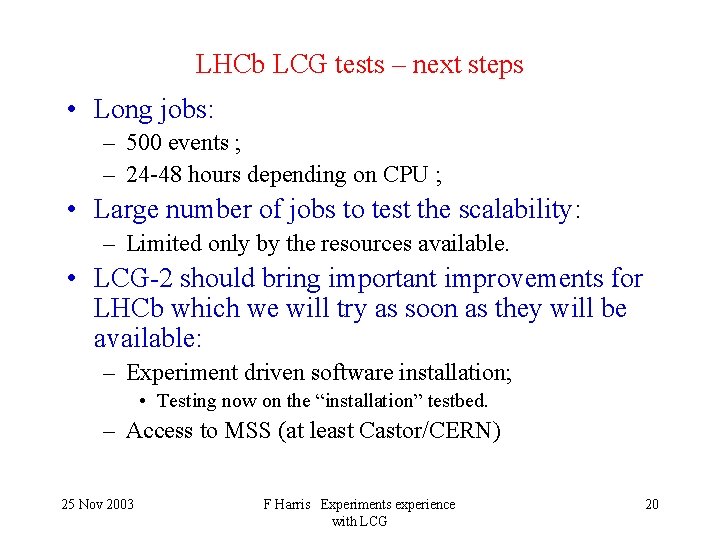
LHCb LCG tests – next steps • Long jobs: – 500 events ; – 24 -48 hours depending on CPU ; • Large number of jobs to test the scalability: – Limited only by the resources available. • LCG-2 should bring important improvements for LHCb which we will try as soon as they will be available: – Experiment driven software installation; • Testing now on the “installation” testbed. – Access to MSS (at least Castor/CERN) 25 Nov 2003 F Harris Experiments experience with LCG 20
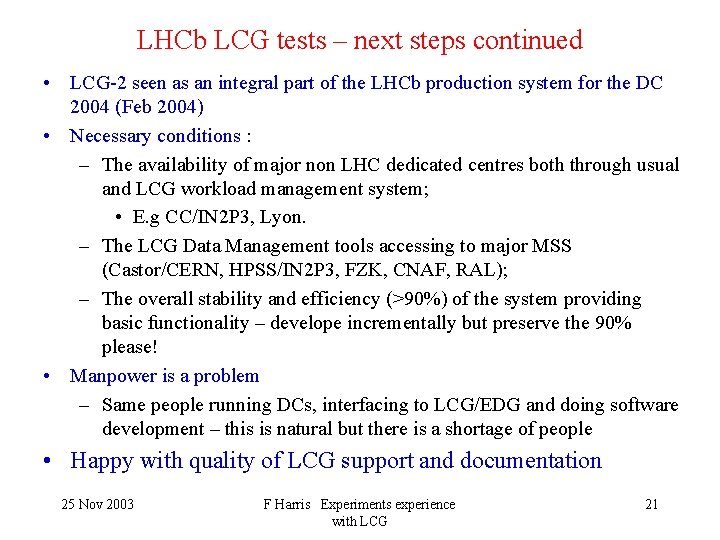
LHCb LCG tests – next steps continued • LCG-2 seen as an integral part of the LHCb production system for the DC 2004 (Feb 2004) • Necessary conditions : – The availability of major non LHC dedicated centres both through usual and LCG workload management system; • E. g CC/IN 2 P 3, Lyon. – The LCG Data Management tools accessing to major MSS (Castor/CERN, HPSS/IN 2 P 3, FZK, CNAF, RAL); – The overall stability and efficiency (>90%) of the system providing basic functionality – develope incrementally but preserve the 90% please! • Manpower is a problem – Same people running DCs, interfacing to LCG/EDG and doing software development – this is natural but there is a shortage of people • Happy with quality of LCG support and documentation 25 Nov 2003 F Harris Experiments experience with LCG 21
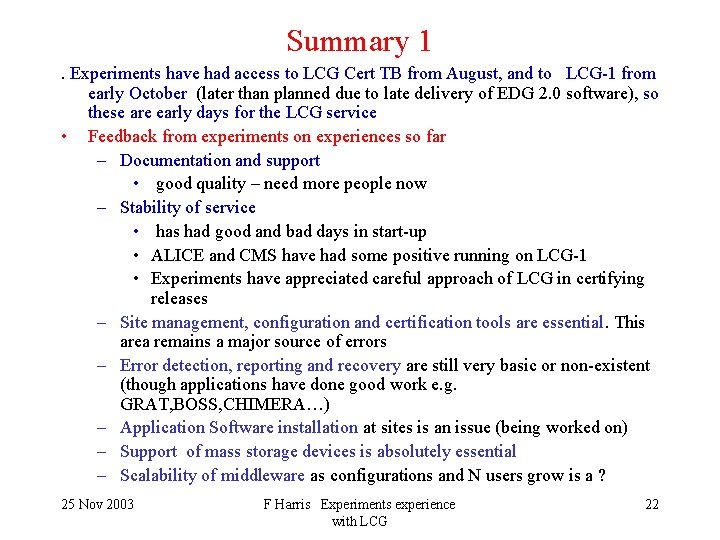
Summary 1. Experiments have had access to LCG Cert TB from August, and to LCG-1 from early October (later than planned due to late delivery of EDG 2. 0 software), so these are early days for the LCG service • Feedback from experiments on experiences so far – Documentation and support • good quality – need more people now – Stability of service • has had good and bad days in start-up • ALICE and CMS have had some positive running on LCG-1 • Experiments have appreciated careful approach of LCG in certifying releases – Site management, configuration and certification tools are essential. This area remains a major source of errors – Error detection, reporting and recovery are still very basic or non-existent (though applications have done good work e. g. GRAT, BOSS, CHIMERA…) – Application Software installation at sites is an issue (being worked on) – Support of mass storage devices is absolutely essential – Scalability of middleware as configurations and N users grow is a ? 25 Nov 2003 F Harris Experiments experience with LCG 22
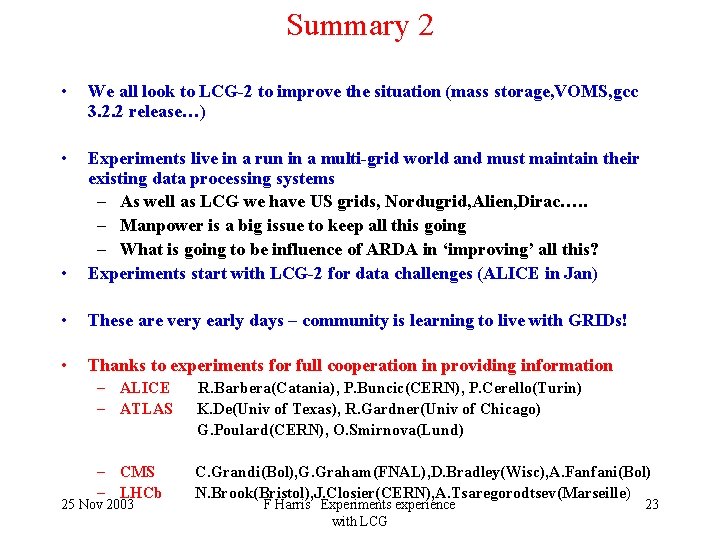
Summary 2 • We all look to LCG-2 to improve the situation (mass storage, VOMS, gcc 3. 2. 2 release…) • • Experiments live in a run in a multi-grid world and must maintain their existing data processing systems – As well as LCG we have US grids, Nordugrid, Alien, Dirac…. . – Manpower is a big issue to keep all this going – What is going to be influence of ARDA in ‘improving’ all this? Experiments start with LCG-2 for data challenges (ALICE in Jan) • These are very early days – community is learning to live with GRIDs! • Thanks to experiments for full cooperation in providing information – ALICE – ATLAS R. Barbera(Catania), P. Buncic(CERN), P. Cerello(Turin) K. De(Univ of Texas), R. Gardner(Univ of Chicago) G. Poulard(CERN), O. Smirnova(Lund) – CMS – LHCb C. Grandi(Bol), G. Graham(FNAL), D. Bradley(Wisc), A. Fanfani(Bol) N. Brook(Bristol), J. Closier(CERN), A. Tsaregorodtsev(Marseille) 25 Nov 2003 F Harris Experiments experience with LCG 23