
The Executive Branch Monday April 30 th Good
The Executive Branch
Monday, April 30 th Good morning/afternoon! n As you enter, please: n Sit in your NEW assigned seat n Front table – pick up your new Unit 4 Objectives/Info Summary and your Day #1 Get It, Got It Government and complete it n
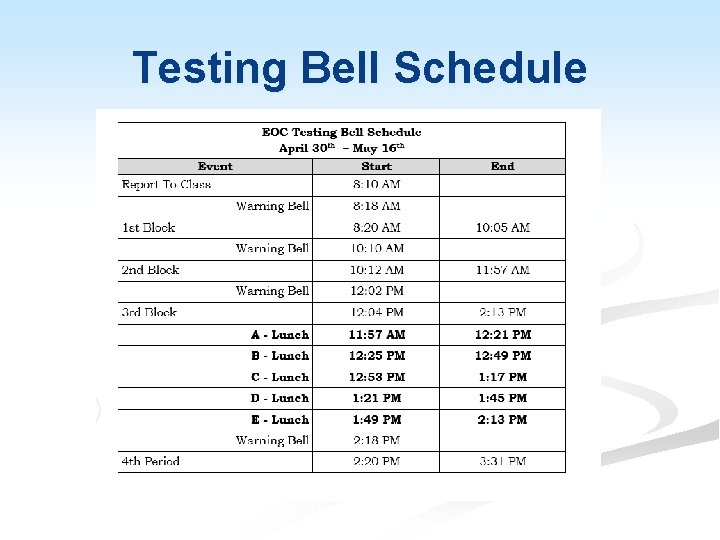
Testing Bell Schedule
Class Updates n Synergy Unit 3 test scores are in Synergy n Working on Unit 3 papers and make-up work! n
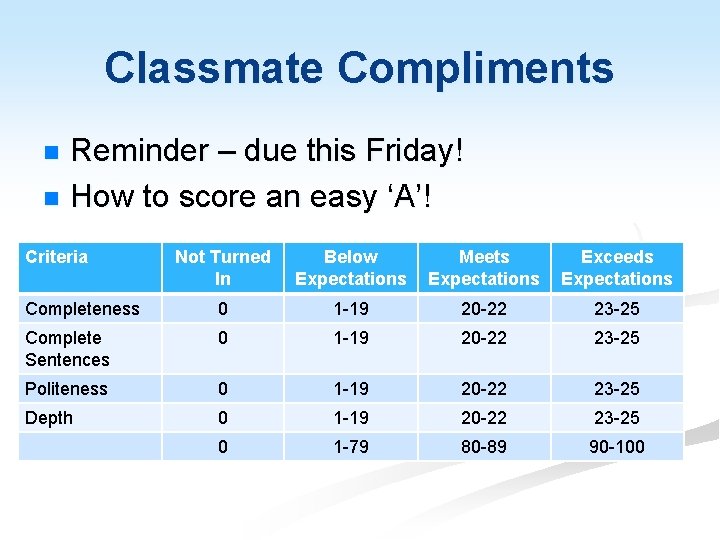
Classmate Compliments Reminder – due this Friday! n How to score an easy ‘A’! n Criteria Not Turned In Below Expectations Meets Expectations Exceeds Expectations Completeness 0 1 -19 20 -22 23 -25 Complete Sentences 0 1 -19 20 -22 23 -25 Politeness 0 1 -19 20 -22 23 -25 Depth 0 1 -19 20 -22 23 -25 0 1 -79 80 -89 90 -100

Class Updates n Unit 4 – Executive Branch Timing Tuesday – Tutoring After School n Wednesday – Formative n Thursday – Tutoring After School n Friday - Summative n
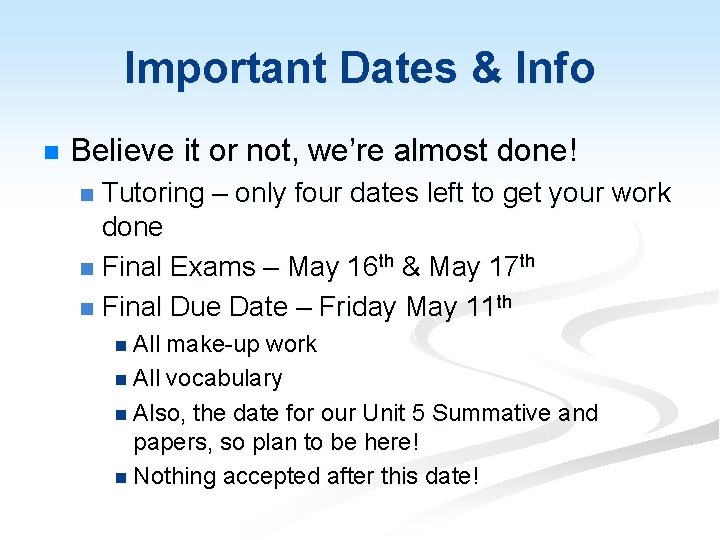
Important Dates & Info n Believe it or not, we’re almost done! Tutoring – only four dates left to get your work done n Final Exams – May 16 th & May 17 th n Final Due Date – Friday May 11 th n n All make-up work n All vocabulary n Also, the date for our Unit 5 Summative and papers, so plan to be here! n Nothing accepted after this date!
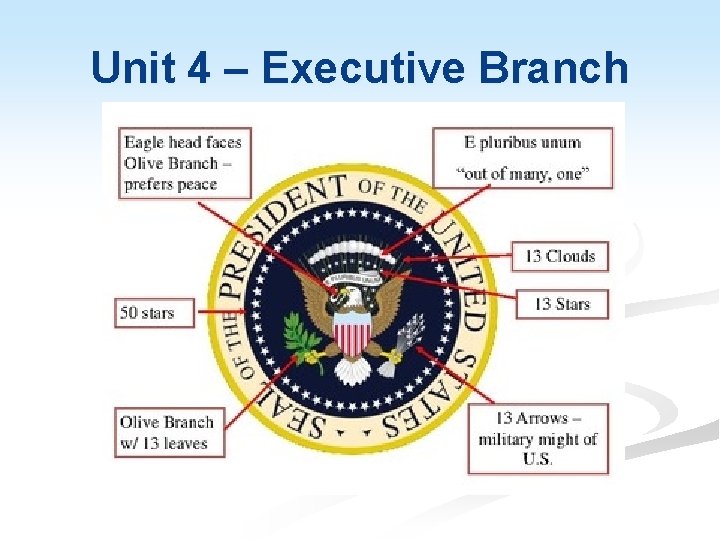
Unit 4 – Executive Branch
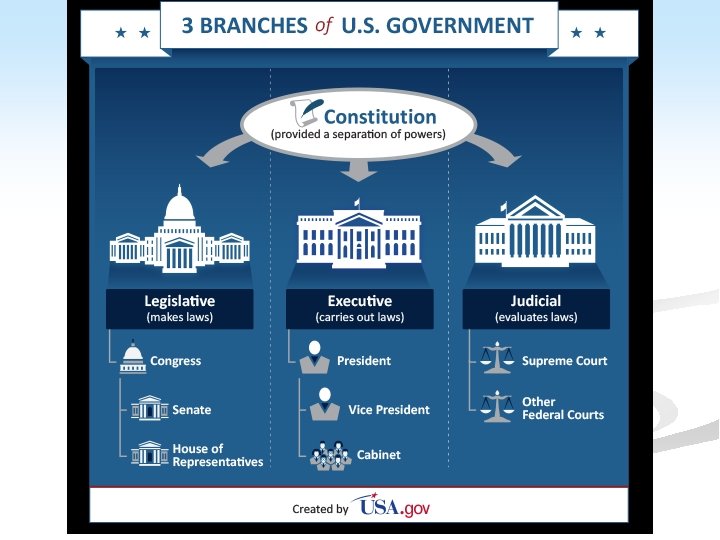
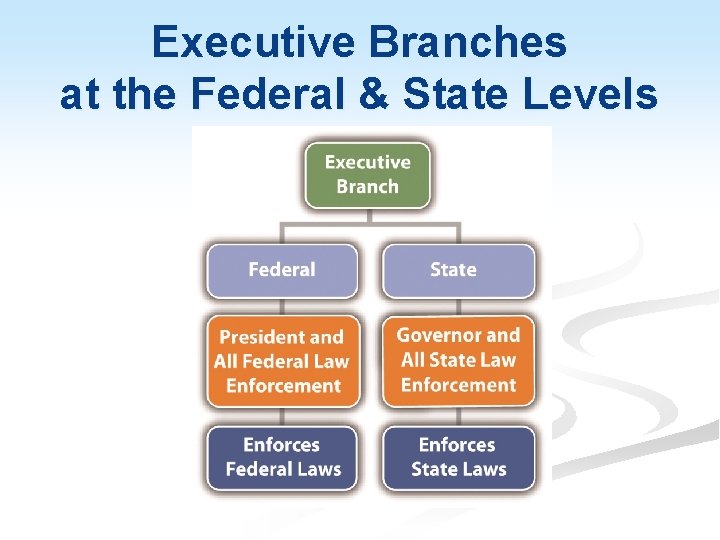
Executive Branches at the Federal & State Levels
Opener – Wednesday, April 20 th n Presidents Rap
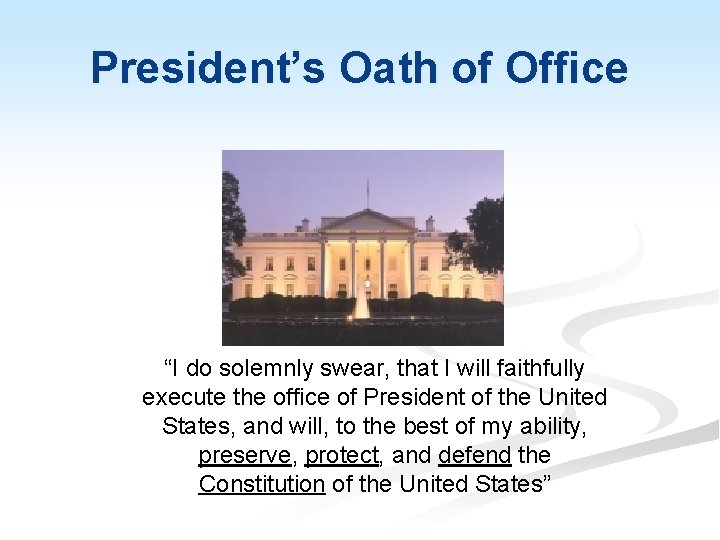
President’s Oath of Office “I do solemnly swear, that I will faithfully execute the office of President of the United States, and will, to the best of my ability, preserve, protect, and defend the Constitution of the United States”
Article II of the Constitution The power of the executive branch is vested in the President, who also serves as Commander in Chief of the Armed Forces. The President appoints the Cabinet and oversees the various agencies and departments of the federal government.
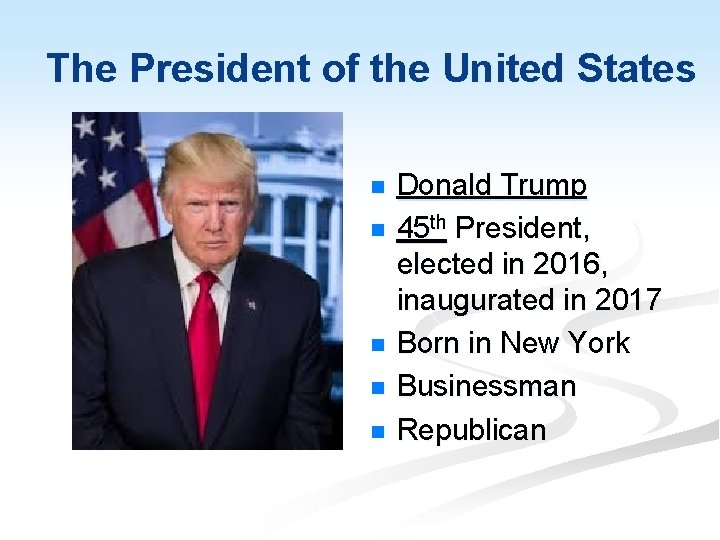
The President of the United States n n n Donald Trump 45 th President, elected in 2016, inaugurated in 2017 Born in New York Businessman Republican
Constitutional Duties of the President - Enforce national/federal laws - Commander in chief of the armed forces - Appoint top officials, federal judges, and ambassadors; - Meet with heads of foreign governments.
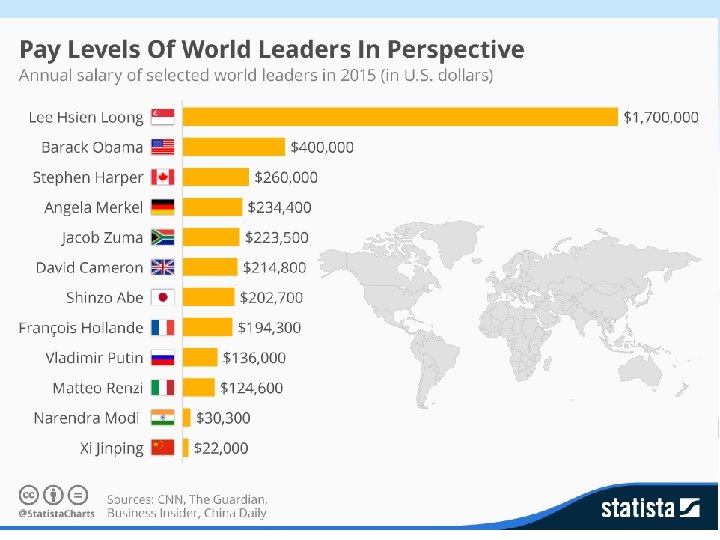
President’s Term and Salary n The 22 nd Amendment limits to two terms. n n Before this, George Washington set a precedent of two presidential terms. FDR was the only president elected to more than 2 terms – he was elected 4 times. Congress determines the president’s salary ($400, 000 beginning in 2001); Benefits are provided for presidents while in office and in retirement.
Compensation n n Salary $400, 000(2001) $50, 000 for expenses n n n $100, 000 for travel White House 132 rooms and office n n Camp David Resort Medical & Dental Care Secret Service protection for life Pension Transportation
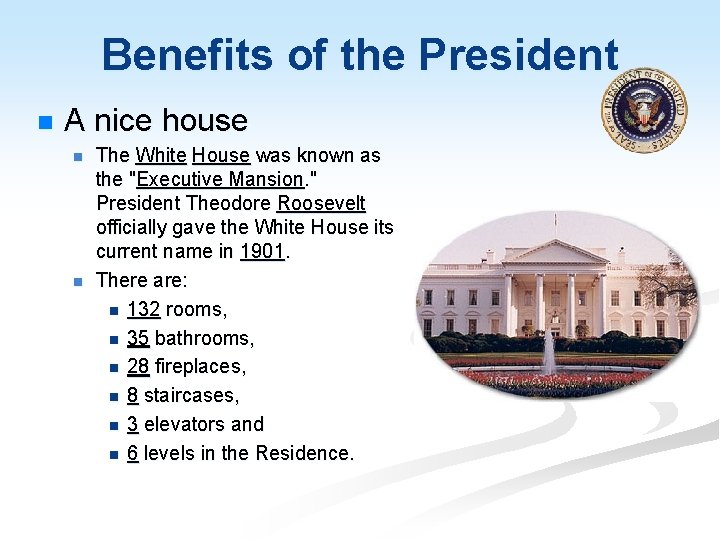
Benefits of the President n A nice house n n The White House was known as the "Executive Mansion. " President Theodore Roosevelt officially gave the White House its current name in 1901. There are: n 132 rooms, n 35 bathrooms, n 28 fireplaces, n 8 staircases, n 3 elevators and n 6 levels in the Residence.
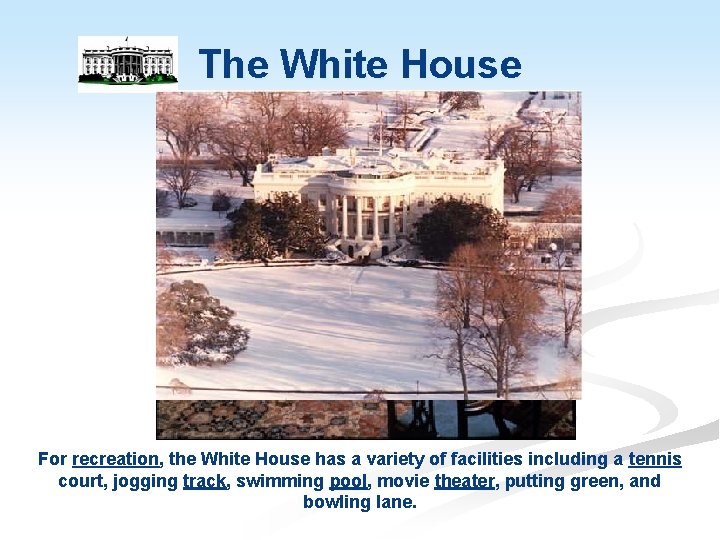
The White House For recreation, the White House has a variety of facilities including a tennis court, jogging track, swimming pool, movie theater, putting green, and bowling lane.
Presidential Qualifications The Constitution sets 3 requirements for the president: 1. a candidate must be a natural-born citizen 2. at least 35 years old 3. a resident of the United States for 14 years n Experience in government is an unwritten but important qualification. n
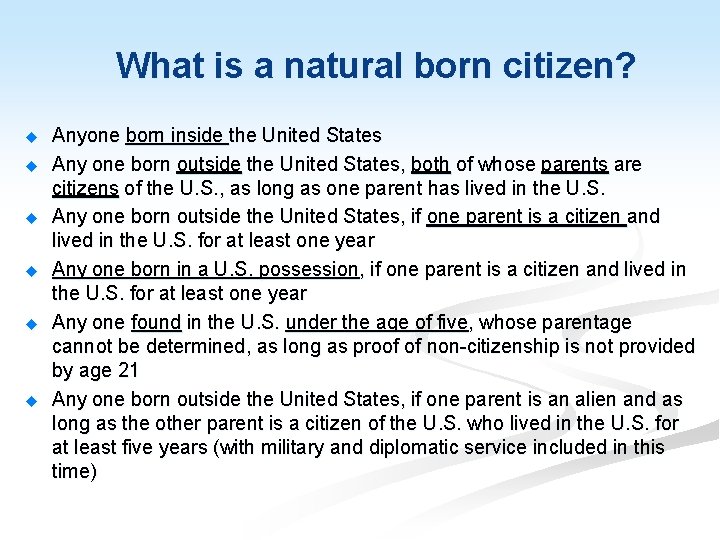
What is a natural born citizen? Anyone born inside the United States Any one born outside the United States, both of whose parents are citizens of the U. S. , as long as one parent has lived in the U. S. Any one born outside the United States, if one parent is a citizen and lived in the U. S. for at least one year Any one born in a U. S. possession, if one parent is a citizen and lived in the U. S. for at least one year Any one found in the U. S. under the age of five, whose parentage cannot be determined, as long as proof of non-citizenship is not provided by age 21 Any one born outside the United States, if one parent is an alien and as long as the other parent is a citizen of the U. S. who lived in the U. S. for at least five years (with military and diplomatic service included in this time)
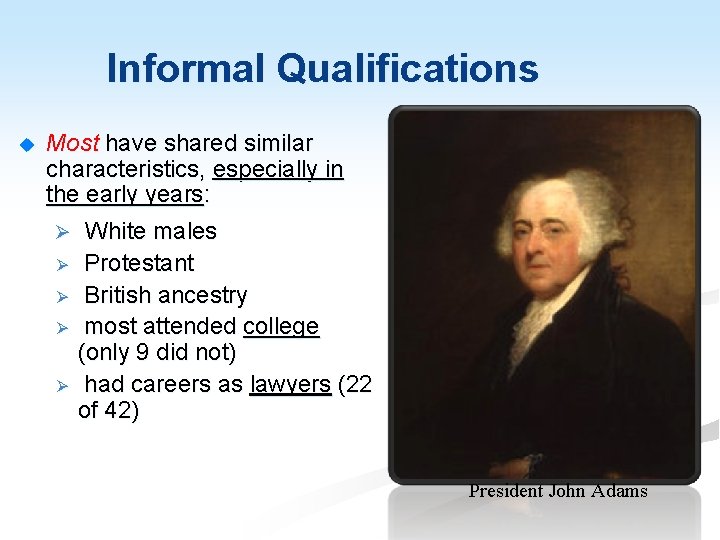
Informal Qualifications Most have shared similar characteristics, especially in the early years: Ø White males Ø Protestant Ø British ancestry Ø most attended college (only 9 did not) Ø had careers as lawyers (22 of 42) President John Adams
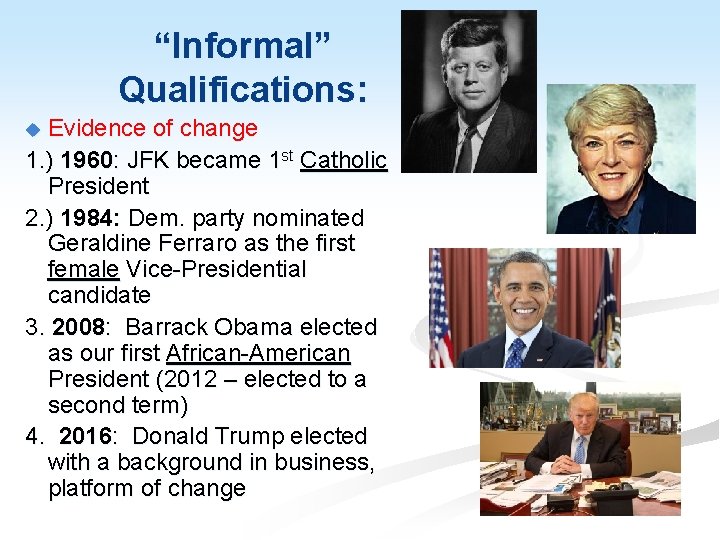
“Informal” Qualifications: Evidence of change 1. ) 1960: JFK became 1 st Catholic President 2. ) 1984: Dem. party nominated Geraldine Ferraro as the first female Vice-Presidential candidate 3. 2008: Barrack Obama elected as our first African-American President (2012 – elected to a second term) 4. 2016: Donald Trump elected with a background in business, platform of change
Qualifications and Characteristics n What do you consider the most important qualifications/characteristics for the office of president? Explain.
Presidential Line-Ups! n Part One Each of you will get a different ‘person’ who’s thinking about running for President of the United States of America. n Within your Quad, determine which ‘candidates’ qualify to run for President n Write your results, on your Activity Sheet n n If they don’t qualify, make sure to write down why they don’t qualify
Presidential Line-Ups! n Part Two NOW all the qualified ‘candidates’ should come up to the front of the class! n Let’s meet each of them and learn about their informal qualifications n Write down which two candidates you think should run for President and why you think they’re the best two candidates n
Tuesday, May 1 st Good morning/afternoon! n As you enter, please: n Sit in your new assigned seat n Front table – pick up a Day #2 Get It, Got It Government and complete it using your Unit 4 Info Summary n

Testing Bell Schedule
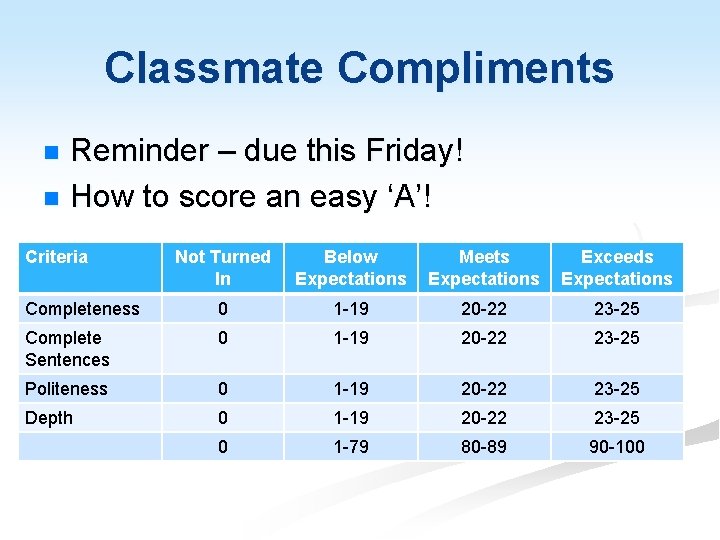
Classmate Compliments Reminder – due this Friday! n How to score an easy ‘A’! n Criteria Not Turned In Below Expectations Meets Expectations Exceeds Expectations Completeness 0 1 -19 20 -22 23 -25 Complete Sentences 0 1 -19 20 -22 23 -25 Politeness 0 1 -19 20 -22 23 -25 Depth 0 1 -19 20 -22 23 -25 0 1 -79 80 -89 90 -100
Class Updates Last call for Native Son tickets for bonus points! n What’s Up with Testing? n n If you anticipate being out of class for an AP test or any other kind of end-of-semester situation, please fill in the ‘What’s Up with Testing’ sheet on the whiteboard and I’ll
Class Updates n Unit 4 – Executive Branch Timing Today – Tutoring After School n Wednesday – Formative n Thursday – Tutoring After School n Friday - Summative n
Important Dates & Info n Believe it or not, we’re almost done! Tutoring – only four dates left to get your work done n Final Exams – May 16 th & May 17 th n Final Due Date – Friday May 11 th n n All make-up work n All vocabulary n Also, the date for our Unit 5 Summative and papers, so plan to be here! n Nothing accepted after this date!
Crash Course n Crash Course Presidential Powers #2
Crash Course https: //www. youtube. com/watch? v=5 l 02 s. K 5 Lov. I n https: //obamawhitehouse. archives. gov/blo g/2012/04/03/youre-invited-take-virtualtour-white-house n
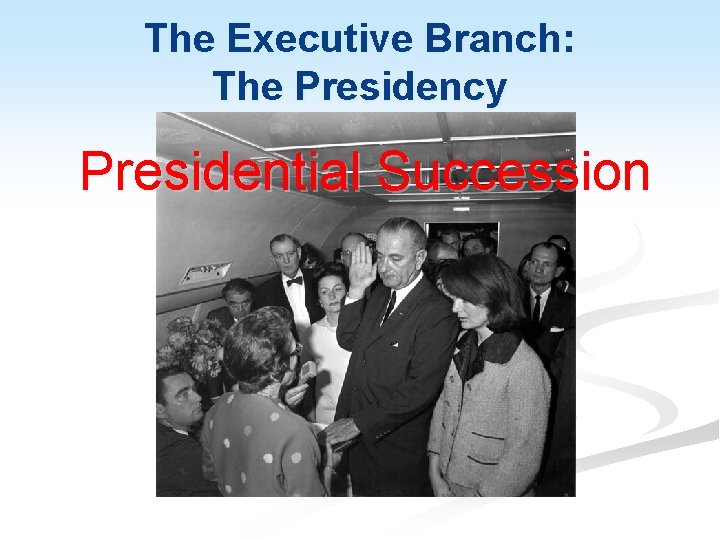
The Executive Branch: The Presidency Presidential Succession
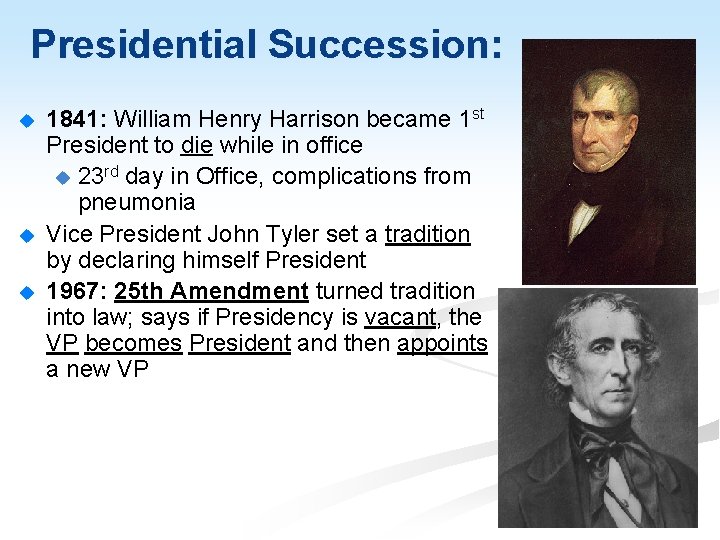
Presidential Succession: 1841: William Henry Harrison became 1 st President to die while in office 23 rd day in Office, complications from pneumonia Vice President John Tyler set a tradition by declaring himself President 1967: 25 th Amendment turned tradition into law; says if Presidency is vacant, the VP becomes President and then appoints a new VP
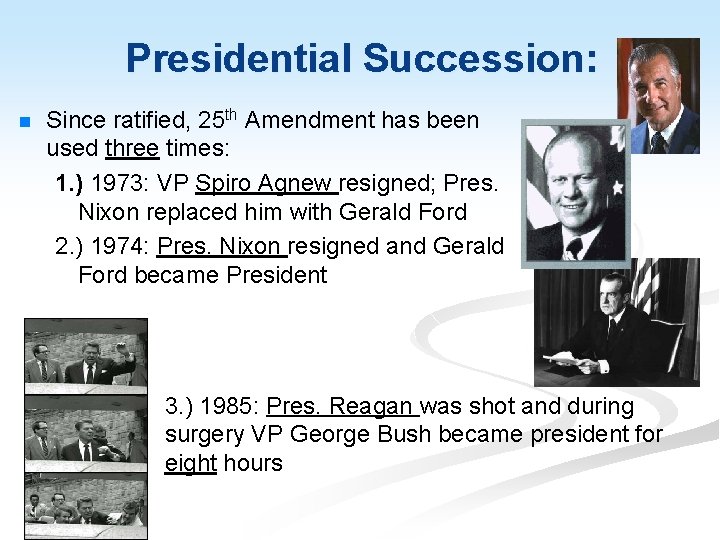
Presidential Succession: n Since ratified, 25 th Amendment has been used three times: 1. ) 1973: VP Spiro Agnew resigned; Pres. Nixon replaced him with Gerald Ford 2. ) 1974: Pres. Nixon resigned and Gerald Ford became President 3. ) 1985: Pres. Reagan was shot and during surgery VP George Bush became president for eight hours
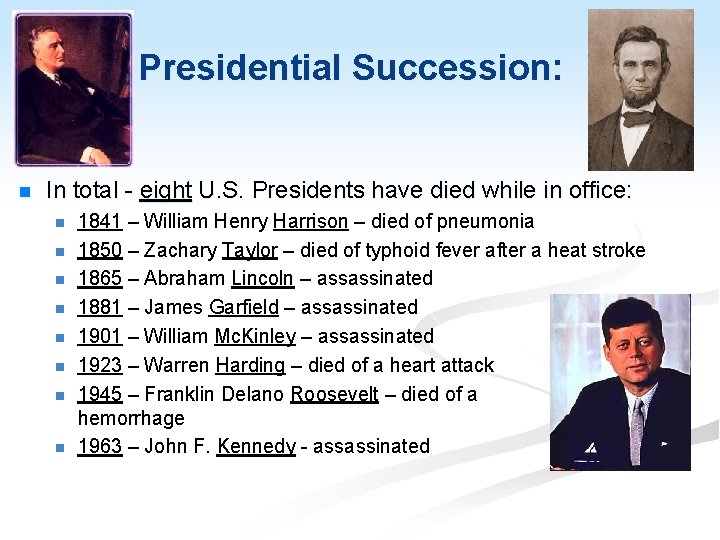
Presidential Succession: n In total - eight U. S. Presidents have died while in office: n n n n 1841 – William Henry Harrison – died of pneumonia 1850 – Zachary Taylor – died of typhoid fever after a heat stroke 1865 – Abraham Lincoln – assassinated 1881 – James Garfield – assassinated 1901 – William Mc. Kinley – assassinated 1923 – Warren Harding – died of a heart attack 1945 – Franklin Delano Roosevelt – died of a cerebral hemorrhage 1963 – John F. Kennedy - assassinated
Removal of President n The president and vice president may be removed from office upon conviction of impeachment for high crimes and misdemeanors
Impeachment Process House of Reps- votes to press charges against president which if approved will take the president to trial n Senate- holds the trial to impeach the president (need 2/3 majority to impeach) n
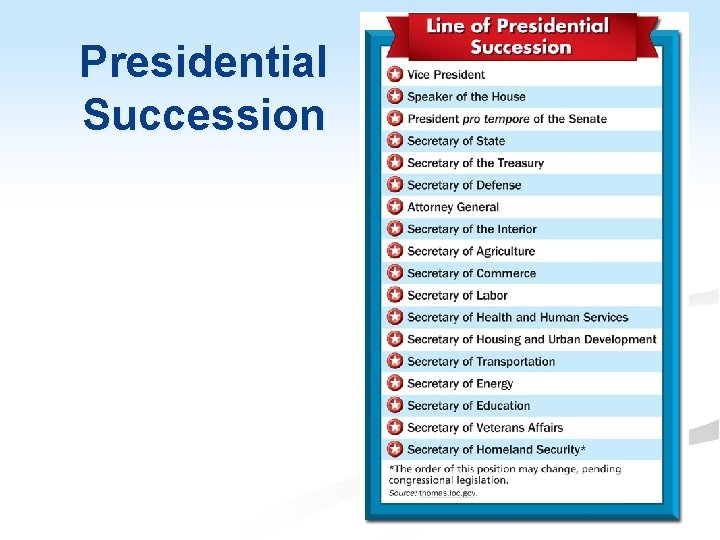
Presidential Succession
Qualifications for Vice President • Same as the President • with the exception that he/she cannot have their primary residence in the same state as the President.
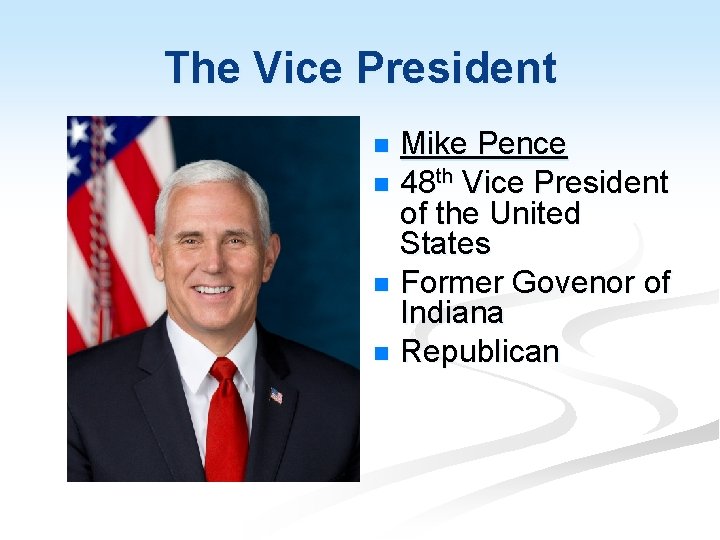
The Vice President Mike Pence n 48 th Vice President of the United States n Former Govenor of Indiana n Republican n
The Vice President’s Role § Regular duties: 1. Presides over the Senate and votes in case of a tie 2. Helps decide if the President is disabled 3. Work load depends on the duties assigned by the President n Ultimate job – to assume presidency if the president is unconscious, dead or otherwise unable to perform the duties of the job
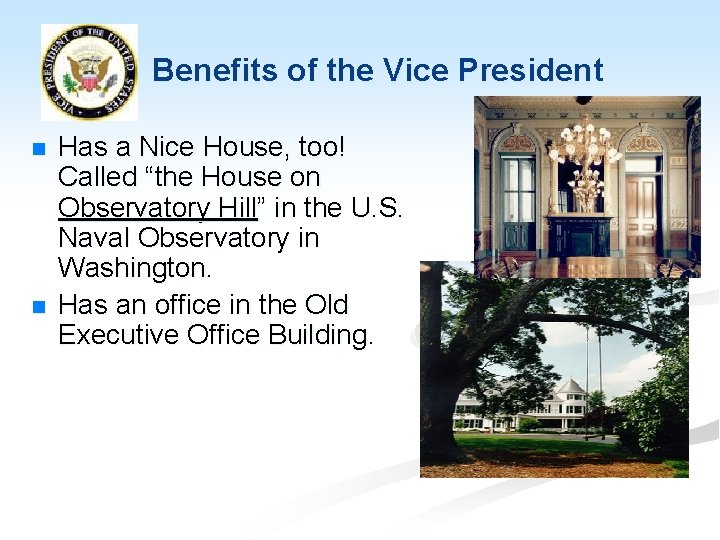
Benefits of the Vice President n n Has a Nice House, too! Called “the House on Observatory Hill” in the U. S. Naval Observatory in Washington. Has an office in the Old Executive Office Building.
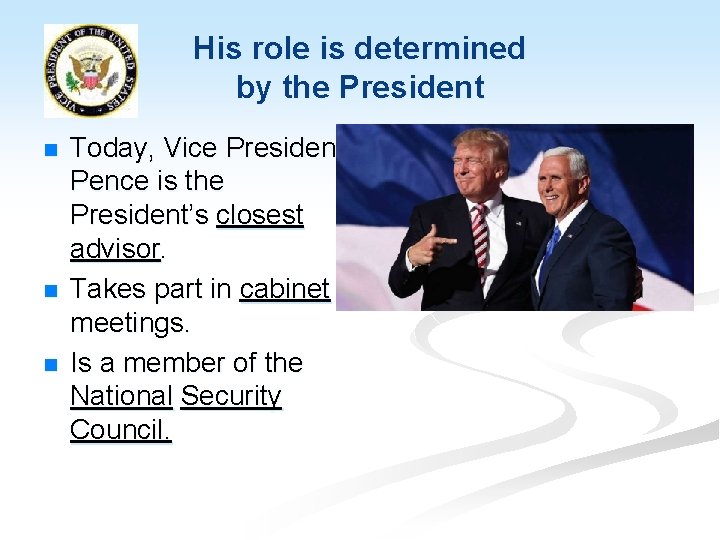
His role is determined by the President n n n Today, Vice President Pence is the President’s closest advisor. Takes part in cabinet meetings. Is a member of the National Security Council.
Electing our President Electoral Process
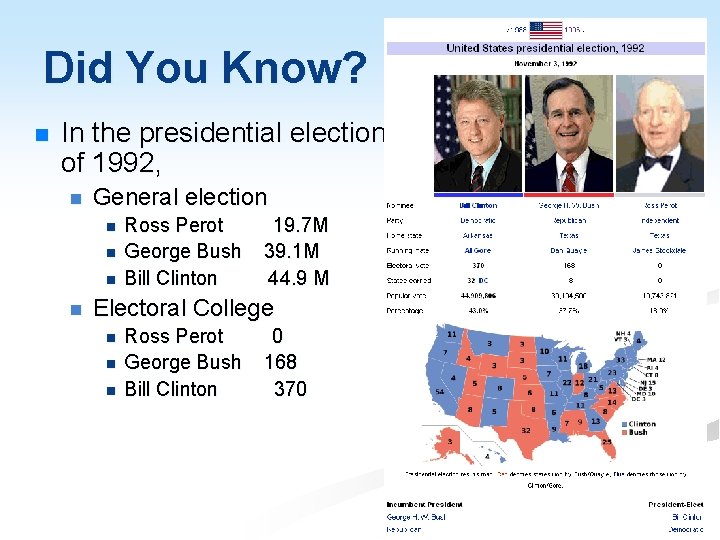
Did You Know? n In the presidential election of 1992, n General election n n Ross Perot 19. 7 M George Bush 39. 1 M Bill Clinton 44. 9 M Electoral College n n n Ross Perot 0 George Bush 168 Bill Clinton 370
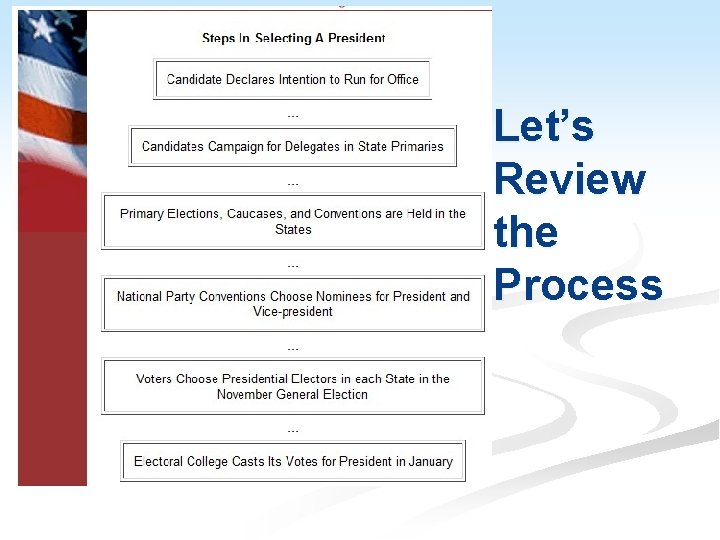
Let’s Review the Process
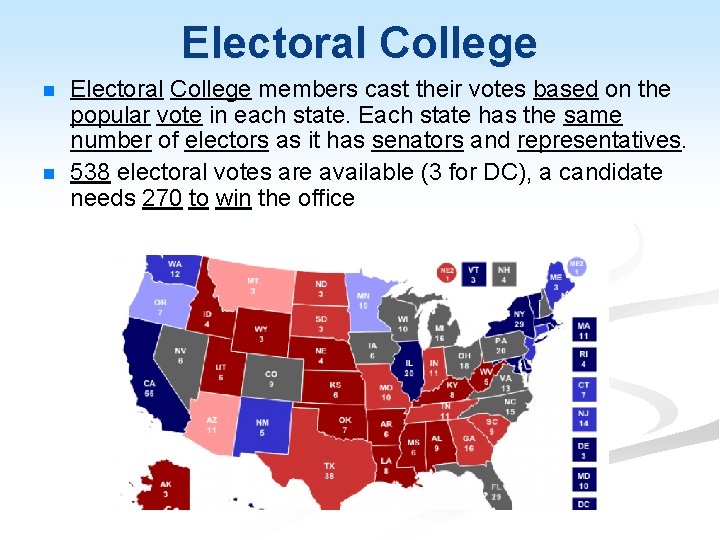
Electoral College n n Electoral College members cast their votes based on the popular vote in each state. Each state has the same number of electors as it has senators and representatives. 538 electoral votes are available (3 for DC), a candidate needs 270 to win the office
What about a tie? n n n Should no presidential candidate receive an absolute majority (270 electoral votes), the House of Representatives determines who the next president will be from the top three candidates. Each state may cast one vote and an absolute majority (26 votes) is needed to win. The Senate decides who the next Vice President will be if there is no absolute majority in the Electoral College vote.
Race to the White House! n Let’s practice our new knowledge with a board game – Race to the White House!
How to Play Race to the White House n n n Each player begins on the Start square. Roll to see who will go first. The highest number starts then it moves clockwise from there. On your check list are the required spaces to land on to sin the game. Move around the game board clockwise collecting each requirement. Once you’ve made it all the way around the board, you need to land last on Roll for Electoral Votes. n n n Roll once each turn and add up your total from each roll until your get 27 (for 270 electoral votes). Then you have to roll to land on the white house. The first player to complete all of these tasks wins!
Presidential Succession Jeopardy n https: //www. superteachertools. us/jeopardy x/jeopardy-reviewgame. php? gamefile=49080#. Why. Erogr. LIU

Crash Course n https: //www. youtube. com/watch? v=5 l 02 s. K 5 Lov. I
Constitutional Powers of the President n n Article II grants the president broad but vaguely described powers. He heads the executive branch, is commander in chief, conducts foreign policy, and has judicial powers. The Founders intended for Congress to lead the country. Presidents have expanded the power of their office and taken more of a leadership role.
Presidential Expansion of Power n n Theodore Roosevelt declared his intent to do anything the needs of the nation required if such action was not expressly forbidden by the Constitution. During national crises, presidents like Abraham Lincoln, Franklin D. Roosevelt, and George W. Bush greatly expanded the powers of the presidency as the federal government dealt with dangers facing the United States.
Limits of Presidential Power n n n Congress has the power to limit presidential authority by overriding a veto or impeaching and removing the president from office for abuse of power. The Supreme Court can overturn presidential actions. Public opinion can limit the president’s actions, as it did with President Lyndon Johnson’s policies in Vietnam and President Clinton’s proposed national health care program.
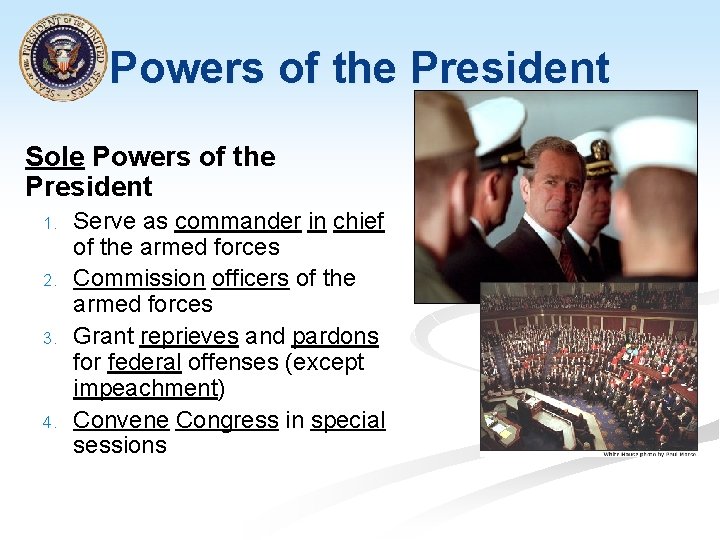
Powers of the President Sole Powers of the President 1. 2. 3. 4. Serve as commander in chief of the armed forces Commission officers of the armed forces Grant reprieves and pardons for federal offenses (except impeachment) Convene Congress in special sessions
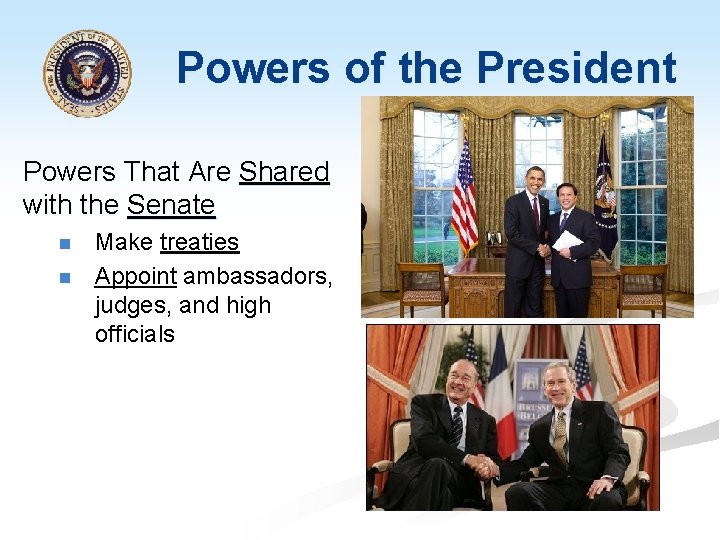
Powers of the President Powers That Are Shared with the Senate n n Make treaties Appoint ambassadors, judges, and high officials
War Powers Act President cannot send out troops unless: Congress declares war A law authorizes the action National emergency: • Notify Congress within 48 hours • Cannot keep troops abroad for more than 60 days without Congressional Approval.
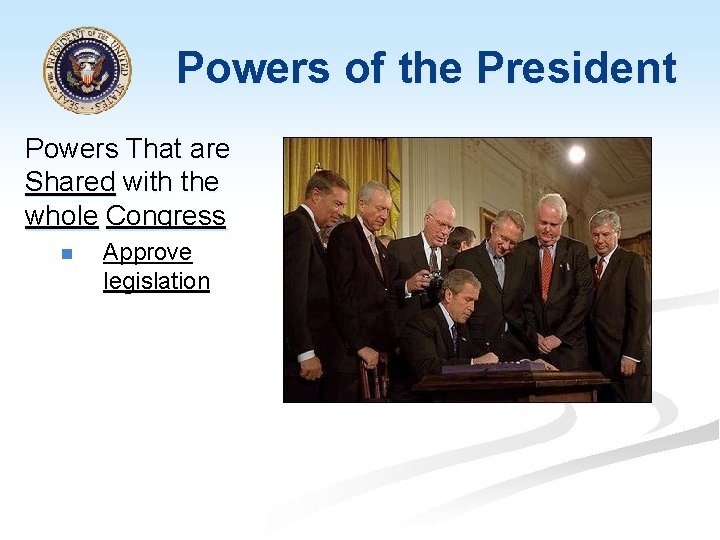
Powers of the President Powers That are Shared with the whole Congress n Approve legislation
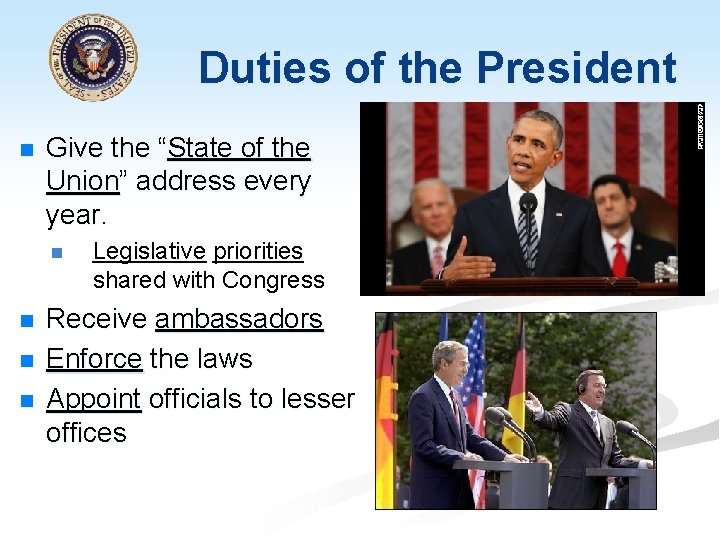
Duties of the President n Give the “State of the Union” address every year. n n Legislative priorities shared with Congress Receive ambassadors Enforce the laws Appoint officials to lesser offices
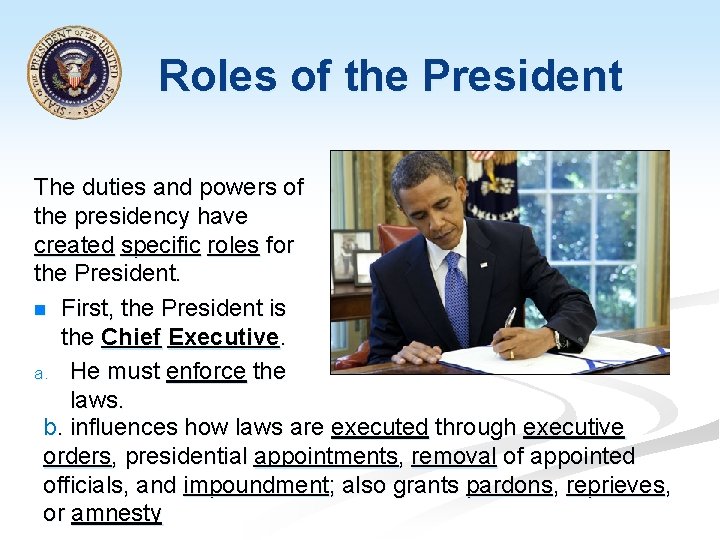
Roles of the President The duties and powers of the presidency have created specific roles for the President. n First, the President is the Chief Executive. a. He must enforce the laws. b. influences how laws are executed through executive orders, presidential appointments, removal of appointed officials, and impoundment; also grants pardons, reprieves, or amnesty
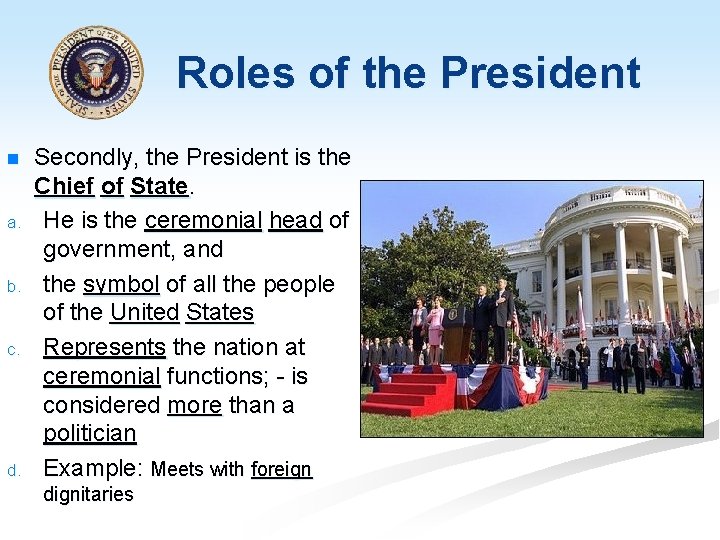
Roles of the President n a. b. c. d. Secondly, the President is the Chief of State. He is the ceremonial head of government, and the symbol of all the people of the United States Represents the nation at ceremonial functions; - is considered more than a politician Example: Meets with foreign dignitaries
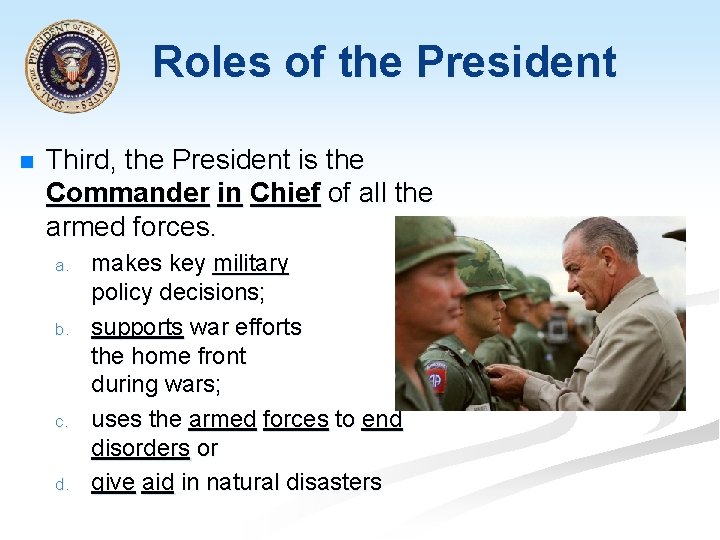
Roles of the President n Third, the President is the Commander in Chief of all the armed forces. a. b. c. d. makes key military policy decisions; supports war efforts on the home front during wars; uses the armed forces to end disorders or give aid in natural disasters
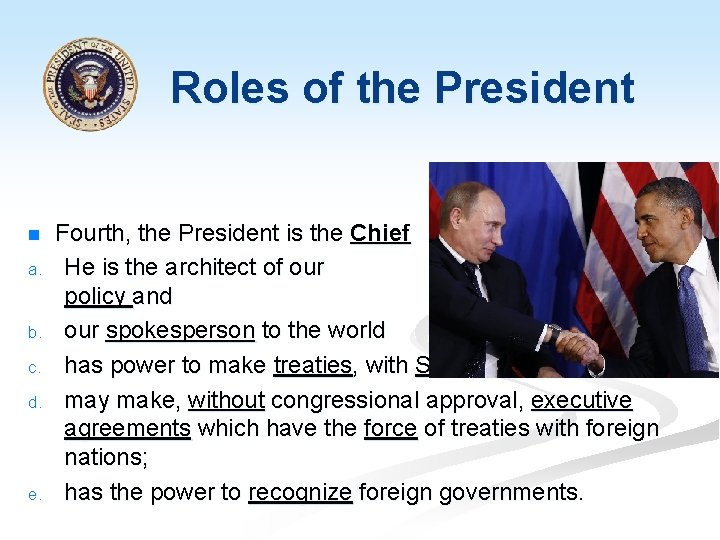
Roles of the President n a. b. c. d. e. Fourth, the President is the Chief Diplomat. He is the architect of our foreign policy and our spokesperson to the world has power to make treaties, with Senate approval; may make, without congressional approval, executive agreements which have the force of treaties with foreign nations; has the power to recognize foreign governments.
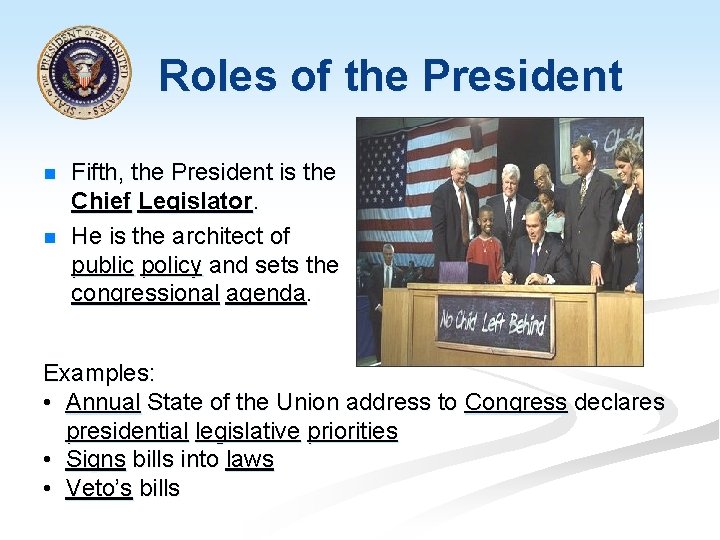
Roles of the President n n Fifth, the President is the Chief Legislator. He is the architect of public policy and sets the congressional agenda. Examples: • Annual State of the Union address to Congress declares presidential legislative priorities • Signs bills into laws • Veto’s bills
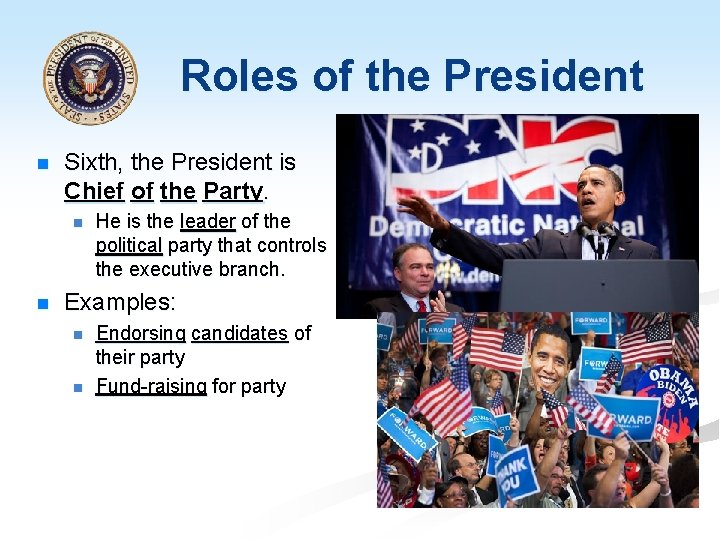
Roles of the President n Sixth, the President is Chief of the Party. n n He is the leader of the political party that controls the executive branch. Examples: n n Endorsing candidates of their party Fund-raising for party
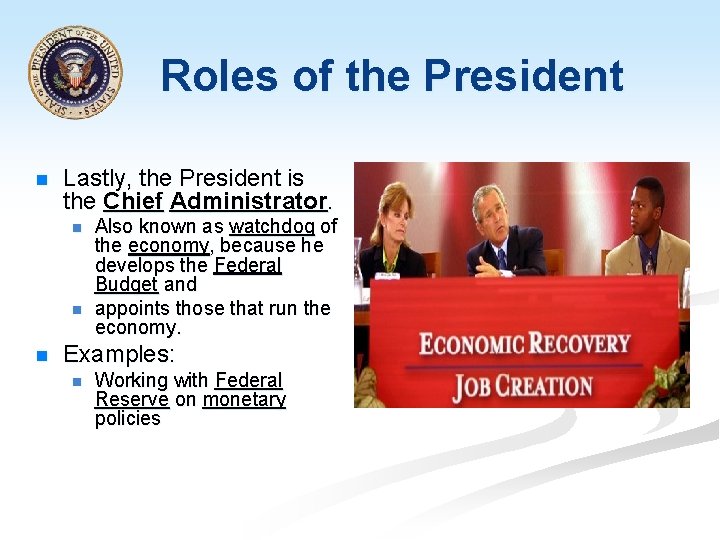
Roles of the President n Lastly, the President is the Chief Administrator. n n n Also known as watchdog of the economy, because he develops the Federal Budget and appoints those that run the economy. Examples: n Working with Federal Reserve on monetary policies
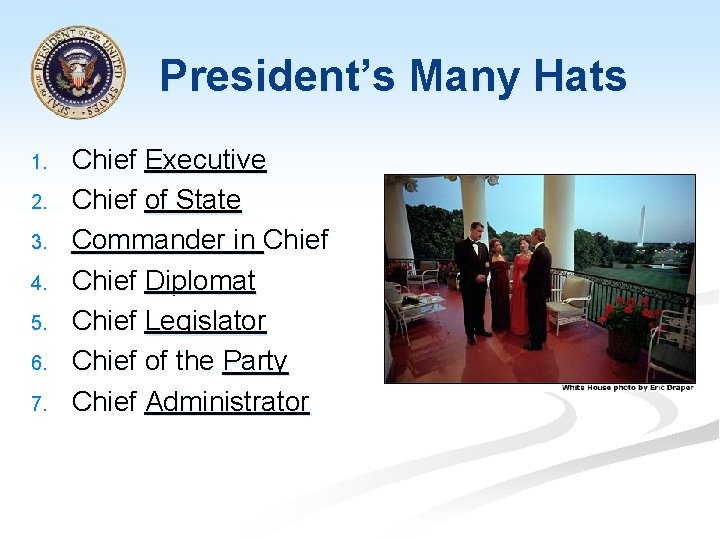
President’s Many Hats 1. 2. 3. 4. 5. 6. 7. Chief Executive Chief of State Commander in Chief Diplomat Chief Legislator Chief of the Party Chief Administrator
Leadership Qualities and Skills n n n Presidents must understand the people. Presidents must be able to communicate effectively and explain their policies clearly in order to inspire public support. Presidents must know when the time is right to introduce new policies or make key decisions.
Leadership Qualities and Skills n Successful presidents must: n be flexible and open to new ideas n be able to compromise n have political courage
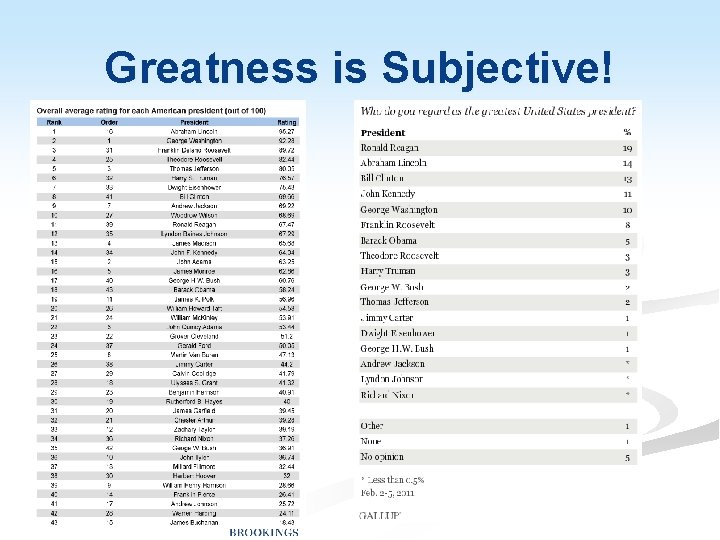
Greatness is Subjective!
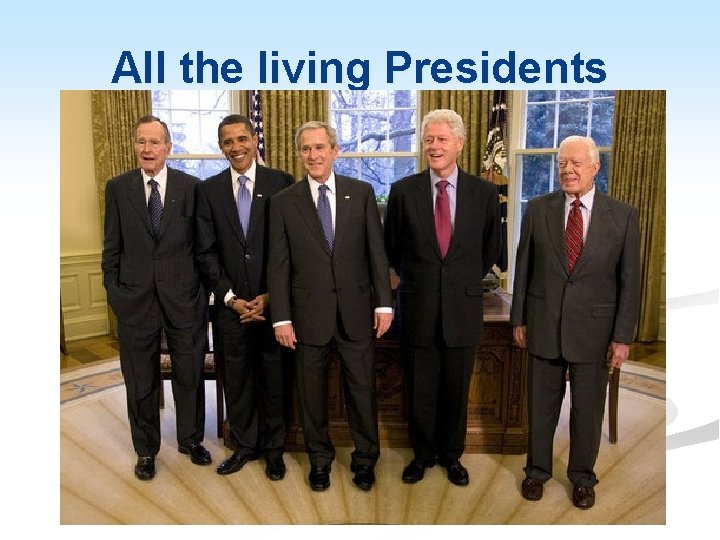
All the living Presidents
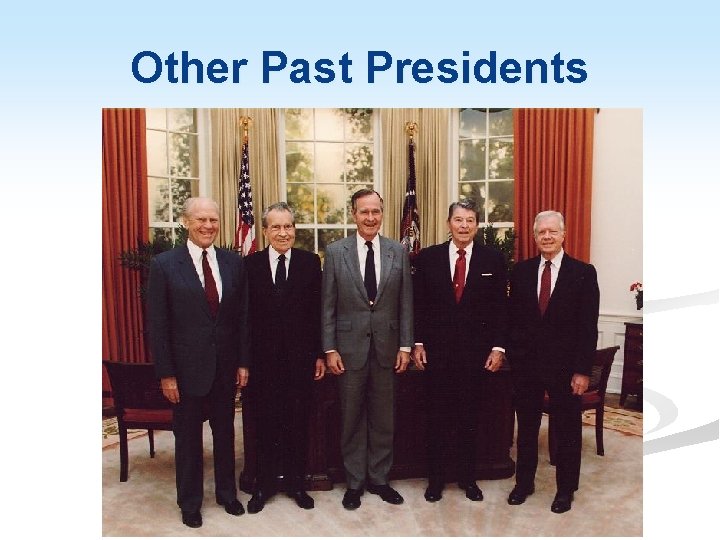
Other Past Presidents
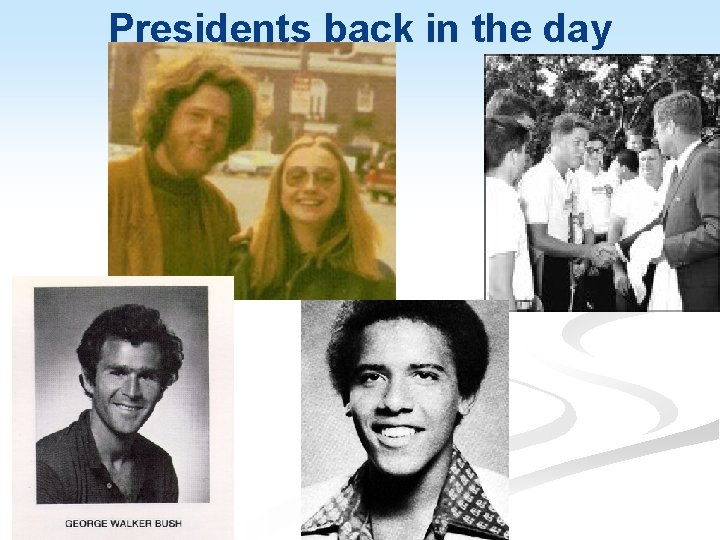
Presidents back in the day
Wednesday, May 2 nd n Good morning/afternoon! n As you enter, please: n Sit in your assigned seat n n Check the whiteboard for your seat number! Front table – Pick up your Day 3 Get It, Got It Government and complete it using your Unit 4 Info Summary Unit 4 Formative Need to Knows! Presidential Qualifications Formal & Informal Term Limits Presidential Roles: Commander in Chief Executive Chief Agenda Setter Chief of State Chief Diplomat Party Leader Vice President Succession
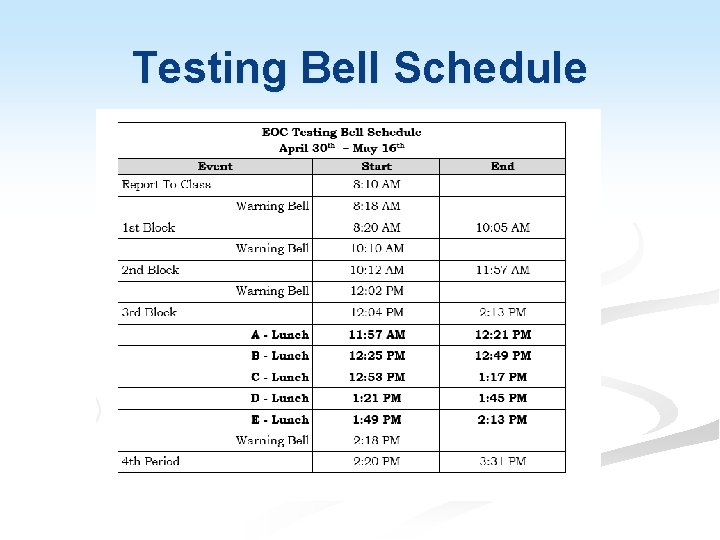
Testing Bell Schedule
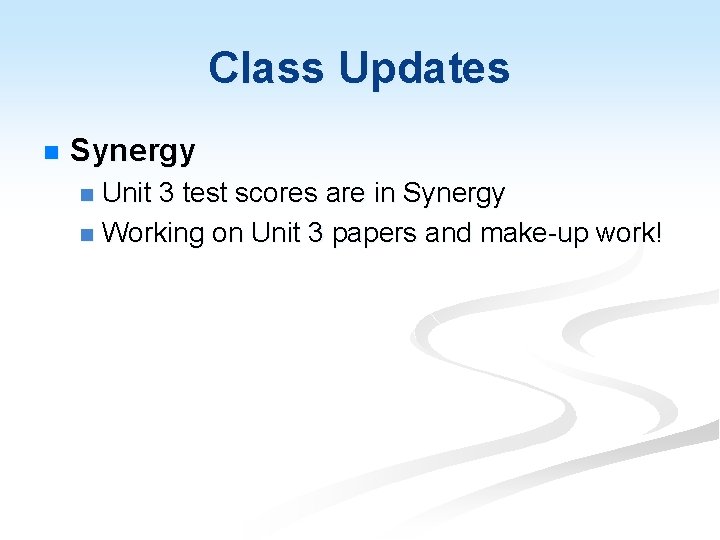
Class Updates n Synergy Unit 3 test scores are in Synergy n Working on Unit 3 papers and make-up work! n
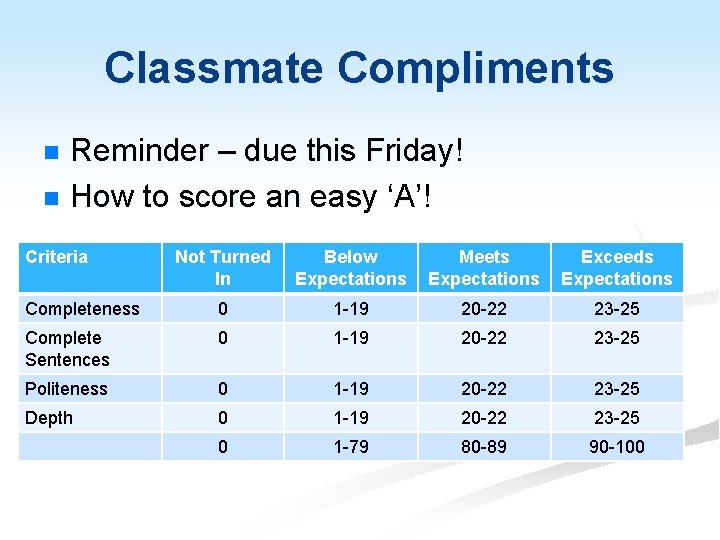
Classmate Compliments Reminder – due this Friday! n How to score an easy ‘A’! n Criteria Not Turned In Below Expectations Meets Expectations Exceeds Expectations Completeness 0 1 -19 20 -22 23 -25 Complete Sentences 0 1 -19 20 -22 23 -25 Politeness 0 1 -19 20 -22 23 -25 Depth 0 1 -19 20 -22 23 -25 0 1 -79 80 -89 90 -100
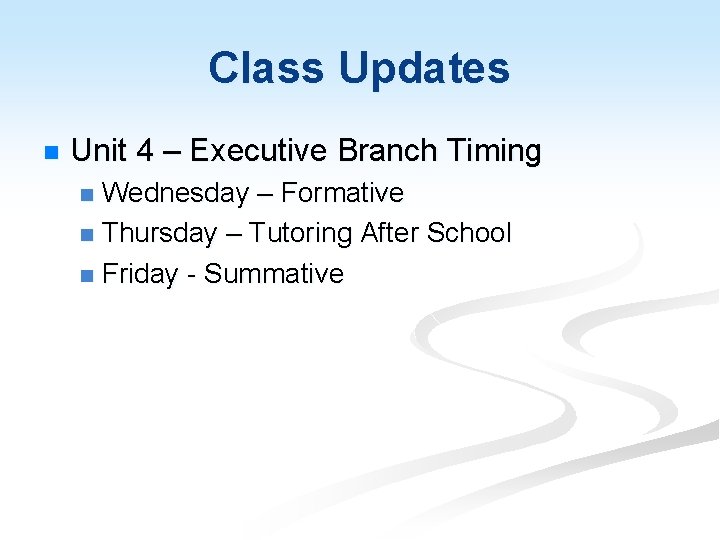
Class Updates n Unit 4 – Executive Branch Timing Wednesday – Formative n Thursday – Tutoring After School n Friday - Summative n
Important Dates & Info n Believe it or not, we’re almost done! Tutoring – only three dates left to get your work done n Final Exams – May 16 th & May 17 th n Final Due Date – Friday May 11 th n n All make-up work n All vocabulary n Also, the date for our Unit 5 Summative and papers, so plan to be here! n Nothing accepted after this date!
Time for a Quick Formative Please clear your desk and power down all electronics – all you need is a pencil Please bubble in your Zipgrade sheet and then raise your hand for an i. Respond clicker. Until the last papers are turned in: • No electronics • No talking • No walking • No gawking!
The American President Today we’ll be starting a great movie about a fictional American president. Please note: • Zero electronics!!! Or you’ll be given an alternate/unfun assignment • I will be having Student Conferences while you watch the movie, so listen for your name & come over • Preview your Movie Guide questions • Answer them as you watch the movie • To help you stay on task, I’ll collect your Movie Guides at the end of each class • You will have homework tonight! Guided Notes to complete using the Unit 4 Master Power. Point off the class website.
Thursday, May 3 rd • Good morning/afternoon! • As you come in, please: • Sit in your assigned seat • Front table – Pick up Day 4 Get It, Got It Government and complete it using your Unit 4 Summary • I’ll hand back your American President Movie Guide in a moment and we’ll finish the movie! • Remember – phone free zone!! • Will turn in Movie Guide at the end of class • Student conferences during the movie
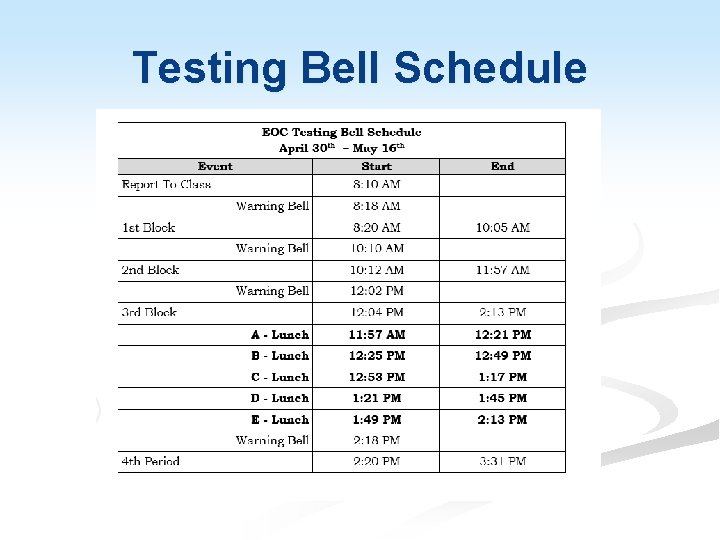
Testing Bell Schedule
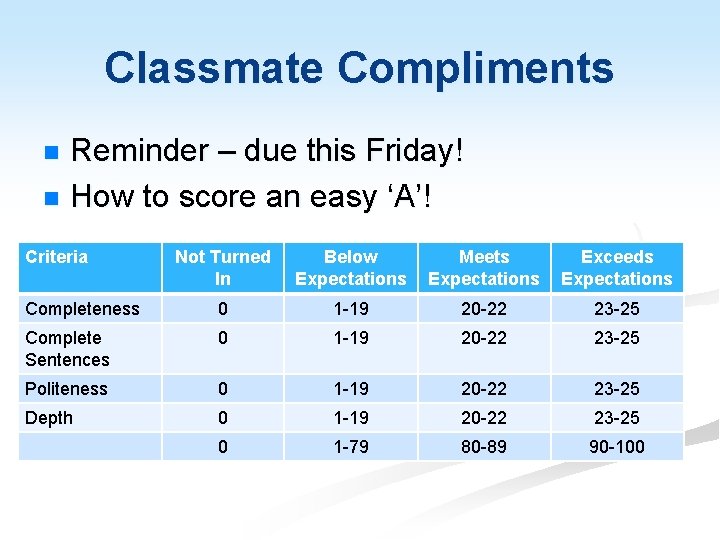
Classmate Compliments Reminder – due this Friday! n How to score an easy ‘A’! n Criteria Not Turned In Below Expectations Meets Expectations Exceeds Expectations Completeness 0 1 -19 20 -22 23 -25 Complete Sentences 0 1 -19 20 -22 23 -25 Politeness 0 1 -19 20 -22 23 -25 Depth 0 1 -19 20 -22 23 -25 0 1 -79 80 -89 90 -100
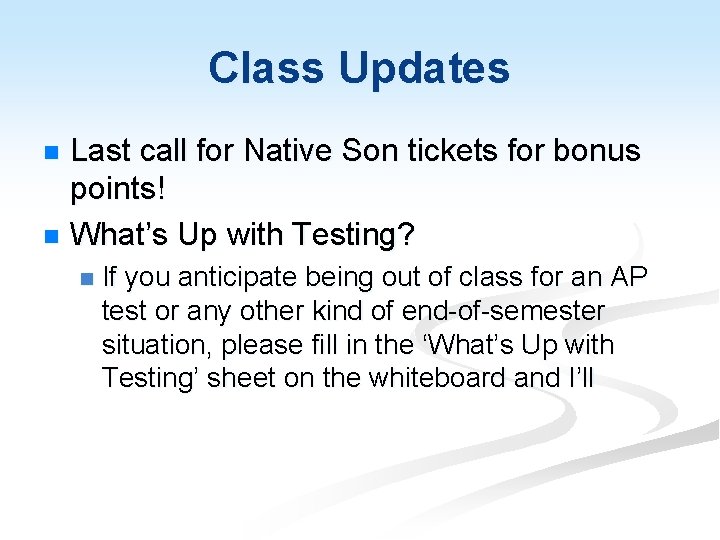
Class Updates Last call for Native Son tickets for bonus points! n What’s Up with Testing? n n If you anticipate being out of class for an AP test or any other kind of end-of-semester situation, please fill in the ‘What’s Up with Testing’ sheet on the whiteboard and I’ll
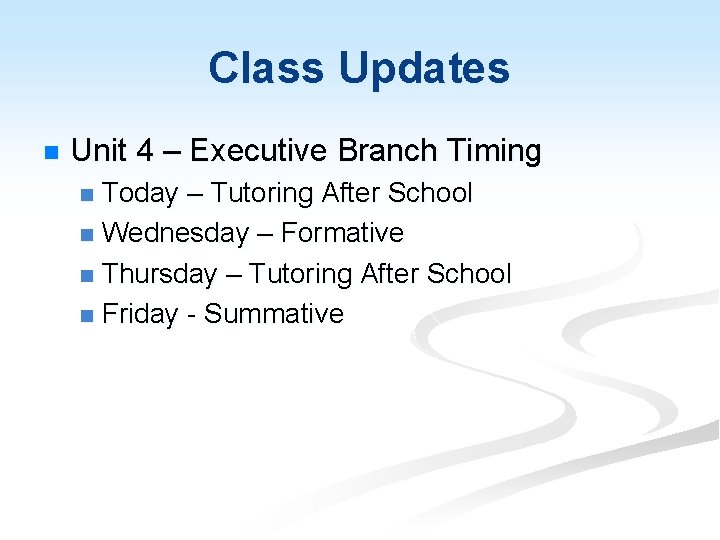
Class Updates n Unit 4 – Executive Branch Timing Today – Tutoring After School n Wednesday – Formative n Thursday – Tutoring After School n Friday - Summative n
Important Dates & Info n Believe it or not, we’re almost done! Tutoring – only three dates left to get your work done n Final Exams – May 16 th & May 17 th n Final Due Date – Friday May 11 th n n All make-up work n All vocabulary n Also, the date for our Unit 5 Summative and papers, so plan to be here! n Nothing accepted after this date!
The Federal Bureaucracy Ch 10
What is a bureaucrat? n A civilian that works for the federal government is called a bureaucrat or a civil servant.
An Overview n n Any Major Organization is a Bureaucracy is a neutral word Easy to bash…Conservatives say it too large, liberal, and unaccountable Liberals say it too slow, too status quo, doesn’t protect us enough (ex. EPA)
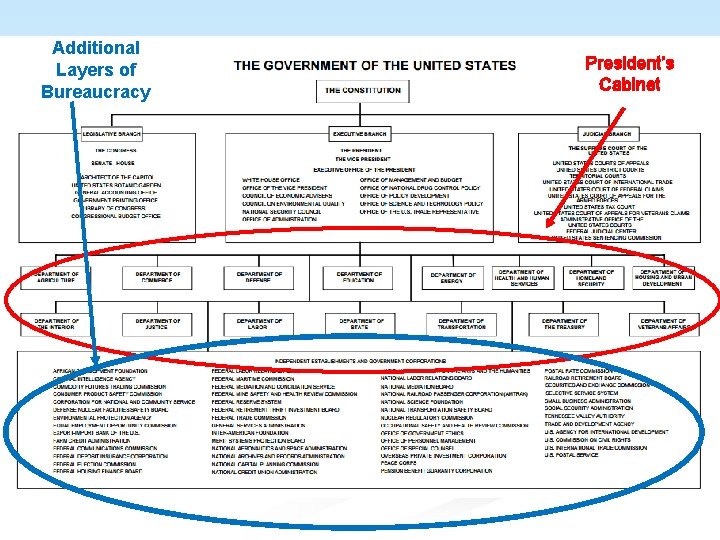
Additional Layers of Bureaucracy President’s Cabinet
Additional Layers Broken Out
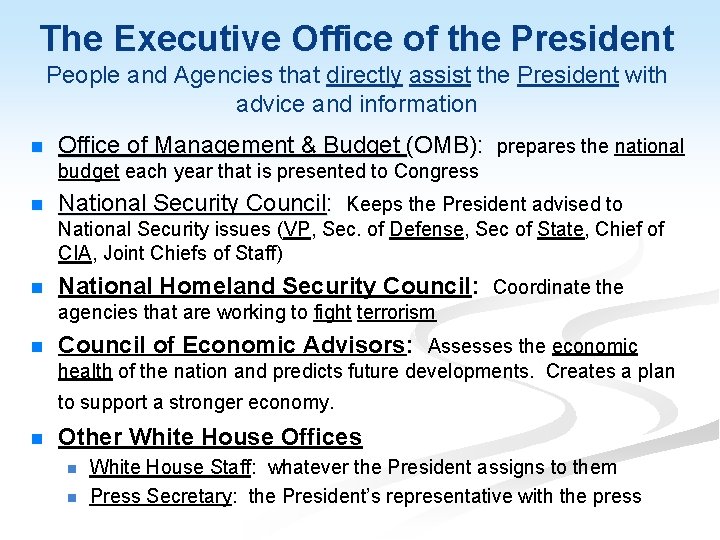
The Executive Office of the President People and Agencies that directly assist the President with advice and information n Office of Management & Budget (OMB): prepares the national budget each year that is presented to Congress n National Security Council: Keeps the President advised to National Security issues (VP, Sec. of Defense, Sec of State, Chief of CIA, Joint Chiefs of Staff) n National Homeland Security Council: Coordinate the agencies that are working to fight terrorism n Council of Economic Advisors: Assesses the economic health of the nation and predicts future developments. Creates a plan to support a stronger economy. n Other White House Offices n n White House Staff: whatever the President assigns to them Press Secretary: the President’s representative with the press
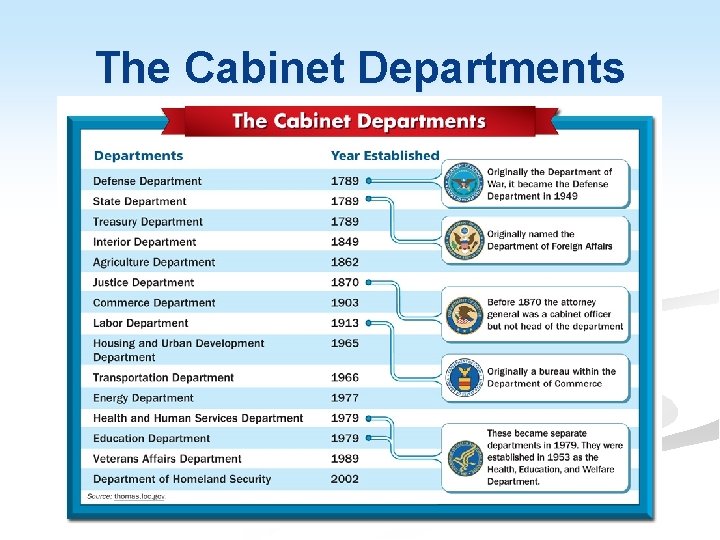
The Cabinet Departments

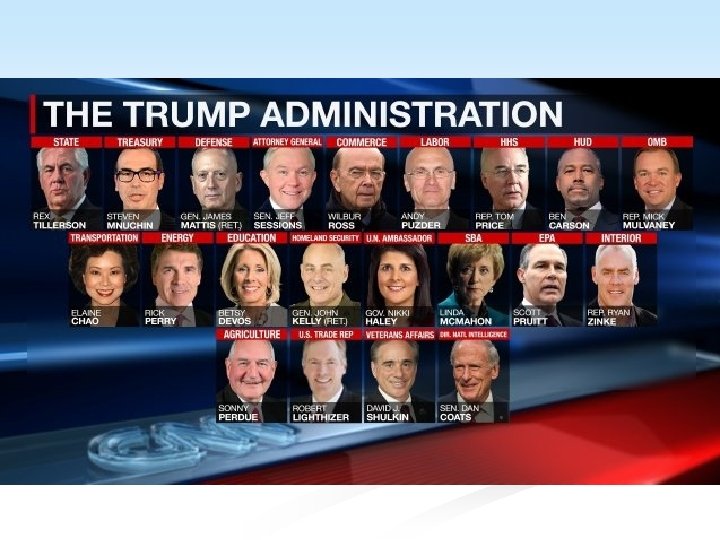
Role of the Cabinet § n n Cabinet members are heads of the executive departments. Influence the president’s decisions on matters related to their departments’ areas of interest. Certain cabinet members—the secretaries of State, Defense, and Treasury, plus the Attorney General—form the “inner cabinet”
The Cabinet Departments n The 15 executive departments are a major part of the federal bureaucracy and are headed by secretaries and staffed with assistant secretaries, n deputy secretaries, and n directors of major units. n
Selection of the Cabinet n The president must consider whether: n n n n potential cabinet members’ backgrounds suit their cabinet posts they bring geographical balance to the cabinet they satisfy interest groups they have high-level administrative skills, they include ethnic and racial minorities and women. The Senate must approve cabinet appointees, and it usually does so out of courtesy to the president. There are 15 major executive departments in the Cabinet https: //www. youtube. com/watch? v=xx. Svi 6 JCCfk
Regulatory Commissions n n Independent regulatory agencies or commissions create and enforce regulations to protect the public at large. Independent regulatory agencies are situated in the executive branch of the government but are not directly under the control of the President. are often under intense pressures from the groups they regulate and their lobbyists; The federal government has increased regulation under the Obama administration.
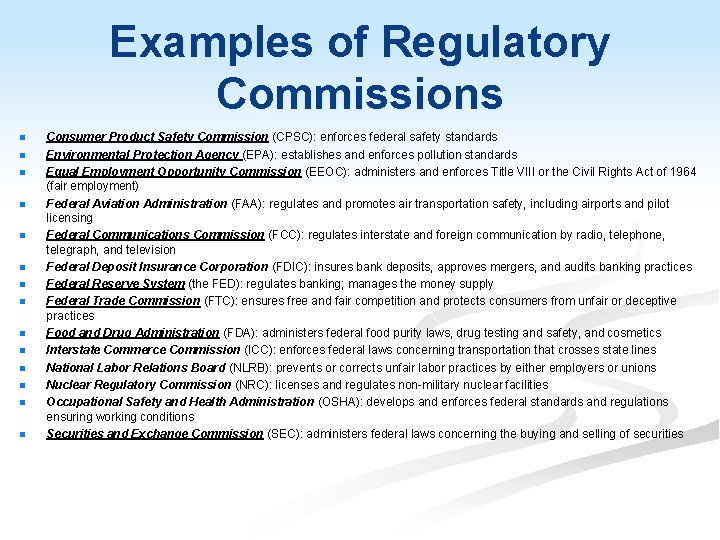
Examples of Regulatory Commissions n n n n Consumer Product Safety Commission (CPSC): enforces federal safety standards Environmental Protection Agency (EPA): establishes and enforces pollution standards Equal Employment Opportunity Commission (EEOC): administers and enforces Title VIII or the Civil Rights Act of 1964 (fair employment) Federal Aviation Administration (FAA): regulates and promotes air transportation safety, including airports and pilot licensing Federal Communications Commission (FCC): regulates interstate and foreign communication by radio, telephone, telegraph, and television Federal Deposit Insurance Corporation (FDIC): insures bank deposits, approves mergers, and audits banking practices Federal Reserve System (the FED): regulates banking; manages the money supply Federal Trade Commission (FTC): ensures free and fair competition and protects consumers from unfair or deceptive practices Food and Drug Administration (FDA): administers federal food purity laws, drug testing and safety, and cosmetics Interstate Commerce Commission (ICC): enforces federal laws concerning transportation that crosses state lines National Labor Relations Board (NLRB): prevents or corrects unfair labor practices by either employers or unions Nuclear Regulatory Commission (NRC): licenses and regulates non-military nuclear facilities Occupational Safety and Health Administration (OSHA): develops and enforces federal standards and regulations ensuring working conditions Securities and Exchange Commission (SEC): administers federal laws concerning the buying and selling of securities
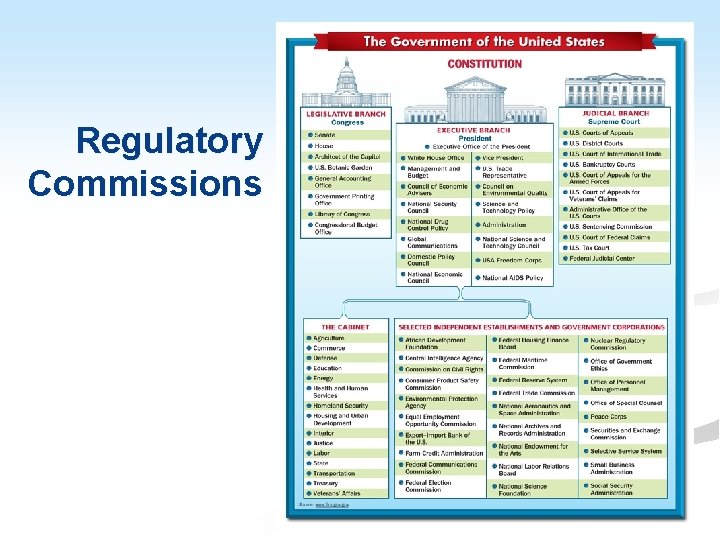
Regulatory Commissions
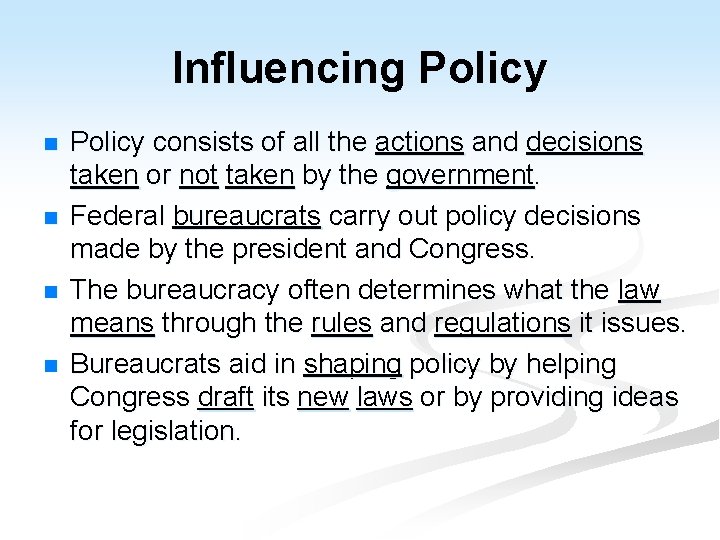
Influencing Policy n n Policy consists of all the actions and decisions taken or not taken by the government. Federal bureaucrats carry out policy decisions made by the president and Congress. The bureaucracy often determines what the law means through the rules and regulations it issues. Bureaucrats aid in shaping policy by helping Congress draft its new laws or by providing ideas for legislation.
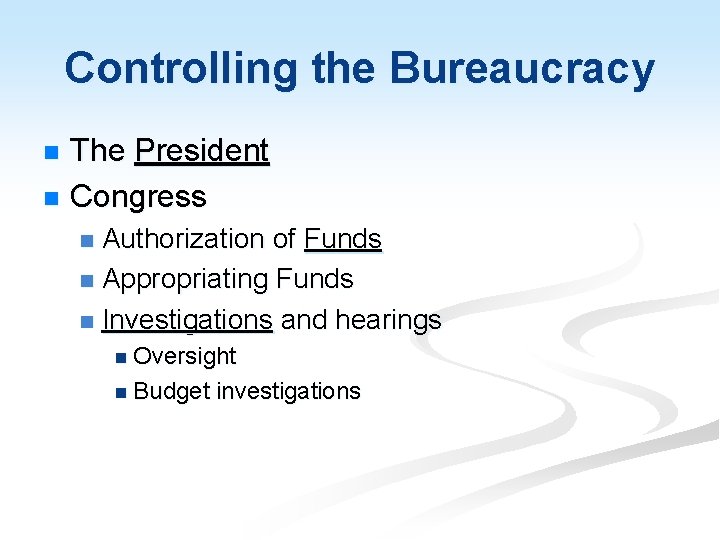
Controlling the Bureaucracy The President n Congress n Authorization of Funds n Appropriating Funds n Investigations and hearings n n Oversight n Budget investigations
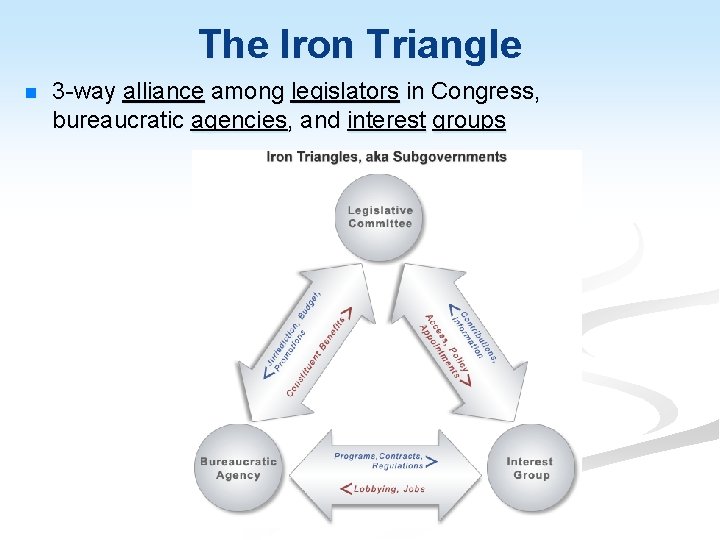
The Iron Triangle n 3 -way alliance among legislators in Congress, bureaucratic agencies, and interest groups
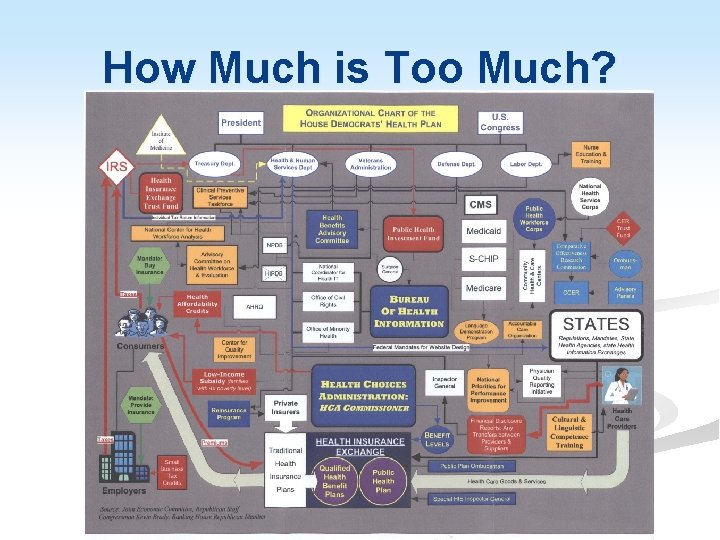
How Much is Too Much?
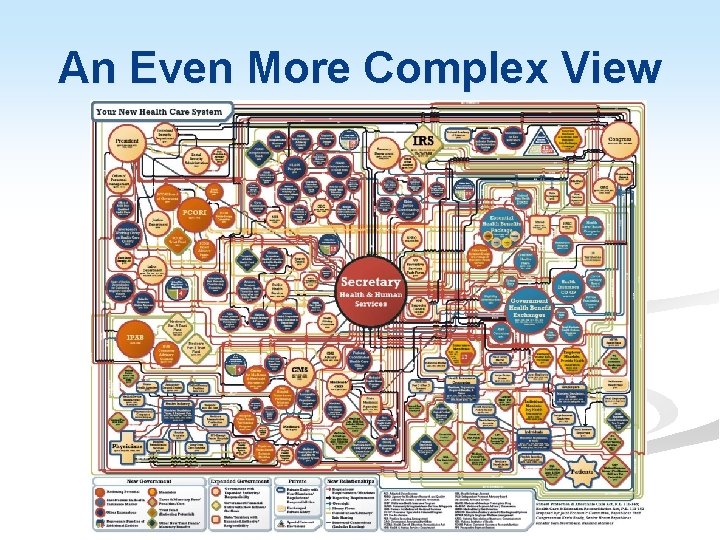
An Even More Complex View
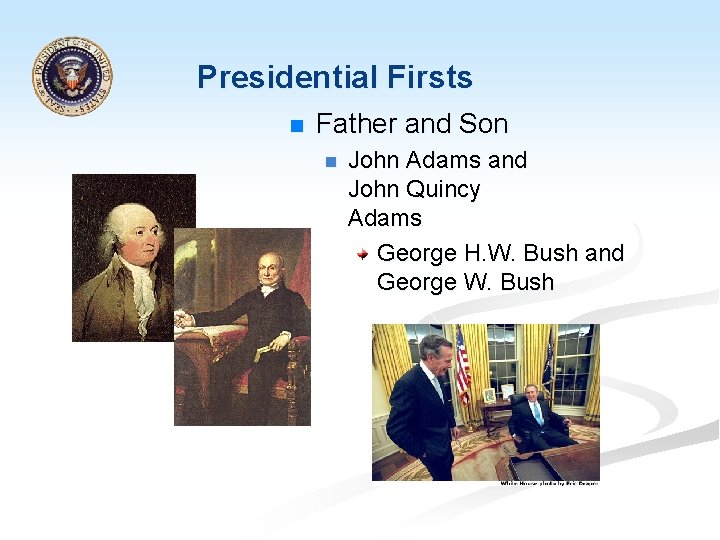
Presidential Firsts n Father and Son n John Adams and John Quincy Adams George H. W. Bush and George W. Bush
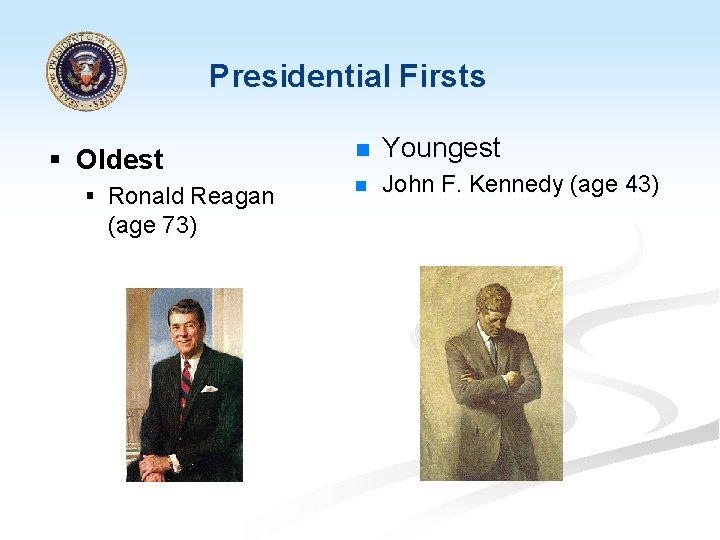
Presidential Firsts § Oldest § Ronald Reagan (age 73) n Youngest n John F. Kennedy (age 43)
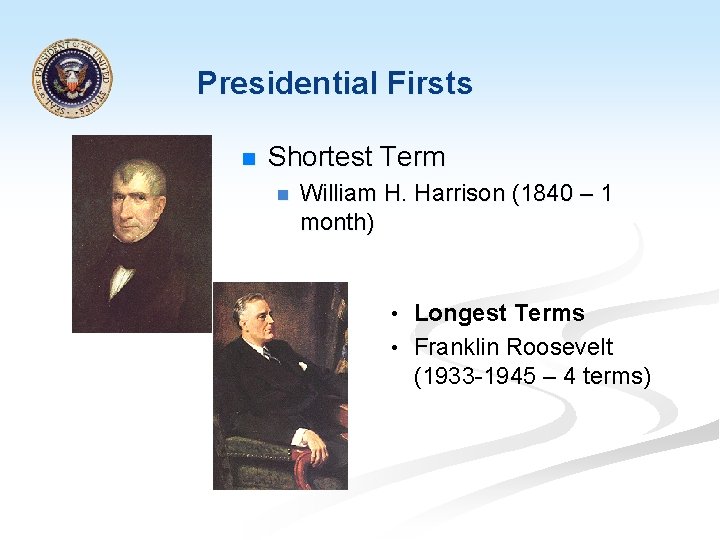
Presidential Firsts n Shortest Term n William H. Harrison (1840 – 1 month) • Longest Terms • Franklin Roosevelt (1933 -1945 – 4 terms)
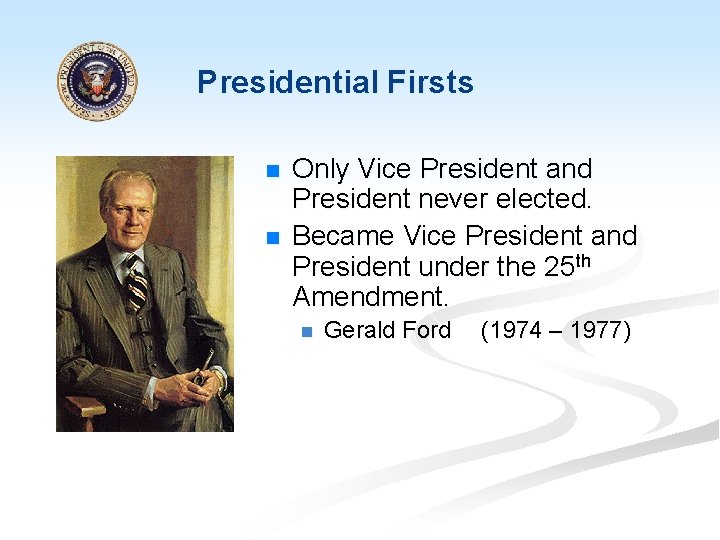
Presidential Firsts n n Only Vice President and President never elected. Became Vice President and President under the 25 th Amendment. n Gerald Ford (1974 – 1977)
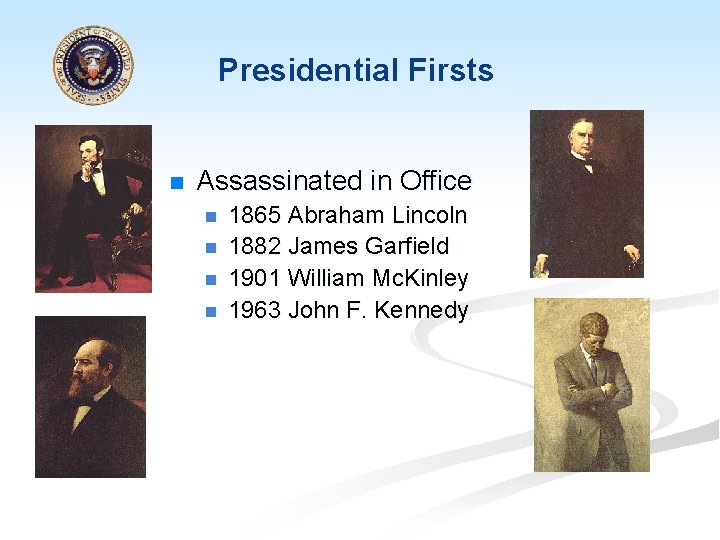
Presidential Firsts n Assassinated in Office n n 1865 Abraham Lincoln 1882 James Garfield 1901 William Mc. Kinley 1963 John F. Kennedy
Friday, May 4 th Good morning/afternoon! n As you come in, please: n Sit in your alphabetical testing seat n Pull out and stack up on the front table: n n your Unit 4 papers and turn them in with a Cover Page stapled on top n Also, turn in your Classmate Compliments n Also, signed Progress Reports
Class Updates n Important Due Dates: n Tutoring n Last two days – next Tuesday & Thursday n Unit 5 Timing – Judicial Branch n Same as this week – formative on Wednesday n Summative on Friday n Final Due Date for Make-up Work – a week from today – Friday, May 11 th
Time for a Kahoot!
Time for Test Mode n Power down all electronics & put them away n n n Put all book bags & purses at the front of the classroom Today you’ll be taking the test by bubble sheet & clicking them in on an i. Respond handheld As always, until the last paper is turned in: n n n No electronics No talking No squawking No walking No gawking!!
Unit 2 Study Guide and Review n You can use the next 45 minutes to complete your Executive Branch Review Guide n When you’re done you can complete the Executive Branch Scoot: n n Walk around the room and answer all the questions on your answer sheet Students who answer all the questions correctly get a doughnut!
Opener – Tuesday, November 15 th n As you enter, please pull out your Executive Branch papers & cover note and turn them in quickly and quietly!
Opener: Tuesday, November 15 th Pre-Test Review n Time for a Kahoot! n
Pre. Test Routine n Please power down your electronics and pack them in your bookbag/purse n Remember – the Phone Hotel is open and ready to recharge your phones! Then put your bookbag/purse at the front of the classroom n As you get your Zipgrade bubble sheet please make sure you got the correct one n
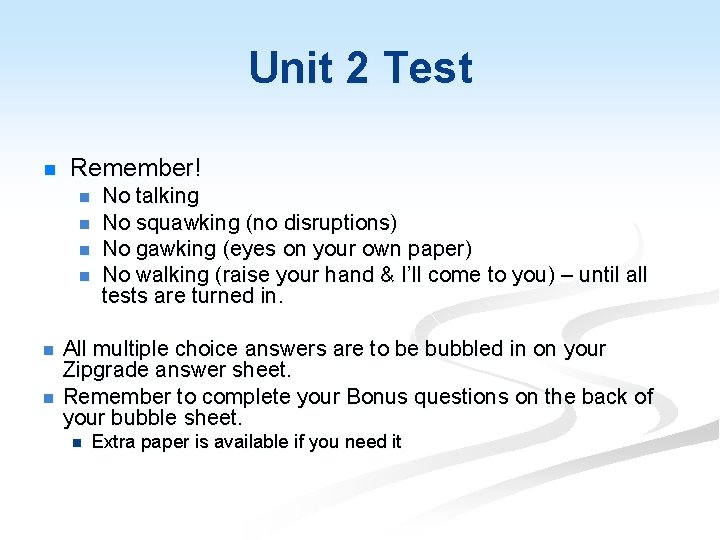
Unit 2 Test n Remember! n n n No talking No squawking (no disruptions) No gawking (eyes on your own paper) No walking (raise your hand & I’ll come to you) – until all tests are turned in. All multiple choice answers are to be bubbled in on your Zipgrade answer sheet. Remember to complete your Bonus questions on the back of your bubble sheet. n Extra paper is available if you need it
- Slides: 125