
THE EVOLUTION OF US CLANDESTINE AND LONGRANGEPATROL RADIOS
- Slides: 27
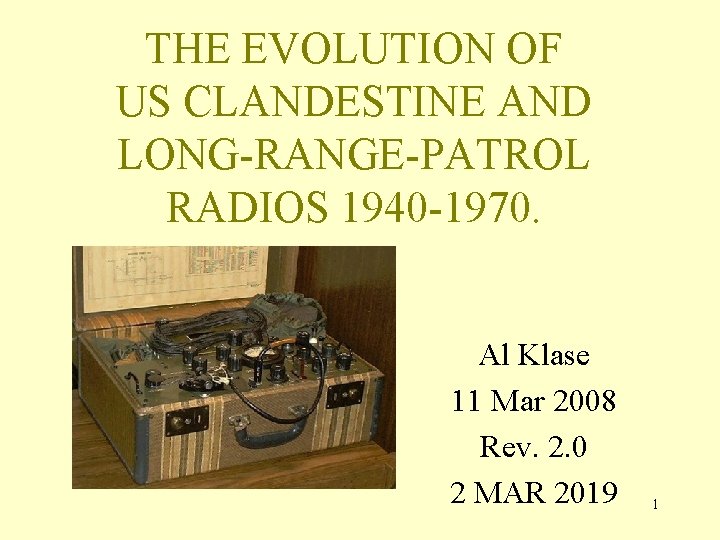
THE EVOLUTION OF US CLANDESTINE AND LONG-RANGE-PATROL RADIOS 1940 -1970. Al Klase 11 Mar 2008 Rev. 2. 0 2 MAR 2019 1
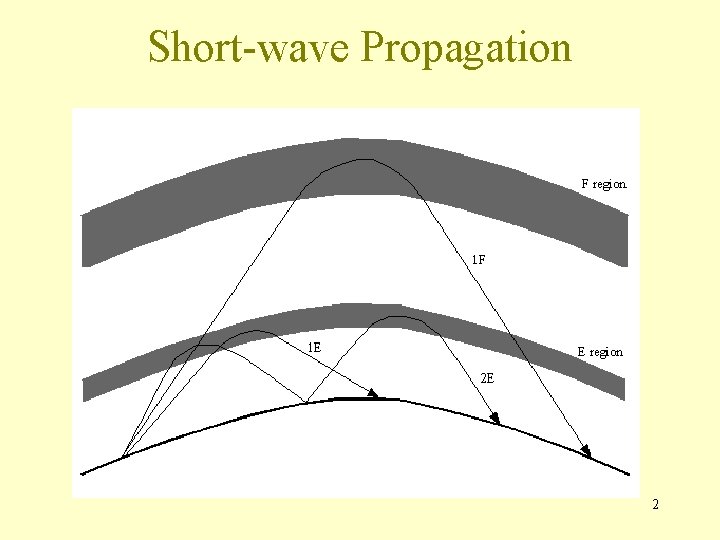
Short-wave Propagation 2
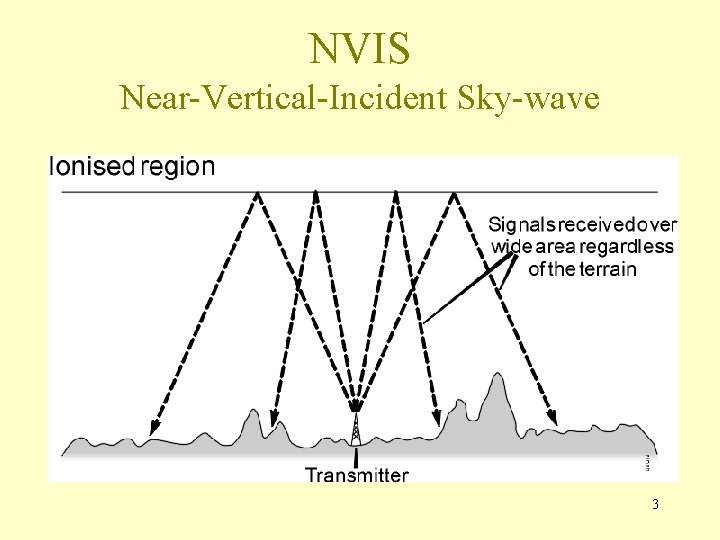
NVIS Near-Vertical-Incident Sky-wave 3
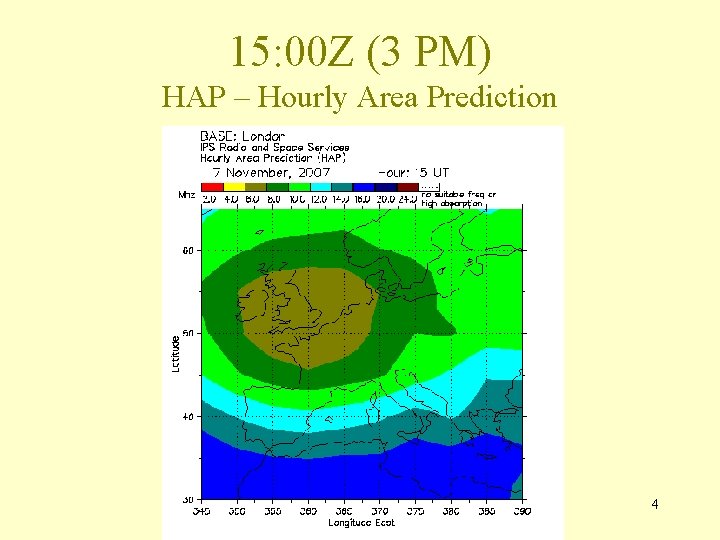
15: 00 Z (3 PM) HAP – Hourly Area Prediction 4
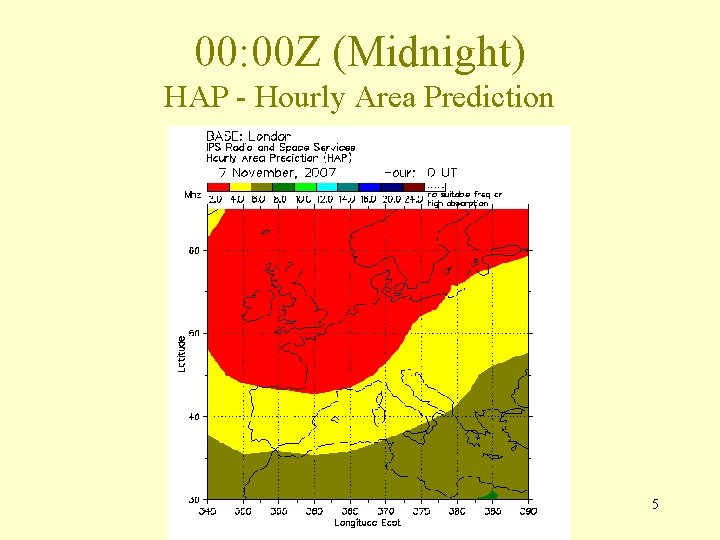
00: 00 Z (Midnight) HAP - Hourly Area Prediction 5
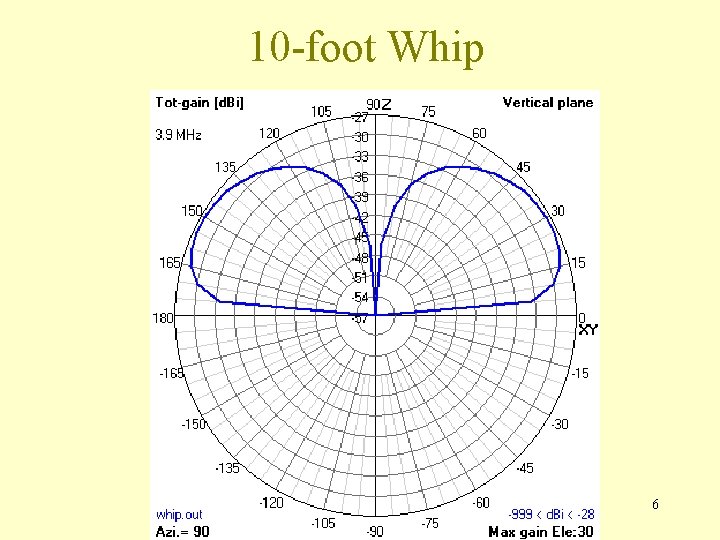
10 -foot Whip 6
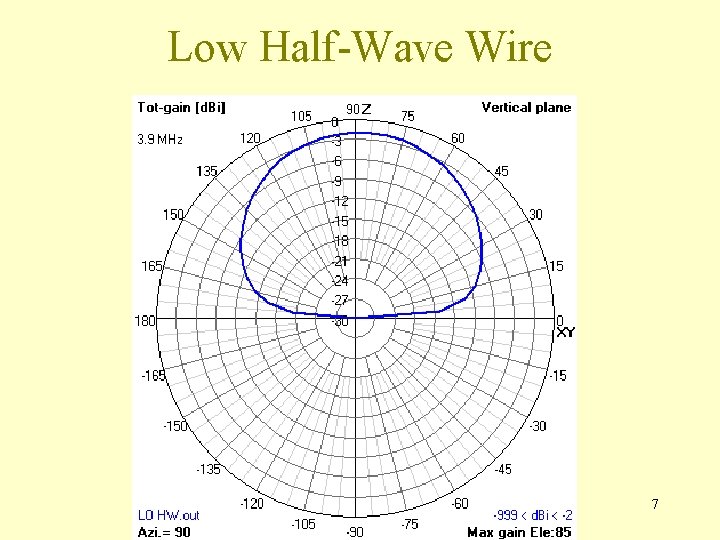
Low Half-Wave Wire 7
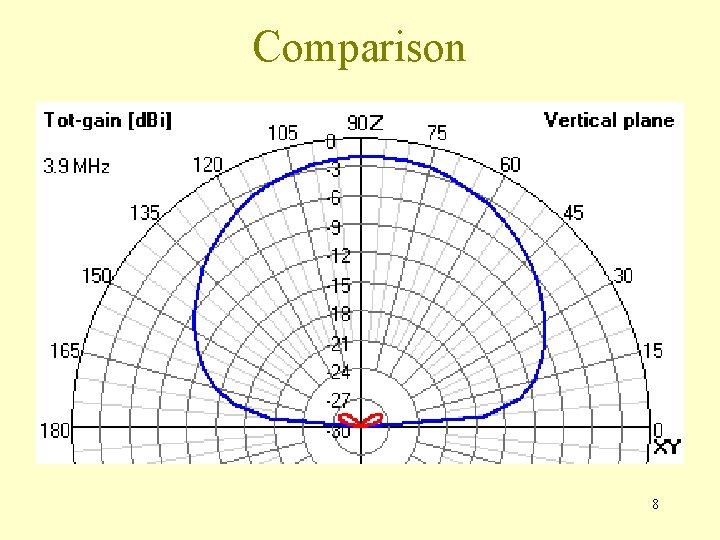
Comparison 8
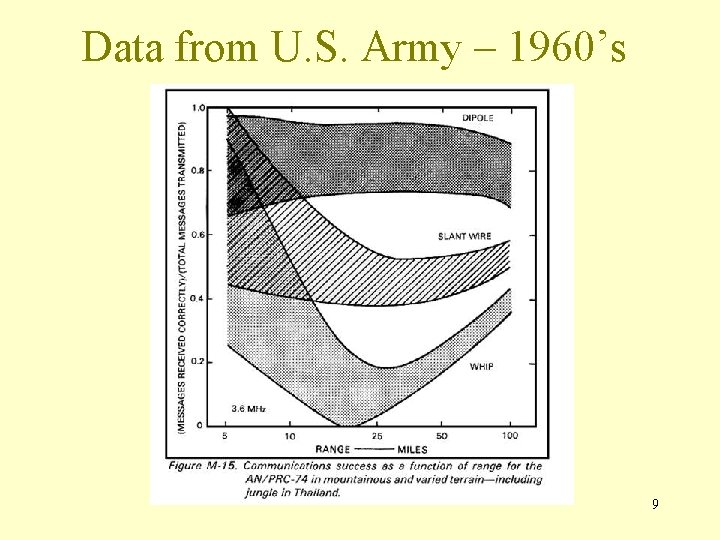
Data from U. S. Army – 1960’s 9
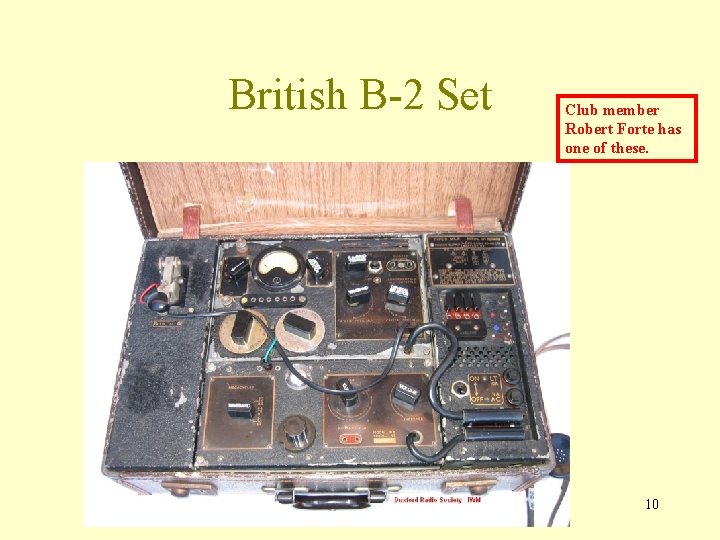
British B-2 Set Club member Robert Forte has one of these. 10
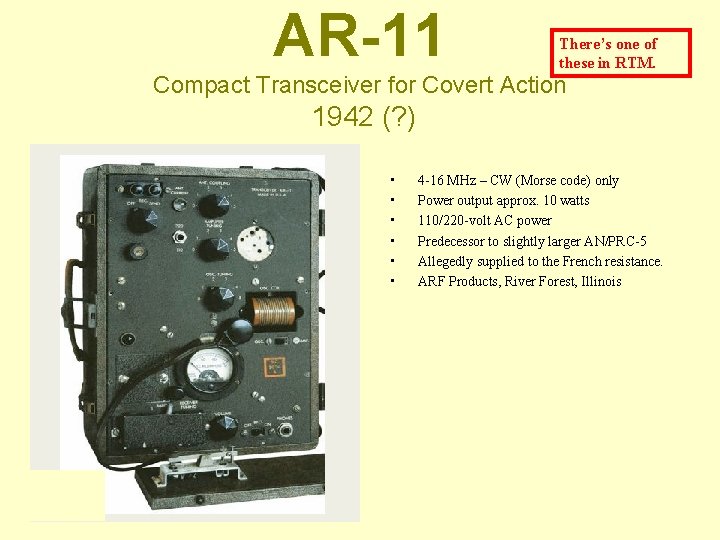
AR-11 There’s one of these in RTM. Compact Transceiver for Covert Action 1942 (? ) • • • 4 -16 MHz – CW (Morse code) only Power output approx. 10 watts 110/220 -volt AC power Predecessor to slightly larger AN/PRC-5 Allegedly supplied to the French resistance. ARF Products, River Forest, Illinois
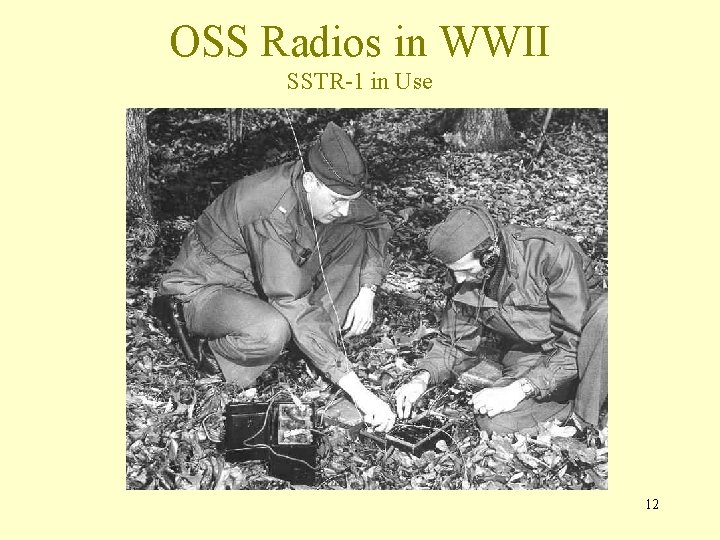
OSS Radios in WWII SSTR-1 in Use 12
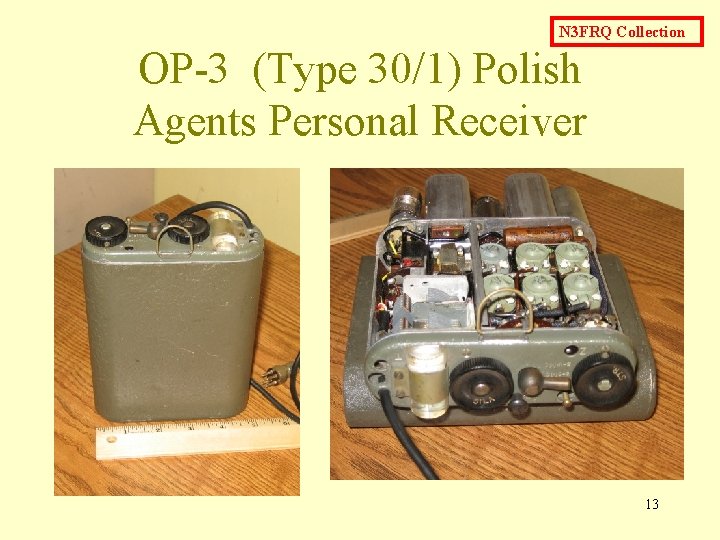
N 3 FRQ Collection OP-3 (Type 30/1) Polish Agents Personal Receiver 13
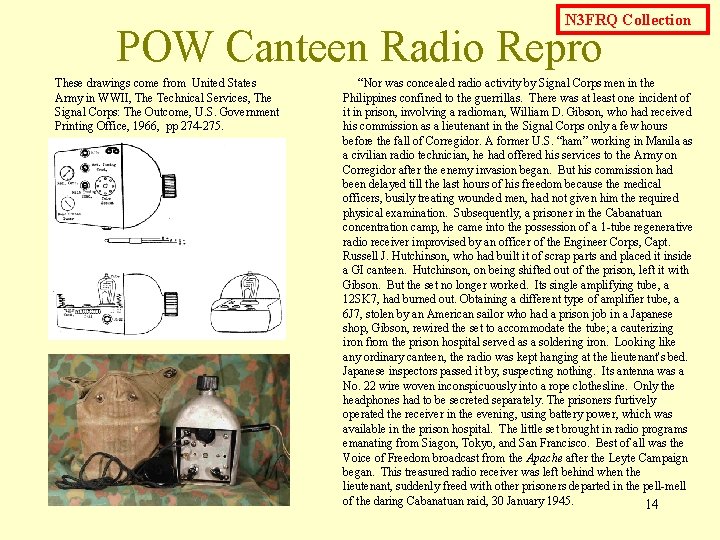
N 3 FRQ Collection POW Canteen Radio Repro These drawings come from United States Army in WWII, The Technical Services, The Signal Corps: The Outcome, U. S. Government Printing Office, 1966, pp 274 -275. “Nor was concealed radio activity by Signal Corps men in the Philippines confined to the guerrillas. There was at least one incident of it in prison, involving a radioman, William D. Gibson, who had received his commission as a lieutenant in the Signal Corps only a few hours before the fall of Corregidor. A former U. S. “ham” working in Manila as a civilian radio technician, he had offered his services to the Army on Corregidor after the enemy invasion began. But his commission had been delayed till the last hours of his freedom because the medical officers, busily treating wounded men, had not given him the required physical examination. Subsequently, a prisoner in the Cabanatuan concentration camp, he came into the possession of a 1 -tube regenerative radio receiver improvised by an officer of the Engineer Corps, Capt. Russell J. Hutchinson, who had built it of scrap parts and placed it inside a GI canteen. Hutchinson, on being shifted out of the prison, left it with Gibson. But the set no longer worked. Its single amplifying tube, a 12 SK 7, had burned out. Obtaining a different type of amplifier tube, a 6 J 7, stolen by an American sailor who had a prison job in a Japanese shop, Gibson, rewired the set to accommodate the tube; a cauterizing iron from the prison hospital served as a soldering iron. Looking like any ordinary canteen, the radio was kept hanging at the lieutenant's bed. Japanese inspectors passed it by, suspecting nothing. Its antenna was a No. 22 wire woven inconspicuously into a rope clothesline. Only the headphones had to be secreted separately. The prisoners furtively operated the receiver in the evening, using battery power, which was available in the prison hospital. The little set brought in radio programs emanating from Siagon, Tokyo, and San Francisco. Best of all was the Voice of Freedom broadcast from the Apache after the Leyte Campaign began. This treasured radio receiver was left behind when the lieutenant, suddenly freed with other prisoners departed in the pell-mell of the daring Cabanatuan raid, 30 January 1945. 14
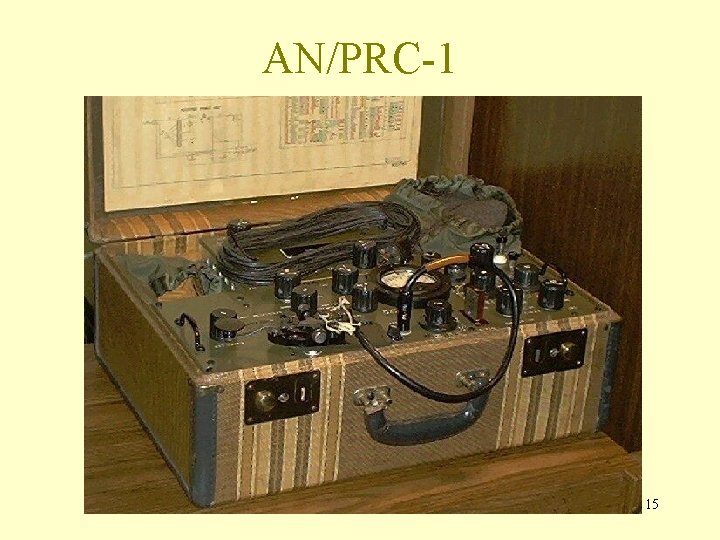
AN/PRC-1 15
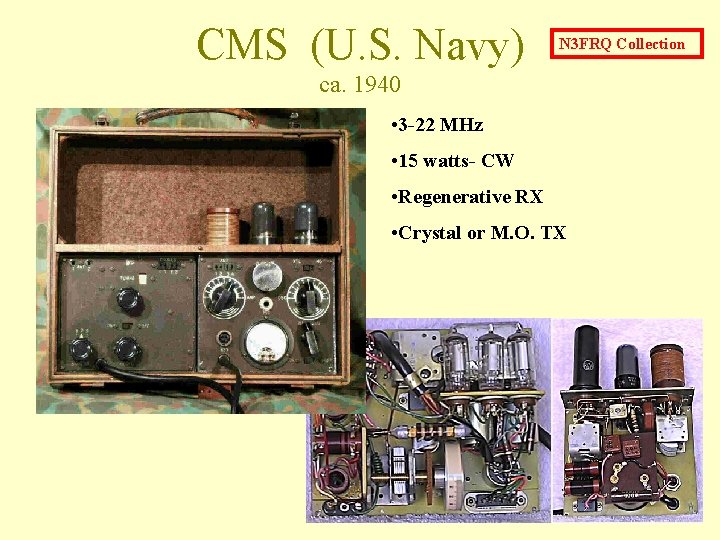
CMS (U. S. Navy) N 3 FRQ Collection ca. 1940 • 3 -22 MHz • 15 watts- CW • Regenerative RX • Crystal or M. O. TX 16
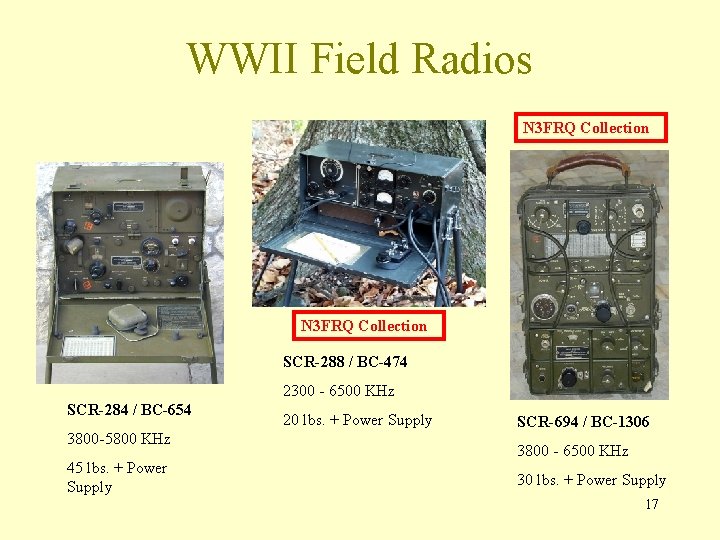
WWII Field Radios N 3 FRQ Collection SCR-288 / BC-474 2300 - 6500 KHz SCR-284 / BC-654 3800 -5800 KHz 45 lbs. + Power Supply 20 lbs. + Power Supply SCR-694 / BC-1306 3800 - 6500 KHz 30 lbs. + Power Supply 17
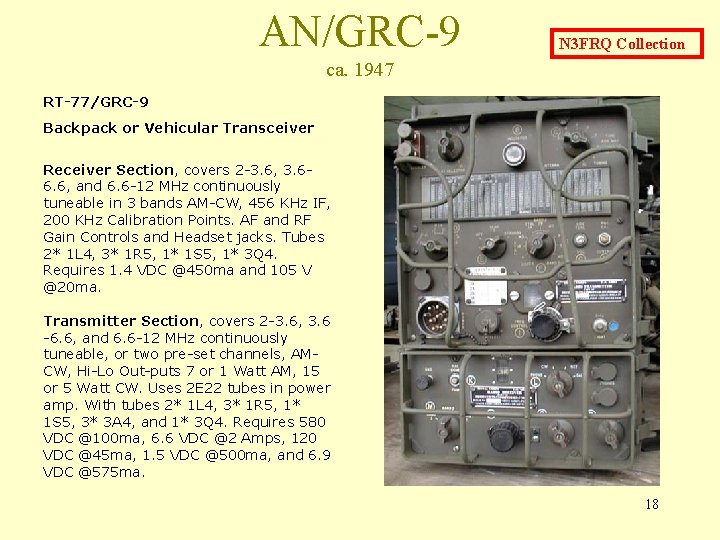
AN/GRC-9 N 3 FRQ Collection ca. 1947 RT-77/GRC-9 Backpack or Vehicular Transceiver Receiver Section, covers 2 -3. 6, 3. 66. 6, and 6. 6 -12 MHz continuously tuneable in 3 bands AM-CW, 456 KHz IF, 200 KHz Calibration Points. AF and RF Gain Controls and Headset jacks. Tubes 2* 1 L 4, 3* 1 R 5, 1* 1 S 5, 1* 3 Q 4. Requires 1. 4 VDC @450 ma and 105 V @20 ma. Transmitter Section, covers 2 -3. 6, 3. 6 -6. 6, and 6. 6 -12 MHz continuously tuneable, or two pre-set channels, AMCW, Hi-Lo Out-puts 7 or 1 Watt AM, 15 or 5 Watt CW. Uses 2 E 22 tubes in power amp. With tubes 2* 1 L 4, 3* 1 R 5, 1* 1 S 5, 3* 3 A 4, and 1* 3 Q 4. Requires 580 VDC @100 ma, 6. 6 VDC @2 Amps, 120 VDC @45 ma, 1. 5 VDC @500 ma, and 6. 9 VDC @575 ma. 18
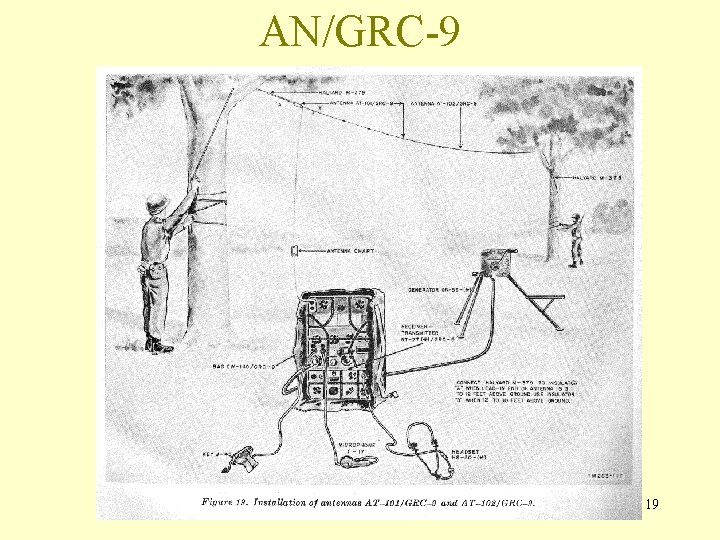
AN/GRC-9 19
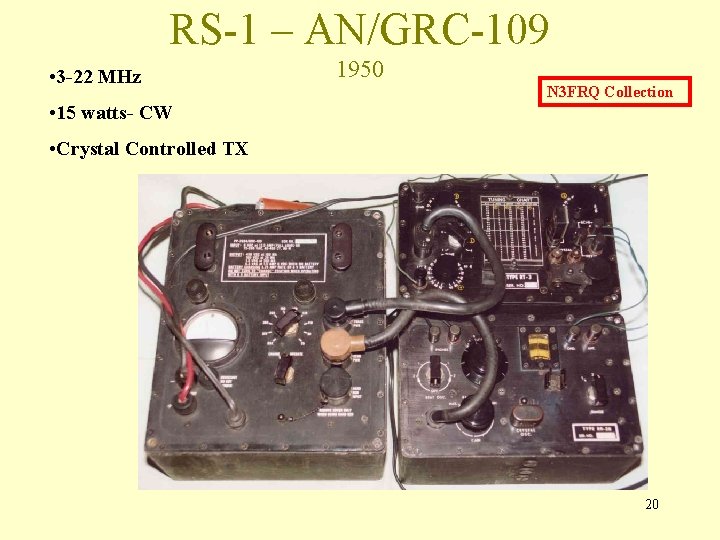
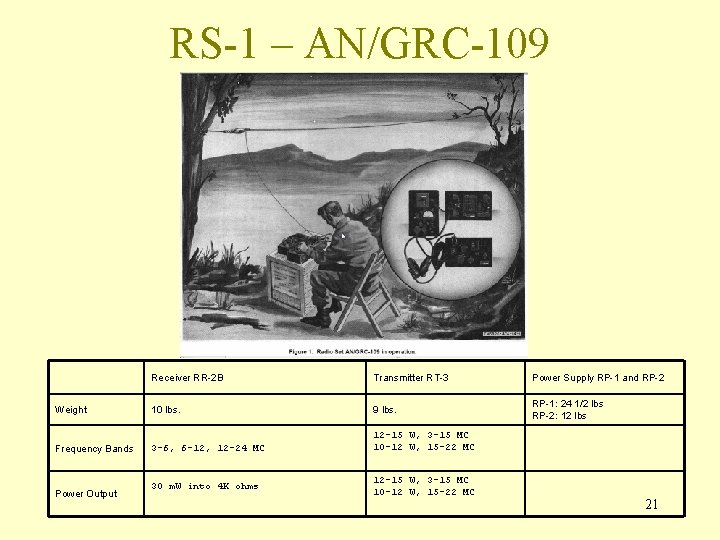
RS-1 – AN/GRC-109 • 3 -22 MHz 1950 N 3 FRQ Collection • 15 watts- CW • Crystal Controlled TX 20
RS-1 – AN/GRC-109 Receiver RR-2 B Transmitter RT-3 Power Supply RP-1 and RP-2 Weight 10 lbs. 9 lbs. RP-1: 24 1/2 lbs RP-2: 12 lbs Frequency Bands 3 -6, 6 -12, 12 -24 MC 12 -15 W, 3 -15 MC 10 -12 W, 15 -22 MC Power Output 30 m. W into 4 K ohms 12 -15 W, 3 -15 MC 10 -12 W, 15 -22 MC 21
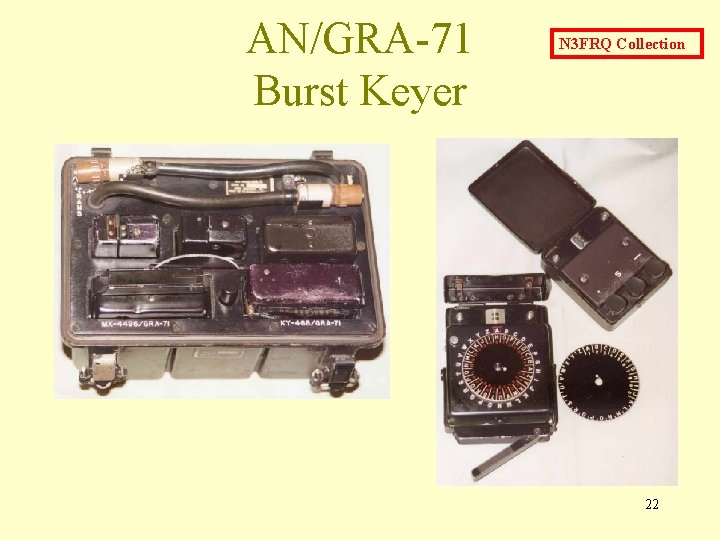
AN/GRA-71 Burst Keyer N 3 FRQ Collection 22
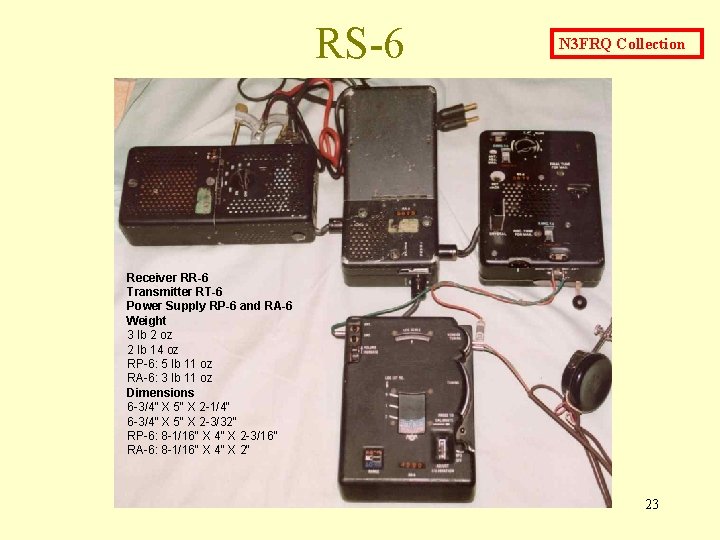
RS-6 N 3 FRQ Collection Receiver RR-6 Transmitter RT-6 Power Supply RP-6 and RA-6 Weight 3 lb 2 oz 2 lb 14 oz RP-6: 5 lb 11 oz RA-6: 3 lb 11 oz Dimensions 6 -3/4" X 5" X 2 -1/4" 6 -3/4" X 5" X 2 -3/32" RP-6: 8 -1/16" X 4" X 2 -3/16" RA-6: 8 -1/16" X 4" X 2" 23
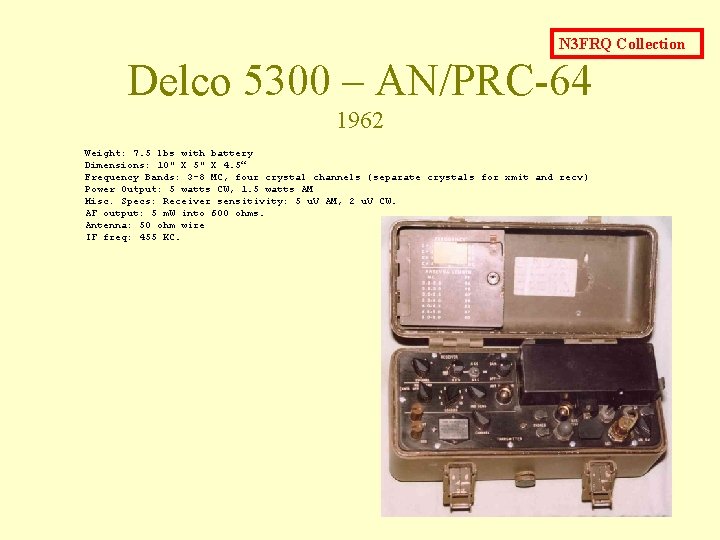
N 3 FRQ Collection Delco 5300 – AN/PRC-64 1962 Weight: 7. 5 lbs with battery Dimensions: 10" X 5" X 4. 5“ Frequency Bands: 3 -8 MC, four crystal channels (separate crystals for xmit and recv) Power Output: 5 watts CW, 1. 5 watts AM Misc. Specs: Receiver sensitivity: 5 u. V AM, 2 u. V CW. AF output: 5 m. W into 600 ohms. Antenna: 50 ohm wire IF freq: 455 KC. 24
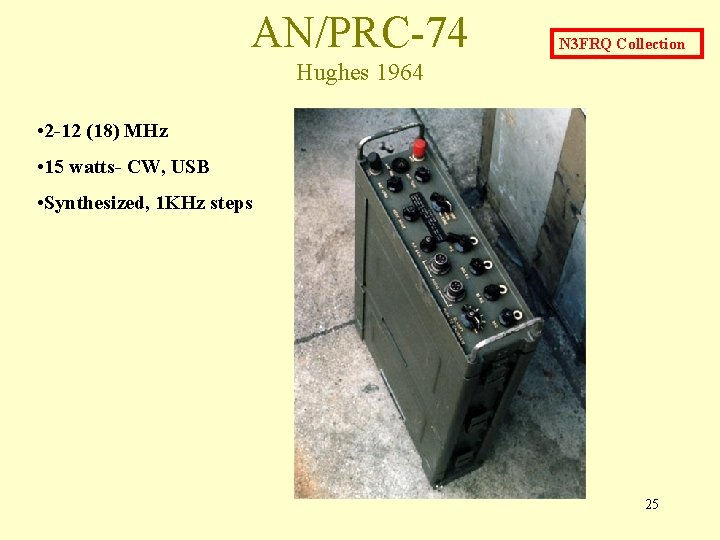
AN/PRC-74 N 3 FRQ Collection Hughes 1964 • 2 -12 (18) MHz • 15 watts- CW, USB • Synthesized, 1 KHz steps 25
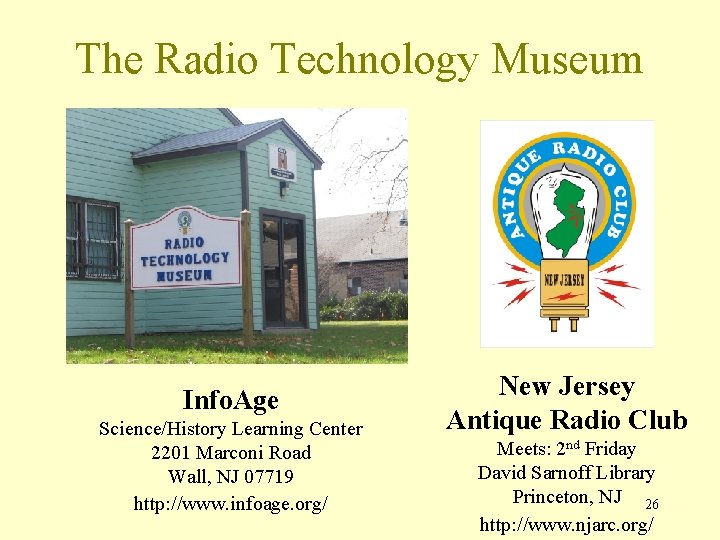
The Radio Technology Museum Info. Age Science/History Learning Center 2201 Marconi Road Wall, NJ 07719 http: //www. infoage. org/ New Jersey Antique Radio Club Meets: 2 nd Friday David Sarnoff Library Princeton, NJ 26 http: //www. njarc. org/
Military Radio Collectors Association The Old Military Radio Net Saturdays - 05: 00 Eastern 3885 Khz AM Sundays – 21: 00 Eastern 3570 KHz CW http: //www. mrca. ar 88. net/ 27