
The Evolution of the PBL COMET Planetary Boundary
The Evolution of the PBL COMET Planetary Boundary Layer Symposium Matt Haugland

Introduction Stages of PBL Evolution • Understand 4 stages of PBL evolution: morning, daytime, sunset, nighttime Diurnal Cycle at the Surface • How the evolution of the PBL impacts conditions at the surface Applications • Discuss examples of impact of PBL evolution on near-surface conditions

Morning Stage • Driven by solar heating of the surface • Convection mixes out nocturnal boundary layer Free Atmos. Potential Temperature Profile PBL
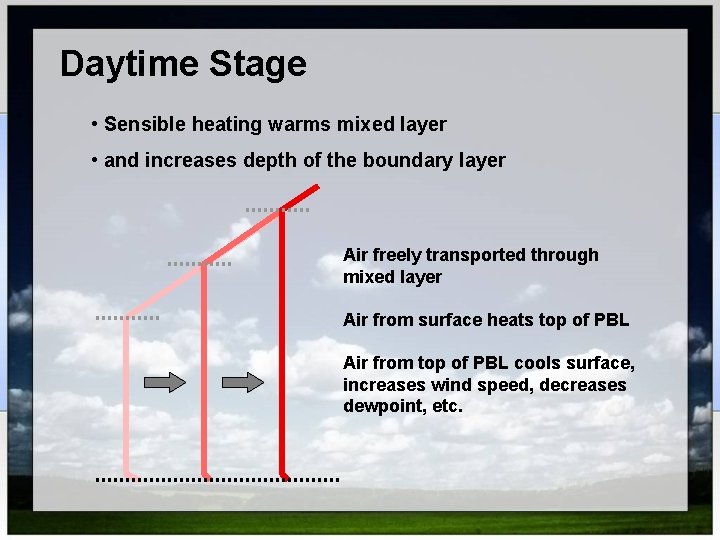
Daytime Stage • Sensible heating warms mixed layer • and increases depth of the boundary layer Air freely transported through mixed layer Air from surface heats top of PBL Air from top of PBL cools surface, increases wind speed, decreases dewpoint, etc.
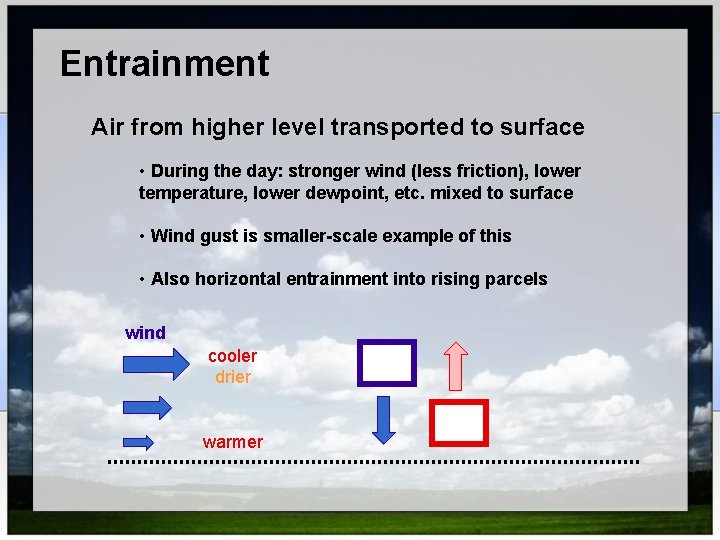
Entrainment Air from higher level transported to surface • During the day: stronger wind (less friction), lower temperature, lower dewpoint, etc. mixed to surface • Wind gust is smaller-scale example of this • Also horizontal entrainment into rising parcels wind cooler drier warmer
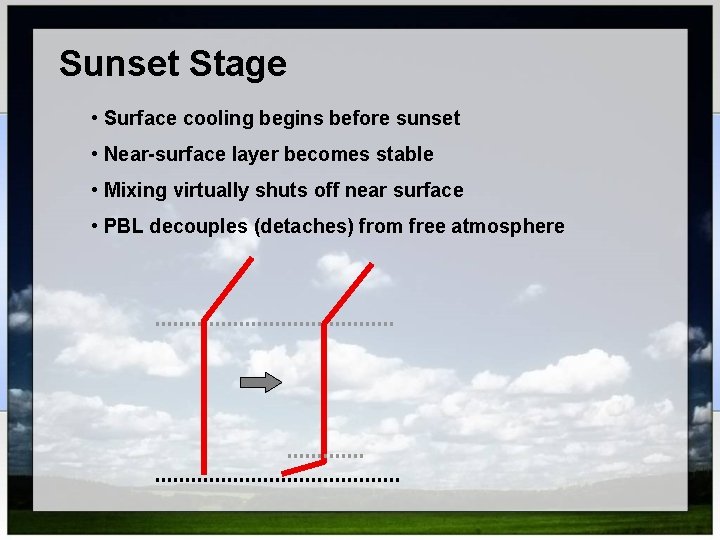
Sunset Stage • Surface cooling begins before sunset • Near-surface layer becomes stable • Mixing virtually shuts off near surface • PBL decouples (detaches) from free atmosphere
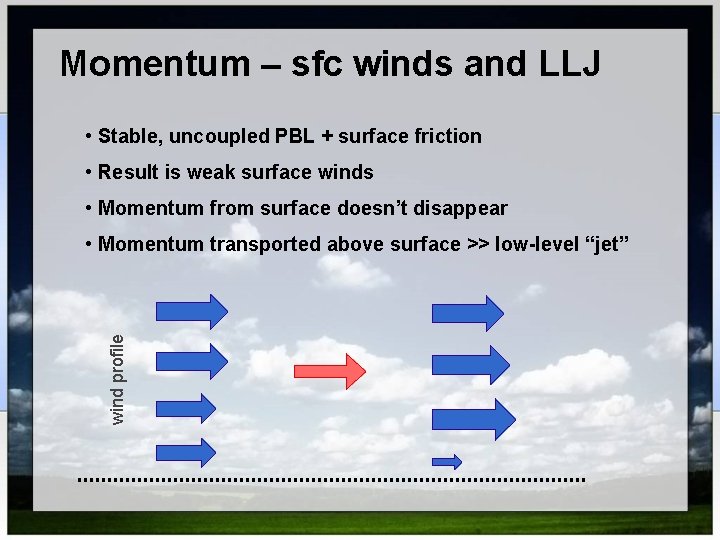
Momentum – sfc winds and LLJ • Stable, uncoupled PBL + surface friction • Result is weak surface winds • Momentum from surface doesn’t disappear wind profile • Momentum transported above surface >> low-level “jet”
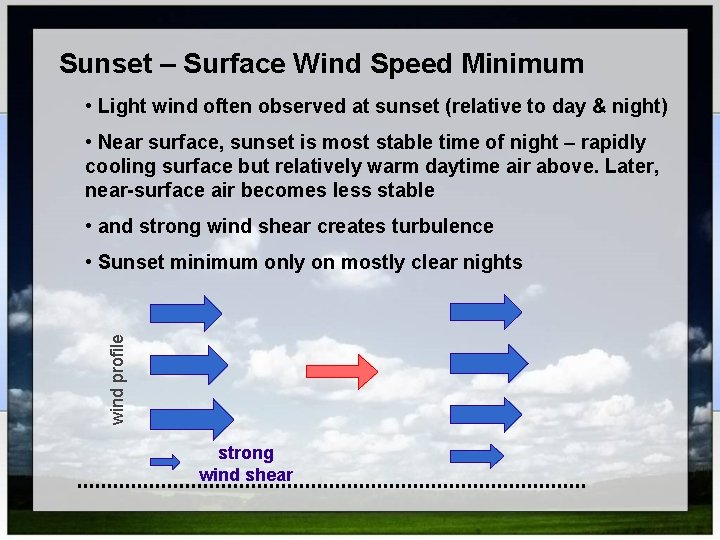
Sunset – Surface Wind Speed Minimum • Light wind often observed at sunset (relative to day & night) • Near surface, sunset is most stable time of night – rapidly cooling surface but relatively warm daytime air above. Later, near-surface air becomes less stable • and strong wind shear creates turbulence wind profile • Sunset minimum only on mostly clear nights strong wind shear
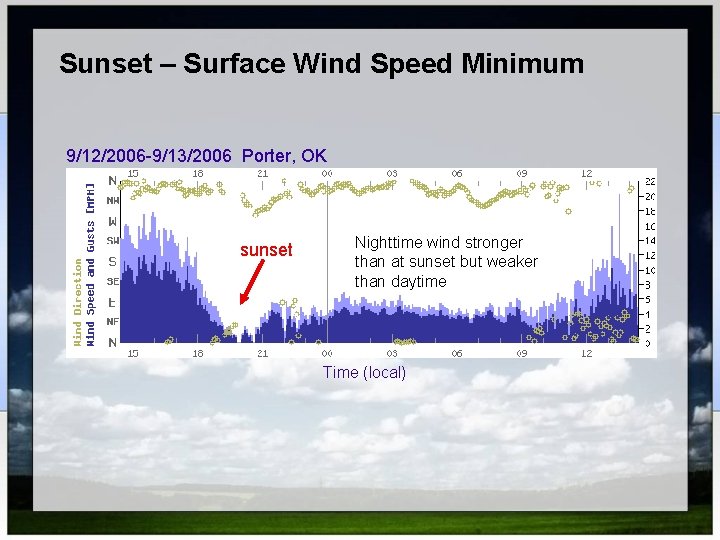
Sunset – Surface Wind Speed Minimum 9/12/2006 -9/13/2006 Porter, OK sunset Nighttime wind stronger than at sunset but weaker than daytime Time (local)
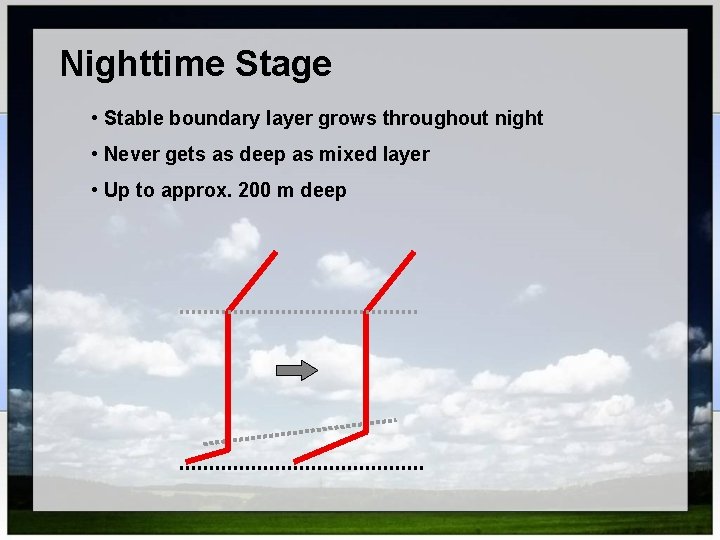
Nighttime Stage • Stable boundary layer grows throughout night • Never gets as deep as mixed layer • Up to approx. 200 m deep
The Diurnal Cycle at the Surface • The sun “powers” the surface energy budget and PBL evolution • A diurnal cycle (or lack thereof) for any parameter indicates importance of land surface • When Rnet is near zero, fluxes (and thus, local variations) are minimal
The Diurnal Cycle at the Surface How evolution of the PBL impacts various parameters measured near the surface Examples from around the country
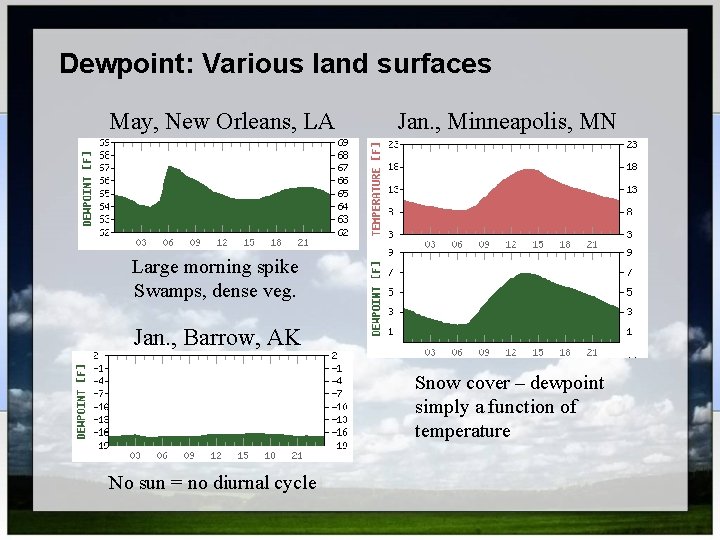
Dewpoint: Various land surfaces May, New Orleans, LA Jan. , Minneapolis, MN Large morning spike Swamps, dense veg. Jan. , Barrow, AK Snow cover – dewpoint simply a function of temperature No sun = no diurnal cycle
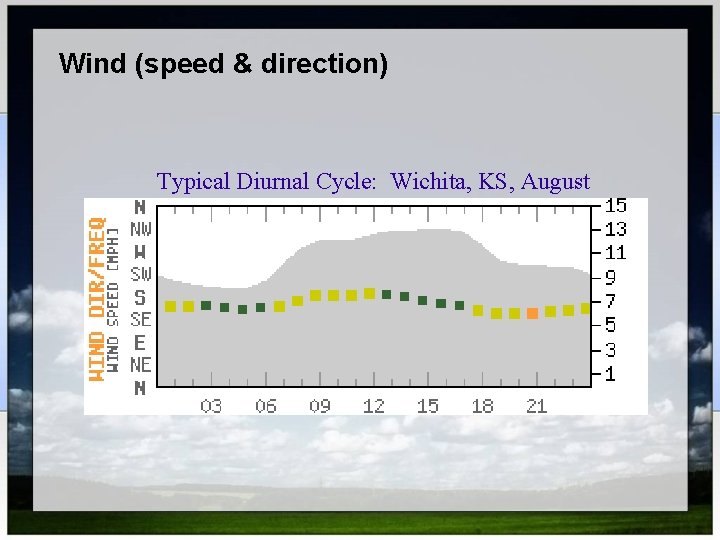
Wind (speed & direction) Typical Diurnal Cycle: Wichita, KS, August
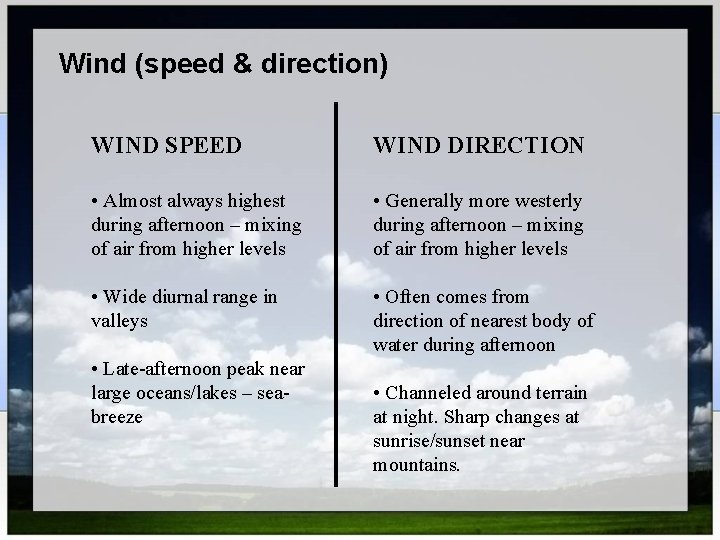
Wind (speed & direction) WIND SPEED WIND DIRECTION • Almost always highest during afternoon – mixing of air from higher levels • Generally more westerly during afternoon – mixing of air from higher levels • Wide diurnal range in valleys • Often comes from direction of nearest body of water during afternoon • Late-afternoon peak near large oceans/lakes – seabreeze • Channeled around terrain at night. Sharp changes at sunrise/sunset near mountains.
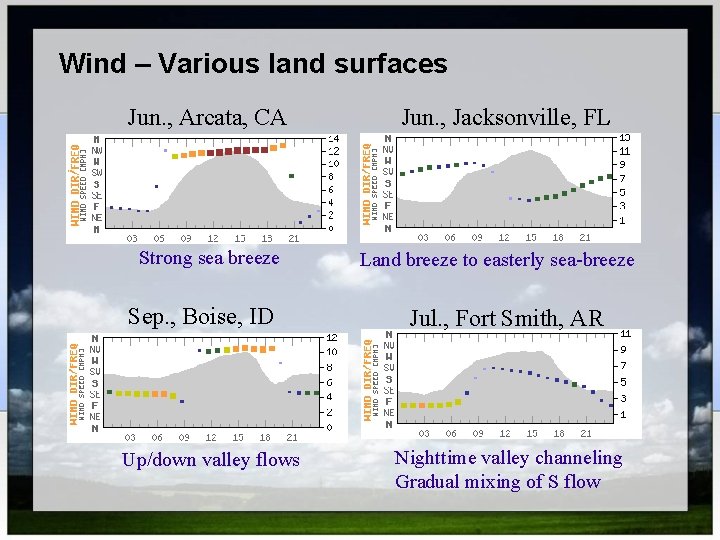
Wind – Various land surfaces Jun. , Arcata, CA Strong sea breeze Sep. , Boise, ID Up/down valley flows Jun. , Jacksonville, FL Land breeze to easterly sea-breeze Jul. , Fort Smith, AR Nighttime valley channeling Gradual mixing of S flow
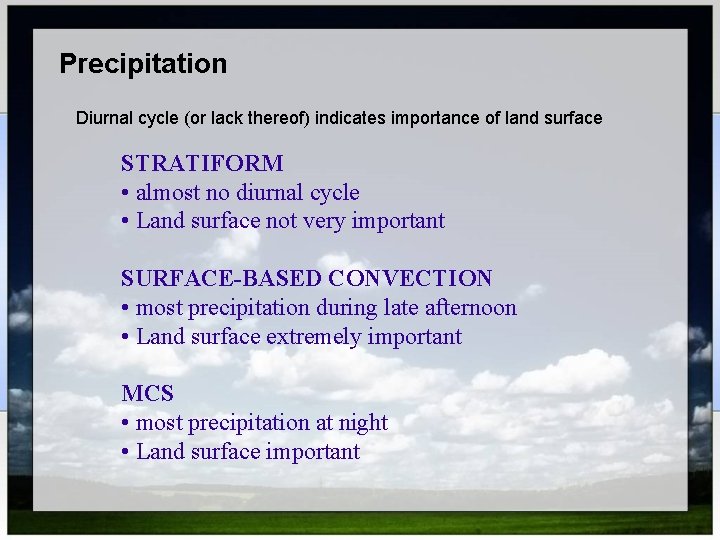
Precipitation Diurnal cycle (or lack thereof) indicates importance of land surface STRATIFORM • almost no diurnal cycle • Land surface not very important SURFACE-BASED CONVECTION • most precipitation during late afternoon • Land surface extremely important MCS • most precipitation at night • Land surface important
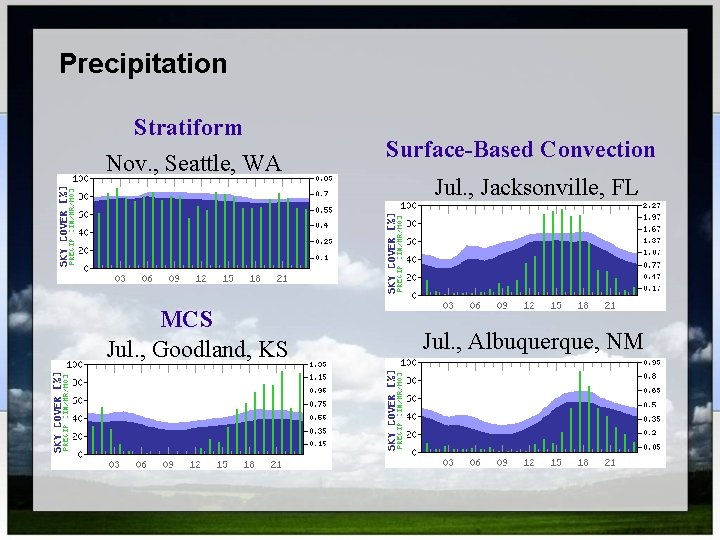
Precipitation Stratiform Nov. , Seattle, WA MCS Jul. , Goodland, KS Surface-Based Convection Jul. , Jacksonville, FL Jul. , Albuquerque, NM
Discuss What do the following diurnal cycles tell you about the land surface… Think about: • terrain • vegetation • bodies of water • regional climate
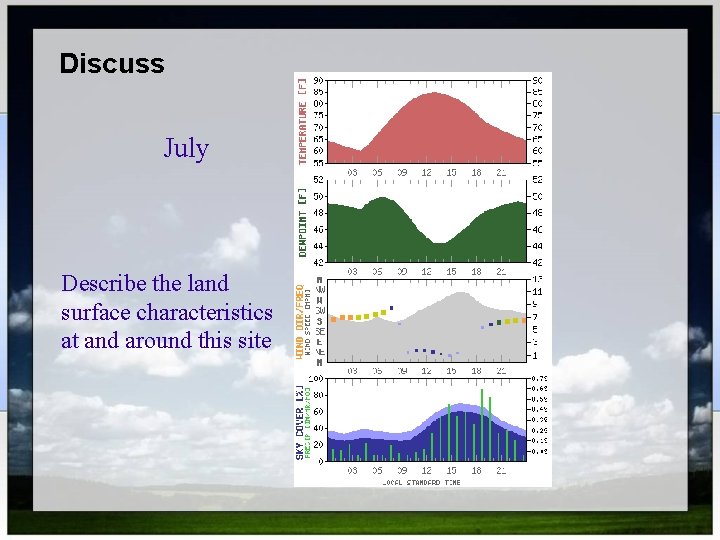
Discuss July Describe the land surface characteristics at and around this site
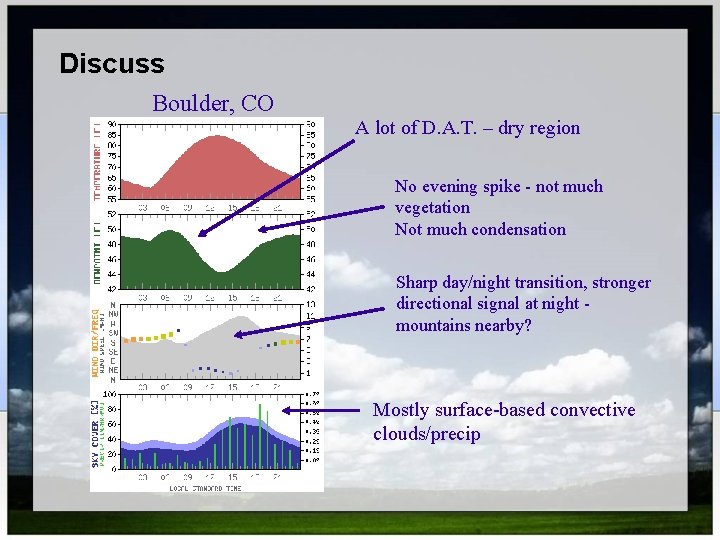
Discuss Boulder, CO A lot of D. A. T. – dry region No evening spike - not much vegetation Not much condensation Sharp day/night transition, stronger directional signal at night mountains nearby? Mostly surface-based convective clouds/precip
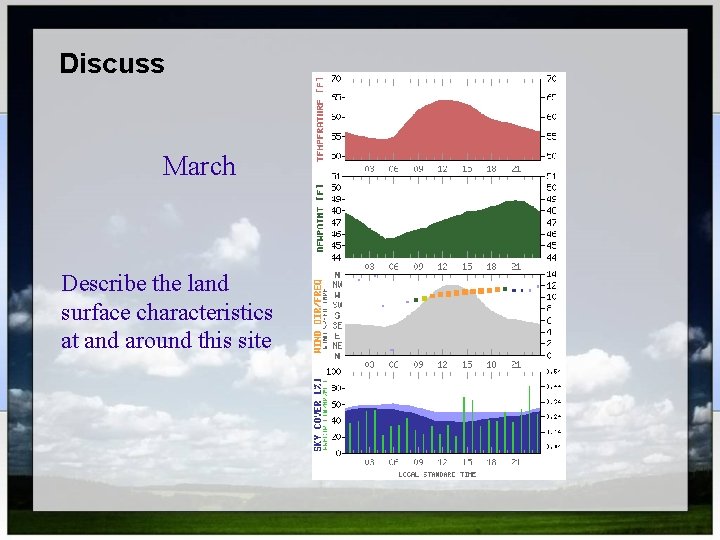
Discuss March Describe the land surface characteristics at and around this site
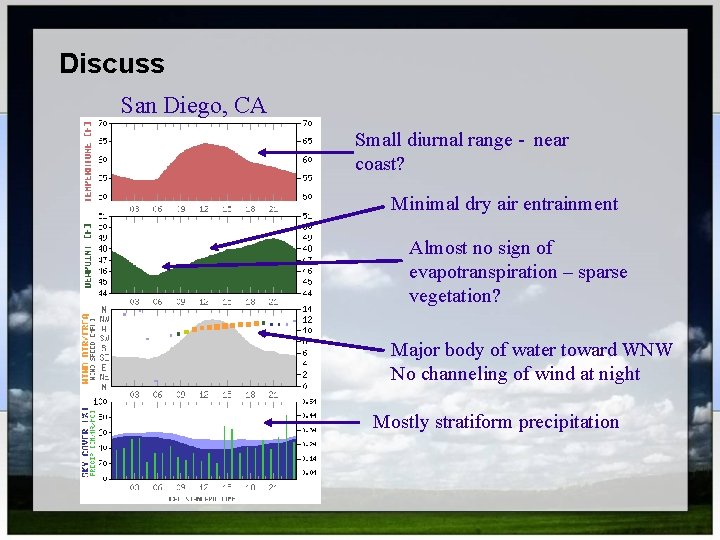
Discuss San Diego, CA Small diurnal range - near coast? Minimal dry air entrainment Almost no sign of evapotranspiration – sparse vegetation? Major body of water toward WNW No channeling of wind at night Mostly stratiform precipitation
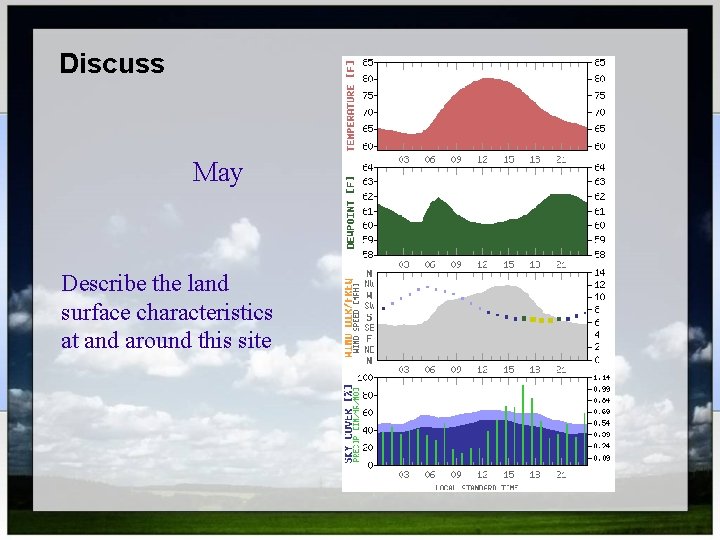
Discuss May Describe the land surface characteristics at and around this site
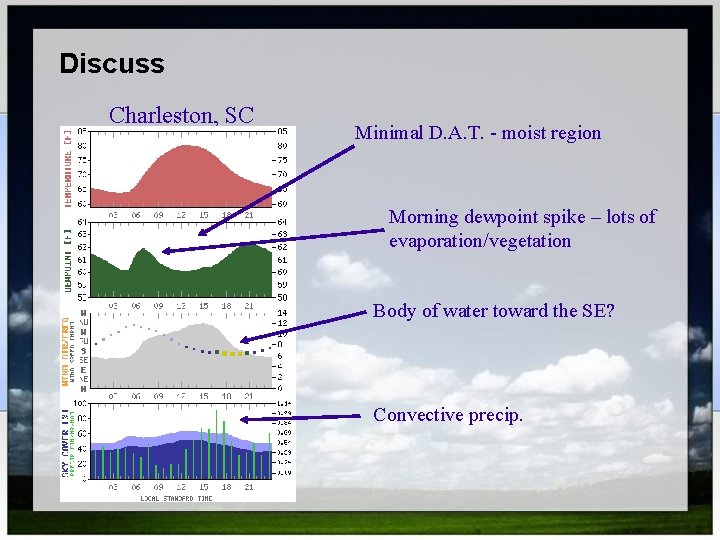
Discuss Charleston, SC Minimal D. A. T. - moist region Morning dewpoint spike – lots of evaporation/vegetation Body of water toward the SE? Convective precip.

Questions?
- Slides: 26