
The Evolution of the Intel 80 x 86

- Slides: 11
The Evolution of the Intel 80 x 86 Architecture Chad Derrenbacker Chris Garvey Manpreet Hundal Tom Opfer CS 350 December 9, 1998
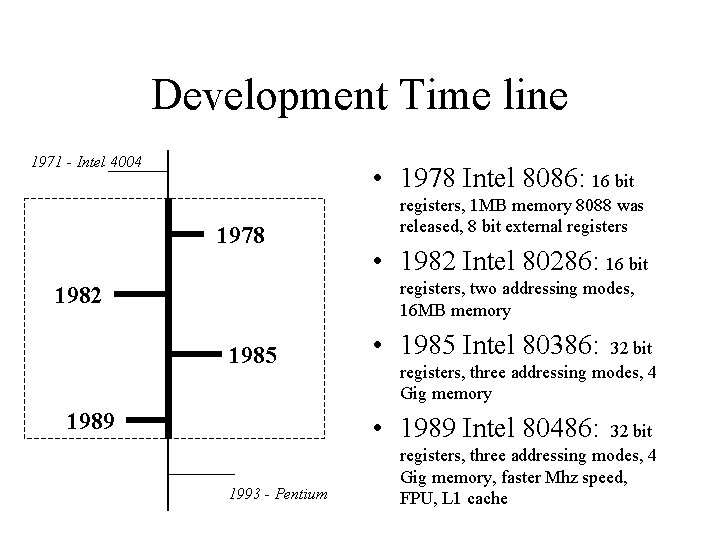
Development Time line 1971 - Intel 4004 • 1978 Intel 8086: 16 bit 1978 registers, 1 MB memory 8088 was released, 8 bit external registers • 1982 Intel 80286: 16 bit registers, two addressing modes, 16 MB memory 1982 1985 1989 • 1985 Intel 80386: 32 bit registers, three addressing modes, 4 Gig memory • 1989 Intel 80486: 1993 - Pentium 32 bit registers, three addressing modes, 4 Gig memory, faster Mhz speed, FPU, L 1 cache
Instruction Set • Data movement instructions – PUSH (push word onto stack), MOV (move byte or word) • Conversions – CBW (convert byte to word), CDQ (convert double to quad) • Arithmetic instructions – ADC (add with Carry), INC (Increment) • Logical, shift, and rotate instructions – XOR (Exclusive OR), ROL (Rotate Left) • String instructions – STOS (store string), LODS (load string) • Program flow and control – CALL (program call), JMP (unconditional jump)
Register Architecture • Register sizes progressed from 16 bit on the 8086 and 286 to 32 bit on the 386 and 486. • General Registers – Accumulator, Base, Counter, Data • Segmented Registers – Code, Data, Stack, Extra • Special Purpose Registers – Stack, Base, Stack, Destination – Instruction, Flag
Addressing Modes • 8086 – only operated in Real Mode • 80286 – Introduced Protected mode: allowed memory to be segmented and protected from conflicts. – Problem was that it couldn’t switch back to Real • 80386, 486 – Virtual Mode: allowed chip to emulate multiple 8086 chips – able to address memory in large chunks
Performance Factors • Few improvement from 8086 - 80286 • 80386 – introduction of cache memory • 80486 – integration of 386 match coprocessor into 486 core logic – introduction of 486 DX 2 and DX 4 (doubled and tripled core clock frequency)
Memory • 8086 – memory segmentation • (total address space 1 MB, 64 K at a time) • 80286 – 16 MB Physical memory, 1 GB Virtual memory • 80386 – 4 GB Physical memory, 64 TB Virtual memory • 80486 – same as 80386
Speed • 8086 – 4. 77 (0. 33 MIPS), 8 (0. 66 MIPS), 10 (0. 75 MIPS) MHz • 80286 – 6 (0. 9 MIPS), 10 (1. 5 MIPS), 12 (2. 66 MIPS) MHz • 80386 – DX 16, 20, 25 (8. 5 MIPS), 33 MHz – SX 16, 20 (2. 5 MIPS), 33 (2. 9 MIPS) MHz • 80486 – DX 25 (20 MIPS), 33, 50 (41 MIPS) MHz – DX 2 66 (54 MIPS) MHz – DX 4 100 MHz - clock tripling – able to execute most instructions in a single cycle with the incorporation of RISC like principles.
Role in the Marketplace • 6 generations, most successful microprocessor in history • Intel was in the right place at the right time when IBM made their decision to use the 8086 in the first desktop computer, the Datamaster • IBM’s own engineers wanted to use the Motorola 68000, but they already had the rights to manufacture the 8086 • 1984 - PC AT, a 6 MHz 80286 computer using PC -DOS, a 5. 25 -inch 1. 2 MB floppy drive, with 256 KB RAM for $4000.
Role in the Marketplace • Cloning of the IBM-PC – 1986 Compaq introduced the first 80386 16 MHz clone. – Turning point that enabled today’s modern computer industry. • Today the x 86 market is a multi-billion dollar industry selling millions of units per year. • Intel’s Key Factors in Success: – Double the speed of the latest microprocessor every 18 months – expand into other markets such as notebooks – keep new processors upwardly compatible
Questions?