
The Evolution of the Data Center Albert Puig
The Evolution of the Data Center Albert Puig Artola apuig@aristanetworks. com 1
Arista Networks – Corporate Overview Software Designed Cloud Networking Founded in 2004 > 2000 clients of all sizes > 600 employees Profitable, self-financed, pre-IPO A generation ahead in software architecture Jayshree Ullal Andy Bechtolsheim President & CEO Chairman & CDO 2
Data Center Transport 3
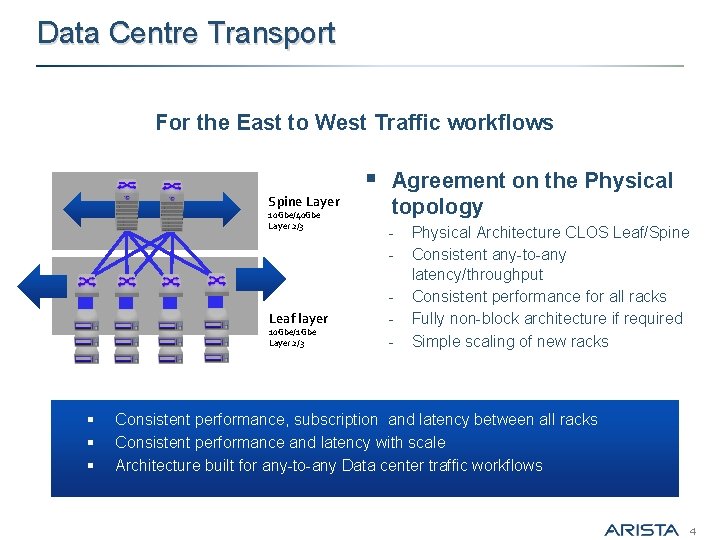
Data Centre Transport For the East to West Traffic workflows Spine Layer 10 Gbe/40 Gbe Layer 2/3 Leaf layer 10 Gbe/1 Gbe Layer 2/3 § § Agreement on the Physical topology - Physical Architecture CLOS Leaf/Spine Consistent any-to-any latency/throughput Consistent performance for all racks Fully non-block architecture if required Simple scaling of new racks Consistent performance, subscription and latency between all racks Consistent performance and latency with scale Architecture built for any-to-any Data center traffic workflows 4
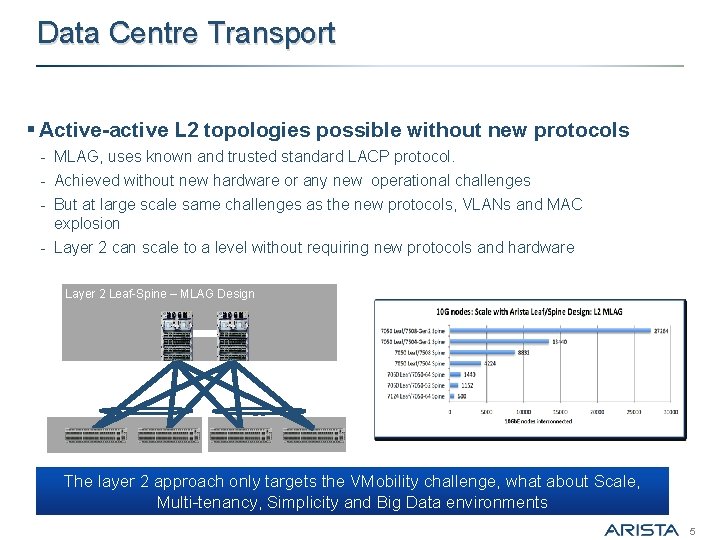
Data Centre Transport § Active-active L 2 topologies possible without new protocols - MLAG, uses known and trusted standard LACP protocol. - Achieved without new hardware or any new operational challenges - But at large scale same challenges as the new protocols, VLANs and MAC explosion - Layer 2 can scale to a level without requiring new protocols and hardware Layer 2 Leaf-Spine – MLAG Design The layer 2 approach only targets the VMobility challenge, what about Scale, Multi-tenancy, Simplicity and Big Data environments 5
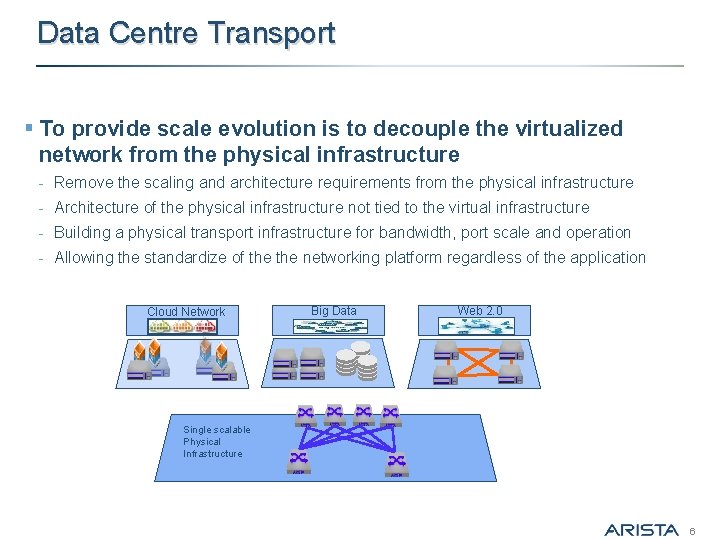
Data Centre Transport § To provide scale evolution is to decouple the virtualized network from the physical infrastructure - Remove the scaling and architecture requirements from the physical infrastructure - Architecture of the physical infrastructure not tied to the virtual infrastructure - Building a physical transport infrastructure for bandwidth, port scale and operation - Allowing the standardize of the networking platform regardless of the application Cloud Network Big Data Web 2. 0 Virtualized Solution Single scalable Physical Infrastructure 6
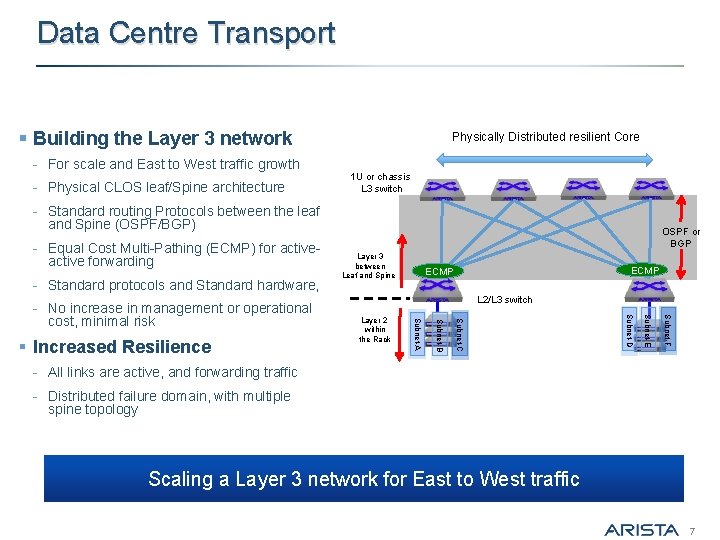
Data Centre Transport § Building the Layer 3 network - For scale and East to West traffic growth - Physical CLOS leaf/Spine architecture Physically Distributed resilient Core 1 U or chassis L 3 switch - Standard routing Protocols between the leaf and Spine (OSPF/BGP) - Equal Cost Multi-Pathing (ECMP) for active forwarding - Standard protocols and Standard hardware, ECMP L 2/L 3 switch Subnet-F Subnet-E Subnet-D Subnet-C Layer 2 within the Rack Subnet-B § Increased Resilience Layer 3 between Leaf and Spine Subnet-A - No increase in management or operational cost, minimal risk OSPF or BGP - All links are active, and forwarding traffic - Distributed failure domain, with multiple spine topology Scaling a Layer 3 network for East to West traffic 7
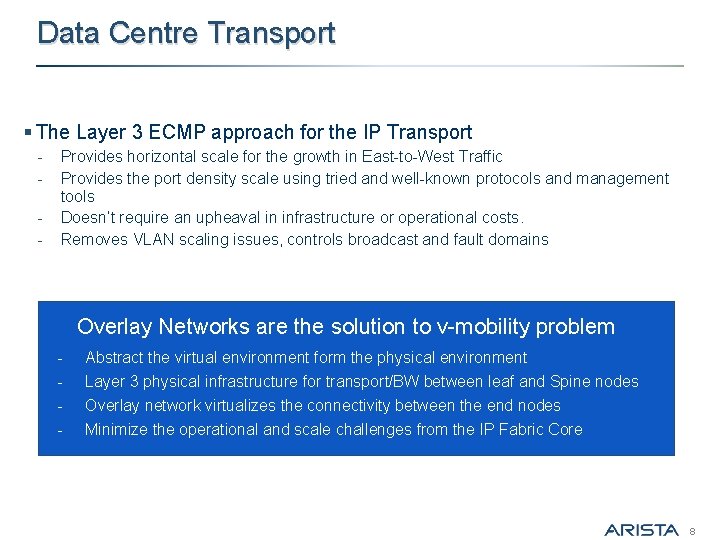
Data Centre Transport § The Layer 3 ECMP approach for the IP Transport - Provides horizontal scale for the growth in East-to-West Traffic Provides the port density scale using tried and well-known protocols and management tools Doesn’t require an upheaval in infrastructure or operational costs. Removes VLAN scaling issues, controls broadcast and fault domains Overlay Networks are the solution to v-mobility problem - Abstract the virtual environment form the physical environment Layer 3 physical infrastructure for transport/BW between leaf and Spine nodes Overlay network virtualizes the connectivity between the end nodes Minimize the operational and scale challenges from the IP Fabric Core 8
Software is the Key for SDN 9
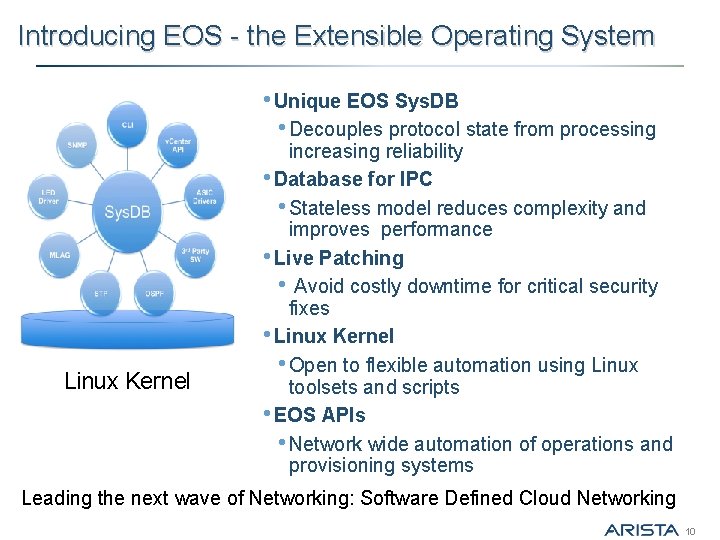
Introducing EOS - the Extensible Operating System • Unique EOS Sys. DB • Decouples protocol state from processing Linux Kernel increasing reliability • Database for IPC • Stateless model reduces complexity and improves performance • Live Patching • Avoid costly downtime for critical security fixes • Linux Kernel • Open to flexible automation using Linux toolsets and scripts • EOS APIs • Network wide automation of operations and provisioning systems Leading the next wave of Networking: Software Defined Cloud Networking 10
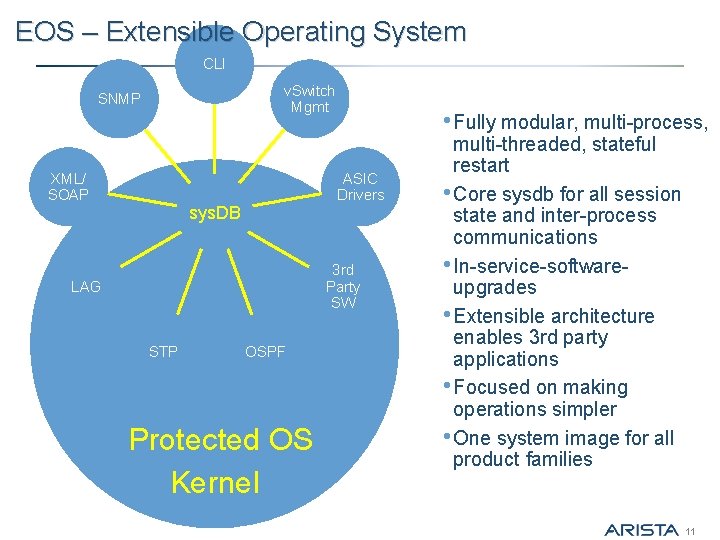
EOS – Extensible Operating System CLI v. Switch Mgmt SNMP XML/ SOAP • Fully modular, multi-process, ASIC Drivers sys. DB 3 rd Party SW LAG STP OSPF Protected OS Kernel multi-threaded, stateful restart • Core sysdb for all session state and inter-process communications • In-service-softwareupgrades • Extensible architecture enables 3 rd party applications • Focused on making operations simpler • One system image for all product families 11
Overlay Networks 12
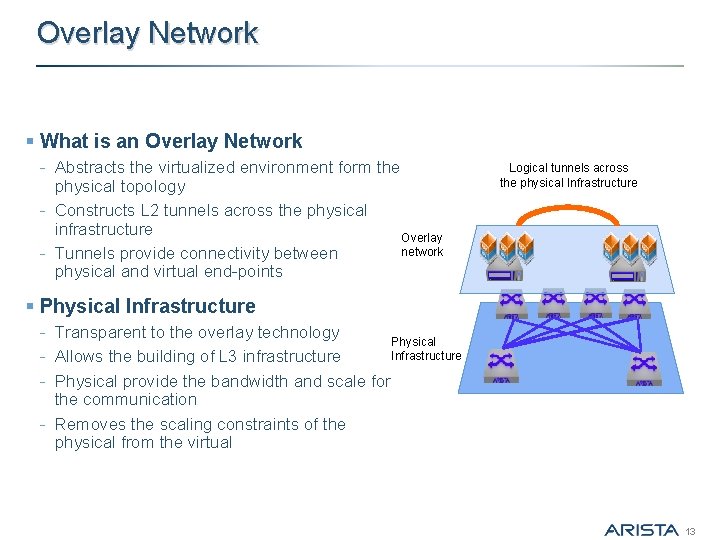
Overlay Network § What is an Overlay Network - Abstracts the virtualized environment form the physical topology - Constructs L 2 tunnels across the physical infrastructure Overlay network - Tunnels provide connectivity between physical and virtual end-points Logical tunnels across the physical Infrastructure § Physical Infrastructure - Transparent to the overlay technology Physical Infrastructure - Allows the building of L 3 infrastructure - Physical provide the bandwidth and scale for the communication - Removes the scaling constraints of the physical from the virtual 13
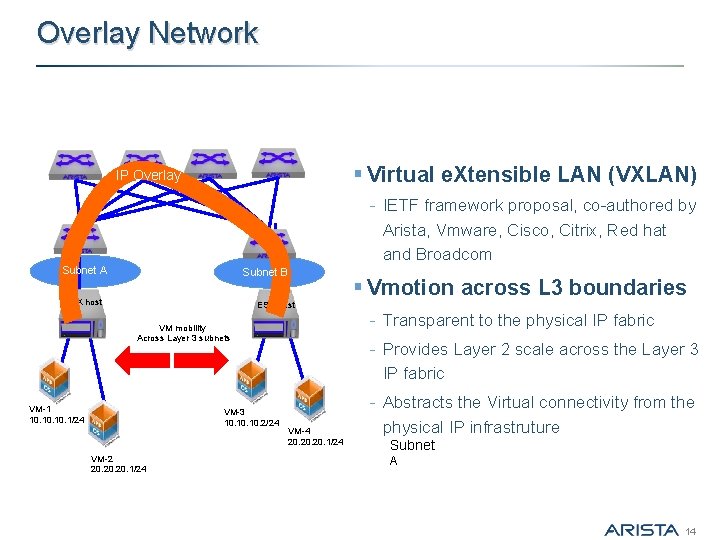
Overlay Network § Virtual e. Xtensible LAN (VXLAN) IP Overlay - IETF framework proposal, co-authored by Arista, Vmware, Cisco, Citrix, Red hat and Broadcom Subnet A Subnet B ESX host - Transparent to the physical IP fabric VM mobility Across Layer 3 subnets VM-1 10. 10. 1/24 VM-3 10. 10. 2/24 VM-2 20. 20. 1/24 § Vmotion across L 3 boundaries - Provides Layer 2 scale across the Layer 3 IP fabric VM-4 20. 20. 1/24 - Abstracts the Virtual connectivity from the physical IP infrastruture Subnet A 14
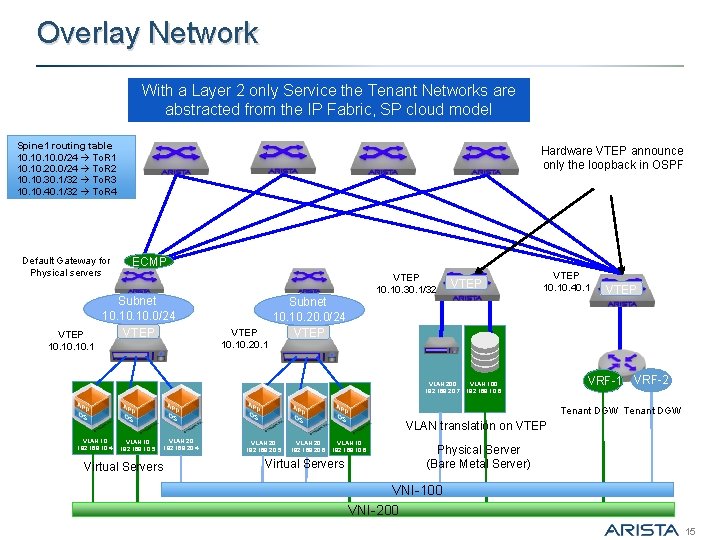
Overlay Network With a Layer 2 only Service the Tenant Networks are abstracted from the IP Fabric, SP cloud model Spine 1 routing table 10. 10. 0/24 To. R 1 10. 20. 0/24 To. R 2 10. 30. 1/32 To. R 3 10. 40. 1/32 To. R 4 Default Gateway for Physical servers VTEP 10. 10. 1 Hardware VTEP announce only the loopback in OSPF ECMP Subnet 10. 10. 0/24 VTEP 10. 30. 1/32 VTEP 10. 20. 1 VTEP 10. 40. 1 Subnet 10. 20. 0/24 VTEP VLAN 200 192. 168. 20. 7 VTEP VRF-1 VLAN 100 192. 168. 10. 6 VRF-2 Tenant DGW VLAN 10 192. 168. 10. 9 VLAN translation on VTEP VLAN 10 192. 168. 10. 4 VLAN 10 192. 168. 10. 5 VLAN 20 192. 168. 20. 4 VLAN 20 192. 168. 20. 5 VLAN 20 192. 168. 20. 6 VLAN 10 192. 168. 10. 6 Virtual Servers VNI-200 Physical Server (Bare Metal Server) VNI-100 VNI-200 VNI-300 15
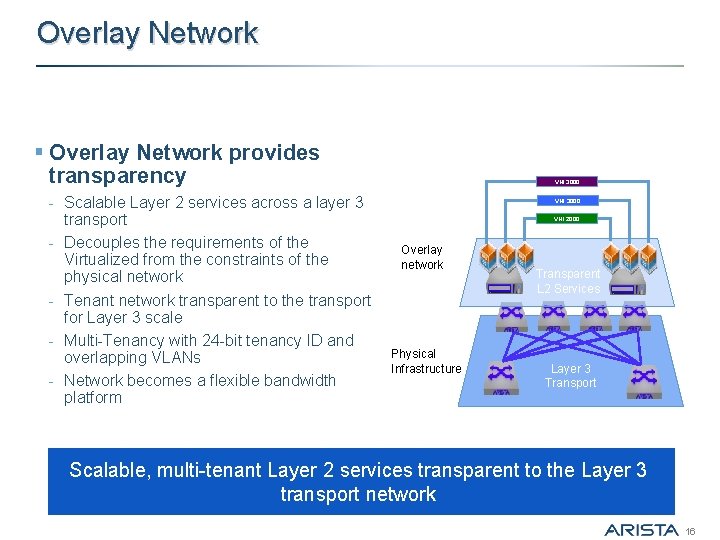
Overlay Network § Overlay Network provides transparency - Scalable Layer 2 services across a layer 3 transport - Decouples the requirements of the Virtualized from the constraints of the physical network - Tenant network transparent to the transport for Layer 3 scale - Multi-Tenancy with 24 -bit tenancy ID and overlapping VLANs - Network becomes a flexible bandwidth platform VNI 3000 VNI 2000 Overlay network Physical Infrastructure Transparent L 2 Services Layer 3 Transport Scalable, multi-tenant Layer 2 services transparent to the Layer 3 transport network 16
Telemetry 17
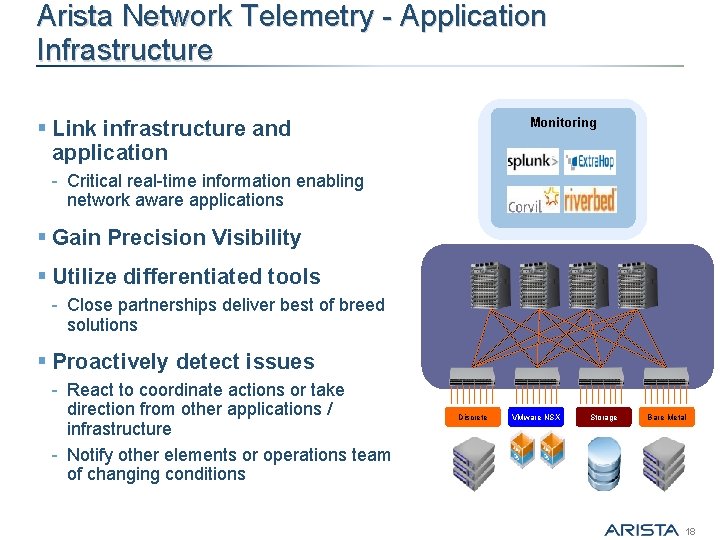
Arista Network Telemetry - Application Infrastructure Monitoring § Link infrastructure and application - Critical real-time information enabling network aware applications § Gain Precision Visibility § Utilize differentiated tools - Close partnerships deliver best of breed solutions § Proactively detect issues - React to coordinate actions or take direction from other applications / infrastructure - Notify other elements or operations team of changing conditions Discrete VMware NSX Storage Bare Metal 18
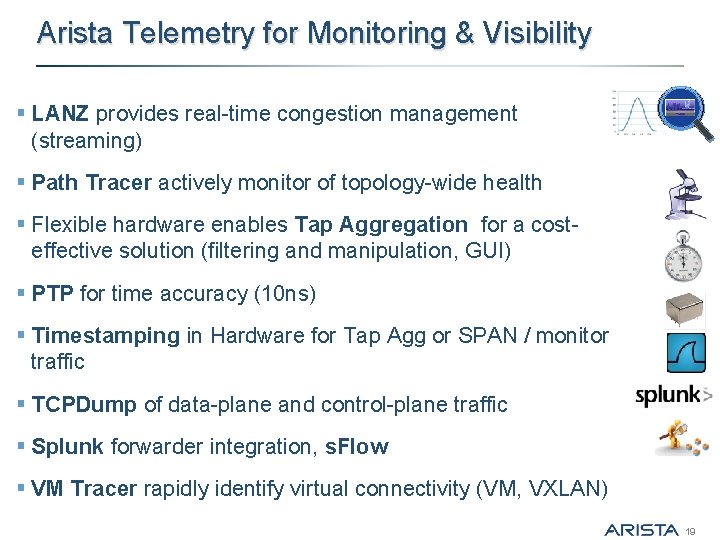
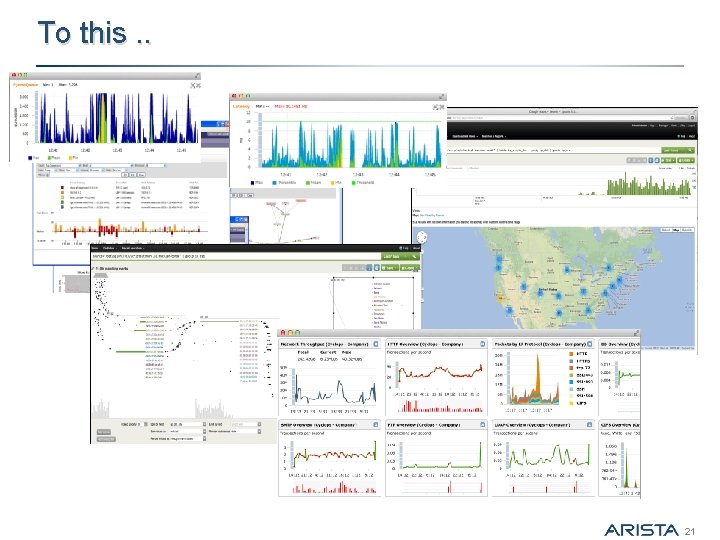
Arista Telemetry for Monitoring & Visibility § LANZ provides real-time congestion management (streaming) § Path Tracer actively monitor of topology-wide health § Flexible hardware enables Tap Aggregation for a costeffective solution (filtering and manipulation, GUI) § PTP for time accuracy (10 ns) § Timestamping in Hardware for Tap Agg or SPAN / monitor traffic § TCPDump of data-plane and control-plane traffic § Splunk forwarder integration, s. Flow § VM Tracer rapidly identify virtual connectivity (VM, VXLAN) 19
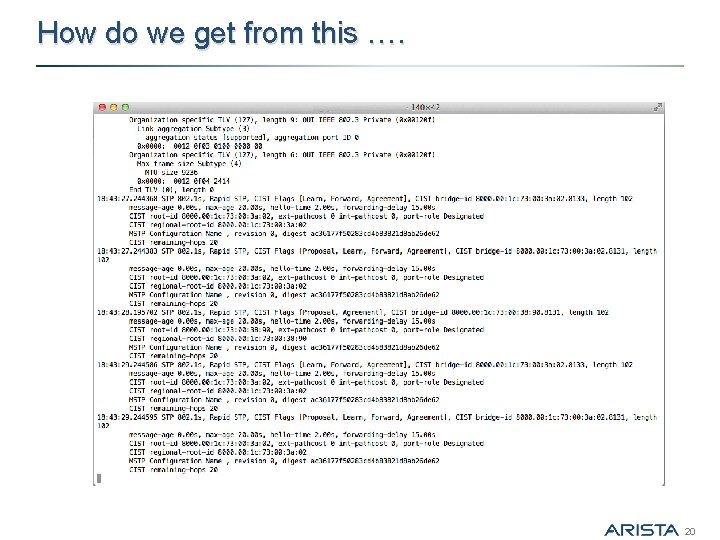
How do we get from this …. 20
To this. . 21
Software Defined Networking 22
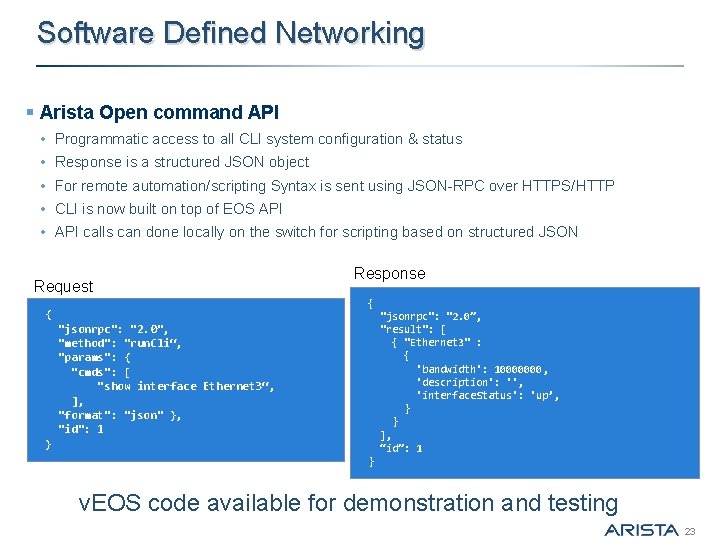
Software Defined Networking § Arista Open command API • Programmatic access to all CLI system configuration & status • Response is a structured JSON object • For remote automation/scripting Syntax is sent using JSON-RPC over HTTPS/HTTP • CLI is now built on top of EOS API • API calls can done locally on the switch for scripting based on structured JSON Request Response { { "jsonrpc": "2. 0”, "result": [ { "Ethernet 3" : { 'bandwidth': 10000000, 'description': '', 'interface. Status': 'up’, } } ], “id”: 1 "jsonrpc": "2. 0", "method": "run. Cli“, "params": { "cmds": [ "show interface Ethernet 3“, ], "format": "json" }, "id": 1 } } v. EOS code available for demonstration and testing 23
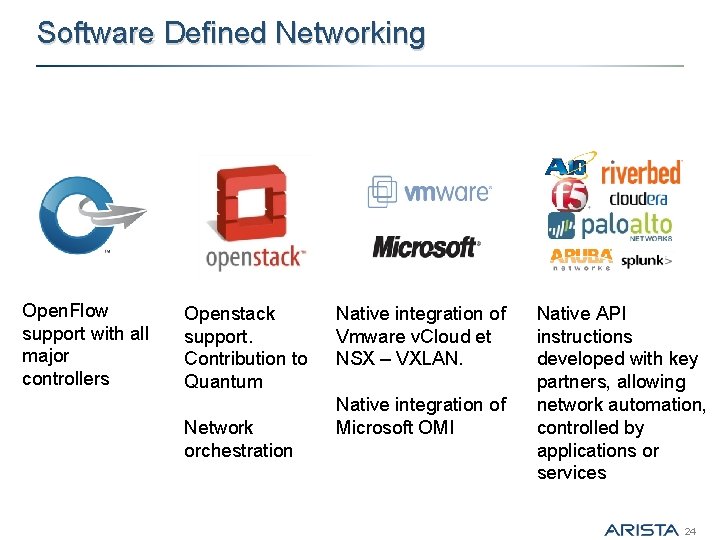
Software Defined Networking Open to Many Controllers & Programming Models Open. Flow support with all major controllers Openstack support. Contribution to Quantum Network orchestration Native integration of Vmware v. Cloud et NSX – VXLAN. Native integration of Microsoft OMI Native API instructions developed with key partners, allowing network automation, controlled by applications or services 24
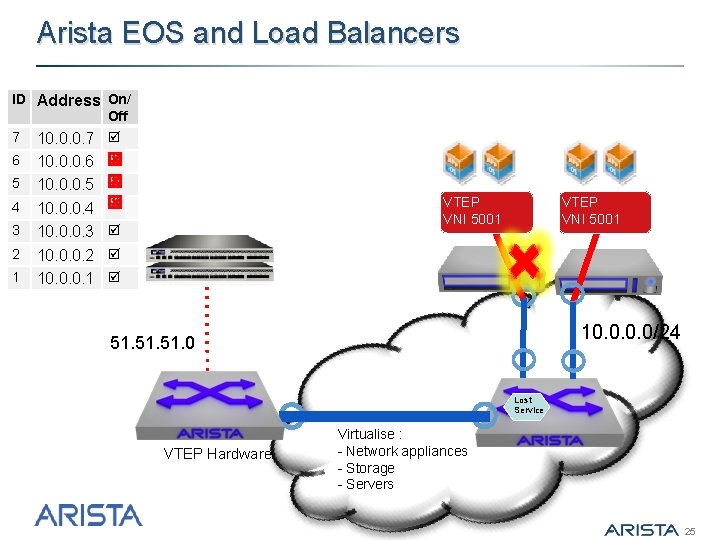
Arista EOS and Load Balancers ID Address On/ Off 7 10. 0. 0. 7 6 5 4 3 2 1 10. 0. 0. 6 10. 0. 0. 5 10. 0. 0. 4 10. 0. 0. 3 10. 0. 0. 2 10. 0. 0. 1 VTEP VNI 5001 10. 0/24 51. 51. 0 Lost Service VTEP Hardware Virtualise : - Network appliances - Storage - Servers 25
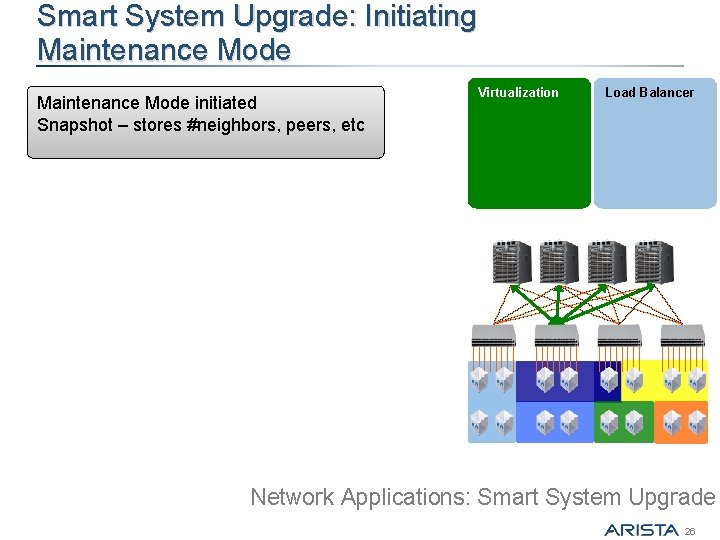
Smart System Upgrade: Initiating Maintenance Mode initiated Snapshot – stores #neighbors, peers, etc Virtualization Load Balancer Network Applications: Smart System Upgrade 26
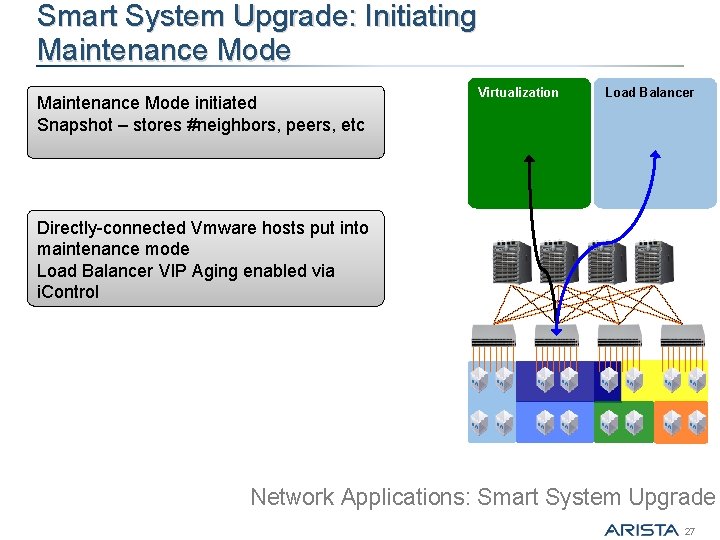
Smart System Upgrade: Initiating Maintenance Mode initiated Snapshot – stores #neighbors, peers, etc Virtualization Load Balancer Directly-connected Vmware hosts put into maintenance mode Load Balancer VIP Aging enabled via i. Control Network Applications: Smart System Upgrade 27
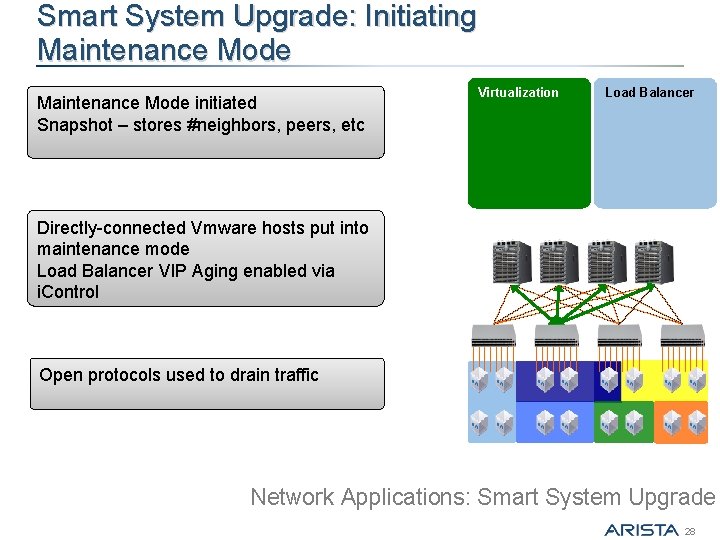
Smart System Upgrade: Initiating Maintenance Mode initiated Snapshot – stores #neighbors, peers, etc Virtualization Load Balancer Directly-connected Vmware hosts put into maintenance mode Load Balancer VIP Aging enabled via i. Control Open protocols used to drain traffic Network Applications: Smart System Upgrade 28
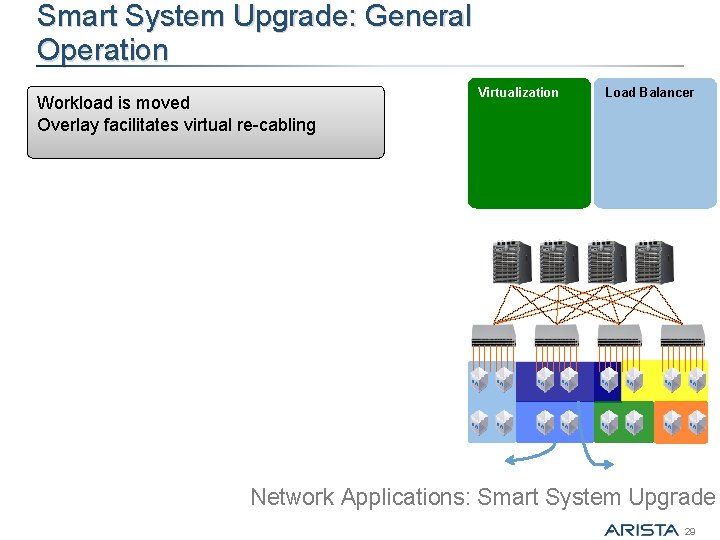
Smart System Upgrade: General Operation Workload is moved Overlay facilitates virtual re-cabling Virtualization Load Balancer Network Applications: Smart System Upgrade 29
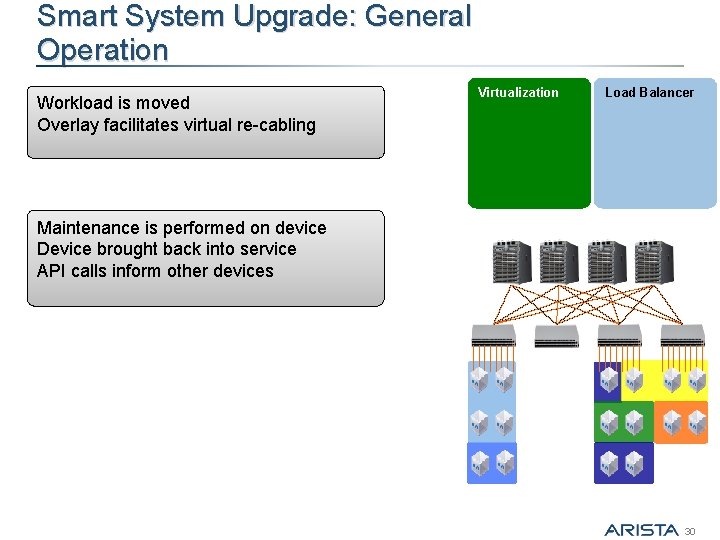
Smart System Upgrade: General Operation Workload is moved Overlay facilitates virtual re-cabling Virtualization Load Balancer Maintenance is performed on device Device brought back into service API calls inform other devices 30
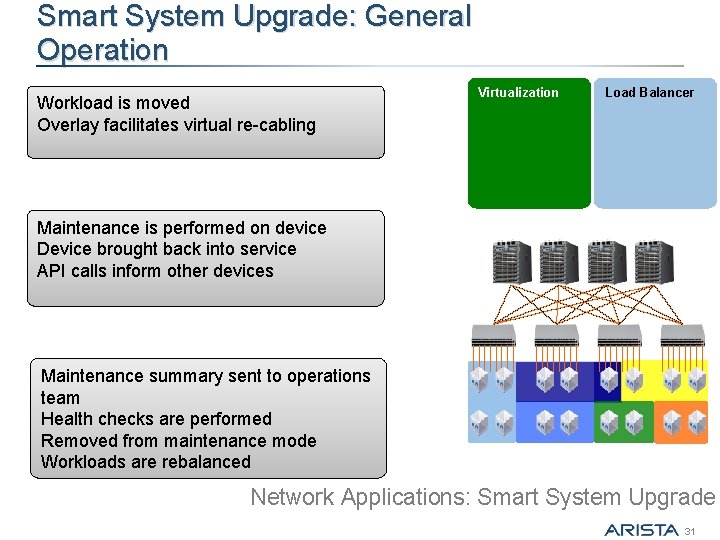
Smart System Upgrade: General Operation Workload is moved Overlay facilitates virtual re-cabling Virtualization Load Balancer Maintenance is performed on device Device brought back into service API calls inform other devices Maintenance summary sent to operations team Health checks are performed Removed from maintenance mode Workloads are rebalanced Network Applications: Smart System Upgrade 31
Questions? 32
- Slides: 32