
The evolution of sagittal segmental alignment of the


- Slides: 20
The evolution of sagittal segmental alignment of the spine during growth Muharrem Yazici, MD Hacettepe University, Ankara, Turkey Hacettepe Orthopaedics Spine Unit
Background q Planning spine of the 3 D reconstruction of the q Normative data about the sagittal plane q Segmental sagittal plane analysis q Many studies for adults q Inadequate data on children
Questions q Whether the pediatric spine is a miniature of adults’ in terms of sagittal plane alignment? q If not, do segmental alignment of the vertebrae change with growth?
Objective q To describe the normative data of the sagittal plane on pediatric age population q To document the evolution of sagittal alignment with growth
Materials&Methods q 151 children (72 girls, 79 boys) q No musculoskeletal abnormality q Spine deformity q Limb length inequality q Hip or knee contracture No previous spinal surgery q Age, 3 to 15 q q Minimum of 10 children in each q At least 4 of them from one sex age group
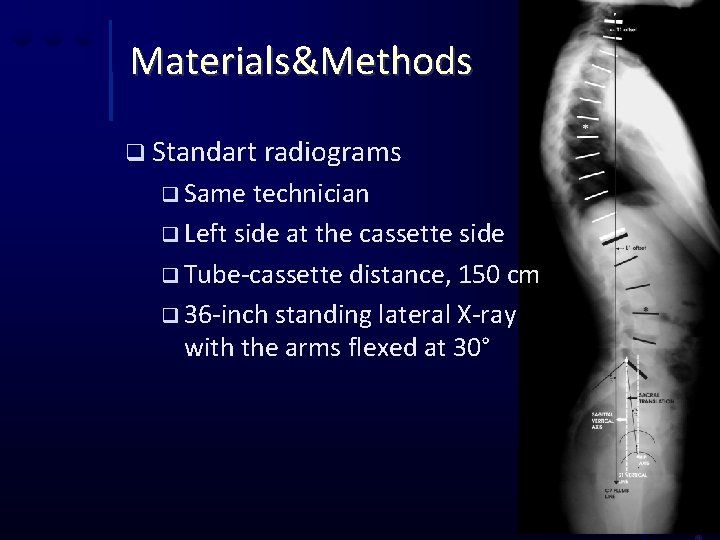
Materials&Methods q Standart radiograms q Same technician q Left side at the cassette side q Tube-cassette distance, 150 cm q 36 -inch standing lateral X-ray with the arms flexed at 30°
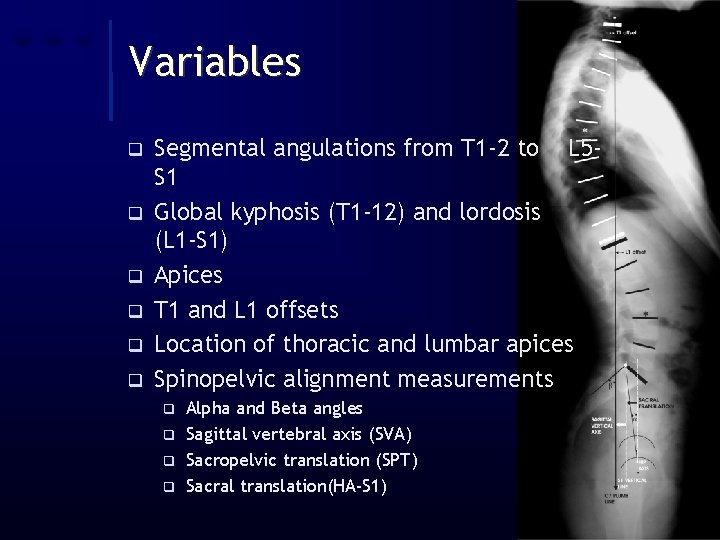
Variables q q q Segmental angulations from T 1 -2 to L 5 S 1 Global kyphosis (T 1 -12) and lordosis (L 1 -S 1) Apices T 1 and L 1 offsets Location of thoracic and lumbar apices Spinopelvic alignment measurements q q Alpha and Beta angles Sagittal vertebral axis (SVA) Sacropelvic translation (SPT) Sacral translation(HA-S 1)
Statistical analysis q Grouping in terms of ages Group I (3 to 6 years of age) q Group II (7 to 9) q Group III (10 to 12) q Group IV (13 to 15) q q Intra-observer error q Re-measurement of 20 radiograms
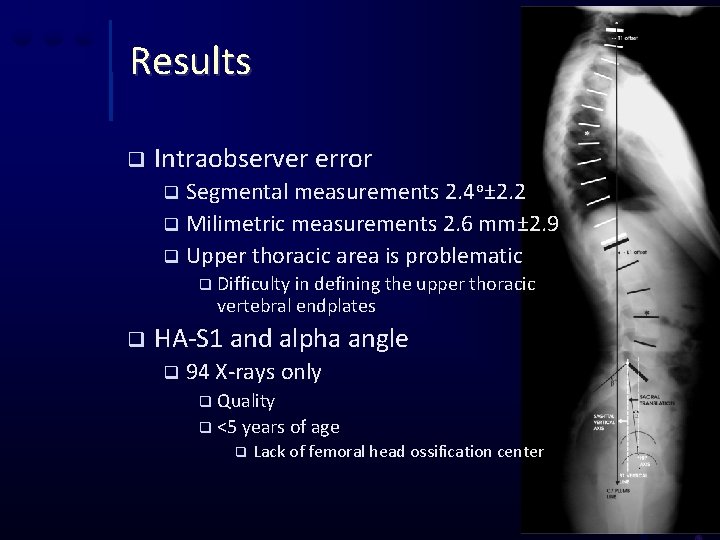
Results q Intraobserver error Segmental measurements 2. 4 o± 2. 2 q Milimetric measurements 2. 6 mm± 2. 9 q Upper thoracic area is problematic q q Difficulty in defining the upper thoracic vertebral endplates q HA-S 1 and alpha angle q 94 X-rays only q Quality q <5 years of age q Lack of femoral head ossification center
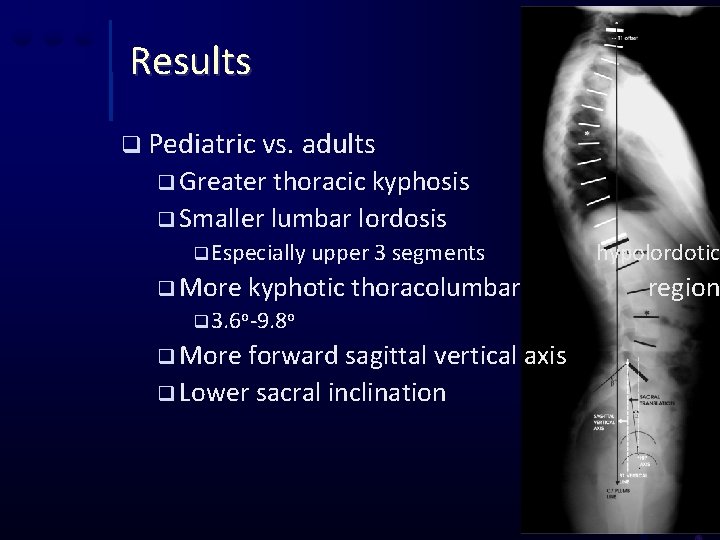
Results q Pediatric vs. adults q Greater thoracic kyphosis q Smaller lumbar lordosis q Especially upper 3 segments q More kyphotic thoracolumbar q 3. 6 o-9. 8 o q More forward sagittal vertical axis q Lower sacral inclination hypolordotic region
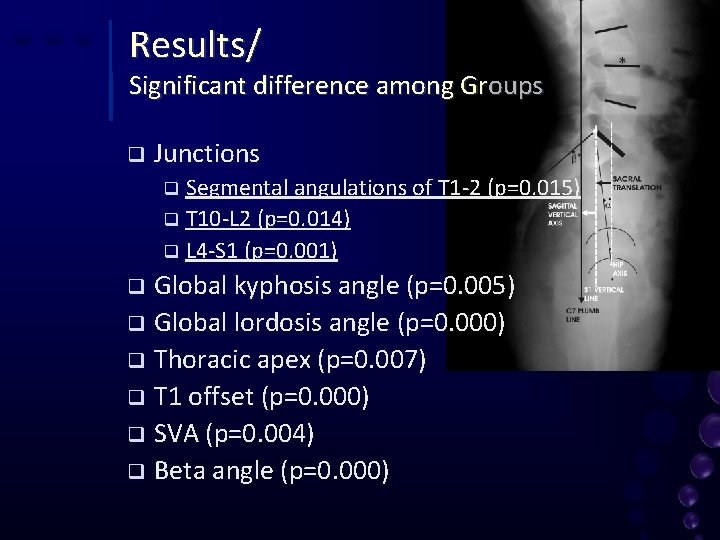
Results/ Significant difference among Groups q Junctions Segmental angulations of T 1 -2 (p=0. 015) q T 10 -L 2 (p=0. 014) q L 4 -S 1 (p=0. 001) q Global kyphosis angle (p=0. 005) q Global lordosis angle (p=0. 000) q Thoracic apex (p=0. 007) q T 1 offset (p=0. 000) q SVA (p=0. 004) q Beta angle (p=0. 000) q
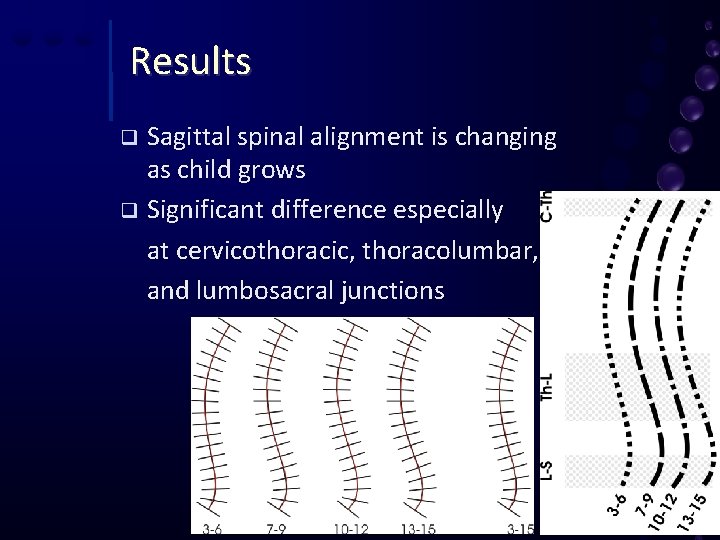
Results Sagittal spinal alignment is changing as child grows q Significant difference especially at cervicothoracic, thoracolumbar, and lumbosacral junctions q
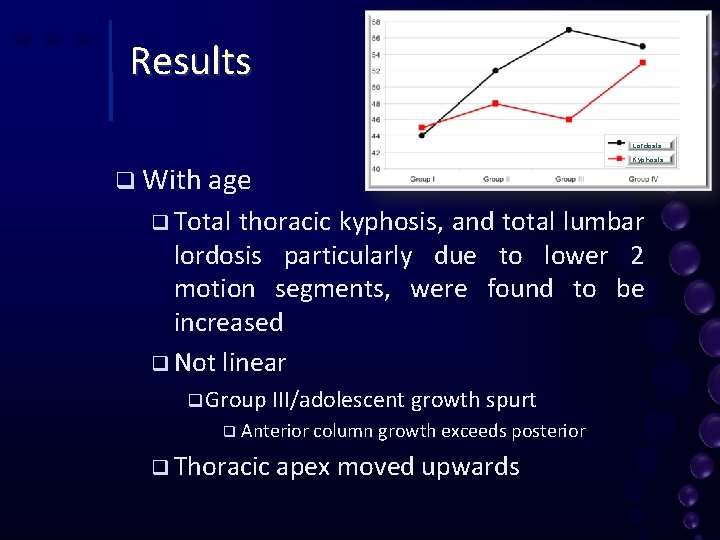
Results Lordosis q With age q Total Kyphosis thoracic kyphosis, and total lumbar lordosis particularly due to lower 2 motion segments, were found to be increased q Not linear q Group III/adolescent growth spurt q Anterior column growth exceeds posterior q Thoracic apex moved upwards
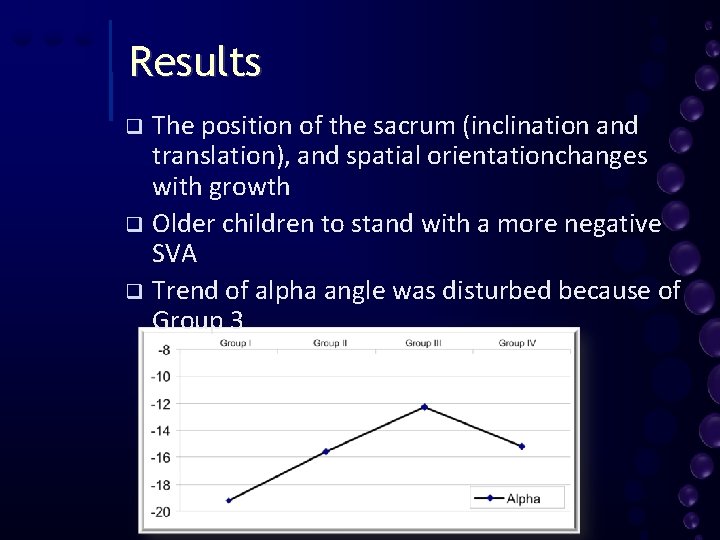
Results The position of the sacrum (inclination and translation), and spatial orientationchanges with growth q Older children to stand with a more negative SVA q Trend of alpha angle was disturbed because of Group 3 q
Drawbacks q Not regular randomization Same technician q Random selection q q No bias q Only ten subjects in each group Statistical power? q Regrouping q q Cross-sectional design q Prospective study? ?
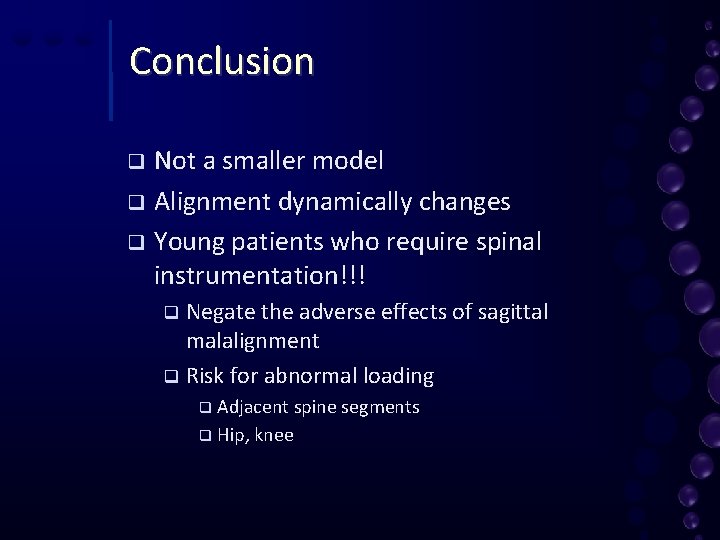
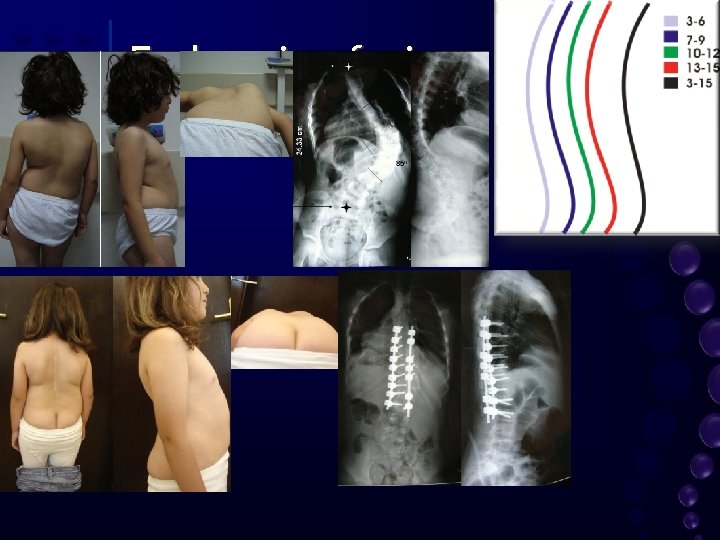
Conclusion Not a smaller model q Alignment dynamically changes q Young patients who require spinal instrumentation!!! q Negate the adverse effects of sagittal malalignment q Risk for abnormal loading q q Adjacent spine segments q Hip, knee
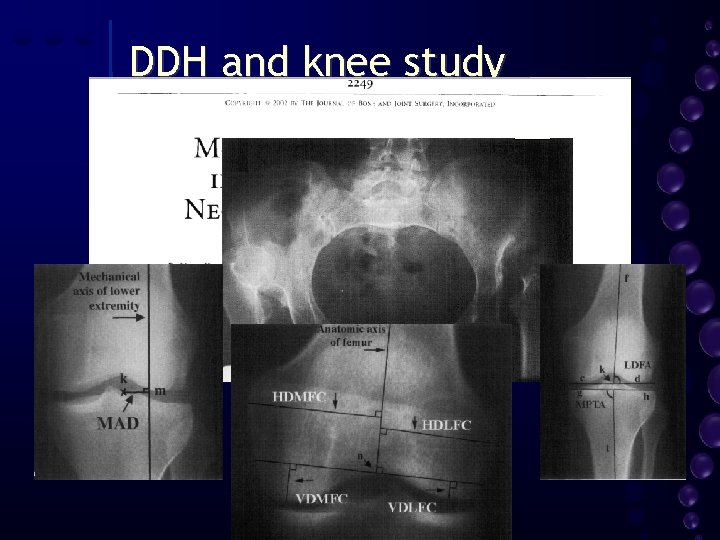
DDH and knee study
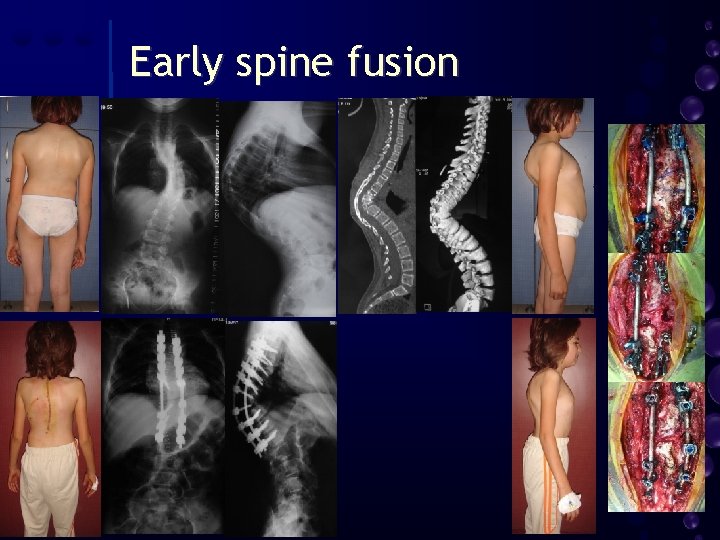
Early spine fusion
Early spine fusion
Conclusion q Whether sagittal alignment should be restored according to the normative data for the child’s age or to the normative data for the adulthood? q Adult data q Abnormal loading q Pediatric data q Adult posture can never be attained