
The Evolution of Organization Theory Evolution Of Management

- Slides: 30
The Evolution of Organization Theory
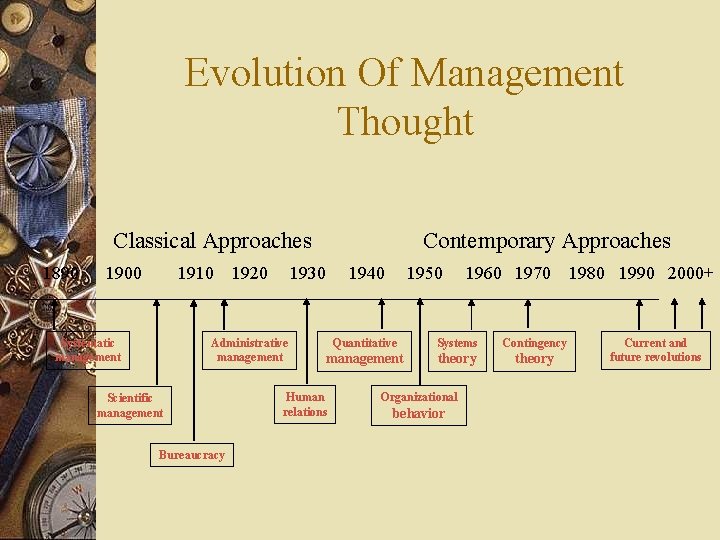
Evolution Of Management Thought Classical Approaches 1890 1900 1910 1920 1930 Administrative management Systematic management Scientific management Bureaucracy Contemporary Approaches 1940 1950 1960 1970 Quantitative Systems Contingency management theory Human relations Organizational behavior 1980 1990 2000+ Current and future revolutions
HINTS w The current state of OT is the result of an evolutionary process. w Theories and contributions have been introduced, evaluated, refined, and synthesized.
Contributors: Adam Smith w Division of labor would lead to significant economic efficiencies. w Industrial revolution: Machine power was rapidly replacing human power, and building railroads and transportation methods. w Building factories requires a creation of organization structure that facilitates efficiency.
Early Management Concepts And Influences w Industrial revolution – minor improvements in management tactics produced impressive increases in production quantity and quality – economies of scale - reductions in the average cost of a unit of production as the total volume produced increases – opportunities for mass production created by the industrial revolution spawned intense and systematic thought about management problems and issues • efficiency • production processes • cost savings
Dimensions of OT w It has been suggested that there are two underlying dimensions in the evolution of OT: w First: organizations are systems. w Second: ends of organization structure.
First: organizations are systems w Prior 1960, organization are dominated by close system where organizations are seen as essentially autonomous and sealed off from their environment. w Beginning around 1960 s, open system perspective begun to prevail.
Second: ends of organization structure. w Two positions w 1 - The rational perspective: the structure of an organization is conceived as a vehicle to effectively achieve specified objectives. w 2 - The social perspective: structure is primarily the result of the conflicting forces by the organization’s constituents who seeks power and control.
Type 1 w Focus on efficiency in internal functions of the organization. w Economic motivates.
Type 1 Theories w The classical school. w Organizations as a closed systems to achieve goals efficiency.
Type 1 Theories (cont. ) Fredrick Taylor w His book “principles of scientific management. ” w He observed that workers output was only onethird of what was possible. w Finding the “one best way” w His focus was on the lowest level of the organization. w He explicitly demonstrated that managers should carefully assess the one best way for each job to be done to maximize efficiency.
Type 1 Theories (cont. ) Henry Fayol w His ideas were based on experience and practice not based on science. w He offered general principles applicable to all managers.
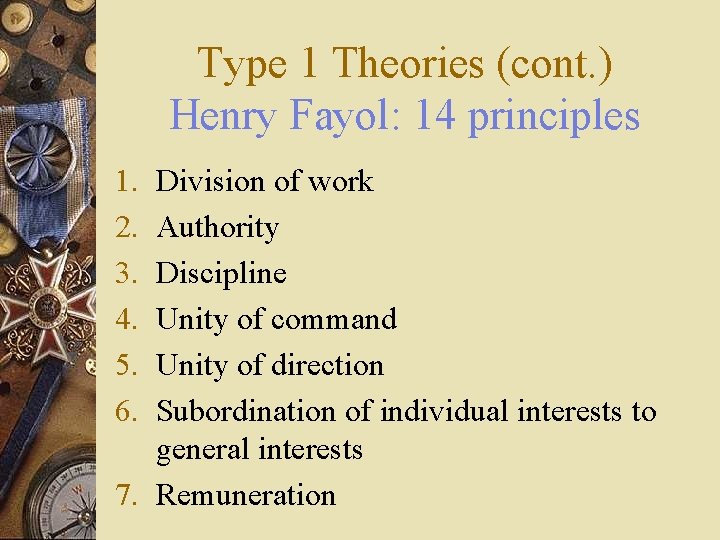
Type 1 Theories (cont. ) Henry Fayol: 14 principles 1. 2. 3. 4. 5. 6. Division of work Authority Discipline Unity of command Unity of direction Subordination of individual interests to general interests 7. Remuneration
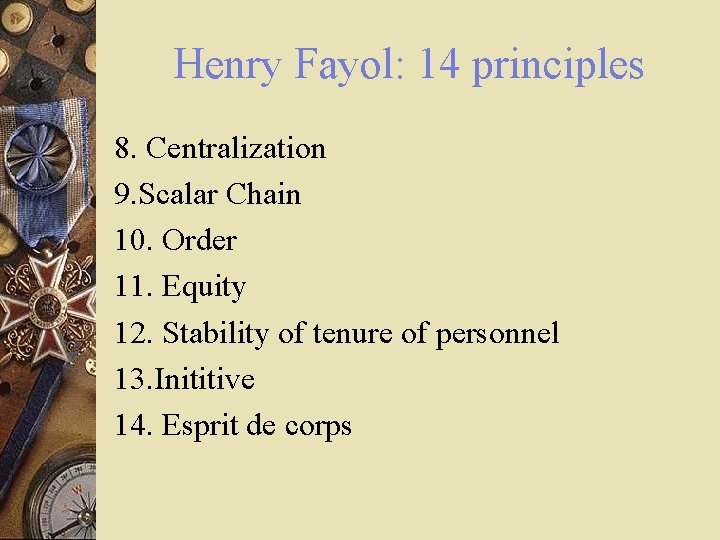
Henry Fayol: 14 principles 8. Centralization 9. Scalar Chain 10. Order 11. Equity 12. Stability of tenure of personnel 13. Inititive 14. Esprit de corps
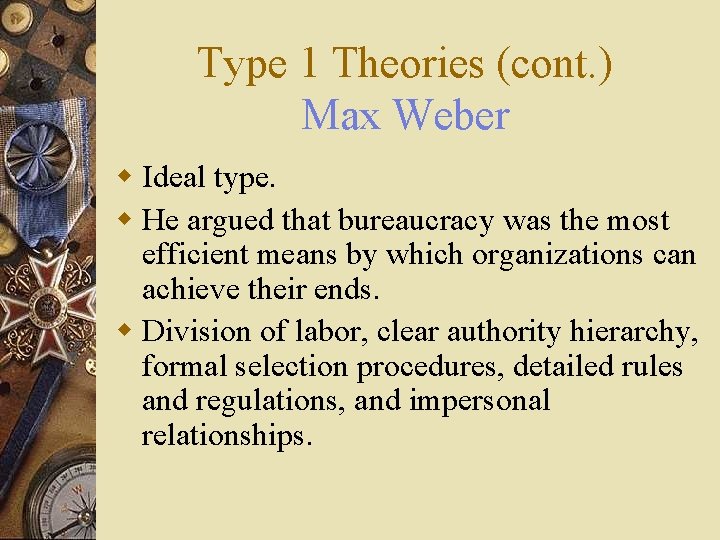
Type 1 Theories (cont. ) Max Weber w Ideal type. w He argued that bureaucracy was the most efficient means by which organizations can achieve their ends. w Division of labor, clear authority hierarchy, formal selection procedures, detailed rules and regulations, and impersonal relationships.
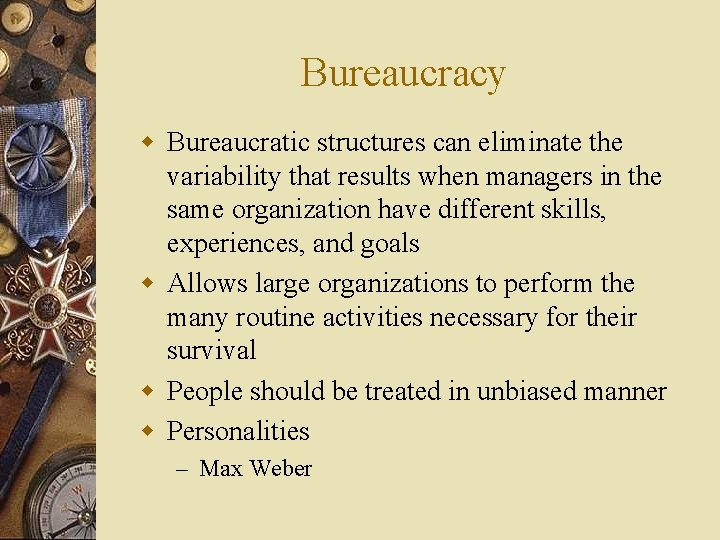
Bureaucracy w Bureaucratic structures can eliminate the variability that results when managers in the same organization have different skills, experiences, and goals w Allows large organizations to perform the many routine activities necessary for their survival w People should be treated in unbiased manner w Personalities – Max Weber
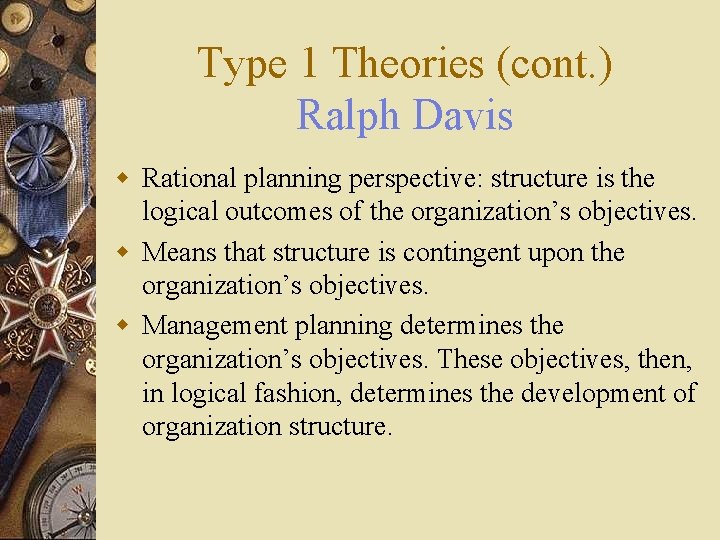
Type 1 Theories (cont. ) Ralph Davis w Rational planning perspective: structure is the logical outcomes of the organization’s objectives. w Means that structure is contingent upon the organization’s objectives. w Management planning determines the organization’s objectives. These objectives, then, in logical fashion, determines the development of organization structure.
Type 1 Theories (cont. ) Fredrick Taylor w Four principles – develop a scientific approach for each element of one’s work instead of rule-of-thumb. – scientifically select, train, teach and develop each worker – cooperate with workers to ensure that jobs match plans and principles to achieve work objectives. – ensure appropriate division of labor by offering equal division and responsibility between managers and workers.
Type 2 w Theories operated under closed system assumptions and emphasized the informal relations and non-economic motives.
Type 2 Elton Mayo and Hawthorne Studies w Illumination and productivity. w Redesign job, change length of workday, rest periods, and individual vs. group wage plans.
Type 2 Chester Bernard and Cooperative Systems w The functions of the Executive. w Tasks and people have to be maintained at an equilibrium state. w Managers should around the requirements of the task to be done and the needs of the people.
Type 2 Theory X and Y – Theory X • managers assume that workers are lazy, irresponsible, and require constant supervision – Theory Y • managers assume employees want to work and control themselves
Type 2 Warren Bennis and the Death of Bureaucracy w He claimed that bureaucracy’s central decision making, impersonal submission to authority, and narrow division of labor was being placed by decentralized and democratic structures organized around flexible groups.
Type 3 w Emphasize rationality. w Focus on size, technology, and environmental uncertainty as a major contingency variables. w Proper alignment of structure to its contingencies would facilitate the achievement of the organization's goals.
Type 3 Herbert Simon w The contingency theory. w He argued that organization theory needed to go beyond superficial and oversimplified principles to a study of the conditions under which competing principles were applicable.
Type 3 Katz and Khan w Environmental perspective. w Open system. w Organizations need to adapt to a changing environment if they are to survive. w Various types of environment.
Type 3 Technology and size w Woodward and Perrow (1960 s) argue that technology determine the appropriate structure. w Aston University Group advocates organize size as an important factor influencing structure.
Type 4 w Social perspective in an open system framework. w The outcome of the political struggles among coalitions within the organization for control would create the most effective structure.
Type 4 March and Simon w They revised the rational-cooperative systems view. w They recognize the limits of a decision maker’s rationality and acknowledge the presence of conflicting goals.
Type 4 Pfeffer’s organizations as political arenas w OT encompasses power collations, inherent conflict over goals, and organizational decisions that favor the self-interest of those in power. w He proposes that control in organizations becomes an end rather then a means to rational goals such as efficient production of out put. w To understand how and why organizations are designed, we need to assess the preferences and interest of those who have power.