
The Evolution of MPI William Gropp Computer Science



- Slides: 43
The Evolution of MPI William Gropp Computer Science www. cs. uiuc. edu/homes/wgropp
Outline 1. Why an MPI talk? 2. MPI Status: Performance, Scalability, and Functionality 3. Changes to MPI: MPI Forum activites 4. What this (should) mean for you 2
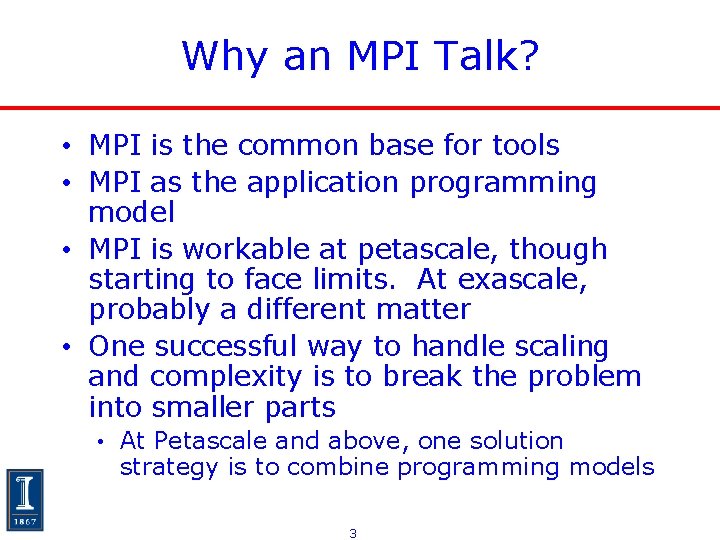
Why an MPI Talk? • MPI is the common base for tools • MPI as the application programming model • MPI is workable at petascale, though starting to face limits. At exascale, probably a different matter • One successful way to handle scaling and complexity is to break the problem into smaller parts • At Petascale and above, one solution strategy is to combine programming models 3
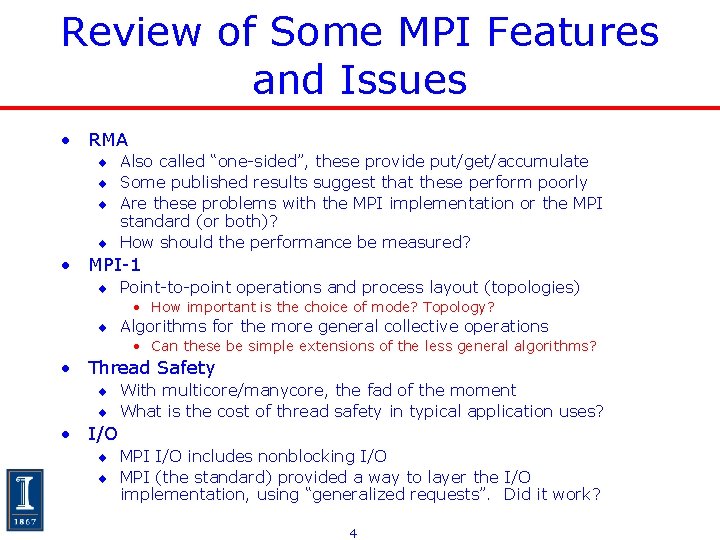
Review of Some MPI Features and Issues • RMA ¨ Also called “one-sided”, these provide put/get/accumulate ¨ Some published results suggest that these perform poorly ¨ Are these problems with the MPI implementation or the MPI standard (or both)? ¨ How should the performance be measured? • MPI-1 ¨ Point-to-point operations and process layout (topologies) • How important is the choice of mode? Topology? ¨ Algorithms for the more general collective operations • Can these be simple extensions of the less general algorithms? • Thread Safety ¨ With multicore/manycore, the fad of the moment ¨ What is the cost of thread safety in typical application uses? • I/O ¨ MPI I/O includes nonblocking I/O ¨ MPI (the standard) provided a way to layer the I/O implementation, using “generalized requests”. Did it work? 4
Some Weaknesses in MPI • Easy to write code that performs and scales poorly ¨ Using blocking sends and receives • The attractiveness of the blocking model suggests a mismatch between the user’s model and the MPI model of parallel computing ¨ The right fix for this is better performance tuning tools • Don’t change MPI, improve the environment • The same problem exists for C, Fortran, etc. • One possibility - model checking against performance assertions • No easy compile-time optimizations ¨ Only MPI_Wtime, MPI_Wtick, and the handler conversion functions may be macros. ¨ Sophisticated analysis allows inlining ¨ Does it make sense to optimize for important special cases • Short messages? Contiguous messages? Are there lessons from the optimizations used in MPI implementations? 5
Issues that are not issues (1) • MPI and RDMA networks and programming models ¨ MPI can make good use of RDMA networks ¨ Comparisons with MPI sometimes compare apples and oranges • How do you signal completion at the target? • Cray SHMEM succeeded because of SHMEM_Barrier - an easy and efficiently implemented (with special hardware) way to indicate completion of RDMA operations • Latency ¨ Users often confuse Memory access times and CPU times; expect to see remote memory access times on the order of register access ¨ Without overlapped access, a single memory reference is 100’s to 1000’s of cycles ¨ A load-store model for reasoning about program performance isn’t enough • Don’t forget memory consistency issues 6
Issues that are not issues (2) • MPI “Buffers” as a scalability limit ¨ This is an implementation issue that existing MPI implementations for large scale systems already address • Buffers do not need to be preallocated • Fault Tolerance (as an MPI problem) ¨ Fault Tolerance is a property of the application; there is no magic solution ¨ MPI implementations can support fault tolerance • RADICMPI is a nice example that includes fault recovery ¨ MPI intended implementations to continue through faults when possible • That’s why there is a sophisticated error reporting mechanism • What is needed is a higher standard of MPI implementation, not a change to the MPI standard ¨ But - Some algorithms do need a more convenient way to manage a collection of processes that may change dynamically • This is not a communicator 7
Scalability Issues in the MPI Definition • How should you define scalable? ¨ Independent of number of processes • Some routines do not have scalable arguments ¨ E. g. , MPI_Graph_create • Some routines require O(p) arrays ¨ E. g. , MPI_Group_incl, MPI_Alltoall • Group construction is explicit (no MPI_Group_split) • Implementation challenges ¨ MPI_Win definition, if you wish to use a remote memory operation by address, requires each process to have the address of each remote processes local memory window (O(p) data at each process). ¨ Various ways to recover scalability, but only at additional overhead and complexity • Some parallel approaches require “symmetric allocation” • Many require Single Program Multiple Data (SPMD) ¨ Representations of Communicators other than MPI_COMM_WORLD (may be represented implicitly on highly scalable systems) • Must not enumerate members, even internally 8
Performance Issues • Library interface introduces overhead ¨ ~200 instructions ? • Hard (though not impossible) to “short cut” the MPI implementation for common cases ¨ Many arguments to MPI routines ¨ These are due to the attempt to limit the number of basic routines • You can’t win --- either you have many routines (too complicated) or too few (too inefficient) • Is MPI for users? Library developers? Compiler writers? • Computer hardware has changed since MPI was designed (1992 e. g. , DEC announces Alpha) ¨ SMPs are more common ¨ Cache-coherence (within a node) almost universal • MPI RMA Epochs provided (in part) to support non-coherent memory • May become important again - fastest single chips are not cache coherent ¨ Interconnect networks support “ 0 -copy” operations ¨ CPU/Memory/Interconnect speed ratios ¨ Note that MPI is often blamed for the poor fraction of peak performance achieved by parallel programs. (But the real culprit is often per-node memory performance) 9
Performance Issues (2) • MPI-2 RMA design supports non-cache-coherent systems ¨ Good for portability to systems of the time ¨ Complex rules for memory model (confuses users) • But note that the rules are precise and the same on all platforms ¨ Performance consequences • Memory synchronization model • One example: Put requires an ack from the target process • Missing operations ¨ No Read-Modify-Write operations ¨ Very difficult to implement even fetch-and-increment • Requires indexed datatypes to get scalable performance(!) • We’ve found bugs in vendor MPI RMA implementations when testing this algorithm ¨ Challenge for any programming model • What operations are provided? • Are there building blocks, akin to the load-link/store-conditional approach to processor atomic operations? • How fast is a good MPI RMA implementation? 10
MPI RMA and Proccess Topologies • To properly evaluate RMA, particularly with respect to point-to-point communication, it is necessary to separate data transfer from synchronization • An example application is Halo Exchange because it involves multiple communications per sync • Joint work with Rajeev Thakur (Argonne), Subhash Saini (NASA Ames) • This is also a good example for process topologies, because it involves communication between many neighboring processes 11
MPI One-Sided Communication • Three data transfer functions ¨ Put, get, accumulate MPI_Put MPI_Get • Three synchronization methods ¨ Fence ¨ Post-start-complete-wait ¨ Lock-unlock • A natural choice for implementing halo exchanges ¨ Multiple communication per synchronization 12
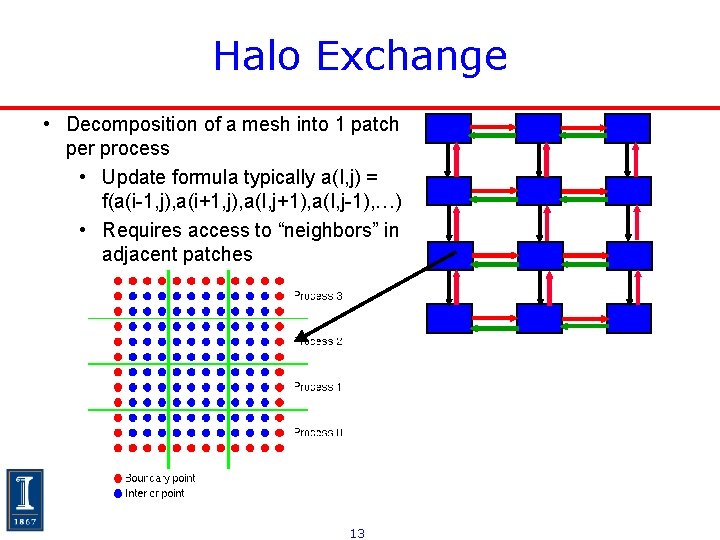
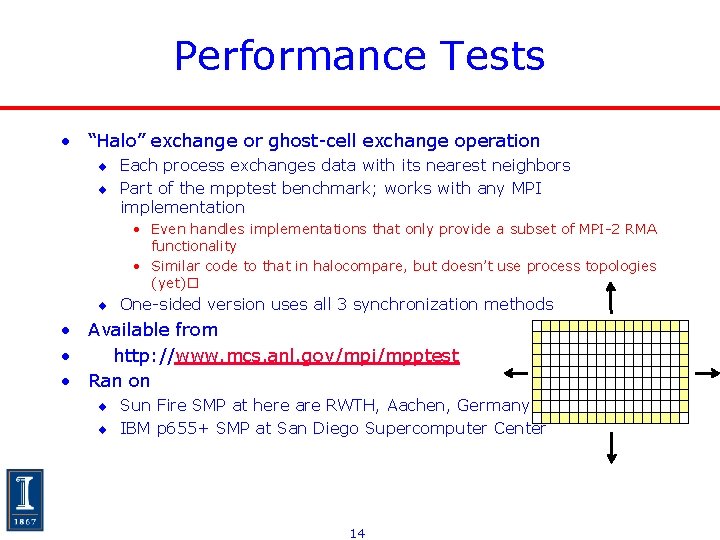
Halo Exchange • Decomposition of a mesh into 1 patch per process • Update formula typically a(I, j) = f(a(i-1, j), a(i+1, j), a(I, j+1), a(I, j-1), …) • Requires access to “neighbors” in adjacent patches 13
Performance Tests • “Halo” exchange or ghost-cell exchange operation ¨ Each process exchanges data with its nearest neighbors ¨ Part of the mpptest benchmark; works with any MPI implementation • Even handles implementations that only provide a subset of MPI-2 RMA functionality • Similar code to that in halocompare, but doesn’t use process topologies (yet)� ¨ One-sided version uses all 3 synchronization methods • Available from • http: //www. mcs. anl. gov/mpi/mpptest • Ran on ¨ Sun Fire SMP at here are RWTH, Aachen, Germany ¨ IBM p 655+ SMP at San Diego Supercomputer Center 14
One-Sided Communication on Sun SMP with Sun MPI 15 15
One-Sided Communication on IBM SMP with IBM MPI 16 16
Observations on MPI RMA and Halo Exchange • With a good implementation and appropriate hardware, MPI RMA can provide a performance benefit over MPI point-to-point • However, there are other effects that impact communication performance in modern machines… 17
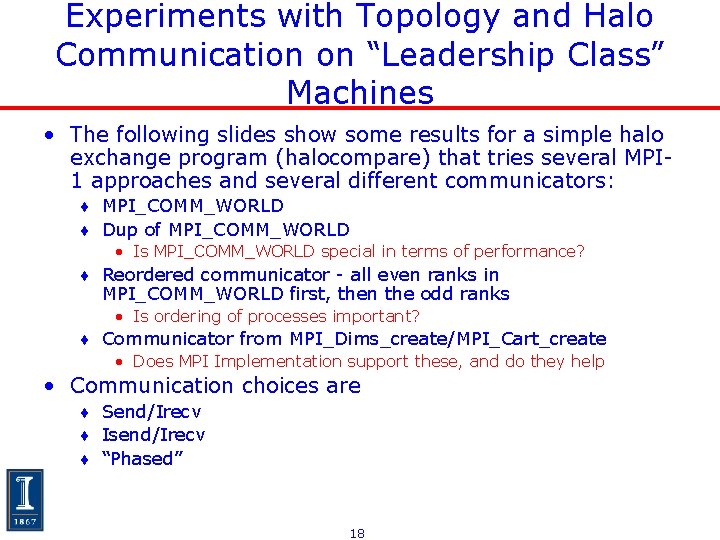
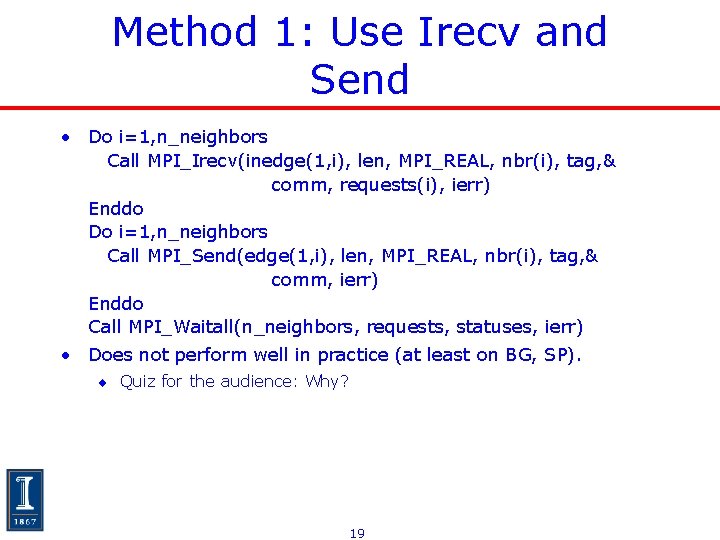
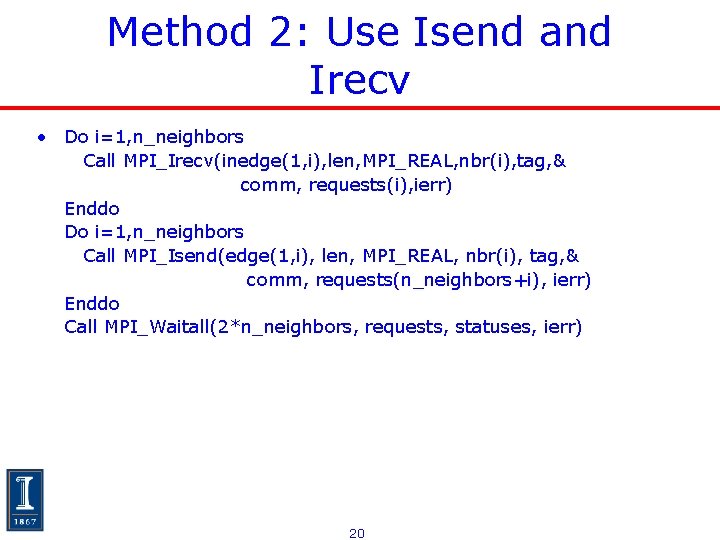
Experiments with Topology and Halo Communication on “Leadership Class” Machines • The following slides show some results for a simple halo exchange program (halocompare) that tries several MPI 1 approaches and several different communicators: ¨ MPI_COMM_WORLD ¨ Dup of MPI_COMM_WORLD • Is MPI_COMM_WORLD special in terms of performance? ¨ Reordered communicator - all even ranks in MPI_COMM_WORLD first, then the odd ranks • Is ordering of processes important? ¨ Communicator from MPI_Dims_create/MPI_Cart_create • Does MPI Implementation support these, and do they help • Communication choices are ¨ Send/Irecv ¨ Isend/Irecv ¨ “Phased” 18
Method 1: Use Irecv and Send • Do i=1, n_neighbors Call MPI_Irecv(inedge(1, i), len, MPI_REAL, nbr(i), tag, & comm, requests(i), ierr) Enddo Do i=1, n_neighbors Call MPI_Send(edge(1, i), len, MPI_REAL, nbr(i), tag, & comm, ierr) Enddo Call MPI_Waitall(n_neighbors, requests, statuses, ierr) • Does not perform well in practice (at least on BG, SP). ¨ Quiz for the audience: Why? 19
Method 2: Use Isend and Irecv • Do i=1, n_neighbors Call MPI_Irecv(inedge(1, i), len, MPI_REAL, nbr(i), tag, & comm, requests(i), ierr) Enddo Do i=1, n_neighbors Call MPI_Isend(edge(1, i), len, MPI_REAL, nbr(i), tag, & comm, requests(n_neighbors+i), ierr) Enddo Call MPI_Waitall(2*n_neighbors, requests, statuses, ierr) 20
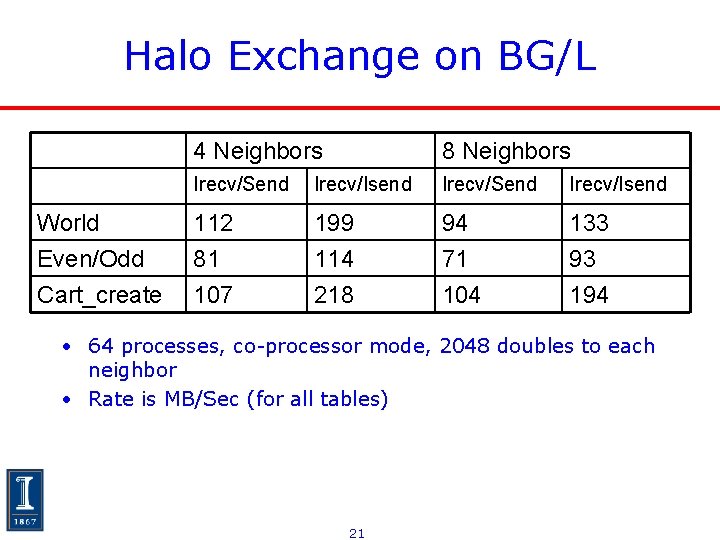
Halo Exchange on BG/L 4 Neighbors 8 Neighbors Irecv/Send Irecv/Isend World Even/Odd 112 81 199 114 94 71 133 93 Cart_create 107 218 104 194 • 64 processes, co-processor mode, 2048 doubles to each neighbor • Rate is MB/Sec (for all tables) 21
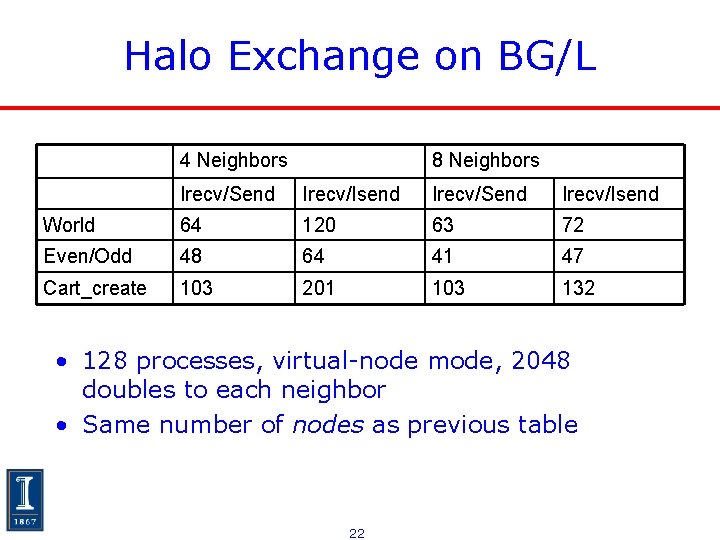
Halo Exchange on BG/L 4 Neighbors 8 Neighbors Irecv/Send Irecv/Isend World 64 120 63 72 Even/Odd 48 64 41 47 Cart_create 103 201 103 132 • 128 processes, virtual-node mode, 2048 doubles to each neighbor • Same number of nodes as previous table 22
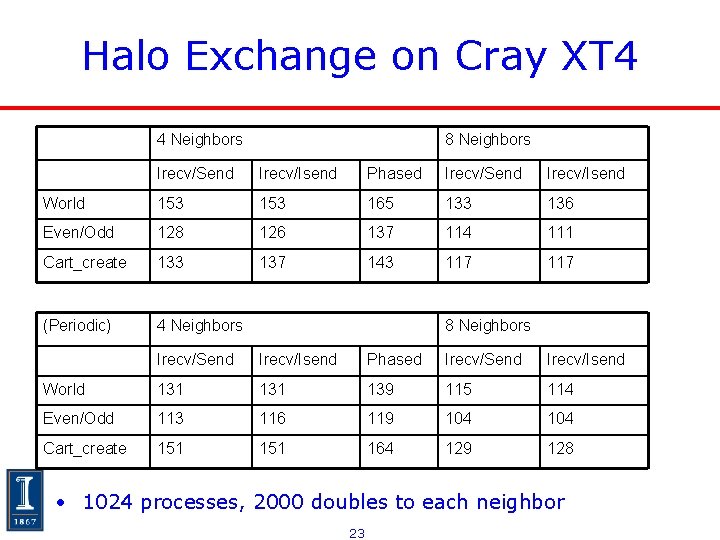
Halo Exchange on Cray XT 4 4 Neighbors 8 Neighbors Irecv/Send Irecv/Isend Phased Irecv/Send Irecv/Isend World 153 165 133 136 Even/Odd 128 126 137 114 111 Cart_create 133 137 143 117 (Periodic) 4 Neighbors 8 Neighbors Irecv/Send Irecv/Isend Phased Irecv/Send Irecv/Isend World 131 139 115 114 Even/Odd 113 116 119 104 Cart_create 151 164 129 128 • 1024 processes, 2000 doubles to each neighbor 23
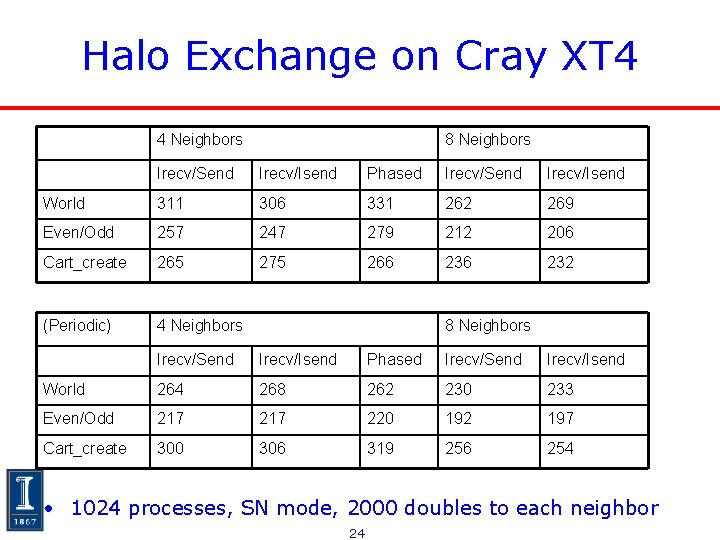
Halo Exchange on Cray XT 4 4 Neighbors 8 Neighbors Irecv/Send Irecv/Isend Phased Irecv/Send Irecv/Isend World 311 306 331 262 269 Even/Odd 257 247 279 212 206 Cart_create 265 275 266 232 (Periodic) 4 Neighbors 8 Neighbors Irecv/Send Irecv/Isend Phased Irecv/Send Irecv/Isend World 264 268 262 230 233 Even/Odd 217 220 192 197 Cart_create 300 306 319 256 254 • 1024 processes, SN mode, 2000 doubles to each neighbor 24
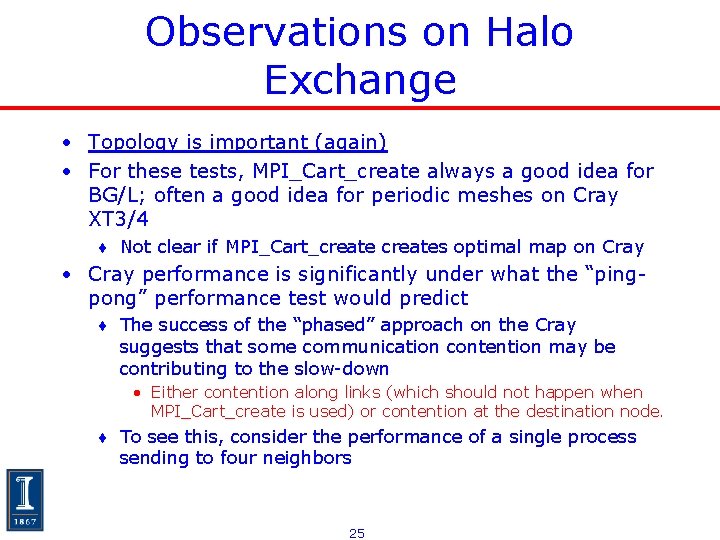
Observations on Halo Exchange • Topology is important (again) • For these tests, MPI_Cart_create always a good idea for BG/L; often a good idea for periodic meshes on Cray XT 3/4 ¨ Not clear if MPI_Cart_creates optimal map on Cray • Cray performance is significantly under what the “pingpong” performance test would predict ¨ The success of the “phased” approach on the Cray suggests that some communication contention may be contributing to the slow-down • Either contention along links (which should not happen when MPI_Cart_create is used) or contention at the destination node. ¨ To see this, consider the performance of a single process sending to four neighbors 25
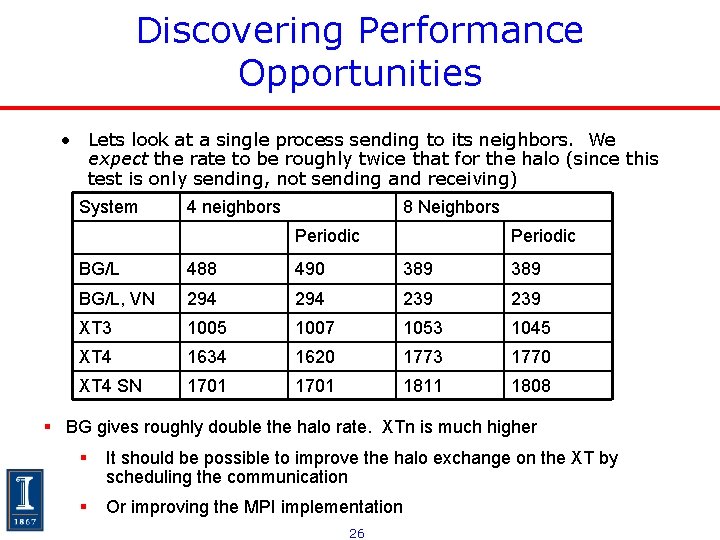
Discovering Performance Opportunities • Lets look at a single process sending to its neighbors. We expect the rate to be roughly twice that for the halo (since this test is only sending, not sending and receiving) System 4 neighbors 8 Neighbors Periodic BG/L 488 490 389 BG/L, VN 294 239 XT 3 1005 1007 1053 1045 XT 4 1634 1620 1773 1770 XT 4 SN 1701 1811 1808 § BG gives roughly double the halo rate. XTn is much higher § It should be possible to improve the halo exchange on the XT by scheduling the communication § Or improving the MPI implementation 26
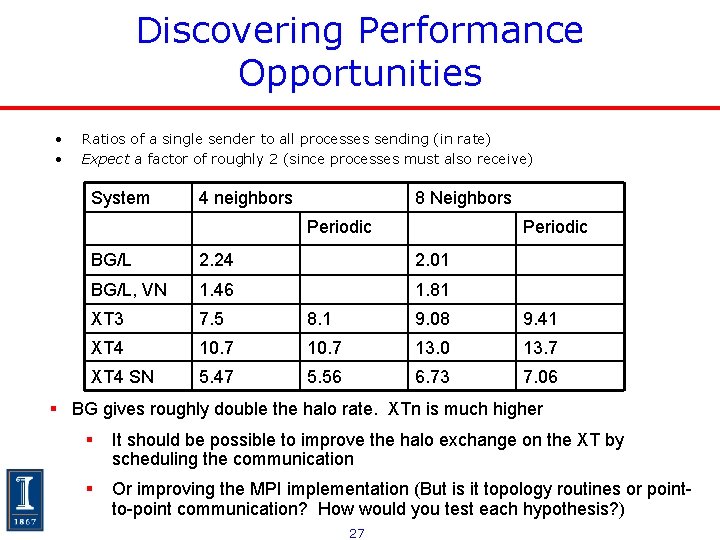
Discovering Performance Opportunities • • Ratios of a single sender to all processes sending (in rate) Expect a factor of roughly 2 (since processes must also receive) System 4 neighbors 8 Neighbors Periodic BG/L 2. 24 2. 01 BG/L, VN 1. 46 1. 81 XT 3 7. 5 8. 1 9. 08 9. 41 XT 4 10. 7 13. 0 13. 7 XT 4 SN 5. 47 5. 56 6. 73 7. 06 § BG gives roughly double the halo rate. XTn is much higher § It should be possible to improve the halo exchange on the XT by scheduling the communication § Or improving the MPI implementation (But is it topology routines or pointto-point communication? How would you test each hypothesis? ) 27
Efficient Support for MPI_THREAD_MULTIPLE • MPI-2 allows users to write multithreaded programs and call MPI functions from multiple threads (MPI_THREAD_MULTIPLE) • Thread safety does not come for free, however • Implementation must protect certain data structures or parts of code with mutexes or critical sections • To measure the performance impact, we ran tests to measure communication performance when using multiple threads versus multiple processes • These results address issues with the thread programming model, in the context of a demanding application (an MPI implementation) • Joint work with Rajeev Thakur (Argonne) 28 28
Application Assumptions about Threads • Thread support cost little, particularly when not used (MPI_Init_thread(MPI_THREAD_FUNNEL ED) • Threads and processes have equal communication performance • Blocked operations in one thread do not slow down other threads • How true are these assumptions? 29
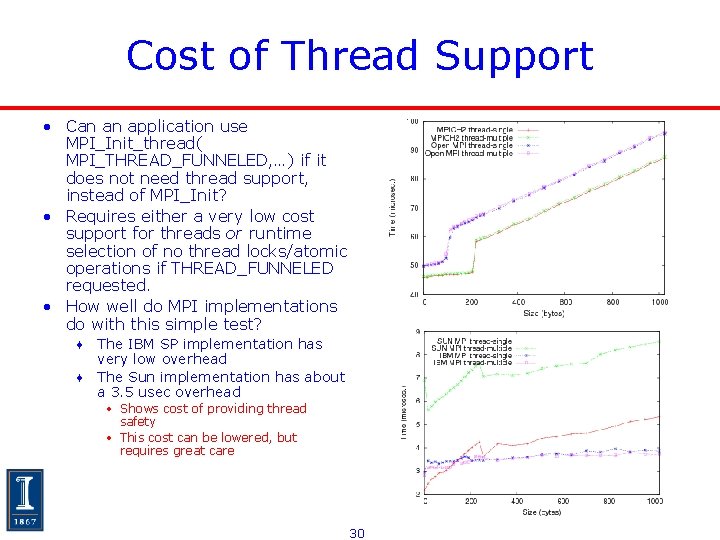
Cost of Thread Support • Can an application use MPI_Init_thread( MPI_THREAD_FUNNELED, …) if it does not need thread support, instead of MPI_Init? • Requires either a very low cost support for threads or runtime selection of no thread locks/atomic operations if THREAD_FUNNELED requested. • How well do MPI implementations do with this simple test? The IBM SP implementation has very low overhead ¨ The Sun implementation has about a 3. 5 usec overhead ¨ • Shows cost of providing thread safety • This cost can be lowered, but requires great care 30
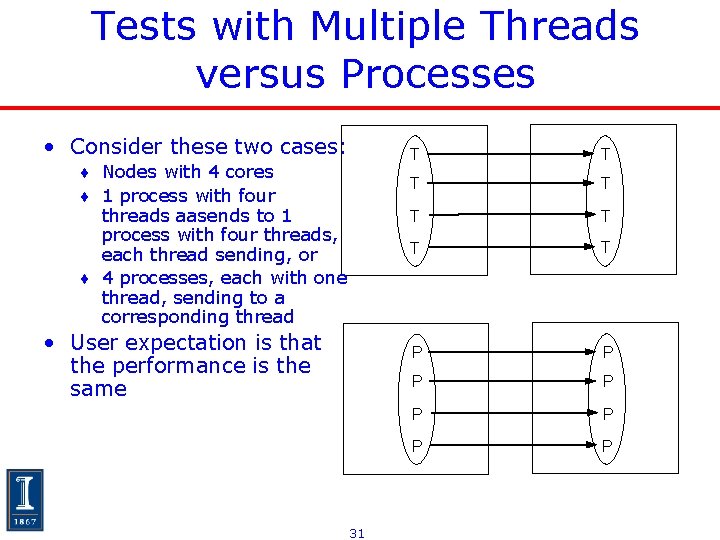
Tests with Multiple Threads versus Processes • Consider these two cases: ¨ Nodes with 4 cores ¨ 1 process with four threads aasends to 1 process with four threads, each thread sending, or ¨ 4 processes, each with one thread, sending to a corresponding thread • User expectation is that the performance is the same T T T T P P P P 31 31
Concurrent Bandwidth Test 32
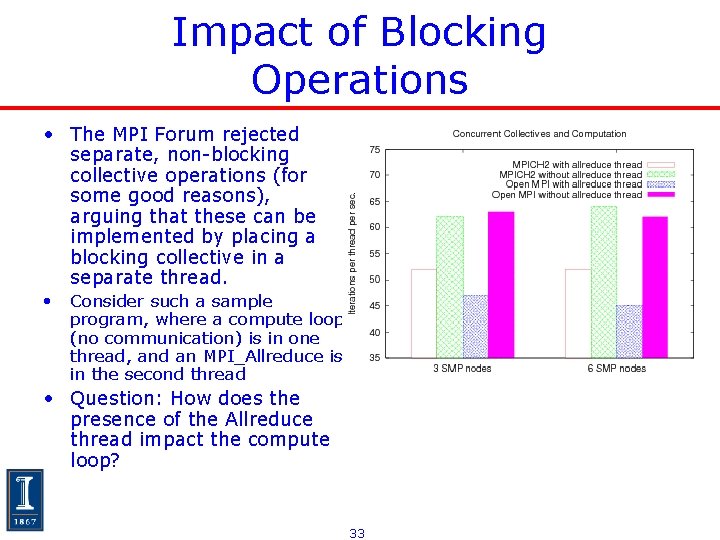
Impact of Blocking Operations • The MPI Forum rejected separate, non-blocking collective operations (for some good reasons), arguing that these can be implemented by placing a blocking collective in a separate thread. • Consider such a sample program, where a compute loop (no communication) is in one thread, and an MPI_Allreduce is in the second thread • Question: How does the presence of the Allreduce thread impact the compute loop? 33
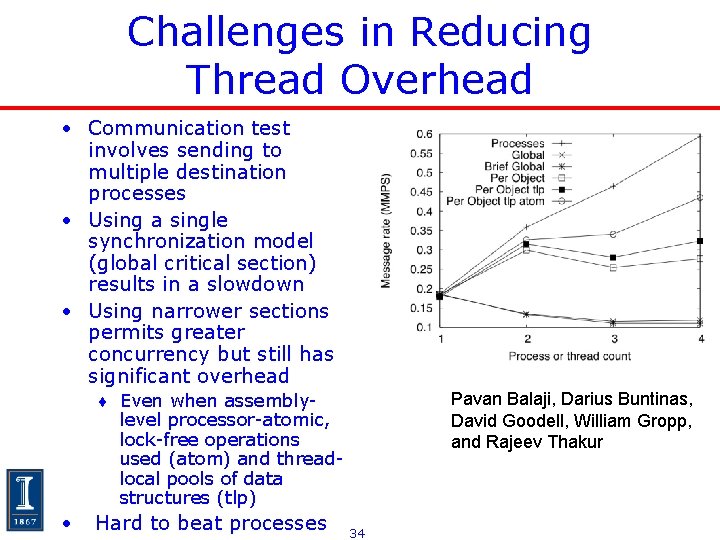
Challenges in Reducing Thread Overhead • Communication test involves sending to multiple destination processes • Using a single synchronization model (global critical section) results in a slowdown • Using narrower sections permits greater concurrency but still has significant overhead ¨ Even when assembly- Pavan Balaji, Darius Buntinas, David Goodell, William Gropp, and Rajeev Thakur level processor-atomic, lock-free operations used (atom) and threadlocal pools of data structures (tlp) • Hard to beat processes 34
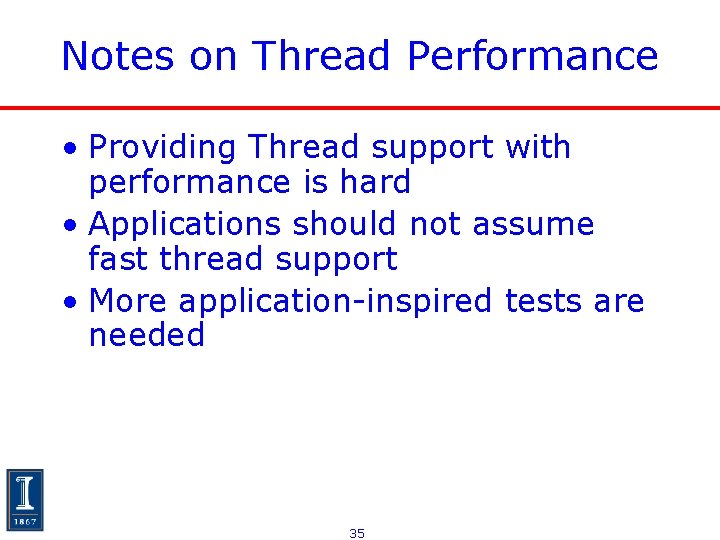
Notes on Thread Performance • Providing Thread support with performance is hard • Applications should not assume fast thread support • More application-inspired tests are needed 35
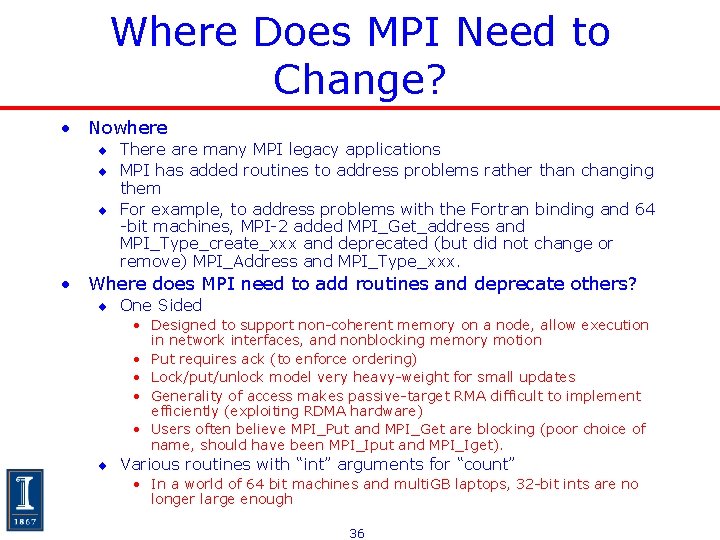
Where Does MPI Need to Change? • Nowhere ¨ There are many MPI legacy applications ¨ MPI has added routines to address problems rather than changing them ¨ For example, to address problems with the Fortran binding and 64 -bit machines, MPI-2 added MPI_Get_address and MPI_Type_create_xxx and deprecated (but did not change or remove) MPI_Address and MPI_Type_xxx. • Where does MPI need to add routines and deprecate others? ¨ One Sided • Designed to support non-coherent memory on a node, allow execution in network interfaces, and nonblocking memory motion • Put requires ack (to enforce ordering) • Lock/put/unlock model very heavy-weight for small updates • Generality of access makes passive-target RMA difficult to implement efficiently (exploiting RDMA hardware) • Users often believe MPI_Put and MPI_Get are blocking (poor choice of name, should have been MPI_Iput and MPI_Iget). ¨ Various routines with “int” arguments for “count” • In a world of 64 bit machines and multi. GB laptops, 32 -bit ints are no longer large enough 36
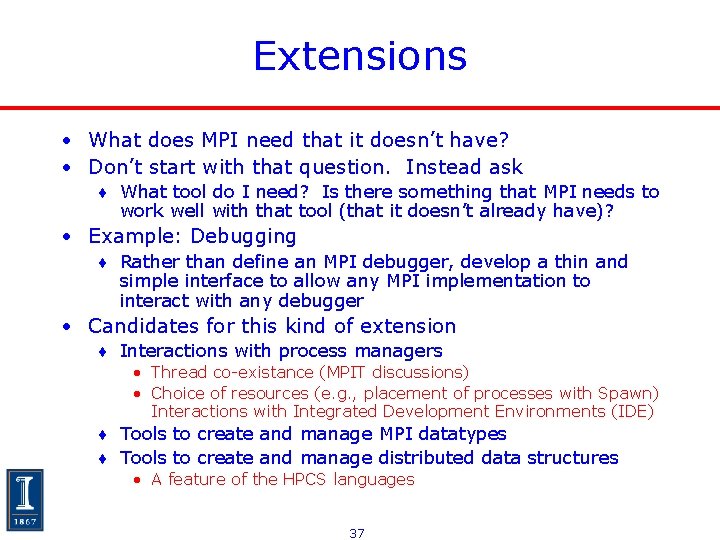
Extensions • What does MPI need that it doesn’t have? • Don’t start with that question. Instead ask ¨ What tool do I need? Is there something that MPI needs to work well with that tool (that it doesn’t already have)? • Example: Debugging ¨ Rather than define an MPI debugger, develop a thin and simple interface to allow any MPI implementation to interact with any debugger • Candidates for this kind of extension ¨ Interactions with process managers • Thread co-existance (MPIT discussions) • Choice of resources (e. g. , placement of processes with Spawn) Interactions with Integrated Development Environments (IDE) ¨ Tools to create and manage MPI datatypes ¨ Tools to create and manage distributed data structures • A feature of the HPCS languages 37
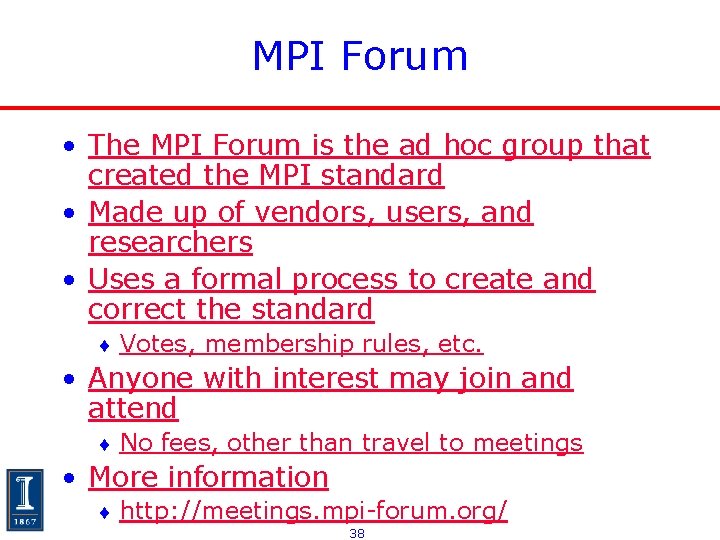
MPI Forum • The MPI Forum is the ad hoc group that created the MPI standard • Made up of vendors, users, and researchers • Uses a formal process to create and correct the standard ¨ Votes, membership rules, etc. • Anyone with interest may join and attend ¨ No fees, other than travel to meetings • More information ¨ http: //meetings. mpi-forum. org/ 38
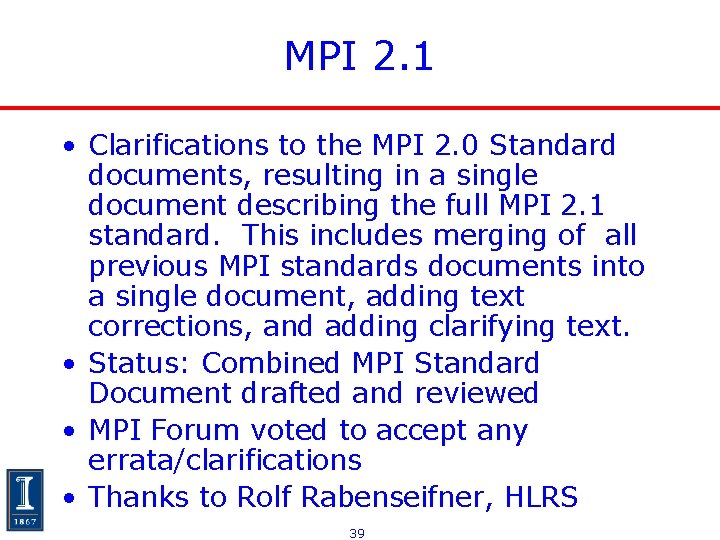
MPI 2. 1 • Clarifications to the MPI 2. 0 Standard documents, resulting in a single document describing the full MPI 2. 1 standard. This includes merging of all previous MPI standards documents into a single document, adding text corrections, and adding clarifying text. • Status: Combined MPI Standard Document drafted and reviewed • MPI Forum voted to accept any errata/clarifications • Thanks to Rolf Rabenseifner, HLRS 39
MPI 2. 2 • Small changes to the MPI 2. 1 standard. A small change is defined as one that does not break existing user code, either by interface changes or by semantic changes, and does not require large implementation changes. • Status: ¨ Two nontrival enhancements • Reuse of send buffers • Consistent use of const ¨ Many errata updates ¨ William Gropp, UIUC 40
MPI Forum Efforts: The Next Generation • MPI 3. 0 - Additions to the MPI 2. 2 standard that are needed for better platform and application support. These are to be consistent with MPI being a library that provides parallel process management and data exchange capabilities. This includes, but is not limited to, issues associated with scalability (performance and robustness), multi-core support, cluster support, and applications support. 41
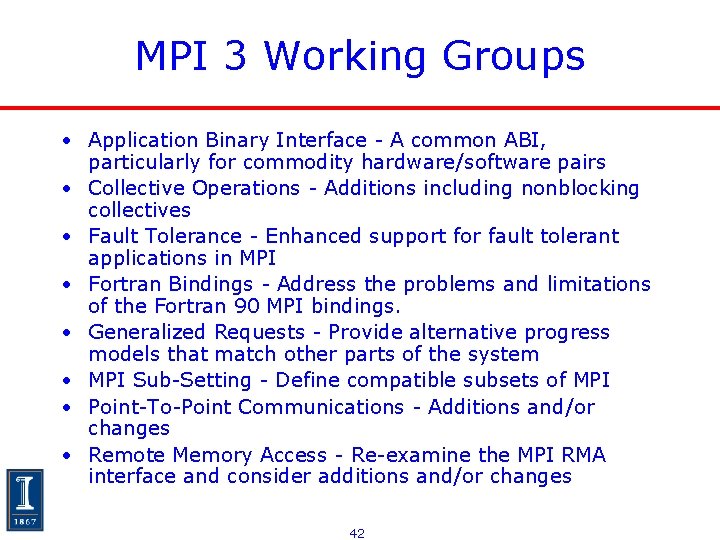
MPI 3 Working Groups • Application Binary Interface - A common ABI, particularly for commodity hardware/software pairs • Collective Operations - Additions including nonblocking collectives • Fault Tolerance - Enhanced support for fault tolerant applications in MPI • Fortran Bindings - Address the problems and limitations of the Fortran 90 MPI bindings. • Generalized Requests - Provide alternative progress models that match other parts of the system • MPI Sub-Setting - Define compatible subsets of MPI • Point-To-Point Communications - Additions and/or changes • Remote Memory Access - Re-examine the MPI RMA interface and consider additions and/or changes 42
What This Means for You • How can MPI coexist with other programming models? ¨ Where does MPI need to change? ¨ Where do others need to change? ¨ Example: allocation of thread/process resources • What could MPI provide to better support other tools? • What can MPI learn from the success of Charm++? • How should MPI evolve? You can help! 43