
The evolution of Medical implant telemetry and Body
The evolution of Medical implant telemetry and Body Area Network Hardware Technology: Hakan Ohlgren 2011 -06 -15
Presentation overview § § § Overview St. Jude Medical at a glance IMD telemetry of today Future IMD telemetry Why BAN? Standards, standards…
St. Jude Medical at a Glance Founded: 1976 Global Headquarters: St. Paul, Minnesota, USA First Product: Mechanical Heart Valve Global Reach: Products sold in 100+ countries More than 20 principal operations and manufacturing facilities worldwide 3 Employees: 16, 000+ 2010 Net Sales: $5. 165 billion Technology Platforms: Atrial Fibrillation Cardiac Rhythm Management Cardiovascular Neuromodulation
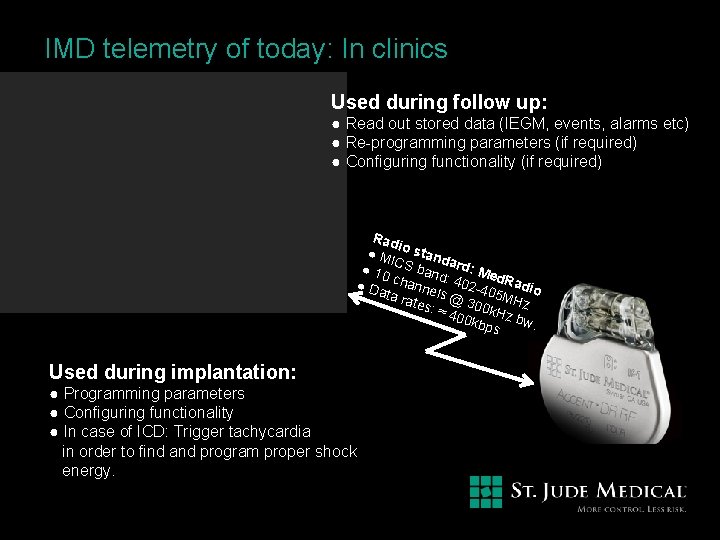
IMD telemetry of today: In clinics Used during follow up: ● Read out stored data (IEGM, events, alarms etc) ● Re-programming parameters (if required) ● Configuring functionality (if required) Rad i ● M o stand IC ● 10 S band ard: Me d ● Da channe : 402 -40 Radio ls ta ra 5 tes: @ 300 MHz k. H ≈ 40 0 kbp z bw. s Used during implantation: ● Programming parameters ● Configuring functionality ● In case of ICD: Trigger tachycardia in order to find and program proper shock energy.
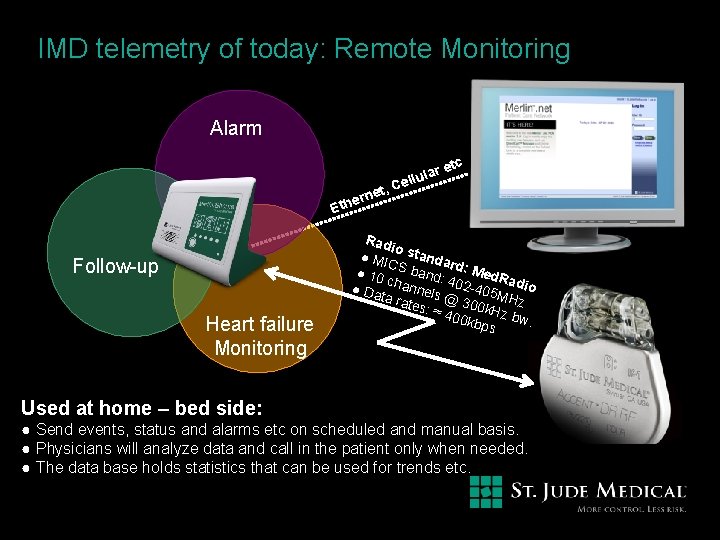
IMD telemetry of today: Remote Monitoring Alarm t, C ne her Et Follow-up Heart failure Monitoring la ellu c r et Rad io ● MI standa C r ● 10 S band: d: Med. R a 4 c ● Da hannels 02 -405 M dio ta ra tes: @ 300 k. H Hz ≈ 40 0 kbp z bw. s Used at home – bed side: ● Send events, status and alarms etc on scheduled and manual basis. ● Physicians will analyze data and call in the patient only when needed. ● The data base holds statistics that can be used for trends etc.
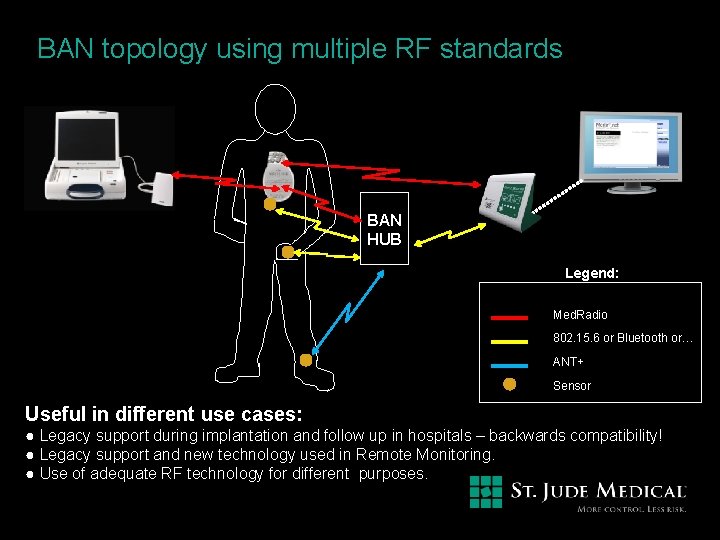
BAN topology using multiple RF standards BAN HUB Legend: Med. Radio 802. 15. 6 or Bluetooth or… ANT+ Sensor Useful in different use cases: ● Legacy support during implantation and follow up in hospitals – backwards compatibility! ● Legacy support and new technology used in Remote Monitoring. ● Use of adequate RF technology for different purposes.
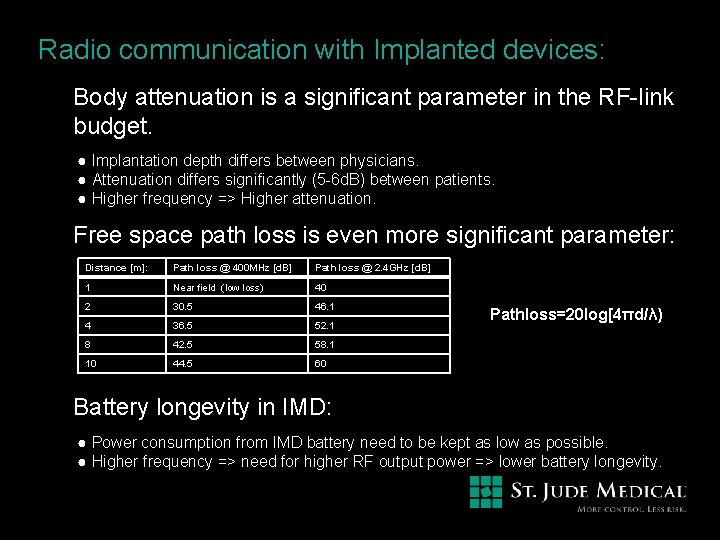
Radio communication with Implanted devices: Body attenuation is a significant parameter in the RF-link budget. ● Implantation depth differs between physicians. ● Attenuation differs significantly (5 -6 d. B) between patients. ● Higher frequency => Higher attenuation. Free space path loss is even more significant parameter: Distance [m]: Path loss @ 400 MHz [d. B] Path loss @ 2. 4 GHz [d. B] 1 Near field (low loss) 40 2 30. 5 46. 1 4 36. 5 52. 1 8 42. 5 58. 1 10 44. 5 60 Pathloss=20 log[4πd/λ) Battery longevity in IMD: ● Power consumption from IMD battery need to be kept as low as possible. ● Higher frequency => need for higher RF output power => lower battery longevity.
Why BAN? Problems to address: ● Health care costs are rapidly growing due to multiple factors. ● Increased demands from patients ● Lifestyle related issues – traveling, use of high tech equipment… What can BAN do to help: ● Remote care with more data from multiple sensors, will improve trend analysis ● Less frequent hospital visits ● High quality & reliable ”automatic” indications. ● Early warnings of negative health trends. ● Integrating remote care into every day life – Cellular phone applications etc
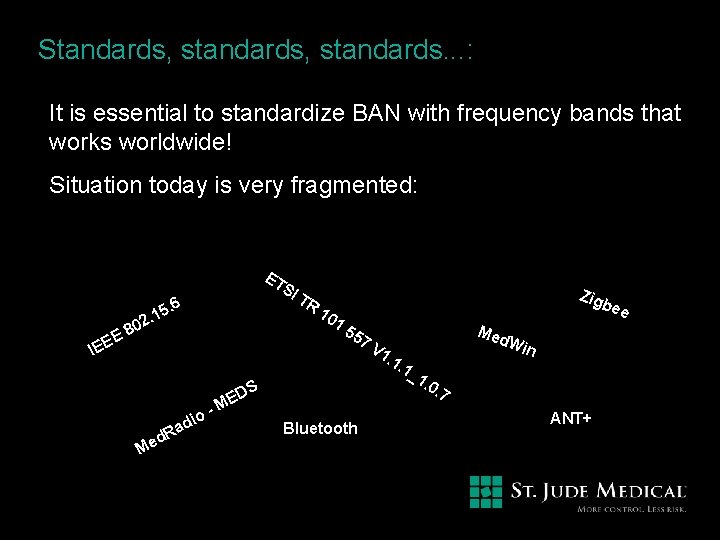
Standards, standards. . . : It is essential to standardize BAN with frequency bands that works worldwide! Situation today is very fragmented: ET SI 5. 6 E IEE 2. 1 0 8 TR 10 Zig b 15 57 V 1 Med . 1. Win Ra d Me dio - DS ME Bluetooth 1_ 1. 0 . 7 ANT+ ee

Thank you!

Global Presence Geographic Divisions Regional Headquarters Asia Pacific Hong Kong Europe, Middle East, Africa, Canada Brussels, Belgium Corporate Headquarters Japan Tokyo, Japan St. Paul, MN Latin America Sao Paolo, Brazil United States Austin, Texas Technology Platforms Cardiovascular St. Paul, MN Atrial Fibrillation St. Paul, MN Cardiac Rhythm Management Sylmar, CA Neuromodulation Plano, TX United States Manufacturing • Arizona • California • Minnesota • New Jersey • Oregon • Puerto Rico • South Carolina • Texas International Manufacturing • • Brazil Israel Sweden Thailand
- Slides: 11