
THE EVOLUTION OF MACROECONOMICS FROM THE PERSPECTIVE OF

- Slides: 19
THE EVOLUTION OF MACROECONOMICS FROM THE PERSPECTIVE OF ECONOMIC HISTORY Carles Manera Prof. Carles Manera 1
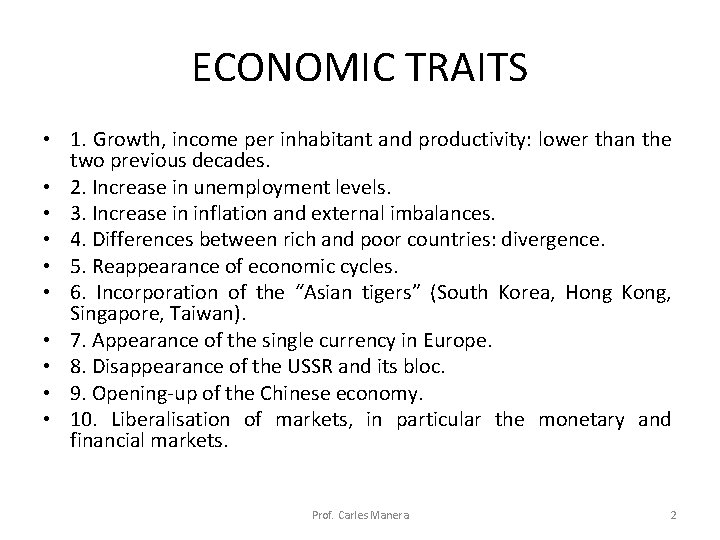
ECONOMIC TRAITS • 1. Growth, income per inhabitant and productivity: lower than the two previous decades. • 2. Increase in unemployment levels. • 3. Increase in inflation and external imbalances. • 4. Differences between rich and poor countries: divergence. • 5. Reappearance of economic cycles. • 6. Incorporation of the “Asian tigers” (South Korea, Hong Kong, Singapore, Taiwan). • 7. Appearance of the single currency in Europe. • 8. Disappearance of the USSR and its bloc. • 9. Opening-up of the Chinese economy. • 10. Liberalisation of markets, in particular the monetary and financial markets. Prof. Carles Manera 2
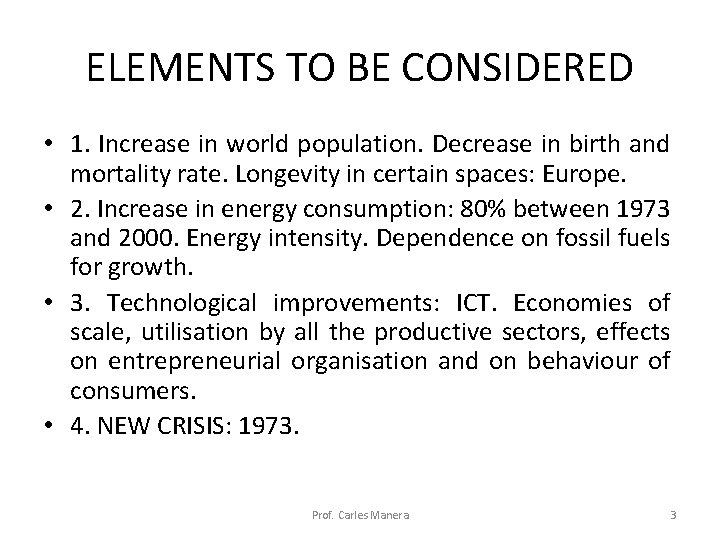
ELEMENTS TO BE CONSIDERED • 1. Increase in world population. Decrease in birth and mortality rate. Longevity in certain spaces: Europe. • 2. Increase in energy consumption: 80% between 1973 and 2000. Energy intensity. Dependence on fossil fuels for growth. • 3. Technological improvements: ICT. Economies of scale, utilisation by all the productive sectors, effects on entrepreneurial organisation and on behaviour of consumers. • 4. NEW CRISIS: 1973. Prof. Carles Manera 3
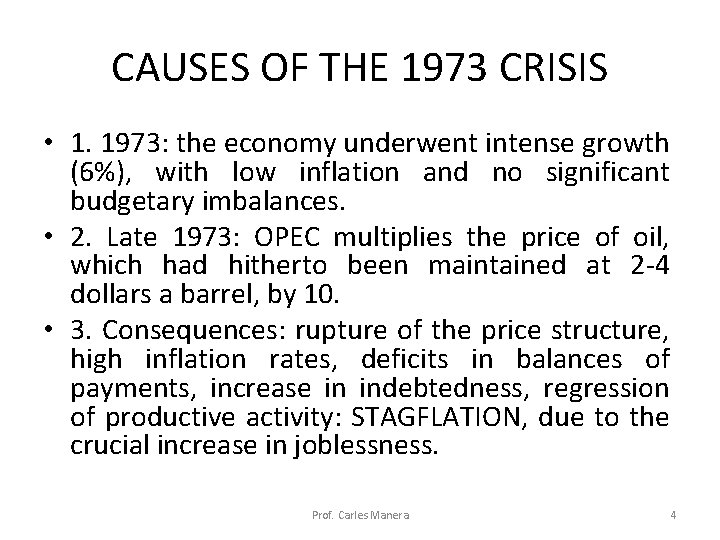
CAUSES OF THE 1973 CRISIS • 1. 1973: the economy underwent intense growth (6%), with low inflation and no significant budgetary imbalances. • 2. Late 1973: OPEC multiplies the price of oil, which had hitherto been maintained at 2 -4 dollars a barrel, by 10. • 3. Consequences: rupture of the price structure, high inflation rates, deficits in balances of payments, increase in indebtedness, regression of productive activity: STAGFLATION, due to the crucial increase in joblessness. Prof. Carles Manera 4
MORE ECONOMIC FACTORS… • 1. Loss of international financial discipline emanating from Bretton Woods. The United States abandon the fixed relationship of the dollar to gold, due to growing external American imbalance. • 2. US commercial deficit from 1968, worsened by the military expenditure of the Vietnam war and the arms race. • 3. US trade deficit and loss of dollar-gold relationship promote uncontrolled international liquidity. Free exchange system. Attempt to maintain stability in Europe: European Monetary System, with maximum fluctuations of 2. 25% with regard to central parities. All of this favours speculative capital movements. Prof. Carles Manera 5
…AND OTHER POLITICAL ONES • 1. The consensus between social democratic and conservative parties had worked: full employment, high growth level, agreements between unions and employers. • 2. The broad movement of capitals wrecked this harmony – it began to appear evident that it could be more profitable to invest in other countries, with lower labour costs. • 3. In this framework, the rises in oil prices took place. Prof. Carles Manera 6
THE ECONOMY FROM 1973 TO 1992 • 1. Slow, inconsistent growth period. • 2. Africa, Latin America halve growth. • 3. Western Europe: 50% reduction. Progress in productivity due to demographic reduction. • 4. Modest growth in USA. • 5. Only Asia grows, and this is due above all to China, Korea and Taiwan. • ALL THIS MAKES FOR CHANGES IN THE COMPOSITION OF PRODUCTIVE ACTIVITY AND IN EMPLOYMENT ON A GLOBAL SCALE: agriculture drops, industry slims down, the services sector advances. • But in the STRUCTURE OF ADDED VALUE related to employment, we see that primary activities make for 5% of the total product, with half of the world’s employment; whilst the third working in services generates 60% of GAV. • IN 1992, THERE ARE STILL LESS DEVELOPED COUNTRIES WHICH CAN TRANSFER LABOUR FROM AGRICULTURE TO INDUSTRY AND SERVICES. Prof. Carles Manera 7
ECONOMIC POLICIES • 1. Governments try to shore up the industrial sectors affected by the increase in the price of crude oil. • 2. This, together with the action of “automatic stabilizers”, cause considerable budgetary imbalances to appear, reinforced by the increase in debt servicing derived from the increase in interest rates. Prof. Carles Manera 8
ECONOMIC POLICIES (2) • 3. 1979: the second rise in the price of oil occurs. Economic agents and authorities lose confidence in the public sector. This is due to the poor results verified after the first crisis in 1973. • 4. Public expenditure came close to 50% of the GNP. This called for high taxes, whilst social benefits grew at a slower pace, undermining the legitimation of fiscal structures which had pronounced progressivity. Prof. Carles Manera 9
ECONOMIC POLICIES (3) • 5. Public deficits had not posed financing problems in periods of strong economic growth and low interest rates. But the change that the crisis brought about gave rise to more problems covering deficits. • 6. Monetary policy was subordinated to the financing of deficits. This meant that if inflation was a monetary phenomenon in the long term, monetary policy was useless as a tool for controlling inflation. Prof. Carles Manera 10
ECONOMIC POLICIES (4) • 7. The new mainstream supports itself on one basic pillar: the pursuit of stability, with strict rules of behaviour; giving more weight to the market, eliminating any possible hindrances. • 8. This implies: an increase in privatisations; and severe control of inflation. Central banks had to increase liquidity to a rate equal to the sum of the growth of the GNP and the desirable inflation rate. This implied rises and reductions in interest rates. (Liquidity: currency in circulation+sight deposits+time deposits for terms under two years available with prior notice of up to three months+shares in money market funds) Prof. Carles Manera 11
ECONOMIC POLICIES (5) • 9. The liberalisation of the capital markets and the application of new information technologies broadened the range of assets as a substitute for cash. • 10. Privatisation of public companies. One derivative of this was business concentration processes which in practice led to competition -restricting practices. Prof. Carles Manera 12
NEW LEADERSHIP? THE ADVANCE OF ASIA FROM 1973 • The only region of the world with economic indicators higher than in the golden decades. • It invests in education, capital goods; it opens up to the outside and reduced military expenditure. • Public support for exportation. Control of inflation and the public deficit. Low unitary labour costs. Absence of social protection. Severe inequalities. Prof. Carles Manera 13
AN EMERGING ECONOMIC MODEL • 1. Requires considerable initial investments. With scant savings, it makes for indebtedness. • 2. Needs to increase exports to cope with the debt services. • 3. Implies exchange rate policies that avoid appreciations. • 4. Investment injections from abroad: signing of commercial agreements (with the United States). Prof. Carles Manera 14
CYCLE CHANGES IN ADVANCED ECONOMIES, FROM 1990 Factors: 1. Reunification of Germany. 2. Persian Gulf conflict. 3. Appearance of problems in the US and Japanese banking systems, resulting from the decline in the stock exchanges and the prices of real estate assets, which brought issues stemming from the granting of subprime loans to the surface. 4. Enlargement of the European Economic Community. The decision to create a single currency was made, and the Maastricht criteria were laid down. Prof. Carles Manera 15
DIFFERENCE BETWEEN EUROPE AND THE UNITED STATES The behaviour of unemployment: In around 1973, Europe had 3% unemployment; the United States had over 6%. This evolution has varied: Europe’s unemployment rates have risen in each cyclical episode since 1973. Why? In the US, the absorption of unemployed persons is faster, although the initial depressive stages are more intense: institutional flexibilities which bring with them social inequalities due to the scant social protection. In Europe, the absorption is slower, with the inefficiency costs of greater unemployment being accepted in exchange for a higher level of social protection which allows inequalities to be kept within narrower margins. Prof. Carles Manera 16
THE ECONOMY FROM 1993 TO THE GREAT RECESSION: THE DEVELOPED COUNTRIES • 1. Developed economies: lower growth rate. • 2. USA: sustained growth until. Price stability, low levels of unemployment, government surplus, growing productivity. Importance of new economics: ICT. • 3. New Economics: over-investment in ICT, breakaway from the growth path in 2001, worsened by the attacks in the United States. • 4. Europe: creation of the EU, introduction of the €. Stability. Growth close to 2. 5%. • 5. Japan: deflation, L growth rate, economy sensitive to variations in the exchange rate, strong competition from its neighbours who keep exchange rates pegged to the $. Prof. Carles Manera 17
THE ECONOMY FROM 1993 TO THE GREAT RECESSION: THE EMERGING COUNTRIES (1) • 1. ASIA. At first: Thailand. It spreads to the Philippines, Malaysia, Indonesia, Korea. Motive: high external current account deficits. High indebtedness: withdrawal of confidence. These countries depend on influxes of foreign capital. Growth of exports, key variable. Exchange system pegged to $ goes well; but the appreciation of the $ from 1995 on drives competitiveness down and increases external deficits. TEACHINGS OF THE CRISIS: countries with initial equilibriums could enter into sudden crises, which called for intense international aid. Prof. Carles Manera 18
THE ECONOMY FROM 1993 TO THE GREAT RECESSION: THE EMERGING COUNTRIES(2) • 2. RUSSIA. Massive debt negotiated at very high rates, contagion from the Asian crisis. Capital outflows and check on stabilisation. Significant aid from the IMF and the World Bank. • 3. ARGENTINA. In conditions of price stability and moderate deficit, the country enters a crisis: Asian and Russian contagion. Reduction of foreign capital, contraction of the GNP, greater inflation. Parity with the dollar was good as long as the American currency was not revalued; afterwards, that linking was lethal. Bank deposits were frozen, failure to meet international commitments. Political corruption. Prof. Carles Manera 19