
The Evolution of Layered Protocol Stacks Leads to




- Slides: 38
The Evolution of Layered Protocol Stacks Leads to an Hourglass-Shaped Architecture Saamer Akhshabi Constantine Dovrolis Georgia Institute of Technology s. akhshabi, constantine@gatech. edu 1
My co-author, Saamer Akhshabi (Very smart 2 nd year Ph. D student, he could not travel to Toronto) 2
Outline • • Motivation Model description Results Concluding remarks 3
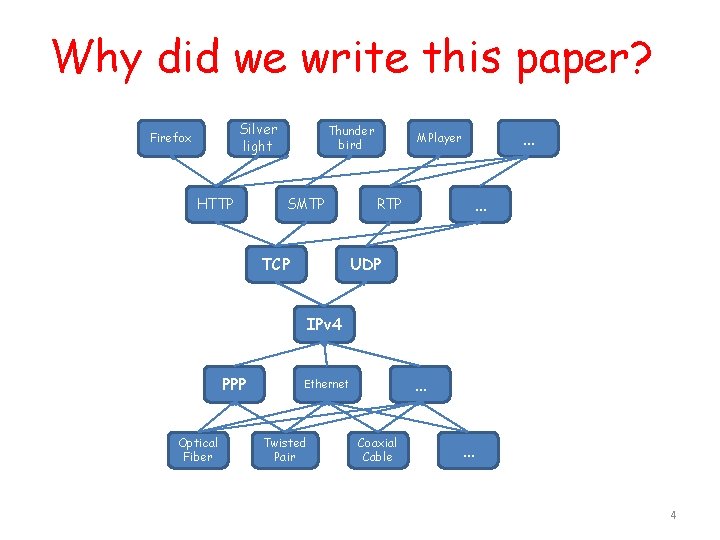
Why did we write this paper? Silver light Firefox HTTP Thunder bird SMTP TCP … MPlayer … RTP UDP IPv 4 PPP Optical Fiber … Ethernet Twisted Pair Coaxial Cable … 4
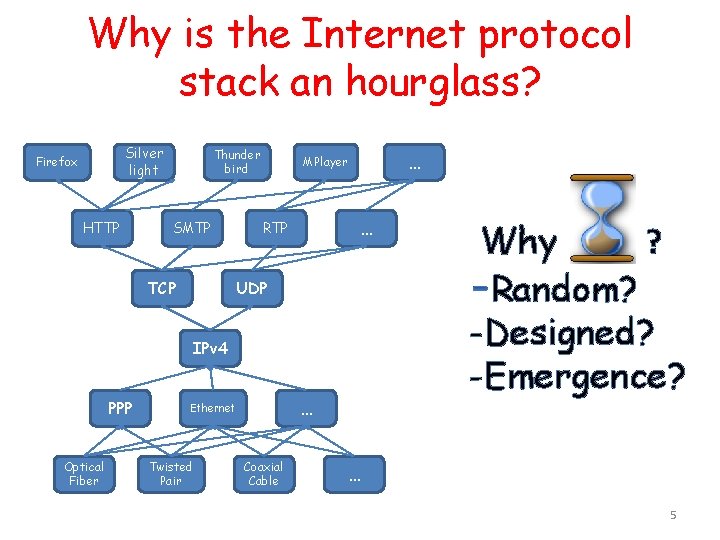
Why is the Internet protocol stack an hourglass? Silver light Firefox HTTP Thunder bird SMTP TCP … MPlayer … RTP UDP IPv 4 PPP Optical Fiber … Ethernet Twisted Pair Coaxial Cable ? Why Random? -Designed? -Emergence? … 5
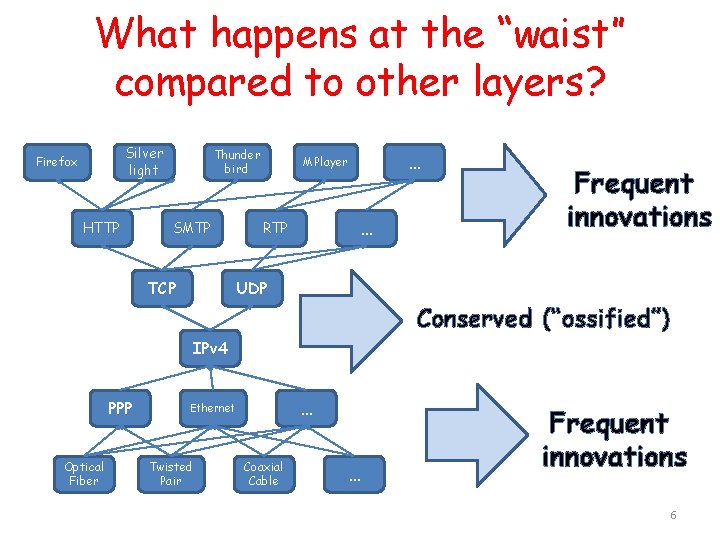
What happens at the “waist” compared to other layers? Silver light Firefox HTTP Thunder bird SMTP TCP … MPlayer … RTP Frequent innovations UDP Conserved (“ossified”) IPv 4 PPP Optical Fiber … Ethernet Twisted Pair Coaxial Cable … Frequent innovations 6
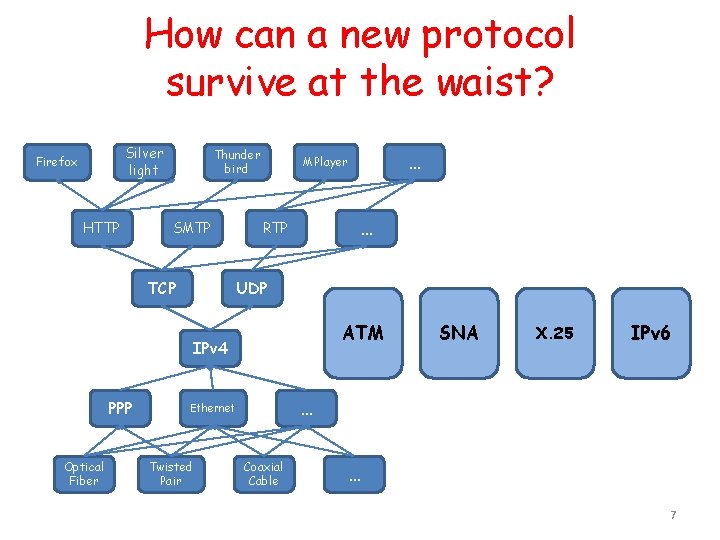
How can a new protocol survive at the waist? Silver light Firefox HTTP Thunder bird SMTP TCP … RTP UDP ATM IPv 4 PPP Optical Fiber … MPlayer X. 25 IPv 6 … Ethernet Twisted Pair SNA Coaxial Cable … 7
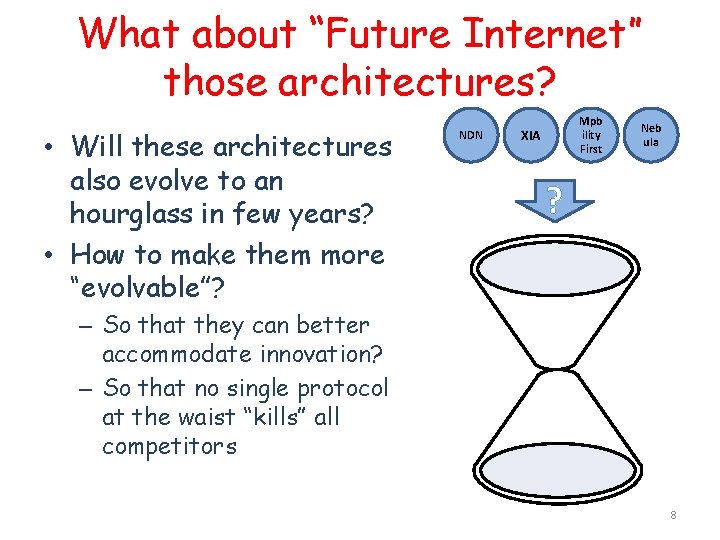
What about “Future Internet” those architectures? • Will these architectures also evolve to an hourglass in few years? • How to make them more “evolvable”? NDN Mpb ility First XIA Neb ula ? – So that they can better accommodate innovation? – So that no single protocol at the waist “kills” all competitors 8
Outline • • Motivation Model: Evo. Arch Results Conclusions 9
Two Disclaimers • Evo. Arch is only an abstraction of protocol stacks – Evo. Arch does not capture many practical aspects and protocol-specific or layer-specific semantics • Evo. Arch is certainly not the only model, or “the correct model”, for the emergence of hourglass -shaped network architectures – Models should be judged based on their assumptions, parsimony and predictions 10
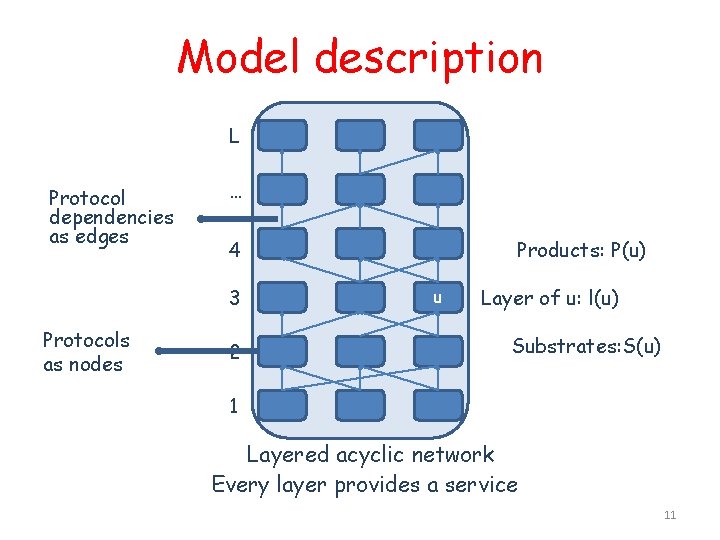
Model description L Protocol dependencies as edges … 4 3 Protocols as nodes 2 Products: P(u) u Layer of u: l(u) Substrates: S(u) 1 Layered acyclic network Every layer provides a service 11
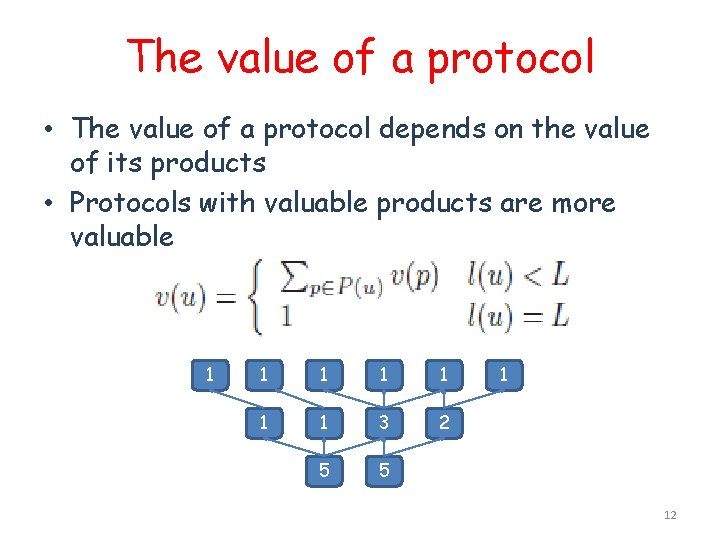
The value of a protocol • The value of a protocol depends on the value of its products • Protocols with valuable products are more valuable 1 1 1 1 3 2 5 5 1 12
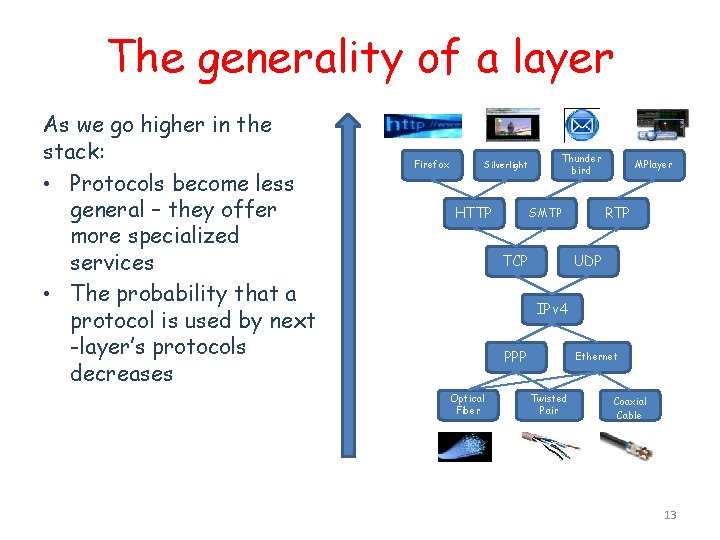
The generality of a layer As we go higher in the stack: • Protocols become less general – they offer more specialized services • The probability that a protocol is used by next -layer’s protocols decreases Firefox Silverlight HTTP Thunder bird RTP SMTP TCP MPlayer UDP IPv 4 PPP Optical Fiber Ethernet Twisted Pair Coaxial Cable 13
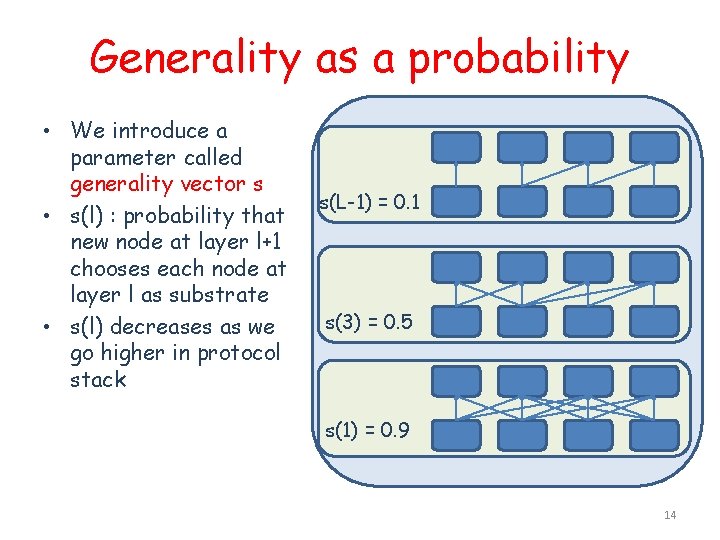
Generality as a probability • We introduce a parameter called generality vector s • s(l) : probability that new node at layer l+1 chooses each node at layer l as substrate • s(l) decreases as we go higher in protocol stack s(L-1) = 0. 1 s(3) = 0. 5 s(1) = 0. 9 14
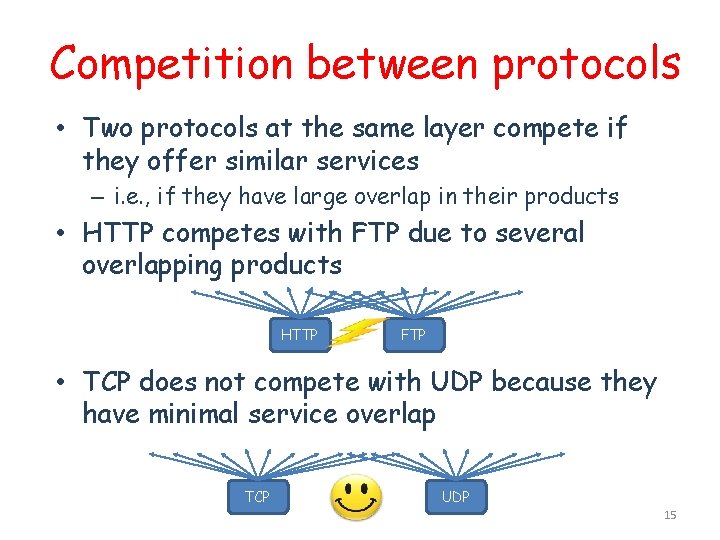
Competition between protocols • Two protocols at the same layer compete if they offer similar services – i. e. , if they have large overlap in their products • HTTP competes with FTP due to several overlapping products HTTP FTP • TCP does not compete with UDP because they have minimal service overlap TCP UDP 15
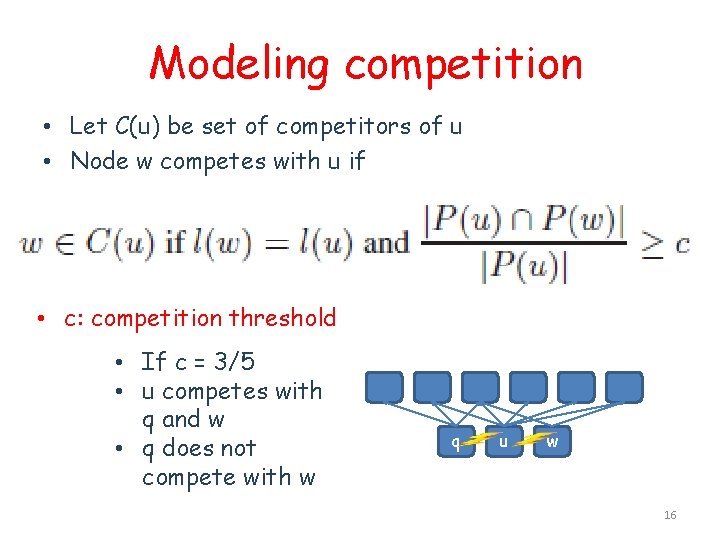
Modeling competition • Let C(u) be set of competitors of u • Node w competes with u if • c: competition threshold • If c = 3/5 • u competes with q and w • q does not compete with w q u w 16
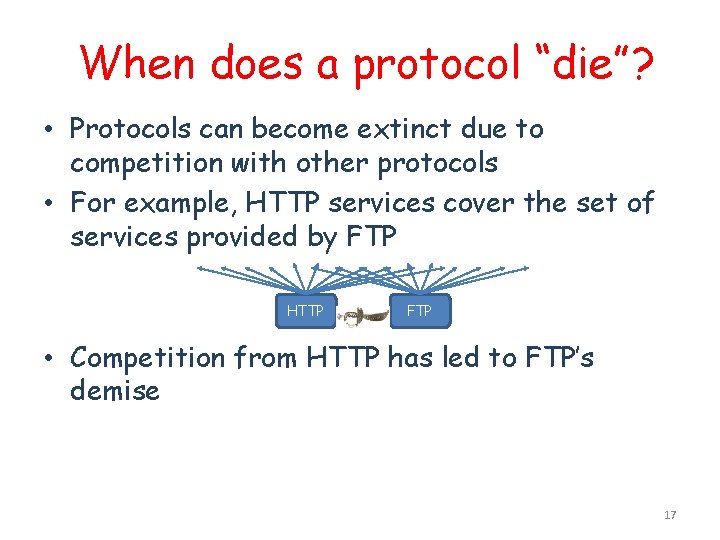
When does a protocol “die”? • Protocols can become extinct due to competition with other protocols • For example, HTTP services cover the set of services provided by FTP HTTP FTP • Competition from HTTP has led to FTP’s demise 17
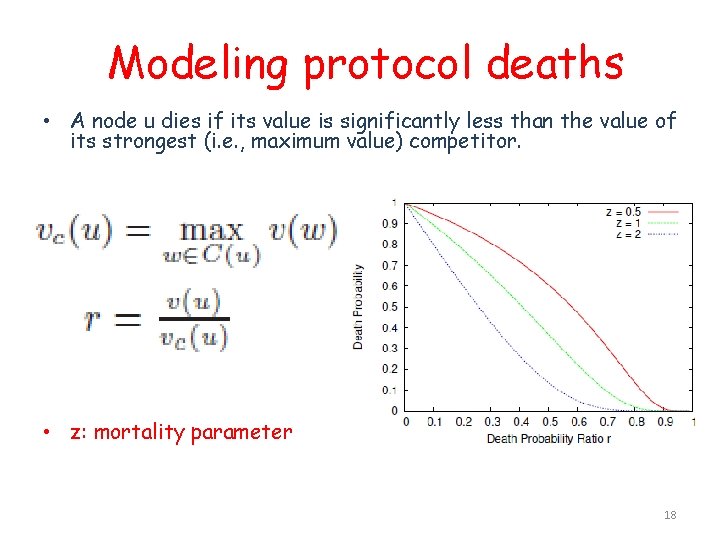
Modeling protocol deaths • A node u dies if its value is significantly less than the value of its strongest (i. e. , maximum value) competitor. • z: mortality parameter 18
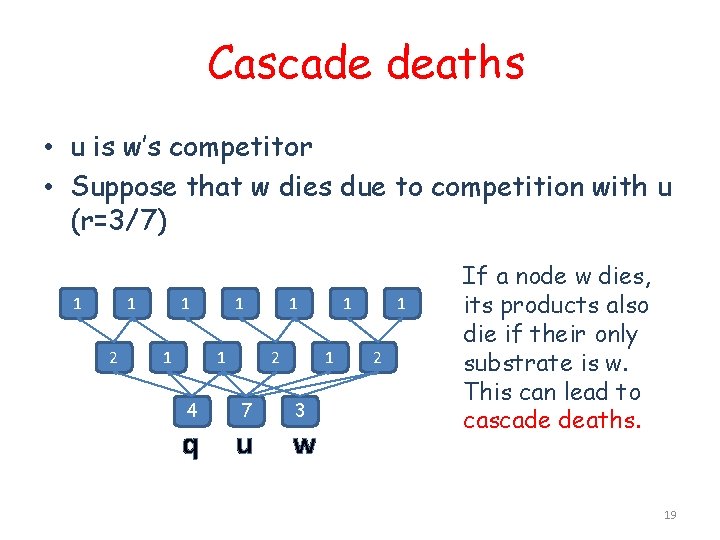
Cascade deaths • u is w’s competitor • Suppose that w dies due to competition with u (r=3/7) 1 1 2 1 1 4 7 3 q u w 1 2 If a node w dies, its products also die if their only substrate is w. This can lead to cascade deaths. 19
Protocol births • Basic birth process ØNumber of new nodes at given time is a small fraction of total number of nodes in network at that time. ØNew nodes assigned randomly to layers • Death-regulated birth process ØThe birth rate at a layer is regulated by the death rate in that layer ØDiscussed later 20
Summary of Evo. Arch • Discrete-time model – Time advances in rounds • Each round includes Ø birth of new nodes Ø competition among nodes at the same layer Ø potentially, death of some nodes • Key parameters – Generality vector s – Competition threshold c – Mortality parameter z 21
Outline • Motivation • Model Description • Results – Emergence of hourglass structures – Controlling the location/width of the waist – Evolutionary kernels – Protocol differences • Conclusions 22
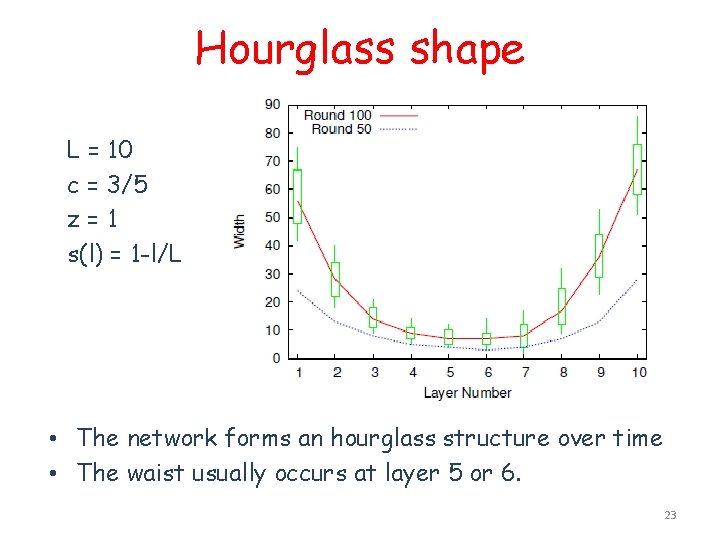
Hourglass shape L = 10 c = 3/5 z=1 s(l) = 1 -l/L • The network forms an hourglass structure over time • The waist usually occurs at layer 5 or 6. 23
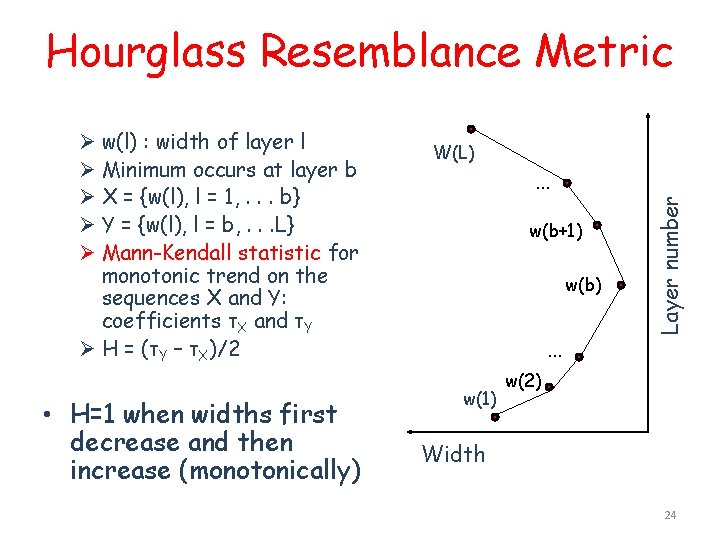
Ø w(l) : width of layer l Ø Minimum occurs at layer b Ø X = {w(l), l = 1, . . . b} Ø Y = {w(l), l = b, . . . L} Ø Mann-Kendall statistic for monotonic trend on the sequences X and Y: coefficients τX and τY Ø H = (τY – τX)/2 • H=1 when widths first decrease and then increase (monotonically) W(L) … w(b+1) w(b) … w(1) Layer number Hourglass Resemblance Metric w(2) Width 24
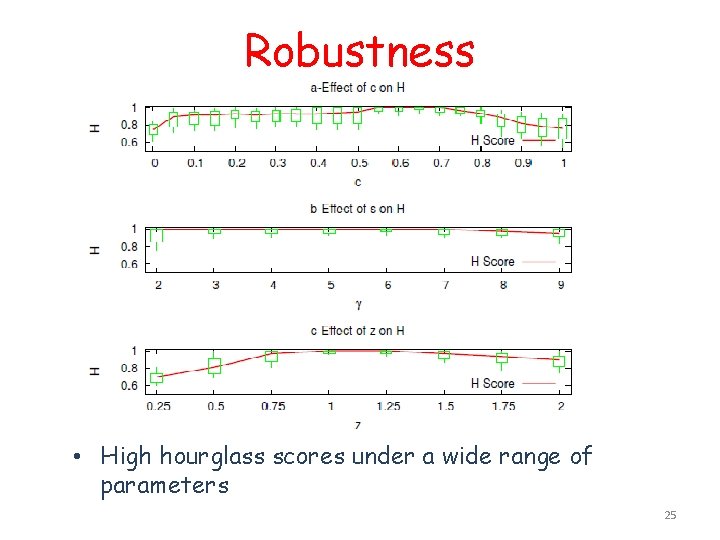
Robustness • High hourglass scores under a wide range of parameters 25
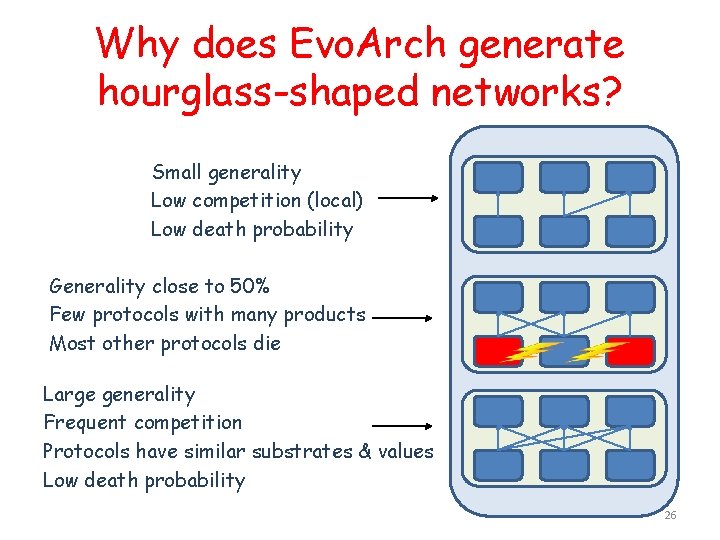
Why does Evo. Arch generate hourglass-shaped networks? Small generality Low competition (local) Low death probability Generality close to 50% Few protocols with many products Most other protocols die Large generality Frequent competition Protocols have similar substrates & values Low death probability 26
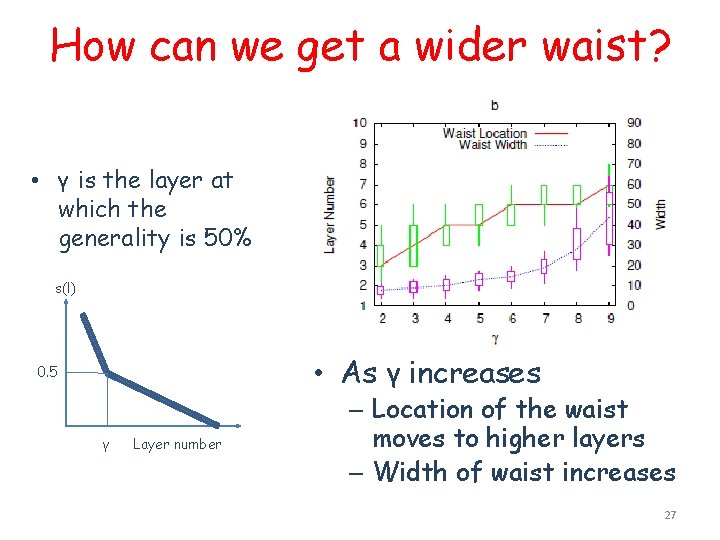
How can we get a wider waist? • γ is the layer at which the generality is 50% s(l) • As γ increases 0. 5 γ Layer number – Location of the waist moves to higher layers – Width of waist increases 27
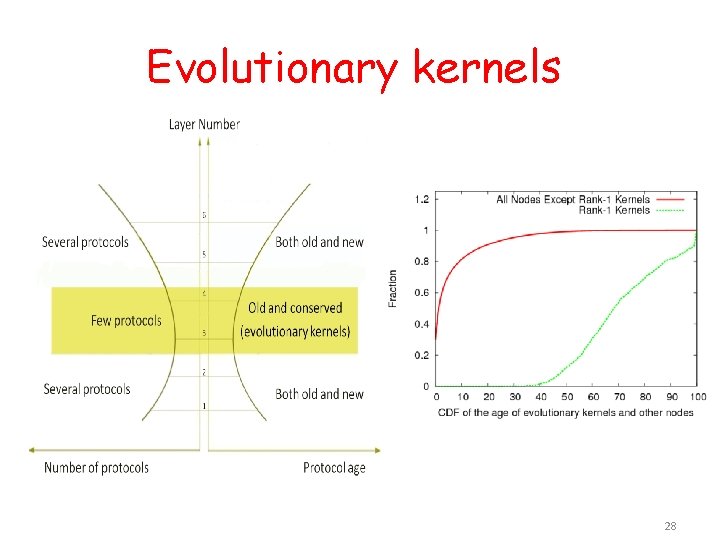
Evolutionary kernels 28
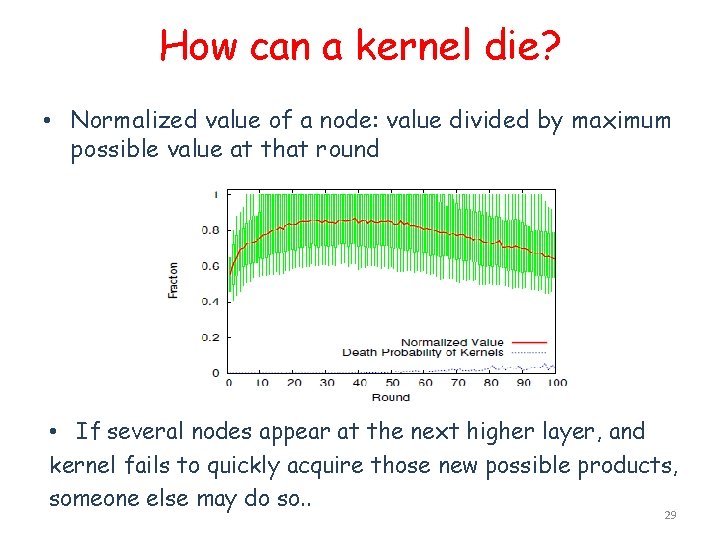
How can a kernel die? • Normalized value of a node: value divided by maximum possible value at that round • If several nodes appear at the next higher layer, and kernel fails to quickly acquire those new possible products, someone else may do so. . 29
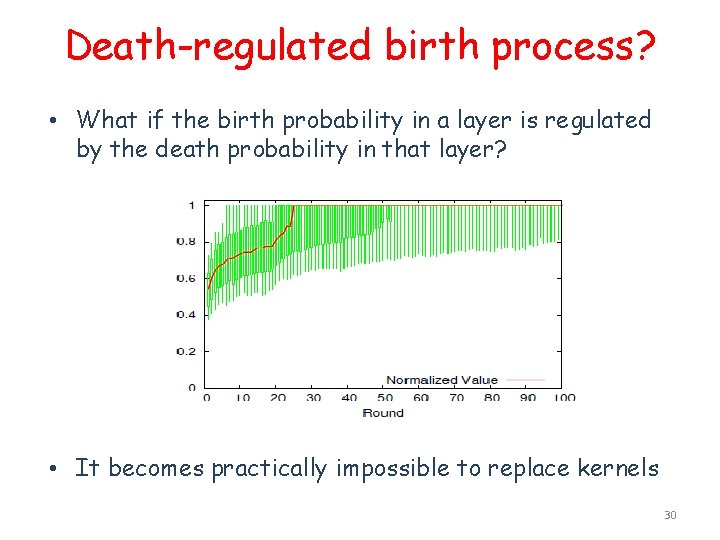
Death-regulated birth process? • What if the birth probability in a layer is regulated by the death probability in that layer? • It becomes practically impossible to replace kernels 30
What if protocols differ in term of a “quality factor”? • The “quality factor” can be interpreted broadly Ø Ø Ø Performance, Extent of deployment, Reliability or security, Incremental improvements, etc 31
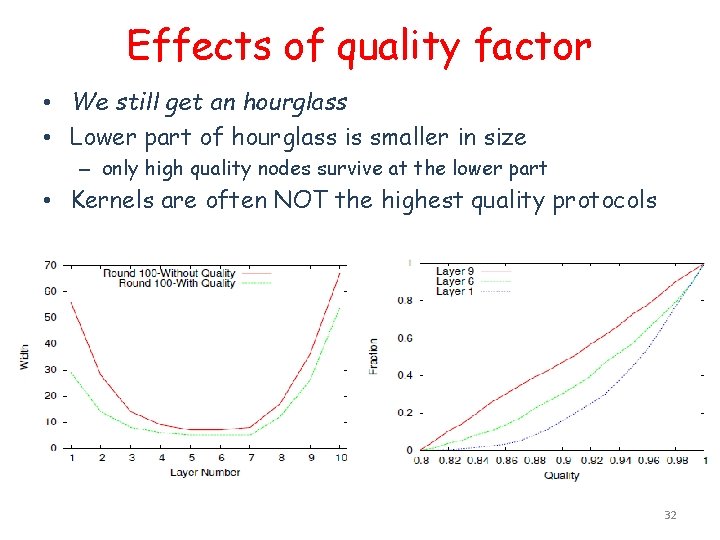
Effects of quality factor • We still get an hourglass • Lower part of hourglass is smaller in size – only high quality nodes survive at the lower part • Kernels are often NOT the highest quality protocols 32
Outline • • Motivation Model Description Results Concluding remarks 33
What does this mean for the Internet architecture? • New way to think about (and teach) Internet’s hourglass architecture • New way to think about “ossification” of protocols at the waist • Parameterized model for TCP/IP stack: – Two protocols compete when their service overlap is more than 70% – A protocol survives only if its value is more than 90% of its strongest competitor’s value – Death-regulated births 34
What does this mean for IPv 4 vs IPv 6? • IPv 6 has same products but lower extent of deployment (i. e. , lower “quality factor”) • IPv 6 would find it easier to compete w IPv 4 if: – It had some distinct products that IPv 4 does not have – Unfortunately, it only offers more addresses • IPv 6 would face easier adoption if it was not presented as “IPv 4 replacement” but as “the second network-layer protocol” 35
What does this mean for future Internet architectures? • Hourglass structures should be expected if these new architectures evolve/compete • Designers should strive for wider waist – More diverse waist -> more evolvable architecture • Evo. Arch: as the waist moves higher, it also becomes wider – How to push the waist to a higher layer? – See highly relevant paper: • L. Popa, A. Ghodsi, and I. Stoica. HTTP as the Narrow Waist of the Future Internet. In ACM SIGCOMM Hot. Nets, 2010 36
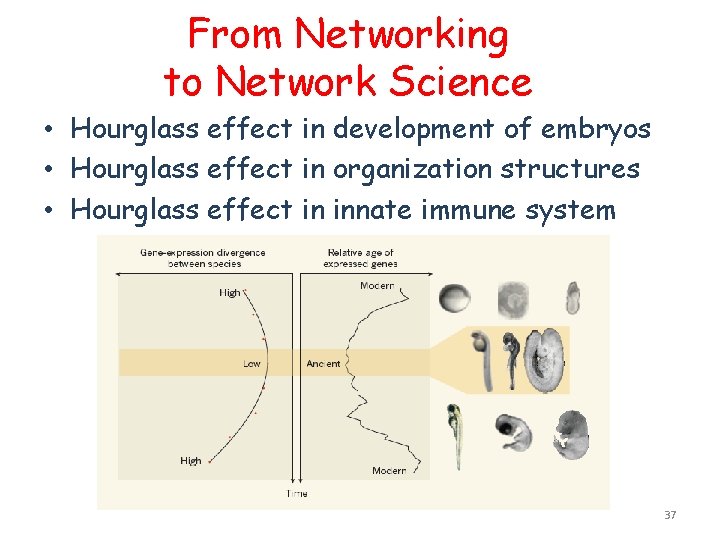
From Networking to Network Science • Hourglass effect in development of embryos • Hourglass effect in organization structures • Hourglass effect in innate immune system 37
Thanks to Todd Streelman (School of Biology, Georgia Tech) Soojin Yi (School of Biology, Georgia Tech) National Science Foundation (NSF) 38