
The Evolution of Homeland Security A Hermeneutic Phenomenological


- Slides: 12
The Evolution of Homeland Security: A Hermeneutic Phenomenological Exploration Toward Defining the Term Tina M. Bynum, DM-Homeland Security Colorado Technical University 22 March 2017
Overview • Explore a definition of homeland security – Bellavita “What is Homeland Security” • Purpose • • Strategic Management & Planning Consistent Allocation of Resources Developing Curriculum Establishing an Academic Discipline • Methodology • Hermeneutic Phenomenological Exploration • Document Analysis • Implications • Conclusions 2
Scope • to understand the evolution of the term “homeland security” • To determine if and how this term has been defined in the government literature • To uncover use of management principles (e. g. , Drucker’s SMART Goals) • To determine if a single definition can be used conceptually and operationally across the homeland security enterprise 3
Research Questions Using hermeneutic phenomenology, focused on three main questions: • How is homeland security defined among a variety of homeland security documents, articles, congressional reports, and presidential directives between 1999 and 2015. • Do these documents provide an indication of how homeland security objectives and initiatives are managed? – Do they contain verbiage that either directly or indirectly link to being SMART - specific, measurable, achievable, relevant, and time-bound? • What does the hermeneutic process tell us about the documents? – Does the hermeneutic process uncover a definition? 4
Considerations • Management styles considered – Crisis management – immediate and proximate – Reactive management – immediate and responsive – Strategic management – planned and measured • Purpose of Homeland Security Written Communication – Required a hermeneutic interpretation • Researcher Bias 5
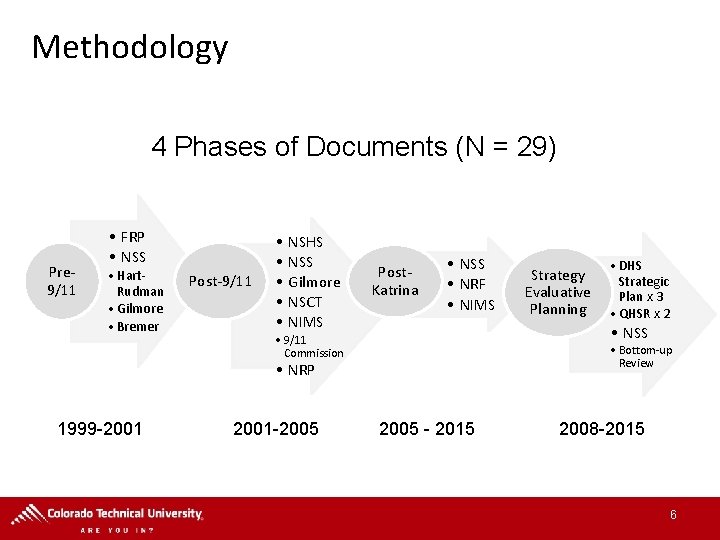
Methodology 4 Phases of Documents (N = 29) Pre 9/11 • FRP • NSS • Hart. Rudman • Gilmore • Bremer Post-9/11 • • • NSHS NSS Gilmore NSCT NIMS Post. Katrina • NSS • NRF • NIMS 2001 -2005 • DHS Strategic Plan x 3 • QHSR x 2 • NSS • 9/11 Commission • Bottom-up Review • NRP 1999 -2001 Strategy Evaluative Planning 2005 - 2015 2008 -2015 6
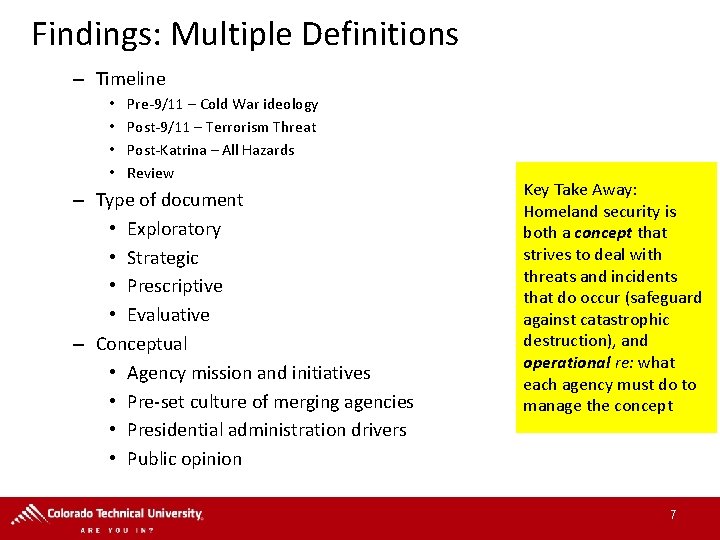
Findings: Multiple Definitions – Timeline • • Pre-9/11 – Cold War ideology Post-9/11 – Terrorism Threat Post-Katrina – All Hazards Review – Type of document • Exploratory • Strategic • Prescriptive • Evaluative – Conceptual • Agency mission and initiatives • Pre-set culture of merging agencies • Presidential administration drivers • Public opinion Key Take Away: Homeland security is both a concept that strives to deal with threats and incidents that do occur (safeguard against catastrophic destruction), and operational re: what each agency must do to manage the concept 7
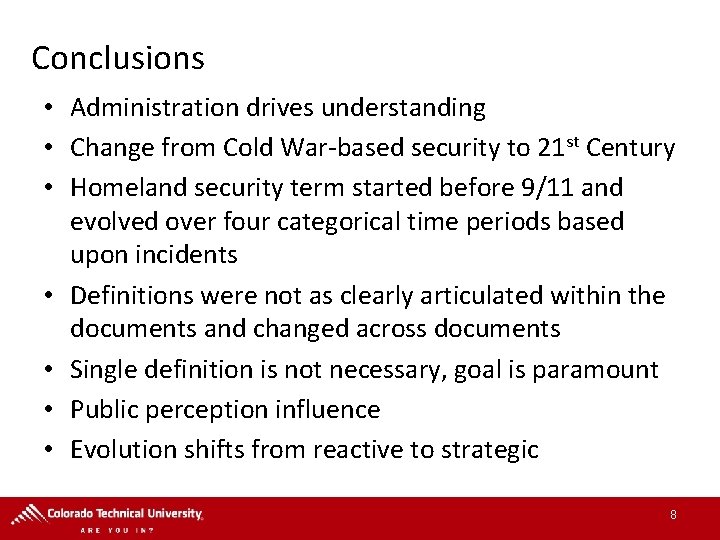
Conclusions • Administration drives understanding • Change from Cold War-based security to 21 st Century • Homeland security term started before 9/11 and evolved over four categorical time periods based upon incidents • Definitions were not as clearly articulated within the documents and changed across documents • Single definition is not necessary, goal is paramount • Public perception influence • Evolution shifts from reactive to strategic 8
Implications of Study and Recommendations for Future Research • Study is interpretive and inherently biased • Absolute conclusions could not be derived • Academic research into the efficacy of management styles, particularly reactive and strategic • OMB requires development of documents to include SMARTlike goals. Research should identify if this is employed and if it works. • Private sector may have useful management tools, but understanding differences in public sector is necessary • Understand how public perception plays into homeland security policy 9
Questions? Tina M. Bynum, tbynum@coloradotech. edu 10
References Bellavita, C. (2007). Changing homeland security: The year in review – 2007. Homeland Security Affairs, 4(1), 1 -22. Bellavita, C. (2008). Changing homeland security: What is homeland security? Homeland Security Affairs, 4(2), 1 -30. Birkland, T. A. (2009). Disasters, catastrophes, and policy failure in the homeland security era. Review of Policy Research, 26(4), 423 -438. Drucker, P. F. (1954). The Practice of Management. New York, NY: Harper & Row. Edmondson, A. C. , & Mc. Manus, S. E. (2007). Methodological fit in management field research. Academy of Management Review, 32(4), 1155 -1179. Heidegger, M. (1996). Being and time: A translation of Sein and Zeit (J. Stambaugh, Trans. ). Albany, New York, NY: State University of New York Press. Kakkori, L. (2009). Hermeneutics and phenomenology problems when applying hermeneutic phenomenological method in educational qualitative research, Paideusis, 18(2), 19 -27. Kettl, D. F. (2014). System under stress (3 Ed). Thousand Oaks, CA: Sage Publications, Inc. Laverty, S. M. (2003). Hermeneutic phenomenology and phenomenology: A comparison of historical and methodological considerations. International Journal of Qualitative Methods, 2(3), 1 -29. 11
References cont. Lum, C. , Kennedy, L. W. , & Sherley, A. (2006). Are counter-terrorism strategies effective? The results of the Campbell systematic review on counter-terrorism evaluation research. Journal of Experimental Criminology, 2, 489 -516. Mueller, J. & Stewart, M. G. (2011). Balancing the risks, benefits, and costs of homeland security. Homeland Security Affairs, 7(16), 1 -26. Rand National Defense Research Institute (RNDRI; 1999 - 2003). Advisory Panel to Assess Domestic Response Capabilities for Terrorism Involving Weapons of Mass Destruction I-V. Reese, S. (2013, January 8). Defining homeland security: Analysis and congressional considerations. (Congressional Report No. R 42462). Washington DC: Library of Congressional Research Service. Retrieved from Open CRS website: http: //fas. org/sgp/crs/homesec/R 42462. pdf Tang, S. (2009). The security dilemma: A conceptual analysis. Security Studies, 18, 587 -623. U. S. Commission on National Security/21 st Century (USCN 21 C; 1999, September – 2001, February). New world coming; Seeking a New Strategy; & Road Map for National Security. 12