
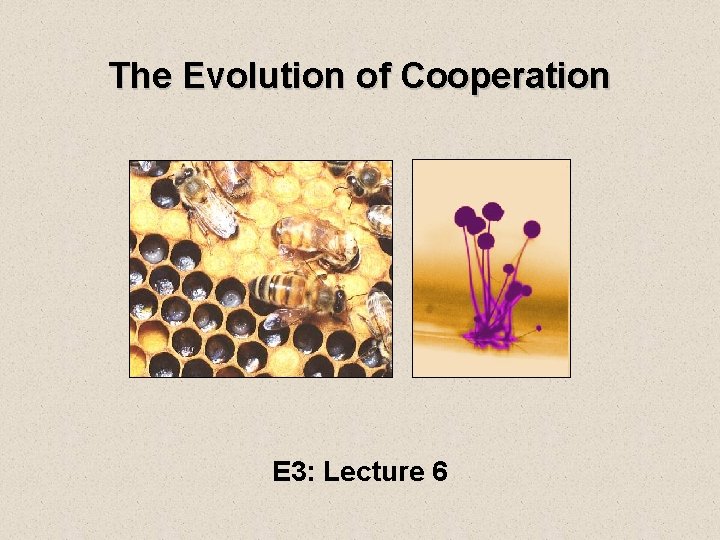
The Evolution of Cooperation E 3 Lecture 6
![Biological Altruism “[Altruism is] the central theoretical problem of sociobiology” (E. O. Wilson, 1975)](https://slidetodoc.com/presentation_image_h2/0b54981c0f18939d634499b89656435f/image-5.jpg "Biological Altruism “[Altruism is] the central theoretical problem of sociobiology” (E. O. Wilson, 1975)")
- Slides: 31
The Evolution of Cooperation E 3: Lecture 6
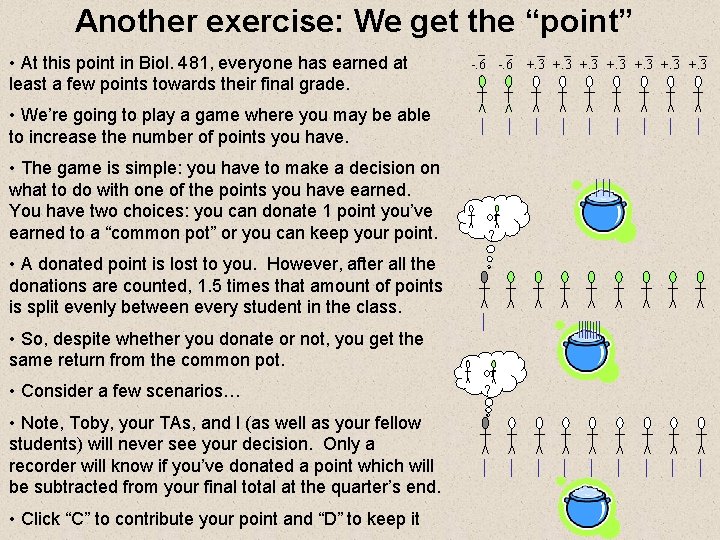
Another exercise: We get the “point” • At this point in Biol. 481, everyone has earned at least a few points towards their final grade. -. 6 +. 3 +. 3 • We’re going to play a game where you may be able to increase the number of points you have. • The game is simple: you have to make a decision on what to do with one of the points you have earned. You have two choices: you can donate 1 point you’ve earned to a “common pot” or you can keep your point. or ? • A donated point is lost to you. However, after all the donations are counted, 1. 5 times that amount of points is split evenly between every student in the class. • So, despite whether you donate or not, you get the same return from the common pot. • Consider a few scenarios… • Note, Toby, your TAs, and I (as well as your fellow students) will never see your decision. Only a recorder will know if you’ve donated a point which will be subtracted from your final total at the quarter’s end. • Click “C” to contribute your point and “D” to keep it or ?
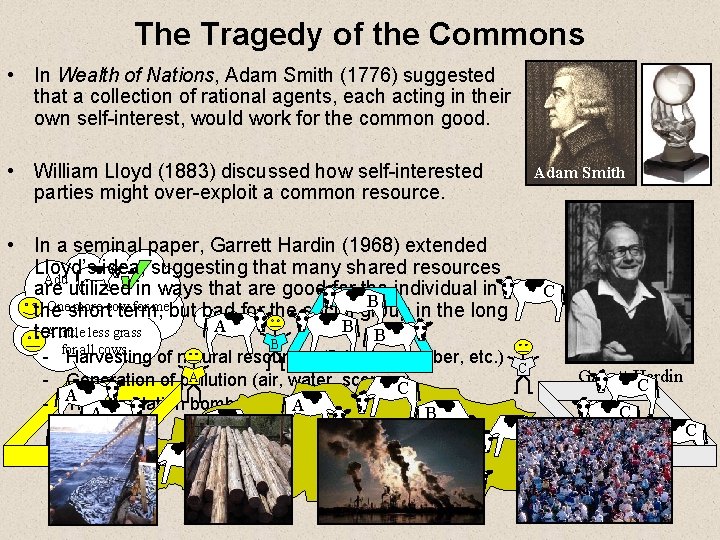
The Tragedy of the Commons • In Wealth of Nations, Adam Smith (1776) suggested that a collection of rational agents, each acting in their own self-interest, would work for the common good. • William Lloyd (1883) discussed how self-interested parties might over-exploit a common resource. • In a seminal paper, Garrett Hardin (1968) extended Lloyd’s idea, ? suggesting that many shared resources Add are utilized in ways that are good for the individual in B Oneshort more cow for mebut bad for the social group the term, in the long A B A little less grass term. B - for all cows Adam Smith C B Harvesting of natural resources (fisheries, lumber, etc. ) C A Generation of pollution (air, water, scenery) C A The population bomb A A B A C A B B C A Garrett Hardin C C C
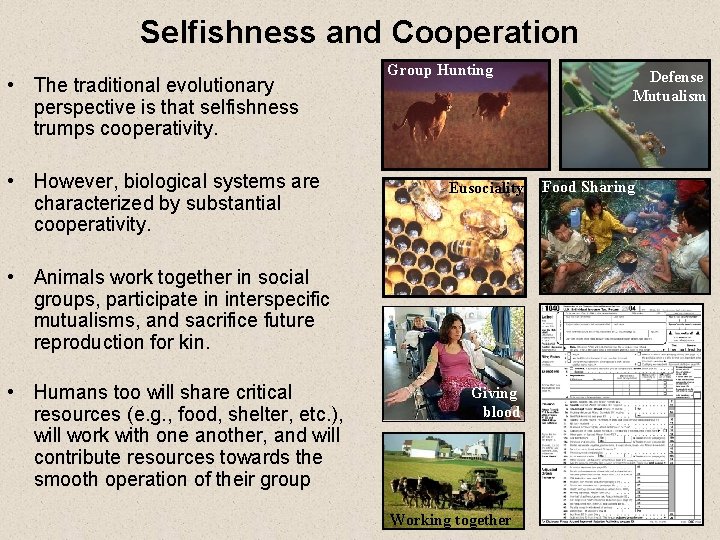
Selfishness and Cooperation • The traditional evolutionary perspective is that selfishness trumps cooperativity. • However, biological systems are characterized by substantial cooperativity. Group Hunting Eusociality • Animals work together in social groups, participate in interspecific mutualisms, and sacrifice future reproduction for kin. • Humans too will share critical resources (e. g. , food, shelter, etc. ), will work with one another, and will contribute resources towards the smooth operation of their group Giving blood Working together Defense Mutualism Food Sharing
Biological Altruism “[Altruism is] the central theoretical problem of sociobiology” (E. O. Wilson, 1975) • An altruist improves the fitness of a recipient at a fitness cost to itself. Altruist + Other • Altruism has fueled many debates in evolutionary biology (e. g. , group selection versus individual selection) Honeybees spore head somatic stalk • From an orthodox evolutionary perspective altruistic behavior is confusing: “Altruism is the very opposite of survival of the fittest” (Sober & Wilson, 1998) Slime mold cells
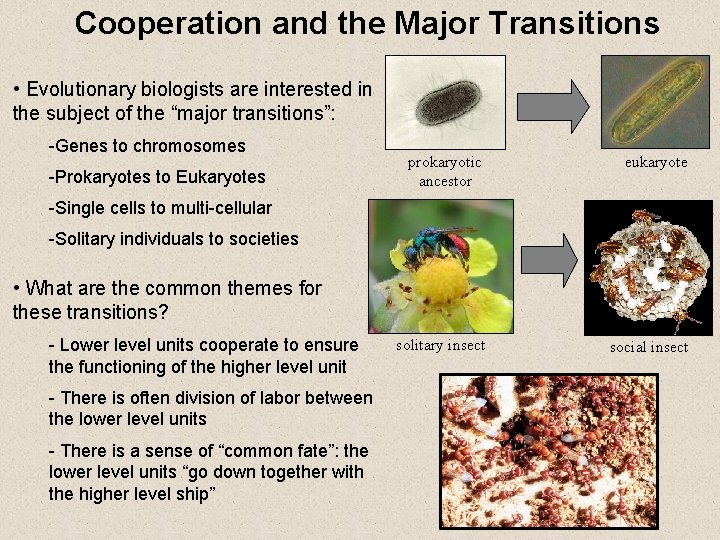
Cooperation and the Major Transitions • Evolutionary biologists are interested in the subject of the “major transitions”: -Genes to chromosomes -Prokaryotes to Eukaryotes prokaryotic ancestor eukaryote solitary insect social insect -Single cells to multi-cellular -Solitary individuals to societies • What are the common themes for these transitions? - Lower level units cooperate to ensure the functioning of the higher level unit - There is often division of labor between the lower level units - There is a sense of “common fate”: the lower level units “go down together with the higher level ship”
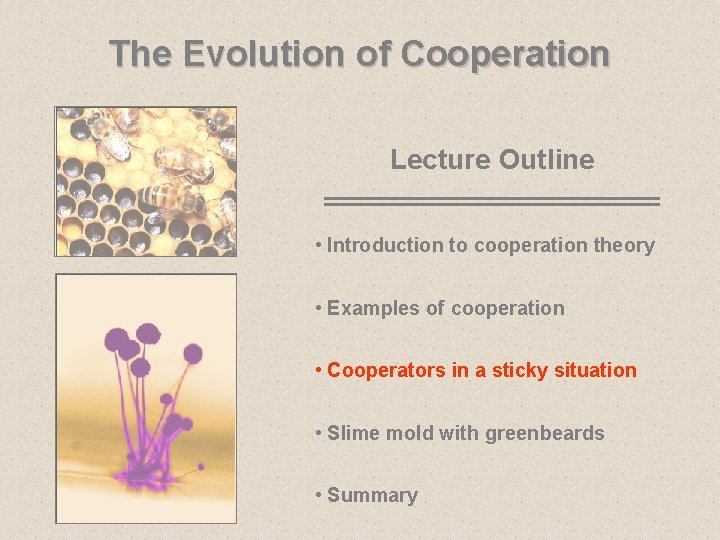
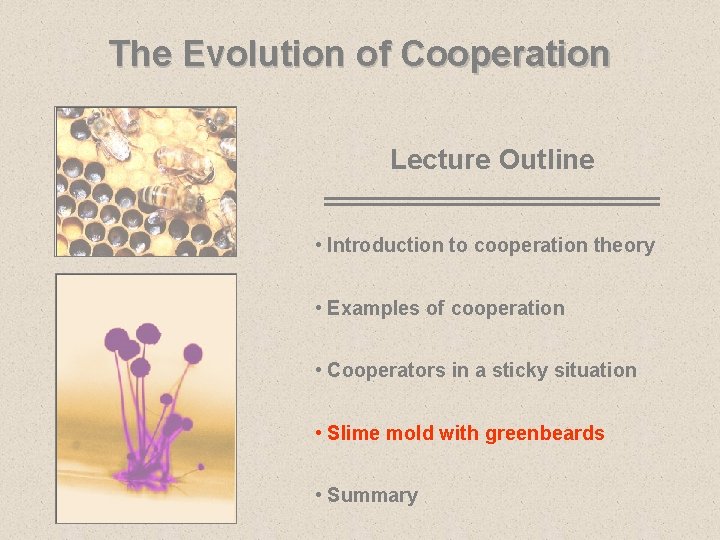
The Evolution of Cooperation Lecture Outline • Introduction to cooperation theory • Examples of cooperation • Cooperators in a sticky situation • Slime mold with greenbeards • Summary
The Evolution of Cooperation Lecture Outline • Introduction to cooperation theory • Examples of cooperation • Cooperators in a sticky situation • Slime mold with greenbeards • Summary
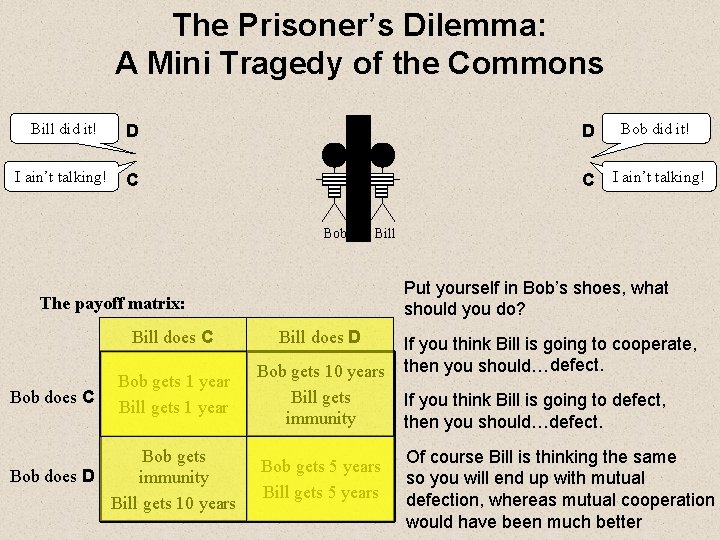
The Prisoner’s Dilemma: A Mini Tragedy of the Commons Bill did it! D D Bob did it! I ain’t talking! C C I ain’t talking! Bob Bill Put yourself in Bob’s shoes, what should you do? The payoff matrix: Bob does C Bill does D Bob gets 1 year Bill gets 1 year Bob gets 10 years Bill gets immunity Bob gets Bob does D immunity Bill gets 10 years Bob gets 5 years Bill gets 5 years If you think Bill is going to cooperate, then you should…defect. If you think Bill is going to defect, then you should…defect. Of course Bill is thinking the same so you will end up with mutual defection, whereas mutual cooperation would have been much better
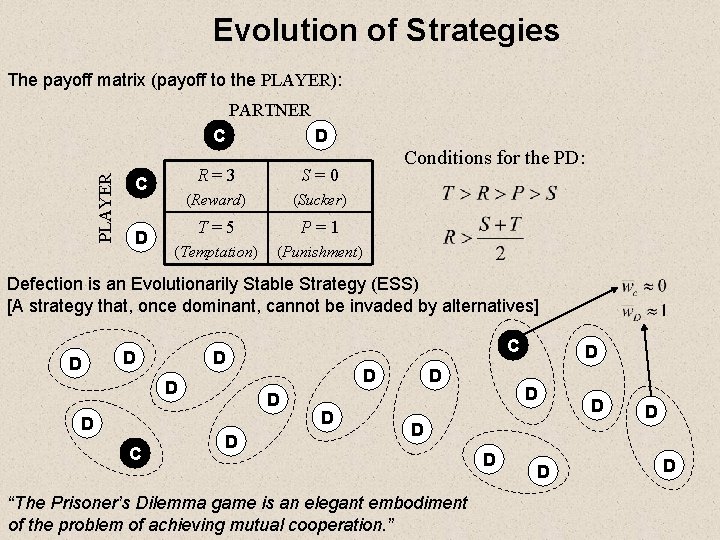
Evolution of Strategies The payoff matrix (payoff to the PLAYER): PARTNER PLAYER C Conditions for the PD: R=3 S=0 (Reward) (Sucker) T=5 P=1 (Temptation) (Punishment) C D D Defection is an Evolutionarily Stable Strategy (ESS) [A strategy that, once dominant, cannot be invaded by alternatives] D D C C D D D D D “The Prisoner’s Dilemma game is an elegant embodiment of the problem of achieving mutual cooperation. ” D D D
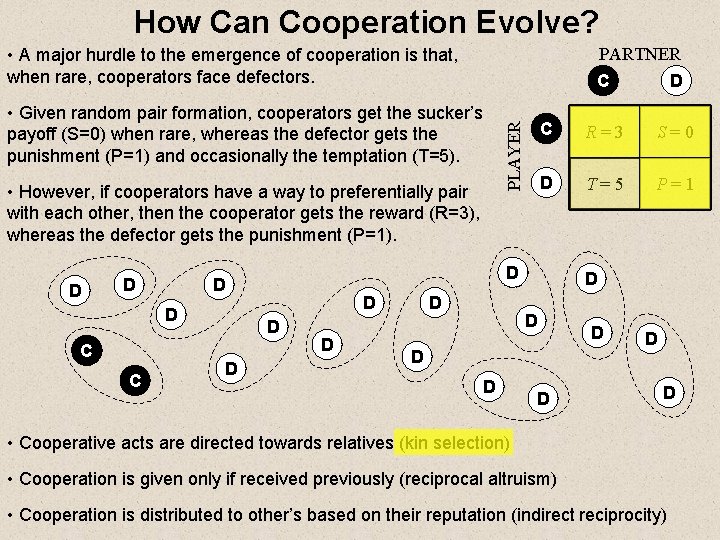
How Can Cooperation Evolve? • A major hurdle to the emergence of cooperation is that, when rare, cooperators face defectors. • Given random pair formation, cooperators get the sucker’s payoff (S=0) when rare, whereas the defector gets the punishment (P=1) and occasionally the temptation (T=5). • However, if cooperators have a way to preferentially pair with each other, then the cooperator gets the reward (R=3), whereas the defector gets the punishment (P=1). D D C D D D C R=3 S=0 D T=5 P=1 D C D D PLAYER PARTNER C D D D • Cooperative acts are directed towards relatives (kin selection) • Cooperation is given only if received previously (reciprocal altruism) • Cooperation is distributed to other’s based on their reputation (indirect reciprocity)
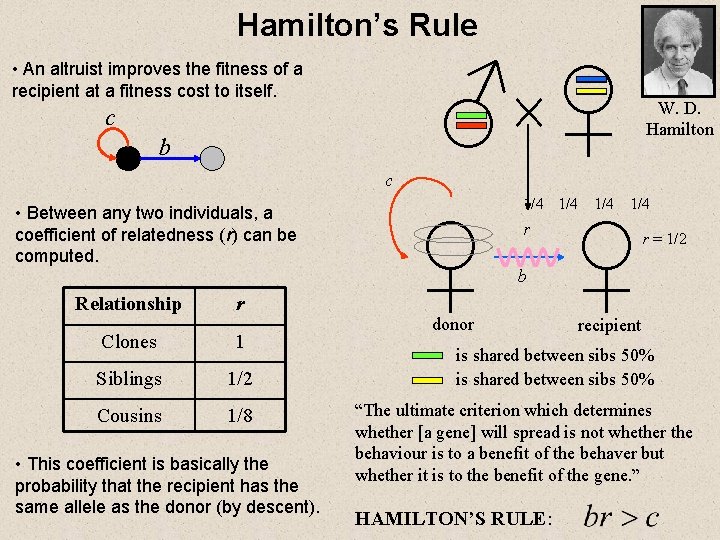
Hamilton’s Rule ♂ ♀ • An altruist improves the fitness of a recipient at a fitness cost to itself. c b W. D. Hamilton c • Between any two individuals, a coefficient of relatedness (r) can be computed. Relationship r Clones 1 Siblings 1/2 Cousins 1/8 • This coefficient is basically the probability that the recipient has the same allele as the donor (by descent). 1/4 1/4 ♀ ♀ r r = 1/2 b donor recipient is shared between sibs 50% “The ultimate criterion which determines whether [a gene] will spread is not whether the behaviour is to a benefit of the behaver but whether it is to the benefit of the gene. ” HAMILTON’S RULE:
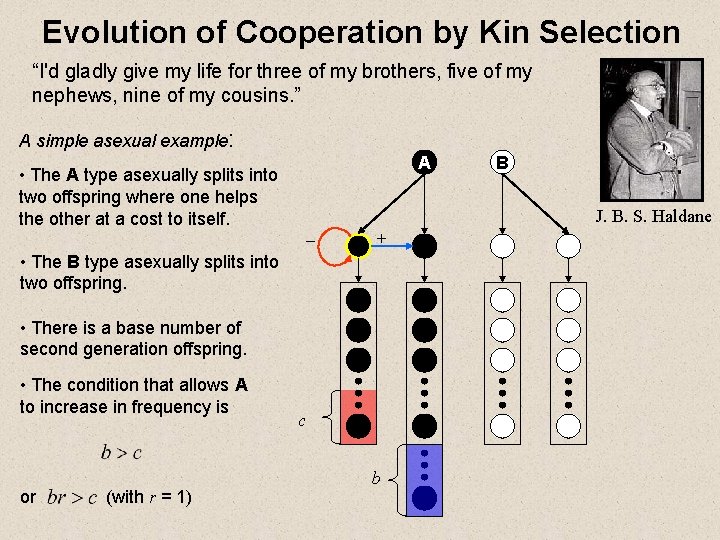
Evolution of Cooperation by Kin Selection “I'd gladly give my life for three of my brothers, five of my nephews, nine of my cousins. ” A simple asexual example: • The A type asexually splits into two offspring where one helps the other at a cost to itself. A - + • The B type asexually splits into two offspring. • There is a base number of second generation offspring. • The condition that allows A to increase in frequency is or (with r = 1) c b B J. B. S. Haldane
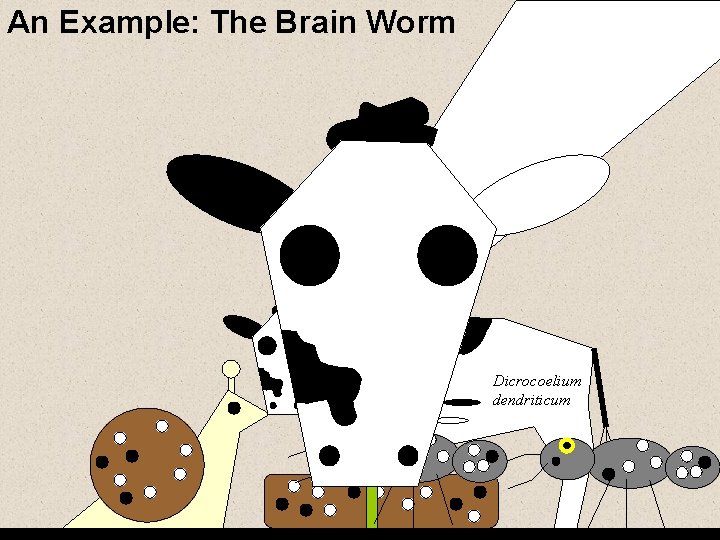
An Example: The Brain Worm Dicrocoelium dendriticum
The Evolution of Cooperation Lecture Outline • Introduction to cooperation theory • Examples of cooperation • Cooperators in a sticky situation • Slime mold with greenbeards • Summary
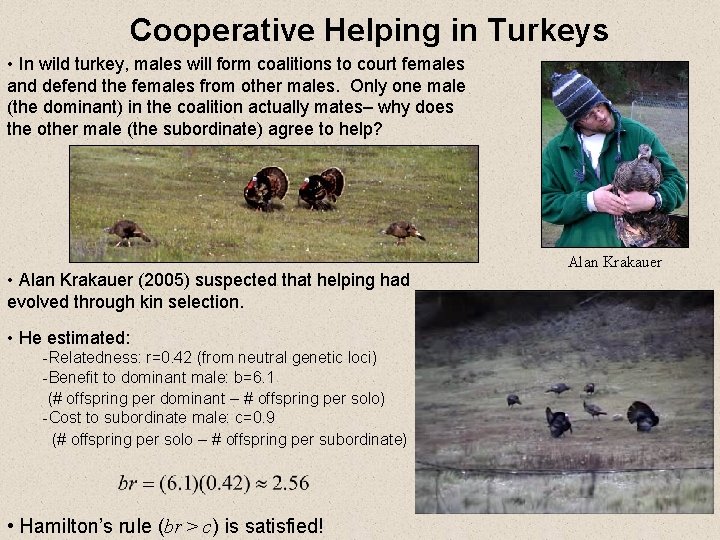
Cooperative Helping in Turkeys • In wild turkey, males will form coalitions to court females and defend the females from other males. Only one male (the dominant) in the coalition actually mates– why does the other male (the subordinate) agree to help? • Alan Krakauer (2005) suspected that helping had evolved through kin selection. • He estimated: -Relatedness: r=0. 42 (from neutral genetic loci) -Benefit to dominant male: b=6. 1 (# offspring per dominant - # offspring per solo) -Cost to subordinate male: c=0. 9 (# offspring per solo - # offspring per subordinate) • Hamilton’s rule (br > c) is satisfied! Alan Krakauer
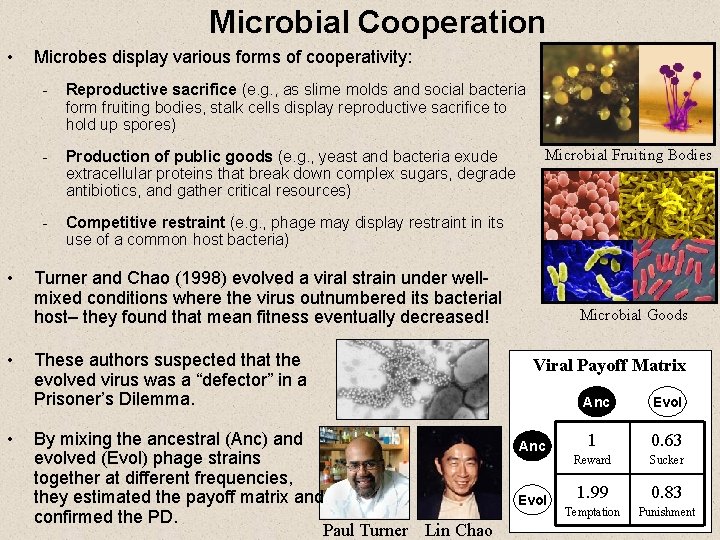
Microbial Cooperation • • Microbes display various forms of cooperativity: - Reproductive sacrifice (e. g. , as slime molds and social bacteria form fruiting bodies, stalk cells display reproductive sacrifice to hold up spores) - Production of public goods (e. g. , yeast and bacteria exude extracellular proteins that break down complex sugars, degrade antibiotics, and gather critical resources) - Competitive restraint (e. g. , phage may display restraint in its use of a common host bacteria) Microbial Fruiting Bodies Turner and Chao (1998) evolved a viral strain under wellmixed conditions where the virus outnumbered its bacterial host– they found that mean fitness eventually decreased! These authors suspected that the evolved virus was a “defector” in a Prisoner’s Dilemma. By mixing the ancestral (Anc) and evolved (Evol) phage strains together at different frequencies, they estimated the payoff matrix and confirmed the PD. Paul Turner Lin Chao Microbial Goods Viral Payoff Matrix Anc Evol 1 0. 63 Reward Sucker 1. 99 0. 83 Temptation Punishment
The Evolution of Cooperation Lecture Outline • Introduction to cooperation theory • Examples of cooperation • Cooperators in a sticky situation • Slime mold with greenbeards • Summary
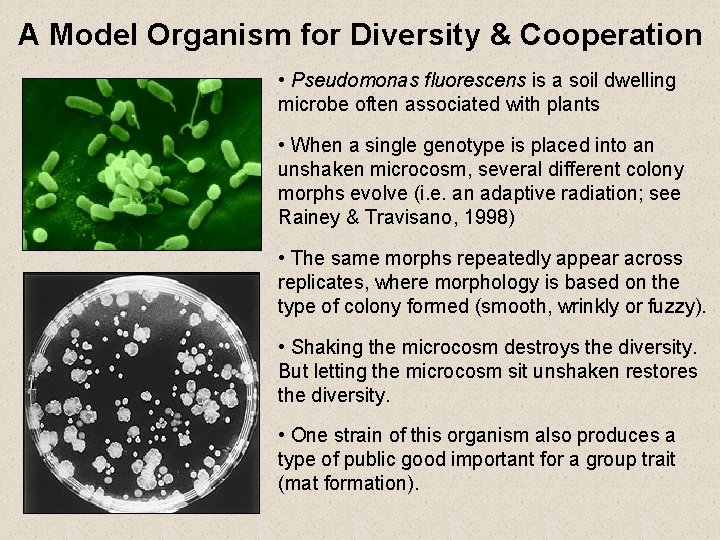
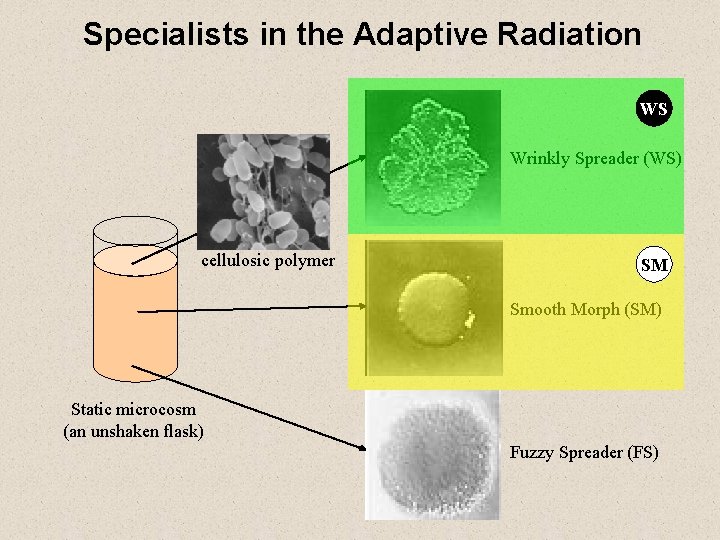
A Model Organism for Diversity & Cooperation • Pseudomonas fluorescens is a soil dwelling microbe often associated with plants • When a single genotype is placed into an unshaken microcosm, several different colony morphs evolve (i. e. an adaptive radiation; see Rainey & Travisano, 1998) • The same morphs repeatedly appear across replicates, where morphology is based on the type of colony formed (smooth, wrinkly or fuzzy). • Shaking the microcosm destroys the diversity. But letting the microcosm sit unshaken restores the diversity. • One strain of this organism also produces a type of public good important for a group trait (mat formation).
Specialists in the Adaptive Radiation WS Wrinkly Spreader (WS) cellulosic polymer SM Smooth Morph (SM) Static microcosm (an unshaken flask) Fuzzy Spreader (FS)
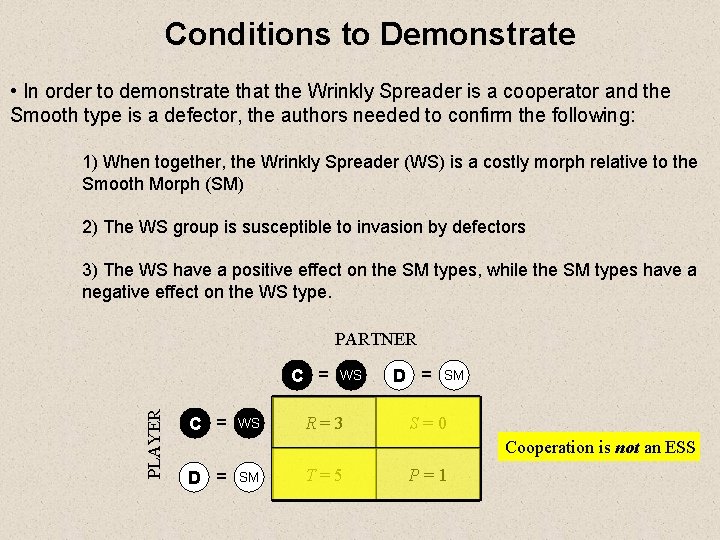
Conditions to Demonstrate • In order to demonstrate that the Wrinkly Spreader is a cooperator and the Smooth type is a defector, the authors needed to confirm the following: 1) When together, the Wrinkly Spreader (WS) is a costly morph relative to the Smooth Morph (SM) 2) The WS group is susceptible to invasion by defectors 3) The WS have a positive effect on the SM types, while the SM types have a negative effect on the WS type. PARTNER PLAYER C = WS WS R=3 D = SM S=0 Cooperation is not an ESS D = SM T=5 P=1
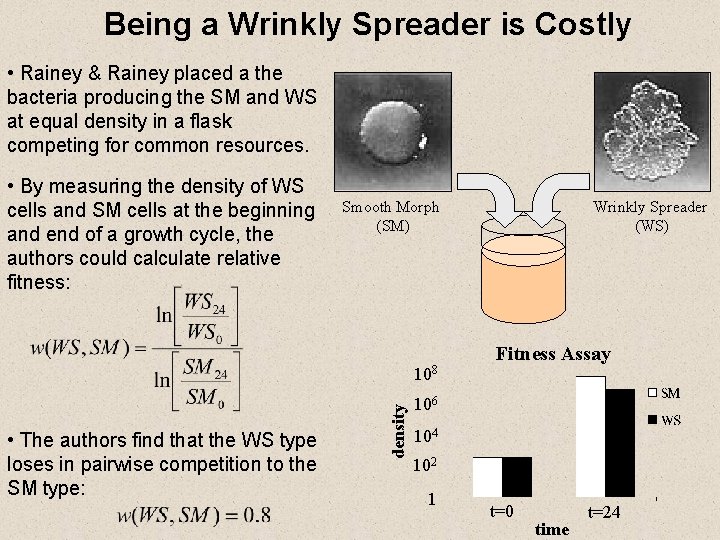
Being a Wrinkly Spreader is Costly • Rainey & Rainey placed a the bacteria producing the SM and WS at equal density in a flask competing for common resources. • By measuring the density of WS cells and SM cells at the beginning and end of a growth cycle, the authors could calculate relative fitness: Smooth Morph (SM) • The authors find that the WS type loses in pairwise competition to the SM type: density 108 Wrinkly Spreader (WS) Fitness Assay 106 104 102 1 t=0 time t=24
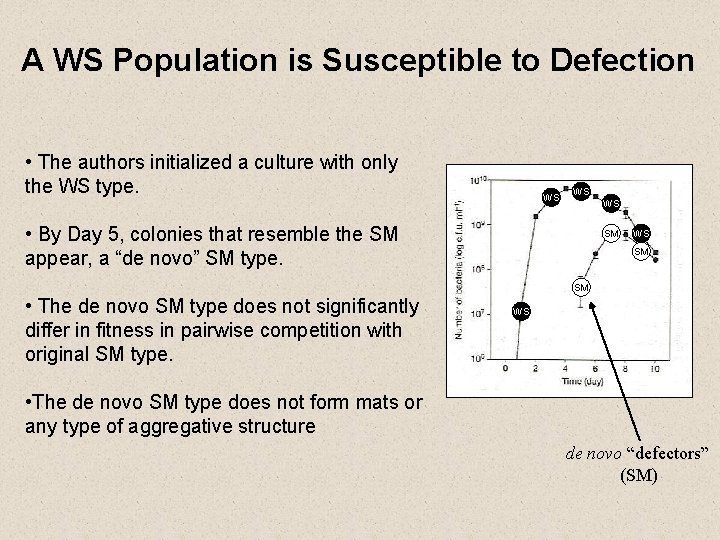
A WS Population is Susceptible to Defection • The authors initialized a culture with only the WS type. WS WS WS • By Day 5, colonies that resemble the SM appear, a “de novo” SM type. SM WS SM SM • The de novo SM type does not significantly differ in fitness in pairwise competition with original SM type. WS • The de novo SM type does not form mats or any type of aggregative structure de novo “defectors” (SM)
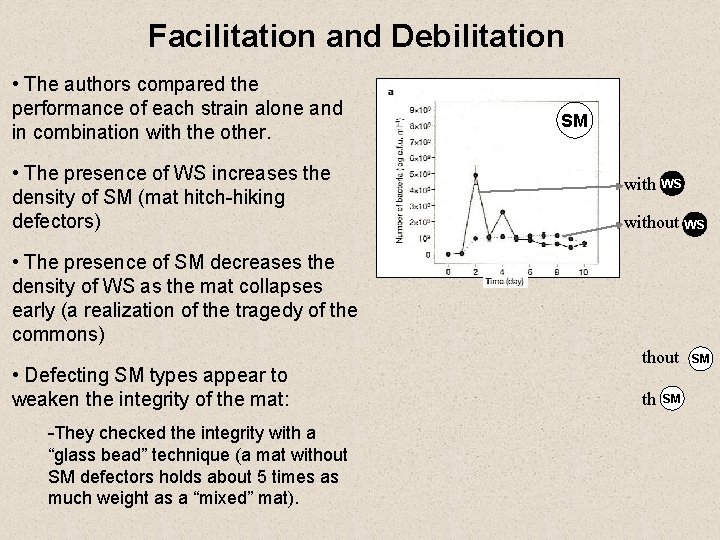
Facilitation and Debilitation • The authors compared the performance of each strain alone and in combination with the other. SM • The presence of WS increases the density of SM (mat hitch-hiking defectors) • The presence of SM decreases the density of WS as the mat collapses early (a realization of the tragedy of the commons) • Defecting SM types appear to weaken the integrity of the mat: -They checked the integrity with a “glass bead” technique (a mat without SM defectors holds about 5 times as much weight as a “mixed” mat). with WS without WS WS without with SM SM
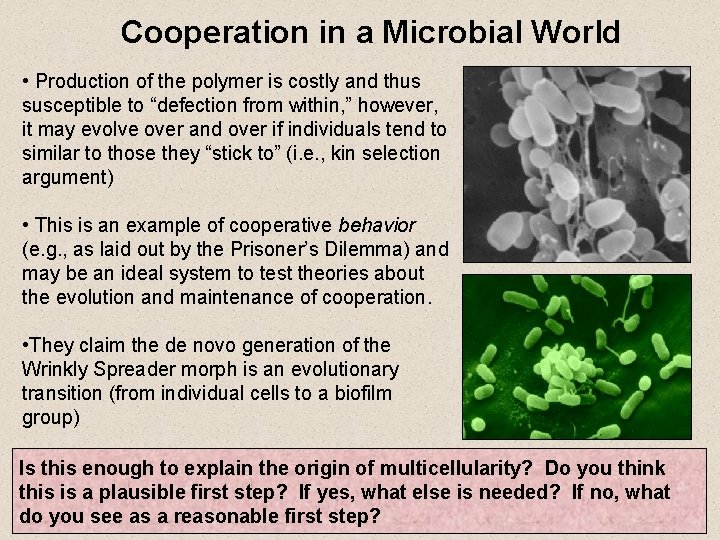
Cooperation in a Microbial World • Production of the polymer is costly and thus susceptible to “defection from within, ” however, it may evolve over and over if individuals tend to similar to those they “stick to” (i. e. , kin selection argument) • This is an example of cooperative behavior (e. g. , as laid out by the Prisoner’s Dilemma) and may be an ideal system to test theories about the evolution and maintenance of cooperation. • They claim the de novo generation of the Wrinkly Spreader morph is an evolutionary transition (from individual cells to a biofilm group) Is this enough to explain the origin of multicellularity? Do you think this is a plausible first step? If yes, what else is needed? If no, what do you see as a reasonable first step?
The Evolution of Cooperation Lecture Outline • Introduction to cooperation theory • Examples of cooperation • Cooperators in a sticky situation • Slime mold with greenbeards • Summary
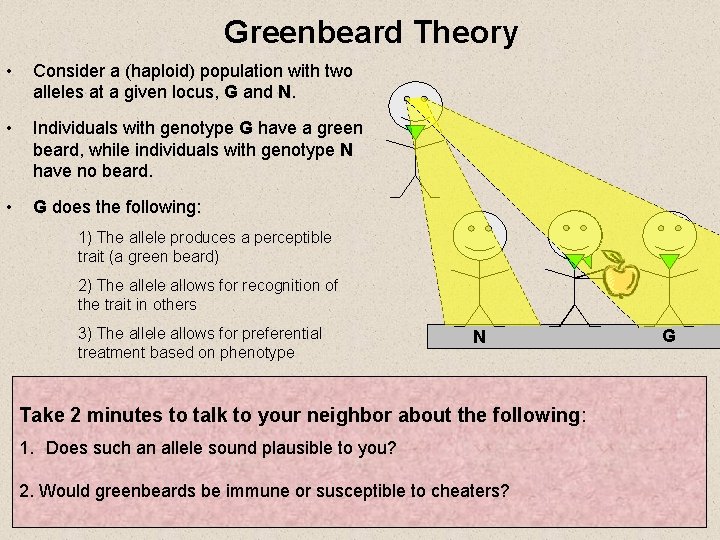
Greenbeard Theory • Consider a (haploid) population with two alleles at a given locus, G and N. • Individuals with genotype G have a green beard, while individuals with genotype N have no beard. • G does the following: 1) The allele produces a perceptible trait (a green beard) 2) The allele allows for recognition of the trait in others 3) The allele allows for preferential treatment based on phenotype N Take 2 minutes to talk to your neighbor about the following: 1. Does such an allele sound plausible to you? 2. Would greenbeards be immune or susceptible to cheaters? G
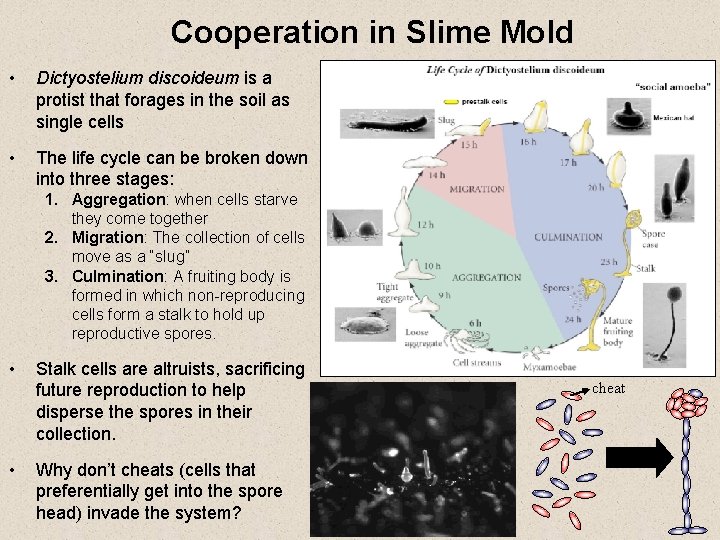
Cooperation in Slime Mold • Dictyostelium discoideum is a protist that forages in the soil as single cells • The life cycle can be broken down into three stages: 1. Aggregation: when cells starve they come together 2. Migration: The collection of cells move as a “slug” 3. Culmination: A fruiting body is formed in which non-reproducing cells form a stalk to hold up reproductive spores. • Stalk cells are altruists, sacrificing future reproduction to help disperse the spores in their collection. • Why don’t cheats (cells that preferentially get into the spore head) invade the system? cheat
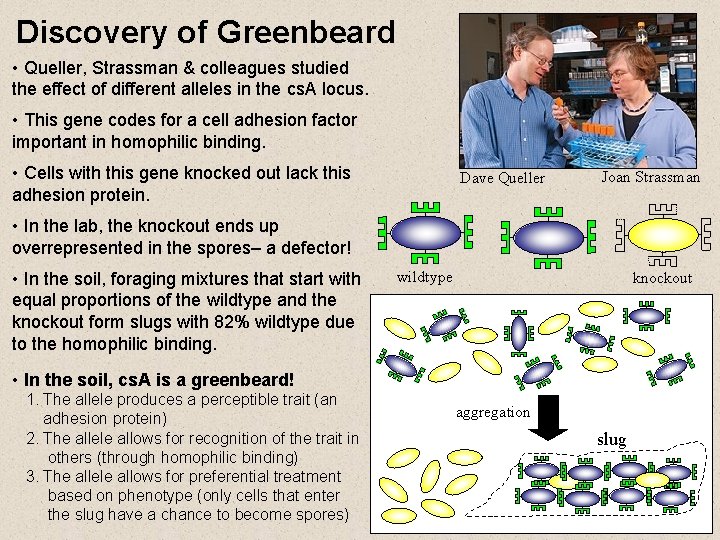
Discovery of Greenbeard • Queller, Strassman & colleagues studied the effect of different alleles in the cs. A locus. • This gene codes for a cell adhesion factor important in homophilic binding. • Cells with this gene knocked out lack this adhesion protein. Dave Queller Joan Strassman • In the lab, the knockout ends up overrepresented in the spores– a defector! • In the soil, foraging mixtures that start with equal proportions of the wildtype and the knockout form slugs with 82% wildtype due to the homophilic binding. wildtype knockout • In the soil, cs. A is a greenbeard! 1. The allele produces a perceptible trait (an adhesion protein) 2. The allele allows for recognition of the trait in others (through homophilic binding) 3. The allele allows for preferential treatment based on phenotype (only cells that enter the slug have a chance to become spores) aggregation slug
The Evolution of Cooperation Lecture Outline • Introduction to cooperation theory • Examples of cooperation • Cooperators in a sticky situation • Slime mold with greenbeards • Summary
Summary • The standard “Darwinian” picture is that selfish variants should always displace their cooperative competitors (individuals that provide a benefit, b, at a personal cost, c). This expectation is belied by many instances of cooperation and altruism in biological systems. • Such cooperation can be favored if interactors are related. Hamilton’s rule formalizes this relationship: cooperation evolves if br>c. • More generally, cooperation is favored if cooperators have ways to distinguish cooperators from defectors and preferentially interact with cooperators. • Cases of cooperation have been discovered in organisms ranging from bacteria to turkeys to primates. • Experiments have been designed to explore the susceptibility of cooperators to cheats (mat formation in Pseudomonas) and the exclusion of cheats by cooperators (greenbeards in Dictyostelium).