
THE EVOLUTION OF COMMUNISM Scott Masters Crestwood College

- Slides: 34
THE EVOLUTION OF COMMUNISM Scott Masters Crestwood College
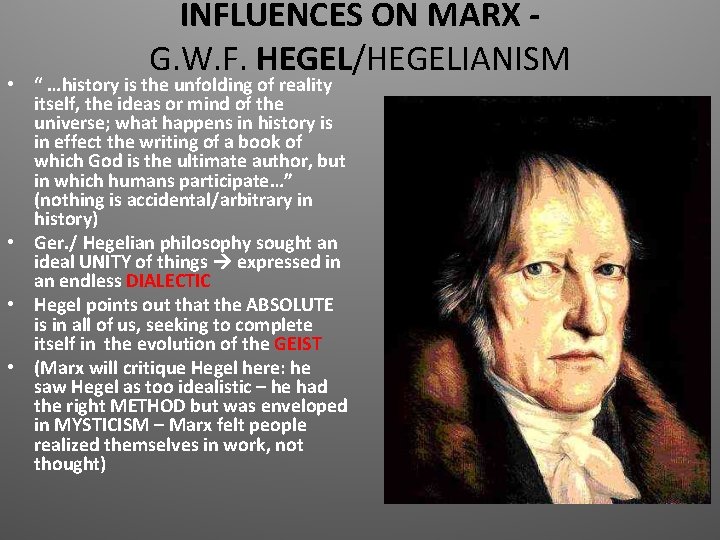
INFLUENCES ON MARX G. W. F. HEGEL/HEGELIANISM • “ …history is the unfolding of reality itself, the ideas or mind of the universe; what happens in history is in effect the writing of a book of which God is the ultimate author, but in which humans participate…” (nothing is accidental/arbitrary in history) • Ger. / Hegelian philosophy sought an ideal UNITY of things expressed in an endless DIALECTIC • Hegel points out that the ABSOLUTE is in all of us, seeking to complete itself in the evolution of the GEIST • (Marx will critique Hegel here: he saw Hegel as too idealistic – he had the right METHOD but was enveloped in MYSTICISM – Marx felt people realized themselves in work, not thought)
• Hegel’s historical analysis moved through three main phases: • ASIATIC – absolute monarchy • GRECO-ROMAN – individual freedom • GERMANIC-EUROPEAN – synthesis of freedom w/ a strong state • Hegel’s preoccupation there can be traced to 18 th c. Ger. disunity – therefore Hegel is connected to burgeoning Ger. nat’lism • and since this historical process is the “March of God through the world” , God can be seen to be on your side if you’re successful
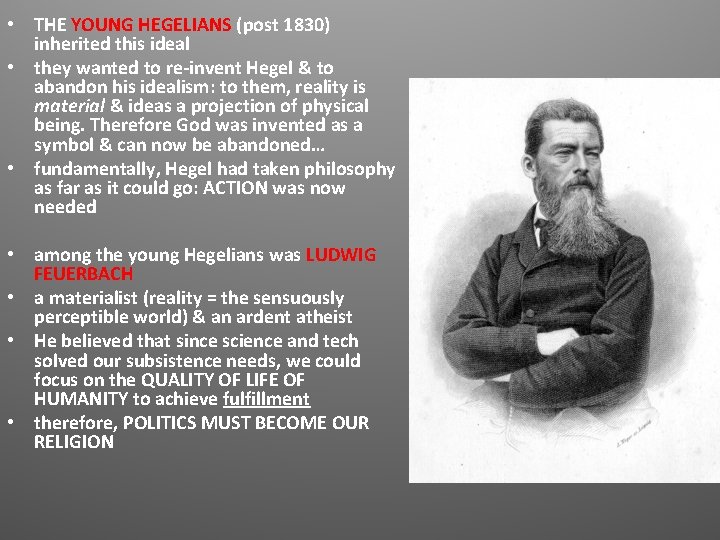
• THE YOUNG HEGELIANS (post 1830) inherited this ideal • they wanted to re-invent Hegel & to abandon his idealism: to them, reality is material & ideas a projection of physical being. Therefore God was invented as a symbol & can now be abandoned… • fundamentally, Hegel had taken philosophy as far as it could go: ACTION was now needed • among the young Hegelians was LUDWIG FEUERBACH • a materialist (reality = the sensuously perceptible world) & an ardent atheist • He believed that since science and tech solved our subsistence needs, we could focus on the QUALITY OF LIFE OF HUMANITY to achieve fulfillment • therefore, POLITICS MUST BECOME OUR RELIGION
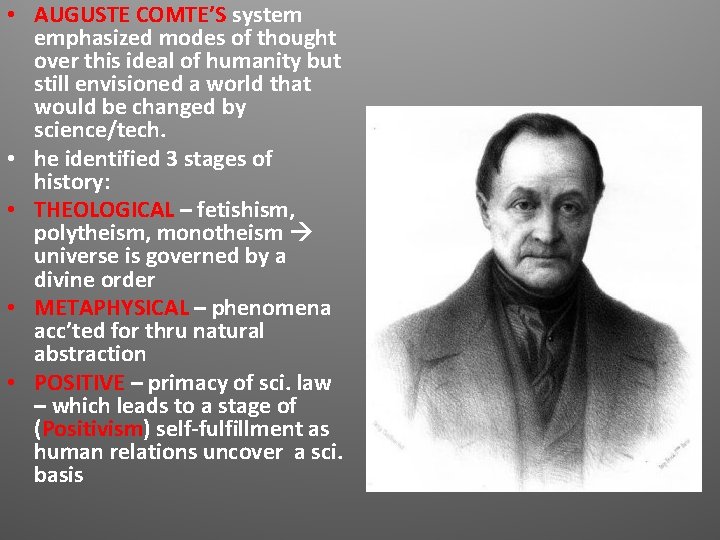
• AUGUSTE COMTE’S system emphasized modes of thought over this ideal of humanity but still envisioned a world that would be changed by science/tech. • he identified 3 stages of history: • THEOLOGICAL – fetishism, polytheism, monotheism universe is governed by a divine order • METAPHYSICAL – phenomena acc’ted for thru natural abstraction • POSITIVE – primacy of sci. law – which leads to a stage of (Positivism) self-fulfillment as human relations uncover a sci. basis
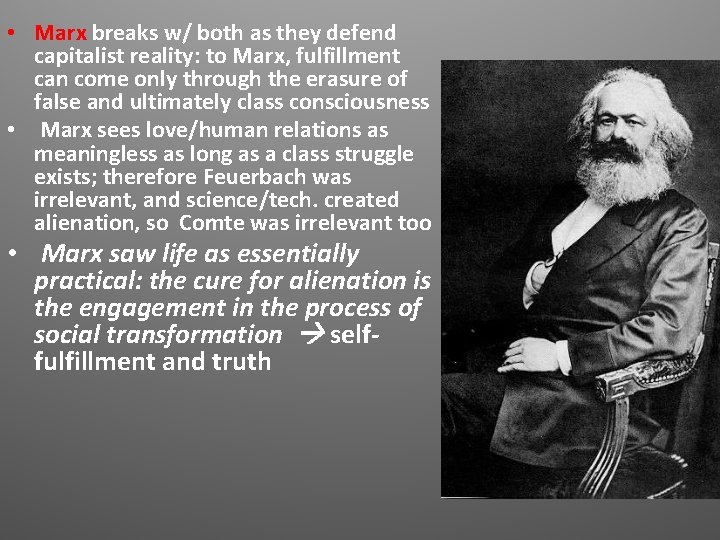
• Marx breaks w/ both as they defend capitalist reality: to Marx, fulfillment can come only through the erasure of false and ultimately class consciousness • Marx sees love/human relations as meaningless as long as a class struggle exists; therefore Feuerbach was irrelevant, and science/tech. created alienation, so Comte was irrelevant too • Marx saw life as essentially practical: the cure for alienation is the engagement in the process of social transformation selffulfillment and truth
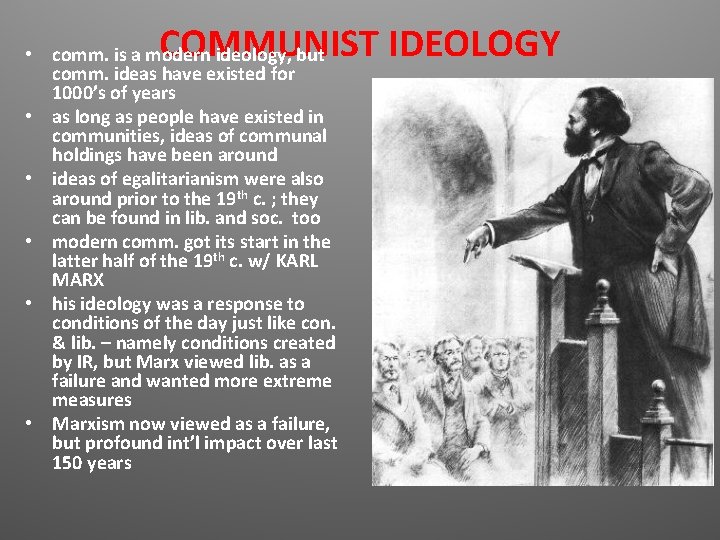
COMMUNIST IDEOLOGY • comm. is a modern ideology, but comm. ideas have existed for 1000’s of years • as long as people have existed in communities, ideas of communal holdings have been around • ideas of egalitarianism were also around prior to the 19 th c. ; they can be found in lib. and soc. too • modern comm. got its start in the latter half of the 19 th c. w/ KARL MARX • his ideology was a response to conditions of the day just like con. & lib. – namely conditions created by IR, but Marx viewed lib. as a failure and wanted more extreme measures • Marxism now viewed as a failure, but profound int’l impact over last 150 years
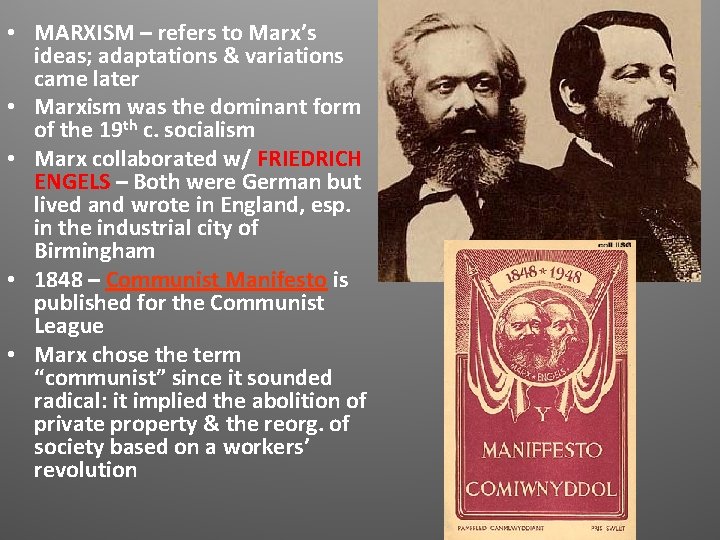
• MARXISM – refers to Marx’s ideas; adaptations & variations came later • Marxism was the dominant form of the 19 th c. socialism • Marx collaborated w/ FRIEDRICH ENGELS – Both were German but lived and wrote in England, esp. in the industrial city of Birmingham • 1848 – Communist Manifesto is published for the Communist League • Marx chose the term “communist” since it sounded radical: it implied the abolition of private property & the reorg. of society based on a workers’ revolution
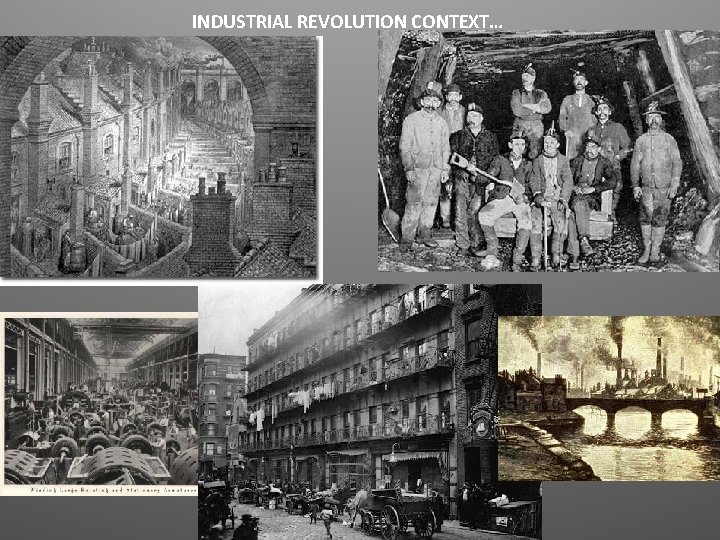
INDUSTRIAL REVOLUTION CONTEXT…
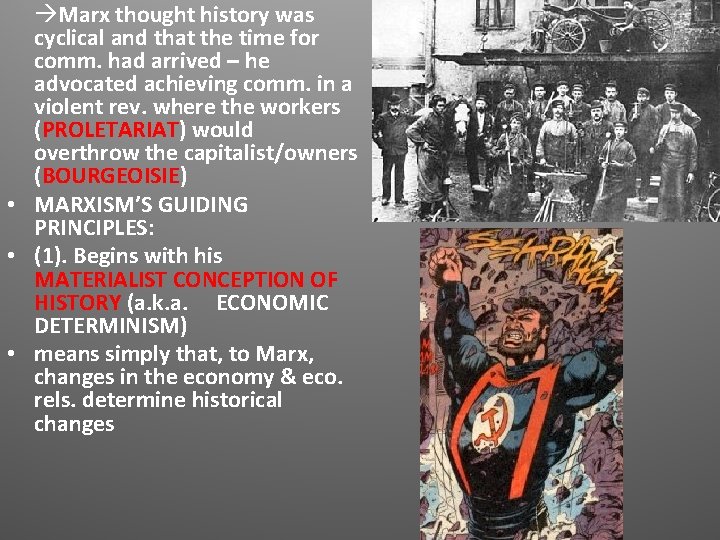
Marx thought history was cyclical and that the time for comm. had arrived – he advocated achieving comm. in a violent rev. where the workers (PROLETARIAT) would overthrow the capitalist/owners (BOURGEOISIE) • MARXISM’S GUIDING PRINCIPLES: • (1). Begins with his MATERIALIST CONCEPTION OF HISTORY (a. k. a. ECONOMIC DETERMINISM) • means simply that, to Marx, changes in the economy & eco. rels. determine historical changes
• To Marx, what is “materialism”? • states that human history is based on wealth & ownership of goods & modes of production (who produces what for whom) • idea of “modes of production” determines the rest of society’s structure • this is because the economy dictates social/political institutions & ideology • therefore changes in material conditions will change the whole nature of society
• • • further, this change follows a regular scientific pattern: FEUDALISM CAPITALISM COMMUNISM… acc. to this pattern communism is inevitable
• • (2). So 2 nd doctrine HISTORICAL INEVITABILITY OF COMM. How does Marx reach this conclusion? he applies a theory of his own creation – DIALECTICAL MATERIALISM this theory tries to explain why one mode of production will yield to another (ie: Feud cap comm. ) “MATERIALISM” – reflects his emphasis on the material basis of society’s devel. (who’s got wealth) & modes of production “DIALECTICAL” – comes from an 18 c. German philosopher HEGEL Hegel’s dialectic is simply a way of studying things as they move through 3 stages of : THESIS ANTITHESIS SYNTHESIS Marx used his own dialectic as a scientific basis for studying history, where comm. is the synthesis of all previously existent eco. systems. Dialectical Materialism is therefore a science of history based on changing eco. rels. that culminate in comm.
• (3). ALIENATION – not part of the natural human condition • Marx viewed this as a signif. problem assoc. w/ capitalism • alienation occurs when people believe they don’t control their world • so to end/minimise alienation, people must be fulfilled/individuated • under capitalism, Marx thought the source of alienation was work • where workers are divided & specialized and not given a say in means of production, an assembly – line mentality is created, where workers are not whole this makes work an unpleasant activity & maximizes alienation for the individual • creates a FALSE CONSCIOUSNESS (w/ religion) & oppression • in a comm. society, he thought sharing of work (variety) and owning means of production would eliminate the problem
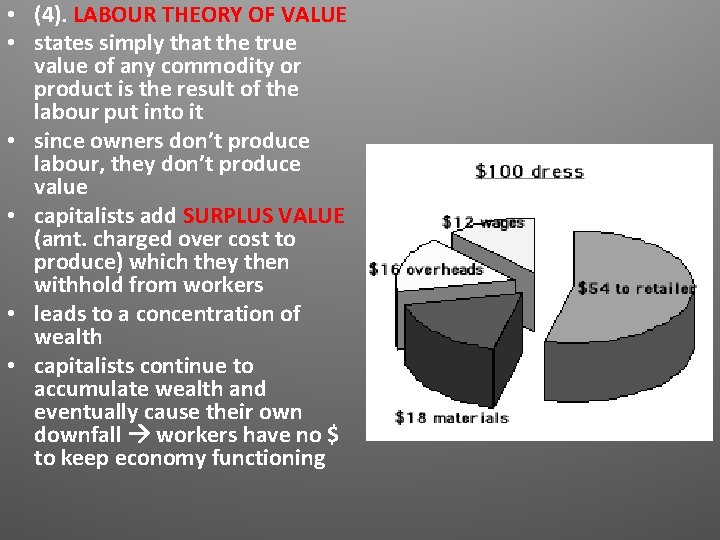
• (4). LABOUR THEORY OF VALUE • states simply that the true value of any commodity or product is the result of the labour put into it • since owners don’t produce labour, they don’t produce value • capitalists add SURPLUS VALUE (amt. charged over cost to produce) which they then withhold from workers • leads to a concentration of wealth • capitalists continue to accumulate wealth and eventually cause their own downfall workers have no $ to keep economy functioning
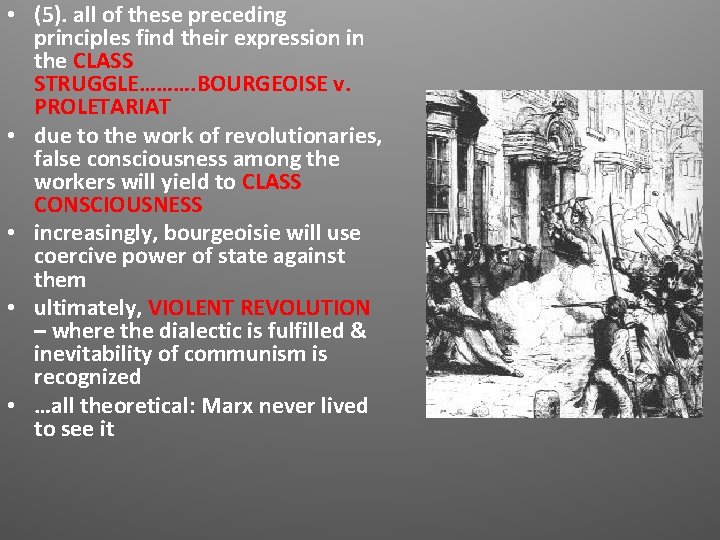
• (5). all of these preceding principles find their expression in the CLASS STRUGGLE………. BOURGEOISE v. PROLETARIAT • due to the work of revolutionaries, false consciousness among the workers will yield to CLASS CONSCIOUSNESS • increasingly, bourgeoisie will use coercive power of state against them • ultimately, VIOLENT REVOLUTION – where the dialectic is fulfilled & inevitability of communism is recognized • …all theoretical: Marx never lived to see it
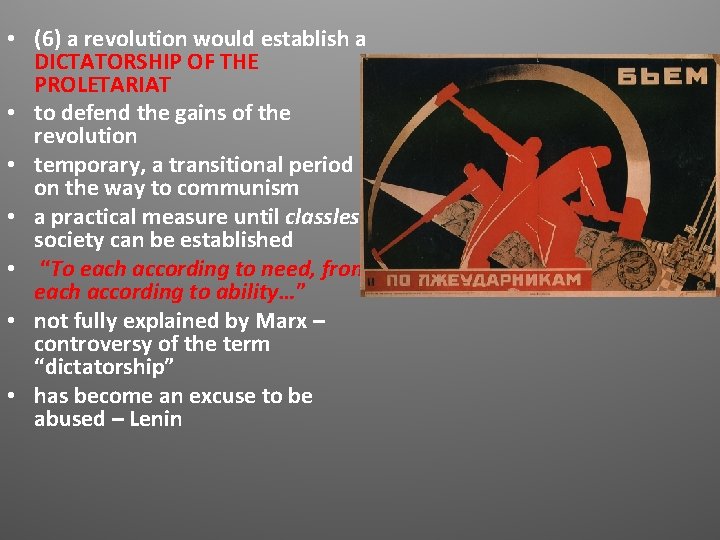
• (6) a revolution would establish a DICTATORSHIP OF THE PROLETARIAT • to defend the gains of the revolution • temporary, a transitional period on the way to communism • a practical measure until classless society can be established • “To each according to need, from each according to ability…” • not fully explained by Marx – controversy of the term “dictatorship” • has become an excuse to be abused – Lenin
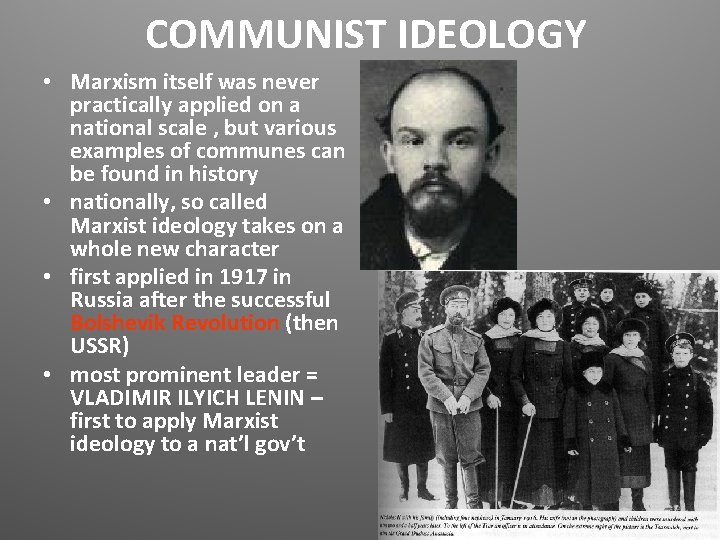
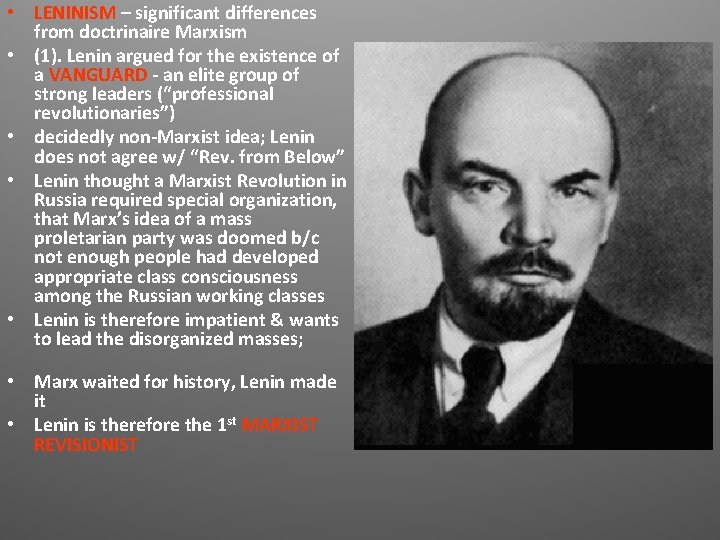
COMMUNIST IDEOLOGY • Marxism itself was never practically applied on a national scale , but various examples of communes can be found in history • nationally, so called Marxist ideology takes on a whole new character • first applied in 1917 in Russia after the successful Bolshevik Revolution (then USSR) • most prominent leader = VLADIMIR ILYICH LENIN – first to apply Marxist ideology to a nat’l gov’t
• LENINISM – significant differences from doctrinaire Marxism • (1). Lenin argued for the existence of a VANGUARD - an elite group of strong leaders (“professional revolutionaries”) • decidedly non-Marxist idea; Lenin does not agree w/ “Rev. from Below” • Lenin thought a Marxist Revolution in Russia required special organization, that Marx’s idea of a mass proletarian party was doomed b/c not enough people had developed appropriate class consciousness among the Russian working classes • Lenin is therefore impatient & wants to lead the disorganized masses; • Marx waited for history, Lenin made it • Lenin is therefore the 1 st MARXIST REVISIONIST
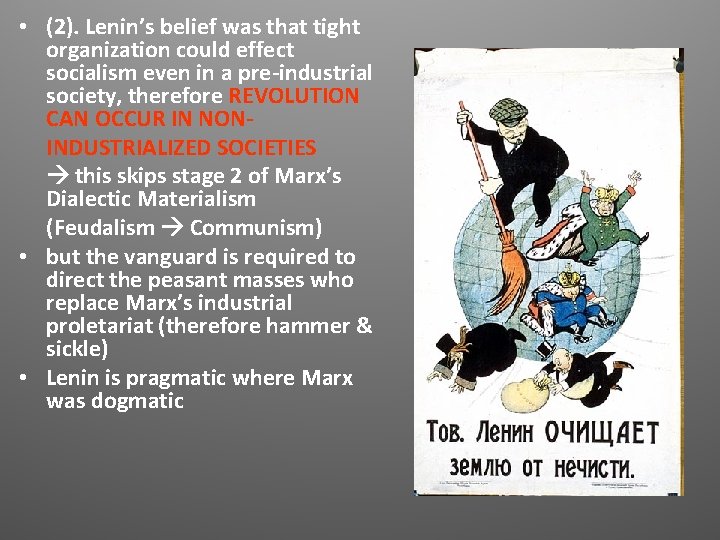
• (2). Lenin’s belief was that tight organization could effect socialism even in a pre-industrial society, therefore REVOLUTION CAN OCCUR IN NONINDUSTRIALIZED SOCIETIES this skips stage 2 of Marx’s Dialectic Materialism (Feudalism Communism) • but the vanguard is required to direct the peasant masses who replace Marx’s industrial proletariat (therefore hammer & sickle) • Lenin is pragmatic where Marx was dogmatic
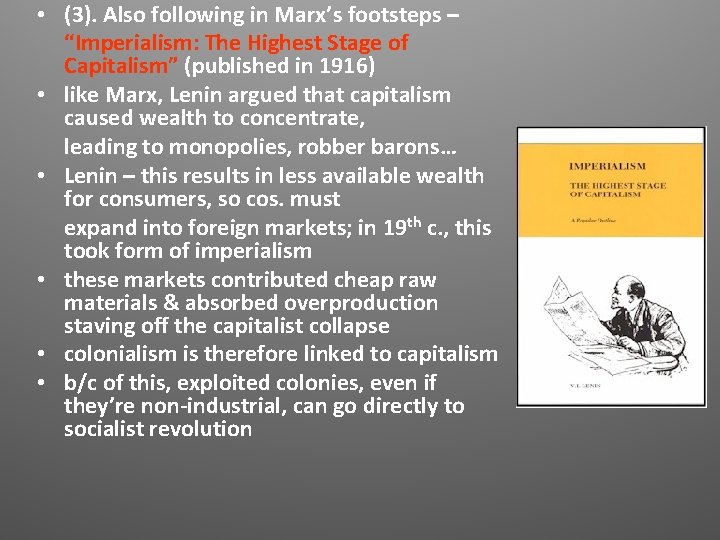
• (3). Also following in Marx’s footsteps – “Imperialism: The Highest Stage of Capitalism” (published in 1916) • like Marx, Lenin argued that capitalism caused wealth to concentrate, leading to monopolies, robber barons… • Lenin – this results in less available wealth for consumers, so cos. must expand into foreign markets; in 19 th c. , this took form of imperialism • these markets contributed cheap raw materials & absorbed overproduction staving off the capitalist collapse • colonialism is therefore linked to capitalism • b/c of this, exploited colonies, even if they’re non-industrial, can go directly to socialist revolution
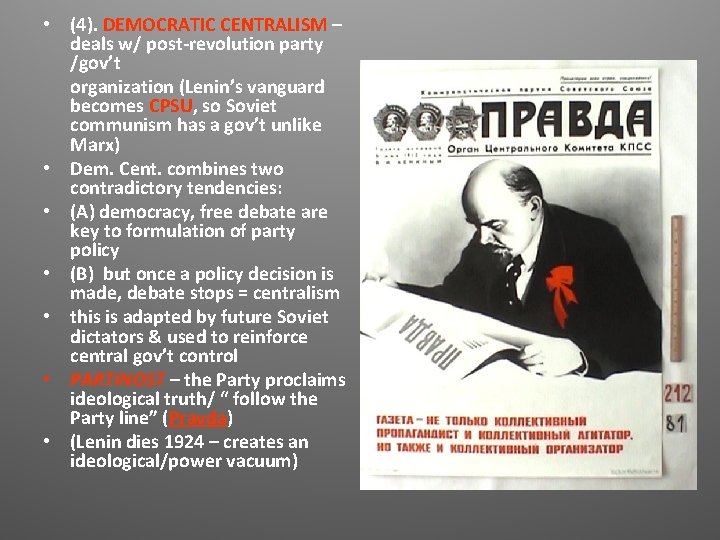
• (4). DEMOCRATIC CENTRALISM – deals w/ post-revolution party /gov’t organization (Lenin’s vanguard becomes CPSU, so Soviet communism has a gov’t unlike Marx) • Dem. Cent. combines two contradictory tendencies: • (A) democracy, free debate are key to formulation of party policy • (B) but once a policy decision is made, debate stops = centralism • this is adapted by future Soviet dictators & used to reinforce central gov’t control • PARTINOST – the Party proclaims ideological truth/ “ follow the Party line” (Pravda) • (Lenin dies 1924 – creates an ideological/power vacuum)
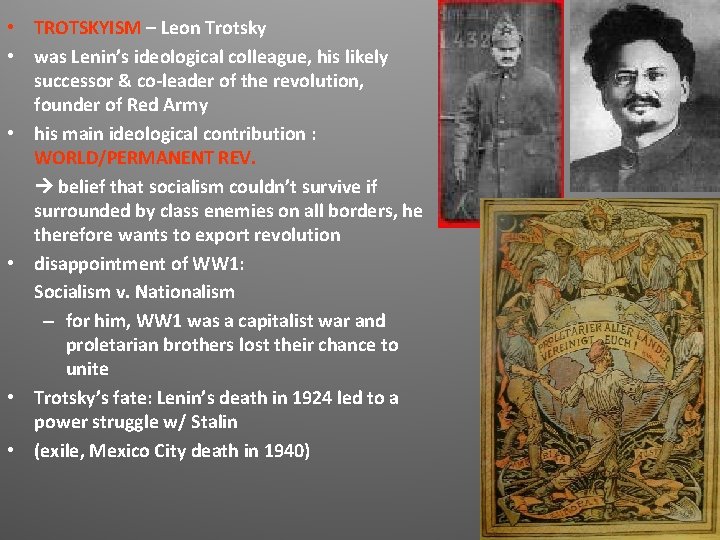
• TROTSKYISM – Leon Trotsky • was Lenin’s ideological colleague, his likely successor & co-leader of the revolution, founder of Red Army • his main ideological contribution : WORLD/PERMANENT REV. belief that socialism couldn’t survive if surrounded by class enemies on all borders, he therefore wants to export revolution • disappointment of WW 1: Socialism v. Nationalism – for him, WW 1 was a capitalist war and proletarian brothers lost their chance to unite • Trotsky’s fate: Lenin’s death in 1924 led to a power struggle w/ Stalin • (exile, Mexico City death in 1940)
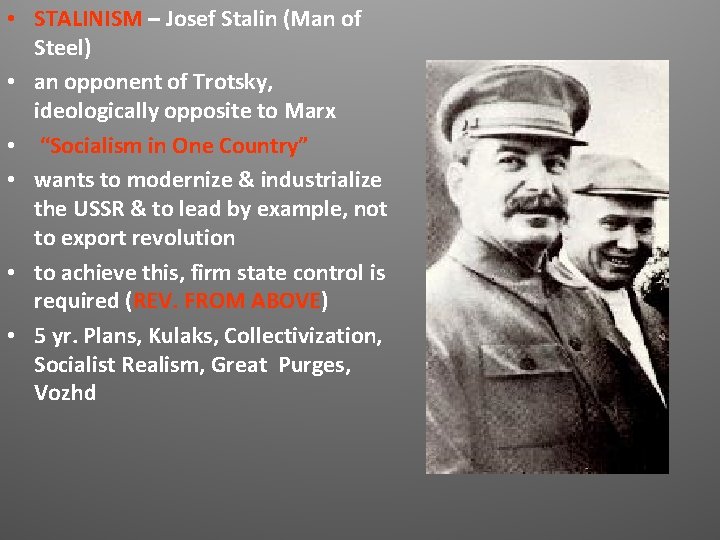
• STALINISM – Josef Stalin (Man of Steel) • an opponent of Trotsky, ideologically opposite to Marx • “Socialism in One Country” • wants to modernize & industrialize the USSR & to lead by example, not to export revolution • to achieve this, firm state control is required (REV. FROM ABOVE) • 5 yr. Plans, Kulaks, Collectivization, Socialist Realism, Great Purges, Vozhd
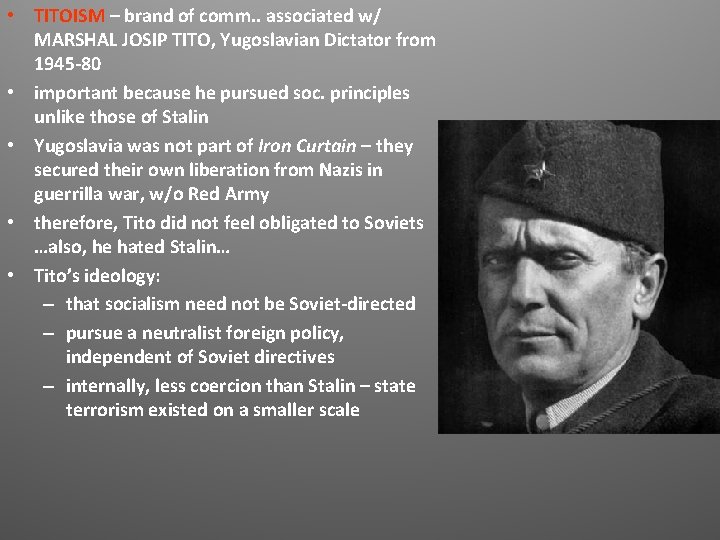
• TITOISM – brand of comm. . associated w/ MARSHAL JOSIP TITO, Yugoslavian Dictator from 1945 -80 • important because he pursued soc. principles unlike those of Stalin • Yugoslavia was not part of Iron Curtain – they secured their own liberation from Nazis in guerrilla war, w/o Red Army • therefore, Tito did not feel obligated to Soviets …also, he hated Stalin… • Tito’s ideology: – that socialism need not be Soviet-directed – pursue a neutralist foreign policy, independent of Soviet directives – internally, less coercion than Stalin – state terrorism existed on a smaller scale
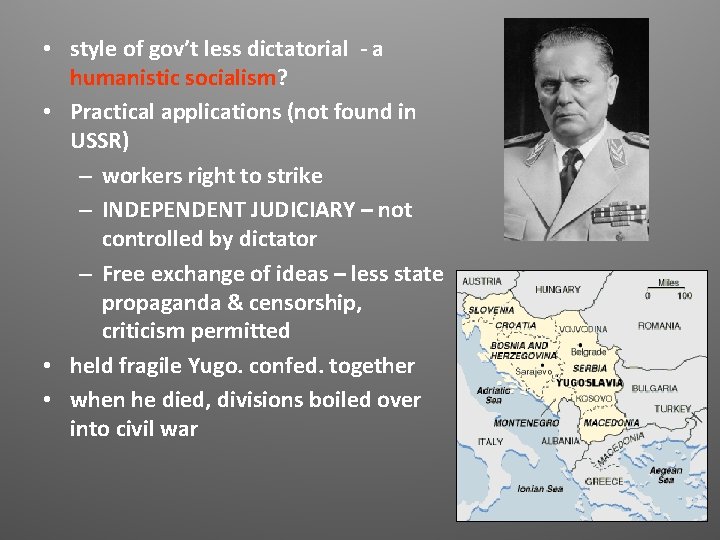
• style of gov’t less dictatorial - a humanistic socialism? • Practical applications (not found in USSR) – workers right to strike – INDEPENDENT JUDICIARY – not controlled by dictator – Free exchange of ideas – less state propaganda & censorship, criticism permitted • held fragile Yugo. confed. together • when he died, divisions boiled over into civil war
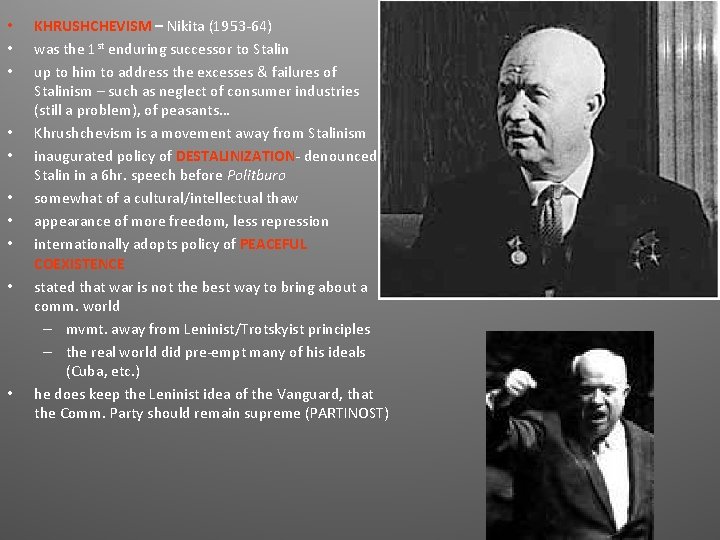
• • • KHRUSHCHEVISM – Nikita (1953 -64) was the 1 st enduring successor to Stalin up to him to address the excesses & failures of Stalinism – such as neglect of consumer industries (still a problem), of peasants… Khrushchevism is a movement away from Stalinism inaugurated policy of DESTALINIZATION- denounced Stalin in a 6 hr. speech before Politburo somewhat of a cultural/intellectual thaw appearance of more freedom, less repression internationally adopts policy of PEACEFUL COEXISTENCE stated that war is not the best way to bring about a comm. world – mvmt. away from Leninist/Trotskyist principles – the real world did pre-empt many of his ideals (Cuba, etc. ) he does keep the Leninist idea of the Vanguard, that the Comm. Party should remain supreme (PARTINOST)
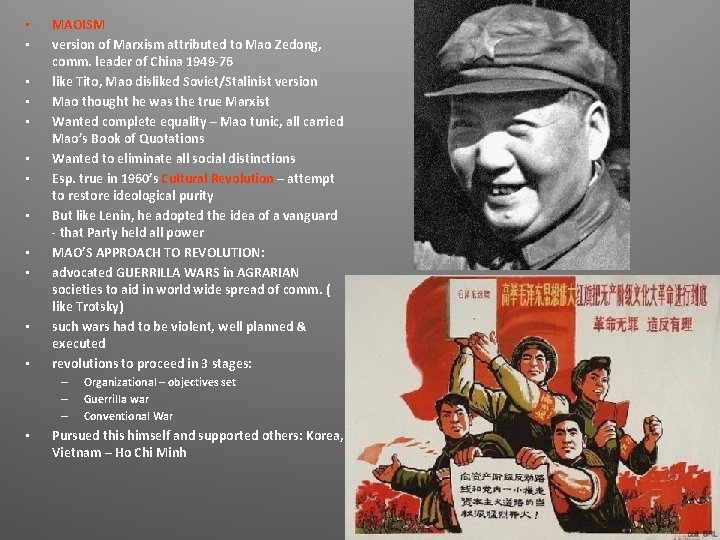
• • • MAOISM version of Marxism attributed to Mao Zedong, comm. leader of China 1949 -76 like Tito, Mao disliked Soviet/Stalinist version Mao thought he was the true Marxist Wanted complete equality – Mao tunic, all carried Mao’s Book of Quotations Wanted to eliminate all social distinctions Esp. true in 1960’s Cultural Revolution – attempt to restore ideological purity But like Lenin, he adopted the idea of a vanguard - that Party held all power MAO’S APPROACH TO REVOLUTION: advocated GUERRILLA WARS in AGRARIAN societies to aid in world wide spread of comm. ( like Trotsky) such wars had to be violent, well planned & executed revolutions to proceed in 3 stages: – – – • Organizational – objectives set Guerrilla war Conventional War Pursued this himself and supported others: Korea, Vietnam – Ho Chi Minh
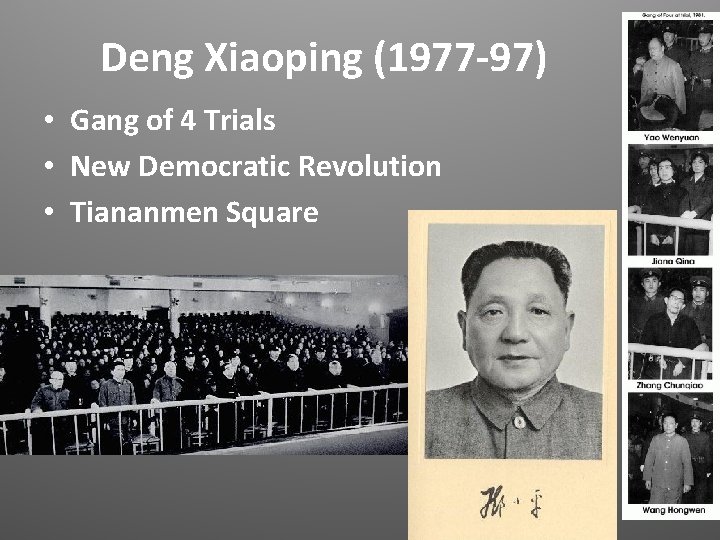
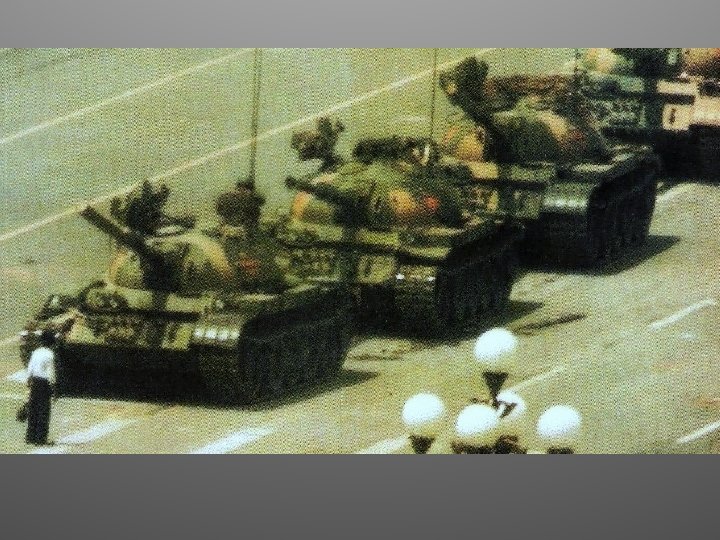
Deng Xiaoping (1977 -97) • Gang of 4 Trials • New Democratic Revolution • Tiananmen Square
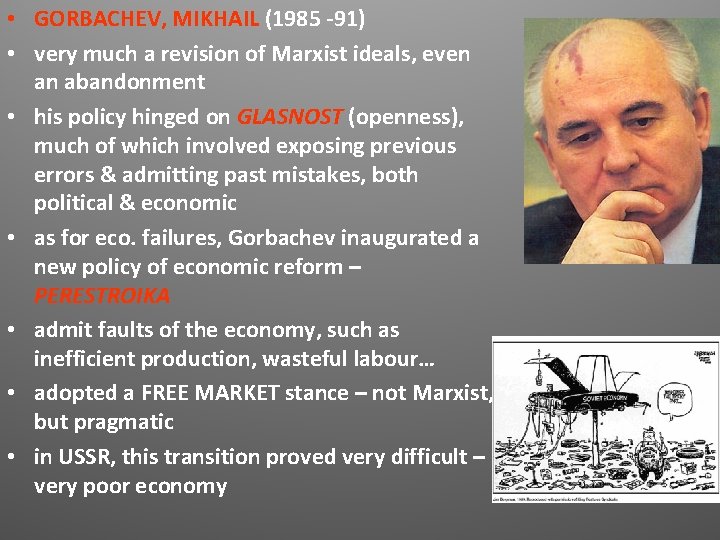
• GORBACHEV, MIKHAIL (1985 -91) • very much a revision of Marxist ideals, even an abandonment • his policy hinged on GLASNOST (openness), much of which involved exposing previous errors & admitting past mistakes, both political & economic • as for eco. failures, Gorbachev inaugurated a new policy of economic reform – PERESTROIKA • admit faults of the economy, such as inefficient production, wasteful labour… • adopted a FREE MARKET stance – not Marxist, but pragmatic • in USSR, this transition proved very difficult – very poor economy
• more protests also permitted • DEMOKRATIZATSIYA is another element of Glasnost – Political (Democratic) Reform • this was tested by Yeltsin and some rebellious republics • was not intended to be an abandonment of Marxism , just an admission that eco. restructuring was necessary…