
The Evolution of a CDR Proposed Systematic Program

- Slides: 26
The Evolution of a CDR: Proposed Systematic Program Jeffrey L. Privette, NOAA On behalf of The Joint Agency Study on the Climate Impacts of the Nunn-Mc. Curdy NPOESS Certification
CDR Status Quo § NASA, NOAA, USGS and other organizations have developed some CDRs as ad hoc research products (e. g. , SST, Ozone, earth radiation budget) § Current investments (Approx. # of grants) – – 2 NASA: ROSES’ 06 (A. 15; Starting Fall 2007): 20 NOAA: CCDD (Stratified starts since 2004): 4 NOAA: SDS (Started Summer 2007): 7 Other activities indirectly supported through mission and Research & Application Program investments Proposed Systematic CDR Program NRC Workshop on Recovery of Climate Measurements from NPOESS
Future CDR Support Outlook § NASA, NOAA and USGS are studying the potential of NRC Decadal Survey missions to provide and/or advance CDRs – Post-mission funding of EOS-based products not clear § CDR production, refinement, reprocessing is not in any operational agency budget § CDR storage (CLASS) and distribution (Data Centers) is not in NOAA budget 3 Proposed Systematic CDR Program NRC Workshop on Recovery of Climate Measurements from NPOESS
Joint-Agency CDR Program Goals § Incorporate NRC input § Devise and cost an end-to-end program – – – CDRs and Climate Information Records (CIRs) Systematic and Coherent Comprehensive (GCOS, IPCC, NRC, CCSP, etc. ) Sustainable Stakeholder and Science Need-driven § Build on current investments and expertise – Interagency and International Need systematic program for evolving CDRs 4 Proposed Systematic CDR Program NRC Workshop on Recovery of Climate Measurements from NPOESS
Planning Development Path 5 Proposed Systematic CDR Program NRC Workshop on Recovery of Climate Measurements from NPOESS
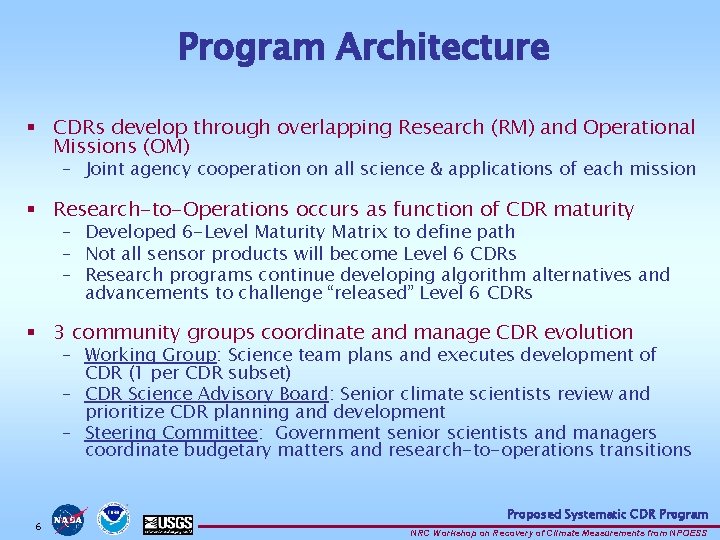
Program Architecture § CDRs develop through overlapping Research (RM) and Operational Missions (OM) – Joint agency cooperation on all science & applications of each mission § Research-to-Operations occurs as function of CDR maturity – Developed 6 -Level Maturity Matrix to define path – Not all sensor products will become Level 6 CDRs – Research programs continue developing algorithm alternatives and advancements to challenge “released” Level 6 CDRs § 3 community groups coordinate and manage CDR evolution – Working Group: Science team plans and executes development of CDR (1 per CDR subset) – CDR Science Advisory Board: Senior climate scientists review and prioritize CDR planning and development – Steering Committee: Government senior scientists and managers coordinate budgetary matters and research-to-operations transitions 6 Proposed Systematic CDR Program NRC Workshop on Recovery of Climate Measurements from NPOESS
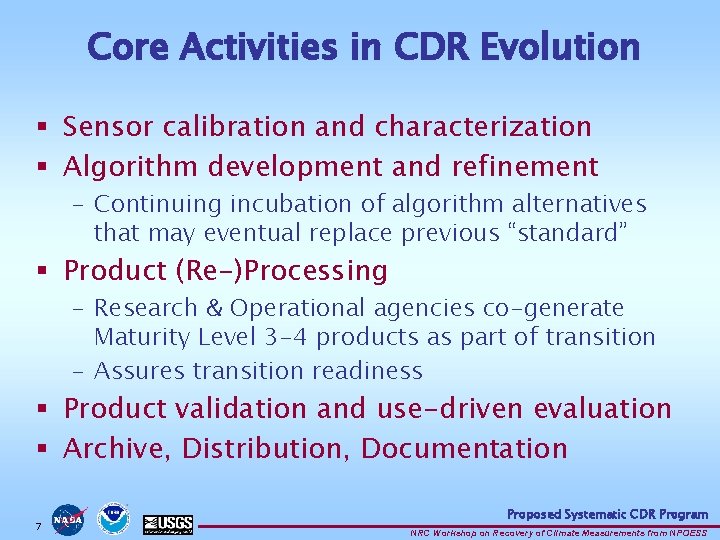
Core Activities in CDR Evolution § Sensor calibration and characterization § Algorithm development and refinement – Continuing incubation of algorithm alternatives that may eventual replace previous “standard” § Product (Re-)Processing – Research & Operational agencies co-generate Maturity Level 3 -4 products as part of transition – Assures transition readiness § Product validation and use-driven evaluation § Archive, Distribution, Documentation 7 Proposed Systematic CDR Program NRC Workshop on Recovery of Climate Measurements from NPOESS
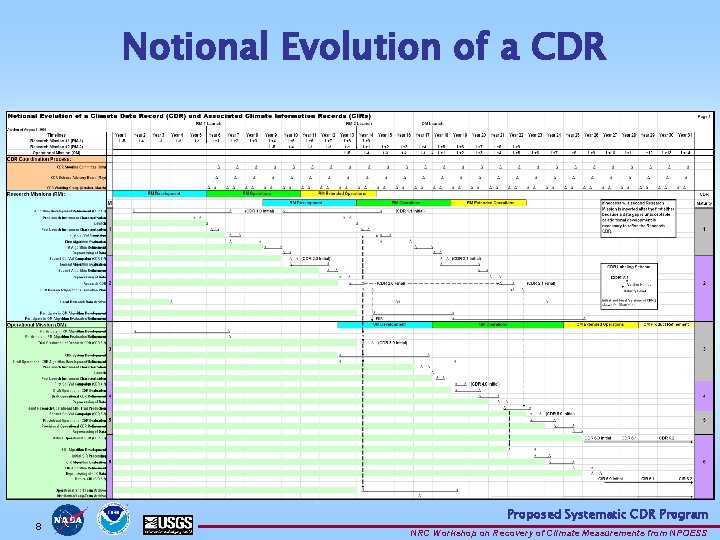
Notional Evolution of a CDR 8 Proposed Systematic CDR Program NRC Workshop on Recovery of Climate Measurements from NPOESS
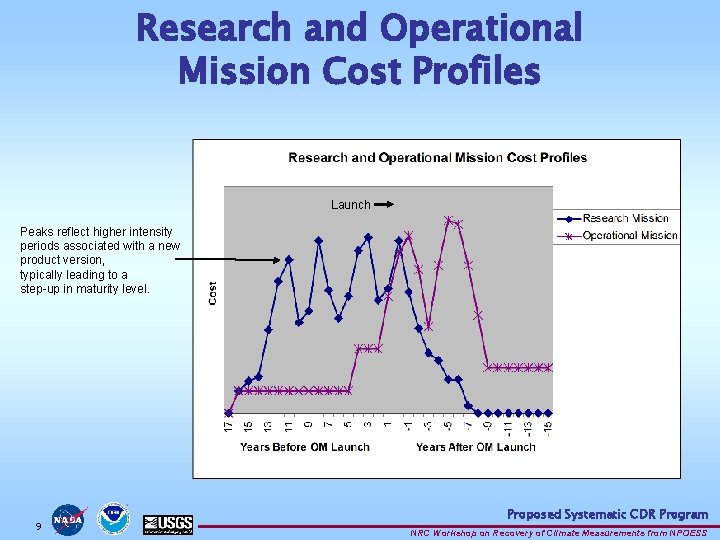
Research and Operational Mission Cost Profiles Launch Peaks reflect higher intensity periods associated with a new product version, typically leading to a step-up in maturity level. 9 Proposed Systematic CDR Program NRC Workshop on Recovery of Climate Measurements from NPOESS
Cost Estimation Approach 1. Notional CDR lifecycle provides schedule and activity breakdown – – NASA historical cost data estimates cost/activity Separate Research and Operational cost profiles 2. Algorithm maturity* determines relative year in notional CDR lifecycle 3. Production complexity* determines multiplier of notional cost profile 4. CDR “ramp-up” rate treated as independent variable – Required CDR prioritization strawman *Maturity and complexity estimates from joint agency sensor expert teams (names provided. Systematic in April Panel Proposed CDRbrief) Program 10 NRC Workshop on Recovery of Climate Measurements from NPOESS
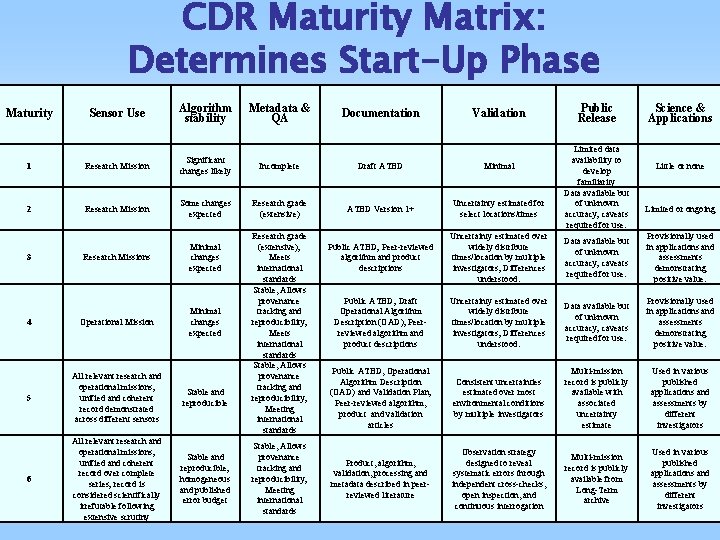
CDR Maturity Matrix: Determines Start-Up Phase Sensor Use Algorithm stability 1 Research Mission Significant changes likely Incomplete Draft ATBD Minimal 2 Research Mission Some changes expected Research grade (extensive) ATBD Version 1+ Uncertainty estimated for select locations/times Research Missions Minimal changes expected Public ATBD; Peer-reviewed algorithm and product descriptions Uncertainty estimated over widely distribute times/location by multiple investigators; Differences understood. Data available but of unknown accuracy; caveats required for use. Provisionally used in applications and assessments demonstrating positive value. 4 Operational Mission Minimal changes expected Public ATBD; Draft Operational Algorithm Description (OAD); Peerreviewed algorithm and product descriptions Uncertainty estimated over widely distribute times/location by multiple investigators; Differences understood. Data available but of unknown accuracy; caveats required for use. Provisionally used in applications and assessments demonstrating positive value. 5 All relevant research and operational missions; unified and coherent record demonstrated across different sensors Stable and reproducible Public ATBD, Operational Algorithm Description (OAD) and Validation Plan; Peer-reviewed algorithm, product and validation articles Consistent uncertainties estimated over most environmental conditions by multiple investigators Multi-mission record is publicly available with associated uncertainty estimate Used in various published applications and assessments by different investigators 6 All relevant research and operational missions; unified and coherent record over complete series; record is considered scientifically irrefutable following extensive scrutiny Stable and reproducible; homogeneous and published error budget Product, algorithm, validation, processing and metadata described in peerreviewed literature Observation strategy designed to reveal systematic errors through independent cross-checks, open inspection, and continuous interrogation Multi-mission record is publicly available from Long-Term archive Used in various published applications and assessments by different investigators Maturity 3 Metadata & QA Research grade (extensive); Meets international standards Stable, Allows provenance tracking and reproducibility; Meeting international standards Documentation Validation Public Release Limited data availability to develop familiarity Data available but of unknown accuracy; caveats required for use. Science & Applications Little or none Limited or ongoing
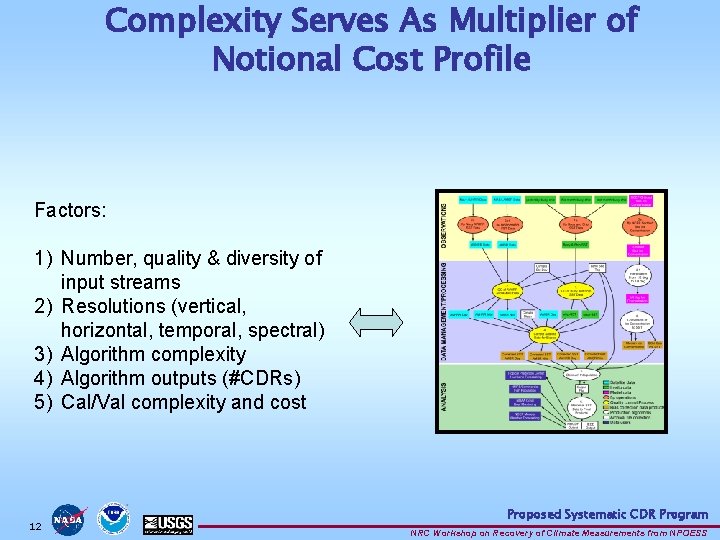
Complexity Serves As Multiplier of Notional Cost Profile Factors: 1) Number, quality & diversity of input streams 2) Resolutions (vertical, horizontal, temporal, spectral) 3) Algorithm complexity 4) Algorithm outputs (#CDRs) 5) Cal/Val complexity and cost 12 Proposed Systematic CDR Program NRC Workshop on Recovery of Climate Measurements from NPOESS
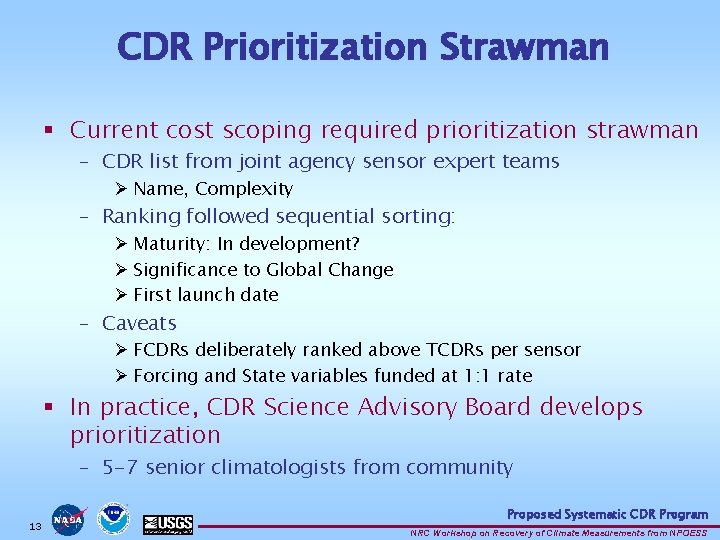
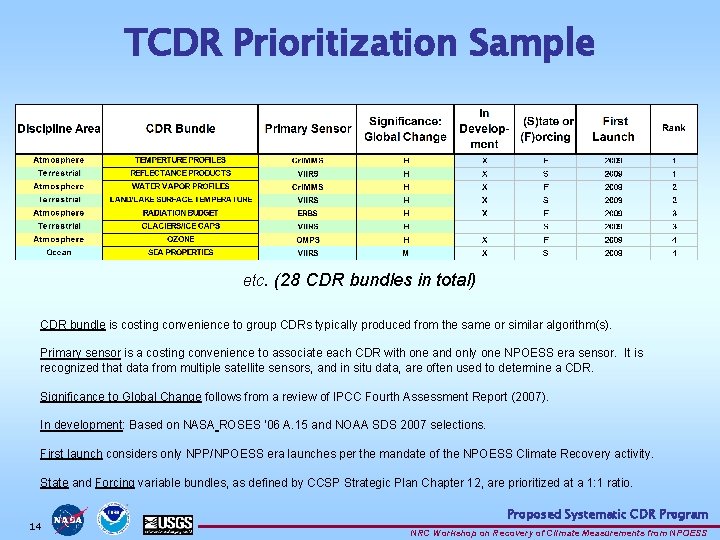
CDR Prioritization Strawman § Current cost scoping required prioritization strawman – CDR list from joint agency sensor expert teams Ø Name, Complexity – Ranking followed sequential sorting: Ø Maturity: In development? Ø Significance to Global Change Ø First launch date – Caveats Ø FCDRs deliberately ranked above TCDRs per sensor Ø Forcing and State variables funded at 1: 1 rate § In practice, CDR Science Advisory Board develops prioritization – 5 -7 senior climatologists from community 13 Proposed Systematic CDR Program NRC Workshop on Recovery of Climate Measurements from NPOESS
TCDR Prioritization Sample etc. (28 CDR bundles in total) CDR bundle is costing convenience to group CDRs typically produced from the same or similar algorithm(s). Primary sensor is a costing convenience to associate each CDR with one and only one NPOESS era sensor. It is recognized that data from multiple satellite sensors, and in situ data, are often used to determine a CDR. Significance to Global Change follows from a review of IPCC Fourth Assessment Report (2007). In development: Based on NASA ROSES ’ 06 A. 15 and NOAA SDS 2007 selections. First launch considers only NPP/NPOESS era launches per the mandate of the NPOESS Climate Recovery activity. State and Forcing variable bundles, as defined by CCSP Strategic Plan Chapter 12, are prioritized at a 1: 1 ratio. 14 Proposed Systematic CDR Program NRC Workshop on Recovery of Climate Measurements from NPOESS
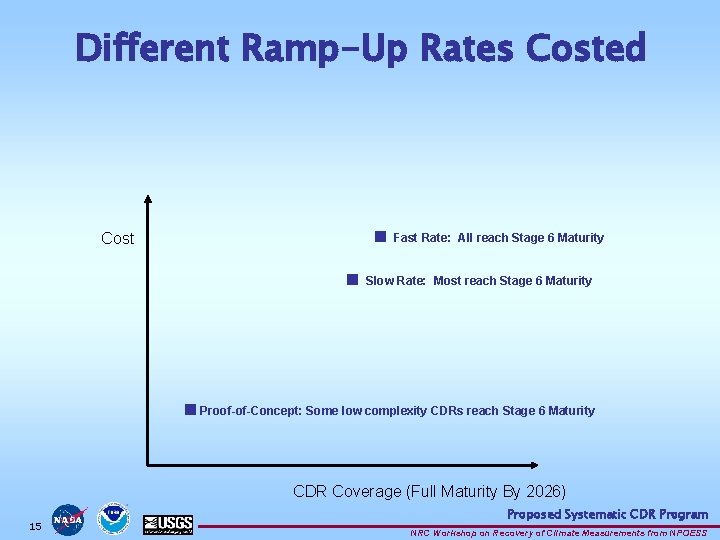
Different Ramp-Up Rates Costed Cost ■ Fast Rate: All reach Stage 6 Maturity ■ Slow Rate: Most reach Stage 6 Maturity ■ Proof-of-Concept: Some low complexity CDRs reach Stage 6 Maturity CDR Coverage (Full Maturity By 2026) 15 Proposed Systematic CDR Program NRC Workshop on Recovery of Climate Measurements from NPOESS
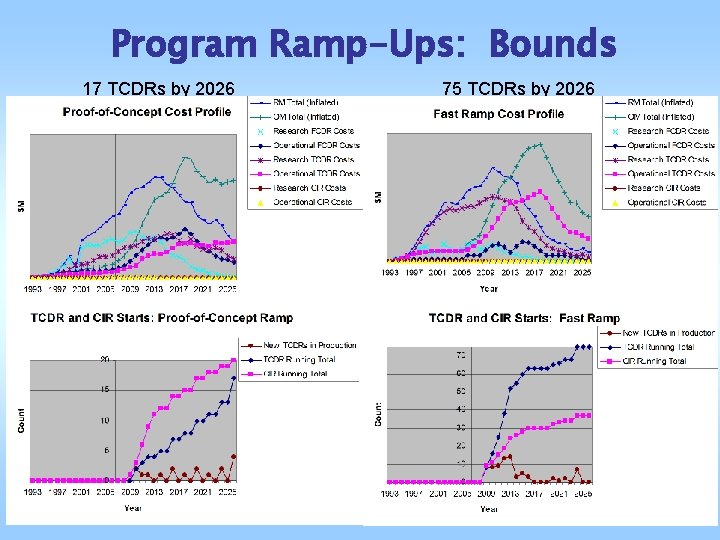
Program Ramp-Ups: Bounds 17 TCDRs by 2026 75 TCDRs by 2026
Cost Subsidies Under Study § Cost model estimates total cost of program § Core-funded agency activities can reduce new funding needs – NASA EOS and Research & Application programs – Integrated Program Office activities 17 Proposed Systematic CDR Program NRC Workshop on Recovery of Climate Measurements from NPOESS
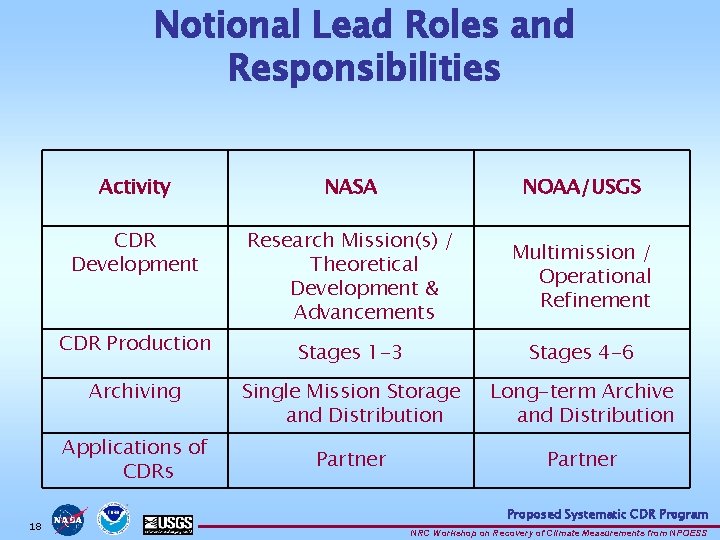
Notional Lead Roles and Responsibilities Activity NASA NOAA/USGS CDR Development Research Mission(s) / Theoretical Development & Advancements Multimission / Operational Refinement CDR Production Stages 1 -3 Stages 4 -6 Archiving Single Mission Storage and Distribution Long-term Archive and Distribution Partner Applications of CDRs 18 Proposed Systematic CDR Program NRC Workshop on Recovery of Climate Measurements from NPOESS
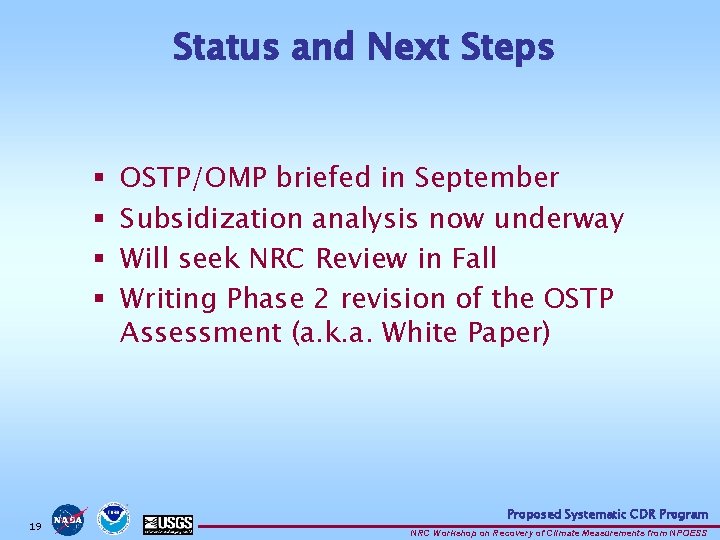
Status and Next Steps § § 19 OSTP/OMP briefed in September Subsidization analysis now underway Will seek NRC Review in Fall Writing Phase 2 revision of the OSTP Assessment (a. k. a. White Paper) Proposed Systematic CDR Program NRC Workshop on Recovery of Climate Measurements from NPOESS
Thank You Joint Team Members NASA – Bryant Cramer, Jack Kaye, Dave Young, Charles Taylor, Thomas Jasin NOAA – Chet Koblinsky, Mike Tanner, Jeff Privette, Tom Karl, John Bates, Mike Bonadonna, Kandis Boyd, Jim Oneal, Gary Davis, Brent Smith USGS - De. Wayne Cecil 20 Proposed Systematic CDR Program NRC Workshop on Recovery of Climate Measurements from NPOESS
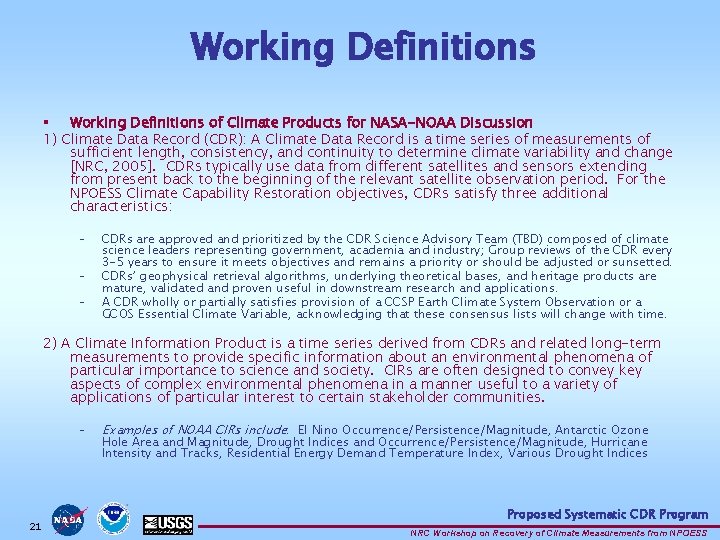
Working Definitions § Working Definitions of Climate Products for NASA-NOAA Discussion 1) Climate Data Record (CDR): A Climate Data Record is a time series of measurements of sufficient length, consistency, and continuity to determine climate variability and change [NRC, 2005]. CDRs typically use data from different satellites and sensors extending from present back to the beginning of the relevant satellite observation period. For the NPOESS Climate Capability Restoration objectives, CDRs satisfy three additional characteristics: – – – CDRs are approved and prioritized by the CDR Science Advisory Team (TBD) composed of climate science leaders representing government, academia and industry; Group reviews of the CDR every 3 -5 years to ensure it meets objectives and remains a priority or should be adjusted or sunsetted. CDRs’ geophysical retrieval algorithms, underlying theoretical bases, and heritage products are mature, validated and proven useful in downstream research and applications. A CDR wholly or partially satisfies provision of a CCSP Earth Climate System Observation or a GCOS Essential Climate Variable, acknowledging that these consensus lists will change with time. 2) A Climate Information Product is a time series derived from CDRs and related long-term measurements to provide specific information about an environmental phenomena of particular importance to science and society. CIRs are often designed to convey key aspects of complex environmental phenomena in a manner useful to a variety of applications of particular interest to certain stakeholder communities. – 21 Examples of NOAA CIRs include: El Nino Occurrence/Persistence/Magnitude, Antarctic Ozone Hole Area and Magnitude, Drought Indices and Occurrence/Persistence/Magnitude, Hurricane Intensity and Tracks, Residential Energy Demand Temperature Index, Various Drought Indices Proposed Systematic CDR Program NRC Workshop on Recovery of Climate Measurements from NPOESS
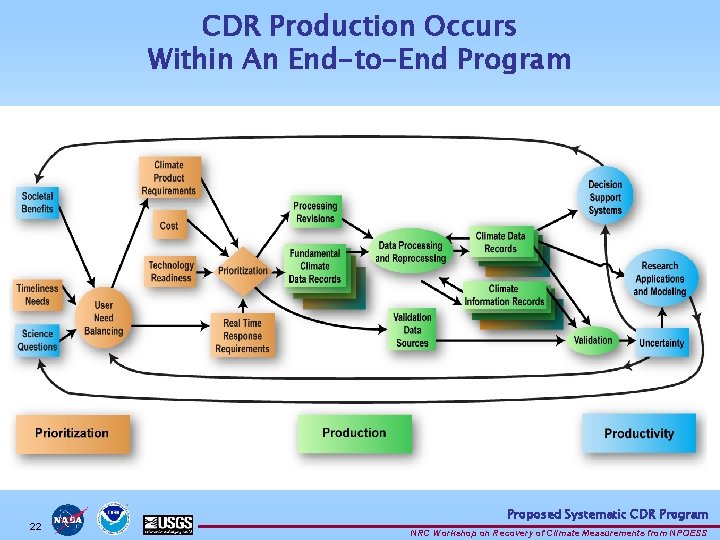
CDR Production Occurs Within An End-to-End Program 22 Proposed Systematic CDR Program NRC Workshop on Recovery of Climate Measurements from NPOESS
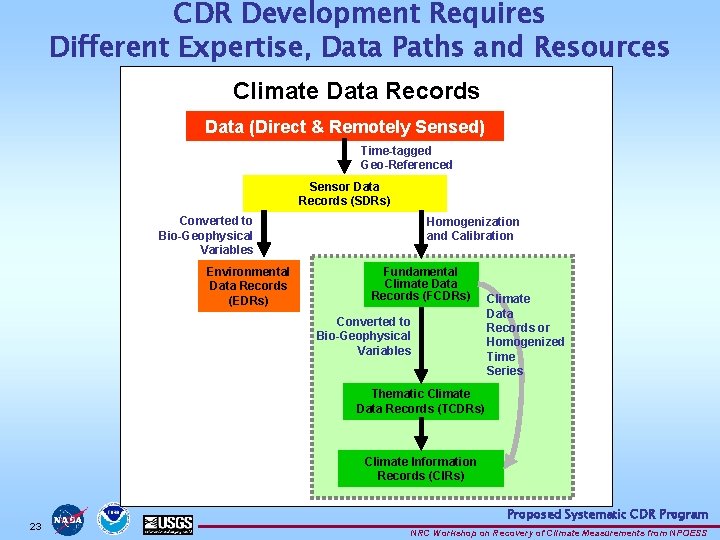
CDR Development Requires Different Expertise, Data Paths and Resources Climate Data Records Data (Direct & Remotely Sensed) Time-tagged Geo-Referenced Sensor Data Records (SDRs) Converted to Bio-Geophysical Variables Environmental Data Records (EDRs) Homogenization and Calibration Fundamental Climate Data Records (FCDRs) Converted to Bio-Geophysical Variables Climate Data Records or Homogenized Time Series Thematic Climate Data Records (TCDRs) Climate Information Records (CIRs) 23 Proposed Systematic CDR Program NRC Workshop on Recovery of Climate Measurements from NPOESS
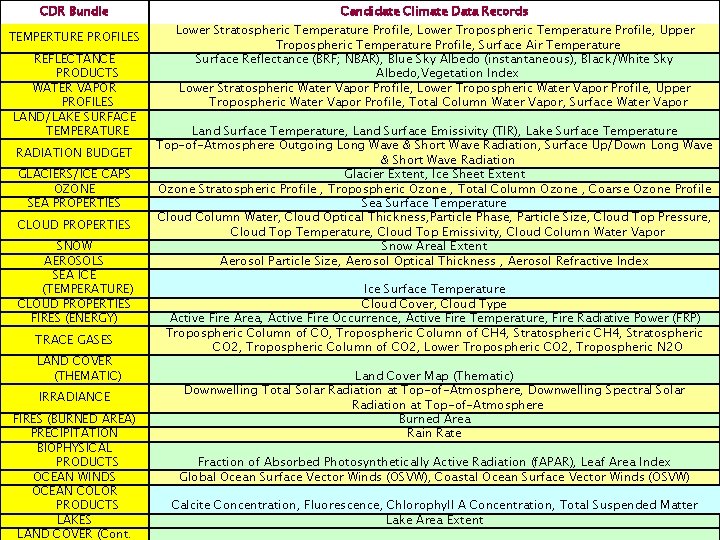
CDR Bundle Example CDR Prioritization Candidate Climate Data Records TEMPERTURE PROFILES Lower Stratospheric Temperature Profile, Lower Tropospheric Temperature Profile, Upper Tropospheric Temperature Profile, Surface Air Temperature Surface Reflectance (BRF; NBAR), Blue Sky Albedo (instantaneous), Black/White Sky Albedo, Vegetation Index Lower Stratospheric Water Vapor Profile, Lower Tropospheric Water Vapor Profile, Upper Tropospheric Water Vapor Profile, Total Column Water Vapor, Surface Water Vapor (Sort By IPCC, Algorithm Investment, Launch) REFLECTANCE PRODUCTS WATER VAPOR PROFILES LAND/LAKE SURFACE TEMPERATURE RADIATION BUDGET GLACIERS/ICE CAPS OZONE SEA PROPERTIES CLOUD PROPERTIES SNOW AEROSOLS SEA ICE (TEMPERATURE) CLOUD PROPERTIES FIRES (ENERGY) TRACE GASES LAND COVER (THEMATIC) IRRADIANCE FIRES (BURNED AREA) PRECIPITATION BIOPHYSICAL PRODUCTS OCEAN WINDS OCEAN COLOR PRODUCTS LAKES 24 LAND COVER (Cont. Land Surface Temperature, Land Surface Emissivity (TIR), Lake Surface Temperature Top-of-Atmosphere Outgoing Long Wave & Short Wave Radiation, Surface Up/Down Long Wave & Short Wave Radiation Glacier Extent, Ice Sheet Extent Ozone Stratospheric Profile , Tropospheric Ozone , Total Column Ozone , Coarse Ozone Profile Sea Surface Temperature Cloud Column Water, Cloud Optical Thickness, Particle Phase, Particle Size, Cloud Top Pressure, Cloud Top Temperature, Cloud Top Emissivity, Cloud Column Water Vapor Snow Areal Extent Aerosol Particle Size, Aerosol Optical Thickness , Aerosol Refractive Index Ice Surface Temperature Cloud Cover, Cloud Type Active Fire Area, Active Fire Occurrence, Active Fire Temperature, Fire Radiative Power (FRP) Tropospheric Column of CO, Tropospheric Column of CH 4, Stratospheric CO 2, Tropospheric Column of CO 2, Lower Tropospheric CO 2, Tropospheric N 2 O Land Cover Map (Thematic) Downwelling Total Solar Radiation at Top-of-Atmosphere, Downwelling Spectral Solar Radiation at Top-of-Atmosphere Burned Area Rain Rate Fraction of Absorbed Photosynthetically Active Radiation (f. APAR), Leaf Area Index Global Ocean Surface Vector Winds (OSVW), Coastal Ocean Surface Vector Winds (OSVW) Calcite Concentration, Fluorescence, Chlorophyll A Concentration, Total Suspended Matter Proposed Systematic CDR Program Lake Area Extent NRC Workshop on Recovery of Climate Measurements from NPOESS
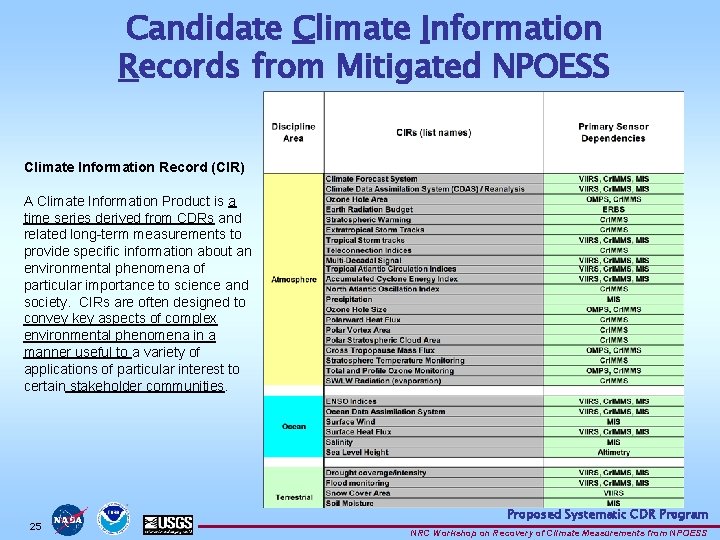
Candidate Climate Information Records from Mitigated NPOESS Climate Information Record (CIR) A Climate Information Product is a time series derived from CDRs and related long-term measurements to provide specific information about an environmental phenomena of particular importance to science and society. CIRs are often designed to convey key aspects of complex environmental phenomena in a manner useful to a variety of applications of particular interest to certain stakeholder communities. 25 Proposed Systematic CDR Program NRC Workshop on Recovery of Climate Measurements from NPOESS
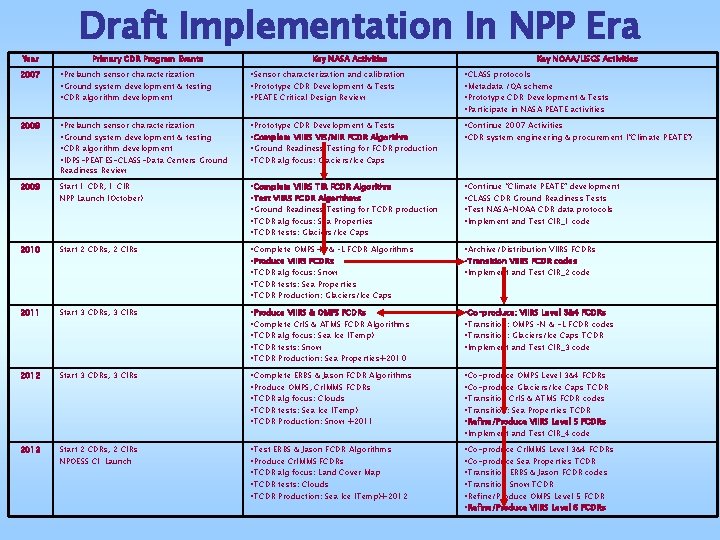
Year Draft Implementation In NPP Era Primary CDR Program Events Key NASA Activities Key NOAA/USGS Activities 2007 §Prelaunch sensor characterization §Ground system development & testing §CDR algorithm development §Sensor characterization and calibration §Prototype CDR Development & Tests §PEATE Critical Design Review §CLASS protocols §Metadata /QA scheme §Prototype CDR Development & Tests §Participate in NASA PEATE activities 2008 §Prelaunch sensor characterization §Ground system development & testing §CDR algorithm development §IDPS-PEATES-CLASS-Data Centers Ground §Prototype CDR Development & Tests §Complete VIIRS VIS/NIR FCDR Algorithm §Ground Readiness Testing for FCDR production §TCDR alg focus: Glaciers/Ice Caps §Continue 2007 Activities §CDR system engineering & procurement (“Climate PEATE”) 2009 Start 1 CDR, 1 CIR NPP Launch (October) §Complete VIIRS TIR FCDR Algorithm §Test VIIRS FCDR Algorithms §Ground Readiness Testing for TCDR production §TCDR alg focus: Sea Properties §TCDR tests: Glaciers/Ice Caps §Continue “Climate PEATE” development §CLASS CDR Ground Readiness Tests §Test NASA-NOAA CDR data protocols §Implement and Test CIR_1 code 2010 Start 2 CDRs, 2 CIRs §Complete OMPS-N & –L FCDR Algorithms §Produce VIIRS FCDRs §TCDR alg focus: Snow §TCDR tests: Sea Properties §TCDR Production: Glaciers/Ice Caps §Archive/Distribution VIIRS FCDRs §Transition VIIRS FCDR codes §Implement and Test CIR_2 code 2011 Start 3 CDRs, 3 CIRs §Produce VIIRS & OMPS FCDRs §Complete Cr. IS & ATMS FCDR Algorithms §TCDR alg focus: Sea Ice (Temp) §TCDR tests: Snow §TCDR Production: Sea Properties+2010 §Co-produce: VIIRS Level 3&4 FCDRs §Transition: OMPS –N & -L FCDR codes §Transition: Glaciers/Ice Caps TCDR §Implement and Test CIR_3 code 2012 Start 3 CDRs, 3 CIRs §Complete ERBS & Jason FCDR Algorithms §Produce OMPS, Cr. IMMS FCDRs §TCDR alg focus: Clouds §TCDR tests: Sea Ice (Temp) §TCDR Production: Snow +2011 §Co-produce OMPS Level 3&4 FCDRs §Co-produce Glaciers/Ice Caps TCDR §Transition Cr. IS & ATMS FCDR codes §Transition: Sea Properties TCDR §Refine/Produce VIIRS Level 5 FCDRs §Implement and Test CIR_4 code 2013 Start 2 CDRs, 2 CIRs NPOESS C 1 Launch §Test ERBS & Jason FCDR Algorithms §Produce Cr. IMMS FCDRs §TCDR alg focus: Land Cover Map §TCDR tests: Clouds §TCDR Production: Sea Ice (Temp)+2012 §Co-produce Cr. IMMS Level 3&4 FCDRs §Co-produce Sea Properties TCDR §Transition ERBS & Jason FCDR codes §Transition Snow TCDR §Refine/Produce OMPS Level 5 FCDR §Refine/Produce VIIRS Level 6 FCDRs Readiness Review