
The Evans method Measuring magnetic susceptibility by NMRhistory
The Evans method Measuring magnetic susceptibility by NMR—history Created by Adam R. Johnson, Harvey Mudd College (adam_johnson@hmc. edu) and posted on VIPEr on June 9, 2016. Copyright Adam R. Johnson, 2016. This work is licensed under the Creative Commons Attribution-Non. Commercial-Share. Alike License. To view a copy of this license visit http: //creativecommons. org/licenses/by-nc-sa/4. 0/

History • Equation for magnetic susceptibility as a function of mass concentration (g/m. L) ∆f = peak separation (Hz) f = NMR frequency (Hz) m = mass per cm 3 cm = mass susceptibility
Historical perspective • When this technique was first being developed, NMR sensitivity was low. • Reference in capillary had to be neat TMS or other material • However, diamagnetic shift of solvent reference was observed; the d for TMS is NOT equal to the d for 1% TMS in CCl 3 for example
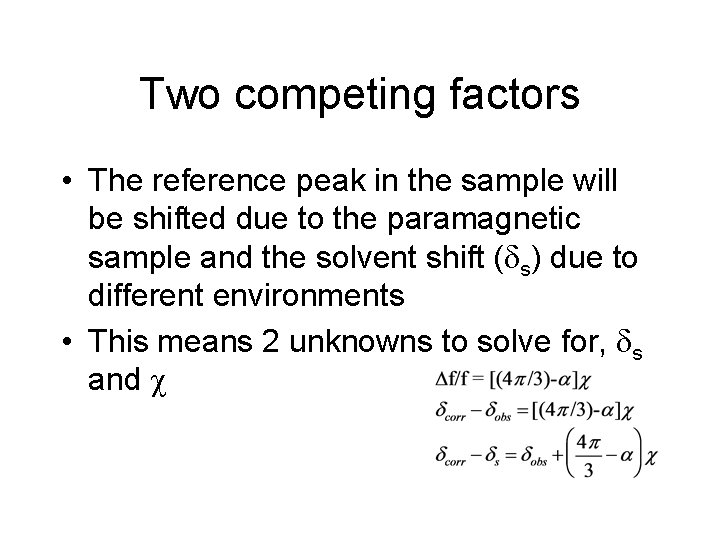
Two competing factors • The reference peak in the sample will be shifted due to the paramagnetic sample and the solvent shift (ds) due to different environments • This means 2 unknowns to solve for, ds and c
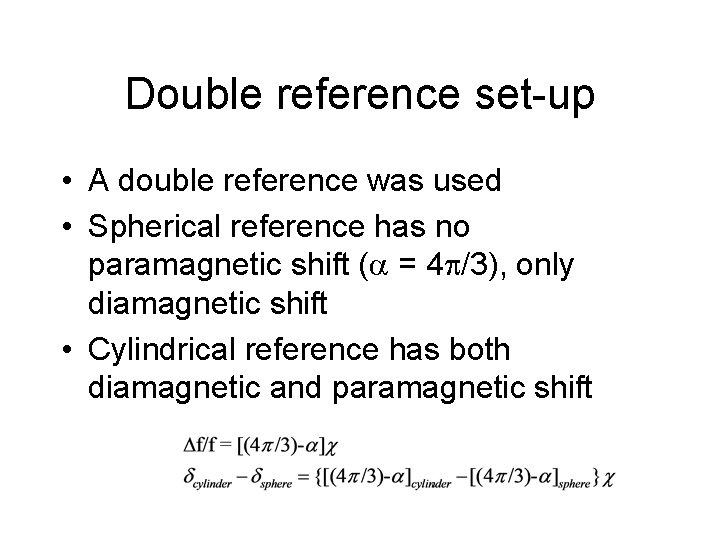
Double reference set-up • A double reference was used • Spherical reference has no paramagnetic shift (a = 4 p/3), only diamagnetic shift • Cylindrical reference has both diamagnetic and paramagnetic shift

Double reference Evans method • Reference tubes contain pure substance (water) • Sample contains pure substance (CH 3 CN)
Superconducting magnets • Modern spectrometers are much more sensitive, and can get good data with only a cylindrical reference tube • The reference need not be neat solvent, but can be 1% TMS in CDCl 3
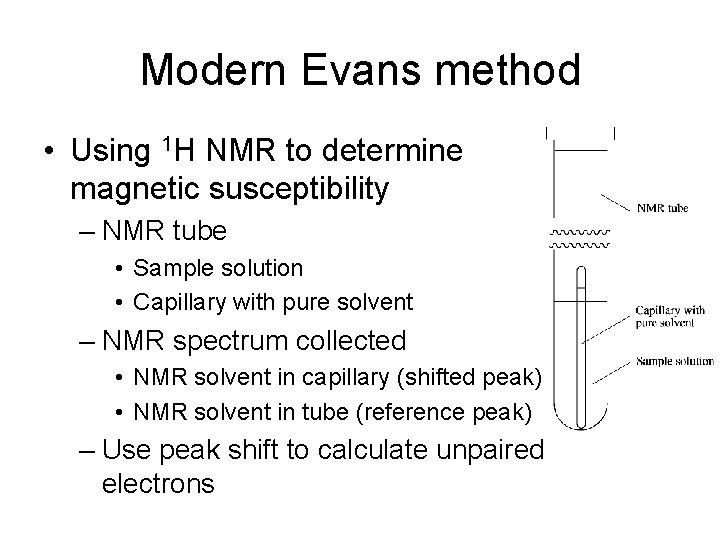
Modern Evans method • Using 1 H NMR to determine magnetic susceptibility – NMR tube • Sample solution • Capillary with pure solvent – NMR spectrum collected • NMR solvent in capillary (shifted peak) • NMR solvent in tube (reference peak) – Use peak shift to calculate unpaired electrons
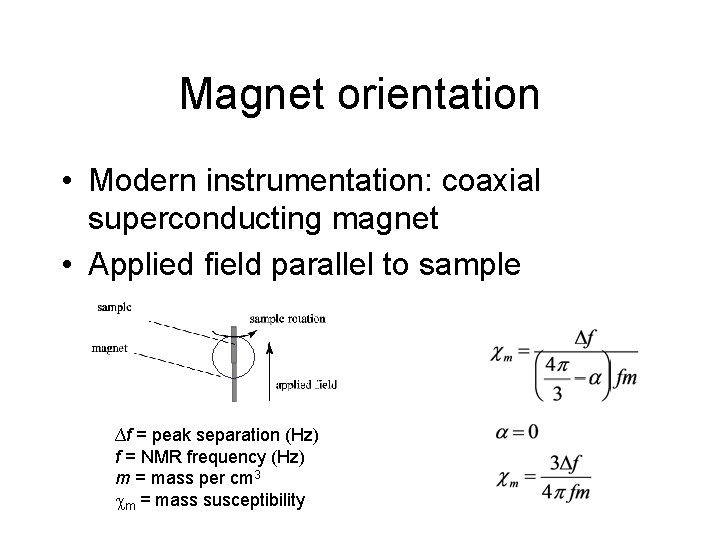
Magnet orientation • Modern instrumentation: coaxial superconducting magnet • Applied field parallel to sample ∆f = peak separation (Hz) f = NMR frequency (Hz) m = mass per cm 3 cm = mass susceptibility
- Slides: 9