
The EUs General Data Protection Regulation GDPR Graham


- Slides: 54
The EU’s General Data Protection Regulation (GDPR) Graham Greenleaf Professor of Law & Information Systems UNSW Australia UNSW Law Continuing Legal Education, 15 March 2019
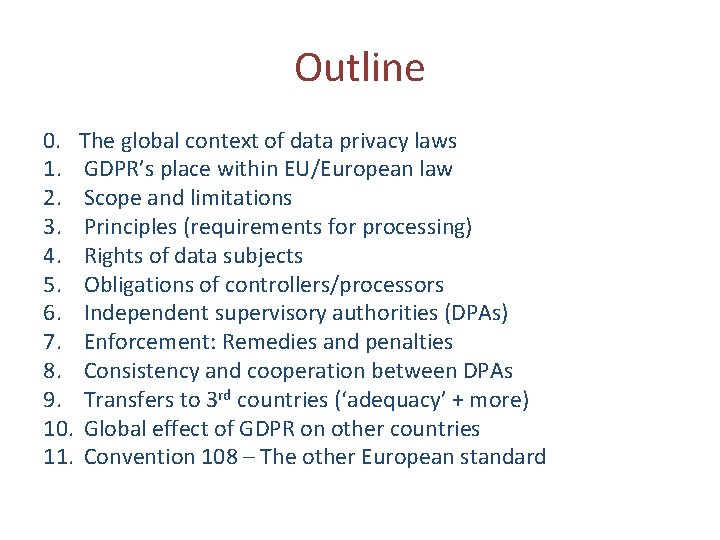
Outline 0. The global context of data privacy laws 1. GDPR’s place within EU/European law 2. Scope and limitations 3. Principles (requirements for processing) 4. Rights of data subjects 5. Obligations of controllers/processors 6. Independent supervisory authorities (DPAs) 7. Enforcement: Remedies and penalties 8. Consistency and cooperation between DPAs 9. Transfers to 3 rd countries (‘adequacy’ + more) 10. Global effect of GDPR on other countries 11. Convention 108 – The other European standard
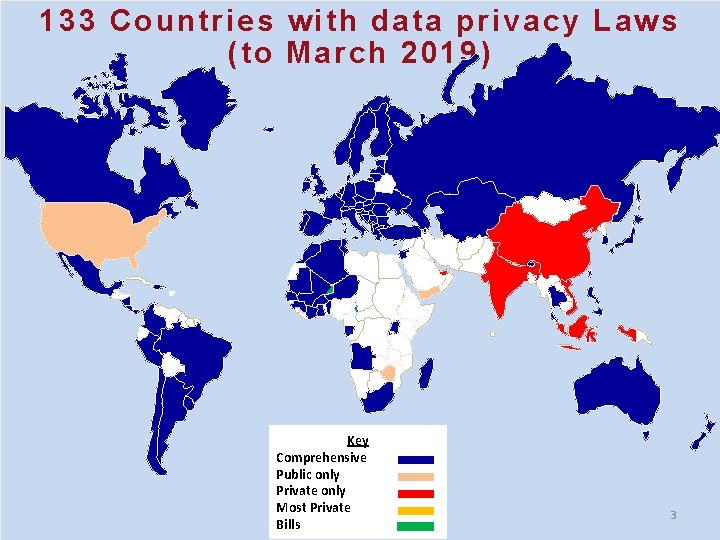
133 Countr ies with data privacy Laws (to March 2019) Key Comprehensive Public only Private only Most Private Bills 3
Global context of data privacy laws
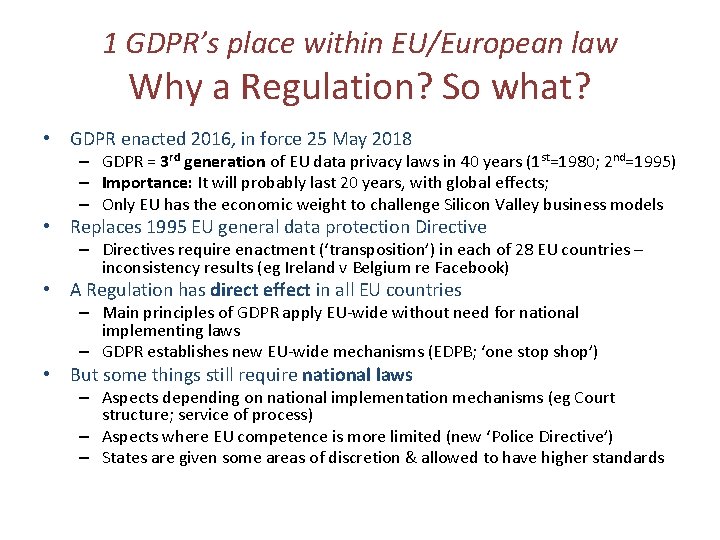
1 GDPR’s place within EU/European law Why a Regulation? So what? • GDPR enacted 2016, in force 25 May 2018 – GDPR = 3 rd generation of EU data privacy laws in 40 years (1 st=1980; 2 nd=1995) – Importance: It will probably last 20 years, with global effects; – Only EU has the economic weight to challenge Silicon Valley business models • Replaces 1995 EU general data protection Directive – Directives require enactment (‘transposition’) in each of 28 EU countries – inconsistency results (eg Ireland v Belgium re Facebook) • A Regulation has direct effect in all EU countries – Main principles of GDPR apply EU-wide without need for national implementing laws – GDPR establishes new EU-wide mechanisms (EDPB; ‘one stop shop’) • But some things still require national laws – Aspects depending on national implementation mechanisms (eg Court structure; service of process) – Aspects where EU competence is more limited (new ‘Police Directive’) – States are given some areas of discretion & allowed to have higher standards
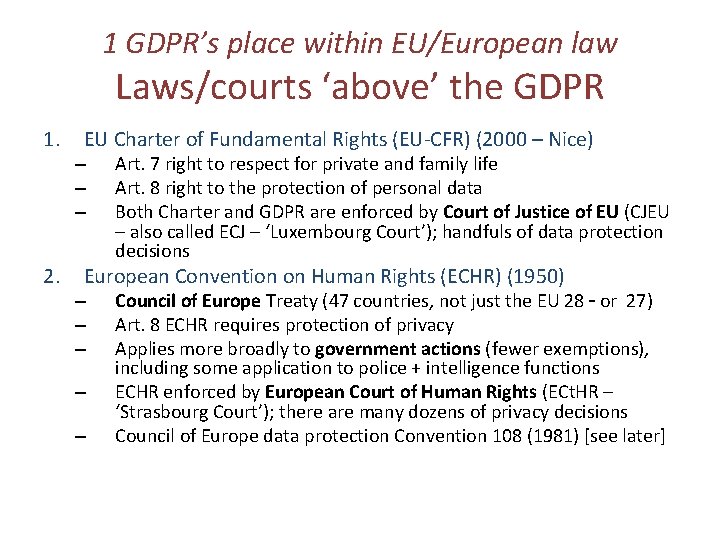
1 GDPR’s place within EU/European law Laws/courts ‘above’ the GDPR 1. 2. EU Charter of Fundamental Rights (EU-CFR) (2000 – Nice) – – – Art. 7 right to respect for private and family life Art. 8 right to the protection of personal data Both Charter and GDPR are enforced by Court of Justice of EU (CJEU – also called ECJ – ‘Luxembourg Court’); handfuls of data protection decisions European Convention on Human Rights (ECHR) (1950) – – – Council of Europe Treaty (47 countries, not just the EU 28 – or 27) Art. 8 ECHR requires protection of privacy Applies more broadly to government actions (fewer exemptions), including some application to police + intelligence functions ECHR enforced by European Court of Human Rights (ECt. HR – ‘Strasbourg Court’); there are many dozens of privacy decisions Council of Europe data protection Convention 108 (1981) [see later]
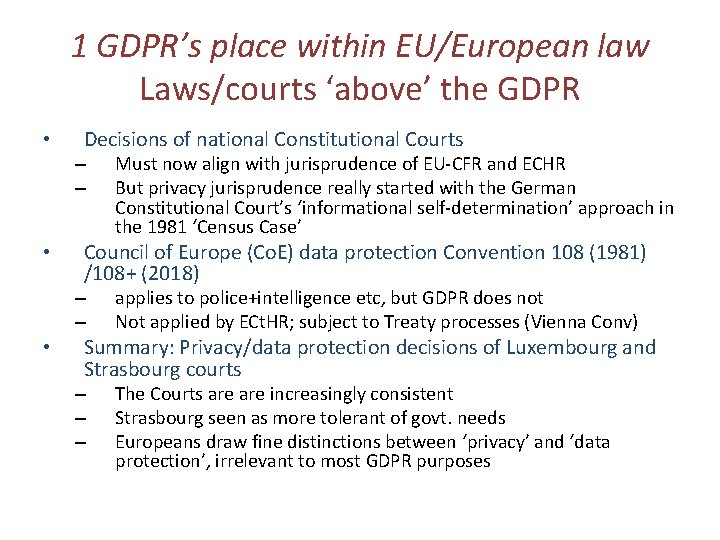
1 GDPR’s place within EU/European law Laws/courts ‘above’ the GDPR • Decisions of national Constitutional Courts – – • Council of Europe (Co. E) data protection Convention 108 (1981) /108+ (2018) – – • Must now align with jurisprudence of EU-CFR and ECHR But privacy jurisprudence really started with the German Constitutional Court’s ‘informational self-determination’ approach in the 1981 ‘Census Case’ applies to police+intelligence etc, but GDPR does not Not applied by ECt. HR; subject to Treaty processes (Vienna Conv) Summary: Privacy/data protection decisions of Luxembourg and Strasbourg courts – – – The Courts are increasingly consistent Strasbourg seen as more tolerant of govt. needs Europeans draw fine distinctions between ‘privacy’ and ‘data protection’, irrelevant to most GDPR purposes
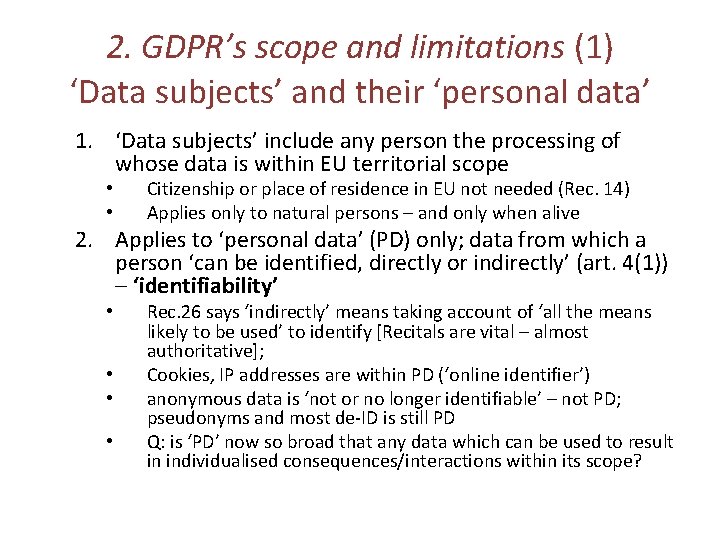
2. GDPR’s scope and limitations (1) ‘Data subjects’ and their ‘personal data’ 1. ‘Data subjects’ include any person the processing of whose data is within EU territorial scope • • Citizenship or place of residence in EU not needed (Rec. 14) Applies only to natural persons – and only when alive 2. Applies to ‘personal data’ (PD) only; data from which a person ‘can be identified, directly or indirectly’ (art. 4(1)) – ‘identifiability’ • • Rec. 26 says ‘indirectly’ means taking account of ‘all the means likely to be used’ to identify [Recitals are vital – almost authoritative]; Cookies, IP addresses are within PD (‘online identifier’) anonymous data is ‘not or no longer identifiable’ – not PD; pseudonyms and most de-ID is still PD Q: is ‘PD’ now so broad that any data which can be used to result in individualised consequences/interactions within its scope?
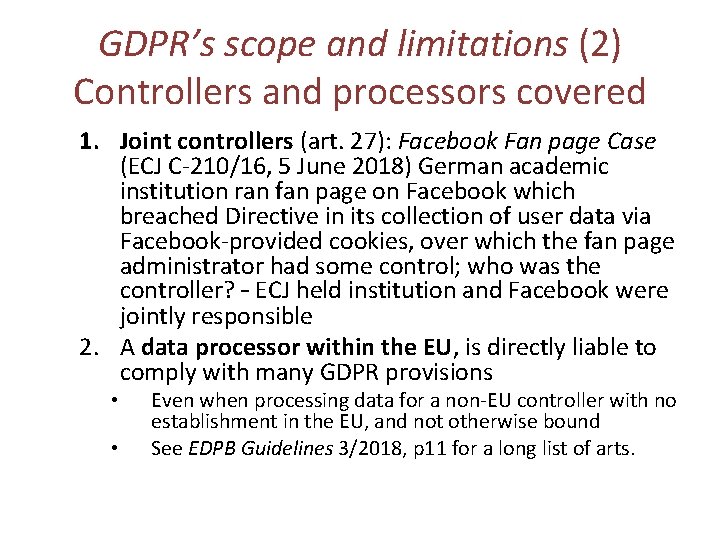
GDPR’s scope and limitations (2) Controllers and processors covered 1. Joint controllers (art. 27): Facebook Fan page Case (ECJ C-210/16, 5 June 2018) German academic institution ran fan page on Facebook which breached Directive in its collection of user data via Facebook-provided cookies, over which the fan page administrator had some control; who was the controller? – ECJ held institution and Facebook were jointly responsible 2. A data processor within the EU, is directly liable to comply with many GDPR provisions • • Even when processing data for a non-EU controller with no establishment in the EU, and not otherwise bound See EDPB Guidelines 3/2018, p 11 for a long list of arts.
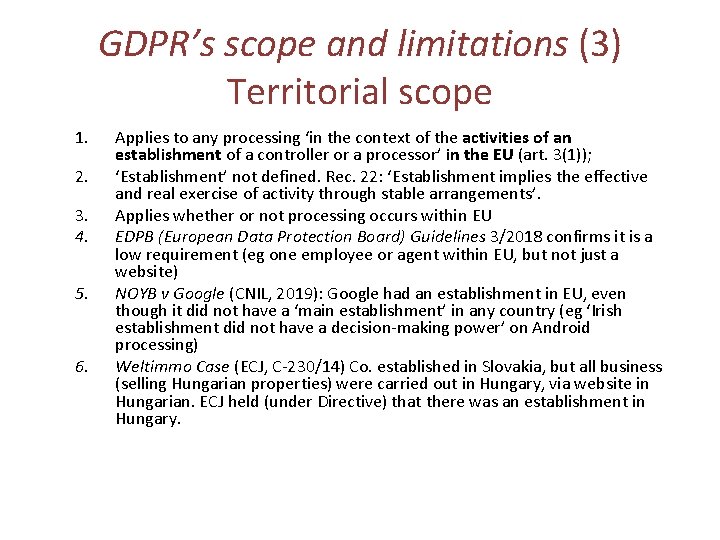
GDPR’s scope and limitations (3) Territorial scope 1. 2. 3. 4. 5. 6. Applies to any processing ‘in the context of the activities of an establishment of a controller or a processor’ in the EU (art. 3(1)); ‘Establishment’ not defined. Rec. 22: ‘Establishment implies the effective and real exercise of activity through stable arrangements’. Applies whether or not processing occurs within EU EDPB (European Data Protection Board) Guidelines 3/2018 confirms it is a low requirement (eg one employee or agent within EU, but not just a website) NOYB v Google (CNIL, 2019): Google had an establishment in EU, even though it did not have a ‘main establishment’ in any country (eg ‘Irish establishment did not have a decision-making power’ on Android processing) Weltimmo Case (ECJ, C-230/14) Co. established in Slovakia, but all business (selling Hungarian properties) were carried out in Hungary, via website in Hungarian. ECJ held (under Directive) that there was an establishment in Hungary.
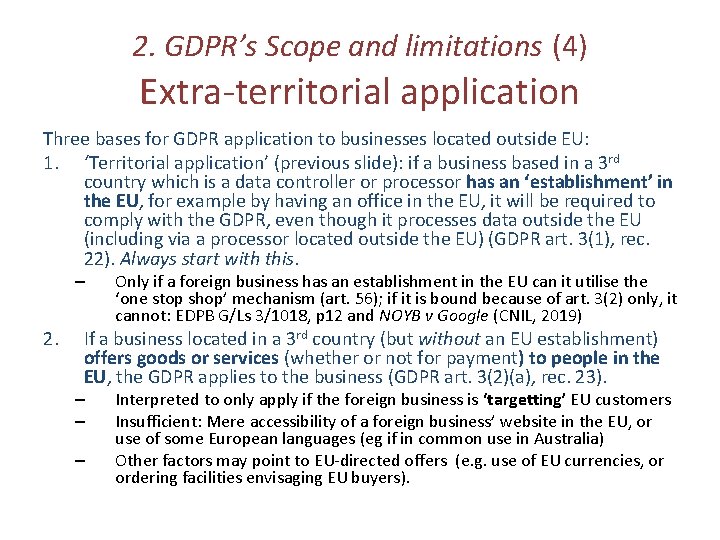
2. GDPR’s Scope and limitations (4) Extra-territorial application Three bases for GDPR application to businesses located outside EU: 1. ‘Territorial application’ (previous slide): if a business based in a 3 rd country which is a data controller or processor has an ‘establishment’ in the EU, for example by having an office in the EU, it will be required to comply with the GDPR, even though it processes data outside the EU (including via a processor located outside the EU) (GDPR art. 3(1), rec. 22). Always start with this. – 2. Only if a foreign business has an establishment in the EU can it utilise the ‘one stop shop’ mechanism (art. 56); if it is bound because of art. 3(2) only, it cannot: EDPB G/Ls 3/1018, p 12 and NOYB v Google (CNIL, 2019) If a business located in a 3 rd country (but without an EU establishment) offers goods or services (whether or not for payment) to people in the EU, the GDPR applies to the business (GDPR art. 3(2)(a), rec. 23). – – – Interpreted to only apply if the foreign business is ‘targetting’ EU customers Insufficient: Mere accessibility of a foreign business’ website in the EU, or use of some European languages (eg if in common use in Australia) Other factors may point to EU-directed offers (e. g. use of EU currencies, or ordering facilities envisaging EU buyers).
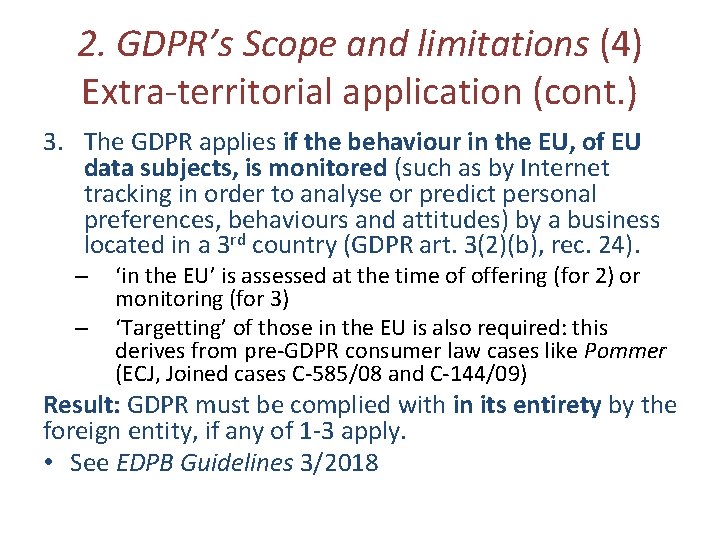
2. GDPR’s Scope and limitations (4) Extra-territorial application (cont. ) 3. The GDPR applies if the behaviour in the EU, of EU data subjects, is monitored (such as by Internet tracking in order to analyse or predict personal preferences, behaviours and attitudes) by a business located in a 3 rd country (GDPR art. 3(2)(b), rec. 24). – – ‘in the EU’ is assessed at the time of offering (for 2) or monitoring (for 3) ‘Targetting’ of those in the EU is also required: this derives from pre-GDPR consumer law cases like Pommer (ECJ, Joined cases C-585/08 and C-144/09) Result: GDPR must be complied with in its entirety by the foreign entity, if any of 1 -3 apply. • See EDPB Guidelines 3/2018
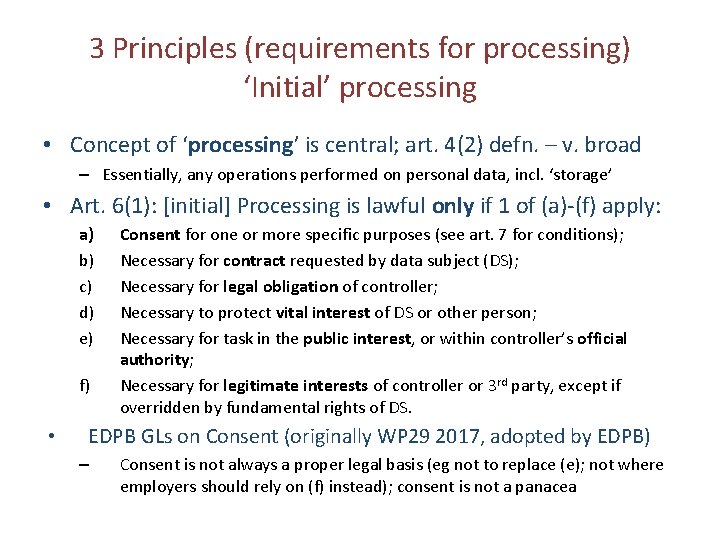
3 Principles (requirements for processing) ‘Initial’ processing • Concept of ‘processing’ is central; art. 4(2) defn. – v. broad – Essentially, any operations performed on personal data, incl. ‘storage’ • Art. 6(1): [initial] Processing is lawful only if 1 of (a)-(f) apply: a) b) c) d) e) f) • Consent for one or more specific purposes (see art. 7 for conditions); Necessary for contract requested by data subject (DS); Necessary for legal obligation of controller; Necessary to protect vital interest of DS or other person; Necessary for task in the public interest, or within controller’s official authority; Necessary for legitimate interests of controller or 3 rd party, except if overridden by fundamental rights of DS. EDPB GLs on Consent (originally WP 29 2017, adopted by EDPB) – Consent is not always a proper legal basis (eg not to replace (e); not where employers should rely on (f) instead); consent is not a panacea
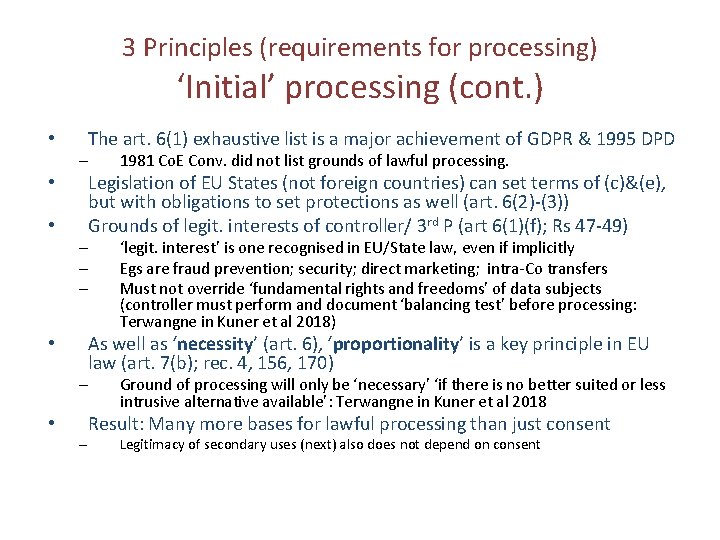
3 Principles (requirements for processing) ‘Initial’ processing (cont. ) The art. 6(1) exhaustive list is a major achievement of GDPR & 1995 DPD • – 1981 Co. E Conv. did not list grounds of lawful processing. Legislation of EU States (not foreign countries) can set terms of (c)&(e), but with obligations to set protections as well (art. 6(2)-(3)) Grounds of legit. interests of controller/ 3 rd P (art 6(1)(f); Rs 47 -49) • • – – – ‘legit. interest’ is one recognised in EU/State law, even if implicitly Egs are fraud prevention; security; direct marketing; intra-Co transfers Must not override ‘fundamental rights and freedoms’ of data subjects (controller must perform and document ‘balancing test’ before processing: Terwangne in Kuner et al 2018) As well as ‘necessity’ (art. 6), ‘proportionality’ is a key principle in EU law (art. 7(b); rec. 4, 156, 170) • – • – Ground of processing will only be ‘necessary’ ‘if there is no better suited or less intrusive alternative available’: Terwangne in Kuner et al 2018 Result: Many more bases for lawful processing than just consent Legitimacy of secondary uses (next) also does not depend on consent
3 Principles (requirements for processing) ‘Secondary processing’ requirements • Art. 6(4) determines what processing beyond the ‘specific purposes’ of initial collection are ‘compatible’. – Art. 5(1)(b) prohibits ‘incompatible’ processing: the fundamental ‘purpose limitation’ test (‘specific, explicit and legitimate purposes’) – ‘purpose of collection’ is still the key: NOT ‘notice and consent’ (US) • ‘Compatible’ processing can be based on (art. 6(4)): 1. 2. 3. DS consent (see art. 7 consent defn); no ‘compatibility’ required; art. 23(1) EU State laws (national security etc); no ‘compatibility’ required; Controller assesses compatibility based on (a) link between purposes; (b) context of collection; (c) nature of PD (sensitive? ); (d) possible consequences; (e) safeguards. . • It’s an objective test: If controller gets it wrong, then liable irrespective of bona fides – This is part of ‘accountability’; Q: what is needed for ‘responsive regulation’? ? – Result: Controllers may take a conservative approach – or ignore? ?
3 Principles (requirements for processing) Conditions for consent & other processing • Art 4(11) defn ‘consent’: ‘freely given, specific, informed & unambiguous indication … by a clear affirmative action’ – ‘opt-out’ provisions will be invalid; implied consent impossible • Art. 7 Consent requirements: 1) 2) 3) 4) • • • Controller must (be able to) demonstrate consent, if processing is based on consent (ie onus of proof on controller); Consents must be unbundled and intelligible – if not, they are not binding; Consent can be withdrawn at any time (notice required); But processing could continue on anther basis (eg a contract). Consent must be ‘freely given’– ‘utmost account’ is taken if not necessary for a contract/service (aspect of data minimisation) art. 8 re children is more restrictive art. 9 re sensitive/’special’ data is more restrictive – – processing prohibited unless (art. 9(1)) ‘explicit consent’ obtained But EU State laws can override exceptions
4 Rights of data subjects GDPR gives stronger rights than the Directive: 1. Notices on collection/use (arts. 13 -14) from DS or 3 rd parties 2. Access (art. 15) (+ art. 12 on ‘modalities’ for arts. 12 -14) 3. *Portability in common format to self or 3 rd P (art. 20) 4. Rectification (art. 16) – correcting errors/incompleteness 5. Erasure (incl ‘right to be forgotten’) (art. 17); 6. Restriction of processing (art. 18) – temporary blocking 7. Notice to 3 rd parties of objections under arts 16 -18 (art. 19) 8. Avoid or contest automated decisions (incl. profiling) (art. 22) 9. * Notice of data breaches to DS (art. 34) • These are ‘rights’ because DS must initiate them (incl. giving notice). • It is arguable that only two (*) are completely new (ie not in Directive). • Only some of these rights need discussion here – those underlined.
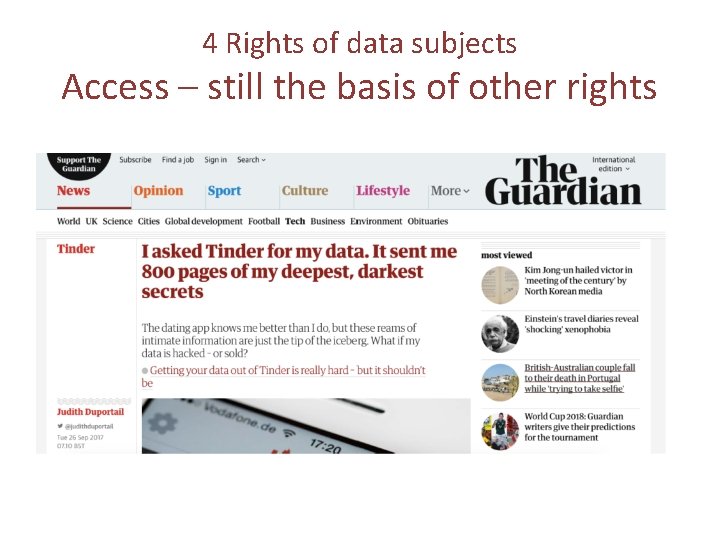
4 Rights of data subjects Access – still the basis of other rights
4 Rights of data subjects Access (cont. ) • NOYB complaints vs 8 streaming services (Jan. 2019) (Materials) – 8 complaints to Austrian DPA that automated access facilities of large streaming services do not comply – eg no information on who data was shared with; retention periods; not understandable – NOYB argues ‘structural violations’ should result in fines from 20 M to 8. 02 billion euros (Apple) – total 18. 8 B. • Other cases underway – NOYB Test Cases On Freedom To Exercise GDPR Rights In Any Format - http: //noyb. eu
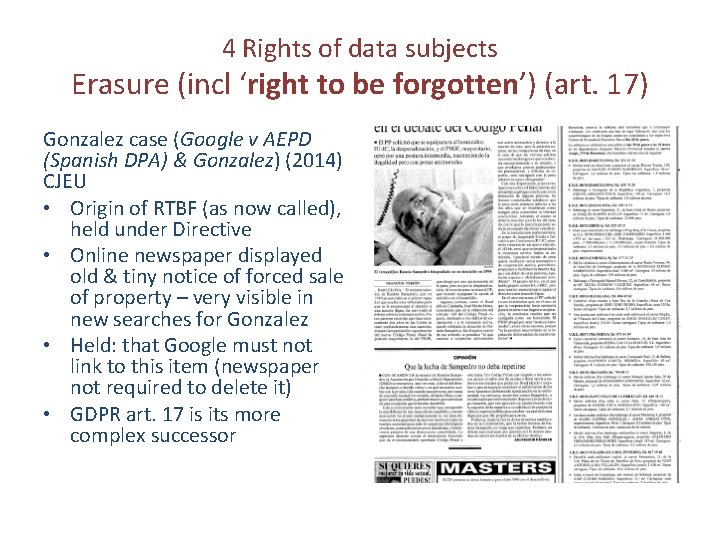
4 Rights of data subjects Erasure (incl ‘right to be forgotten’) (art. 17) Gonzalez case (Google v AEPD (Spanish DPA) & Gonzalez) (2014) CJEU • Origin of RTBF (as now called), held under Directive • Online newspaper displayed old & tiny notice of forced sale of property – very visible in new searches for Gonzalez • Held: that Google must not link to this item (newspaper not required to delete it) • GDPR art. 17 is its more complex successor
4 Rights of data subjects Erasure (incl ‘right to be forgotten’) (art. 17) • Art. 17(1) gives 6 grounds for ‘erasure’ (not ‘de-linking’): a) b) c) d) No longer necessary for purpose [most important – data minimisation]; Consent withdrawn, where it is the only ground for processing; Objects to processing on grounds of interests of processor (or DM opt-out); Unlawful processing; e) State laws require erasure; or f) [children] • The grounds must be applied separately to each controller: – For search engines = erasure (deletion) of both the link in search results & cached copy; • Must advise data source that erasure requested (art. 17(2)) – For the source of the data (eg online newspaper = deletion of online content; • Requires a separate action, with separate defences – For recipients of the data, separate action and defences • Search engine must inform them of requests (art, 17(2)) & erasures (art. 19) • Defences (art. 17(3)) insofar as necessary for freedom of speech/information, legal obligations, public health, archiving, research etc – ECt. HR case law indicates it is difficult to interfere with freedom of press publication (Kranenborg in Kuner, 2018)
4 Rights of data subjects Erasure (incl ‘right to be forgotten’) (art. 17) • What is the geographical scope of RTBF? : ‘global’ or otherwise? – Google Inc. [and many others] v Commission nationale de l’informatique et des libertés (CNIL – French DPA) CJEU (Case C 507/17)(Materials) – Dispute (under 1995 Directive (DPD)) • CNIL required Google, when acceding to a ‘de-linking’ request, to do so on all versions of Google search engine. • Google refused to do so except on EU versions –> 100 Keuros fine. • Google appealed; Conseil d’État requested preliminary CJEU ruling. – Opinion of Advocate-General (10/1/19): • DPD does not expressly govern scope of de-linking; preferable that EU law not be given scope beyond EU borders (but can be exceptions) • Proposes: correct distinction is b/w searches made from a location (physical) within the EU; search engines are not required to limit results of searches made from outside EU; but they must use all available technical measures (incl. geo-blocking) to recognise searches from an EU-located IP address. – Q: If CJEU disagrees with A-G, can CNIL enforce the decision?
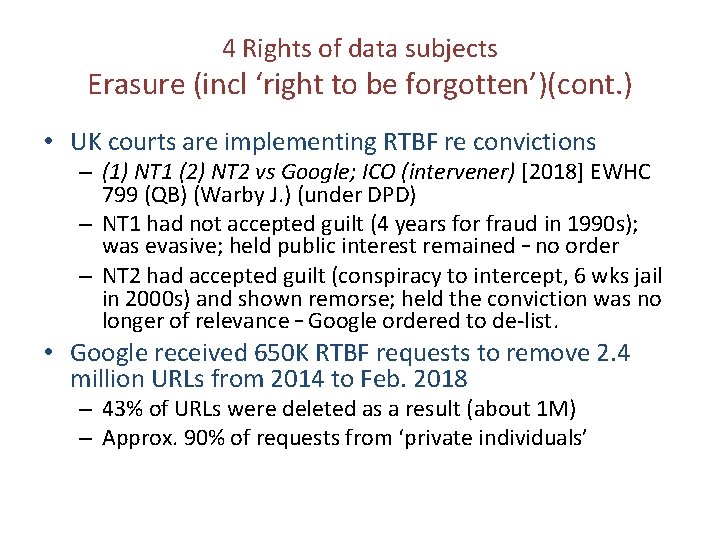
4 Rights of data subjects Erasure (incl ‘right to be forgotten’)(cont. ) • UK courts are implementing RTBF re convictions – (1) NT 1 (2) NT 2 vs Google; ICO (intervener) [2018] EWHC 799 (QB) (Warby J. ) (under DPD) – NT 1 had not accepted guilt (4 years for fraud in 1990 s); was evasive; held public interest remained – no order – NT 2 had accepted guilt (conspiracy to intercept, 6 wks jail in 2000 s) and shown remorse; held the conviction was no longer of relevance – Google ordered to de-list. • Google received 650 K RTBF requests to remove 2. 4 million URLs from 2014 to Feb. 2018 – 43% of URLs were deleted as a result (about 1 M) – Approx. 90% of requests from ‘private individuals’
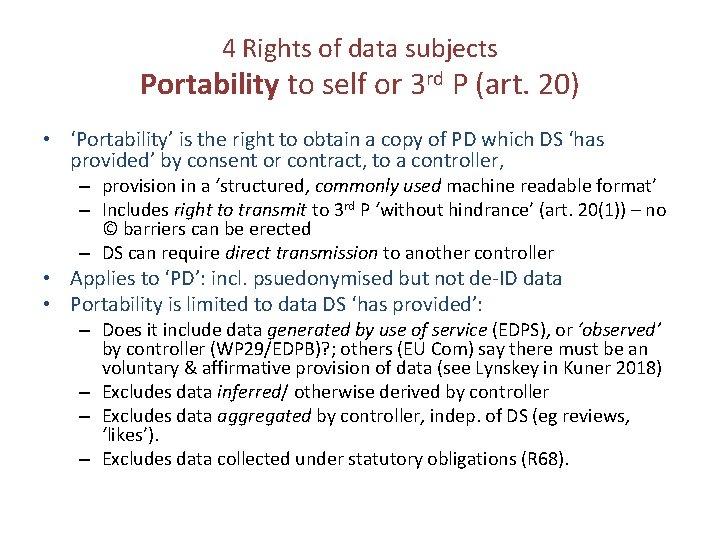
4 Rights of data subjects Portability to self or 3 rd P (art. 20) • ‘Portability’ is the right to obtain a copy of PD which DS ‘has provided’ by consent or contract, to a controller, – provision in a ‘structured, commonly used machine readable format’ – Includes right to transmit to 3 rd P ‘without hindrance’ (art. 20(1)) – no © barriers can be erected – DS can require direct transmission to another controller • Applies to ‘PD’: incl. psuedonymised but not de-ID data • Portability is limited to data DS ‘has provided’: – Does it include data generated by use of service (EDPS), or ‘observed’ by controller (WP 29/EDPB)? ; others (EU Com) say there must be an voluntary & affirmative provision of data (see Lynskey in Kuner 2018) – Excludes data inferred/ otherwise derived by controller – Excludes data aggregated by controller, indep. of DS (eg reviews, ‘likes’). – Excludes data collected under statutory obligations (R 68).
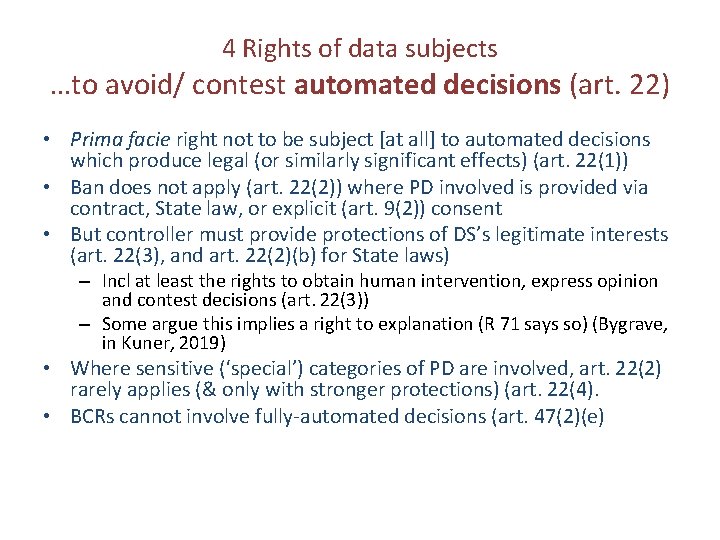
4 Rights of data subjects …to avoid/ contest automated decisions (art. 22) • Prima facie right not to be subject [at all] to automated decisions which produce legal (or similarly significant effects) (art. 22(1)) • Ban does not apply (art. 22(2)) where PD involved is provided via contract, State law, or explicit (art. 9(2)) consent • But controller must provide protections of DS’s legitimate interests (art. 22(3), and art. 22(2)(b) for State laws) – Incl at least the rights to obtain human intervention, express opinion and contest decisions (art. 22(3)) – Some argue this implies a right to explanation (R 71 says so) (Bygrave, in Kuner, 2019) • Where sensitive (‘special’) categories of PD are involved, art. 22(2) rarely applies (& only with stronger protections) (art. 22(4). • BCRs cannot involve fully-automated decisions (art. 47(2)(e)
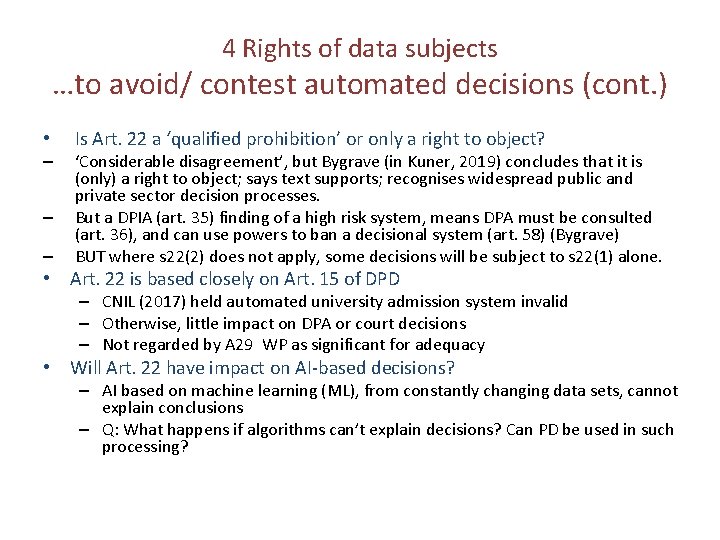
4 Rights of data subjects …to avoid/ contest automated decisions (cont. ) • – – – Is Art. 22 a ‘qualified prohibition’ or only a right to object? ‘Considerable disagreement’, but Bygrave (in Kuner, 2019) concludes that it is (only) a right to object; says text supports; recognises widespread public and private sector decision processes. But a DPIA (art. 35) finding of a high risk system, means DPA must be consulted (art. 36), and can use powers to ban a decisional system (art. 58) (Bygrave) BUT where s 22(2) does not apply, some decisions will be subject to s 22(1) alone. • Art. 22 is based closely on Art. 15 of DPD – CNIL (2017) held automated university admission system invalid – Otherwise, little impact on DPA or court decisions – Not regarded by A 29 WP as significant for adequacy • Will Art. 22 have impact on AI-based decisions? – AI based on machine learning (ML), from constantly changing data sets, cannot explain conclusions – Q: What happens if algorithms can’t explain decisions? Can PD be used in such processing?
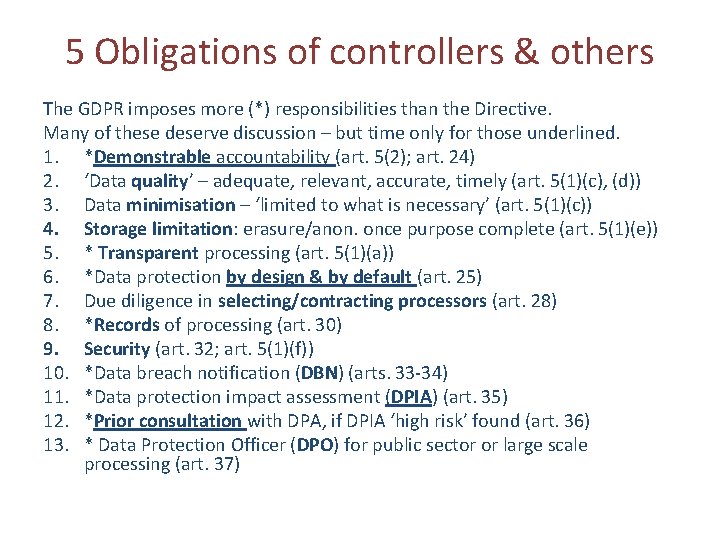
5 Obligations of controllers & others The GDPR imposes more (*) responsibilities than the Directive. Many of these deserve discussion – but time only for those underlined. 1. *Demonstrable accountability (art. 5(2); art. 24) 2. ‘Data quality’ – adequate, relevant, accurate, timely (art. 5(1)(c), (d)) 3. Data minimisation – ‘limited to what is necessary’ (art. 5(1)(c)) 4. Storage limitation: erasure/anon. once purpose complete (art. 5(1)(e)) 5. * Transparent processing (art. 5(1)(a)) 6. *Data protection by design & by default (art. 25) 7. Due diligence in selecting/contracting processors (art. 28) 8. *Records of processing (art. 30) 9. Security (art. 32; art. 5(1)(f)) 10. *Data breach notification (DBN) (arts. 33 -34) 11. *Data protection impact assessment (DPIA) (art. 35) 12. *Prior consultation with DPA, if DPIA ‘high risk’ found (art. 36) 13. * Data Protection Officer (DPO) for public sector or large scale processing (art. 37)
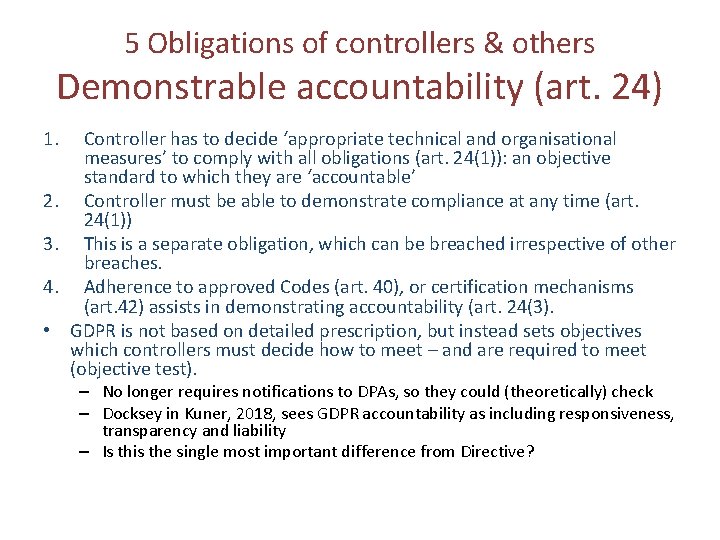
5 Obligations of controllers & others Demonstrable accountability (art. 24) 1. 2. 3. 4. • Controller has to decide ‘appropriate technical and organisational measures’ to comply with all obligations (art. 24(1)): an objective standard to which they are ‘accountable’ Controller must be able to demonstrate compliance at any time (art. 24(1)) This is a separate obligation, which can be breached irrespective of other breaches. Adherence to approved Codes (art. 40), or certification mechanisms (art. 42) assists in demonstrating accountability (art. 24(3). GDPR is not based on detailed prescription, but instead sets objectives which controllers must decide how to meet – and are required to meet (objective test). – No longer requires notifications to DPAs, so they could (theoretically) check – Docksey in Kuner, 2018, sees GDPR accountability as including responsiveness, transparency and liability – Is this the single most important difference from Directive?
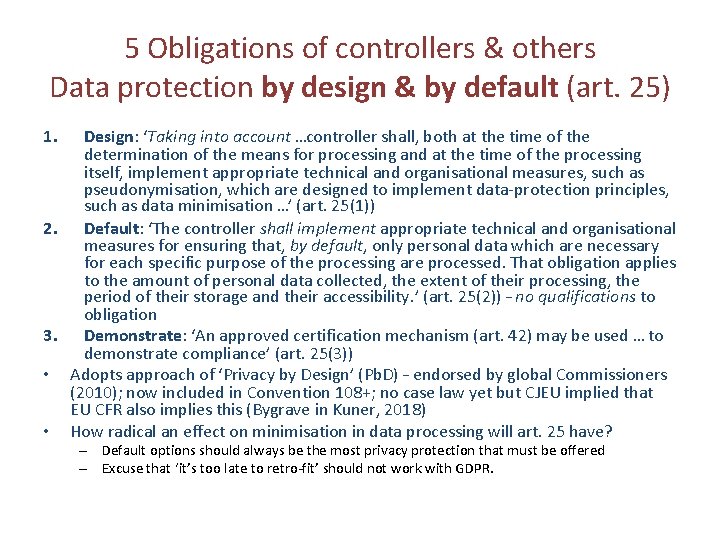
5 Obligations of controllers & others Data protection by design & by default (art. 25) Design: ‘Taking into account …controller shall, both at the time of the determination of the means for processing and at the time of the processing itself, implement appropriate technical and organisational measures, such as pseudonymisation, which are designed to implement data-protection principles, such as data minimisation …’ (art. 25(1)) 2. Default: ‘The controller shall implement appropriate technical and organisational measures for ensuring that, by default, only personal data which are necessary for each specific purpose of the processing are processed. That obligation applies to the amount of personal data collected, the extent of their processing, the period of their storage and their accessibility. ’ (art. 25(2)) – no qualifications to obligation 3. Demonstrate: ‘An approved certification mechanism (art. 42) may be used … to demonstrate compliance’ (art. 25(3)) • Adopts approach of ‘Privacy by Design’ (Pb. D) – endorsed by global Commissioners (2010); now included in Convention 108+; no case law yet but CJEU implied that EU CFR also implies this (Bygrave in Kuner, 2018) • How radical an effect on minimisation in data processing will art. 25 have? 1. – Default options should always be the most privacy protection that must be offered – Excuse that ‘it’s too late to retro-fit’ should not work with GDPR.
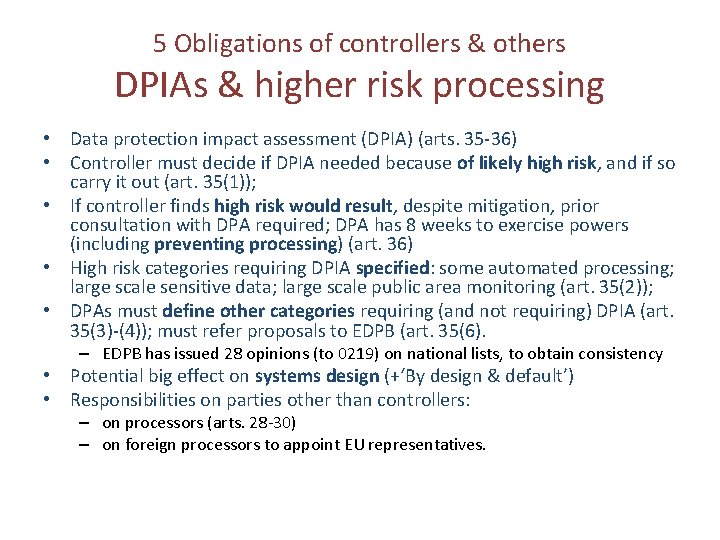
5 Obligations of controllers & others DPIAs & higher risk processing • Data protection impact assessment (DPIA) (arts. 35 -36) • Controller must decide if DPIA needed because of likely high risk, and if so carry it out (art. 35(1)); • If controller finds high risk would result, despite mitigation, prior consultation with DPA required; DPA has 8 weeks to exercise powers (including preventing processing) (art. 36) • High risk categories requiring DPIA specified: some automated processing; large scale sensitive data; large scale public area monitoring (art. 35(2)); • DPAs must define other categories requiring (and not requiring) DPIA (art. 35(3)-(4)); must refer proposals to EDPB (art. 35(6). – EDPB has issued 28 opinions (to 0219) on national lists, to obtain consistency • Potential big effect on systems design (+‘By design & default’) • Responsibilities on parties other than controllers: – on processors (arts. 28 -30) – on foreign processors to appoint EU representatives.
6 Independent supervisory authorities DPAs (arts. 51 -59) • Each EU country must have one or more supervisory authority which is independent (art. 51) – a ‘DPA’ (Data Protection Authority) • Considerable CJEU case law on ‘completely independent’ (arts. 52 -54) • How DPAs are structured depends on State laws, but GDPR requires a substantial degree of consistency • 20 tasks of a DPA within its territory listed (art. 57) • DPAs must have a wide range of ‘corrective powers’ (art. 58(2)) – Consistent with theories of ‘responsive regulation’ – BUT powers to publicise breaches are not stated • DPAs must have ‘authorisation and advisory powers’ (art. 58(3)) beyond complaint resolution – Includes powers to make various standards & codes • DPAs must have extensive ‘investigative powers’ including requiring documents, audits, and entering premises (art. 58(1))
7 Enforcement: Remedies and penalties Alternative enforcement routes • DPAs must have ‘corrective powers’ (art. 58(1)) including: – Ordering compliance; ordering bans on processing (temporary/permanent); ordering rectifications and erasures; – Ordering suspension of international data flows; – Imposing administrative fines under art. 83. • Right of appeal against DPA decisions required (art. 58(4); art. 78 details) – DS may go directly to Court if DPA does not act in 3 months (art. 78(2)) • DPA must be able to refer infringements to the Courts (art. 58(5)) • DS can sue controllers/processors directly in the Courts (art. 79) – Can do so when controller has an establishment, or where the DS resides • Right to obtain compensation required (art. 82), not necessarily from DPAs, but State laws can provide for DPA ‘additional powers’ (art 58(6) • GDPR does not require criminal offences – but States can provide them • Result: In effect, DS has two alternative approaches – DPA or Courts
7 Enforcement: Remedies and penalties Role of NGOs in enforcement • Representative actions by DS must be allowed (art. 80) – two types 1. DS has right to mandate a not-for-profit body to exercise rights and receive compensation (art 80(1)). – Body must be properly constituted with public interest objectives, and be active in data protection 2. Such a body may lodge complaints and exercise rights even without a DS mandate (art. 80(2)). • Such representative actions are now driving GDPR – NOYB (Austria), LQDN (France) and Privacy International (UK) seem to be the most active GDPR litigants – PI complaints against 8 streaming services (Materials) argue they have no legal basis for processing (including sensitive data)
7 Enforcement: Remedies and penalties Role of NGOs in enforcement (cont) • Various Claimants v WM Morrisons Supermarket plc [2017] EWHC 3113 (QB) – First eg of data protection group (class) action in UK – Held: Morrisons liable for acts of malicious IT security staffer disclosing payroll data of 100 K employees; • vicarious liability because actions were close enough to his normal role to be regarded as acting in course of employment – Held: Morrisons was liable for data breach; on appeal, on vicarious liability point • This should also be an alternative approach to group actions under GDPR
7 Enforcement: Remedies and penalties Administrative fines under art. 83 • Administrative fines (GDPR art. 83) – Not automatic, must be ‘effective, proportionate and dissuasive’ ‘in each individual case’ – Factors to be considered: ‘nature, gravity and duration’; ‘intentional or negligent’; mitigating acts; ‘degree of responsibility’; ‘previous infringements’ etc – Depending on provisions breached, fines are up to 10 -20 M euros, or 2 -4% of ‘total annual worldwide turnover’, whichever is higher. Breach of DPA orders = 4%. (art. 83(4)-(6)). • Facebook fined £ 500 K (Directive’s maximum fine) by UK ICO (DPA) for failing to protect user data against Cambridge Analytica (10 July 2018); fine = 18 minutes earnings – Facebook has appealed to the 1 st Tier tribunal – Q: What max. fine could Facebook now get for a similar breach?
7 Enforcement: Remedies and penalties Administrative fines (art. 83) (cont. ) • Under GDPR, 11 DPA have issued 56 M eur fines in 9 months (EDPB Overview, 0219) – 50 M eur is from one fine, NOYB v Google (CNIL, 2019) (later) • Other fines by national DPAs (to 1218) – Germany: unencrypted passwords and other PD of 330 K chat platform users hacked: 20 K eur fine – Austria: business had CCTV camera covering sidewalk, and did not label it: 4, 800 eur fine – Portugal: hospital liable for inadequate security of patient files (eg open to all doctors, too many accounts; sensitive data): 400 K eur fine • Facebook fined 10 M eur. by Italian competition regulator under consumer law (0119) – reasons have strong overlap with GDPR: misleading on uses of data; failure to disclose profit-making purposes; default settings which favour transfer of data to 3 rd parties.
8 Consistency and cooperation between DPAs • ‘A layered system of cooperation’: major GDPR innovation, involving lead DPAs, one-stop-shop & EDPB • ‘Lead supervisory authority’ (lead DPA) (art. 56(1)) = DPA in the country where a controller’s ‘main establishment’ is located (eg Ireland, for Facebook), for any cross-border cases. – But any DPA can handle cases involving a controller’s establishment solely in its jurisdiction, or substantially affecting DS only in its jurisdiction (art. 56(2)) – However, lead DPA has 3 weeks to take lead role in the case (art. 56(3)) – aim is to create EU-wide consistency • ‘One stop shop’ – Where multiple DPAs involved, lead DPA does draft resolution; other DPAs involved try to reach consensus; if not, case referred to whole European Data Protection Board (art. 60) – EDPB’s binding decision (art. 65) is referred to lead DPA to implement in final decision (with other aspects not referred) – Appeals are to national Courts, then CJEU, but EDPB aspect can be appealed direct to CJEU
8 Consistency and cooperation between DPAs (cont) • NYOB and La Quadrature du Net v Google (CNIL, 0219) – NYOB & LQDN NGOs lodged group complaints, with LQDN mandated by 10 K complainants – CNIL held Google did not have valid legal basis for processing, particularly for ad personalisation, when users set up an Android account • invalid consent, and breaches of transparency – CNIL held Google did not have a ‘main establishment’ (defn art. 4(16)) anywhere in EU • Irish establishment had no decision powers re Android • Therefore ‘one-stop shop’ did not apply, any DPA could investigate – Fine of 50 M eur: continuous breaches; essential principles of GDPR; serious consequences for users
8 Consistency and cooperation between DPAs European Data Protection Board (EDPB) • EDPB = All 28 EU + 3 EEA DPAs + EDPS (European Data Protection Supervisor) (art. 68) [old art. 29 Working Party under Directive] – Has a separate legal personality & independence (art. 69) – Is central to the ‘consistency mechanism’ (art. 63) • Main role may be art. 65 complaints where DPAs do not agree – Example: Irish DPA has considered many of Facebook’s actions legal, but DPAs in Belgium and elsewhere consider they are not – DPAs collectively may be willing to issue stronger penalties than individually – EDPB decides by simple majority as a last resort • EDPB can make 6 types of other binding decisions with EU-wide implications (art. 64(1)) – issues of DPIA scope; codes; certification; standard DP clauses; binding corporate rules (BCRs); + DPIA ‘high risk’ categories • EDPB has many ‘guidance’ roles (Opinions, not decisions) (art. 70) – EDPB website includes 16 Opinions made under the Directive endorsed by EDPS; + all consistency mechanism findings (when made)
9 Transfers to 3 rd countries • International transfers of PD always involve two steps (as in Australia): – Legitimate processing (as use, disclosure or storage) – An approved form of international transfer (art. 44) • ‘Data transfer’ is not defined – Lindqvist (2003) CJEU (ECLI: EU: C: 2003: 596) – merely making PD accessible on a website (in Swedish, about a local school) was not a data transfer. • GDPR is more explicit than Directive that there a variety of tools for approved transfers, and the Commission stresses this – Reason is that few countries are likely to get positive ‘adequacy’ assessments for their whole legal system. • Broadly, 3 ways of legitimating data transfers: adequacy findings (art. 45); ‘appropriate safeguards’ (art. 46); and derogations (art. 47). • Detailed analysis: Kuner on art. 45 in Kuner et al, 2019.
9 Transfers to 3 rd countries Adequacy decisions (art. 45) – USA • Schrems v Irish DPA (2015) CJEU (ECLI: EU: C: 2015: 650): – In ‘Safe Harbor’ Decision (2000) EC found that individual US companies that undertook to apply a set of data protection principles would be considered ‘adequate’, allowing unrestricted PD transfers from EU – Max Schrems complained that transfers from EU to Facebook (under Safe Harbor) were in breach of DPD, because EC Decision was invalid – CJEU Held EU-US ‘Safe Harbor’ adequacy assessment was an invalid decision by EC under the Directive 1. ‘adequate level of protection’ means ‘essentially equivalent’ to protection under the EU Directive, ‘read in light of’ the EU CFR’ (which requires standards only existing after DPD and Safe Harbor) [GDPR adopts and continues this language] 2. EC had failed to apply this [or any] test to the whole US privacy regime 3. Safe Harbor also failed because US public authorities could have bulk access to PD coming from EU; and EU citizens could not pursue judicial remedies – failed to respect two fundamental rights in the EU Charter (not just Directive) – Result: Schrems Case toughened adequacy, mainly re public authority accesses; but meaning of ‘essentially equivalent’ remained unclear. • Kuner, 2019, extracts 8 points from CJEU as to what ‘essential equivalence’ means
9 Transfers to 3 rd countries Adequacy decisions (art. 45) – USA (cont. ) • EU-US ‘Privacy Shield’ (EC adequacy Decision) (2016) – made to replace ‘Safe Harbor’ after Schrems I – also under challenge before CJEU (La Quadrature du Net v EC (Case T 738/16) – claims contrary to EU Charter rights – ongoing – CJEU dismissed another challenge in Digital Rights Ireland v EC ECLI: EU: T: 2017: 838 – Shield has now passed its 2 nd annual review by EC – Result: Adequacy of Privacy Shield still unresolved • EU-Canada PNR decision (CJEU, 2017) – ‘PNR’ concern transfer of passenger name records – Although done under an international agreement, held that it must comply with EU CFR data protection (art. 16(2)) – In summary, standards set out in Schrems apply; here CJEU required some improvements, but PNR survived
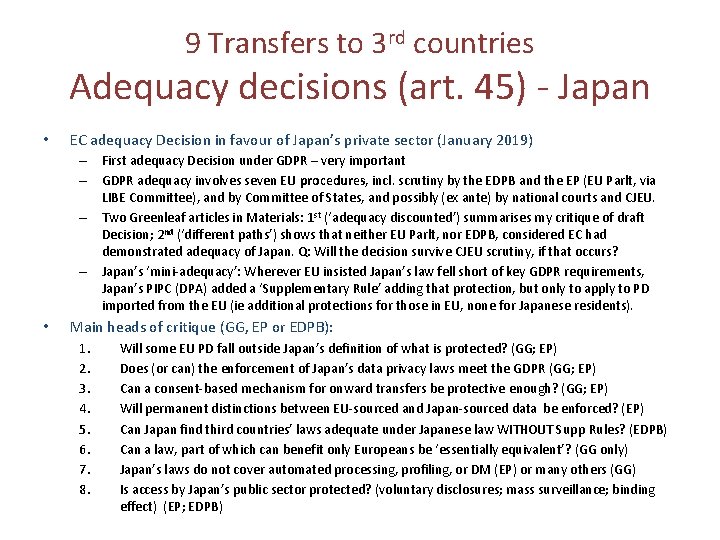
9 Transfers to 3 rd countries Adequacy decisions (art. 45) - Japan • EC adequacy Decision in favour of Japan’s private sector (January 2019) – First adequacy Decision under GDPR – very important – GDPR adequacy involves seven EU procedures, incl. scrutiny by the EDPB and the EP (EU Parlt, via LIBE Committee), and by Committee of States, and possibly (ex ante) by national courts and CJEU. – Two Greenleaf articles in Materials: 1 st (‘adequacy discounted’) summarises my critique of draft Decision; 2 nd (‘different paths’) shows that neither EU Parlt, nor EDPB, considered EC had demonstrated adequacy of Japan. Q: Will the decision survive CJEU scrutiny, if that occurs? – Japan’s ‘mini-adequacy’: Wherever EU insisted Japan’s law fell short of key GDPR requirements, Japan’s PIPC (DPA) added a ‘Supplementary Rule’ adding that protection, but only to apply to PD imported from the EU (ie additional protections for those in EU, none for Japanese residents). • Main heads of critique (GG, EP or EDPB): 1. 2. 3. 4. 5. 6. 7. 8. Will some EU PD fall outside Japan’s definition of what is protected? (GG; EP) Does (or can) the enforcement of Japan’s data privacy laws meet the GDPR (GG; EP) Can a consent-based mechanism for onward transfers be protective enough? (GG; EP) Will permanent distinctions between EU-sourced and Japan-sourced data be enforced? (EP) Can Japan find third countries’ laws adequate under Japanese law WITHOUT Supp Rules? (EDPB) Can a law, part of which can benefit only Europeans be ‘essentially equivalent’? (GG only) Japan’s laws do not cover automated processing, profiling, or DM (EP) or many others (GG) Is access by Japan’s public sector protected? (voluntary disclosures; mass surveillance; binding effect) (EP; EDPB)
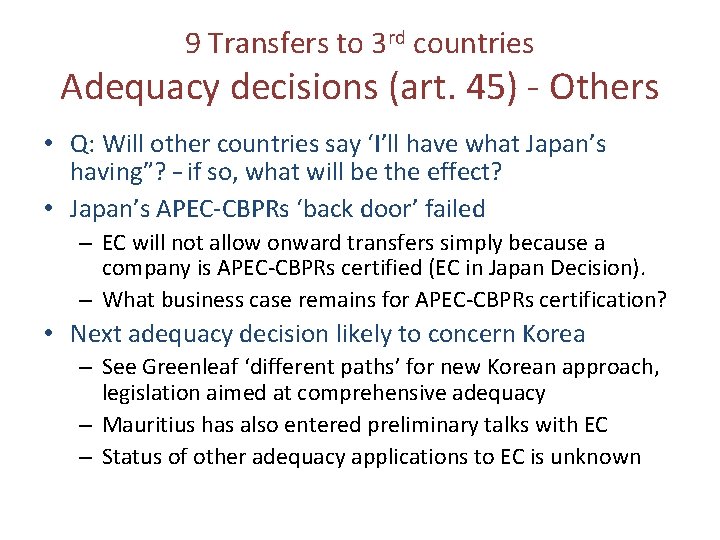
9 Transfers to 3 rd countries Adequacy decisions (art. 45) - Others • Q: Will other countries say ‘I’ll have what Japan’s having”? – if so, what will be the effect? • Japan’s APEC-CBPRs ‘back door’ failed – EC will not allow onward transfers simply because a company is APEC-CBPRs certified (EC in Japan Decision). – What business case remains for APEC-CBPRs certification? • Next adequacy decision likely to concern Korea – See Greenleaf ‘different paths’ for new Korean approach, legislation aimed at comprehensive adequacy – Mauritius has also entered preliminary talks with EC – Status of other adequacy applications to EC is unknown
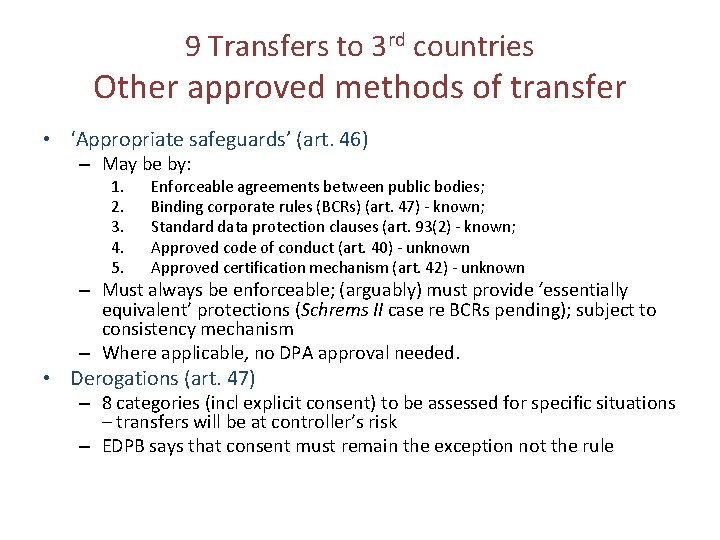
9 Transfers to 3 rd countries Other approved methods of transfer • ‘Appropriate safeguards’ (art. 46) – May be by: 1. 2. 3. 4. 5. Enforceable agreements between public bodies; Binding corporate rules (BCRs) (art. 47) - known; Standard data protection clauses (art. 93(2) - known; Approved code of conduct (art. 40) - unknown Approved certification mechanism (art. 42) - unknown – Must always be enforceable; (arguably) must provide ‘essentially equivalent’ protections (Schrems II case re BCRs pending); subject to consistency mechanism – Where applicable, no DPA approval needed. • Derogations (art. 47) – 8 categories (incl explicit consent) to be assessed for specific situations – transfers will be at controller’s risk – EDPB says that consent must remain the exception not the rule
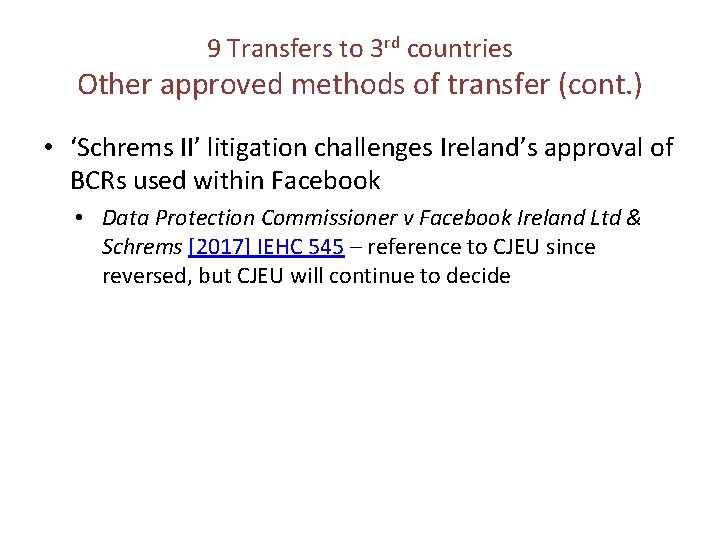
9 Transfers to 3 rd countries Other approved methods of transfer (cont. ) • ‘Schrems II’ litigation challenges Ireland’s approval of BCRs used within Facebook • Data Protection Commissioner v Facebook Ireland Ltd & Schrems [2017] IEHC 545 – reference to CJEU since reversed, but CJEU will continue to decide
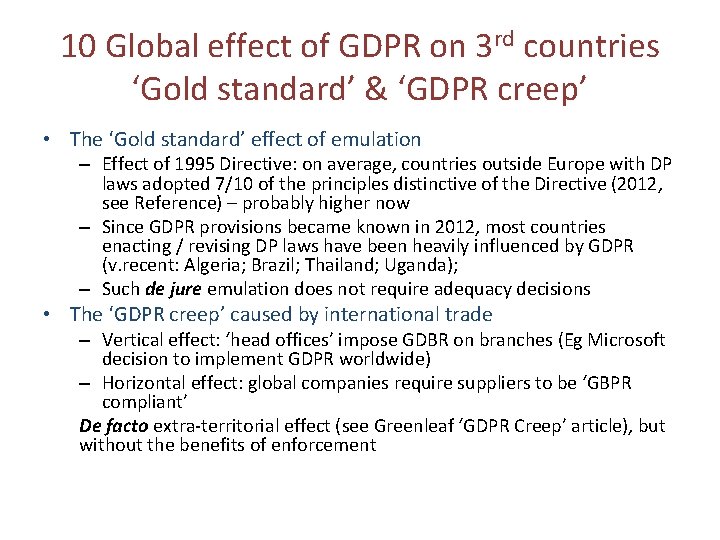
10 Global effect of GDPR on 3 rd countries ‘Gold standard’ & ‘GDPR creep’ • The ‘Gold standard’ effect of emulation – Effect of 1995 Directive: on average, countries outside Europe with DP laws adopted 7/10 of the principles distinctive of the Directive (2012, see Reference) – probably higher now – Since GDPR provisions became known in 2012, most countries enacting / revising DP laws have been heavily influenced by GDPR (v. recent: Algeria; Brazil; Thailand; Uganda); – Such de jure emulation does not require adequacy decisions • The ‘GDPR creep’ caused by international trade – Vertical effect: ‘head offices’ impose GDBR on branches (Eg Microsoft decision to implement GDPR worldwide) – Horizontal effect: global companies require suppliers to be ‘GBPR compliant’ De facto extra-territorial effect (see Greenleaf ‘GDPR Creep’ article), but without the benefits of enforcement
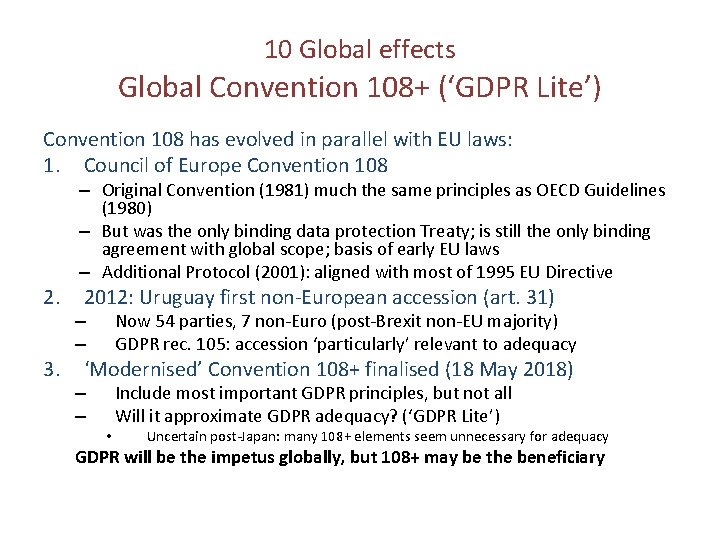
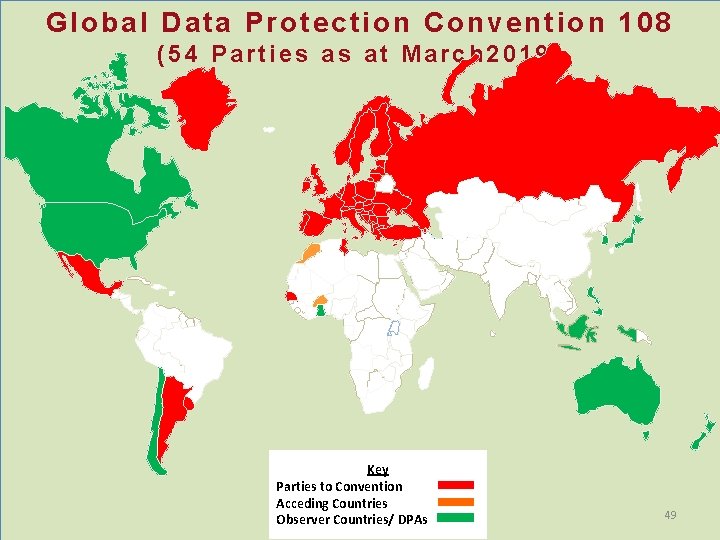
10 Global effects Global Convention 108+ (‘GDPR Lite’) Convention 108 has evolved in parallel with EU laws: 1. Council of Europe Convention 108 2. 3. – Original Convention (1981) much the same principles as OECD Guidelines (1980) – But was the only binding data protection Treaty; is still the only binding agreement with global scope; basis of early EU laws – Additional Protocol (2001): aligned with most of 1995 EU Directive 2012: Uruguay first non-European accession (art. 31) Now 54 parties, 7 non-Euro (post-Brexit non-EU majority) GDPR rec. 105: accession ‘particularly’ relevant to adequacy – – ‘Modernised’ Convention 108+ finalised (18 May 2018) – – • Include most important GDPR principles, but not all Will it approximate GDPR adequacy? (‘GDPR Lite’) Uncertain post-Japan: many 108+ elements seem unnecessary for adequacy GDPR will be the impetus globally, but 108+ may be the beneficiary
Global Data Protection Convention 108 (54 Parties as at March 2019) Key Parties to Convention Acceding Countries Observer Countries/ DPAs 49
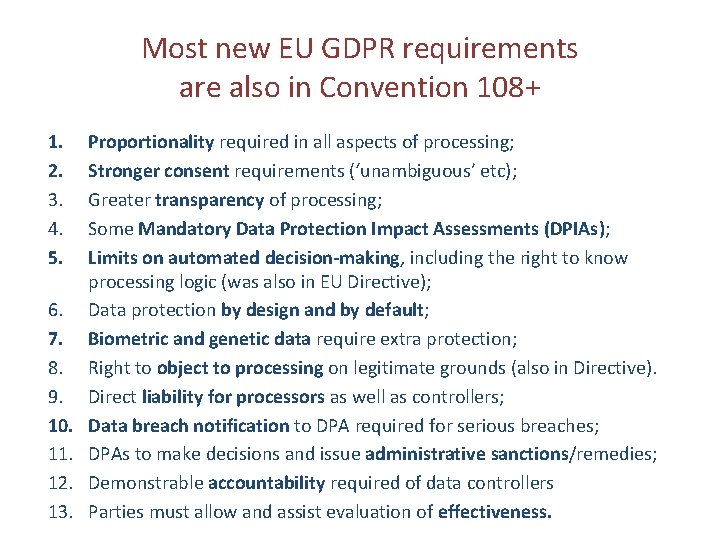
Most new EU GDPR requirements are also in Convention 108+ 1. 2. 3. 4. 5. 6. 7. 8. 9. 10. 11. 12. 13. Proportionality required in all aspects of processing; Stronger consent requirements (‘unambiguous’ etc); Greater transparency of processing; Some Mandatory Data Protection Impact Assessments (DPIAs); Limits on automated decision-making, including the right to know processing logic (was also in EU Directive); Data protection by design and by default; Biometric and genetic data require extra protection; Right to object to processing on legitimate grounds (also in Directive). Direct liability for processors as well as controllers; Data breach notification to DPA required for serious breaches; DPAs to make decisions and issue administrative sanctions/remedies; Demonstrable accountability required of data controllers Parties must allow and assist evaluation of effectiveness.
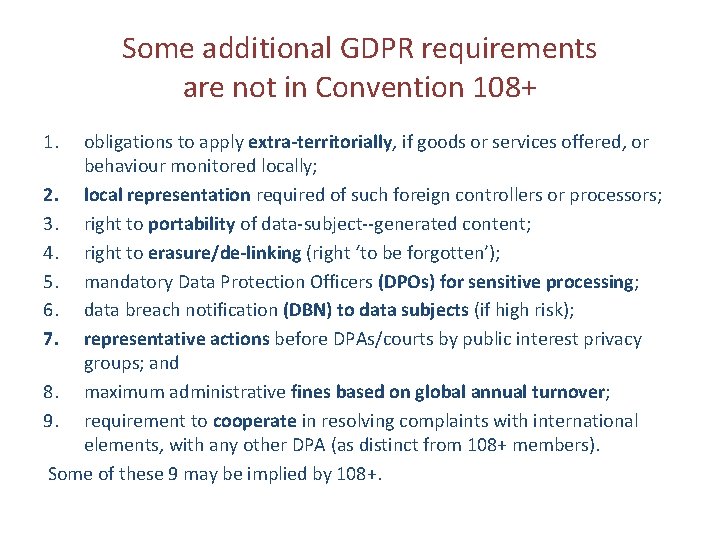
Some additional GDPR requirements are not in Convention 108+ 1. obligations to apply extra-territorially, if goods or services offered, or behaviour monitored locally; 2. local representation required of such foreign controllers or processors; 3. right to portability of data-subject--generated content; 4. right to erasure/de-linking (right ‘to be forgotten’); 5. mandatory Data Protection Officers (DPOs) for sensitive processing; 6. data breach notification (DBN) to data subjects (if high risk); 7. representative actions before DPAs/courts by public interest privacy groups; and 8. maximum administrative fines based on global annual turnover; 9. requirement to cooperate in resolving complaints with international elements, with any other DPA (as distinct from 108+ members). Some of these 9 may be implied by 108+.
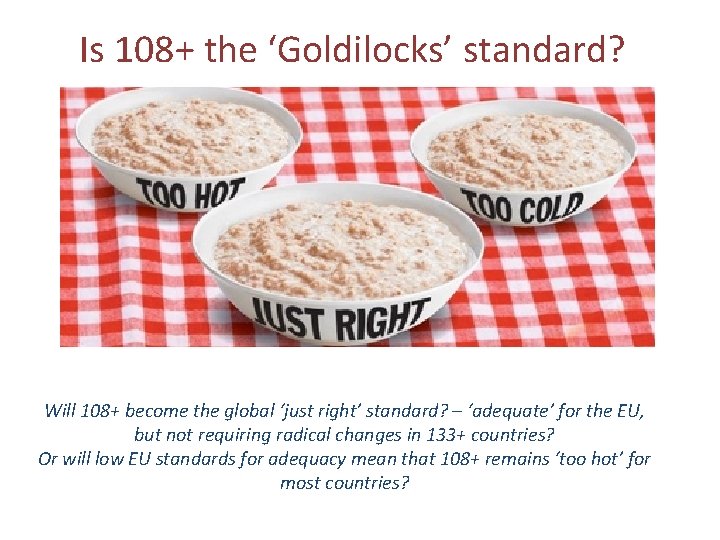
Is 108+ the ‘Goldilocks’ standard? Will 108+ become the global ‘just right’ standard? – ‘adequate’ for the EU, but not requiring radical changes in 133+ countries? Or will low EU standards for adequacy mean that 108+ remains ‘too hot’ for most countries?
References • G. Greenleaf ‘The Influence of European Data Privacy Standards Outside Europe: Implications for Globalisation of Convention 108’ International Data Privacy Law, Vol. 2, Issue 2, 2012; https: //ssrn. com/abstract=1960299 • See my SSRN pages for many later articles on EU adequacy (including Japan and Korea) and on Convention 108/108+ https: //papers. ssrn. com/per_id=57970 • Intersoft GDPR Guide https: //gdpr-info. eu/ (useful) • Thanks to the faculty of the VUB GDPR Summer School, Brussels, June 2018 for sharing their views
References (2) • Gloria González Fuster The Emergence of Personal Data Protection as a Fundamental Right of the EU (Springer, 2014) - Background to everything European pre-GDPR • Kuner, Bygrave & Docksey (Eds. ) 2018 Draft commentaries on 10 GDPR articles (from Commentary on the EU General Data Protection Regulation, forthcoming OUP 2019) (on Be. Press) – arts. 3, 5, 6, 17, 20, 24, 25 46, 56, 95 https: //works. bepress. com/christopherkuner/1/download/ • Kuner, Bygrave & Docksey (Eds. ) 2019 Draft commentaries on 6 GDPR articles (from Commentary on the EU General Data Protection Regulation, forthcoming OUP 2019) (on Be. Press) – arts. 13, 22, 45, 69, 80, 91 https: //works. bepress. com/christopher-kuner/2/