
THE EUROPEAN SPACE AGENCY Programma 1 Overview Wat
- Slides: 23
THE EUROPEAN SPACE AGENCY Programma → 1: Overview - Wat doet ESA ESTEC? 2: Design - Het ontwerpen van satellieten 3: Testing - Europa’s grootste Test Centre 4: Q&A - Vragen en discussie Robert Willemsen | ESTEC Communications
ESA FACTS AND FIGURES • Over 40 years of experience • 20 Member States • Five establishments in Europe, about 2200 staff • 4 billion Euro budget (2013) • Over 70 satellites designed, tested and operated in flight • 17 scientific satellites in operation • Six types of launcher developed • Celebrated the 200 th launch of Ariane in February 2011 2
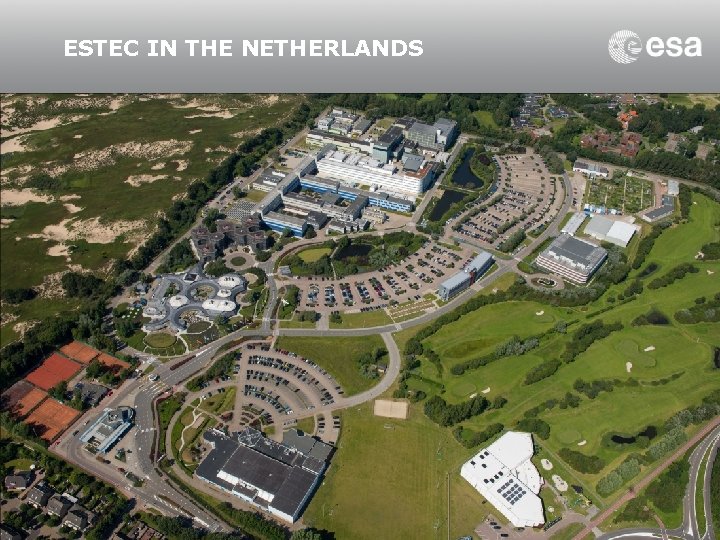
ESTEC IN THE NETHERLANDS 3
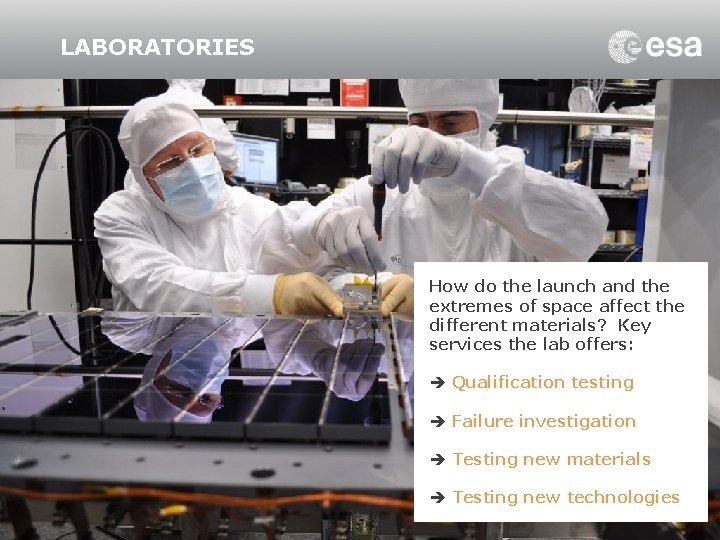
LABORATORIES How do the launch and the extremes of space affect the different materials? Key services the lab offers: Qualification testing Failure investigation Testing new materials Testing new technologies 4
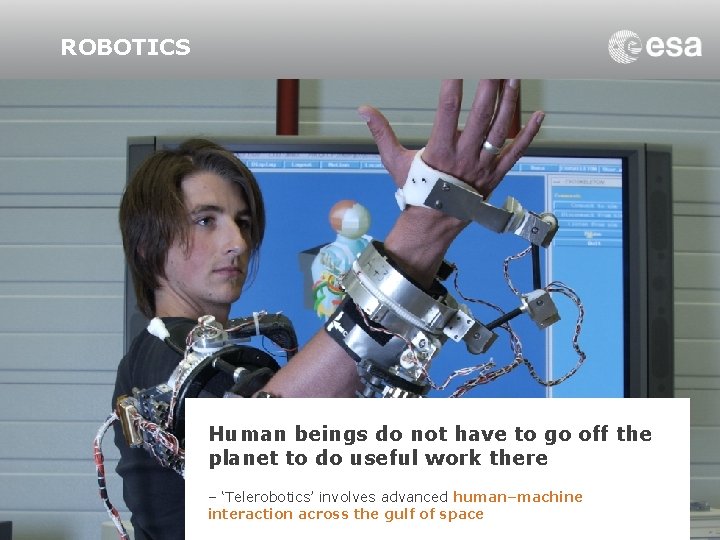
ROBOTICS Human beings do not have to go off the planet to do useful work there 5 – ‘Telerobotics’ involves advanced human–machine interaction across the gulf of space
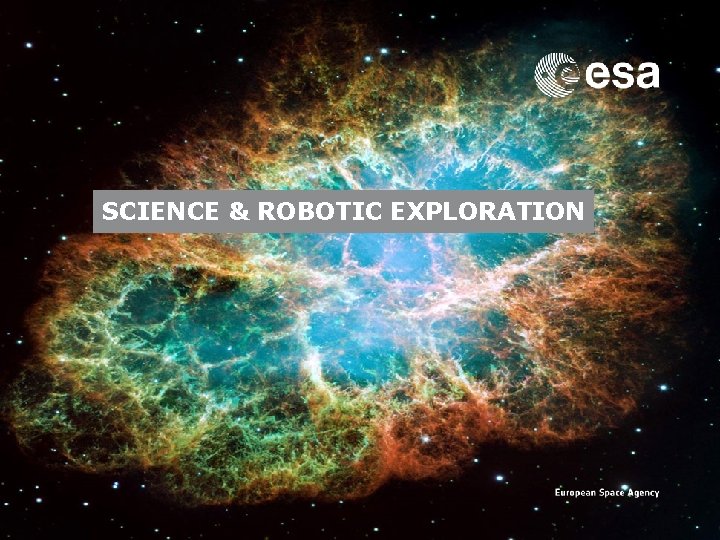
→ SCIENCE & ROBOTIC EXPLORATION
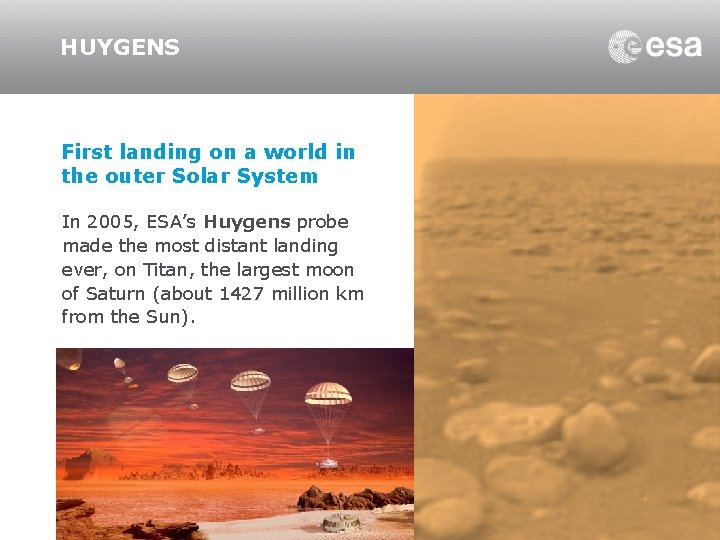
HUYGENS First landing on a world in the outer Solar System In 2005, ESA’s Huygens probe made the most distant landing ever, on Titan, the largest moon of Saturn (about 1427 million km from the Sun). 7
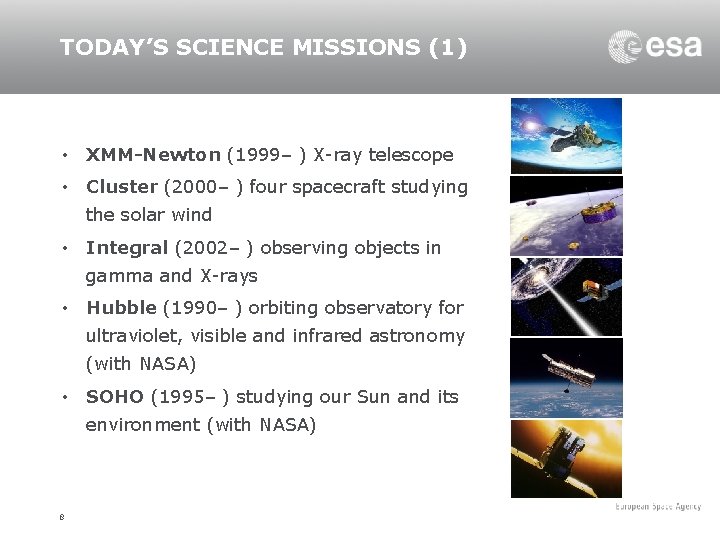
TODAY’S SCIENCE MISSIONS (1) • XMM-Newton (1999– ) X-ray telescope • Cluster (2000– ) four spacecraft studying the solar wind • Integral (2002– ) observing objects in gamma and X-rays • Hubble (1990– ) orbiting observatory for ultraviolet, visible and infrared astronomy (with NASA) • SOHO (1995– ) studying our Sun and its environment (with NASA) 8
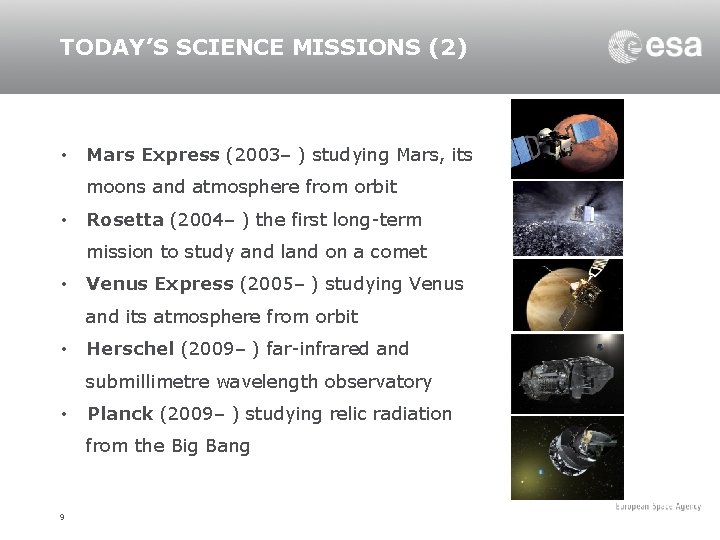
TODAY’S SCIENCE MISSIONS (2) • Mars Express (2003– ) studying Mars, its moons and atmosphere from orbit • Rosetta (2004– ) the first long-term mission to study and land on a comet • Venus Express (2005– ) studying Venus and its atmosphere from orbit • Herschel (2009– ) far-infrared and submillimetre wavelength observatory • Planck (2009– ) studying relic radiation from the Big Bang 9
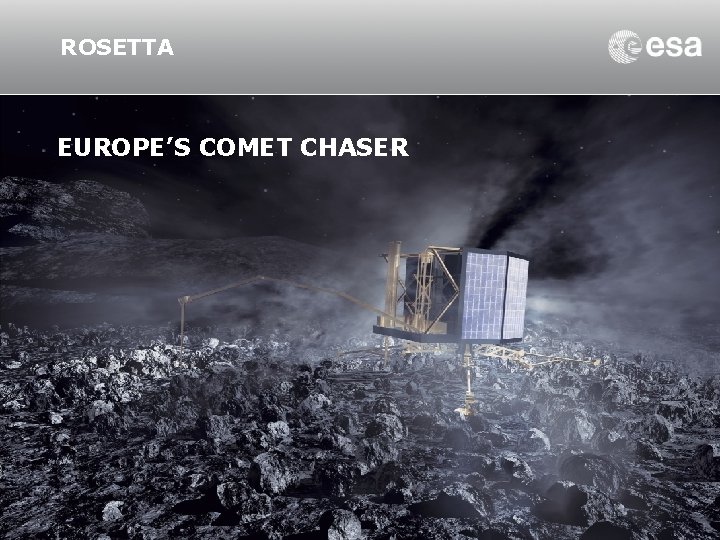
ROSETTA EUROPE’S COMET CHASER 10
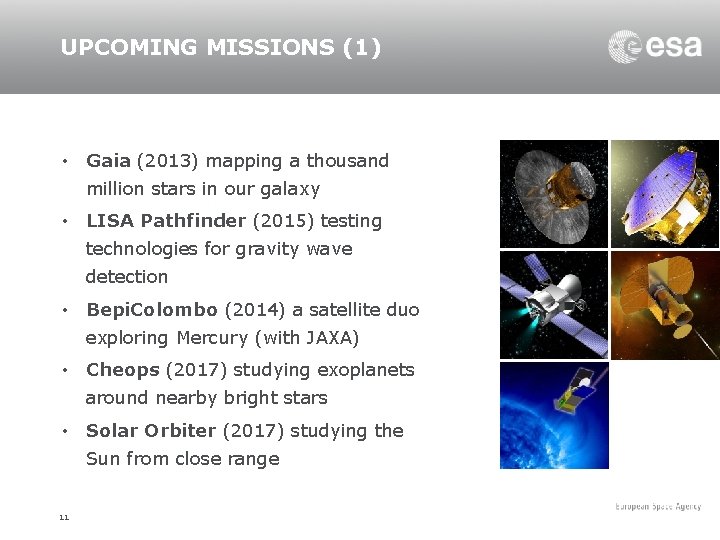
UPCOMING MISSIONS (1) • Gaia (2013) mapping a thousand million stars in our galaxy • LISA Pathfinder (2015) testing technologies for gravity wave detection • Bepi. Colombo (2014) a satellite duo exploring Mercury (with JAXA) • Cheops (2017) studying exoplanets around nearby bright stars • Solar Orbiter (2017) studying the Sun from close range 11
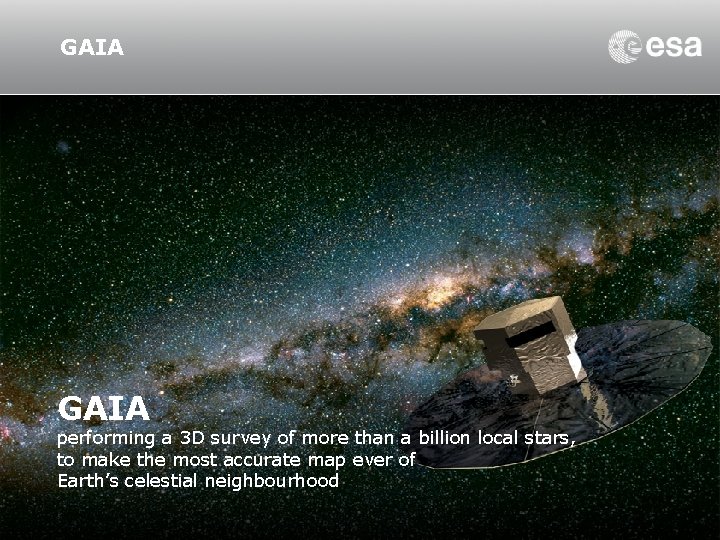
GAIA performing a 3 D survey of more than a billion local stars, to make the most accurate map ever of Earth’s celestial neighbourhood 12
→ HUMAN SPACEFLIGHT
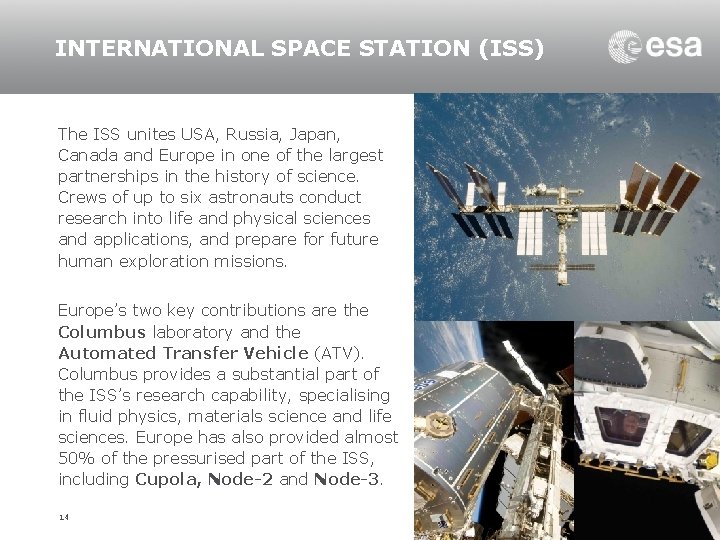
INTERNATIONAL SPACE STATION (ISS) The ISS unites USA, Russia, Japan, Canada and Europe in one of the largest partnerships in the history of science. Crews of up to six astronauts conduct research into life and physical sciences and applications, and prepare for future human exploration missions. Europe’s two key contributions are the Columbus laboratory and the Automated Transfer Vehicle (ATV). Columbus provides a substantial part of the ISS’s research capability, specialising in fluid physics, materials science and life sciences. Europe has also provided almost 50% of the pressurised part of the ISS, including Cupola, Node-2 and Node-3. 14
→ EARTH OBSERVATION
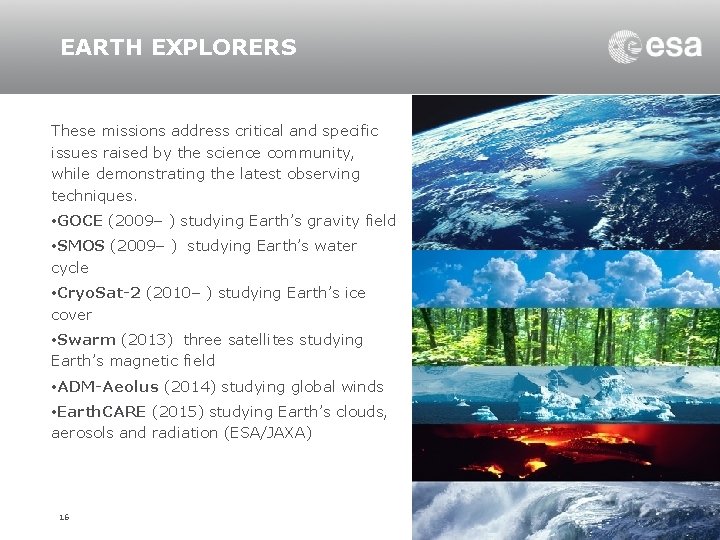
EARTH EXPLORERS These missions address critical and specific issues raised by the science community, while demonstrating the latest observing techniques. • GOCE (2009– ) studying Earth’s gravity field • SMOS (2009– ) studying Earth’s water cycle • Cryo. Sat-2 (2010– ) studying Earth’s ice cover • Swarm (2013) three satellites studying Earth’s magnetic field • ADM-Aeolus (2014) studying global winds • Earth. CARE (2015) studying Earth’s clouds, aerosols and radiation (ESA/JAXA) 16
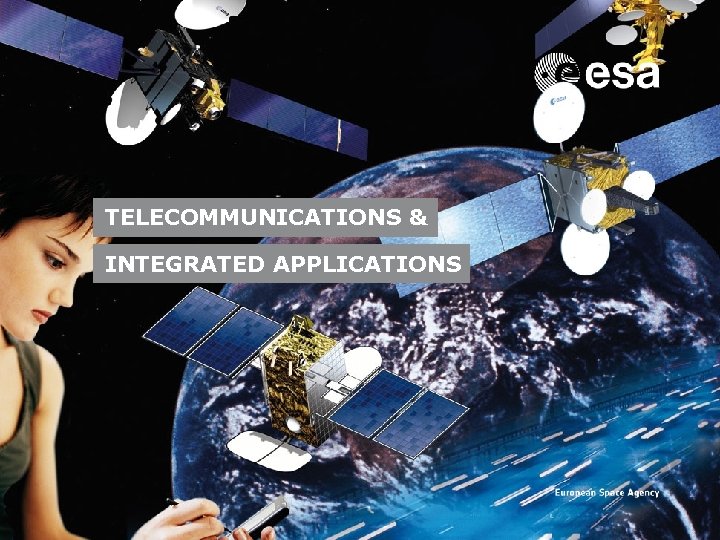
→ TELECOMMUNICATIONS & INTEGRATED APPLICATIONS
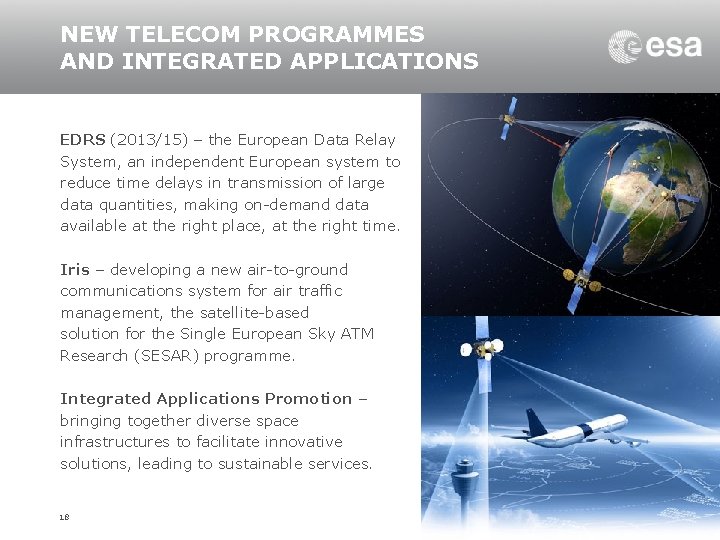
NEW TELECOM PROGRAMMES AND INTEGRATED APPLICATIONS EDRS (2013/15) – the European Data Relay System, an independent European system to reduce time delays in transmission of large data quantities, making on-demand data available at the right place, at the right time. Iris – developing a new air-to-ground communications system for air traffic management, the satellite-based solution for the Single European Sky ATM Research (SESAR) programme. Integrated Applications Promotion – bringing together diverse space infrastructures to facilitate innovative solutions, leading to sustainable services. 18
→ NAVIGATION
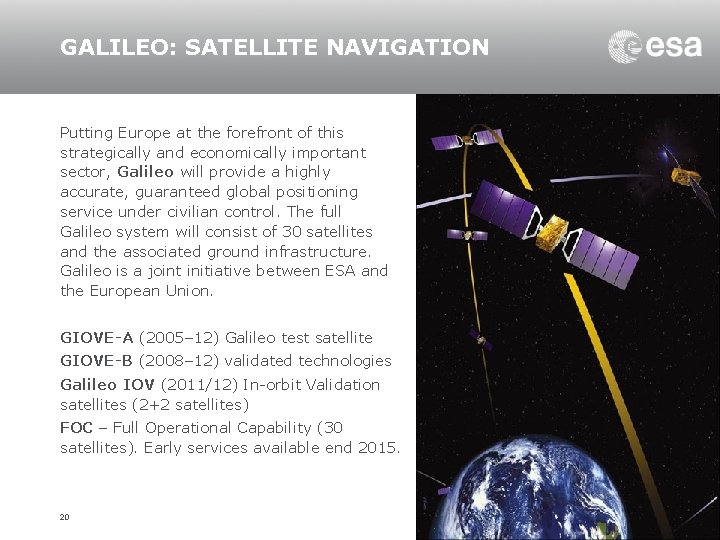
GALILEO: SATELLITE NAVIGATION Putting Europe at the forefront of this strategically and economically important sector, Galileo will provide a highly accurate, guaranteed global positioning service under civilian control. The full Galileo system will consist of 30 satellites and the associated ground infrastructure. Galileo is a joint initiative between ESA and the European Union. GIOVE-A (2005– 12) Galileo test satellite GIOVE-B (2008– 12) validated technologies Galileo IOV (2011/12) In-orbit Validation satellites (2+2 satellites) FOC – Full Operational Capability (30 satellites). Early services available end 2015. 20
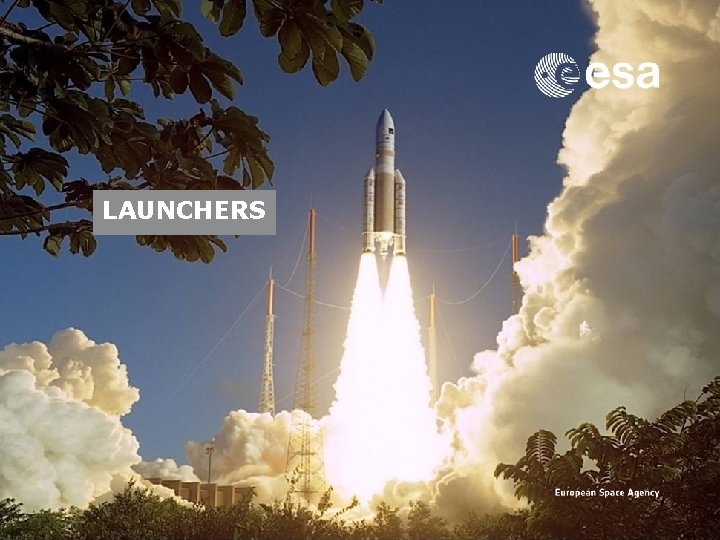
→ LAUNCHERS
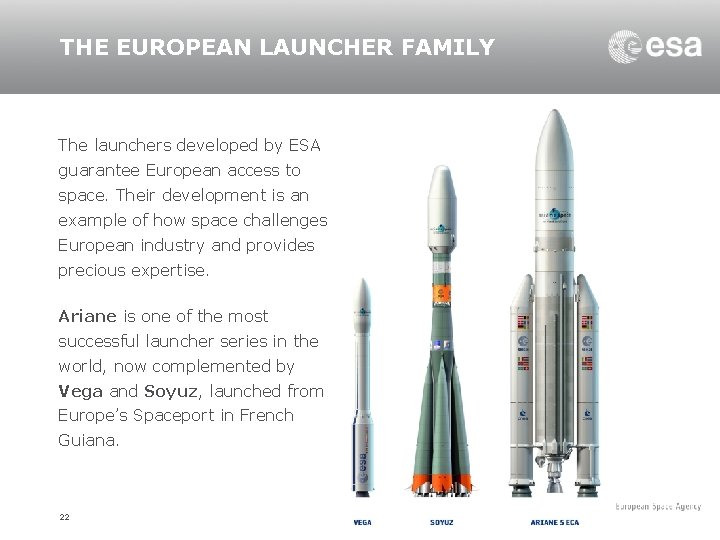
THE EUROPEAN LAUNCHER FAMILY The launchers developed by ESA guarantee European access to space. Their development is an example of how space challenges European industry and provides precious expertise. Ariane is one of the most successful launcher series in the world, now complemented by Vega and Soyuz, launched from Europe’s Spaceport in French Guiana. 22
→ THE EUROPEAN SPACE AGENCY March 2013