
The European Quality Award lsimply the best There
The European Quality Award l“simply the best…” “There are many benefits of entering the European Quality Award. It gives us a better image in the markets we serve – both in the eyes of our customers and our employees. It helps to promote a better spirit of pride and trust in our employees. ”
Agenda l Elements used in the Award l Some History and Background l The EQA process l How EQA fits with recognition generally Version: 1 Diane Dibley, EFQM Date: 30/10/04
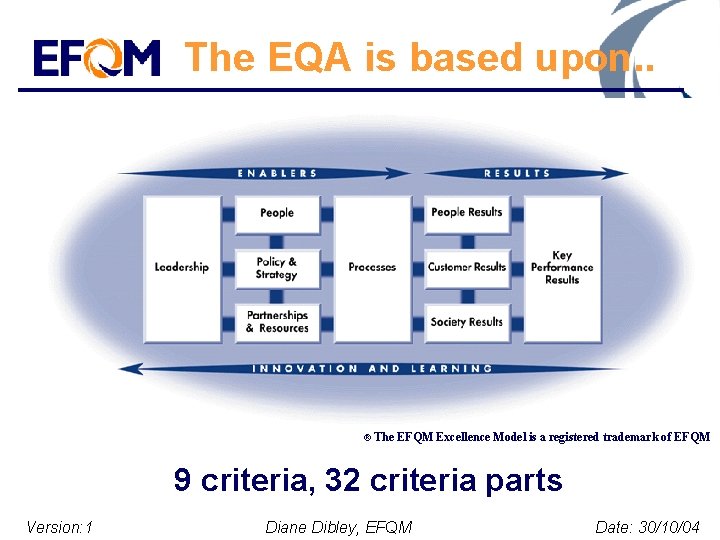
The EQA is based upon. . The EFQM Excellence Model is a registered trademark of EFQM 9 criteria, 32 criteria parts Version: 1 Diane Dibley, EFQM Date: 30/10/04
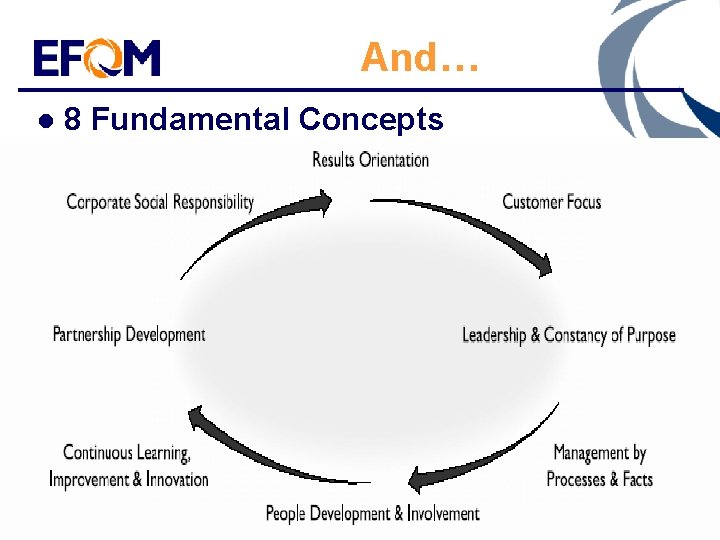
And… l 8 Fundamental Concepts Version: 1 Diane Dibley, EFQM The 30/10/04 Benefits Date:
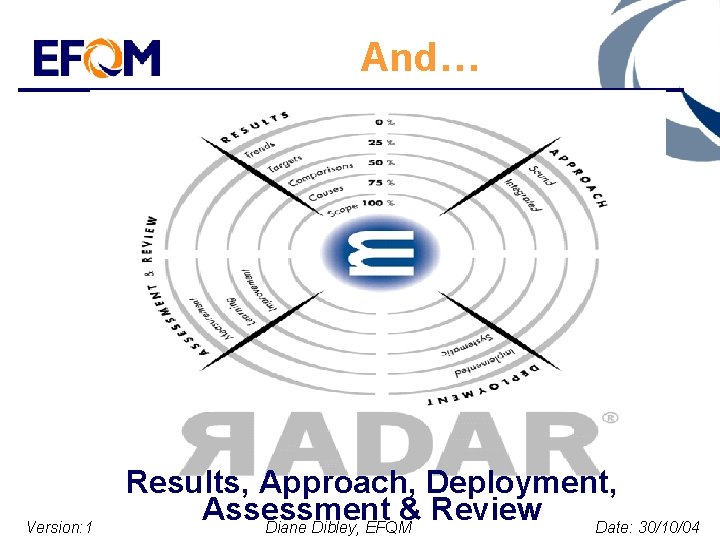
And… Version: 1 Results, Approach, Deployment, Assessment & Review Diane Dibley, EFQM Date: 30/10/04
The EQA exists to: l Help promote the fundamental beliefs contained in the EFQM Excellence Model l Identify role models that others will identify with and learn from l Identify good practices that others will learn from l Attract organisations to the EFQM and keep them as members Version: 1 Diane Dibley, EFQM Date: 30/10/04
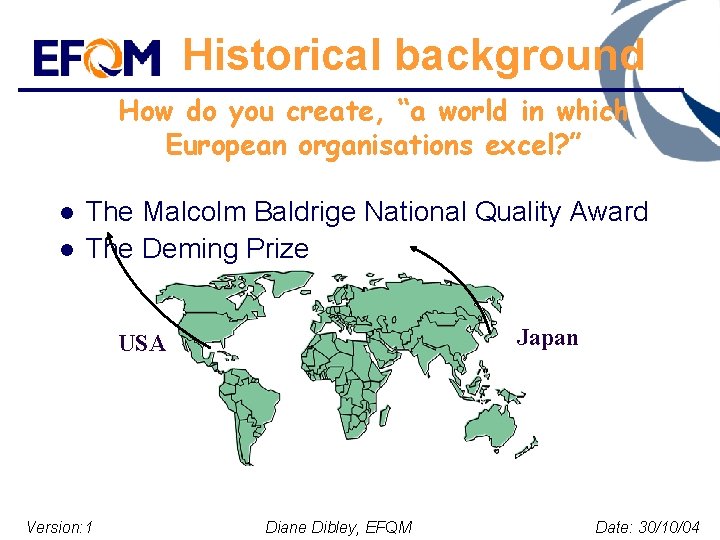
Historical background How do you create, “a world in which European organisations excel? ” l l The Malcolm Baldrige National Quality Award The Deming Prize Japan USA Version: 1 Diane Dibley, EFQM Date: 30/10/04
Historical background (cont’d) • EFQM formed 1988 • Launch of The European Quality Award 1991 • Launch of Public Sector Award 1995 • Launch of SME Awards 1996 • Launch of Award for operational units 1996 • Launch of ‘Levels of Excellence’ 2001 Diane Dibley, EFQM Prizes in 2003 Date: 30/10/04 • Introduction of Special Version: 1
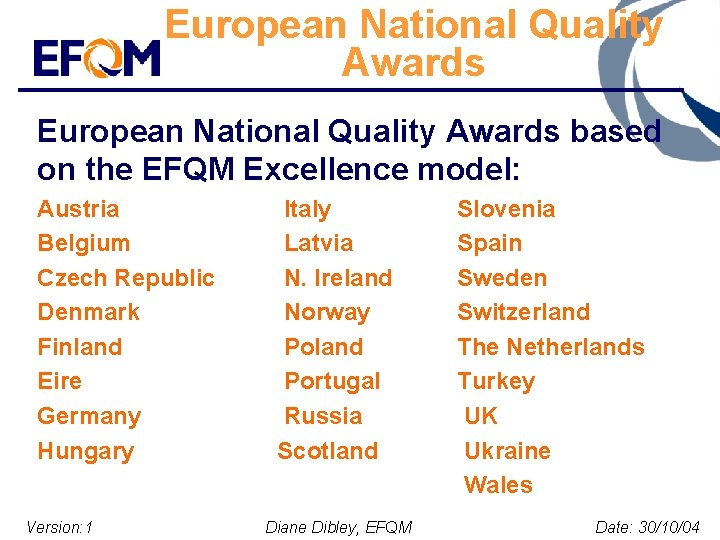
European National Quality Awards based on the EFQM Excellence model: Austria Belgium Czech Republic Denmark Finland Eire Germany Hungary Version: 1 Italy Latvia N. Ireland Norway Poland Portugal Russia Scotland Diane Dibley, EFQM Slovenia Spain Sweden Switzerland The Netherlands Turkey UK Ukraine Wales Date: 30/10/04
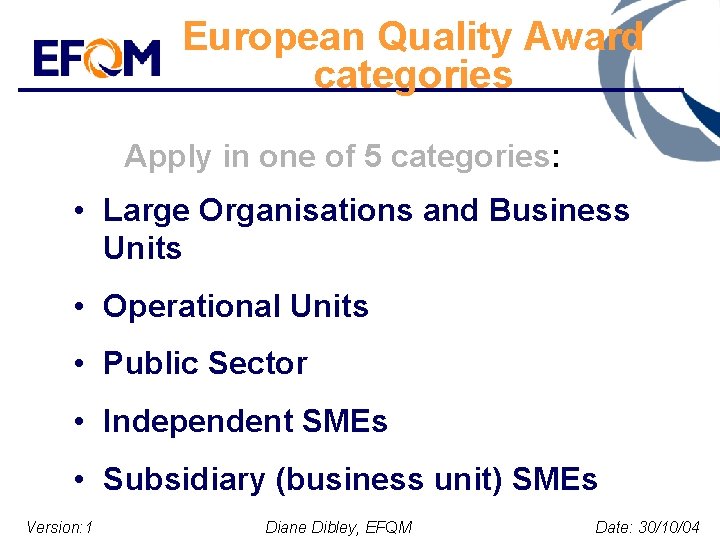
European Quality Award categories Apply in one of 5 categories: • Large Organisations and Business Units • Operational Units • Public Sector • Independent SMEs • Subsidiary (business unit) SMEs Version: 1 Diane Dibley, EFQM Date: 30/10/04
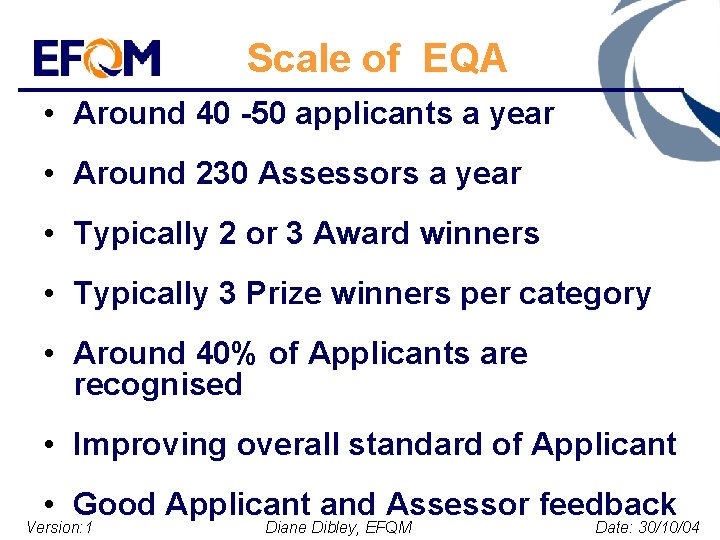
Scale of EQA • Around 40 -50 applicants a year • Around 230 Assessors a year • Typically 2 or 3 Award winners • Typically 3 Prize winners per category • Around 40% of Applicants are recognised • Improving overall standard of Applicant • Good Applicant and Assessor feedback Version: 1 Diane Dibley, EFQM Date: 30/10/04
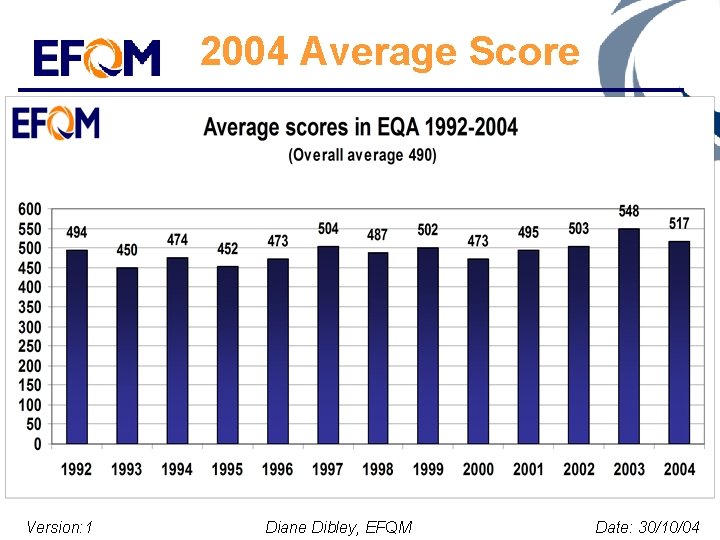
2004 Average Score Version: 1 Diane Dibley, EFQM Date: 30/10/04
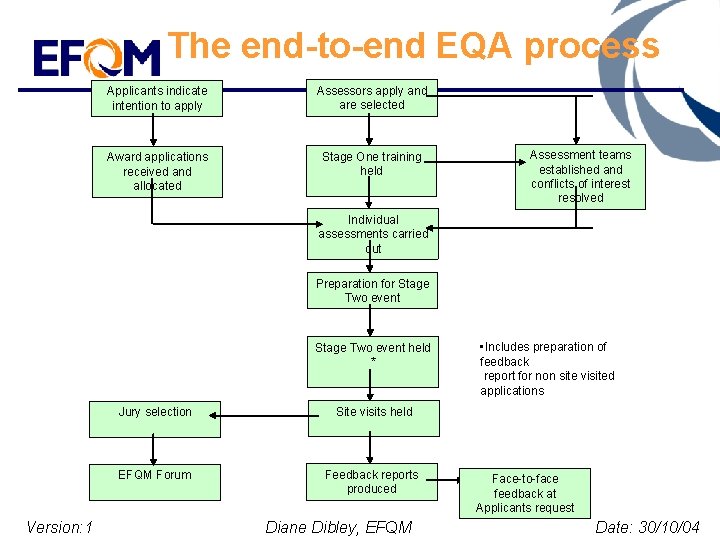
The end-to-end EQA process Applicants indicate intention to apply Assessors apply and are selected Award applications received and allocated Stage One training held Assessment teams established and conflicts of interest resolved Individual assessments carried out Preparation for Stage Two event held * Version: 1 Jury selection Site visits held EFQM Forum Feedback reports produced Diane Dibley, EFQM • Includes preparation of feedback report for non site visited applications Face-to-face feedback at Applicants request Date: 30/10/04
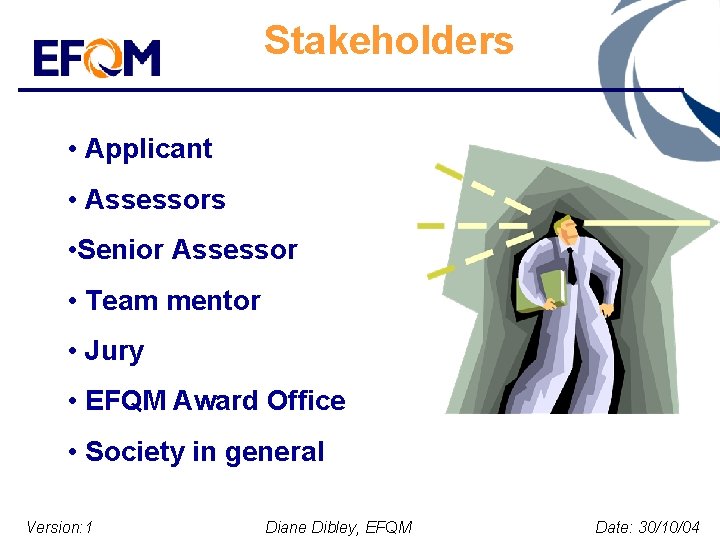
Stakeholders • Applicant • Assessors • Senior Assessor • Team mentor • Jury • EFQM Award Office • Society in general Version: 1 Diane Dibley, EFQM Date: 30/10/04
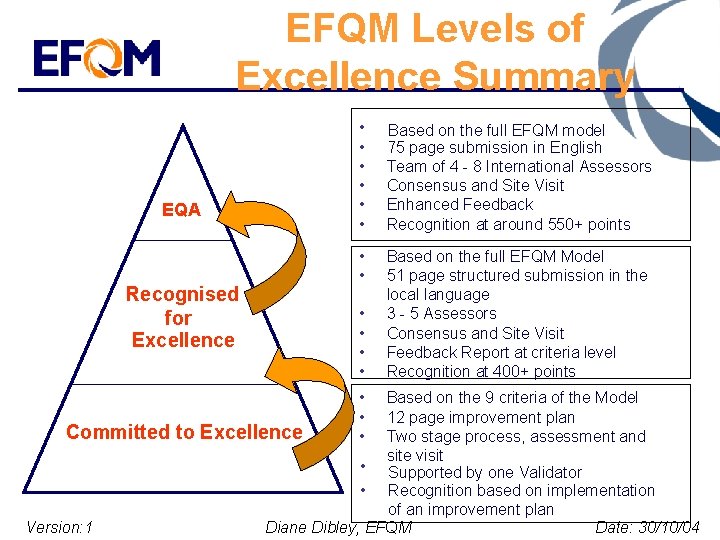
EFQM Levels of Excellence Summary EQA Recognised for Excellence Committed to Version: 1 • • • Based on the full EFQM model 75 page submission in English Team of 4 - 8 International Assessors Consensus and Site Visit Enhanced Feedback Recognition at around 550+ points • • Based on the full EFQM Model 51 page structured submission in the local language 3 - 5 Assessors Consensus and Site Visit Feedback Report at criteria level Recognition at 400+ points • • Based on the 9 criteria of the Model 12 page improvement plan Excellence Two stage process, assessment and site visit • Supported by one Validator • Recognition based on implementation of an improvement plan Diane Dibley, EFQM Date: 30/10/04
Version: 1 Diane Dibley, EFQM Date: 30/10/04
- Slides: 16