
The European International Regulatory Environments ULB PHARMED Module
The European & International Regulatory Environments ULB PHARMED Module 6: Drug Safety Evaluation, Pharmacovigilance & Regulatory Affairs - April 24 th, 2013 Stéphane Callewaert Regulatory Policy & Intelligence, Global Regulatory Affairs, Glaxo. Smith. Kline Vaccines
Outline § EU Regulatory Environment – EU pharmaceutical legislation: basic principles – EU Clinical Trials Directive – EU Registration Procedures: CP & MRP/DCP – Post-Authorisation Variations – EU Paediatric Regulation: impact on development and registration – New Pharmacovigilance legislative requirements § US Regulatory Environment – FDA & relevant legislation – IND & BLA § Japanese Regulatory Environment – Law and relevant authorities (MHLW, PMDA, NIID) – Clinical Trials Notification & JNDA § International Regulatory Environment § Global Harmonisation
A representative sample of the slides that will be presented and discussed during the course is displayed hereafter.
EU Regulatory Environment
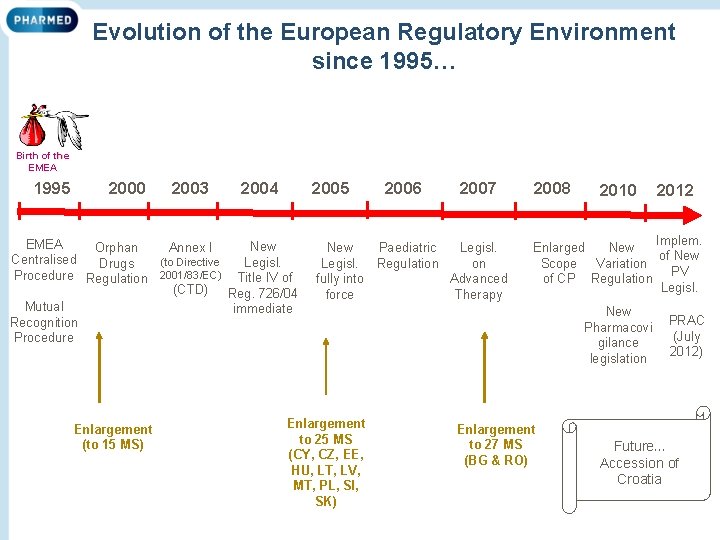
Evolution of the European Regulatory Environment since 1995… Birth of the EMEA 1995 2000 2003 2004 2005 EMEA New Orphan Annex I Centralised Drugs (to Directive Legisl. Procedure Regulation 2001/83/EC) Title IV of (CTD) Reg. 726/04 Mutual immediate Recognition Procedure Enlargement (to 15 MS) 2006 2007 New Paediatric Legisl. Regulation on fully into Advanced force Therapy Enlargement to 25 MS (CY, CZ, EE, HU, LT, LV, MT, PL, SI, SK) 2008 2010 2012 Implem. Enlarged New of New Scope Variation PV of CP Regulation Legisl. New Pharmacovi gilance legislation Enlargement to 27 MS (BG & RO) PRAC (July 2012) Future… Accession of Croatia

Experts appointed by NCA EMA Permanent Staff Structure of the European Medicines Agency (EMA) EXECUTIVE DIRECTOR Guido Rasi COMMUNICATIONS AND NETWORKING CHMP Committee for Medicinal Products for Human Use HUMAN MEDICINES DEVELOPMENT AND EVALUATION CVMP Committee for Medicinal Products for veterinary use COMP Committee on Orphan Medicinal Products PATIENT HEALTH PROTECTION HMPC Committee on Herbal Medicinal Products NATIONAL COMPETENT AUTHORITIES VETERINARY MEDICINES AND INSPECTIONS CAT PDCO Committee for Advanced Therapies Paediatric Committee ( > 3 500 EUROPEAN EXPERTS ) ADMINISTRATION PRAC Pharmacovig. and Risk Assessment Committee
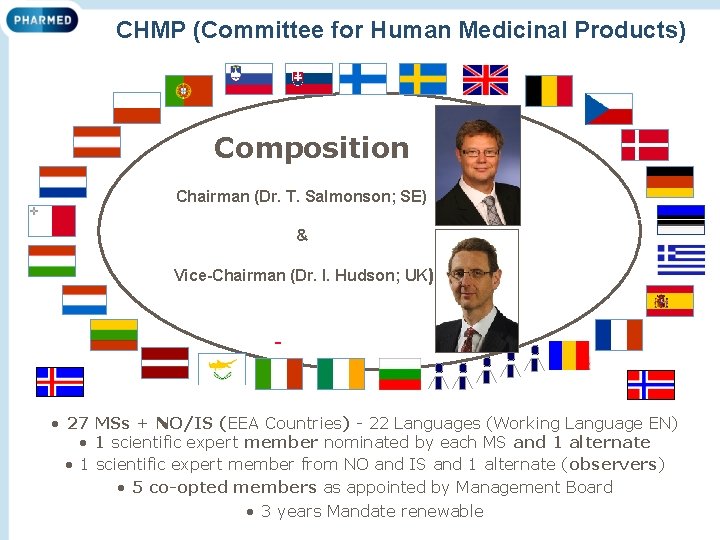
CHMP (Committee for Human Medicinal Products) Composition Chairman (Dr. T. Salmonson; SE) & Vice-Chairman (Dr. I. Hudson; UK) • 27 MSs + NO/IS (EEA Countries) - 22 Languages (Working Language EN) • 1 scientific expert member nominated by each MS and 1 alternate • 1 scientific expert member from NO and IS and 1 alternate (observers) • 5 co-opted members as appointed by Management Board • 3 years Mandate renewable

CHMP main tasks & responsibilities § Delivering opinions to the European Commission – on new medicinal products/variation/renewal/line extension – on arbitration/referral procedures · Advising on general EU guidelines/policies · Scientific Advice & guidelines to companies · Opinions on Compassionate Use to MSs · Contribution to ICH process · Establish Working Parties, SAGs & Expert Groups · Delivering opinions to WHO
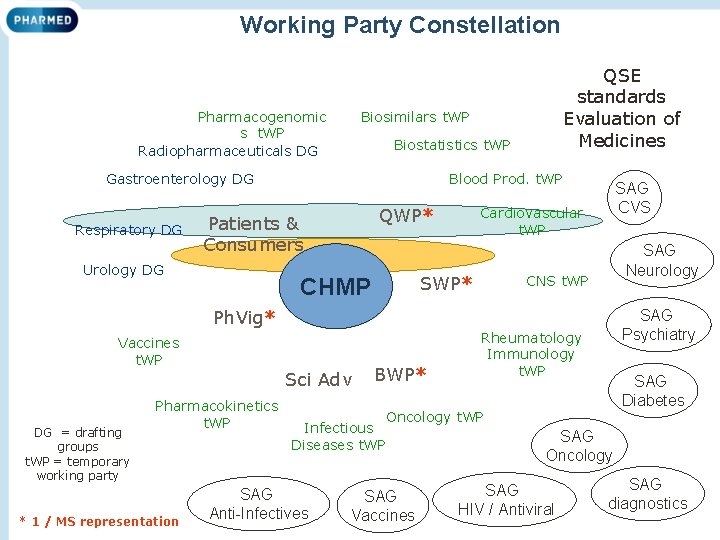
Working Party Constellation Pharmacogenomic s t. WP Radiopharmaceuticals DG Biosimilars t. WP Biostatistics t. WP Gastroenterology DG Respiratory DG Blood Prod. t. WP QWP* Patients & Consumers Urology DG QSE standards Evaluation of Medicines Cardiovascular t. WP SWP* CHMP SAG CVS SAG Neurology CNS t. WP Ph. Vig* Vaccines t. WP Sci Adv DG = drafting groups t. WP = temporary working party Pharmacokinetics t. WP * 1 / MS representation BWP* Infectious Diseases t. WP SAG Anti-Infectives SAG Psychiatry Rheumatology Immunology t. WP SAG Diabetes Oncology t. WP SAG Vaccines SAG Oncology SAG HIV / Antiviral SAG diagnostics
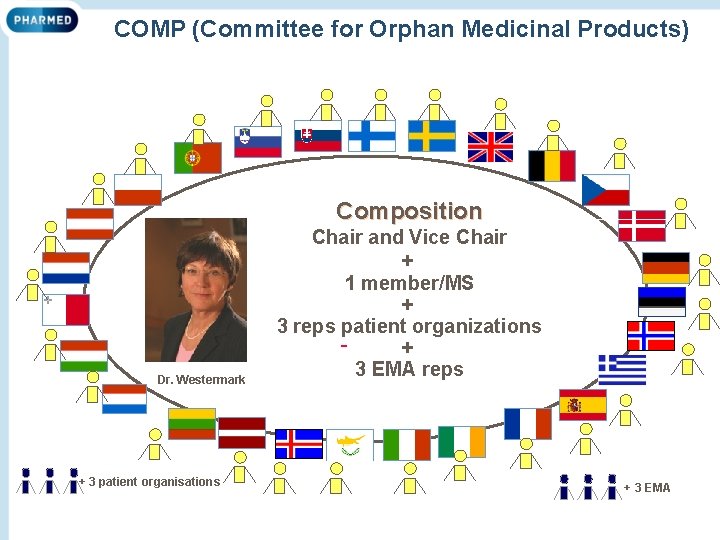
COMP (Committee for Orphan Medicinal Products) Composition Dr. Westermark + 3 patient organisations Chair and Vice Chair + 1 member/MS + 3 reps patient organizations + 3 EMA reps + 3 EMA
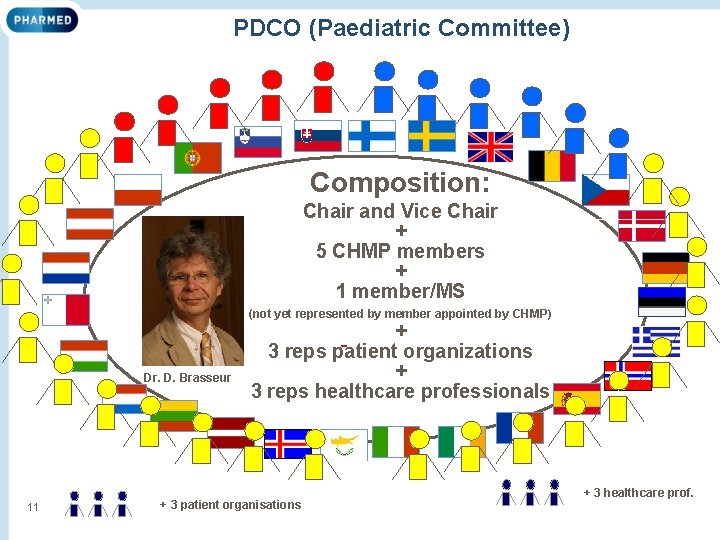
PDCO (Paediatric Committee) Composition: Chair and Vice Chair + 5 CHMP members + 1 member/MS (not yet represented by member appointed by CHMP) + 3 reps patient organizations + 3 reps healthcare professionals Dr. D. Brasseur 11 + 3 patient organisations + 3 healthcare prof.
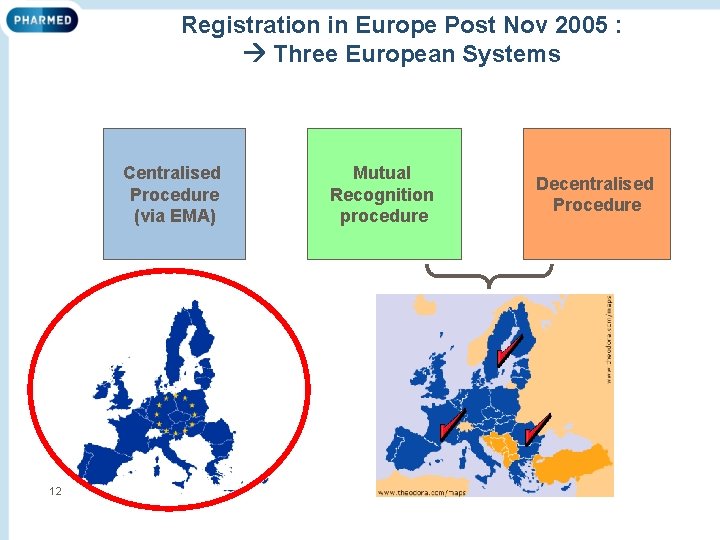
Registration in Europe Post Nov 2005 : Three European Systems Centralised Procedure (via EMA) 12 Mutual Recognition procedure Decentralised Procedure
EU Centralised Procedure § Legal Basis: Regul. (EC) No 726/2004 (also establishing “EMA” European Medicines Agency) § Principle: single application / evaluation single authorisation direct access to all EU(27 MSs) + Norway, Iceland Liechtenstein § Scope: – Compulsory for: Ø Biotech (recombinant DNA, gene expressed proteins, hybridoma & monoclonal antibodies) Ø New Active Substances in Specific Therapy Areas: AIDS, Cancer, Neuro-degenerative disorder, Diabetes, Auto-immune disease, other immune deficiencies, Viral diseases Ø Orphan Drugs – Optional for: Ø Ø Any Other New Active Substance significant innovation (therapeutic, scientific or technical) in the interests of patients at community level Generic of Centralised reference prod. (may use CP or MRP/DCP)
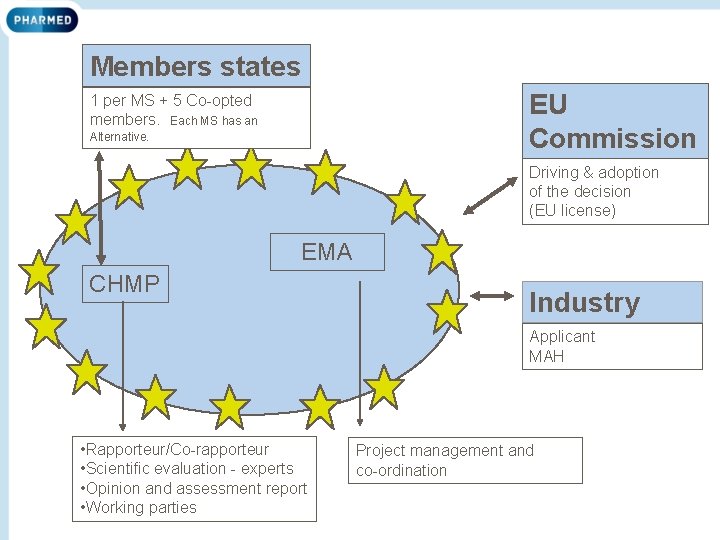
Members states EU Commission 1 per MS + 5 Co-opted members. Each MS has an Alternative. Driving & adoption of the decision (EU license) EMA CHMP Industry Applicant MAH • Rapporteur/Co-rapporteur • Scientific evaluation - experts • Opinion and assessment report • Working parties Project management and co-ordination
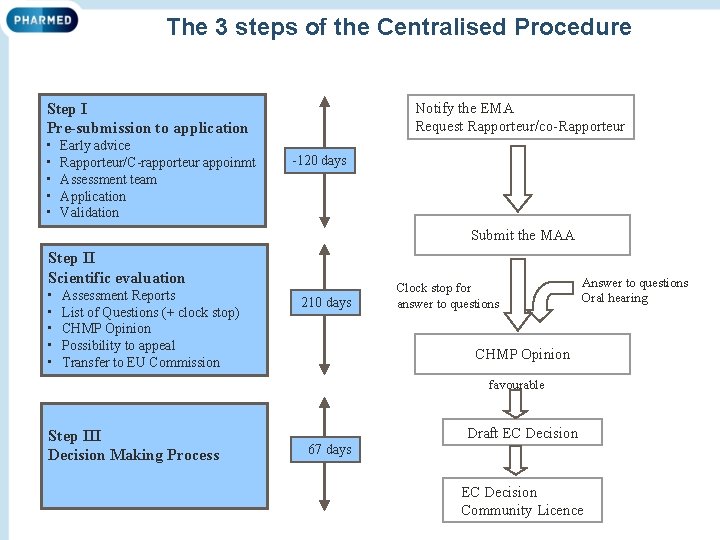
The 3 steps of the Centralised Procedure Notify the EMA Request Rapporteur/co-Rapporteur Step I Pre-submission to application • • • Early advice Rapporteur/C-rapporteur appoinmt Assessment team Application Validation -120 days Submit the MAA Step II Scientific evaluation • • • Assessment Reports List of Questions (+ clock stop) CHMP Opinion Possibility to appeal Transfer to EU Commission 210 days Clock stop for answer to questions Answer to questions Oral hearing CHMP Opinion favourable Step III Decision Making Process Draft EC Decision 67 days EC Decision Community Licence
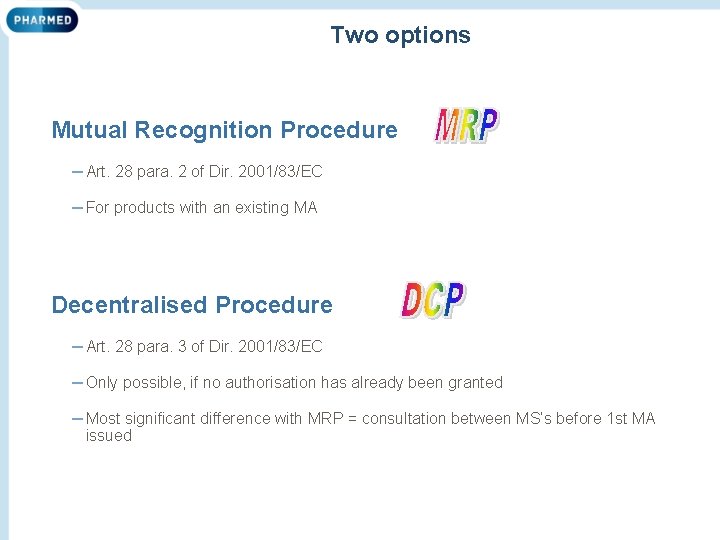
: Two options & Mutual Recognition Procedure – Art. 28 para. 2 of Dir. 2001/83/EC – For products with an existing MA Decentralised Procedure – Art. 28 para. 3 of Dir. 2001/83/EC – Only possible, if no authorisation has already been granted – Most significant difference with MRP = consultation between MS‘s before 1 st MA issued
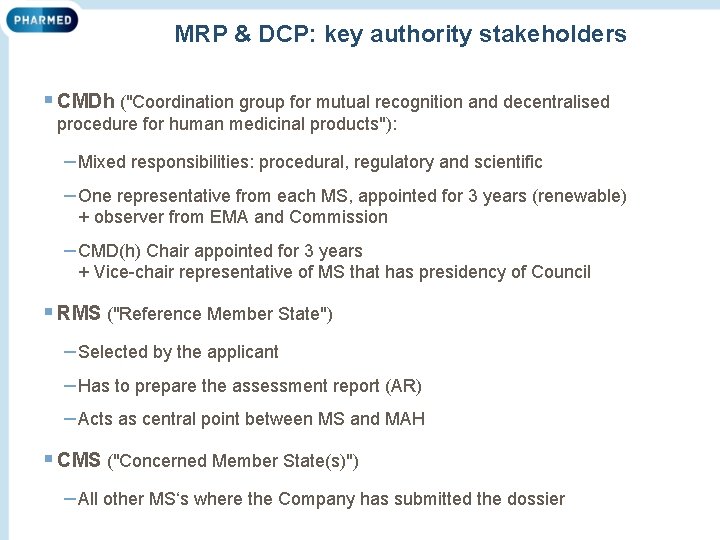
MRP & DCP: key authority stakeholders § CMDh ("Coordination group for mutual recognition and decentralised procedure for human medicinal products"): – Mixed responsibilities: procedural, regulatory and scientific – One representative from each MS, appointed for 3 years (renewable) + observer from EMA and Commission – CMD(h) Chair appointed for 3 years + Vice-chair representative of MS that has presidency of Council § RMS ("Reference Member State") – Selected by the applicant – Has to prepare the assessment report (AR) – Acts as central point between MS and MAH § CMS ("Concerned Member State(s)") – All other MS‘s where the Company has submitted the dossier
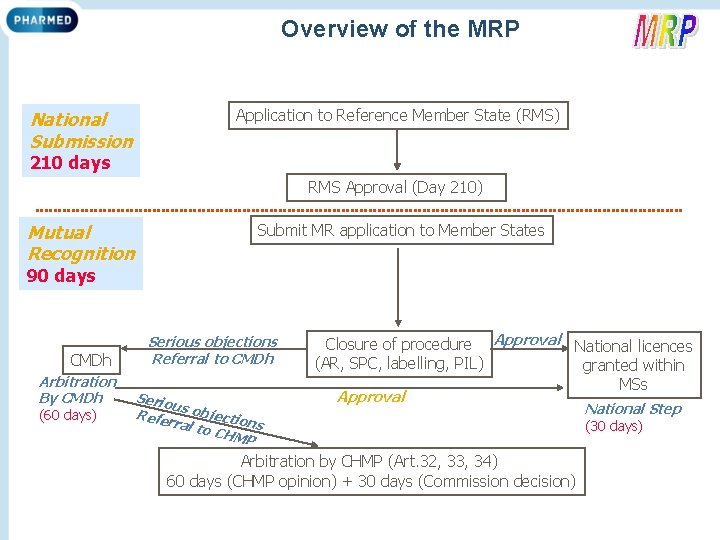
Overview of the MRP National Submission Application to Reference Member State (RMS) 210 days RMS Approval (Day 210) Mutual Recognition Submit MR application to Member States 90 days CMDh Arbitration By CMDh (60 days) Serious objections Referral to CMDh Serio u Refer s objectio ns ral to CHMP Closure of procedure Approval National licences (AR, SPC, labelling, PIL) granted within MSs Approval Arbitration by CHMP (Art. 32, 33, 34) 60 days (CHMP opinion) + 30 days (Commission decision) National Step (30 days)
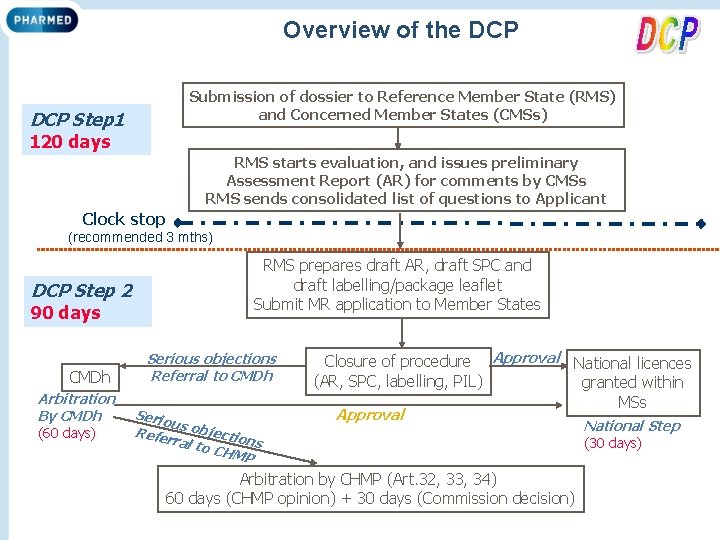
Overview of the DCP Submission of dossier to Reference Member State (RMS) and Concerned Member States (CMSs) DCP Step 1 120 days RMS starts evaluation, and issues preliminary Assessment Report (AR) for comments by CMSs RMS sends consolidated list of questions to Applicant Clock stop (recommended 3 mths) DCP Step 2 90 days CMDh Arbitration By CMDh (60 days) RMS prepares draft AR, draft SPC and draft labelling/package leaflet Submit MR application to Member States Serious objections Referral to CMDh Serio u Refer s objectio ns ral to CHMP Closure of procedure Approval National licences (AR, SPC, labelling, PIL) granted within MSs Approval Arbitration by CHMP (Art. 32, 33, 34) 60 days (CHMP opinion) + 30 days (Commission decision) National Step (30 days)
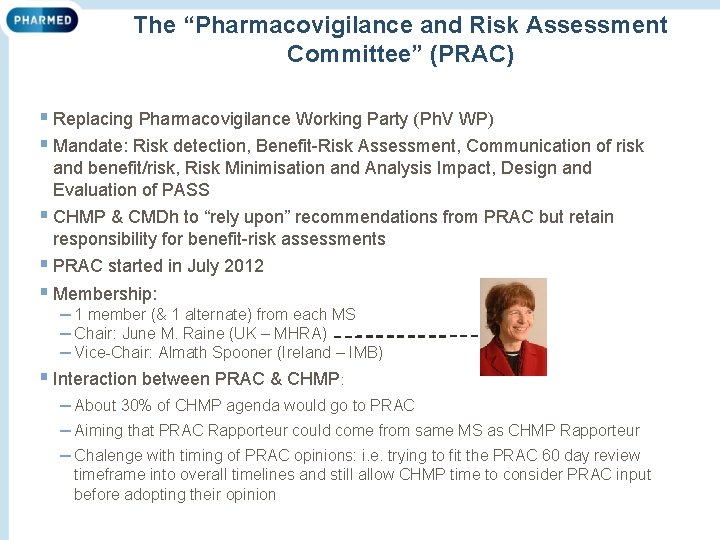
The “Pharmacovigilance and Risk Assessment Committee” (PRAC) § Replacing Pharmacovigilance Working Party (Ph. V WP) § Mandate: Risk detection, Benefit-Risk Assessment, Communication of risk and benefit/risk, Risk Minimisation and Analysis Impact, Design and Evaluation of PASS § CHMP & CMDh to “rely upon” recommendations from PRAC but retain responsibility for benefit-risk assessments § PRAC started in July 2012 § Membership: – 1 member (& 1 alternate) from each MS – Chair: June M. Raine (UK – MHRA) – Vice-Chair: Almath Spooner (Ireland – IMB) § Interaction between PRAC & CHMP: – About 30% of CHMP agenda would go to PRAC – Aiming that PRAC Rapporteur could come from same MS as CHMP Rapporteur – Chalenge with timing of PRAC opinions: i. e. trying to fit the PRAC 60 day review timeframe into overall timelines and still allow CHMP time to consider PRAC input before adopting their opinion
New requirements for the Marketing Authorisation Application (MAA) § Pharmacovigilance System Master File (PSMF) – MAH must prepare and maintain “Pharmacovigilance system master file” (PSMF): replaces former “Detailed Description of Pharmacovigilance System” (DDPS), and must be held at MAH site – Summary of the Pharmacovigilance System must be included in the MAA dossier – Full PSMF to be provided within 7 days of request from a competent authority § Risk Management Plan (RMP) – ‘detailed description of risk management system’ – RMPs to be included in MAAs for all new products § N. B. Authorities can impose need for Risk Management System on already authorised products if concerns about Benefit/Risk balance – Format and content of RMPs addressed in Commission’s implementing measures
US Regulatory Environment
The US Regulatory Environment (1) The US Food and Drug Administration (FDA) § FDA’s Role and Responsibilities: – FDA is regulating drugs, foods, cosmetics, biologics, medical devices – FDA is responsible for administration, enforcement, interpretation of US drug law and has power to establish regulations which have the force and effect of law – FDA has developed policies, procedures and regulations to implement its Reglatory initiatives, some going beyond the intent of the original laws Drug Registration in the US = one of the most rigorous systems in the world
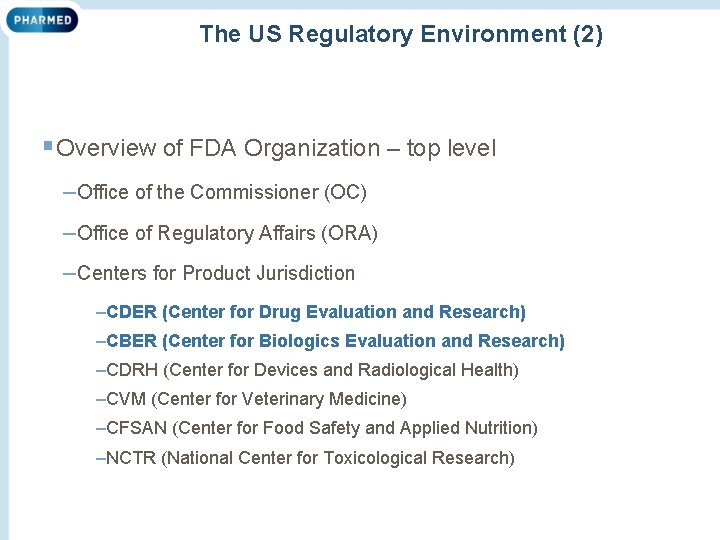
The US Regulatory Environment (2) §Overview of FDA Organization – top level –Office of the Commissioner (OC) –Office of Regulatory Affairs (ORA) –Centers for Product Jurisdiction –CDER (Center for Drug Evaluation and Research) –CBER (Center for Biologics Evaluation and Research) –CDRH (Center for Devices and Radiological Health) –CVM (Center for Veterinary Medicine) –CFSAN (Center for Food Safety and Applied Nutrition) –NCTR (National Center for Toxicological Research)
The IND Process : What is an IND? Where are regulations found? § IND = Investigational New Drug application § Seeks permission to test a new drug or biologic in humans § Usually begins in Phase I; can begin in Phase II or III if have adequate human experience § FDA’s review of IND focuses on: – Phase I: Patient safety – Phase II/III: also includes assessment of the scientific quality of the clinical evaluation (data supportive or not for BLA? ) § IND Regulations are contained in Title 21, CFR, Part 312
Japanese Regulatory Environment
Japanese law and relevant authorities for medicines registration § Pharmaceutical Affairs Law (PAL) – April 2005 § MHLW (Ministry of Health, Labour and Welfare) – Responsibility for approvals and licensing – http: //www. mhlw. go. jp/english/index. html § PMDA (Pharmaceuticals and Medical Devices Agency) – Responsibility for scientific review (incl. audit for GMP, GLP, GCP) – Branch under MHLW, created in 2004 – http: //www. pmda. go. jp/english/index. html § NIID (National Institute of Infectious Diseases) – Responsibility for national testing – http: //www. nih. go. jp/niid/index-e. html
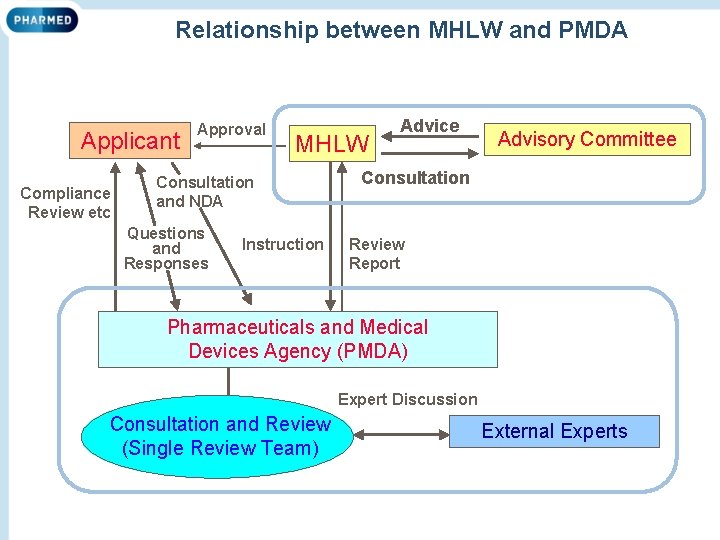
Relationship between MHLW and PMDA Applicant Compliance Review etc Approval MHLW Consultation and NDA Questions and Responses Instruction Advice Advisory Committee Consultation Review Report Pharmaceuticals and Medical Devices Agency (PMDA) Expert Discussion Consultation and Review (Single Review Team) External Experts
International Regulatory Environment
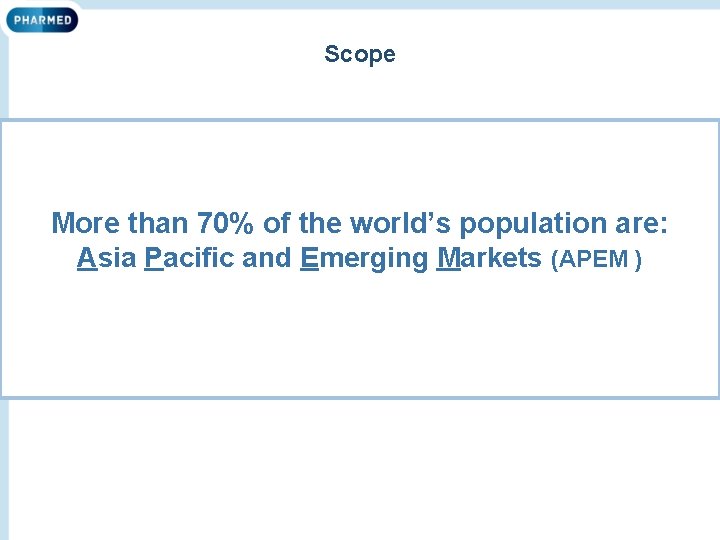
Scope 192 countries More than 70% of 23 time zones the world’s population are: Between 4000 and 6000 languages Asia Pacific and Emerging Markets (APEM ) More than 150 monetary currencies
International & Emerging Regions Key markets § Asia Pacific: ØIndia, Philippines, South Korea, Taiwan § China / Hong Kong / Macau: ØChina § Latin America : ØArgentina, Brazil, Chile, Mexico § Middle East and North Africa (MENA): ØEgypt, Pakistan, Saudi Arabia, Turkey § Sub Saharan Africa (SSA): ØSouth Africa § Eastern Europe: ØRussia
Models for drug regulatory assessment Countries can be categorised in 2 licensing models: – model of licensing system based upon submission of evidence of registration in reference countries – model of licensing system based upon a full assessment of new drug applications (including biological products)
Global Harmonisation Initiatives
ICH Definition and Background § “International Conference on Harmonisation of Technical Requirements for the Registration of Pharmaceuticals for Human Use” § Joint regulatory/industry project § EU, Japan and the United States § To improve (through harmonisation), efficiency of development/registration of new medicinal products § Based on scientific consensus § Commitment by regulatory parties to implement ICH recommendations
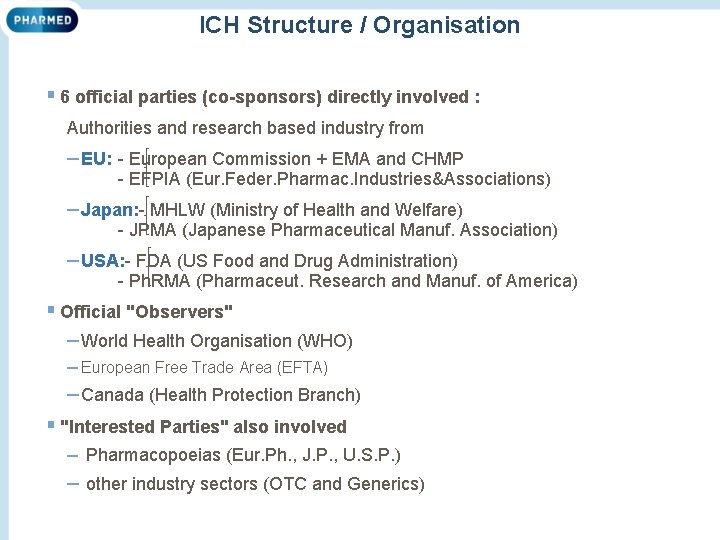
ICH Structure / Organisation § 6 official parties (co-sponsors) directly involved : Authorities and research based industry from – EU: - European Commission + EMA and CHMP - EFPIA (Eur. Feder. Pharmac. Industries&Associations) – Japan: - MHLW (Ministry of Health and Welfare) - JPMA (Japanese Pharmaceutical Manuf. Association) – USA: - FDA (US Food and Drug Administration) - Ph. RMA (Pharmaceut. Research and Manuf. of America) § Official "Observers" – World Health Organisation (WHO) – European Free Trade Area (EFTA) – Canada (Health Protection Branch) § "Interested Parties" also involved – Pharmacopoeias (Eur. Ph. , J. P. , U. S. P. ) – other industry sectors (OTC and Generics)
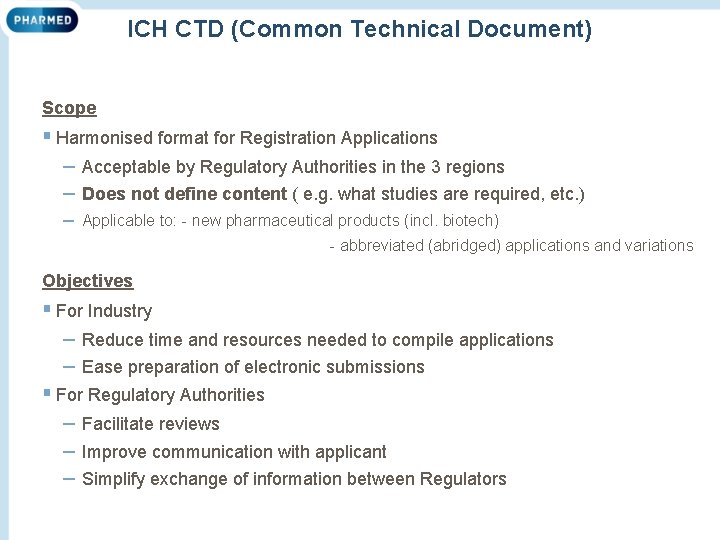
ICH CTD (Common Technical Document) Scope § Harmonised format for Registration Applications – Acceptable by Regulatory Authorities in the 3 regions – Does not define content ( e. g. what studies are required, etc. ) – Applicable to: - new pharmaceutical products (incl. biotech) - abbreviated (abridged) applications and variations Objectives § For Industry – Reduce time and resources needed to compile applications – Ease preparation of electronic submissions § For Regulatory Authorities – Facilitate reviews – Improve communication with applicant – Simplify exchange of information between Regulators
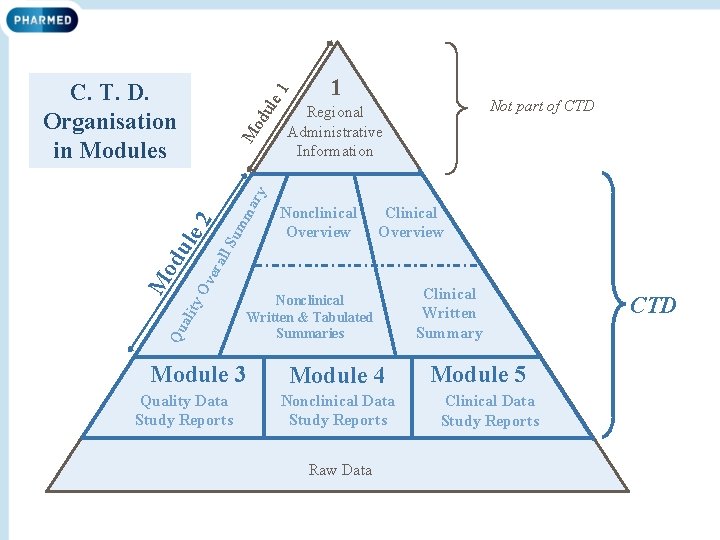
ll S um ma ry 1 Not part of CTD Regional Administrative Information Nonclinical Overview Clinical Overview era Qu ali ty Ov M od ule 2 Mo du le 1 C. T. D. Organisation in Modules Nonclinical Written & Tabulated Summaries Module 3 Quality Data Study Reports Module 4 Nonclinical Data Study Reports Raw Data Clinical Written Summary Module 5 Clinical Data Study Reports CTD
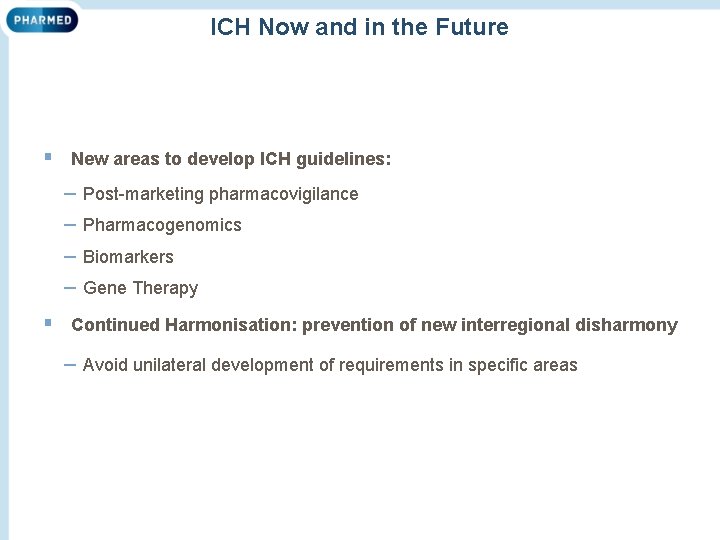
ICH Now and in the Future § New areas to develop ICH guidelines: – Post-marketing pharmacovigilance – Pharmacogenomics – Biomarkers – Gene Therapy § Continued Harmonisation: prevention of new interregional disharmony – Avoid unilateral development of requirements in specific areas
…Globalising ICH § ICH Global Cooperation Group (GCG) – Representatives from other Regional Harmonisation initiatives § APEC (Asia-Pacific Economic Cooperation) § ASEAN (Association of the Southeast Asian Nations) § GCC (Gulf Cooperation Council) § PANDRH (Pan American Network for Drug Regulatory Harmonization) § SADC (Southern African Development Community) – Evolution in ICH and understanding that some non-ICH countries are now major contributors/consumers to the global pharmaceutical market § Regulators Forum - started in 2008 – Including representatives from Australia, Brazil, China, Taiwan, India, Russia, Singapore and South Korea most of which are not part of Harmonisation Initiatives already – Key areas of focus: API GMP; clinical trials; pharmacovigilance
- Slides: 39