
The European cooperation for Accreditation Serving the European

- Slides: 24
The European co-operation for Accreditation Serving the European Economy and Society
Contents What is EA? EA organizational structure MLA Signatories Standards for Accreditation The Development of European Accreditation EA in the global network
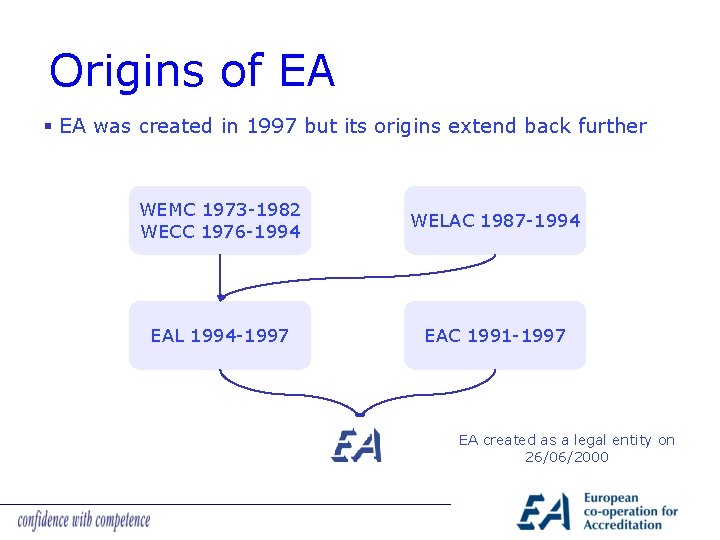
Origins of EA § EA was created in 1997 but its origins extend back further WEMC 1973 -1982 WECC 1976 -1994 WELAC 1987 -1994 EAL 1994 -1997 EAC 1991 -1997 EA created as a legal entity on 26/06/2000
The European co-operation for Accreditation (1) • A not-for-profit association registered in the Netherlands in June 2000. • 35 Full Members representing 33 European economies • 16 Contracts of Cooperation signed with non EU / EFTA AB’s (3 AB’s covered by the ENP, 5 AB’s located in Europe, Russia, Ukraine and 8 AB’s located outside Europe) • Out of these contracts, 9 have turned into a bilateral agreement with EA.
The European co-operation for Accreditation (2) • A permanent secretariat of 3 persons: Martine Blum & Bénédicte Ziemann, EA Secretariat Marga Zaffe, secretary of the MLA Committee • EA is an active Member of ILAC (International laboratory Accreditation Cooperation) and IAF (International Accreditation Forum) as a recognised regional cooperation.
Purpose of EA (1) • The European co-operation for Accreditation (EA) is the Association of the national accreditation bodies that provide accreditation for the following conformity assessment activities: – – – – Calibration Testing Inspection Certification of quality, environmental management systems Certification of products Certification of persons EMAS verifiers
Purpose of EA (2) • Provide Europe with an effective, reliable accreditation infrastructure • Develop accreditation criteria and guidelines supporting harmonisation of practices • Operate a sound, robust, reliable peer evaluation process • Ensure equivalence of accreditation and equal reliability of accredited results • Cooperate with the European Commission and other European, international stakeholders
The European Accreditation model • • • A service of general interest Public authority Last level of control of CA services Voluntary, mandatory fields Mandate of the Government Full compliance with applicable rules Accountability to stakeholders No predominance of any single interest group Non-profit distributing No competition
Contents What is EA? EA organizational structure MLA Signatories Standards for Accreditation The Development of European Accreditation EA in the global network
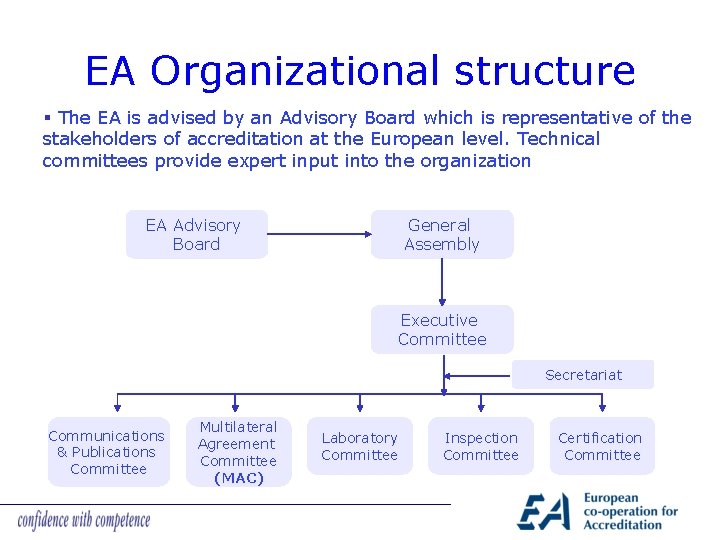
EA Organizational structure § The EA is advised by an Advisory Board which is representative of the stakeholders of accreditation at the European level. Technical committees provide expert input into the organization EA Advisory Board General Assembly Executive Committee Secretariat Communications & Publications Committee Multilateral Agreement Committee (MAC) Laboratory Committee Inspection Committee Certification Committee
Contents What is EA? EA organizational structure MLA Signatories Standards for Accreditation The Development of European Accreditation EA in the global network
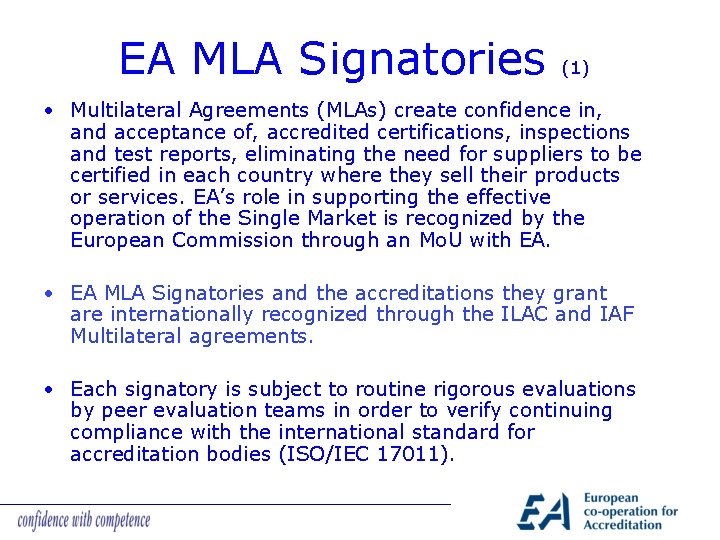
EA MLA Signatories (1) • Multilateral Agreements (MLAs) create confidence in, and acceptance of, accredited certifications, inspections and test reports, eliminating the need for suppliers to be certified in each country where they sell their products or services. EA’s role in supporting the effective operation of the Single Market is recognized by the European Commission through an Mo. U with EA. • EA MLA Signatories and the accreditations they grant are internationally recognized through the ILAC and IAF Multilateral agreements. • Each signatory is subject to routine rigorous evaluations by peer evaluation teams in order to verify continuing compliance with the international standard for accreditation bodies (ISO/IEC 17011).
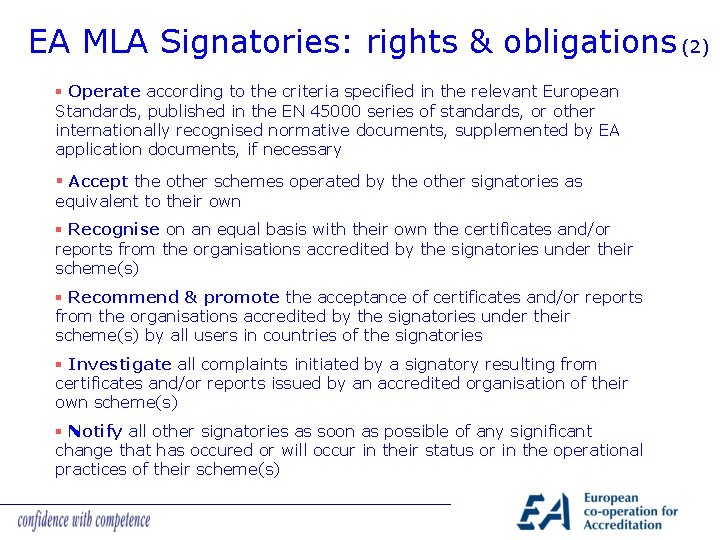
EA MLA Signatories: rights & obligations (2) § Operate according to the criteria specified in the relevant European Standards, published in the EN 45000 series of standards, or other internationally recognised normative documents, supplemented by EA application documents, if necessary § Accept the other schemes operated by the other signatories as equivalent to their own § Recognise on an equal basis with their own the certificates and/or reports from the organisations accredited by the signatories under their scheme(s) § Recommend & promote the acceptance of certificates and/or reports from the organisations accredited by the signatories under their scheme(s) by all users in countries of the signatories § Investigate all complaints initiated by a signatory resulting from certificates and/or reports issued by an accredited organisation of their own scheme(s) § Notify all other signatories as soon as possible of any significant change that has occured or will occur in their status or in the operational practices of their scheme(s)
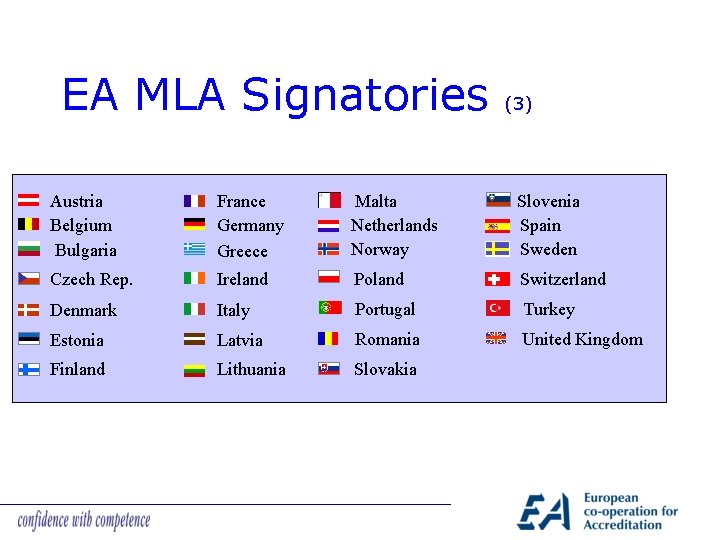
EA MLA Signatories (3) Austria Belgium Bulgaria France Germany Greece Malta Netherlands Norway Slovenia Spain Sweden Czech Rep. Ireland Poland Switzerland Denmark Italy Portugal Turkey Estonia Latvia Romania United Kingdom Finland Lithuania Slovakia
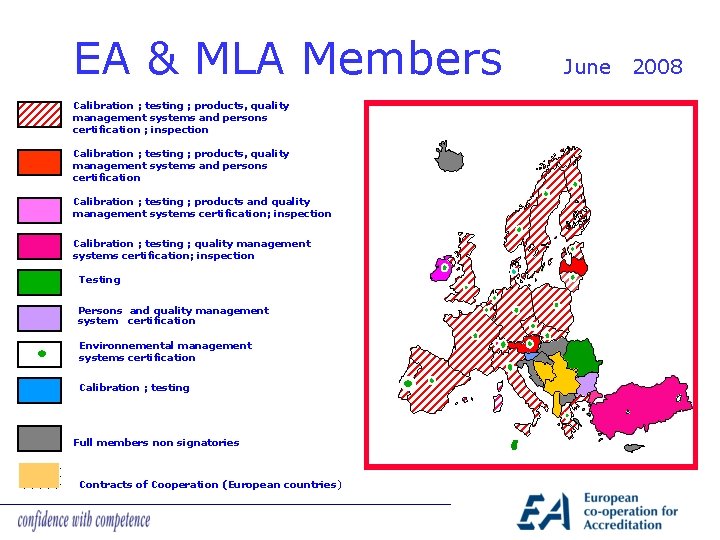
EA & MLA Members Calibration ; testing ; products, quality management systems and persons certification ; inspection Calibration ; testing ; products, quality management systems and persons certification Calibration ; testing ; products and quality management systems certification; inspection Calibration ; testing ; quality management systems certification; inspection Testing Persons and quality management system certification Environnemental management systems certification Calibration ; testing Full members non signatories Contracts of Cooperation (European countries) June 2008
Contents What is EA? EA organizational structure MLA Signatories Standards for Accreditation The Development of European Accreditation EA in the global network
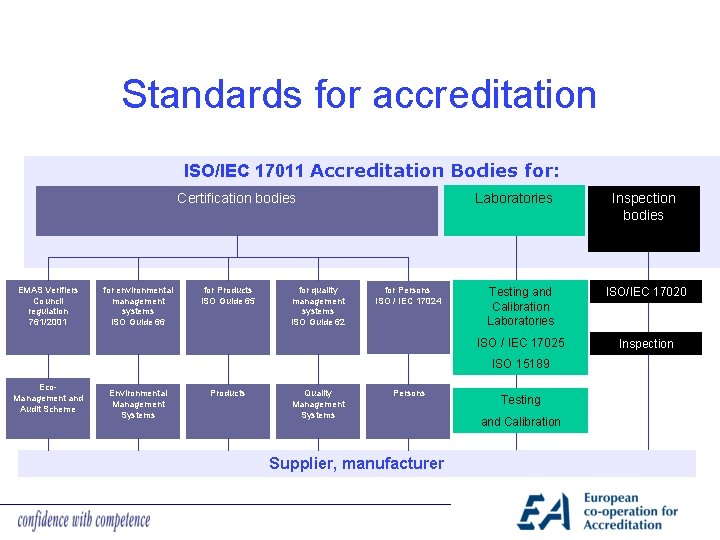
Standards for accreditation ISO/IEC 17011 Accreditation Bodies for: Laboratories Certification bodies EMAS Verifiers Council regulation 761/2001 for environmental management systems ISO Guide 66 for Products ISO Guide 65 for quality management systems ISO Guide 62 for Persons ISO / IEC 17024 Testing and Calibration Laboratories ISO/IEC 17020 ISO / IEC 17025 Inspection ISO 15189 Eco. Management and Audit Scheme Environmental Management Systems Products Quality Management Systems Persons Supplier, manufacturer Inspection bodies Testing and Calibration Manufacturer
Contents What is EA? EA organizational structure MLA Signatories Standards for Accreditation The Development of European Accreditation EA in the global network
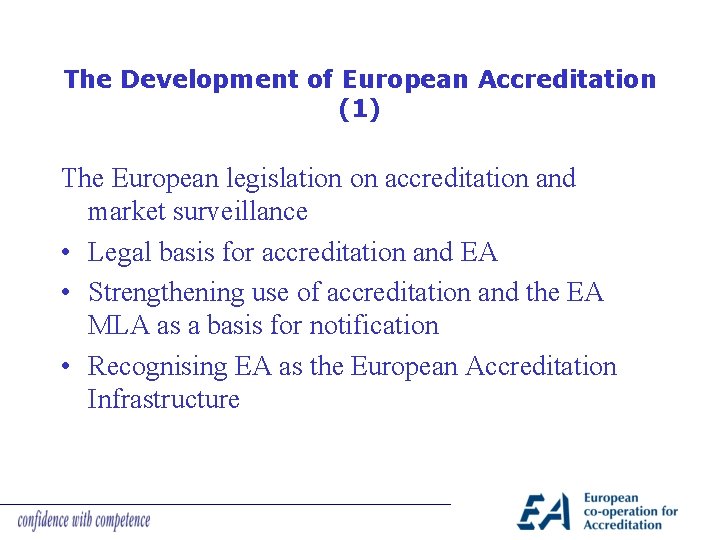
The Development of European Accreditation (1) The European legislation on accreditation and market surveillance • Legal basis for accreditation and EA • Strengthening use of accreditation and the EA MLA as a basis for notification • Recognising EA as the European Accreditation Infrastructure
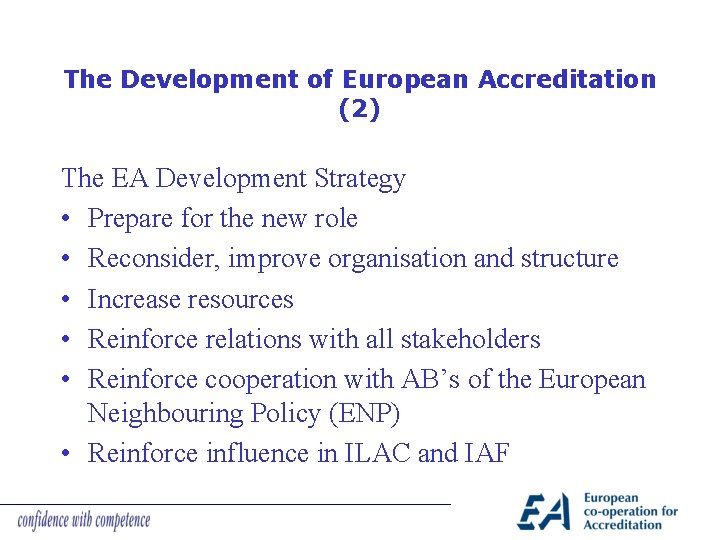
The Development of European Accreditation (2) The EA Development Strategy • Prepare for the new role • Reconsider, improve organisation and structure • Increase resources • Reinforce relations with all stakeholders • Reinforce cooperation with AB’s of the European Neighbouring Policy (ENP) • Reinforce influence in ILAC and IAF
Contents What is EA? EA organizational structure MLA Signatories Standards for Accreditation The Development of European Accreditation EA in the global network
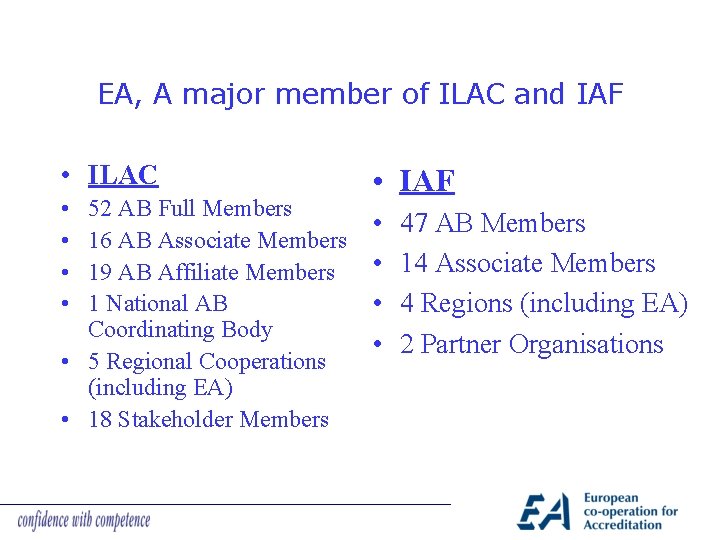
EA, A major member of ILAC and IAF • ILAC • • 52 AB Full Members 16 AB Associate Members 19 AB Affiliate Members 1 National AB Coordinating Body • 5 Regional Cooperations (including EA) • 18 Stakeholder Members • IAF • • 47 AB Members 14 Associate Members 4 Regions (including EA) 2 Partner Organisations
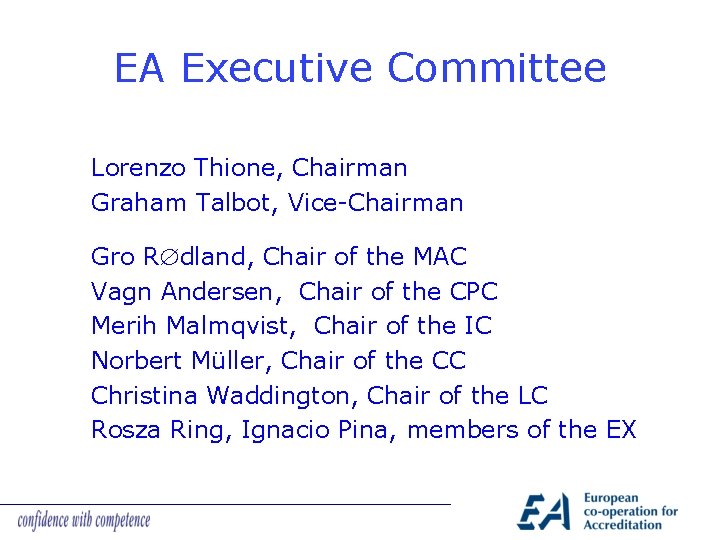
EA Executive Committee Lorenzo Thione, Chairman Graham Talbot, Vice-Chairman Gro R dland, Chair of the MAC Vagn Andersen, Chair of the CPC Merih Malmqvist, Chair of the IC Norbert Müller, Chair of the CC Christina Waddington, Chair of the LC Rosza Ring, Ignacio Pina, members of the EX
To contact the EA secretariat Martine Blum, Bénédicte Ziemann EA 37, rue de Lyon FR - 75012 Paris tel: + 33 1 44 68 82 25/87 48 fax: + 33 1 44 68 96 06 email: secretariat. EA@european-accreditation. org website: www. european-accreditation. org