
The EU Trade Policy 1 Contents 1 General
- Slides: 15
The EU Trade Policy 1
Contents 1. General background of the EU’s trade policy: how is the EU trading bloc structured? The institutional setting Statistics: the EU in world trade 2. Going into depth: the EU’s approach to multilaterlism, regionalism and unilateralism 3. At a glance: the advantages of belonging to the EU trading bloc 2
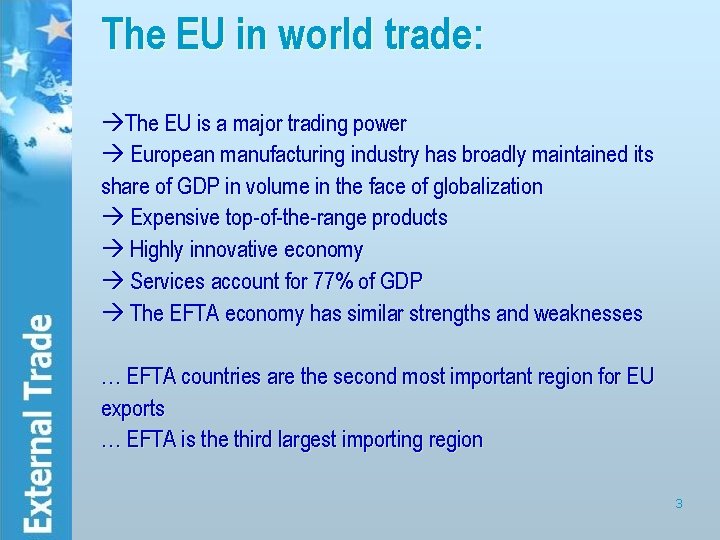
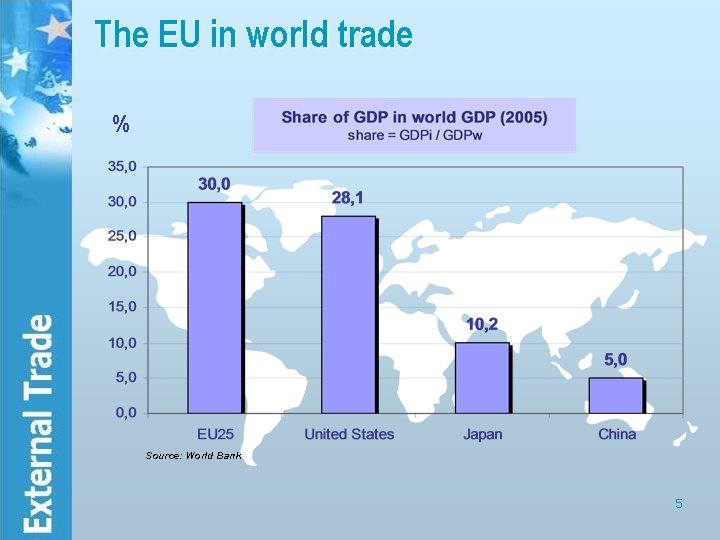
The EU in world trade: The EU is a major trading power European manufacturing industry has broadly maintained its share of GDP in volume in the face of globalization Expensive top-of-the-range products Highly innovative economy Services account for 77% of GDP The EFTA economy has similar strengths and weaknesses … EFTA countries are the second most important region for EU exports … EFTA is the third largest importing region 3
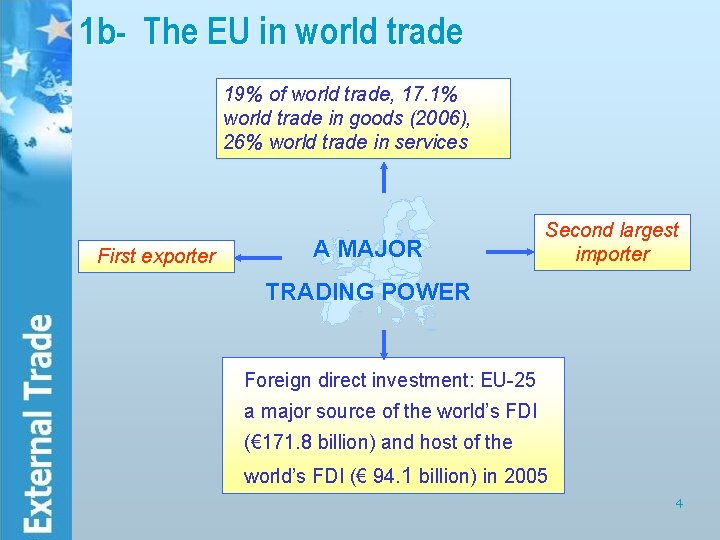
1 b- The EU in world trade 19% of world trade, 17. 1% world trade in goods (2006), 26% world trade in services First exporter A MAJOR Second largest importer TRADING POWER Foreign direct investment: EU-25 a major source of the world’s FDI (€ 171. 8 billion) and host of the world’s FDI (€ 94. 1 billion) in 2005 4
The EU in world trade % Source: World Bank 5
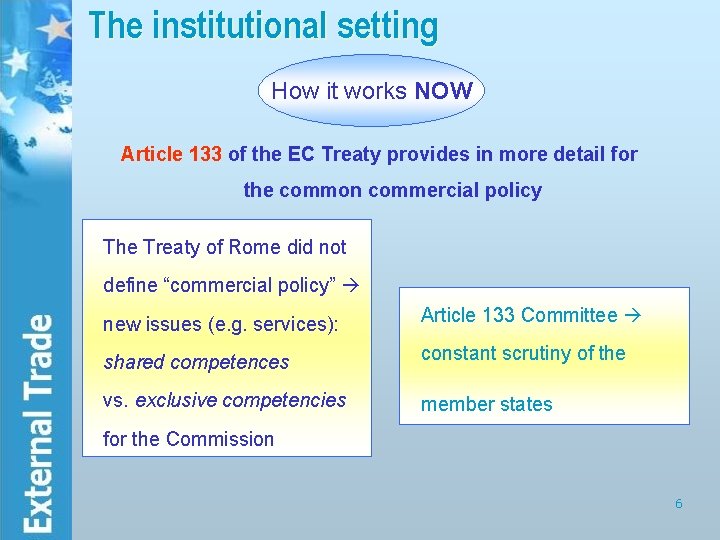
The institutional setting How it works NOW Article 133 of the EC Treaty provides in more detail for the common commercial policy The Treaty of Rome did not define “commercial policy” new issues (e. g. services): Article 133 Committee shared competences constant scrutiny of the vs. exclusive competencies member states for the Commission 6
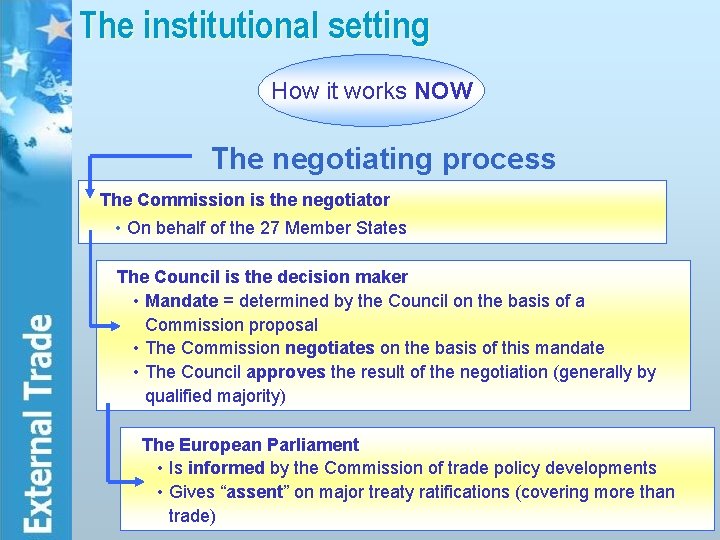
The institutional setting How it works NOW The negotiating process The Commission is the negotiator • On behalf of the 27 Member States The Council is the decision maker • Mandate = determined by the Council on the basis of a Commission proposal • The Commission negotiates on the basis of this mandate • The Council approves the result of the negotiation (generally by qualified majority) The European Parliament • Is informed by the Commission of trade policy developments • Gives “assent” on major treaty ratifications (covering more than 7 trade)
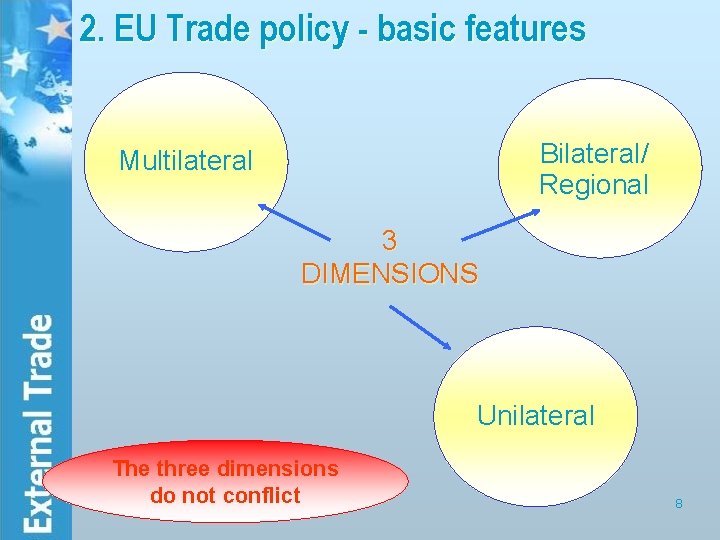
2. EU Trade policy - basic features Bilateral/ Regional Multilateral 3 DIMENSIONS Unilateral The three dimensions do not conflict 8
The EU’s first priority: multilateralism • The WTO is the most effective means of managing trade (e. g. it covers 95% of world trade) = effective global governance • The EU wishes to maintain the WTO at the centre of the international trading system • The WTO’s rules enforcement mechanism is the most important feature (dispute settlement body) • The EU has a strong interest in open markets and a clear regulatory framework • A failure of multilateralism would present a wider risk of increased protectionism and economic nationalism around the world 9
The EU’s position on DDA remains the first priority for the EU • The EU seeks a real new multilateral agreement: to improve existing rules (e. g. on anti-dumping - subsidies) and to create new rules (e. g. trade facilitation) • to achieve an ambitious and balanced agreement to liberalise world trade – emerging developing countries will also have to contribute 10
Regionalism The negotiation of Bilateral and Regional Trade Agreements are not an alternative to our multilateral commitment but a complement 11
A new generation of FTAs • Our new FTAs are designed to be stepping stones for the widest possible openness in the global trading system • DDA commitments are the baseline and add further liberalization while also covering issues which are not yet ready for multilateral discussion, such as investment or government procurement • Our new FTA parties have been targeted responding to economic criteria, such as market potential and the level of protection 12 against the EU export interests
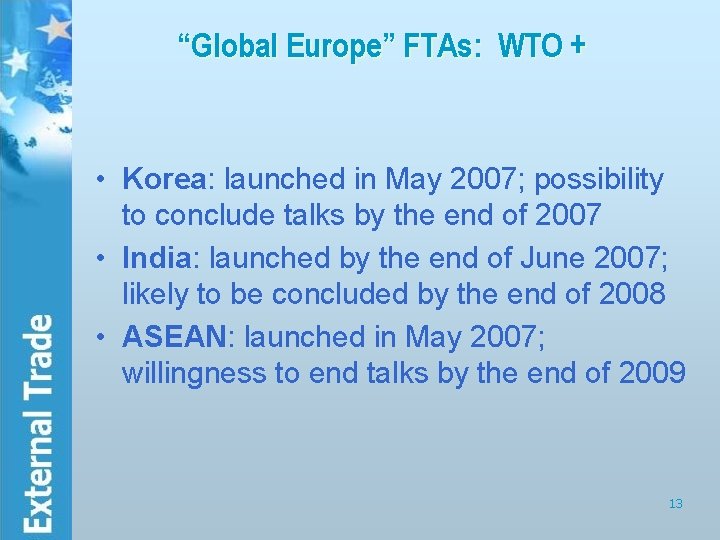
“Global Europe” FTAs: WTO + • Korea: launched in May 2007; possibility to conclude talks by the end of 2007 • India: launched by the end of June 2007; likely to be concluded by the end of 2008 • ASEAN: launched in May 2007; willingness to end talks by the end of 2009 13
The advantages of being in the EU(I): • The EU is based on common values (e. g. sustainable development, labour standards, intellectual property rights) the trading bloc structure enables the EU to uphold these values internationally (behind-the-border issues, notion of fair trade) • The EU can influence the forces driving change – although the global economy is rapidly changing, the EU trading bloc can pursue a forward-looking external trade policy in a world of change stability • Openness on the outside proved to be a catalyst for jobs on the inside – given that internal and external politics are linked, the EU as trading bloc can pursue an integrated, coherent approach that ensures prosperity • The trading bloc equips Europeans for globalization and enables the EU to seize the opportunities of globalization 14
The advantages of being in the EU (II): • As a trading bloc, the EU can defend its values also internally: member states could sustain their social systems and could respond to issues of social justice – there is no race to the bottom • As a trading bloc, the EU can ensure access to raw material and energy • The trading bloc structure also fosters innovation on the inside – allows for economies of scale • Within the EU, there is rather trade creation than trade diversion • The EU Market Access Strategy and the EU Market Access Database provide information about market access conditions in non-EU countries 15