
THE EU RESEARCH INNOVATION PROGRAMME 2021 2027 HOW
- Slides: 43
THE EU RESEARCH & INNOVATION PROGRAMME 2021 – 2027 HOW TO PREPARE A SUCCESSFUL PROPOSAL IN HORIZON EUROPE THE RULES OF THE GAME – THE MODEL GRANT AGREEMENT 24 March 2021 HE MGA Team - Common Legal Support Centre, DG R&I, European Commission Research and Innovation
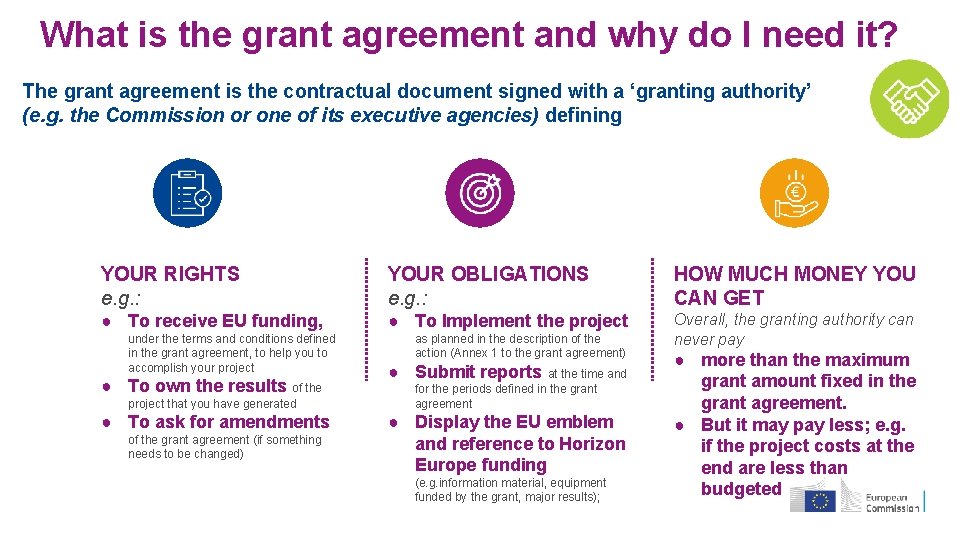
What is the grant agreement and why do I need it? The grant agreement is the contractual document signed with a ‘granting authority’ (e. g. the Commission or one of its executive agencies) defining YOUR RIGHTS e. g. : YOUR OBLIGATIONS e. g. : HOW MUCH MONEY YOU CAN GET ● To receive EU funding, ● To Implement the project Overall, the granting authority can never pay under the terms and conditions defined in the grant agreement, to help you to accomplish your project ● To own the results of the project that you have generated ● To ask for amendments of the grant agreement (if something needs to be changed) as planned in the description of the action (Annex 1 to the grant agreement) ● Submit reports at the time and for the periods defined in the grant agreement ● Display the EU emblem and reference to Horizon Europe funding (e. g. information material, equipment funded by the grant, major results); ● more than the maximum grant amount fixed in the grant agreement. ● But it may pay less; e. g. if the project costs at the end are less than budgeted
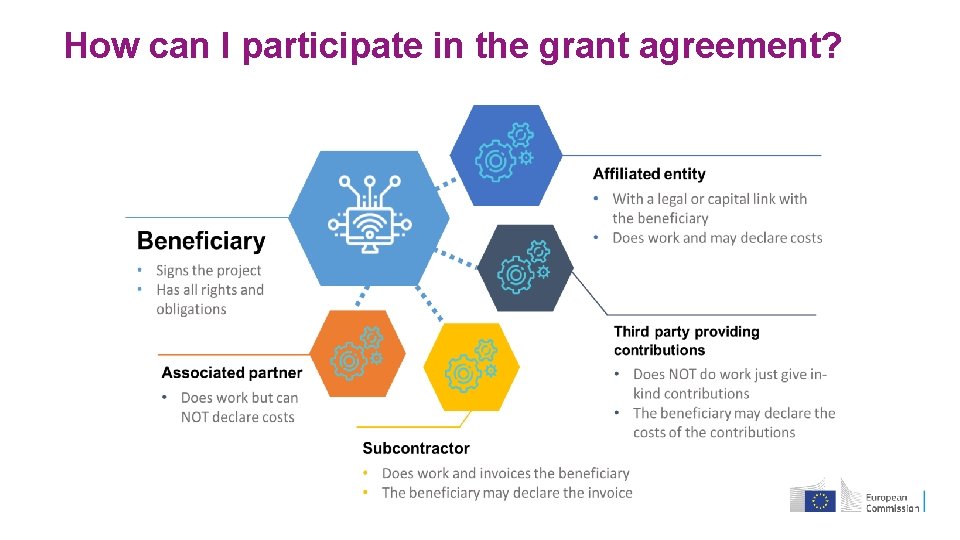
How can I participate in the grant agreement?
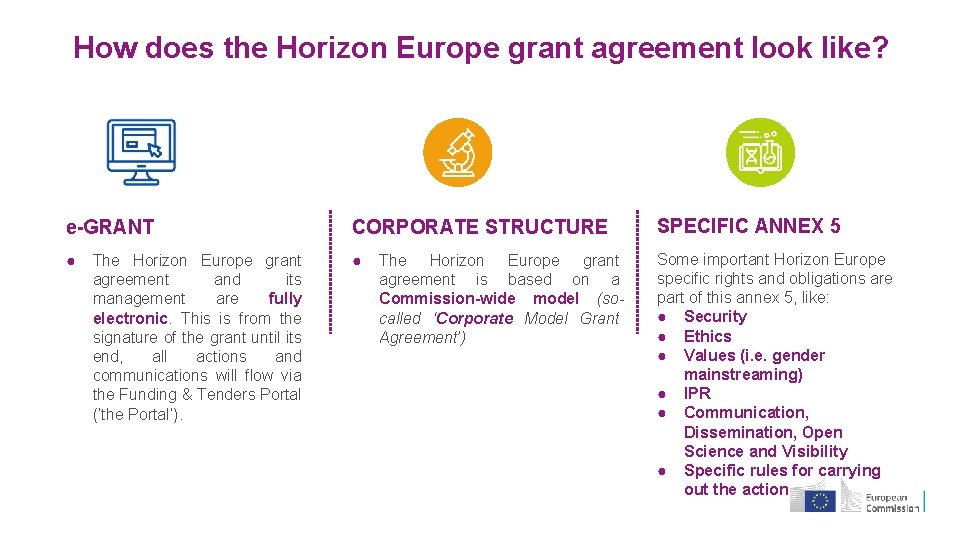
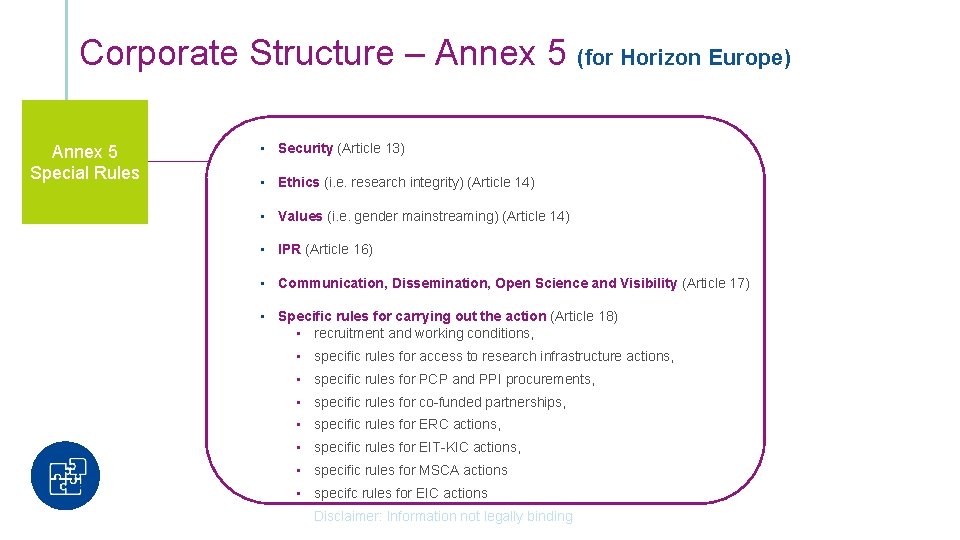
How does the Horizon Europe grant agreement look like? e-GRANT CORPORATE STRUCTURE SPECIFIC ANNEX 5 ● ● Some important Horizon Europe specific rights and obligations are part of this annex 5, like: ● Security ● Ethics ● Values (i. e. gender mainstreaming) ● IPR ● Communication, Dissemination, Open Science and Visibility ● Specific rules for carrying out the action The Horizon Europe grant agreement and its management are fully electronic. This is from the signature of the grant until its end, all actions and communications will flow via the Funding & Tenders Portal (‘the Portal’). The Horizon Europe grant agreement is based on a Commission-wide model (socalled ‘Corporate Model Grant Agreement’)
THE CORPORATE APPROACH The Model Grant Agreement
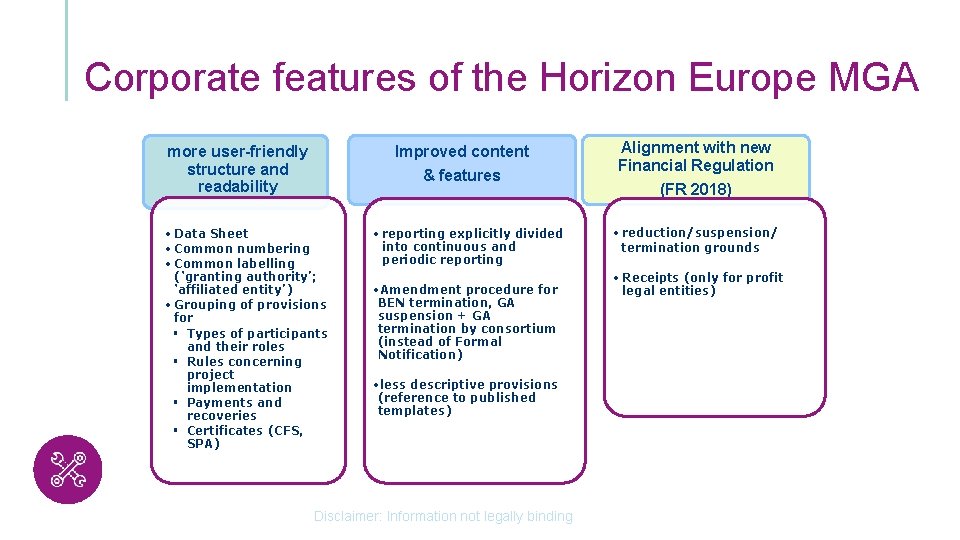
Corporate features of the Horizon Europe MGA more user-friendly structure and readability Improved content & features • Data Sheet • Common numbering • Common labelling (‘granting authority’; ‘affiliated entity’) • Grouping of provisions for § Types of participants and their roles § Rules concerning project implementation § Payments and recoveries § Certificates (CFS, SPA) • reporting explicitly divided into continuous and periodic reporting • Amendment procedure for BEN termination, GA suspension + GA termination by consortium (instead of Formal Notification) • less descriptive provisions (reference to published templates) Disclaimer: Information not legally binding Alignment with new Financial Regulation (FR 2018) • reduction/suspension/ termination grounds • Receipts (only for profit legal entities)
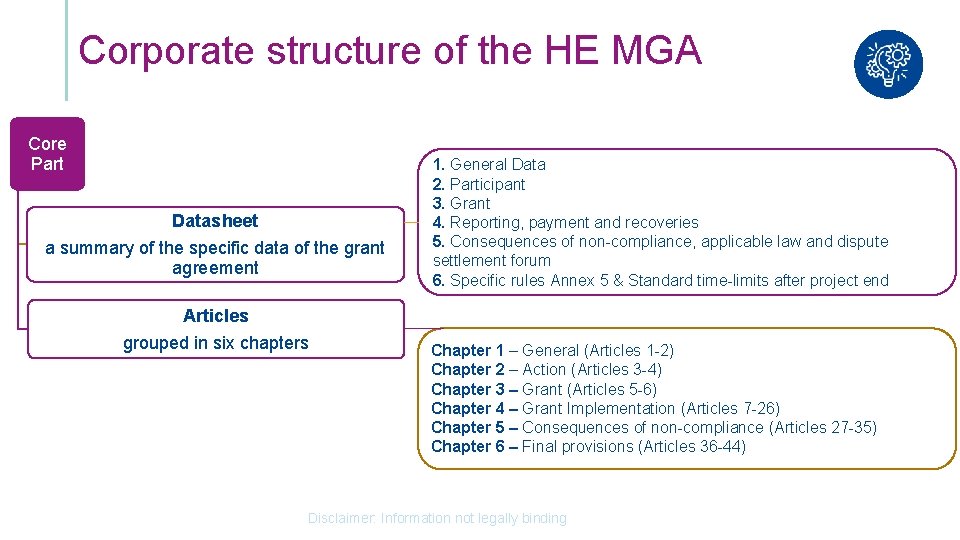
Corporate structure of the HE MGA Core Part Datasheet a summary of the specific data of the grant agreement 1. General Data 2. Participant 3. Grant 4. Reporting, payment and recoveries 5. Consequences of non-compliance, applicable law and dispute settlement forum 6. Specific rules Annex 5 & Standard time-limits after project end Articles grouped in six chapters Chapter 1 – General (Articles 1 -2) Chapter 2 – Action (Articles 3 -4) Chapter 3 – Grant (Articles 5 -6) Chapter 4 – Grant Implementation (Articles 7 -26) Chapter 5 – Consequences of non-compliance (Articles 27 -35) Chapter 6 – Final provisions (Articles 36 -44) Disclaimer: Information not legally binding
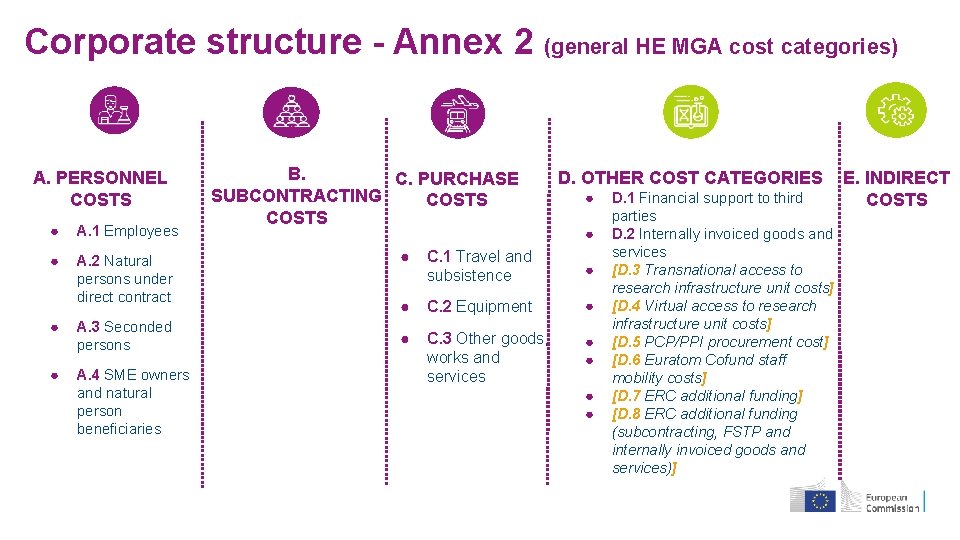
Corporate structure - Annex 2 (general HE MGA cost categories) A. PERSONNEL COSTS ● A. 1 Employees ● A. 2 Natural persons under direct contract ● A. 3 Seconded persons ● A. 4 SME owners and natural person beneficiaries B. C. PURCHASE SUBCONTRACTING COSTS D. OTHER COST CATEGORIES ● ● ● C. 1 Travel and subsistence ● ● C. 2 Equipment ● ● C. 3 Other goods, works and services ● ● D. 1 Financial support to third parties D. 2 Internally invoiced goods and services [D. 3 Transnational access to research infrastructure unit costs] [D. 4 Virtual access to research infrastructure unit costs] [D. 5 PCP/PPI procurement cost] [D. 6 Euratom Cofund staff mobility costs] [D. 7 ERC additional funding] [D. 8 ERC additional funding (subcontracting, FSTP and internally invoiced goods and services)] E. INDIRECT COSTS
Corporate Structure – Annex 5 (for Horizon Europe) Annex 5 Special Rules • Security (Article 13) • Ethics (i. e. research integrity) (Article 14) • Values (i. e. gender mainstreaming) (Article 14) • IPR (Article 16) • Communication, Dissemination, Open Science and Visibility (Article 17) • Specific rules for carrying out the action (Article 18) • recruitment and working conditions, • specific rules for access to research infrastructure actions, • specific rules for PCP and PPI procurements, • specific rules for co-funded partnerships, • specific rules for ERC actions, • specific rules for EIT-KIC actions, • specific rules for MSCA actions • specifc rules for EIC actions Disclaimer: Information not legally binding
MAIN LEGAL AND FINANCIAL NOVELTIES OF Horizon Europe Model Grant Agreement
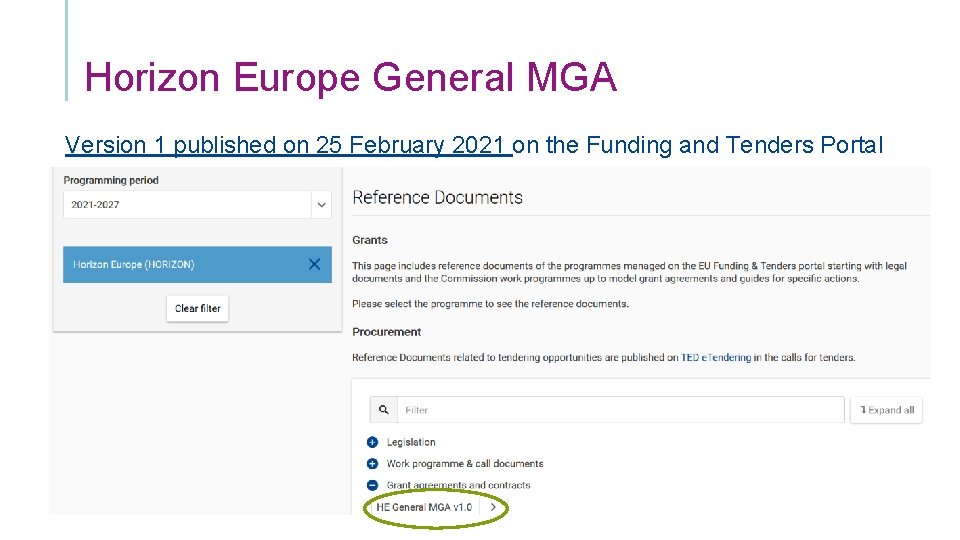
Horizon Europe General MGA Version 1 published on 25 February 2021 on the Funding and Tenders Portal
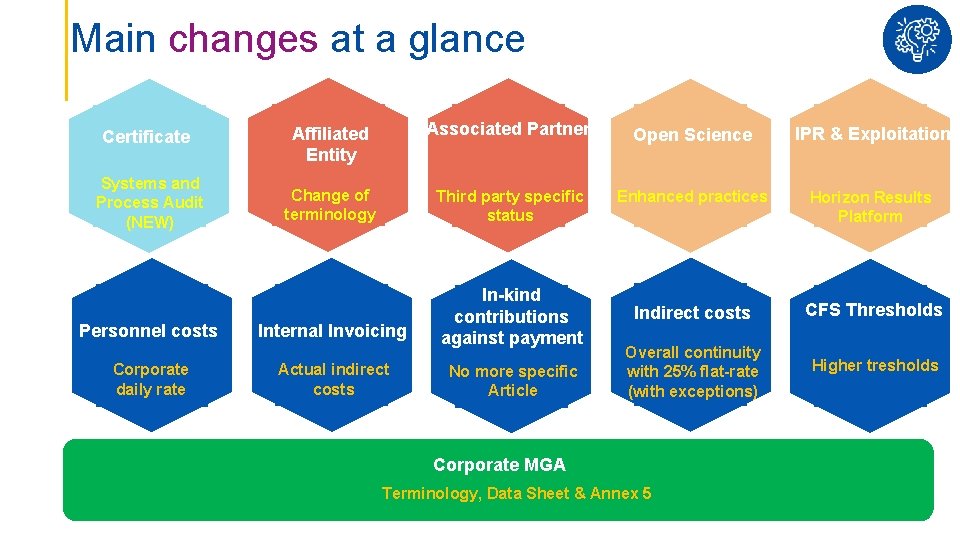
Main changes at a glance Certificate Affiliated Entity Associated Partner Open Science IPR & Exploitation Systems and Process Audit (NEW) Change of terminology Third party specific status Enhanced practices Horizon Results Platform Indirect costs CFS Thresholds Internal Invoicing In-kind contributions against payment Overall continuity with 25% flat-rate (with exceptions) Higher tresholds Personnel costs Corporate daily rate Actual indirect costs No more specific Article Corporate MGA Terminology, Data Sheet & Annex 5
THIRD PARTIES Horizon Europe Model Grant Agreement
Affiliated entities Article 187 (1)(b) of the EU Financial Regulation: Entities ‘that have a link with the beneficiary, in particular a legal or capital link, which is neither limited to the action nor established for the sole purpose of its implementation’. Affiliated entities in Horizon Europe = Linked third parties in Horizon 2020 (alignement of labelling/definition in the corporate context) Disclaimer: Information not legally binding
Associated Partner (AP) • Inherited and derived from the ‘International partner’ status in H 2020 MGA • Corporate terminology and status with the following features: • AP does work but cannot declare costs • AP can be linked: • either to one or more beneficiaries • or with the whole consortium • The beneficiaries must ensure that some of MGA obligations also applied to AP (i. e. Articles 11 (proper implementation), 12 (conflict of interests), 13 (confidentiality and security), 14 (ethics), 17. 2 (visibility), 18 (specific rules for carrying out action), 19 (information) and 20 (record-keeping)
PERSONNEL COSTS General case – Corporate daily rate provisions
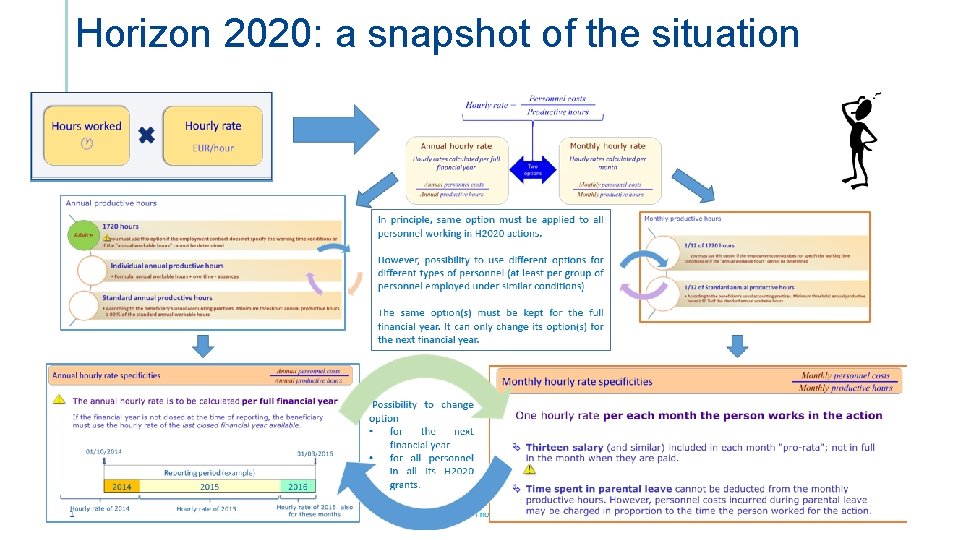
Horizon 2020: a snapshot of the situation
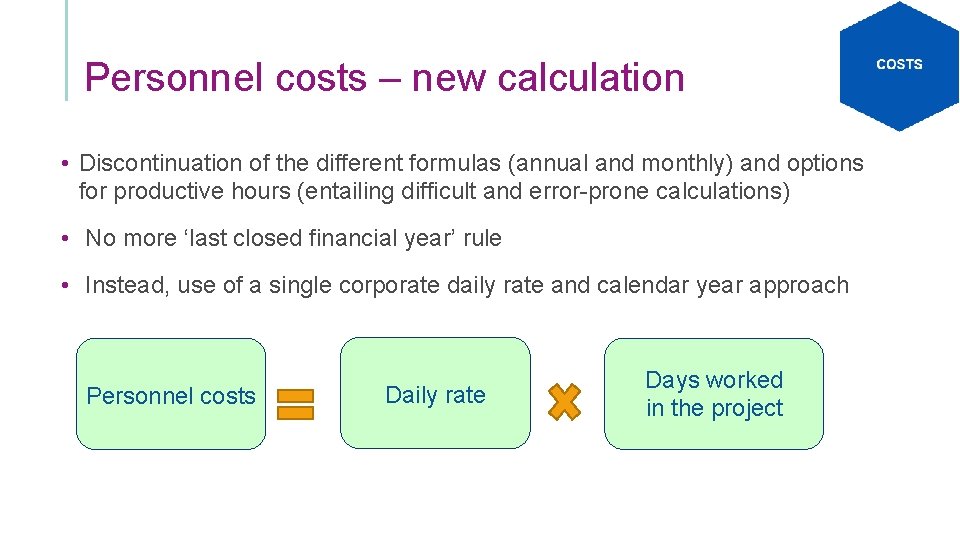
Personnel costs – new calculation • Discontinuation of the different formulas (annual and monthly) and options for productive hours (entailing difficult and error-prone calculations) • No more ‘last closed financial year’ rule • Instead, use of a single corporate daily rate and calendar year approach Personnel costs Daily rate Days worked in the project
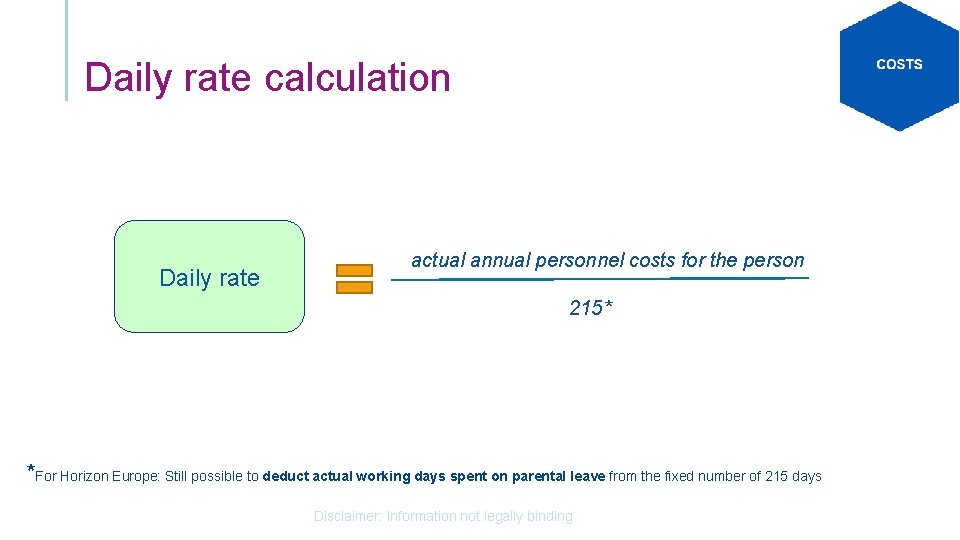
Daily rate calculation Daily rate actual annual personnel costs for the person 215* *For Horizon Europe: Still possible to deduct actual working days spent on parental leave from the fixed number of 215 days Disclaimer: Information not legally binding
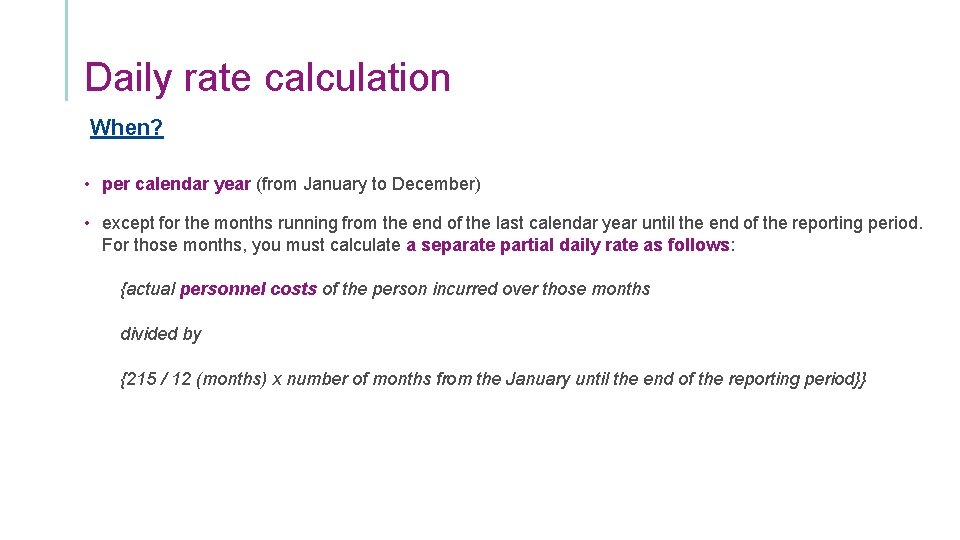
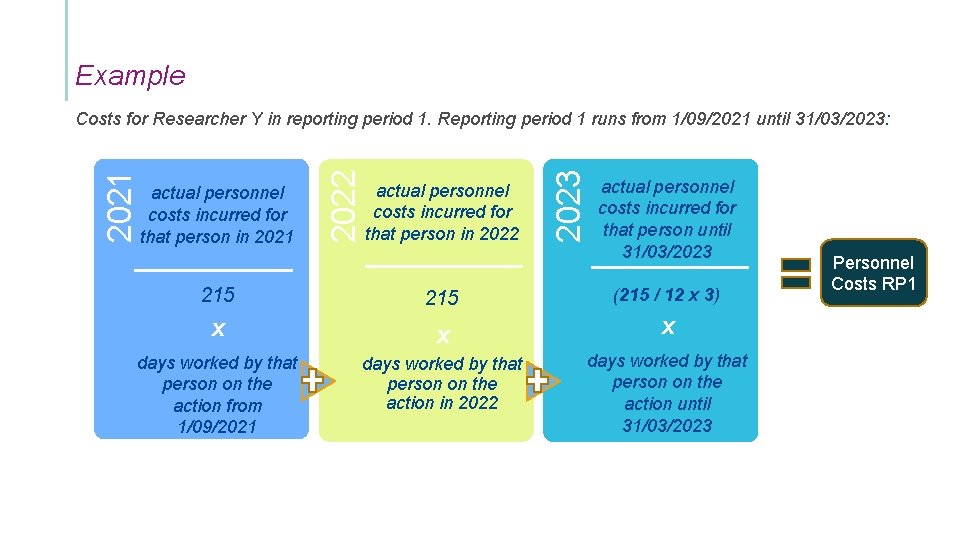
Daily rate calculation When? • per calendar year (from January to December) • except for the months running from the end of the last calendar year until the end of the reporting period. For those months, you must calculate a separate partial daily rate as follows: {actual personnel costs of the person incurred over those months divided by {215 / 12 (months) x number of months from the January until the end of the reporting period}}
Example actual personnel costs incurred for that person in 2022 2023 actual personnel costs incurred for that person in 2021 2022 2021 Costs for Researcher Y in reporting period 1. Reporting period 1 runs from 1/09/2021 until 31/03/2023: actual personnel costs incurred for that person until 31/03/2023 215 (215 / 12 x 3) X X days worked by that person on the action in 2022 X days worked by that person on the action from 1/09/2021 days worked by that person on the action until 31/03/2023 Personnel Costs RP 1
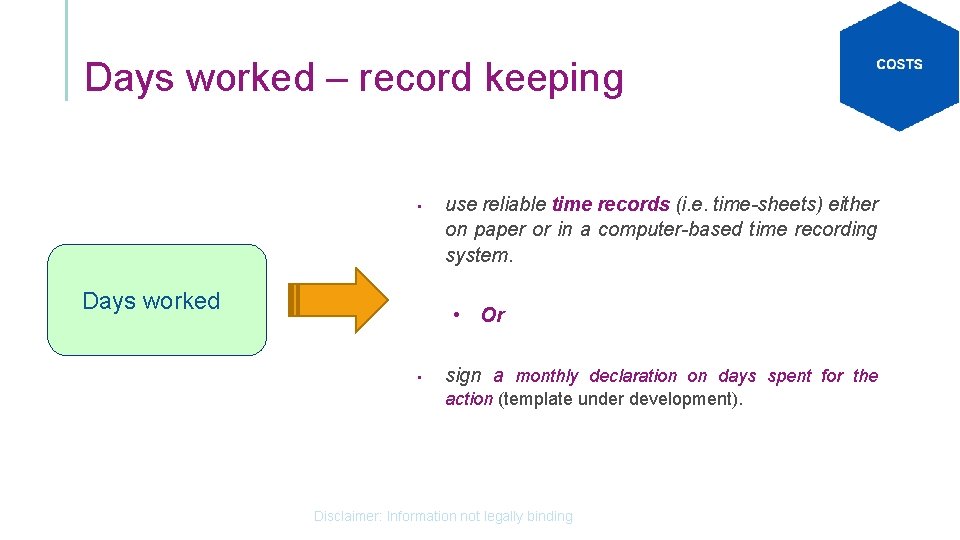
Days worked – record keeping • Days worked use reliable time records (i. e. time-sheets) either on paper or in a computer-based time recording system. • Or • sign a monthly declaration on days spent for the action (template under development). Disclaimer: Information not legally binding
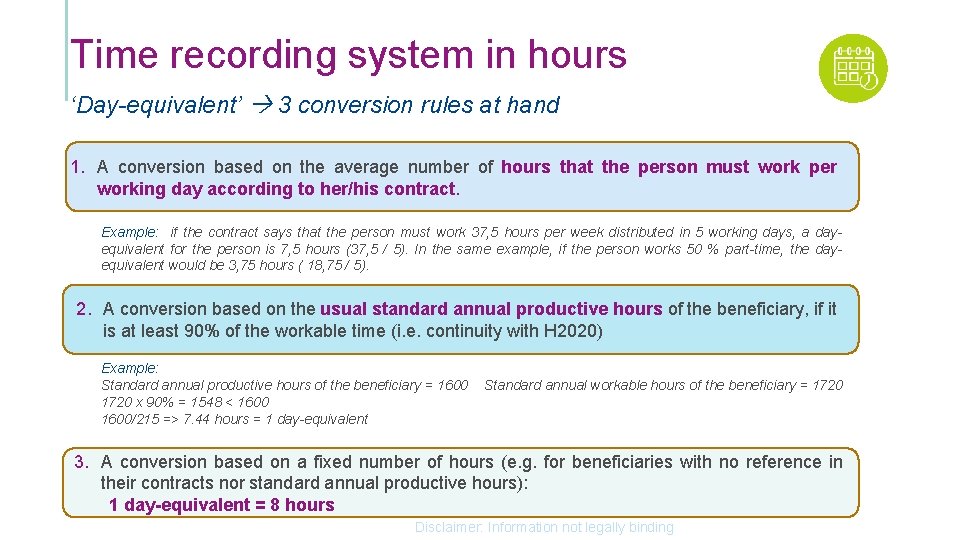
Time recording system in hours ‘Day-equivalent’ 3 conversion rules at hand 1. A conversion based on the average number of hours that the person must work per working day according to her/his contract. Example: if the contract says that the person must work 37, 5 hours per week distributed in 5 working days, a dayequivalent for the person is 7, 5 hours (37, 5 / 5). In the same example, if the person works 50 % part-time, the dayequivalent would be 3, 75 hours ( 18, 75 / 5). 2. A conversion based on the usual standard annual productive hours of the beneficiary, if it is at least 90% of the workable time (i. e. continuity with H 2020) Example: Standard annual productive hours of the beneficiary = 1600 1720 x 90% = 1548 < 1600/215 => 7. 44 hours = 1 day-equivalent Standard annual workable hours of the beneficiary = 1720 3. A conversion based on a fixed number of hours (e. g. for beneficiaries with no reference in their contracts nor standard annual productive hours): 1 day-equivalent = 8 hours Disclaimer: Information not legally binding
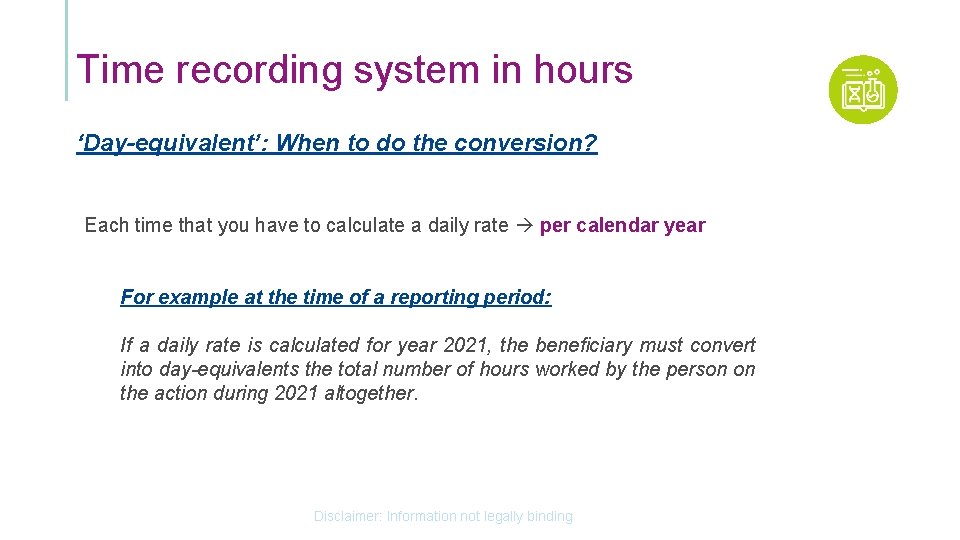
Time recording system in hours ‘Day-equivalent’: When to do the conversion? Each time that you have to calculate a daily rate per calendar year For example at the time of a reporting period: If a daily rate is calculated for year 2021, the beneficiary must convert into day-equivalents the total number of hours worked by the person on the action during 2021 altogether. Disclaimer: Information not legally binding
Main differences with Horizon 2020 • Discontinuation of the different formulas (annual and monthly) and options for productive hours (entailing difficult and error-prone calculations) • No more ‘last closed financial year’ rule • Instead, use of a single corporate daily rate and calendar year approach
PROJECT-BASED REMUNERATION Horizon Europe specific provisions
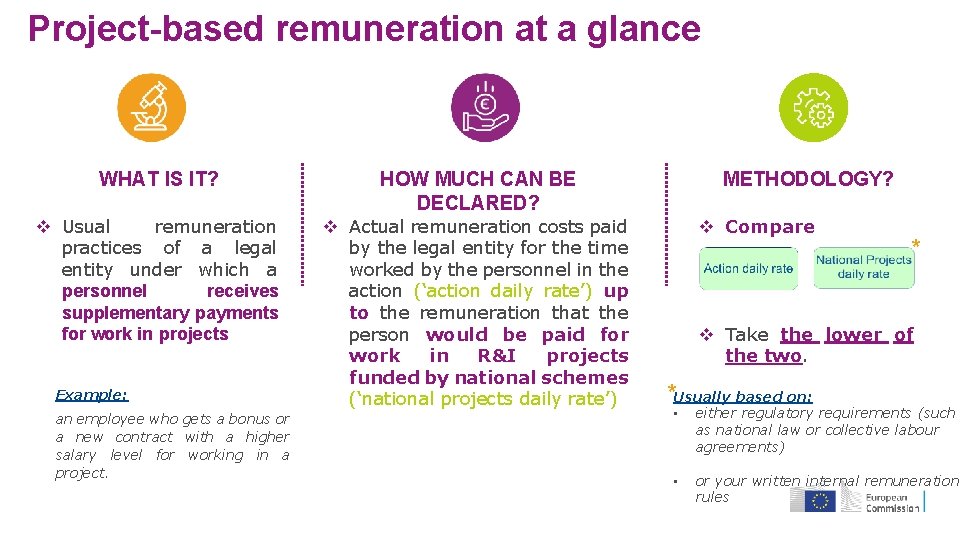
Project-based remuneration at a glance WHAT IS IT? HOW MUCH CAN BE DECLARED? v Usual remuneration practices of a legal entity under which a personnel receives supplementary payments for work in projects v Actual remuneration costs paid by the legal entity for the time worked by the personnel in the action (‘action daily rate’) up to the remuneration that the person would be paid for work in R&I projects funded by national schemes (‘national projects daily rate’) Example: an employee who gets a bonus or a new contract with a higher salary level for working in a project. METHODOLOGY? v Compare * v Take the lower of the two. *Usually based on: • either regulatory requirements (such as national law or collective labour agreements) • or your written internal remuneration rules
INTERNALLY INVOICED GOODS & SERVICES Horizon Europe specific provisions
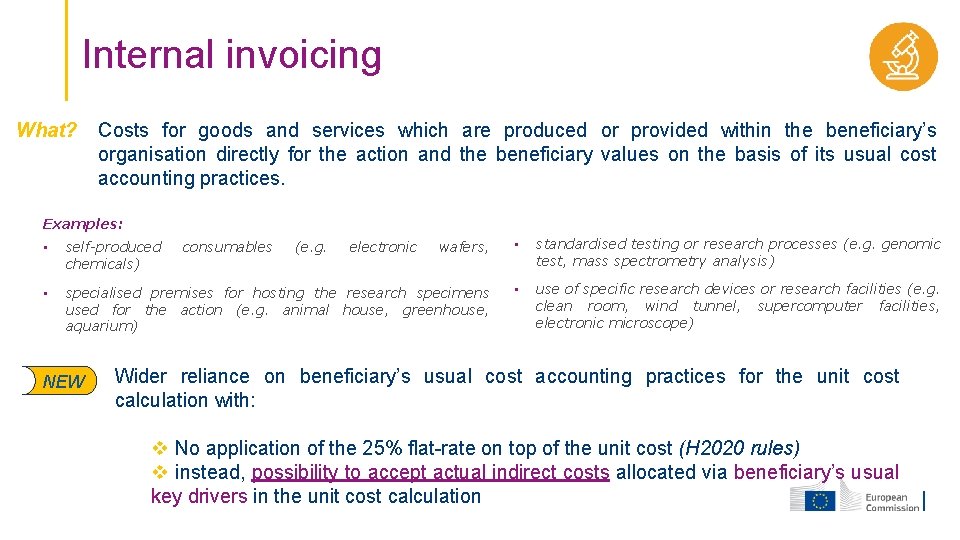
Internal invoicing What? Costs for goods and services which are produced or provided within the beneficiary’s organisation directly for the action and the beneficiary values on the basis of its usual cost accounting practices. Examples: • self-produced chemicals) wafers, • standardised testing or research processes (e. g. genomic test, mass spectrometry analysis) • specialised premises for hosting the research specimens used for the action (e. g. animal house, greenhouse, aquarium) • use of specific research devices or research facilities (e. g. clean room, wind tunnel, supercomputer facilities, electronic microscope) NEW consumables (e. g. electronic Wider reliance on beneficiary’s usual cost accounting practices for the unit cost calculation with: v No application of the 25% flat-rate on top of the unit cost (H 2020 rules) v instead, possibility to accept actual indirect costs allocated via beneficiary’s usual key drivers in the unit cost calculation
IN-KIND CONTRIBUTIONS Horizon Europe specific provisions
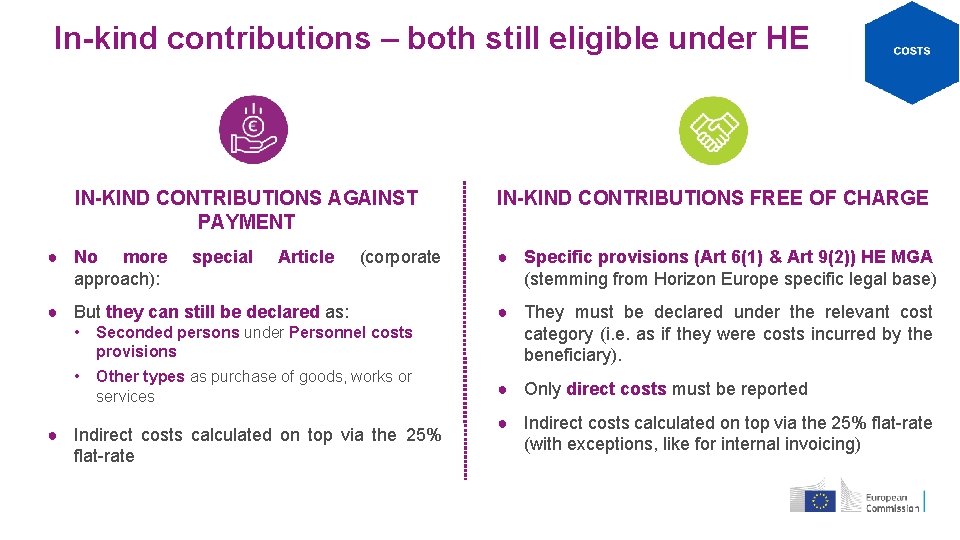
In-kind contributions – both still eligible under HE IN-KIND CONTRIBUTIONS AGAINST PAYMENT ● No more approach): special Article (corporate IN-KIND CONTRIBUTIONS FREE OF CHARGE ● Specific provisions (Art 6(1) & Art 9(2)) HE MGA (stemming from Horizon Europe specific legal base) • Seconded persons under Personnel costs provisions ● They must be declared under the relevant cost category (i. e. as if they were costs incurred by the beneficiary). • Other types as purchase of goods, works or services ● Only direct costs must be reported ● But they can still be declared as: ● Indirect costs calculated on top via the 25% flat-rate (with exceptions, like for internal invoicing)
RECEIPTS Horizon Europe specific provisions
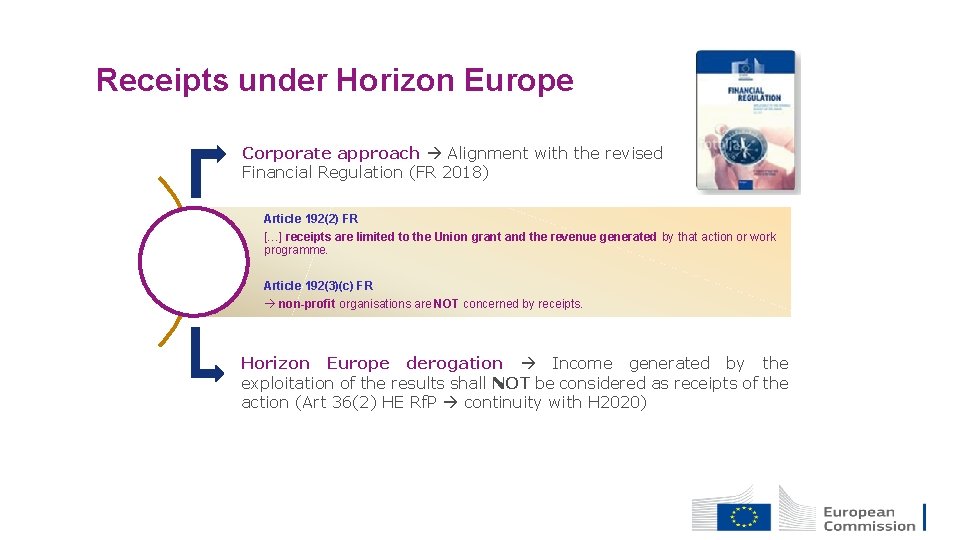
Receipts under Horizon Europe Corporate approach Alignment with the revised Financial Regulation (FR 2018) Article 192(2) FR […] receipts are limited to the Union grant and the revenue generated by that action or work programme. Article 192(3)(c) FR non-profit organisations are NOT concerned by receipts. Horizon Europe derogation Income generated by the exploitation of the results shall NOT be considered as receipts of the action (Art 36(2) HE Rf. P continuity with H 2020)
EQUIPMENT COSTS Horizon Europe specific provisions
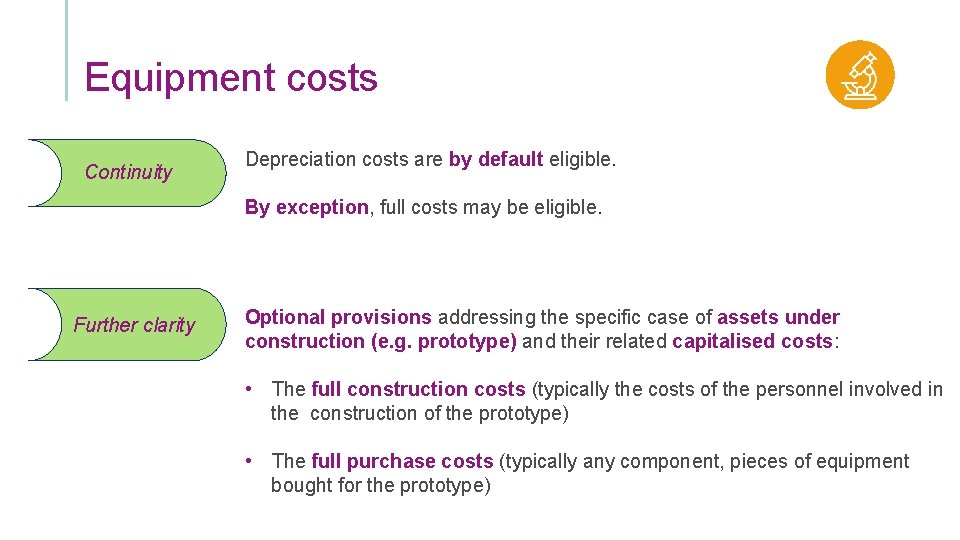
Equipment costs Continuity Depreciation costs are by default eligible. By exception, full costs may be eligible. Further clarity Optional provisions addressing the specific case of assets under construction (e. g. prototype) and their related capitalised costs: • The full construction costs (typically the costs of the personnel involved in the construction of the prototype) • The full purchase costs (typically any component, pieces of equipment bought for the prototype)
INDIRECT COSTS Horizon Europe specific provisions
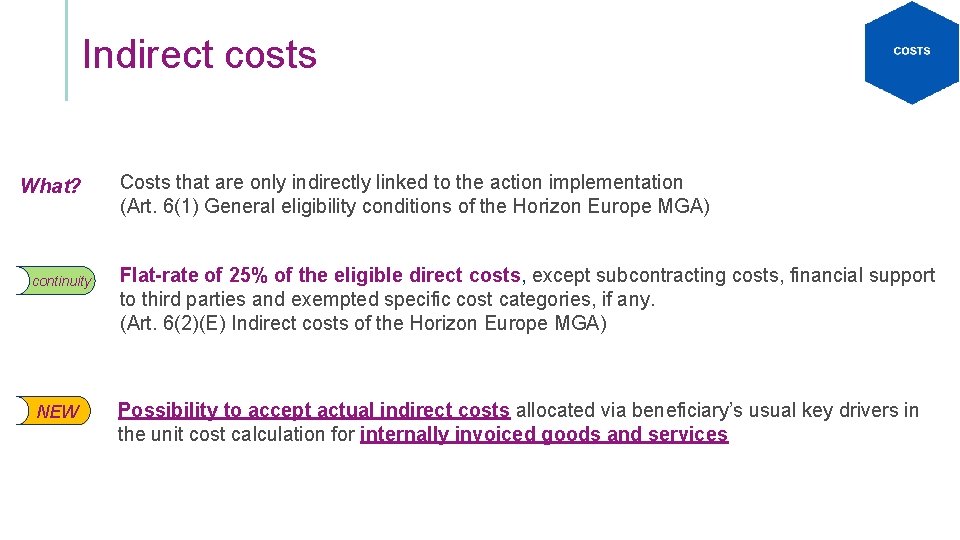
Indirect costs What? continuity NEW Costs that are only indirectly linked to the action implementation (Art. 6(1) General eligibility conditions of the Horizon Europe MGA) Flat-rate of 25% of the eligible direct costs, except subcontracting costs, financial support to third parties and exempted specific cost categories, if any. (Art. 6(2)(E) Indirect costs of the Horizon Europe MGA) Possibility to accept actual indirect costs allocated via beneficiary’s usual key drivers in the unit cost calculation for internally invoiced goods and services
CERTIFICATE ON FINANCIAL STATEMENTS (CFS) Horizon Europe specific provisions
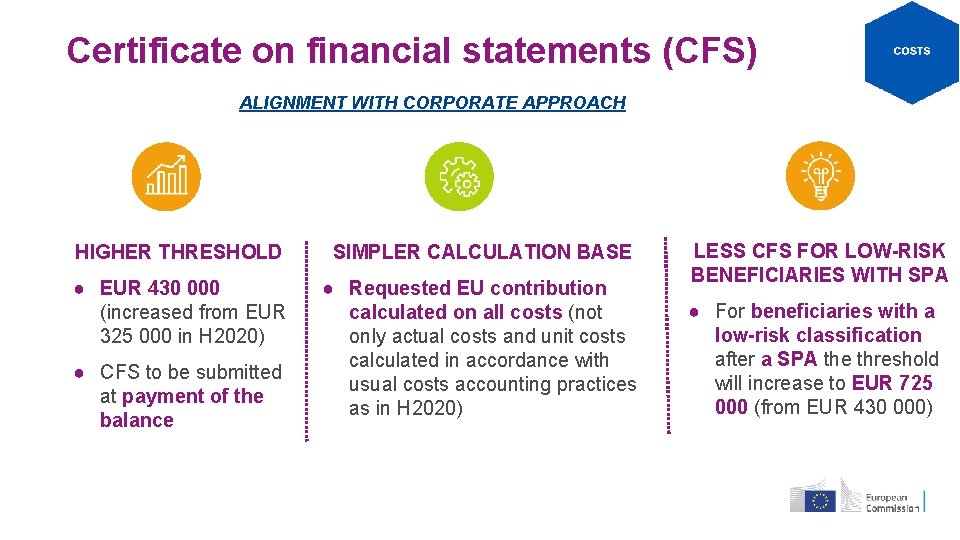
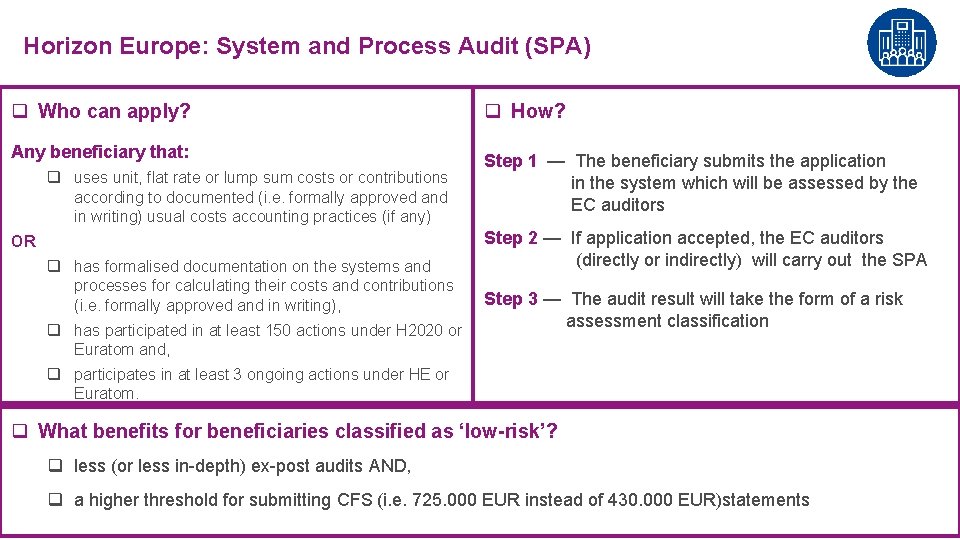
Certificate on financial statements (CFS) ALIGNMENT WITH CORPORATE APPROACH HIGHER THRESHOLD SIMPLER CALCULATION BASE ● EUR 430 000 (increased from EUR 325 000 in H 2020) ● Requested EU contribution calculated on all costs (not only actual costs and unit costs calculated in accordance with usual costs accounting practices as in H 2020) ● CFS to be submitted at payment of the balance LESS CFS FOR LOW-RISK BENEFICIARIES WITH SPA ● For beneficiaries with a low-risk classification after a SPA the threshold will increase to EUR 725 000 (from EUR 430 000)
SYSTEMS AND PROCESSES AUDITS (SPA) Horizon Europe specific provisions
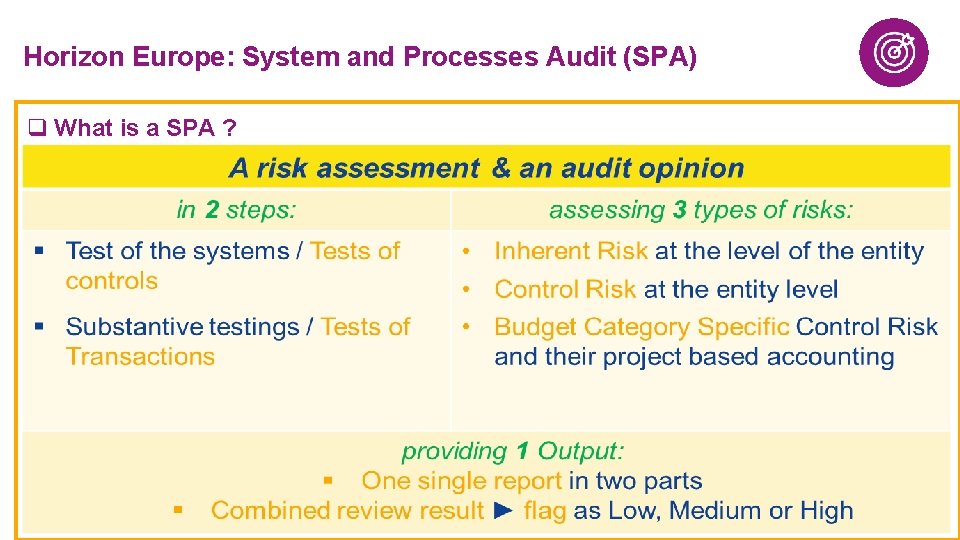
Horizon Europe: System and Processes Audit (SPA) q What is a SPA ?
Horizon Europe: System and Process Audit (SPA) q Who can apply? Any beneficiary that: q uses unit, flat rate or lump sum costs or contributions according to documented (i. e. formally approved and in writing) usual costs accounting practices (if any) OR q has formalised documentation on the systems and processes for calculating their costs and contributions (i. e. formally approved and in writing), q has participated in at least 150 actions under H 2020 or Euratom and, q How? Step 1 — The beneficiary submits the application in the system which will be assessed by the EC auditors Step 2 — If application accepted, the EC auditors (directly or indirectly) will carry out the SPA Step 3 — The audit result will take the form of a risk assessment classification q participates in at least 3 ongoing actions under HE or Euratom. q What benefits for beneficiaries classified as ‘low-risk’? q less (or less in-depth) ex-post audits AND, q a higher threshold for submitting CFS (i. e. 725. 000 EUR instead of 430. 000 EUR)statements (CFS;
Thank you! # Horizon. EU http: //ec. europa. eu/horizon-europe © European Union 2021 Unless otherwise noted the reuse of this presentation is authorised under the CC BY 4. 0 license. For any use or reproduction of elements that are not owned by the EU, permission may need to be sought directly from the respective right holders. Image credits: © ivector #235536634, #249868181, #251163013, #266009682, #273480523, #362422833, #241215668, #244690530, #245719946, #251163053, # 252508849, 2020. Source: Stock. Adobe. com. Icons © Flaticon – all rights reserved.