
The EU International Procurement Instrument in the Age
- Slides: 16
The EU International Procurement Instrument - in the Age of Economic Nationalism Rome, 4 July 2017 Dr. Aris GEORGOPOULOS University of Nottingham, School of Law, Public Procurement Research Group
Outline q Introduction q The EU International Procurement Instrument (IPI)2012 q The EU IPI 2016 q Perception v Reality q Reversing gear? q Food for thought
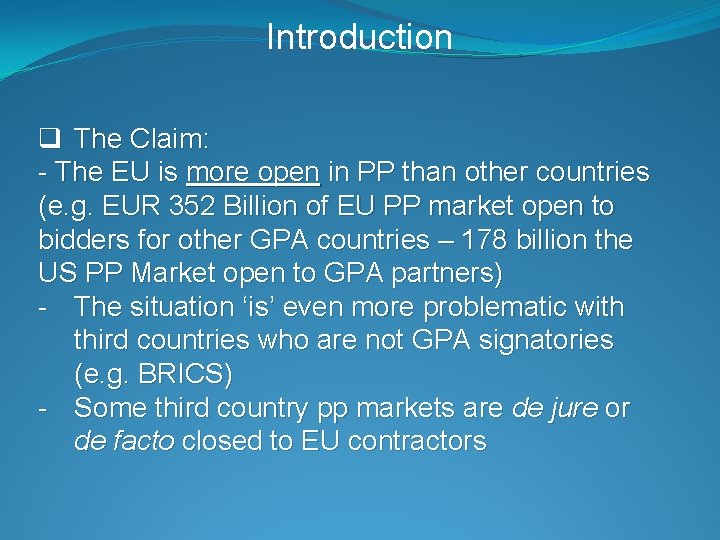
Introduction q The Claim: - The EU is more open in PP than other countries (e. g. EUR 352 Billion of EU PP market open to bidders for other GPA countries – 178 billion the US PP Market open to GPA partners) - The situation ‘is’ even more problematic with third countries who are not GPA signatories (e. g. BRICS) - Some third country pp markets are de jure or de facto closed to EU contractors
Introduction q The Solution: - Need to create a level playing field for EU contractors q The Method: - EU International Procurement Instrument Regulating the access of third country goods and services to the EU PP market
EU IPI 2012 q The IPI Proposal of 2012 had two parts: - “Covered” Procurement i. e. referring to existing pp market access international commitments of the EU - “Non-covered” procurement, where the EU has no international commitments e. g. below GPA threshold procurement
EU IPI 2012 q For “Non-covered” procurement there were two proposed mechanisms/procedures: - A “decentralised” one where a contracting authority would be allowed to exclude a third country tender after seeking the Commission’s approval - A “centralised” one where the Commission would investigate the situation and decide to exclude third country tender or impose a penalty. - The IPI was meant to be part of the 2014 PP Package but was not included eventually.
EU IPI 2016 q The Juncker Commission revived the process and submitted a new amended proposal in 2016 q Key Features: - No autonomous “Decentralised” mechanism - Possibility for the imposition of “price adjustment measures” financial penalty - but no exclusion of third country tenders - Commission findings about market barriers in other jurisdictions should be made public (transparency of the investigation)
EU IPI 2016 q Key Features (cont. ): - Presumption that third country tenders will be subject to “price adjustment measure” unless they (the tenderers) can show that than less than 50% of the value of the tender consist of “non covered” good or service originating a third country. - MSs authorities will decide which procuring entities will be implementing such price adjustment measures. - European SMEs and bidders and products from developing countries(GPS+) will not be subject to such measures
EU IPI 2016 q Key Features (cont. ): - Possibility to target territories at national and regional level q Aim: - To incentivise third countries to open their pp markets on a reciprocal basis
Perception v Reality
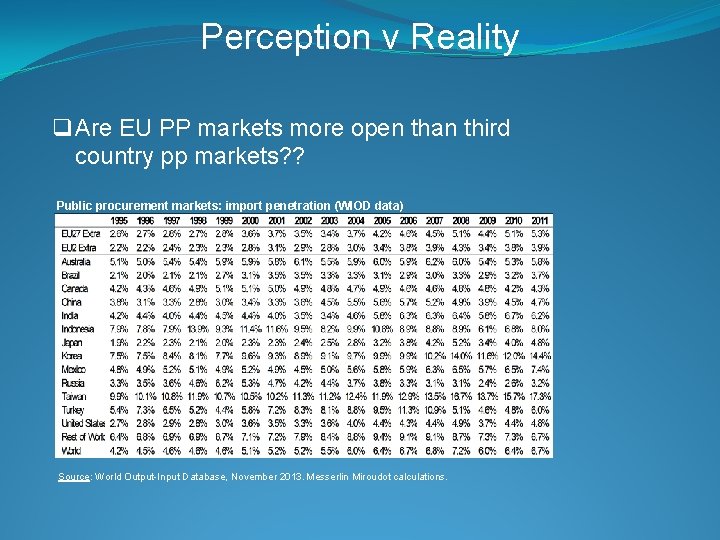
Perception v Reality q. Are EU PP markets more open than third country pp markets? ? Public procurement markets: import penetration (WIOD data) Source: World Output-Input Database, November 2013. Messerlin Miroudot calculations.
And then later in 2016… #America. First #covfefe
Reversing gear? US Presidential elections: “America First…” In the US pre-election rhetoric has been matched with post election actions: q US Withdrawal from the Transpacific Trade Partnership (TPP) q “Buy America, Hire America” Commitment; American Steel for pipelines (Presidential order)
Reversing gear? q Two main risks: - To actually start reversing gear (particularly if the signal is given by the economies that championed the post Bretton Woods global free market system) - To conflate the plausible concerns about the limitations of the current regulatory framework(s) vis-à-vis policies of social sustainability with the protectionist agenda
Food for Thought q Will the EU IPI facilitate or impede trade?
Thank You Dr Aris GEORGOPOULOS School of Law University of Nottingham Public Procurement Research Group Nottingham NG 7 2 RD UK Email: aris. georgopoulos@nottingham. ac. uk