
The EU current and future framework for Tourism
- Slides: 35
The EU current and future framework for Tourism Policy: challenges and opportunities Mathieu Hoeberigs IRU 20 October 2011
Summary presentation 1. Introduction 2. Legal basis and policy framework 3. New Communication on Tourism 4. Tourism unit’s preparatory actions
Introduction - 1 Tourism is more than an economic activity. It contributes to a wide range of other key EU objectives: Øsustainable development Øeconomic growth Øjob creation Øsocial and regional cohesion Øprotection of natural and cultural heritage ØEU citizenship Øpeaceful relationships etc.
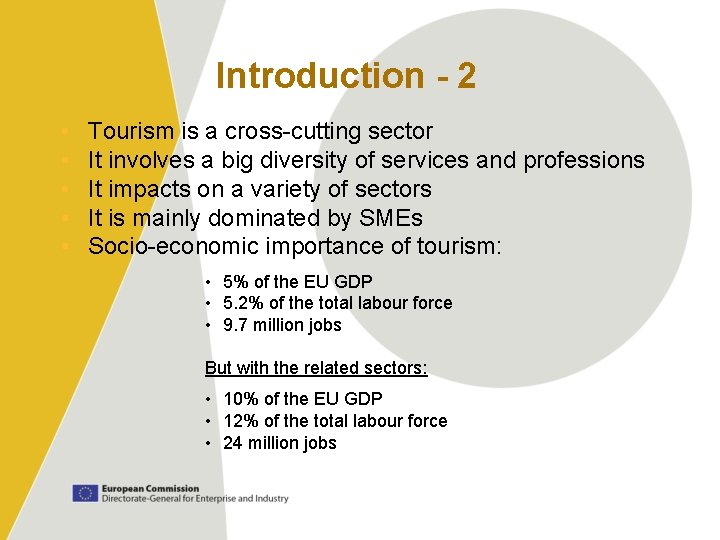
Introduction - 2 • • • Tourism is a cross-cutting sector It involves a big diversity of services and professions It impacts on a variety of sectors It is mainly dominated by SMEs Socio-economic importance of tourism: • 5% of the EU GDP • 5. 2% of the total labour force • 9. 7 million jobs But with the related sectors: • 10% of the EU GDP • 12% of the total labour force • 24 million jobs
Tourism and the Political. Institutional Framework
Strategies for a Competitive and Sustainable Tourism at EU level (1/2) • 2001 – Communication on « Working together for the future of European Tourism » • 2003 – Communication on « Basic orientations for the sustainability of European tourism » • 2006 – Communication on a « renewed EU Tourism Policy »
Strategies for a Competitive and Sustainable Tourism at EU level (2/2) • 2007 – Communication on « an agenda for a competitive and sustainable European tourism » • 2010 – Communication on « Europe, the world’s No 1 tourist destination - a new political framework for tourism in Europe » ØA new political framework for Tourism in Europe in line with the Lisbon Treaty and the Europe 2020 Strategy for growth and employment
Lisbon Treaty – a new competence for tourism (1/2) • Title I, Article 6(d) TFEU The Union shall have competence to carry out actions to support, coordinate or supplement the actions of the Member States. The areas of such action shall, at European level, be: (…) (d) tourism • Title XXII, Article 195 TFEU 1. The Union shall complement the action of the Member States in the tourism sector, in particular by promoting the competitiveness of Union competitiveness undertakings in that sector. To that end, Union action shall be aimed at:
Lisbon Treaty – a new competence for tourism (2/2) § encouraging the creation of a favourable environment for the development of undertakings in this sector; § promoting cooperation between the Member States, States particularly by the exchange of good practice. 2. accordance with the ordinary legislative procedure, shall establish specific measures to complement actions within the Member States to achieve the objectives referred to in this Article, excluding any harmonisation of the laws and regulations of the Member States.
A new consolidated framework for the EU Tourism Policy EC Communication COM(2010) 352 final
Key principles 1. European or multinational dimension multinational 2. European added value 3. Principles of subsidiarity and proportionality 4. Commitment from and involvement of all stakeholders of the EU Tourism Industry to cooperate and jointly ensure a successful implementation
Four axes of action • Stimulate competitiveness in the European Tourism sector • Promote the development of sustainable, responsible and high quality tourism • Consolidate the image and profile of Europe as home to sustainable and high-quality destinations • Maximise the potential of EU policies and financial instruments
Stimulate competitiveness of the European Tourism sector (1/2) Develop a coherent strategy for diversifying the promotion of tourist services and capitalise on Europe's common cultural and natural heritage Launch an 'ICT and tourism' platform for stakeholders to facilitate platform the adaptation of the tourism sector and its businesses to market developments in new information technologies Improve professional skills by supporting training in the tourism sector (promote opportunities offered by various EU programmes) In the short term, support networking of research institutes, universities, public and private observatories, regional and national universities authorities and national tourism offices
Stimulate competitiveness of the European Tourism sector (2/2) In the medium term, promote the implementation of a “Virtual Observatory for Tourism” to support and coordinate research Tourism” activities by the various national research institutes and provide socioeconomic data on tourism at European level Provide a voluntary tourism exchange mechanism between Member States, enabling in particular certain key groups such as young or elderly people, people with reduced mobility and low-income families to travel, particularly during the low season Develop a voluntary online information exchange mechanism to improve the coordination of school holidays in the Member holidays States, without prejudice to their cultural traditions
Promote the development of sustainable, responsible and high-quality tourism Develop a system of indicators for a sustainable management of tourist destinations Develop a European “Quality Tourism” brand, brand based on existing national experience, to increase consumer security and confidence in tourism products and reward rigorous efforts by tourism professionals whose aim is quality of tourism service for customer satisfaction Propose a charter for a sustainable and responsible tourism Establish or strengthen cooperation with main emerging and Mediterranean countries to promote sustainable and responsible tourism development models
Consolidate the image and profile of Europe as a collection of sustainable and high-quality tourist destinations Creation of a 'Europe brand' in cooperation with the Member States to complement promotional efforts at national and regional level and enable European destinations to distinguish themselves from other international destinations Promotion of the portal “visiteurope. com” in order to increase the attractiveness of Europe as a collection of Europe sustainable and high-quality tourist destinations Encourage joint promotional actions at major international events or large-scale tourism fairs and exhibitions
Maximise the potential of EU policies and financial instruments Mainstream tourism in the different policies which have policies a direct or indirect impact on it Step up coordination of the various policies concerned, policies with the aim of ensuring that the interests and needs of the tourism industry are fully taken into account when formulating and implementing EU policies Promote and mobilise Union support instruments and programmes and reinforce support and coordination actions in favour of tourism
Implementation These actions complement the policies of the Member States and aim to coordinate efforts by determining measures which provide a real European added value The success of this strategy will depend on the commitment of all stakeholders and on their capacity to stakeholders work together to implement it: • Priorities and implementation modes to be agreed on • Workshops and meetings with all stakeholders • Time horizon: 2010 – 2014 • Scope for more initiatives beyond the Communication!
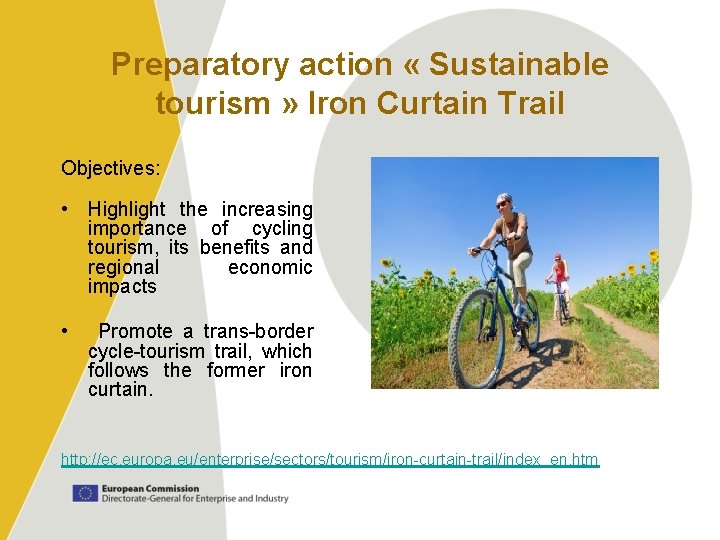
Preparatory action « Sustainable tourism » Iron Curtain Trail Objectives: • Highlight the increasing importance of cycling tourism, its benefits and regional economic impacts • Promote a trans-border cycle-tourism trail, which follows the former iron curtain. http: //ec. europa. eu/enterprise/sectors/tourism/iron-curtain-trail/index_en. htm
Preparatory action « CALYPSO » Objectives: • Encourage tourism activity during the off-peak season • Facilitate the elaboration of a mechanism enabling particular target groups (senior citizens, young people and families facing difficult social circumstances) to go on holiday on the basis of themed programmes and accommodation offers recommended by public authorities (national, regional or local) and, if possible, during the low season http: //ec. europa. eu/enterprise/sectors/tourism/calypso/index_en. htm
Preparatory action European Destinations of Excellence “EDEN” Objectives: • Enhance visibility of the emerging, non traditional European tourist destinations of excellence • Award sustainable forms of tourism Award sustainable forms • Create a platform for the exchange of good practices at European level, promote networking between awarded destinations which could persuade other destinations to adopt sustainable tourism development mode http: //ec. europa. eu/eden
EDEN Editions • EDEN 2007 “best emerging rural destinations” • EDEN 2008 “tourism and local intangible heritage” • EDEN 2009 “tourism and protected areas” • EDEN 2010 “aquatic tourism” • EDEN 2011 « tourism and regeneration of physical sites »
Preparatory action Launch of an ICT and Tourism Platform Objectives: • facilitate the adaptation of the tourism sector and its businesses to market developments in new information technologies • create a favourable environment for the European environment tourism industry that stimulates and enables the uptake of ICT and e-Business technologies.
Preparatory action Launch of an ICT and Tourism Platform In practice: • possible launch of a large-scale pilot action to help SMEs participate in the global digital supply chain and become fully integrated international business partners (ongoing similar actions: textile, transport, automotive sectors) • harmonise business processes, data exchange architectures and standards, for the Tourism sector, at European or international level.
Preparatory action Virtual Observatory for Tourism • Objective: support and coordinate research activities by the various national research institutes and provide socioeconomic data on tourism at European level • In practice: launch of a feasibility study leading to the creation of a state-of-the-art observatory which should become a central source of information for policy makers, tourism stakeholders, researchers, etc in need of reliable information, analysis of the performance and trends of the sector.
Preparatory action Improving professional skills • Objective: Improve professional skills by Improve professional skills supporting training in the tourism sector in order to facilitate adaptation of the workers to new technologies and new market expectations
Preparatory action Improving professional skills In practice: • link-up with and promote opportunities offered by other policies and programmes (eg. New skills for new jobs, Leonardo, Erasmus, etc) • draft a Tourism Competences Framework in close cooperation with the sector: mapping needs and requirements, check available solutions, close the gaps through policy recommendations
TRAVEL and TOURISM COM(2011) 144 final WHITE PAPER Roadmap to a Single European Transport Area – Towards a competitive and resource efficient transport system • 1. "A fully functional and EU-wide multimodal TEN-T ‘core network’ by 2030, with a high quality and capacity network by 2050 and a corresponding set of information services. " • 2. "By 2050, complete a European high-speed rail network. Triple the length of the existing high-speed rail network by 2030 and maintain a dense railway network in all Member States. By 2050 the majority of medium-distance passenger transport should go by rail. " • 3. "Deployment of the modernised air traffic management infrastructure (SESAR) in Europe by 2020 and completion of the European Common Aviation Area. Deployment of equivalent land waterborne transport management systems (ERTMS, ITS, SSN and LRIT, RIS 1). Deployment of the European Global Navigation Satellite System (Galileo). "
Travel and Tourism(2) • Concerning emergency situations, the White Paper sets out Action 23 ("Mobility Continuity Plans") as follows: • "Ensure the definition of mobility plans to ensure service continuity in case of disruptive events. The plans should address the issue of prioritisation in the use of working facilities, the cooperation of infrastructure managers, operators, national authorities and neighbouring countries, and the temporary adoption or relaxation of specific rules. " • Action 27 of the White Paper on Transport ("Travel information") is as follows: • "Promote awareness of the availability of alternatives to individual conventional transport (drive less, walk and cycle, car sharing, park & ride, intelligent ticketing etc. )"
Travel and Tourism (3) • Creating a Single European Transport is the principal objective of the White Paper. In addition to the completion of the Single European Sky, already in 2011 the Commission will address the capacity and quality of airports. The area where bottlenecks are still most evident is the internal market for rail services, which must be completed as a priority in order to achieve a Single European Railway Area. This includes the abolishment of technical, administrative and legal obstacles which still impede entry to national railway markets. For maritime transport, a “Blue Belt” in the seas around Europe shall simplify the formalities for ships travelling between EU ports. •
Travel and Tourism (4) • Action 21 ("Passengers’ rights") of the White Paper is as follows: • " • Develop a uniform interpretation of EU Law on passenger rights and a harmonised and effective enforcement, to ensure both a level playing field for the industry and a European standard of protection for the citizens. • • Assemble common principles applicable to passengers’ rights in all transport modes (Charter of basic rights), notably the ‘right to be informed’, and further clarify existing rights. At a later stage, consider the adoption of a single EU framework Regulation covering passenger rights for all modes of transports (EU Codex).
Travel and Tourism (5) • • Improve the quality of transport for elderly people, Passengers with Reduced Mobility and for disabled passengers, including better accessibility of infrastructure. • • Complete the established legislative framework on passenger rights with measures covering passengers on multimodal journeys with integrated tickets under a single purchase contract as well as in the event of transport operator’s bankruptcy. • • Improve the level playing field at international level through the inclusion of care quality standards in bilateral and multilateral agreements for all modes of transport, with a view to further passengers’ rights also in the international context. "
Coordination at EU Level • • Stakeholders EU MS EU institutions Institutional cooperation and coordination ( internal and external) « Working Together for the Sustainable Future of Tourism in Europe »
major recent tourism events • 27 September 2011 – European Tourism Day in Brussels organised by the Commission. EDEN 2011 Awards ceremony. • 5 -7 October 2011 – European Tourism Forum in Krakow, Poland (Presidency event).
Thank you EC Tourism website: http: //ec. europa. eu/enterprise/tourism/