
The Ethics of Mathematics and Mathematics in Society
- Slides: 29
The Ethics of Mathematics and Mathematics in Society Paul Ernest University of Exeter, UK AMET webinar 24 th February 2021
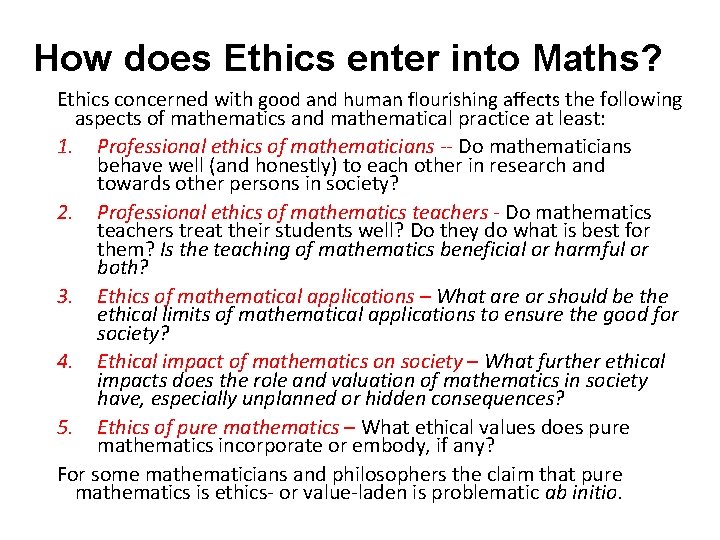
How does Ethics enter into Maths? Ethics concerned with good and human flourishing affects the following aspects of mathematics and mathematical practice at least: 1. Professional ethics of mathematicians -- Do mathematicians behave well (and honestly) to each other in research and towards other persons in society? 2. Professional ethics of mathematics teachers - Do mathematics teachers treat their students well? Do they do what is best for them? Is the teaching of mathematics beneficial or harmful or both? 3. Ethics of mathematical applications – What are or should be the ethical limits of mathematical applications to ensure the good for society? 4. Ethical impact of mathematics on society – What further ethical impacts does the role and valuation of mathematics in society have, especially unplanned or hidden consequences? 5. Ethics of pure mathematics – What ethical values does pure mathematics incorporate or embody, if any? For some mathematicians and philosophers the claim that pure mathematics is ethics- or value-laden is problematic ab initio.
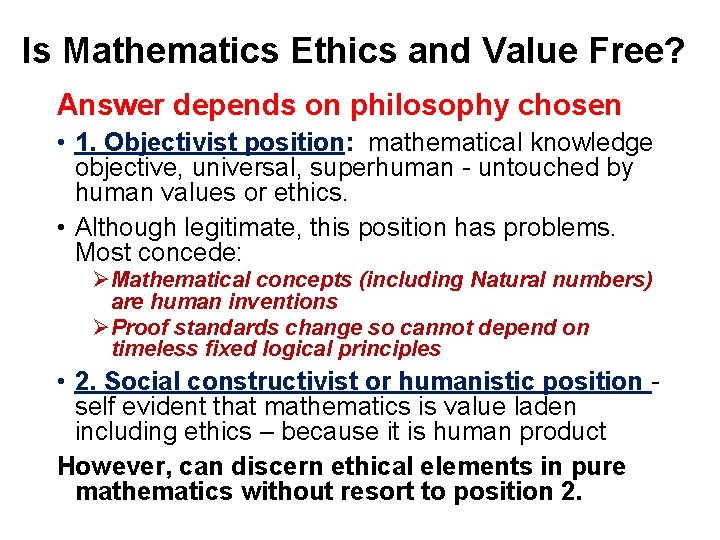
Is Mathematics Ethics and Value Free? Answer depends on philosophy chosen • 1. Objectivist position: mathematical knowledge objective, universal, superhuman - untouched by human values or ethics. • Although legitimate, this position has problems. Most concede: ØMathematical concepts (including Natural numbers) are human inventions ØProof standards change so cannot depend on timeless fixed logical principles • 2. Social constructivist or humanistic position self evident that mathematics is value laden including ethics – because it is human product However, can discern ethical elements in pure mathematics without resort to position 2.
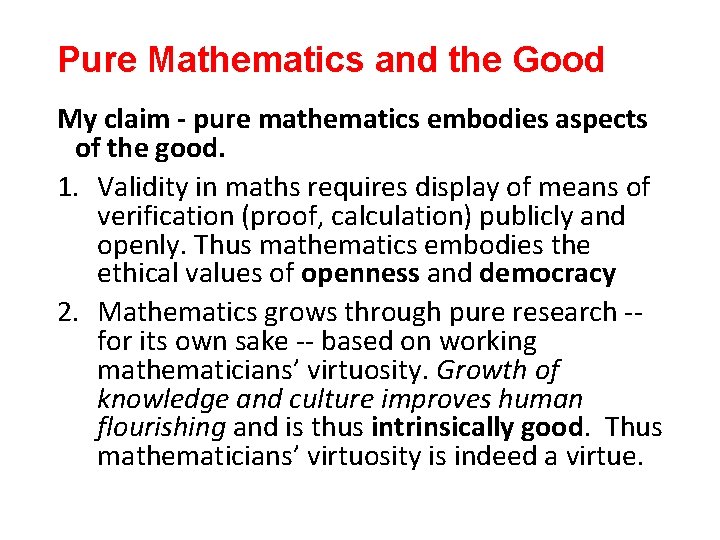
Pure Mathematics and the Good My claim - pure mathematics embodies aspects of the good. 1. Validity in maths requires display of means of verification (proof, calculation) publicly and openly. Thus mathematics embodies the ethical values of openness and democracy 2. Mathematics grows through pure research -for its own sake -- based on working mathematicians’ virtuosity. Growth of knowledge and culture improves human flourishing and is thus intrinsically good. Thus mathematicians’ virtuosity is indeed a virtue.
The Ethics of Mathematics in Society The ethics of mathematics in society is problematic because of the ubiquity of mathematics in governance, science, information and communication technologies, finance and education. GOOD IMPACTS • mathematics is a great tool that enables the rich material basis for modern life. Almost all live healthier more comfortable lives because of maths and the science and technology it supports NEGATIVE IMPACTS • Unethical applications. Many can be cited, e. g. , in the news: Cambridge Analytica privacy intrusion and data mining to influence politics and subvert democracy. • Gross overvaluation of mathematics in modern society harmful
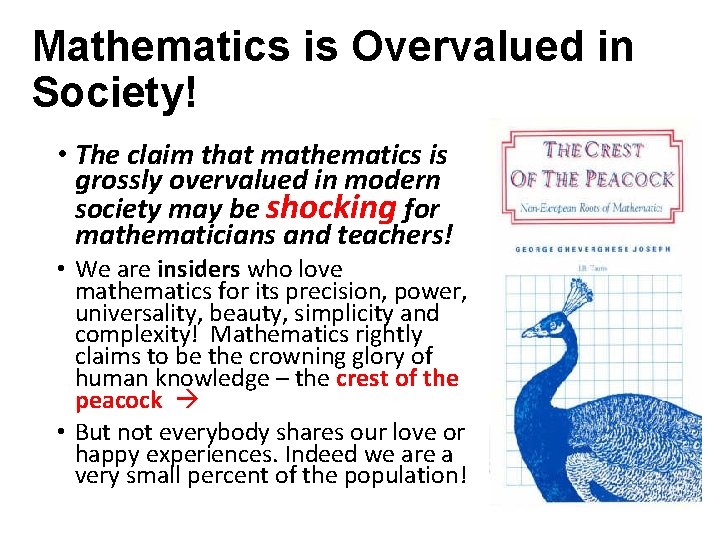
Mathematics is Overvalued in Society! • The claim that mathematics is grossly overvalued in modern society may be shocking for mathematicians and teachers! • We are insiders who love mathematics for its precision, power, universality, beauty, simplicity and complexity! Mathematics rightly claims to be the crowning glory of human knowledge – the crest of the peacock • But not everybody shares our love or happy experiences. Indeed we are a very small percent of the population!
How and Why is Maths Overvalued? Ubiquity of maths in modern computerized society seen as reason everybody needs maths: • Society depends on maths everybody needs maths Maths is a central feature of rationality • Reason matters Maths counts The lifeblood of the modern world is money: • Money matters Money is an application of maths Mathematics matters Modern business and government depend on utility • Utilitarianism depends on benefit (cost/profit) calculations (i. e. mathematical applications)
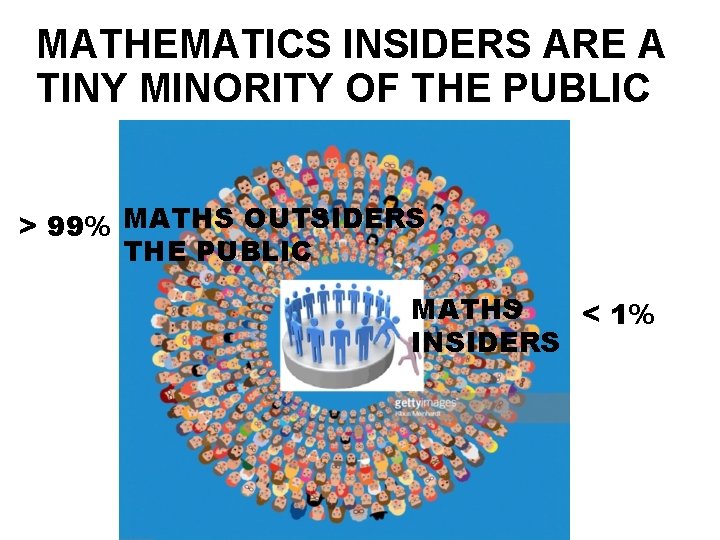
MATHEMATICS INSIDERS ARE A TINY MINORITY OF THE PUBLIC > 99% MATHS OUTSIDERS THE PUBLIC MATHS < 1% INSIDERS
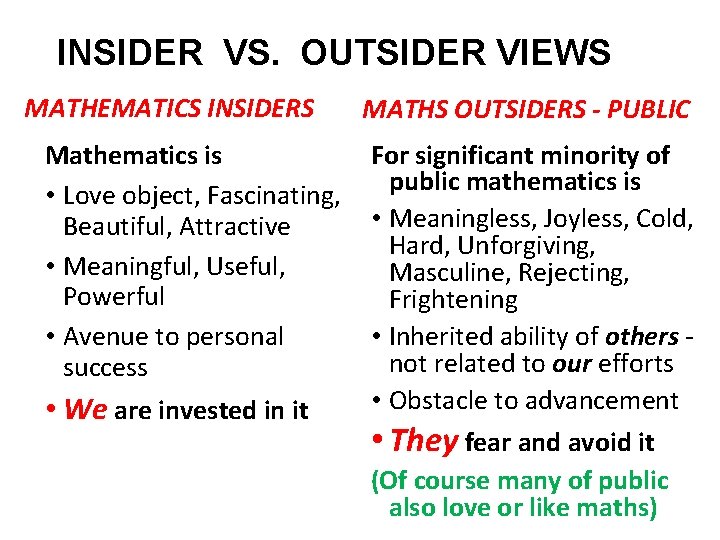
INSIDER VS. OUTSIDER VIEWS MATHEMATICS INSIDERS Mathematics is • Love object, Fascinating, Beautiful, Attractive • Meaningful, Useful, Powerful • Avenue to personal success • We are invested in it MATHS OUTSIDERS - PUBLIC For significant minority of public mathematics is • Meaningless, Joyless, Cold, Hard, Unforgiving, Masculine, Rejecting, Frightening • Inherited ability of others not related to our efforts • Obstacle to advancement • They fear and avoid it (Of course many of public also love or like maths)
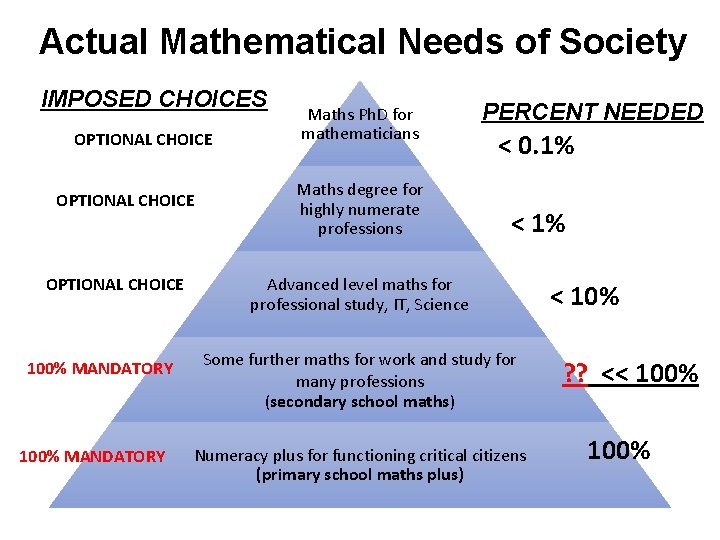
Actual Mathematical Needs of Society IMPOSED CHOICES OPTIONAL CHOICE 100% MANDATORY Maths Ph. D for mathematicians Maths degree for highly numerate professions PERCENT NEEDED < 0. 1% < 1% Advanced level maths for professional study, IT, Science Some further maths for work and study for many professions (secondary school maths) Numeracy plus for functioning critical citizens (primary school maths plus) < 10% ? ? << 100%
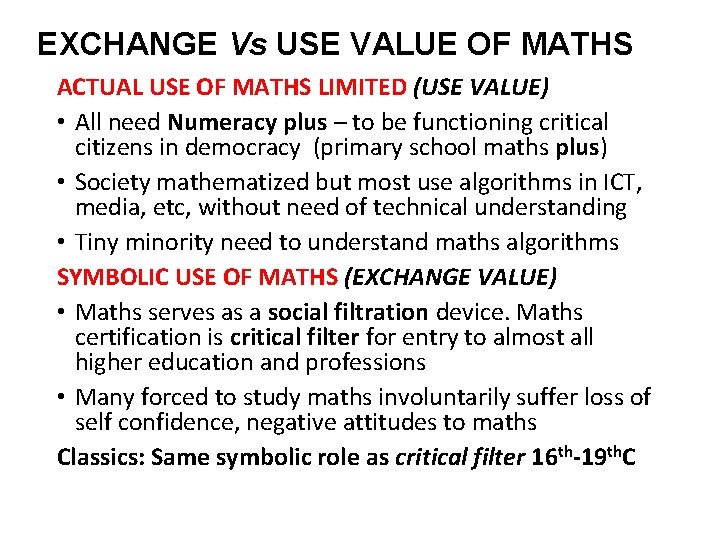
EXCHANGE Vs USE VALUE OF MATHS ACTUAL USE OF MATHS LIMITED (USE VALUE) • All need Numeracy plus – to be functioning critical citizens in democracy (primary school maths plus) • Society mathematized but most use algorithms in ICT, media, etc, without need of technical understanding • Tiny minority need to understand maths algorithms SYMBOLIC USE OF MATHS (EXCHANGE VALUE) • Maths serves as a social filtration device. Maths certification is critical filter for entry to almost all higher education and professions • Many forced to study maths involuntarily suffer loss of self confidence, negative attitudes to maths Classics: Same symbolic role as critical filter 16 th-19 th. C
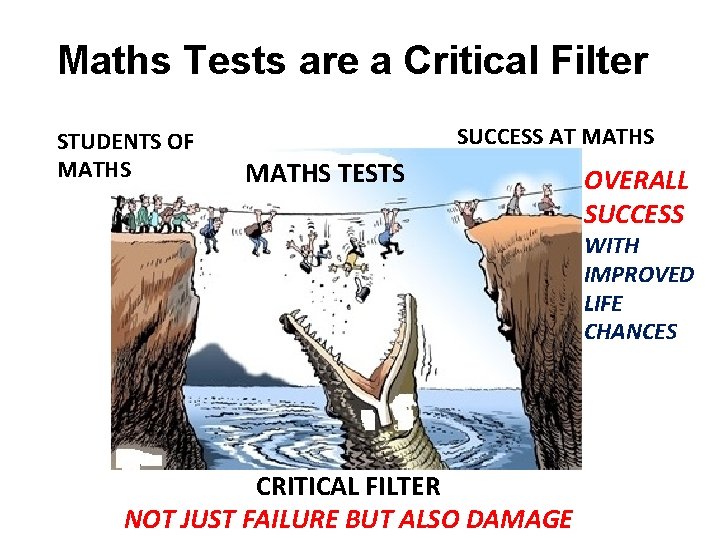
Maths Tests are a Critical Filter STUDENTS OF MATHS SUCCESS AT MATHS TESTS OVERALL SUCCESS WITH IMPROVED LIFE CHANCES CRITICAL FILTER NOT JUST FAILURE BUT ALSO DAMAGE
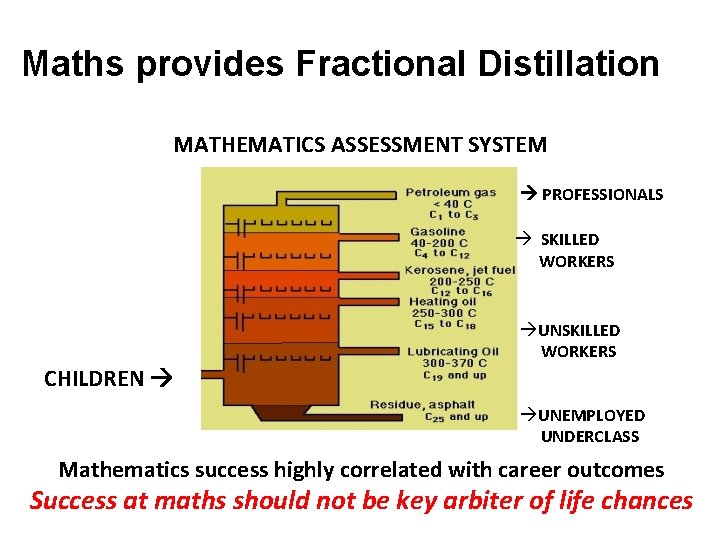
Maths provides Fractional Distillation MATHEMATICS ASSESSMENT SYSTEM PROFESSIONALS SKILLED WORKERS UNSKILLED WORKERS CHILDREN UNEMPLOYED UNDERCLASS Mathematics success highly correlated with career outcomes Success at maths should not be key arbiter of life chances
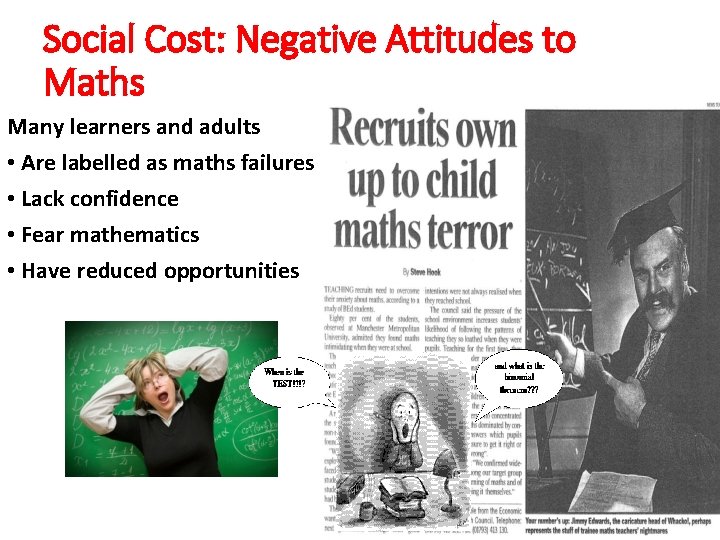
Social Cost: Negative Attitudes to Maths Many learners and adults • Are labelled as maths failures • Lack confidence • Fear mathematics • Have reduced opportunities
We are Complicit in this Over-Valuing We gain by not questioning the over-valuing of maths in society • Gain more resources, prestige, dominance in schooling We accept uncritically argument that ubiquity in society maths means all must study abstract maths to 16 or 18 But we accept not everyone must study to 16 or 18 years • Arts, Literature, Drama, Psychology, Classics, Languages, Philosophy, Politics, Geography, History, Computing Are these not equally important for personal development and work? But we leave them optional Is maths failure learner fault or society’s fault forcing it on everybody to 16 or 18 years?
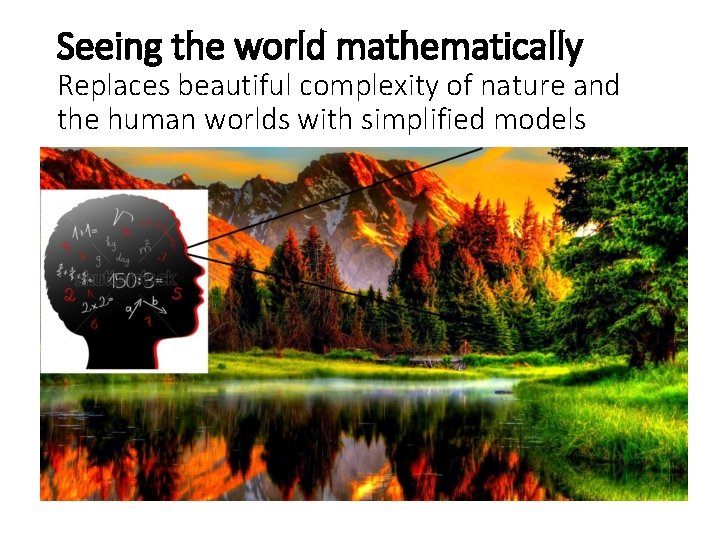
Seeing the world mathematically Replaces beautiful complexity of nature and the human worlds with simplified models
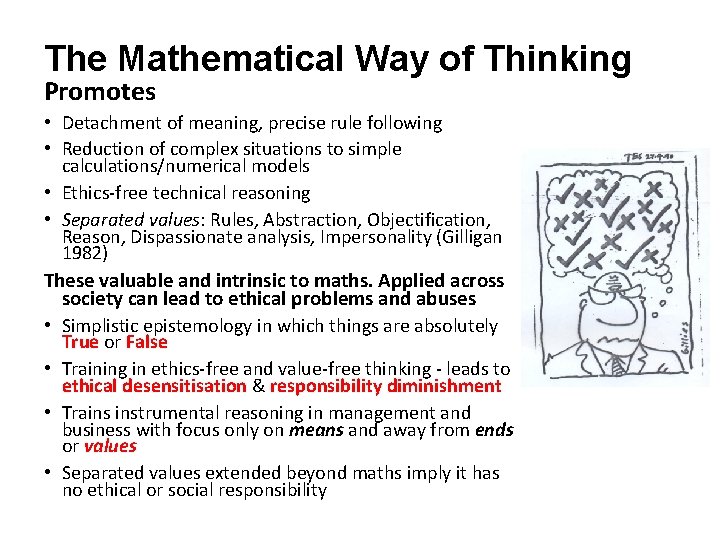
The Mathematical Way of Thinking Promotes • Detachment of meaning, precise rule following • Reduction of complex situations to simple calculations/numerical models • Ethics-free technical reasoning • Separated values: Rules, Abstraction, Objectification, Reason, Dispassionate analysis, Impersonality (Gilligan 1982) These valuable and intrinsic to maths. Applied across society can lead to ethical problems and abuses • Simplistic epistemology in which things are absolutely True or False • Training in ethics-free and value-free thinking - leads to ethical desensitisation & responsibility diminishment • Trains instrumental reasoning in management and business with focus only on means and away from ends or values • Separated values extended beyond maths imply it has no ethical or social responsibility
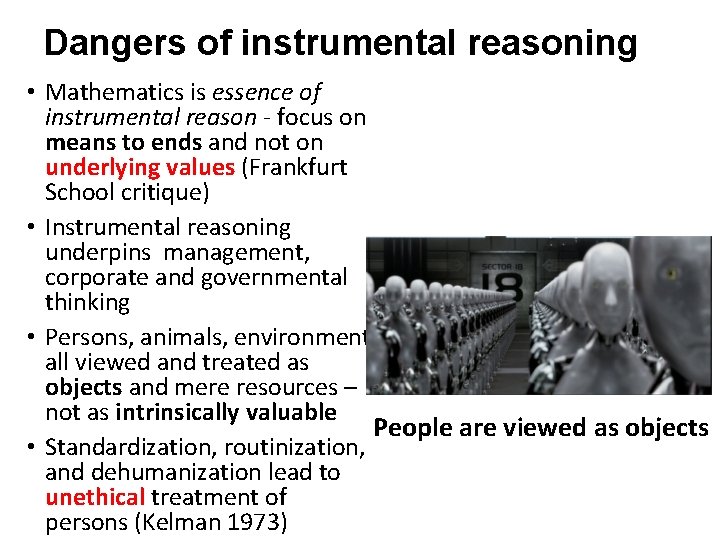
Dangers of instrumental reasoning • Mathematics is essence of instrumental reason - focus on means to ends and not on underlying values (Frankfurt School critique) • Instrumental reasoning underpins management, corporate and governmental thinking • Persons, animals, environment all viewed and treated as objects and mere resources – not as intrinsically valuable People are viewed as objects • Standardization, routinization, and dehumanization lead to unethical treatment of persons (Kelman 1973)
Hidden Harm caused by Mathematics 1. Overvaluing mathematical qualifications blights lives of millions labeled as mathematical failures 2. Overvaluing Quantitative outlook supports managerialism & neoliberal performative agenda through privileging of measurement, accountability, and targets 3. Mathematical training can develops an ethicsfree instrumentalist outlook that prioritises profit above any social costs -- powering exploitative corporativism and neoliberalism. This is collateral damage – but we should acknowledge it and limit harm via teaching
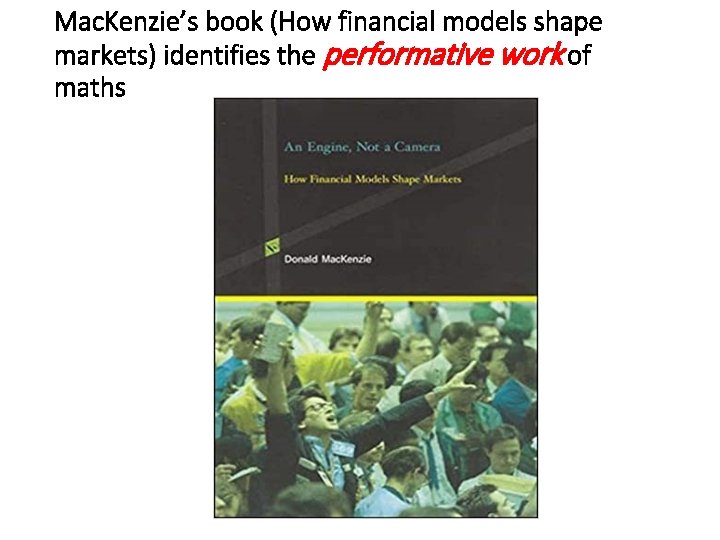
Mac. Kenzie’s book (How financial models shape markets) identifies the performative work of maths
Mathematics is Performative • Mathematics is an engine not a mirror – rather than merely reflect society it changes it • When you apply measures of performance – you change the activities to meeting the targets – not to meeting the original goals • Schooling becomes about passing exams not learning flexible and adaptable skills • When business is all about the bottom line (profit) • The valuable service provided becomes secondary to profit • When welfare or health is all about meeting targets • Professionals forced to compromise their standards to meet targets • Maybe not yet in Norway – but certainly in USA and UK
Example: Victorian Payment by Results in British schools MEASURES: No. Students & Results Determine PAY Payment by Results SYSTEM CHANGES EDUCATION • Other perverse effects included inducing teachers, whose annual salaries were now tied to the numbers of pupils in their classes and to their performance at particular exams, to cheat. Teachers drilled their pupils mercilessly on test items (Hyndman, 1978: 34) once the inspector’s visit was imminent. Some secretly trained their pupils in classroom tricks that would create a more favourable impression. Yet others falsified enrolment registers, to keep numbers artificially high. Sick children were dragged along to school to satisfy attendance requirements, upon which teachers’ salaries were dependent (Hyndman, 1978: 37), while teachers now had to negotiate their salaries directly with school managers (Welch, 2007 a). • Cramming, rather than teaching, became the means to ensure a teacher’s livelihood – weakening pupils, teachers, and pedagogy. Hence, a further product of the Revised Code was a narrowing of the curriculum and a narrow instrumentalism with respect to educational aims. Overall, while the scheme was justified by appeals to the principle of ‘efficiency’, it was in fact introduced largely as a means of curbing justifiable growth in state expenditure on education. • Anthony Welch, Mammon, Markets, and Managerialism, in R. Cowen and A. M. Kazamias (eds. ), International Handbook of Comparative Education, Springer 2009, p 591.
How to correct or prevent such harm? Overall harms comes from overvaluation and misapplication of Mathematical How can we rectify this? (Through education) Include philosophy of maths with mathematics • Teach the limits of mathematical knowledge - its certainties do not apply to the world – there is always a margin of error • Teach limits of mathematical thinking – true/false dichotomies do not apply to the world Add the ethics of mathematics to maths courses • Teach the limits and dangers of instrumental thinking – it dehumanization of people and institutions • Mathematics must be applied responsibly or with awareness – it is wrong to ignore ‘incidental’ outcomes or ‘collateral damage’ in social impacts Use ethical examples in teaching of mathematics • Use real world examples – Covid, Global warming, Pollution of the environment, Health and mortality figures from around the world, statistics on gender and race inequalities to show the impact of models, measures and mathematization
Reform Mathematics Teaching • Put less stress on examinations and testing • Give students maths course choices 11 -16/18 years • Humanize mathematics teaching - duty of care for learners: their maths attitudes and images matter • Don’t demonize errors – they are inevitable steps in learning – not sins or failures • Teach critical thinking – look critically at social applications and mathematics-based claims • Add mathematical appreciation (<5%) to mathematical capability i. e. ‘doing maths’ (>95%)
Teach Appreciation of Maths more than calculating, solving and proving At all levels taught maths must give a broader appreciation of • Maths in culture, art and social life • Impact of applications of maths on society and context • History of mathematics and maths in history • Proof and how maths knowledge validated – limits of mathematical certainty and applications • Controversies in philosophy of maths • Introduction of big ideas of mathematics pattern, modelling, symmetry, structure, equivalence, invariance, proof, paradox, recursion, randomness, chaos, infinity, etc. • Critical citizenship through mathematics • Ethics of mathematical applications in society
Teach critical citizenship via maths • Mathematics should socially and politically empower students as numerate critical citizens in society to: ü Critically understand uses of mathematics in society ü Use maths in social and political activity, for betterment of students and democratic society as a whole ü Interpret and critique uses of maths in social, commercial and political claims in adverts, headlines, blogs, reports, etc ü Understand limits of validity of uses of maths, what decisions are concealed, and reject spurious or misleading claims ü Scrutinize financial sector and government systems and procedures for objectivity, correctness and hidden assumptions ü Address ethical implications of maths applications to balance instrumentalism, dehumanization and separated values • Every citizen needs these capabilities to defend democracy and values of humanistic and civilised society
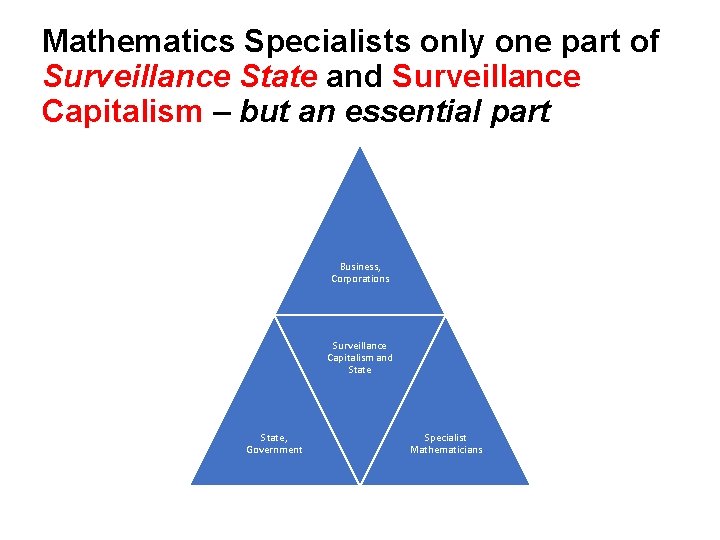
Mathematics Specialists only one part of Surveillance State and Surveillance Capitalism – but an essential part Business, Corporations Surveillance Capitalism and State, Government Specialist Mathematicians
Reaching the Other Parts of Society • If we can teach mathematicians to see mathematics as ethical, perhaps we can also teach future • Politicians and Government workers • Business leaders • to see mathematics as ethical in the long term, because they study in school too • If we teach all citizens to see mathematics as an ethical issue • Then we may be able to CURB THE EXCESSES of the Orwellian Surveillance State, Surveillance Capitalism and Politics manipulated via Data/Apps
Paul Ernest References on Maths and Ethics • Ernest, P. (2020) Mathematics, ethics and purism: an application of Mac. Intyre’s virtue theory. Synthese (2020). https: //doi. org/10. 1007/s 11229 -020 -02928 -1 • Ernest, P. (2020) The ideologies of Purity and Neutrality and the Ethics of Mathematics. Philosophy of Mathematics Education Journal, No. 36 (December 2020). • Ernest, P. (2020) Unpicking the Meaning of the Deceptive Mathematics Behind the Covid Alert Levels. Philosophy of Mathematics Education Journal, No. 36 (December 2020). • Ernest, P. (2019) Privilege, Power and Performativity: The Ethics of Mathematics in Society and Education , Philosophy of Mathematics Education Journal, No. 35 (December 2019) • Ernest, P. (2019). The ethical obligations of the mathematics teacher. Journal of Pedagogical Research, 3(1), 80 -91. doi: 10. 33902/JPR. 2019. 6 • Ernest, P. (2019). Ethics and the Mathematics Teacher, Part 1. Mathematics Teaching, April 2019, pp. 28 -33. • Ernest, P. (2019) Ethics and the Mathematics Teacher 2, Mathematics Teaching • Ernest, P. (2019) A Theoretical Inquiry into the Ethics of Mathematics Teaching. Malikussaleh Journal of Mathematics Learning, Vol. 2, No. 2, October 2019, pp. 68 -75. • Ernest, P. (2018) The Ethics of Mathematics, in P. Ernest, Ed. The Philosophy of Mathematics Education Today, Switzerland: Springer international. 2018. • Ernest, P. (2016) A Dialogue on the Ethics of Mathematics, The Mathematical Intelligencer Vol. 38, No. 3, pp. 69 -77. ; DOI: 10. 1007/s 00283 -016 -9656 -z • Ernest, P. (2016) Mathematics and Values. B. Larvor, Ed. Mathematical Cultures. Switzerland: Springer, 2016, pp. 189 -214. • Ernest, P. (2016) Challenging Three Myths about Mathematics: Recognising the social responsibility of mathematics. P. Blaszczyk, Ed. Mathematical Transgressions. • Ernest, P. (2016) Values and Mathematics: Overt and Covert, Culture and Dialogue, Volume 4, No. 1 (special issue Culture, Science and Dialogue, Guest Editor: M. Ovens). • Ernest, P. (2016) The Collateral Damage of Learning Mathematics, Philosophy of Mathematics Education Journal, No. 31. Freely available online. • Ernest, P. (2012) ‘What is our First Philosophy in Mathematics Education? ’, For the Learning of Mathematics, Vol. 32 no. 3: 8 -14. • Ernest, P. (2009) 'Globalization, Ideology and Research in Mathematics Education’, Ernest, P. Greer, B, & Sriraman, B. Eds. (2009) Critical Issues in Mathematics Education, Charlotte, NC, USA: Information Age Publishing, 67 -110. • Ernest, P. (2009) 'Values and the Social Responsibility of Mathematics’, Ernest, P. Greer, B, & Sriraman, B. Eds. (2009) Critical Issues in Mathematics Education, Charlotte, NC, USA: Information Age Publishing, 207 -216. • Ernest, P. (1998) Social Constructivism as a Philosophy of Mathematics, Albany, New York: SUNY Press. (Plus refs on social justice, race, gender, special needs, critical citizenship, empowerment and critique of objectivist and absolutist philosophies of mathematics)