
The Ethics of Global Ophthalmology Why is this
The Ethics of Global Ophthalmology
Why is this Topic Important? • Growing interest among ophthalmologists and ophthalmologists-in-training in global ophthalmology. • Accreditation Council for Graduate Medical Education (ACGME) now recognizes an international elective rotation for ophthalmology trainees. • Improve the quality of care provided by ophthalmologists who wish to participate in global ophthalmology activities.
Rules of the AAO Code of Ethics Pertinent to this Topic • • • Rule 1. Competence Rule 2. Informed Consent Rule 3. Research & Innovation Rule 4. Other Opinions Rule 5. The Impaired Ophthalmologist • Rule 9. Medical & Surgical Procedures • Rule 10. Procedures & Materials • Rule 11. Commercial Relationships • Rule 12. Communications to Colleagues • Rule 13. Communications to the Public • Rule 14. Interrelations Between Ophthalmologists • Rule 6. Pretreatment Assessment • Rule 7. Delegation of Services • Rule 15. Conflicts of Interest • Rule 8. Postoperative Care • Rule 16. Expert Testimony • Rule 17. Confidentiality
What is Global Ophthalmology? • Refers to a number of different aspects of ophthalmology including: o Research o Clinical Care o Education and Skills Transfer • Ethical considerations in Global Ophthalmology involve issues regarding: o Appropriate supervision, competence, informed consent, preoperative assessment, delegation of care, postoperative care, patient vulnerability, patient privacy, and conflicts of interest including research and industry sponsorship.
10 Tips for Global Ophthalmology 1. Always act in the best interest of the individual patient and the local community. 2. Ophthalmic care providers in any stage of training or practice should consider these issues before initiating travel and take necessary steps for appropriate preparation.
10 Tips for Global Ophthalmology 3. Global ophthalmic care should not exclusively be used as a means to hone surgical or medical skills. o Provide an experience where both the ophthalmologist-in-training and the host benefit. o Ensure proper supervision of trainees at all times. o Develop a practice protocol to avoid potential exploitation of patients and the host institution. 4. Be honest. The ophthalmic care provider must honestly assess his or her competence before treating patients in these settings. o An ophthalmologist should perform only those procedures in which he or she is competent by virtue of specific training or experience or is assisted by one who is.

10 Tips for Global Ophthalmology 5. Determine what, if any, permissions are required to provide medical and surgical care in the destination country and obtain such permissions prior to initiating travel. o Consult with your liability carrier to determine whether liability coverage will be provided. 6. Familiarize yourself with the surgical suite prior to performing surgery, and preferably, prior to leaving home.
10 Tips for Global Ophthalmology 7. If planning to perform surgery: o Evaluate the patient prior to surgery to confirm accuracy in the documentation of findings and recommended treatment plan prepared by other health care providers. o Obtain informed consent and ensure that proper postoperative care is provided to the patient.
10 Tips for Global Ophthalmology 8. If planning to perform research: o Conduct research in the same manner as at home; this may include the need for IRB approval at home and approval from an IRB or equivalent entity in the country in which the research will take place. o All research should be approved by appropriate review mechanisms to protect patients from being subjected to or potentially affected by inappropriate, ill-considered, or fraudulent basic science or patient-oriented research. o In emerging areas of ophthalmic surgery and treatment where recognized guidelines do not exist, exercise careful judgment and take appropriate precautions to safeguard patient welfare.
10 Tips for Global Ophthalmology 9. Carefully assess your motivations o Assure that participation in the program is not influenced by a commercial or industry relationship, the potential for increased professional reputation/recognition or surgical acumen, and the potential for publication following the international visit. 10. Have realistic expectations and maintain the same standards abroad as at home.
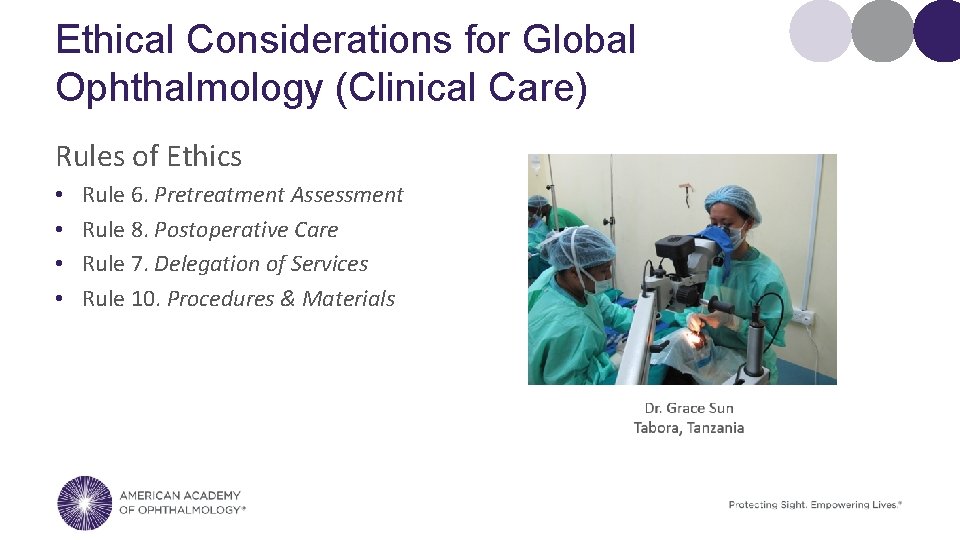
Ethical Considerations for Global Ophthalmology (Clinical Care) Rules of Ethics • • Rule 6. Pretreatment Assessment Rule 8. Postoperative Care Rule 7. Delegation of Services Rule 10. Procedures & Materials
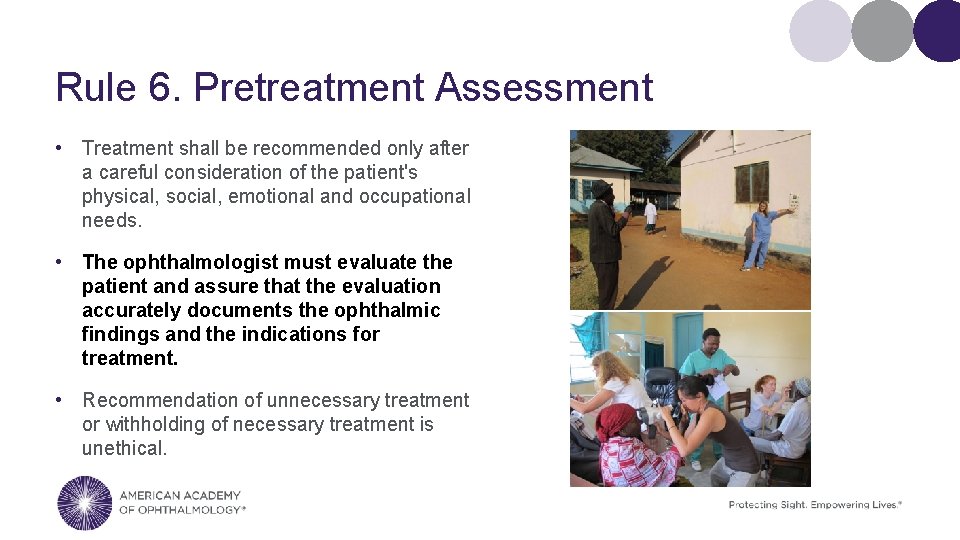
Rule 6. Pretreatment Assessment • Treatment shall be recommended only after a careful consideration of the patient's physical, social, emotional and occupational needs. • The ophthalmologist must evaluate the patient and assure that the evaluation accurately documents the ophthalmic findings and the indications for treatment. • Recommendation of unnecessary treatment or withholding of necessary treatment is unethical.
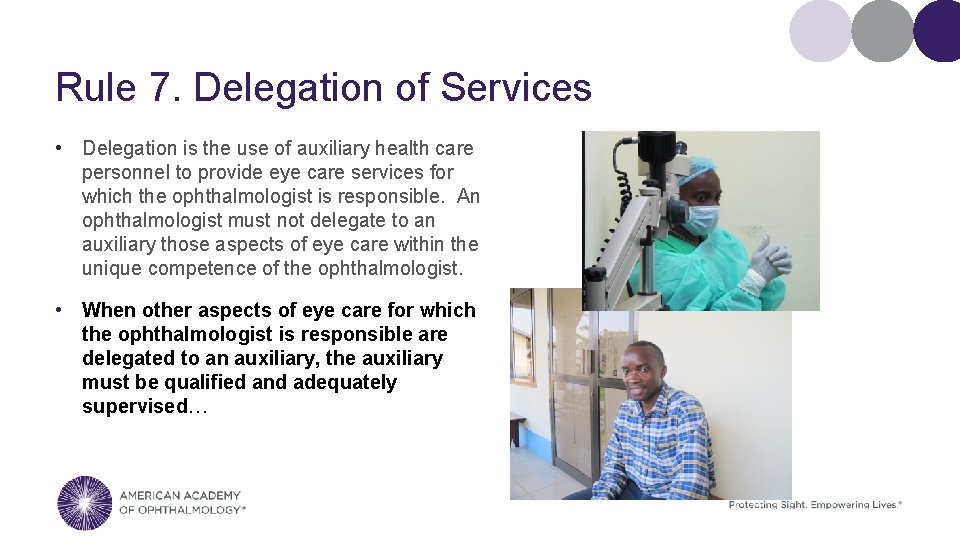
Rule 7. Delegation of Services • Delegation is the use of auxiliary health care personnel to provide eye care services for which the ophthalmologist is responsible. An ophthalmologist must not delegate to an auxiliary those aspects of eye care within the unique competence of the ophthalmologist. • When other aspects of eye care for which the ophthalmologist is responsible are delegated to an auxiliary, the auxiliary must be qualified and adequately supervised…
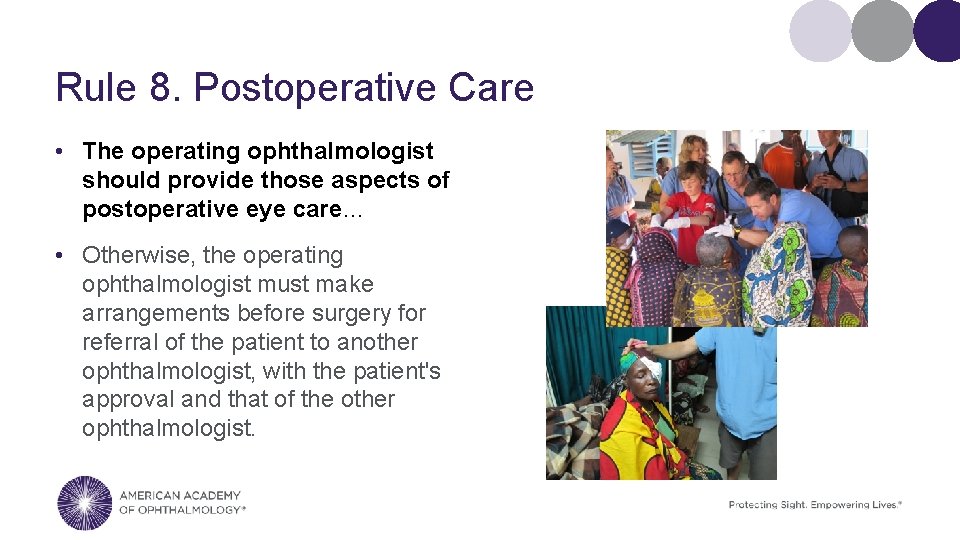
Rule 8. Postoperative Care • The operating ophthalmologist should provide those aspects of postoperative eye care… • Otherwise, the operating ophthalmologist must make arrangements before surgery for referral of the patient to another ophthalmologist, with the patient's approval and that of the other ophthalmologist.
Rule 10. Procedures & Materials • Ophthalmologists should order only those laboratory procedures, optical devices or pharmacological agents that are in the best interest of the patient. Ordering unnecessary procedures or materials or withholding necessary procedures or materials is unethical.
Ethical Considerations • Ophthalmologists should adhere to appropriate standards of ethics and professionalism by acting in the best interests of the patients and thus maintaining the public’s trust in our profession. • Ophthalmologists should keep in mind the potential for devaluing the public’s perception of ophthalmology and medical care in the global arena by putting their own interests ahead of the patients in their host country.

- Slides: 17