
The Ethical Conduct of Research with Humans Human



- Slides: 39
The Ethical Conduct of Research with Humans Human Subjects Division Box 355752 3935 University Way, NE Seattle, WA 98105 -6613 (206) 543 -0098 (T) (206) 685 -9502 (F) http: //depts. washington. edu/hsd
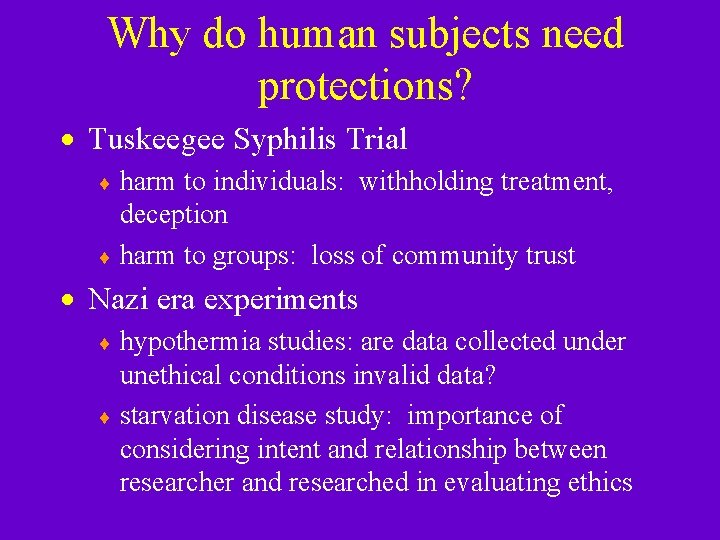
Why do human subjects need protections? · Tuskeegee Syphilis Trial ¨ harm to individuals: withholding treatment, deception ¨ harm to groups: loss of community trust · Nazi era experiments ¨ hypothermia studies: are data collected under unethical conditions invalid data? ¨ starvation disease study: importance of considering intent and relationship between researcher and researched in evaluating ethics
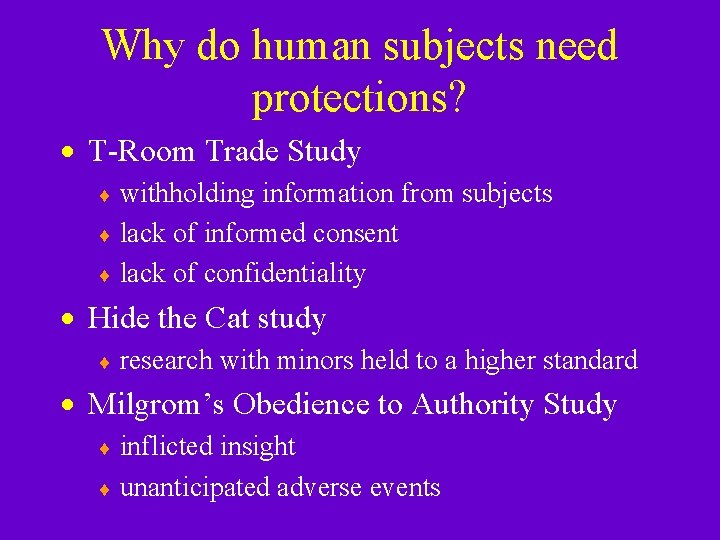
Why do human subjects need protections? · T-Room Trade Study ¨ withholding information from subjects ¨ lack of informed consent ¨ lack of confidentiality · Hide the Cat study ¨ research with minors held to a higher standard · Milgrom’s Obedience to Authority Study ¨ inflicted insight ¨ unanticipated adverse events
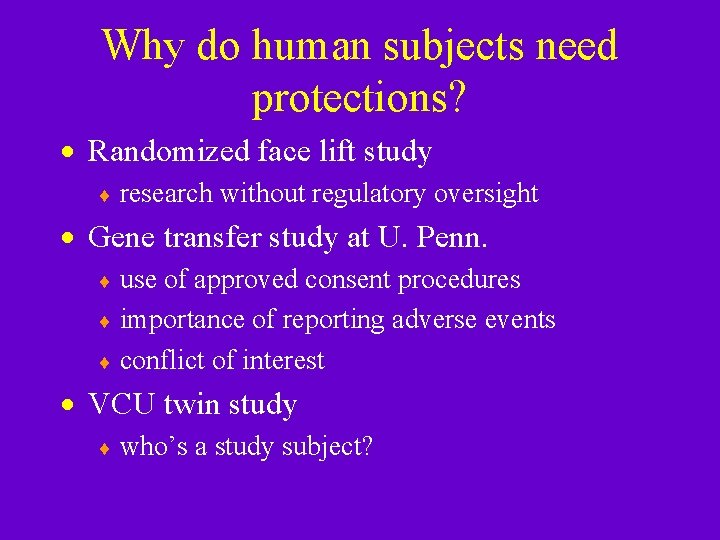
Why do human subjects need protections? · Randomized face lift study ¨ research without regulatory oversight · Gene transfer study at U. Penn. ¨ use of approved consent procedures ¨ importance of reporting adverse events ¨ conflict of interest · VCU twin study ¨ who’s a study subject?
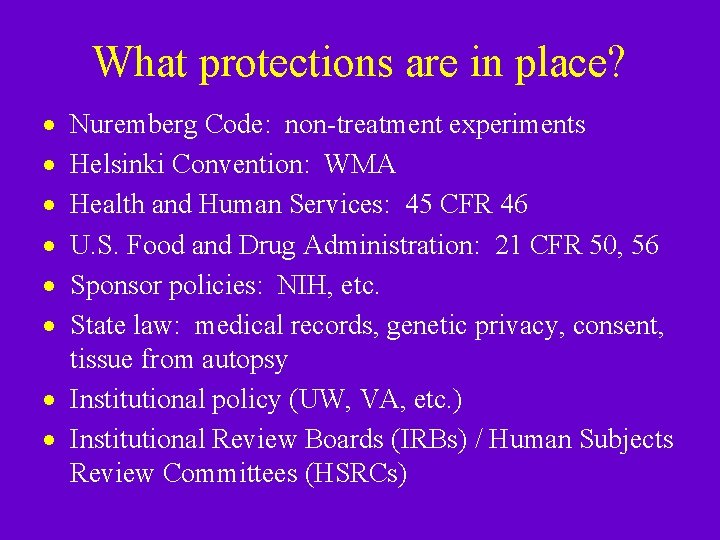
What protections are in place? · · · Nuremberg Code: non-treatment experiments Helsinki Convention: WMA Health and Human Services: 45 CFR 46 U. S. Food and Drug Administration: 21 CFR 50, 56 Sponsor policies: NIH, etc. State law: medical records, genetic privacy, consent, tissue from autopsy · Institutional policy (UW, VA, etc. ) · Institutional Review Boards (IRBs) / Human Subjects Review Committees (HSRCs)
What are my responsibilities as a researcher? · Recognize what activities constitute research with human subjects and obtain appropriate IRB review and approval · Research = A systematic investigation designed to develop or contribute to generalizable knowledge. (45 CFR 46. 102 (d)) -- distinct from “practice” · Human Subject = A living individual about whom an investigator… conducting research obtains (1) Data through intervention or interaction with the individual, or (2) Identifiable private information. (45 CFR 46. 102(f)) · Design research in accord with the ethical principles.
What are the ethical principles on which the regulations and codes are based? · Respect (autonomy of subjects) · Beneficence (benefits outweigh risks) · Justice (selection of subjects is equitable)
The principle of respect · Humans should be treated as autonomous agents · Those with diminished autonomy are entitled to protection · Implementation of principle is informed consent · There is a continuum from prospective explicit informed consent to complete waiver of consent · Issues: ¨ assessing autonomy/competence ¨ assessing comprehension ¨ protecting vulnerable subjects/populations ¨ trust and sharing of authority
Implementing the principle of respect: informed consent · Consent is a continuous process, not a one-time event · based on face-to-face conversation · requires continuing reiteration ~ when initial consent obtained under stress ~ during longitudinal studies · A document · evidentiary, but not a legal contract · useful information for subjects ~ names and contact information ~ reminder about study procedures
Informed Consent · Content of consent process based on requirements stated in the Belmont Report ¨ information ¨ comprehension ¨ voluntariness “While the importance of informed consent is unquestioned, controversy prevails over the nature and possibility of an informed consent. ”
Types of informed consent • • Written consent/assent* forms Oral consent/assent Proxy consent/assent Waiver of consent/assent *Minors younger than 18 years of age and adults not mentally competent to provide legally effective consent must provide “assent. ”
Informed Consent: Basic Rules · · · · Short words Short sentences Large type font, wide margins Avoid technical language or jargon Avoid passive tense Do not use first person voice Do not include exculpatory language Use language of subject population
Informed Consent: Basic Rules · Use written text or narrative approved by IRB · Form must be signed and dated by subject or legally authorized representative · PI or designee administering consent must sign and date · Give copy to subject/ representative · Place in medical record if study is relevant to clinical care
Exceptions to (written) documentation of consent · The consent form is the only record linking subject and research / poses risk, OR · Study risks of harm are no more than minimal · Study involves procedures for which consent is not normally required · Subjects should be provided with documentation if they want to have it
Privacy and Confidentiality · Culture-sensitive; valued highly in U. S. society · Approach issues ¨ Use intermediaries ¨ Create recruitment method through which subjects contact researcher · Using records to screen prospective subjects
Privacy and Confidentiality · Do anonymous research whenever possible · Code data with a unique study code (selfgenerated? ) · Destroy identifiers as soon as possible · Protect data: removable hard drive; master list linking code to names stored securely, separately · Protect phone lines, privacy of interview, phone calls, letters that don't refer to study topic, good building security, etc.
Vulnerable Subjects · · · · Minors, students Prisoners Pregnant women Fetuses Cognitively impaired Educationally and economically disadvantaged People with acute and chronic diseases or conditions
What are the ethical principles on which the regulations and codes are based? · Respect (autonomy of subjects) · Beneficence (benefits outweigh risks) · Justice (selection of subjects is equitable)
Beneficence · Probability of benefits must outweigh risks of harm ¨ clinical equipoise · Study must maximize benefits and minimize risks of harm ¨ ¨ good study design, sample size competent researchers · Benefits to society vs. risks of harm to individuals: apples and oranges ¨ ¨ individual subjects rarely benefit society must place value on research
Beneficence · Benefits: neither over- nor under-state · Types of benefits: ¨ ¨ ¨ direct collateral aspirational · Dimensions of benefits: ¨ ¨ ¨ nature magnitude (size and duration) likelihood
Risks of harm · Harms are not just physiological ¨ Psycho-social: depression, emotional distress, personal relationships ¨ Socio-economic: stigmatization, loss of insurance, employment, benefit program, housing, economic support · Harms are variable by age, gender, ethnicity, and environment · Harms can result to groups as well as individuals
Researcher Responsibilities · Design research in accord with ethical principles ¨ Respect (autonomy of subjects) ¨ Beneficence ¨ Justice (benefits outweigh risks) (selection of subjects is equitable)
What are the ethical principles on which the regulations and codes are based? · Respect (autonomy of subjects) · Beneficence (benefits outweigh risks) · Justice (selection of subjects is equitable)
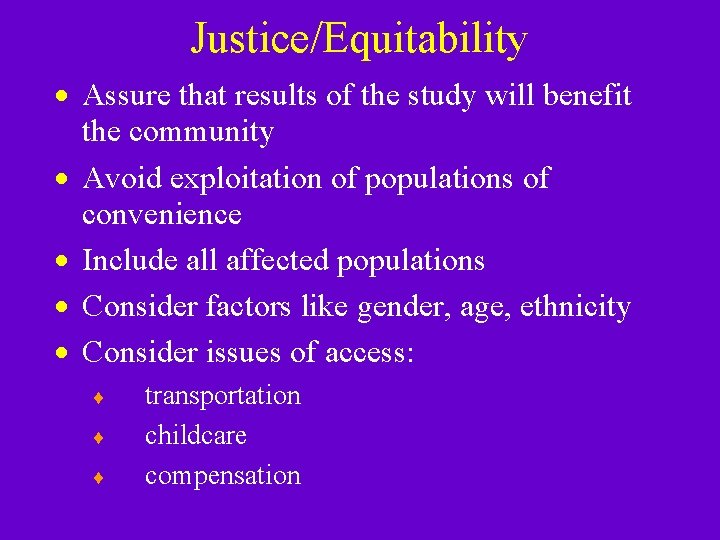
Justice/Equitability · Assure that results of the study will benefit the community · Avoid exploitation of populations of convenience · Include all affected populations · Consider factors like gender, age, ethnicity · Consider issues of access: ¨ ¨ ¨ transportation childcare compensation
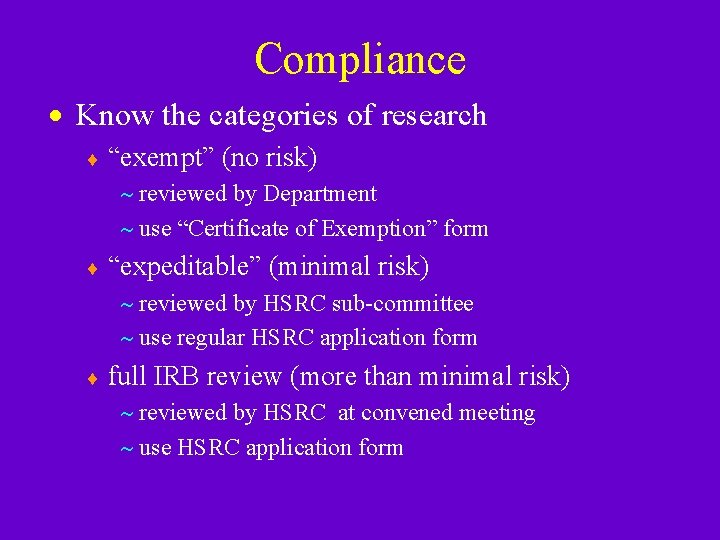
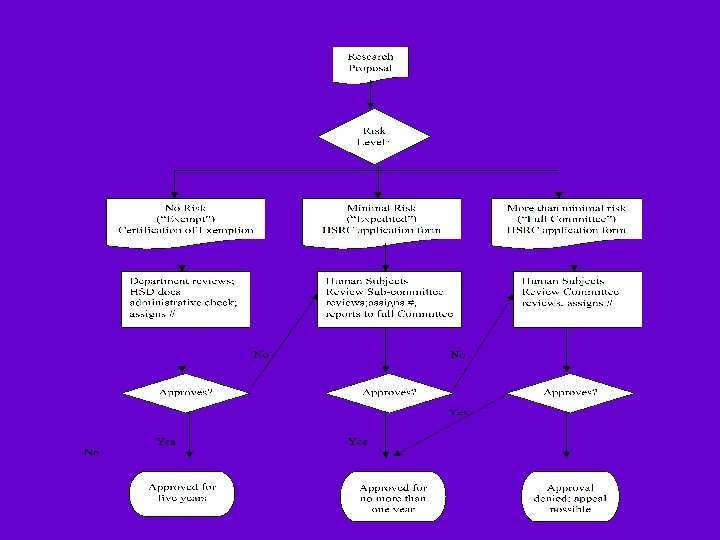
Compliance · Know the categories of research ¨ “exempt” (no risk) ~ reviewed by Department ~ use “Certificate of Exemption” form ¨ “expeditable” (minimal risk) ~ reviewed by HSRC sub-committee ~ use regular HSRC application form ¨ full IRB review (more than minimal risk) ~ reviewed by HSRC at convened meeting ~ use HSRC application form
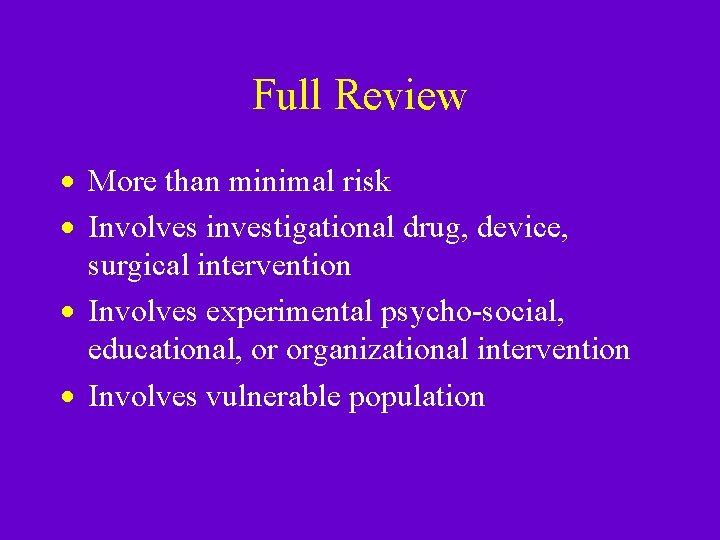
Full Review · More than minimal risk · Involves investigational drug, device, surgical intervention · Involves experimental psycho-social, educational, or organizational intervention · Involves vulnerable population
HSRC/IRB Review · Risk of harm versus potential benefits of study (includes evaluation of study design only when risk-benefit evaluation is problematic) · Protections of subject privacy and confidentiality (recruitment and data management) · Consent process
Researcher Responsibilities · Prepare applications in lay language (Scientific American) · Answer ALL questions -- use “does not apply” if appropriate · In studies of therapeutic or diagnostic interventions, identify what is experimental and what isn’t · Do not conduct research until final IRB approval
Researcher Responsibilities · Assure that non-UW sites obtain IRB approval · Obtain IRB approval for changes before implementation except to prevent immediate harm to subjects · Apply for continuing review and approval well before current approval period expires · Do not conduct research if approval lapses · Report problems promptly
Reporting to IRB, Institution, Sponsor · Unanticipated adverse events or problems · Adverse events that are more frequent or serious than expected · Protocol violations · Subject complaints, withdrawals for cause · Study closure
Researcher Responsibilities DOCUMENT, DOCUMENT · Research protocols · Correspondence · IRB application/approvals · Continuing reviews · Signed consent/assent forms · Original data “If it isn’t written down, we can’t determine if you did it. ”
Hot Topics · Research with human genetic materials ¨ privacy and confidentiality ¨ what to do with test results? · Records-based research ¨ with consent ¨ without consent: Confidentiality Agreements · Registries, subject pools, and data banks ¨ require continuing HSRC approval ¨ require informed consent ¨ may include “layered” consent
Case study You ask a trainee who works in your lab and her husband, whom you ran into in the hall, to donate 10 cc of blood each for one of your established protocols. While enumerating the T cell subsets, you find very low values in the husband. This is worrisome as HIV can cause such low values.
Questions: Do you tell him? Do you tell his wife? What should the consent form have said?
Case study You have developed a new drug for malaria and wish to test it in humans. Since there are too few cases in the United States, you want to test it in Africa on a population at significant risk for malaria. Unfortunately, the drug is quite expensive to manufacture and you are unlikely to be able to make it available to the population of the country chosen for testing.
Questions: Is it ethical to use this population when it will not likely be able to benefit from the research? What will be the considerations regarding informed consent? Should local standards, which may be lax or nonexistent, be used, or should the researchers impose outside standards on the research? Are there obligations of the research team toward the medical community in the country where the testing occurs?
Case Study A researcher proposes to examine communication processing in aphasic patients. The study would involve three separate sessions, in which patients (or age matched controls recruited from local nursing homes) take a battery of word and sound association tests. The total time involved will be 3 -5 hrs. The inclusion criteria for the protocol means that only a few patients (<15) will be available for the study.
Questions: Will the number of research and control subjects in the study allow the investigators to make meaningful statistical comparisons between the groups? Is it reasonable to study whatever patients the investigator can recruit, regardless of considerations of statistical validity? Does this study pose more than minimal risks or harm to the subjects, and, if not, does that make a difference in determining whether or not this study should be conducted?