
The ethical conduct of research with human participants
- Slides: 17
The ethical conduct of research with human participants Nancy E. Kass, Sc. D Department of Health Policy and Management Johns Hopkins Berman Institute of Bioethics
Five minute history of research ethics in the U. S. • Nuremberg Code • Declaration of Helsinki • Public becomes more aware of potential research ethics problems in U. S. funded/conducted studies – Jewish Chronic Disease Hospital – Henry Beecher 1966 NEJM article – Tuskegee study • Tuskegee Ad Hoc panel convened 1972
The National Commission and The Belmont Report • 1974 -1978: National Commission for the Protection of Human Subjects in Behavioral and Biomedical Research • produced Belmont Report , which defined principles for ethical research • Beneficence • Respect for persons • Justice
Three principles of bioethics (from The Belmont Report) • Beneficence: – duty to protect the welfare of participants • Respect for persons – duty to respect autonomous persons, their choices, and their information – Out of respect, duty to protect those less than fully autonomous • Justice – Duty to distribute benefits and burdens fairly
How principles apply to research: beneficence • Risks/benefits: to individuals and communities – Physical – Psychological – Social • Considerations when assessing risk: – Nature of risk – Likelihood of risk – Severity/magnitude of harm – Permanence/reversibility of harm
Study design often consideration of beneficence – Valid design? Valid findings? If not, no benefit – Sufficient sample size? – Is randomization appropriate? – Are placebos appropriate? – Surrogate markers vs. clinical endpoints? – Often can change design to reduce risk
Respect for persons • Requires we go through informed consent process • Requires we provide additional protection for persons who cannot consent themselves • Requires we respect privacy and maintain confidentiality
Elements of informed consent • Disclosure • Understanding • Voluntariness • Capacity (competence)
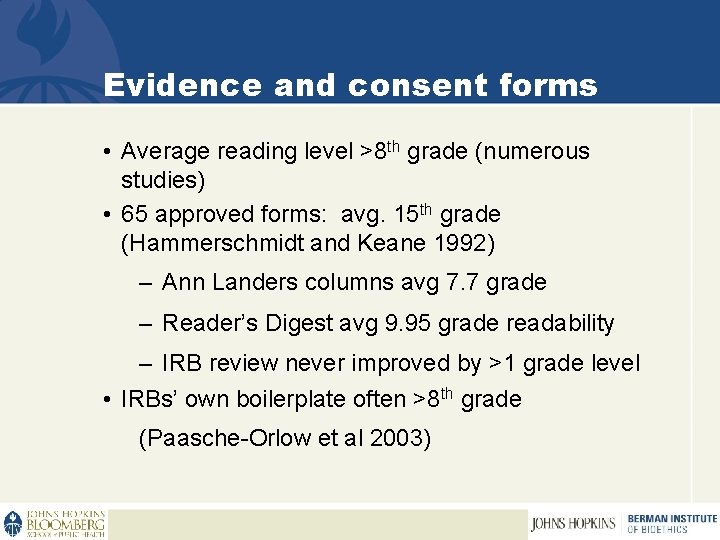
Evidence and consent forms • Average reading level >8 th grade (numerous studies) • 65 approved forms: avg. 15 th grade (Hammerschmidt and Keane 1992) – Ann Landers columns avg 7. 7 grade – Reader’s Digest avg 9. 95 grade readability – IRB review never improved by >1 grade level • IRBs’ own boilerplate often >8 th grade (Paasche-Orlow et al 2003)
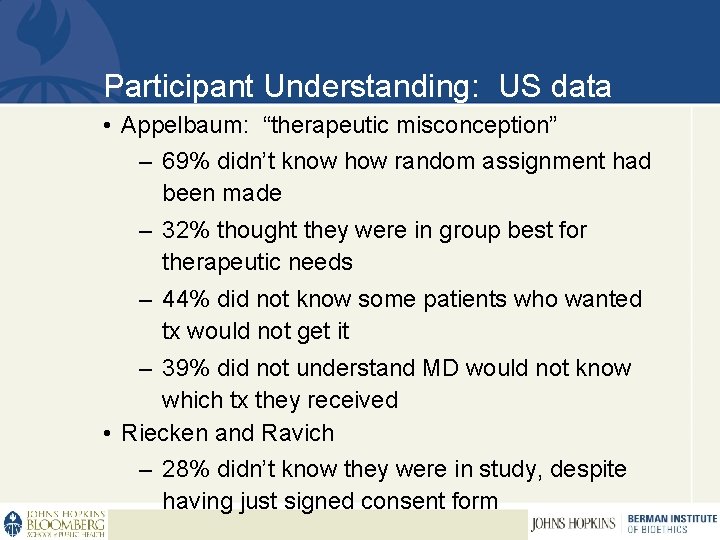
Participant Understanding: US data • Appelbaum: “therapeutic misconception” – 69% didn’t know how random assignment had been made – 32% thought they were in group best for therapeutic needs – 44% did not know some patients who wanted tx would not get it – 39% did not understand MD would not know which tx they received • Riecken and Ravich – 28% didn’t know they were in study, despite having just signed consent form
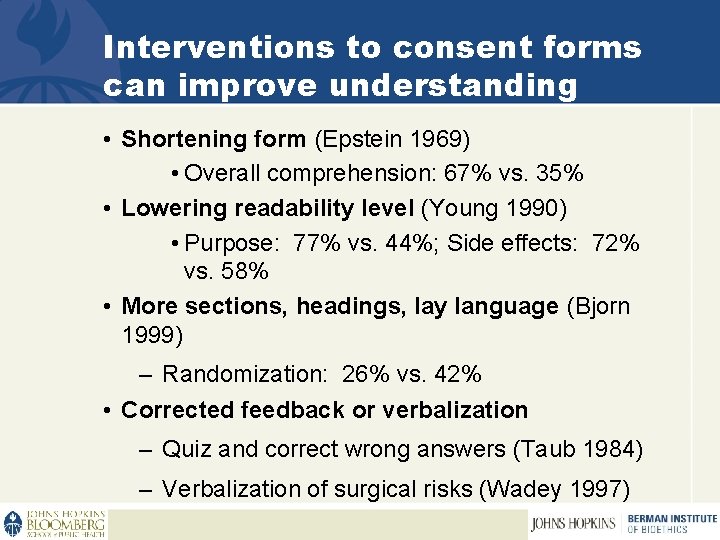
Interventions to consent forms can improve understanding • Shortening form (Epstein 1969) • Overall comprehension: 67% vs. 35% • Lowering readability level (Young 1990) • Purpose: 77% vs. 44%; Side effects: 72% vs. 58% • More sections, headings, lay language (Bjorn 1999) – Randomization: 26% vs. 42% • Corrected feedback or verbalization – Quiz and correct wrong answers (Taub 1984) – Verbalization of surgical risks (Wadey 1997)
Justice • Fair selection of individuals • Fair selection of populations • Opposite is exploitation
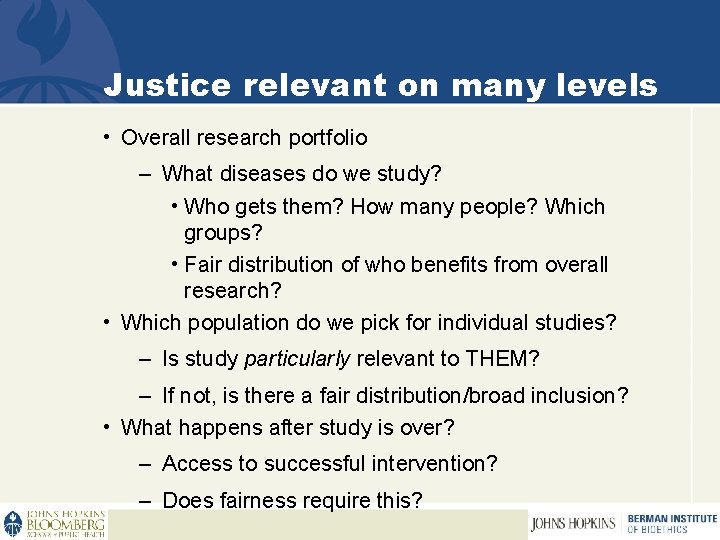
Justice relevant on many levels • Overall research portfolio – What diseases do we study? • Who gets them? How many people? Which groups? • Fair distribution of who benefits from overall research? • Which population do we pick for individual studies? – Is study particularly relevant to THEM? – If not, is there a fair distribution/broad inclusion? • What happens after study is over? – Access to successful intervention? – Does fairness require this?
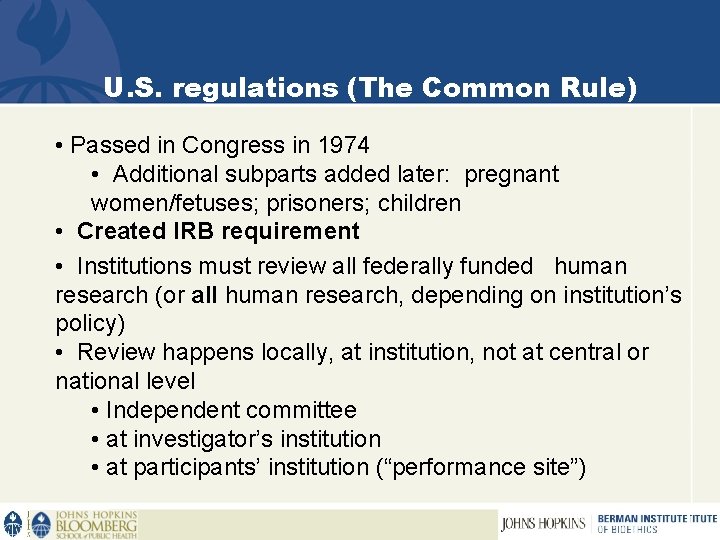
U. S. regulations (The Common Rule) • Passed in Congress in 1974 • Additional subparts added later: pregnant women/fetuses; prisoners; children • Created IRB requirement • Institutions must review all federally funded human research (or all human research, depending on institution’s policy) • Review happens locally, at institution, not at central or national level • Independent committee • at investigator’s institution • at participants’ institution (“performance site”)
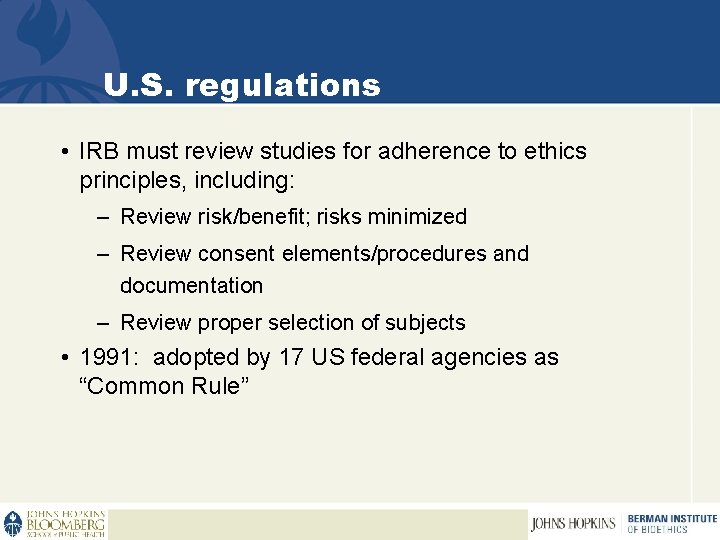
U. S. regulations • IRB must review studies for adherence to ethics principles, including: – Review risk/benefit; risks minimized – Review consent elements/procedures and documentation – Review proper selection of subjects • 1991: adopted by 17 US federal agencies as “Common Rule”
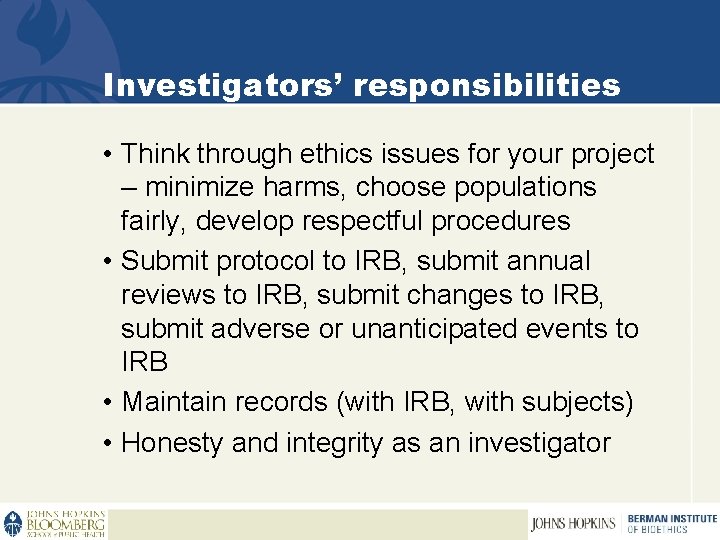
Investigators’ responsibilities • Think through ethics issues for your project – minimize harms, choose populations fairly, develop respectful procedures • Submit protocol to IRB, submit annual reviews to IRB, submit changes to IRB, submit adverse or unanticipated events to IRB • Maintain records (with IRB, with subjects) • Honesty and integrity as an investigator
Regulations and ethics • You must follow regulations • You must be thoughtful about the ethics of your studies • If you’re lucky, these will happen at the same time