
The Eta Model Design History Performance What Lessons




- Slides: 41
The Eta Model: Design, History, Performance, What Lessons have we Learned? Fedor Mesinger NCEP/EMC, and UCAR, Camp Springs, MD; fedor. mesinger@noaa. gov 15 June 2004
Early history: Design of the Eta ancestor code started in Belgrade, first code written beginning of 1973 (Notes on my code worksheets: started January 24, done March 2. In the same time period, on 7 February 1973, for the first time fcst BCs incorporated in the NMC’s first operational PE LAM, the LFM) Aim: use the Arakawa approach • Maintenance of chosen integral properties; • Avoidance of computational modes; • . . . The very first code: some of each
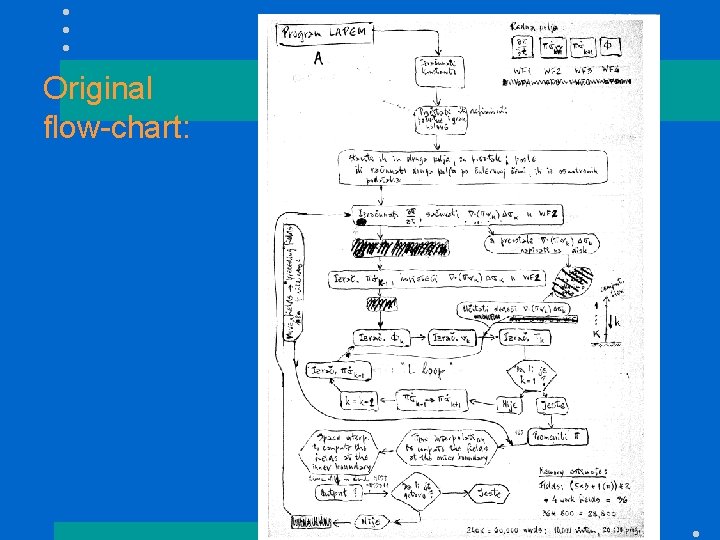
Original flow-chart:
Some of the features of this very first code that survive in today’s Eta • Choice of the E horizontal grid; • Lateral BC scheme BCs prescribed (or, extrapolated from the inside) along a single outer line of grid points (consistent with the mathematical nature of our initial-boundary value problem)
Some of the features of this very first code that survive in today’s Eta • Choice of the E horizontal grid; • Lateral BC scheme BCs prescribed (or, extrapolated from the inside) along a single outer line of grid points (consistent with the mathematical nature of our initial-boundary value problem) Many milestones (see the pdf !) A few: • • gravity-wave coupling scheme (Mesinger 1973, 1974) E-grid enstrophy, energy conservation, “wa”, (Janjic 1977) Janjic (1984) Arakawa C-grid enstrophy … conserving scheme eta coordinate (Mesinger 1984); Eta dynamical core code: Belgrade (Dushka Zupanski), GFDL, NMC (1984), ….
Why eta? I convinced myself (Mesinger 1982) the sigma system problem • seems to have no acceptable solution; • should become more serious as we increase resolution; Quasi-horizontal coordinates are needed !
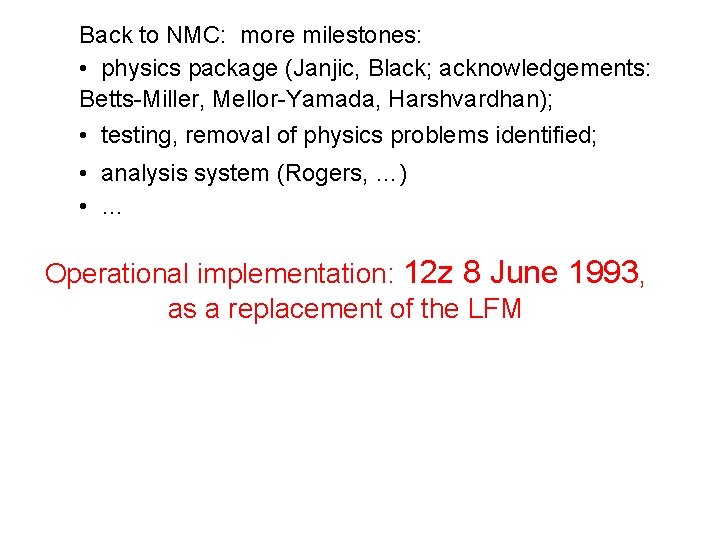
Back to NMC: more milestones: • physics package (Janjic, Black; acknowledgements: Betts-Miller, Mellor-Yamada, Harshvardhan); • testing, removal of physics problems identified; • analysis system (Rogers, …) • … Operational implementation: 12 z 8 June 1993, as a replacement of the LFM
Challenges, and an inadvertent experiment: • Comparisons against the NGM and the RSM; • The “Early” vs the “Meso” Eta; • Eta vs the Avn/GFS
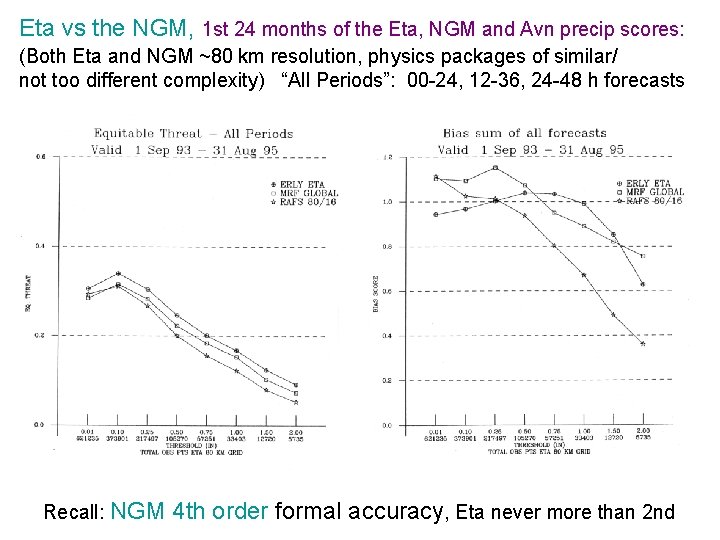
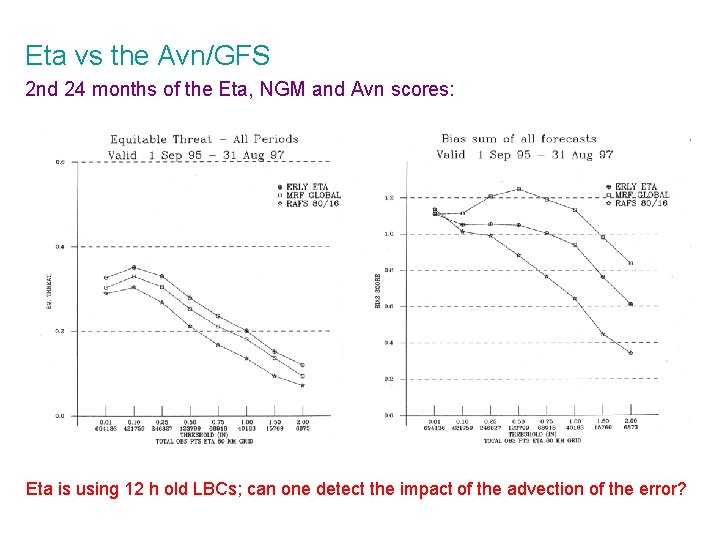
Eta vs the NGM, 1 st 24 months of the Eta, NGM and Avn precip scores: (Both Eta and NGM ~80 km resolution, physics packages of similar/ not too different complexity) “All Periods”: 00 -24, 12 -36, 24 -48 h forecasts Recall: NGM 4 th order formal accuracy, Eta never more than 2 nd
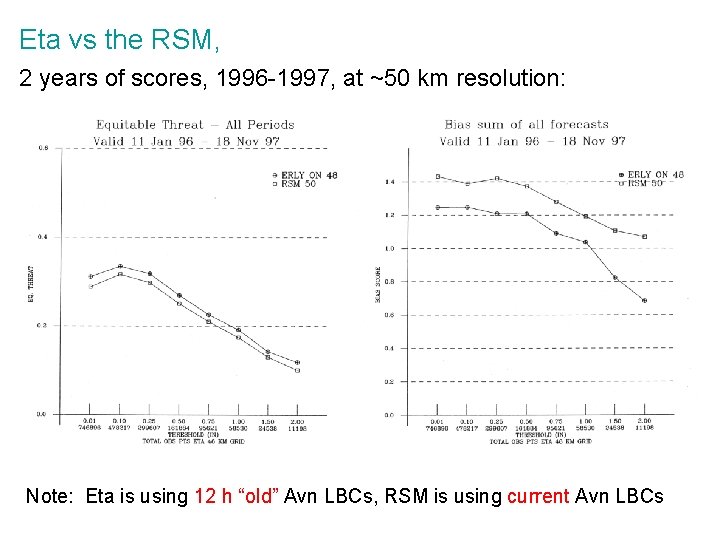
Eta vs the RSM, 2 years of scores, 1996 -1997, at ~50 km resolution: Note: Eta is using 12 h “old” Avn LBCs, RSM is using current Avn LBCs
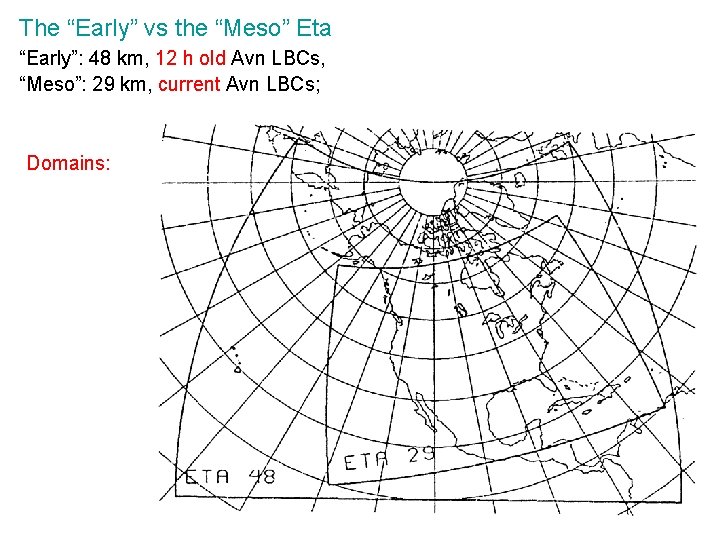
The “Early” vs the “Meso” Eta “Early”: 48 km, 12 h old Avn LBCs, “Meso”: 29 km, current Avn LBCs; Domains:
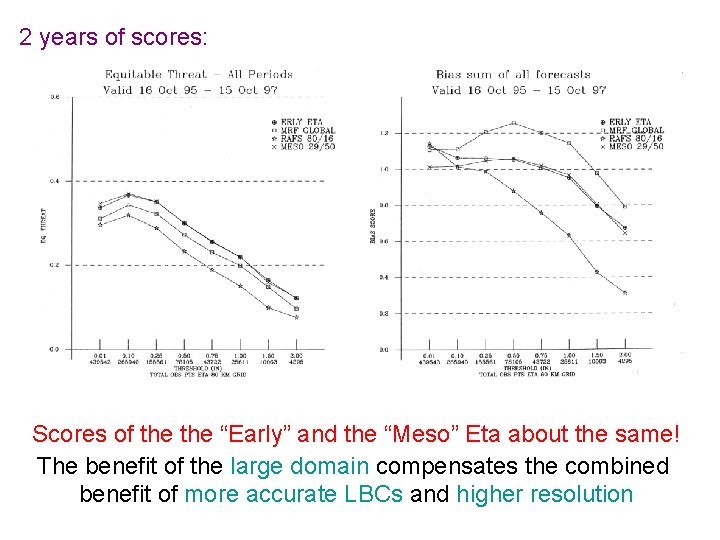
2 years of scores: Scores of the “Early” and the “Meso” Eta about the same! The benefit of the large domain compensates the combined benefit of more accurate LBCs and higher resolution
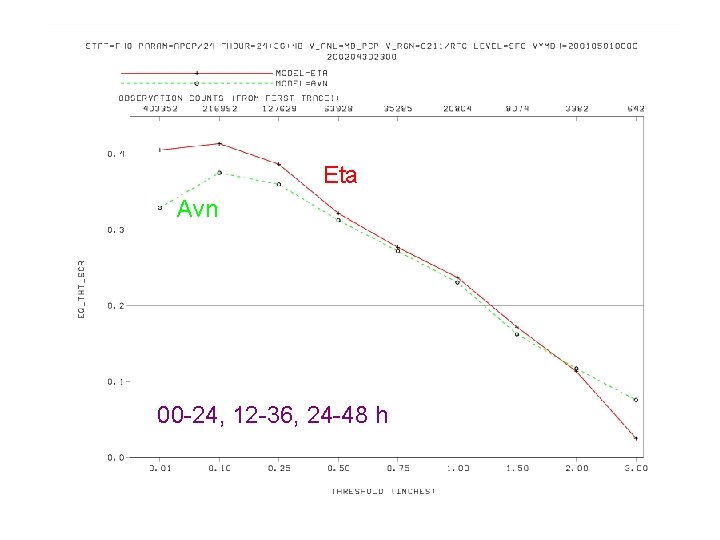
Eta vs the Avn/GFS 2 nd 24 months of the Eta, NGM and Avn scores: Eta is using 12 h old LBCs; can one detect the impact of the advection of the error?
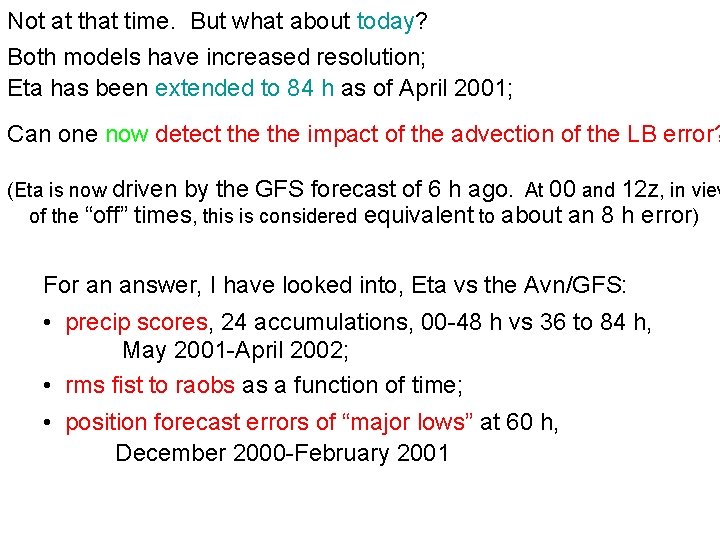
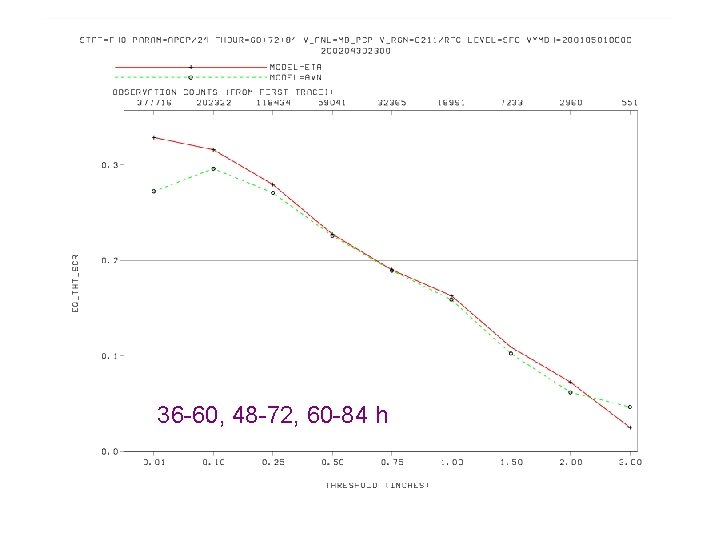
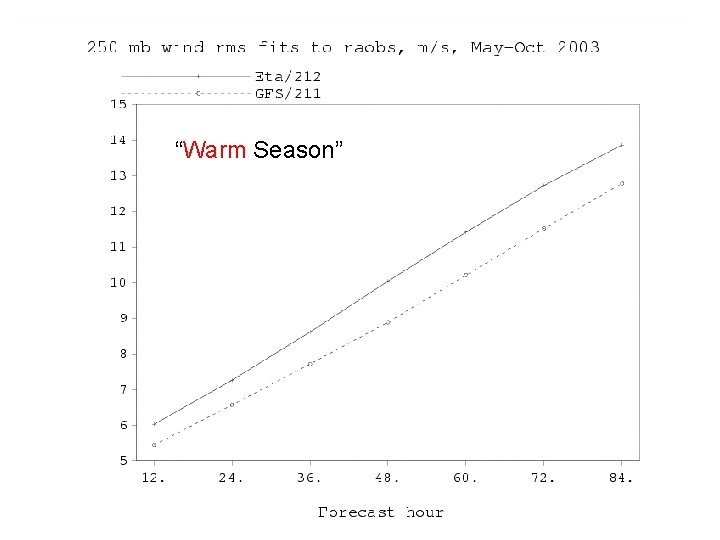
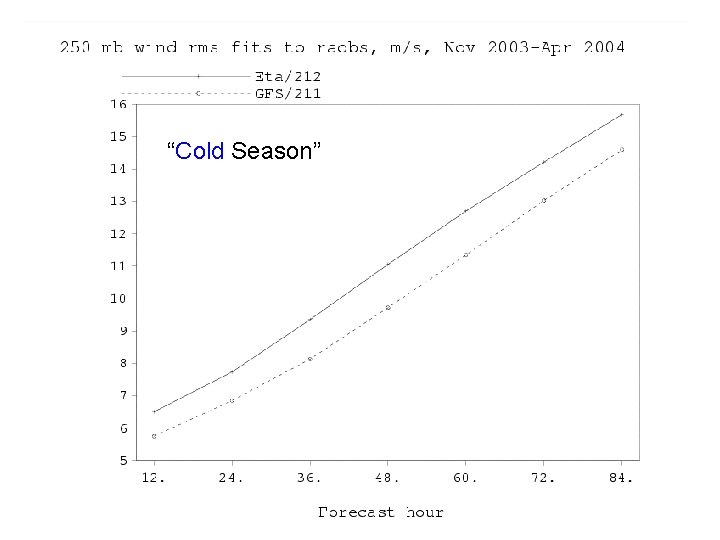
Not at that time. But what about today? Both models have increased resolution; Eta has been extended to 84 h as of April 2001; Can one now detect the impact of the advection of the LB error? (Eta is now driven by the GFS forecast of 6 h ago. At 00 and 12 z, in view of the “off” times, this is considered equivalent to about an 8 h error) For an answer, I have looked into, Eta vs the Avn/GFS: • precip scores, 24 accumulations, 00 -48 h vs 36 to 84 h, May 2001 -April 2002; • rms fist to raobs as a function of time; • position forecast errors of “major lows” at 60 h, December 2000 -February 2001
Eta Avn 00 -24, 12 -36, 24 -48 h
36 -60, 48 -72, 60 -84 h
“Warm Season”
“Cold Season”
In cold season, 250 mb winds, for a 6 months sample, the Eta is • ~10 -11 h behind the GFS at 60 h; • ~9 h behind the GFS at 84 h
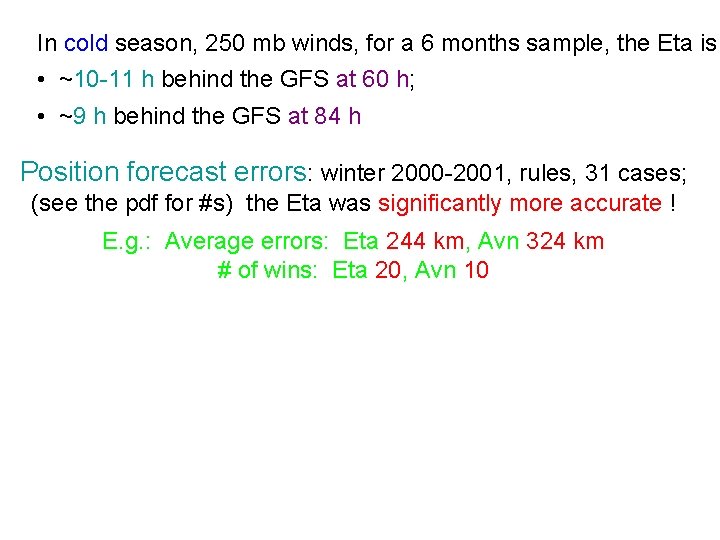
In cold season, 250 mb winds, for a 6 months sample, the Eta is • ~10 -11 h behind the GFS at 60 h; • ~9 h behind the GFS at 84 h Position forecast errors: winter 2000 -2001, rules, 31 cases; (see the pdf for #s) the Eta was significantly more accurate ! E. g. : Average errors: Eta 244 km, Avn 324 km # of wins: Eta 20, Avn 10
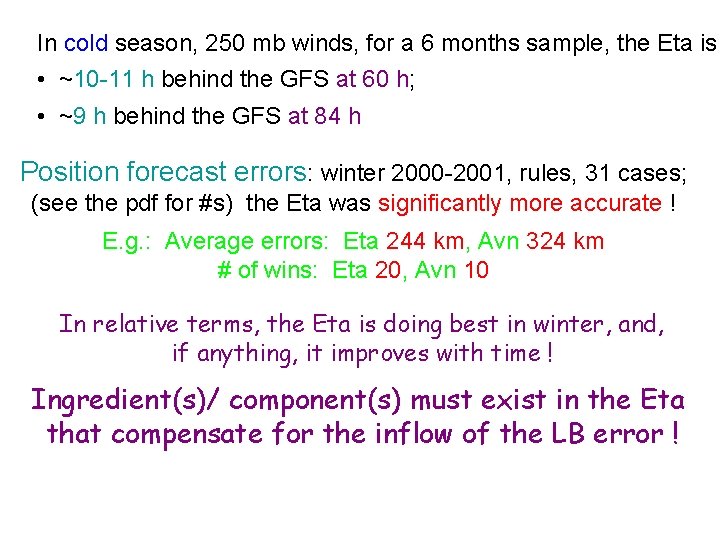
In cold season, 250 mb winds, for a 6 months sample, the Eta is • ~10 -11 h behind the GFS at 60 h; • ~9 h behind the GFS at 84 h Position forecast errors: winter 2000 -2001, rules, 31 cases; (see the pdf for #s) the Eta was significantly more accurate ! E. g. : Average errors: Eta 244 km, Avn 324 km # of wins: Eta 20, Avn 10 In relative terms, the Eta is doing best in winter, and, if anything, it improves with time ! Ingredient(s)/ component(s) must exist in the Eta that compensate for the inflow of the LB error !
Strong case can be made that the primary candidate for this role is the eta coordinate Some of the arguments: • One eta/ sigma experiment; • Precip scores for the 1 st 12 months of the availability of three model scores on NMM domains (Con. US “East”, …, “West”, …)
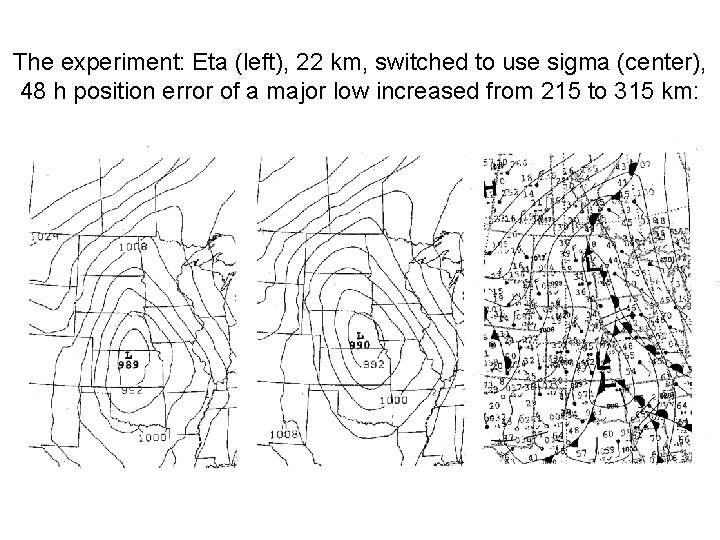
The experiment: Eta (left), 22 km, switched to use sigma (center), 48 h position error of a major low increased from 215 to 315 km:
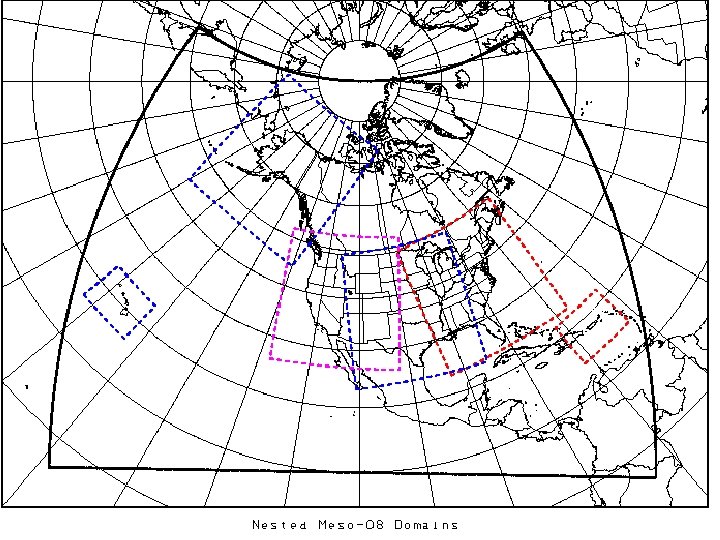
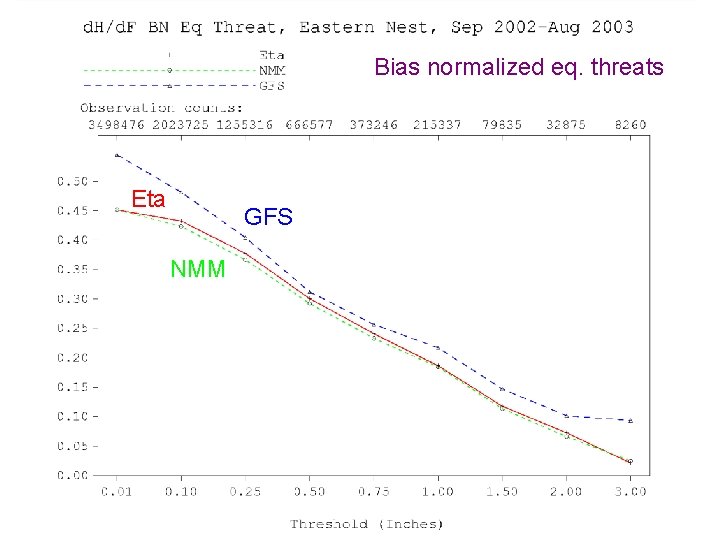
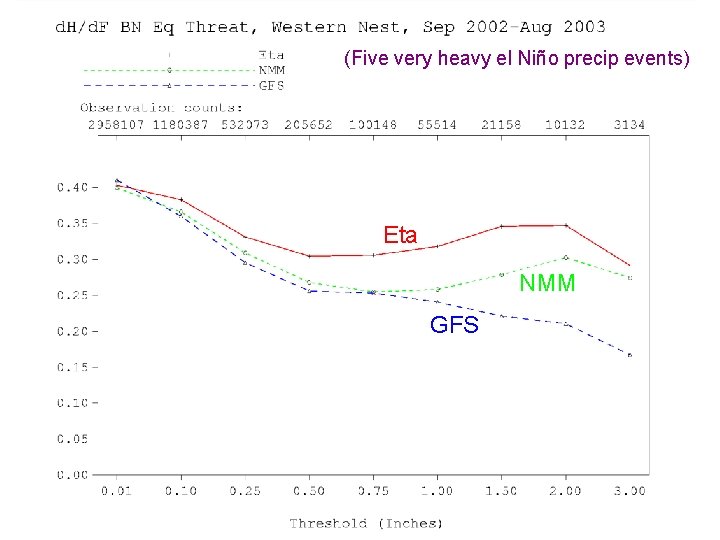
Three-model precipitation scores, on NMM Con. US domains ("East" , …, "West"), available since Sep. 2002 • Operational Eta: 12 km, driven by 6 h old GFS forecasts; • NMM: “Nonhydrostatic Mesoscale Model” nonhydrostatic, 8 km, most other features same or similar to Eta, but switched back to sigma, driven by the Eta; • GFS (Global Forecasting System) as of the end of Oct. 2002 T 254 (55 km) resolution
Bias normalized eq. threats Eta GFS NMM
(Five very heavy el Niño precip events) Eta NMM GFS
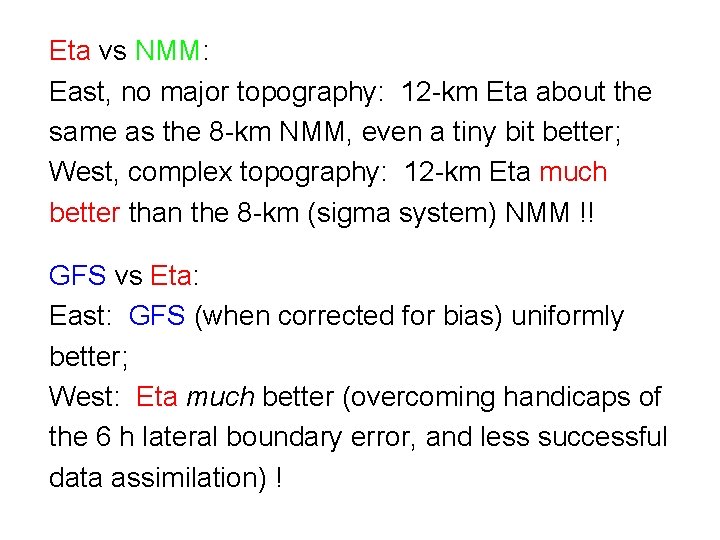
Eta vs NMM: East, no major topography: 12 -km Eta about the same as the 8 -km NMM, even a tiny bit better; West, complex topography: 12 -km Eta much better than the 8 -km (sigma system) NMM !! GFS vs Eta: East: GFS (when corrected for bias) uniformly better; West: Eta much better (overcoming handicaps of the 6 h lateral boundary error, and less successful data assimilation) !
However: what about a lot of bad press the eta had lately: Schär et al. , Mon. Wea. Rev. , 2002; Janjic, Meteor. Atmos. Phys. , 2003; Steppeler et al. , Meteor. Atmos. Phys. , 2003; Mass et al. , Bull. Amer. Meteor. Soc. , 2003; Zängl, Mon. Wea. Rev. , 2003; the eta coordinate system is "ill suited for high resolution prediction models” ?
The Eta Problem Flow separation on the lee side (à la Gallus and Klemp 2000)
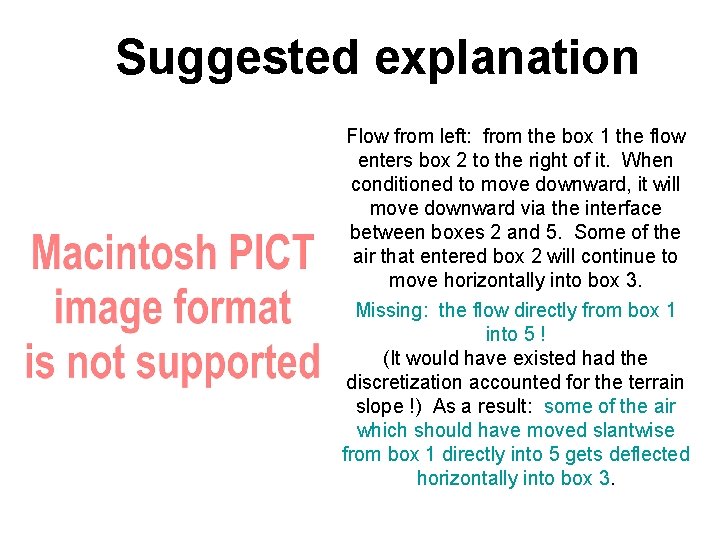
Suggested explanation Flow from left: from the box 1 the flow enters box 2 to the right of it. When conditioned to move downward, it will move downward via the interface between boxes 2 and 5. Some of the air that entered box 2 will continue to move horizontally into box 3. Missing: the flow directly from box 1 into 5 ! (It would have existed had the discretization accounted for the terrain slope !) As a result: some of the air which should have moved slantwise from box 1 directly into 5 gets deflected horizontally into box 3.
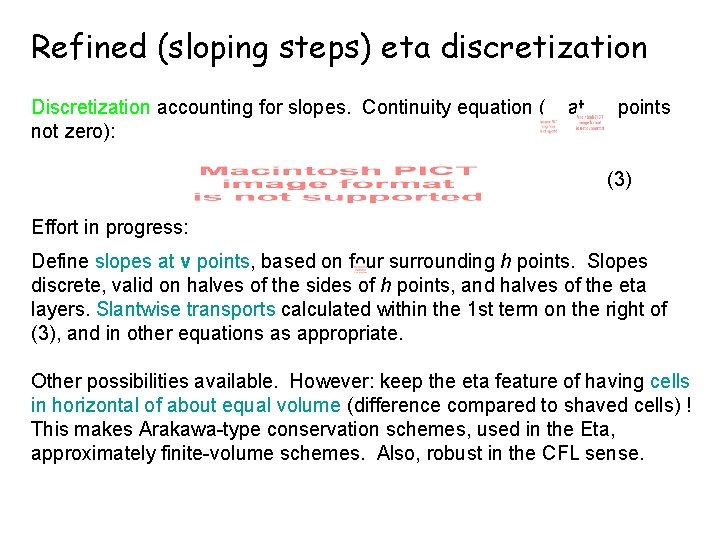
Refined (sloping steps) eta discretization Discretization accounting for slopes. Continuity equation ( not zero): at points (3) Effort in progress: Define slopes at v points, based on four surrounding h points. Slopes discrete, valid on halves of the sides of h points, and halves of the eta layers. Slantwise transports calculated within the 1 st term on the right of (3), and in other equations as appropriate. Other possibilities available. However: keep the eta feature of having cells in horizontal of about equal volume (difference compared to shaved cells) ! This makes Arakawa-type conservation schemes, used in the Eta, approximately finite-volume schemes. Also, robust in the CFL sense.
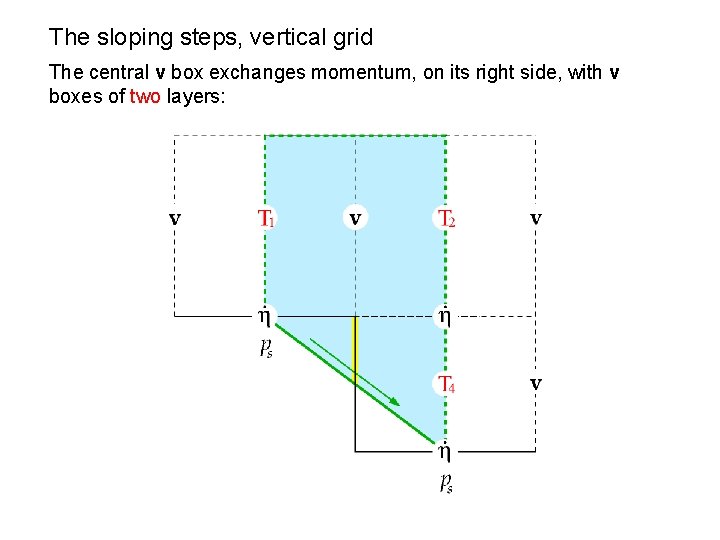
The sloping steps, vertical grid The central v box exchanges momentum, on its right side, with v boxes of two layers:
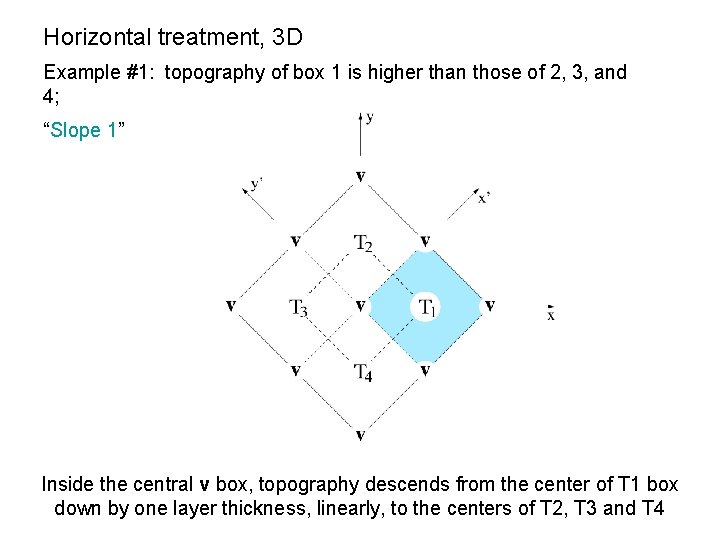
Horizontal treatment, 3 D Example #1: topography of box 1 is higher than those of 2, 3, and 4; “Slope 1” Inside the central v box, topography descends from the center of T 1 box down by one layer thickness, linearly, to the centers of T 2, T 3 and T 4
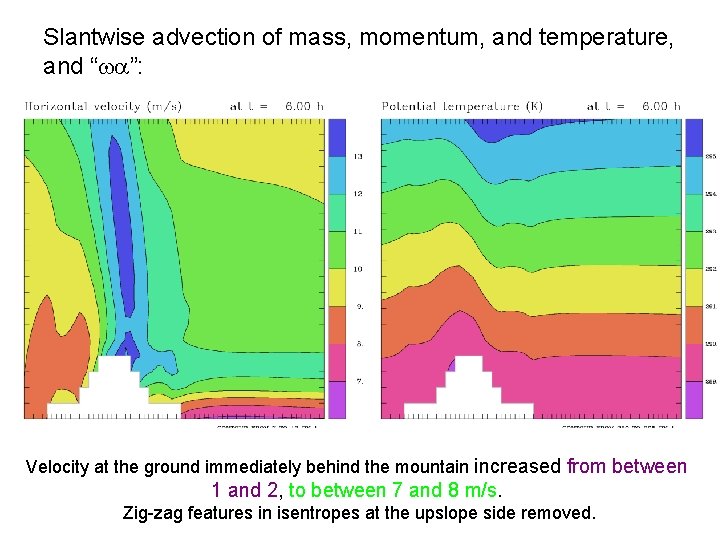
Slantwise advection of mass, momentum, and temperature, and “wa”: Velocity at the ground immediately behind the mountain increased from between 1 and 2, to between 7 and 8 m/s. Zig-zag features in isentropes at the upslope side removed.
Thus, 12 -km Eta: excellent QPF performance over complex topography ! Better than the sigma system 8 -km NMM, and better than the GFS; The Eta downslope windstorm problem: correctible, while keeping favorable Eta features: • quasi horizontal coordinates (PGF !); • approximately finite-volume (because of the quasihorizontal coordinate and flux-type schemes); • robustness in the CFL sense
“The Future of NWP”: Can one still significantly increase the skill of NWP ? Yes. How can we tell?
“The Future of NWP”: Can one still significantly increase the skill of NWP ? Yes. How can we tell? Eta view of things: • The Eta skill at NCEP – throughout its extended forecast range – is comparable to that of GFS, in spite of its handicaps of 1) absorbing a 6 (or, 8) h error advected at the lateral boundaries; 2) using a considerably less successful data assimilation system
“The Future of NWP”: Can one still significantly increase the skill of NWP ? Yes. How can we tell? Eta view of things: • The Eta skill at NCEP – throughout its extended forecast range – is comparable to that of GFS, in spite of its handicaps of 1) absorbing a 6 (or, 8) h error advected at the lateral boundaries; 2) using a considerably less successful data assimilation system The LB error, 1), is removed by • having a global Eta-like model, or • running a global model and the Eta simultaneously
Eta rms wind fits to raobs vs same except in. cnd. interpolated from GFS October 2002 -May 2003, 48 h fcsts: At 250 -300 mb, error reduced more than 10%
The two operational Eta handicaps: Each on the order of 10% error at 48 h; both can be removed/ improved upon ! • - Numerous options to improve the Eta further. Dynamical core: Sloping steps; Advection of scalars: piecewise linear, or biparabolic (Rancic); Gravity wave coupling: do momentum equation forward; Lateral boundaries: avoid space interpolation … … And: discretizations still more consistent with “physics”; and/or, physics that moves away from forcing at individual grid points