
The essence of strategy lies in creating tomorrows






- Slides: 69
The essence of strategy lies in creating tomorrow’s competitive advantages faster than competitors mimic the ones you possess today. Gary Hamel and C. K. Prahalad Strategies for taking the hill won’t necessarily hold it. Amar Bhide “Quote”
Chapter Outline l l l Generic Competitive Strategies 4 Low-Cost Leadership Strategy 4 Broad Differentiation Strategies 4 Best-Cost Provider Strategies 4 Focused Low-Cost Strategies 4 Focused Differentiation Strategies Vertical Integration Strategies Cooperative Strategies Offensive and Defensive Strategies First-Mover Advantages and Disadvantages 2 Irwin/Mc. Graw-Hill © The Mc. Graw-Hill Companies, Inc. , 1998
Strategy and Competitive Advantage l COMPETITIVE ADVANTAGE exists when a firm’s strategy gives it an edge in 4 Defending against competitive forces and 4 Securing customers Key to Success l Convince customers firm’s product / service offers SUPERIOR VALUE 4 Offer buyers a good product at a lower price 4 Use differentiation to provide a better product buyers think is worth a premium price Irwin/Mc. Graw-Hill © The Mc. Graw-Hill Companies, Inc. , 1998 3
What Is Competitive Strategy? Consists of business approaches to 4 Attract customers, fulfilling their expectations 4 Withstand competitive pressures 4 Strengthen market position l Includes offensive and defensive moves to 4 Counter actions of key rivals 4 Shift resources to improve long-term market position 4 Respond to prevailing market conditions l Narrower in scope than business strategy l 4 Irwin/Mc. Graw-Hill © The Mc. Graw-Hill Companies, Inc. , 1998
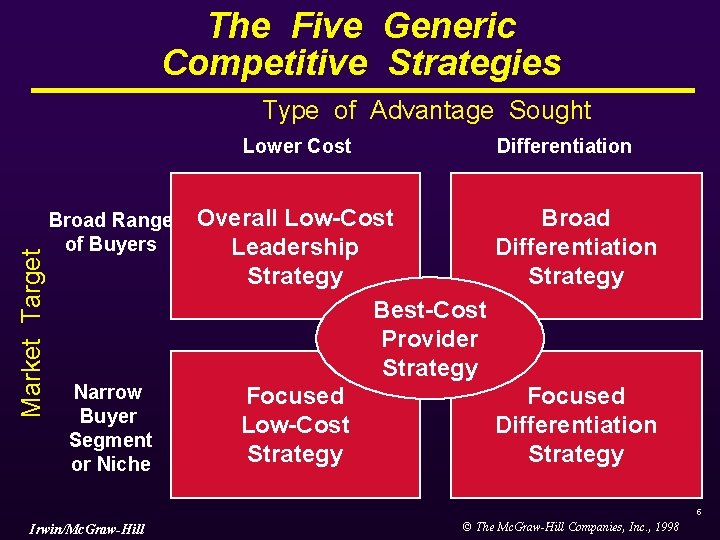
The Five Generic Competitive Strategies Type of Advantage Sought Market Target Lower Cost Broad Range of Buyers Narrow Buyer Segment or Niche Differentiation Overall Low-Cost Broad Leadership Differentiation Strategy Best-Cost Provider Strategy Focused Low-Cost Differentiation Strategy 5 Irwin/Mc. Graw-Hill © The Mc. Graw-Hill Companies, Inc. , 1998
A Low-Cost Leadership Strategy Objective l Open up a sustainable cost advantage over rivals, using lower-cost edge as a basis either to 4 Under-price rivals and reap market share gains OR 4 Earn higher profit margin selling at going price 6 Irwin/Mc. Graw-Hill © The Mc. Graw-Hill Companies, Inc. , 1998
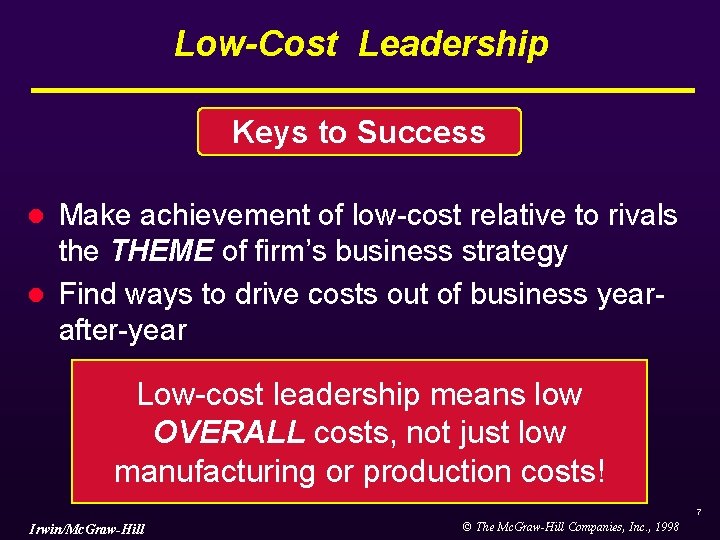
Low-Cost Leadership Keysto to Success Keys Make achievement of low-cost relative to rivals the THEME of firm’s business strategy l Find ways to drive costs out of business yearafter-year l Low-costleadershipmeanslow OVERALL costs, notnot just lowlow OVERALL costs, manufacturing or or production costs! 7 Irwin/Mc. Graw-Hill © The Mc. Graw-Hill Companies, Inc. , 1998
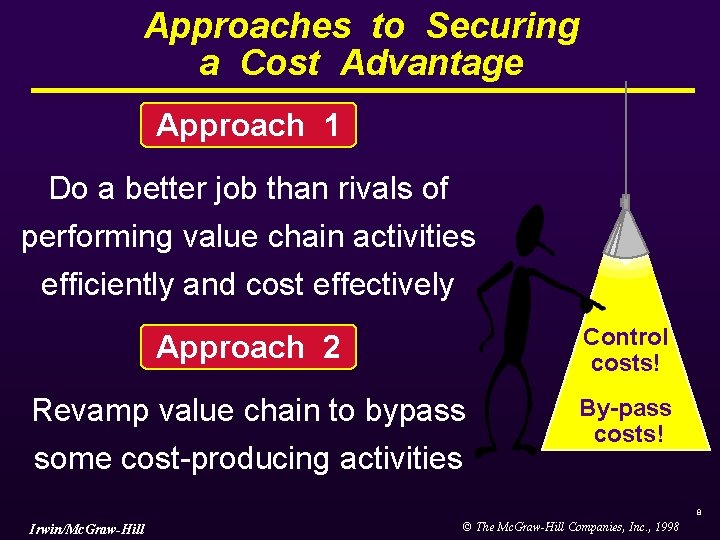
Approaches to Securing a Cost Advantage Approach 1 Do a better job than rivals of performing value chain activities efficiently and cost effectively Approach 2 Control costs! Revamp value chain to bypass some cost-producing activities By-pass costs! 8 Irwin/Mc. Graw-Hill © The Mc. Graw-Hill Companies, Inc. , 1998
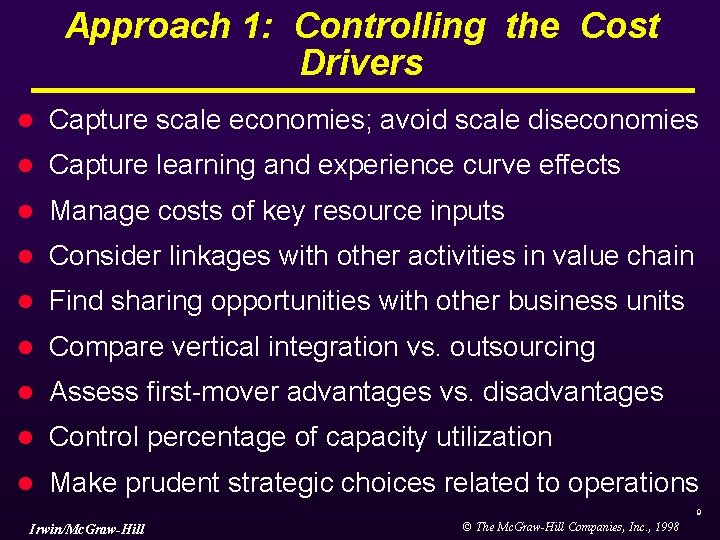
Approach 1: Controlling the Cost Drivers l Capture scale economies; avoid scale diseconomies l Capture learning and experience curve effects l Manage costs of key resource inputs l Consider linkages with other activities in value chain l Find sharing opportunities with other business units l Compare vertical integration vs. outsourcing l Assess first-mover advantages vs. disadvantages l Control percentage of capacity utilization l Make prudent strategic choices related to operations 9 Irwin/Mc. Graw-Hill © The Mc. Graw-Hill Companies, Inc. , 1998
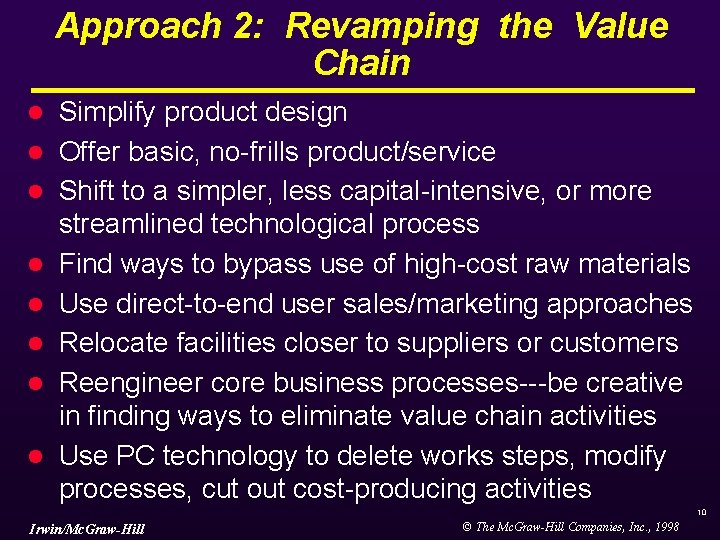
Approach 2: Revamping the Value Chain l l l l Simplify product design Offer basic, no-frills product/service Shift to a simpler, less capital-intensive, or more streamlined technological process Find ways to bypass use of high-cost raw materials Use direct-to-end user sales/marketing approaches Relocate facilities closer to suppliers or customers Reengineer core business processes---be creative in finding ways to eliminate value chain activities Use PC technology to delete works steps, modify processes, cut out cost-producing activities 10 Irwin/Mc. Graw-Hill © The Mc. Graw-Hill Companies, Inc. , 1998
Characteristics of a Low-Cost Provider l Cost conscious corporate culture Employee participation in cost-control efforts l Ongoing efforts to benchmark costs l Intensive scrutiny of budget requests l Programs promoting continuous cost improvement l Low-cost producers champion Successful low-cost producers FRUGALITY while aggressively frugality but wisely and aggressively INVESTING in cost-saving improvements! invest in cost-saving improvements ! 11 Irwin/Mc. Graw-Hill © The Mc. Graw-Hill Companies, Inc. , 1998
What Company Managers Have to Do to Achieve Low-Cost Leadership Scrutinize each cost-creating activity, identifying cost drivers l Use knowledge about cost drivers to manage costs of each activity down year after year l Find ways to reengineer how activities are performed and coordinated---eliminate unnecessary work steps l Be creative in cutting some activities out of value chain system---re-invent the industry value chain l 12 Irwin/Mc. Graw-Hill © The Mc. Graw-Hill Companies, Inc. , 1998
The Competitive Strengths of Low-Cost Leadership l Better positioned than RIVAL COMPETITORS to compete offensively on basis of price l Low-cost provides some protection from bargaining leverage of powerful BUYERS l Low-cost provides some protection from bargaining leverage of powerful SUPPLIERS l Low-cost provider’s pricing power acts as a significant barrier for POTENTIAL ENTRANTS l Low cost puts a company in position to use low price as a defense against SUBSTITUTES 13 Irwin/Mc. Graw-Hill © The Mc. Graw-Hill Companies, Inc. , 1998
A Low-Cost Strategy Works Best When: l l l Price competition is vigorous Product is standardized or readily available from many suppliers There are few ways to achieve differentiation that have value Most buyers use product in same ways Buyers incur low switching costs Buyers are large and have significant bargaining power 14 Irwin/Mc. Graw-Hill © The Mc. Graw-Hill Companies, Inc. , 1998
Pitfalls of Low-Cost Strategies Being overly aggressive in cutting price (revenue erosion of lower price is not offset by gains in sales volume--profits go down, not up) l Low cost methods are easily imitated by rivals l Becoming too fixated on reducing costs and ignoring 4 Buyer interest in additional features 4 Declining buyer sensitivity to price 4 Changes in how the product is used l Technological breakthroughs open up cost reductions for rivals l Irwin/Mc. Graw-Hill © The Mc. Graw-Hill Companies, Inc. , 1998 15
Differentiation Strategies Objective l Incorporate differentiating features that cause buyers to prefer firm’s product or service over the brands of rivals Keys to Success Find ways to differentiate that CREATE VALUE for buyers and that are NOT EASILY MATCHED or CHEAPLY COPIED by rivals l Not spending more to achieve differentiation than the price premium that can be charged l Irwin/Mc. Graw-Hill © The Mc. Graw-Hill Companies, Inc. , 1998 16
The Appeal of Differentiation Strategies l A powerful competitive approach when uniqueness can be achieved in ways that 4 Buyers 4 Rivals 4 Can perceive as valuable find hard to match or copy be incorporated at a cost well below the price premium that buyers will pay Which hat is unique? 17 Irwin/Mc. Graw-Hill © The Mc. Graw-Hill Companies, Inc. , 1998
The Benefits of Successful Differentiation A product / service with unique and appealing attributes allows a firm to 4 Command a premium price and/or 4 Increase unit sales and/or 4 Build brand loyalty = Competitive Advantage 18 Irwin/Mc. Graw-Hill © The Mc. Graw-Hill Companies, Inc. , 1998
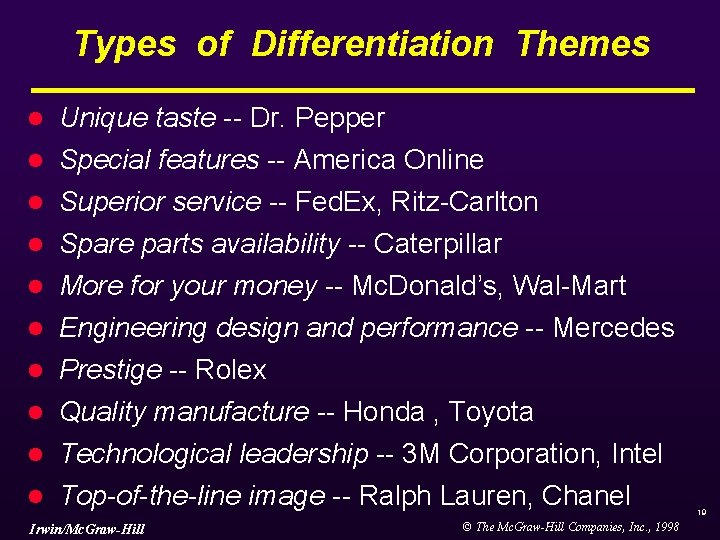
Types of Differentiation Themes l Unique taste -- Dr. Pepper l Special features -- America Online l Superior service -- Fed. Ex, Ritz-Carlton l Spare parts availability -- Caterpillar More for your money -- Mc. Donald’s, Wal-Mart Engineering design and performance -- Mercedes Prestige -- Rolex Quality manufacture -- Honda , Toyota Technological leadership -- 3 M Corporation, Intel Top-of-the-line image -- Ralph Lauren, Chanel l l l Irwin/Mc. Graw-Hill © The Mc. Graw-Hill Companies, Inc. , 1998 19
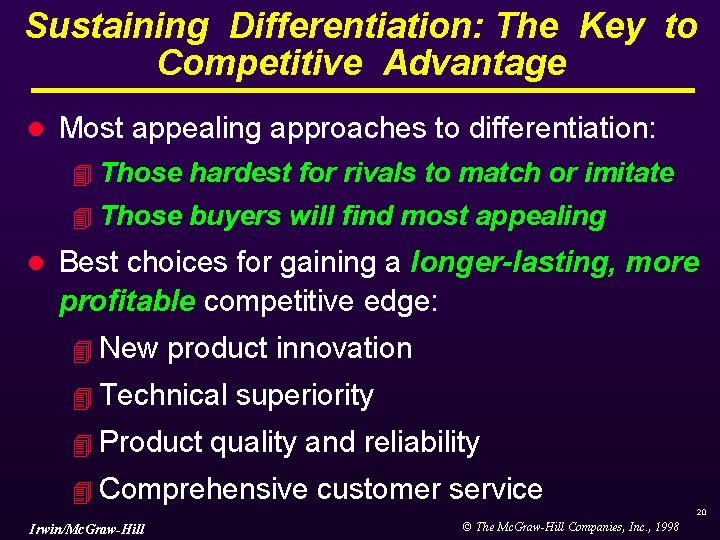
Sustaining Differentiation: The Key to Competitive Advantage l l Most appealing approaches to differentiation: 4 Those hardest for rivals to match or imitate 4 Those buyers will find most appealing Best choices for gaining a longer-lasting, more profitable competitive edge: 4 New product innovation 4 Technical 4 Product superiority quality and reliability 4 Comprehensive customer service 20 Irwin/Mc. Graw-Hill © The Mc. Graw-Hill Companies, Inc. , 1998
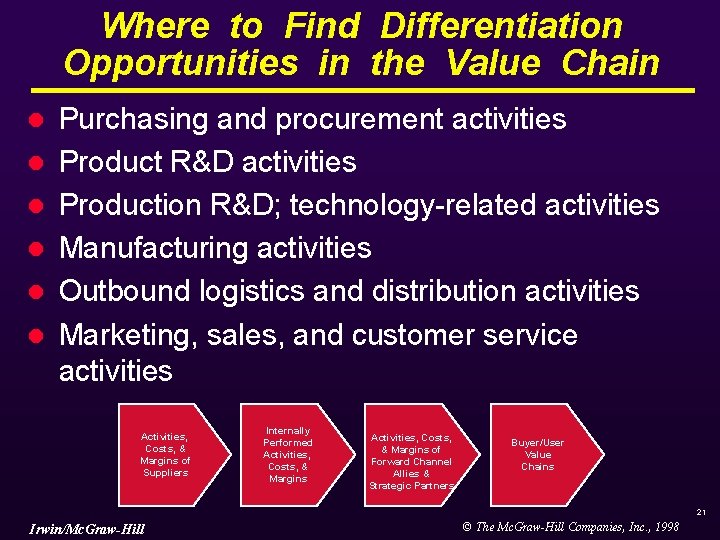
Where to Find Differentiation Opportunities in the Value Chain l l l Purchasing and procurement activities Product R&D activities Production R&D; technology-related activities Manufacturing activities Outbound logistics and distribution activities Marketing, sales, and customer service activities Activities, Costs, & Margins of Suppliers Internally Performed Activities, Costs, & Margins of Forward Channel Allies & Strategic Partners Buyer/User Value Chains 21 Irwin/Mc. Graw-Hill © The Mc. Graw-Hill Companies, Inc. , 1998
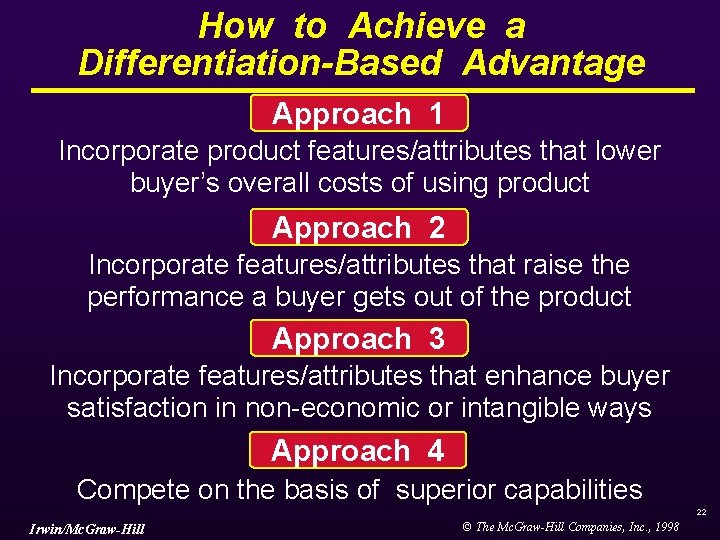
How to Achieve a Differentiation-Based Advantage Approach 1 Incorporate product features/attributes that lower buyer’s overall costs of using product Approach 2 Incorporate features/attributes that raise the performance a buyer gets out of the product Approach 3 Incorporate features/attributes that enhance buyer satisfaction in non-economic or intangible ways Approach 4 Compete on the basis of superior capabilities 22 Irwin/Mc. Graw-Hill © The Mc. Graw-Hill Companies, Inc. , 1998
Signaling Value as Well as Delivering Value Buyers seldom pay for value that is not perceived l Signals of value may be as important as actual value when 4 Nature of differentiation is hard to quantify 4 Buyers are making first-time purchases 4 Repurchase is infrequent 4 Buyers are unsophisticated l 23 Irwin/Mc. Graw-Hill © The Mc. Graw-Hill Companies, Inc. , 1998
The Competitive Strengths of a Differentiation Strategy l l l Buyers develop loyalty to brand they like best--can beat RIVAL COMPETITORS in the marketplace Mitigates bargaining power of large BUYERS since other products are less attractive Differentiation puts a seller in better position to withstand efforts of SUPPLIERS to raise prices Buyer loyalty acts as a barrier to POTENTIAL ENTRANTS Differentiation puts a seller in better position to fend off threats of SUBSTITUTES not having comparable features 24 Irwin/Mc. Graw-Hill © The Mc. Graw-Hill Companies, Inc. , 1998
A Differentiation Strategy Works Best When: l There are many ways to differentiate a product that have value and please customers l Buyer needs and uses are diverse l Few rivals are following a similar type of differentiation approach l Technological change is fast-paced and competition is focused on evolving product features 25 Irwin/Mc. Graw-Hill © The Mc. Graw-Hill Companies, Inc. , 1998
What Can Make a Differentiation Strategy Fail l l Trying to differentiate on a feature buyers do not perceive as lowering their cost or enhancing their well-being Over-differentiating such that product features exceed buyers’ needs Charging a price premium that buyers perceive is too high Failing to signal value Not understanding what buyers want or prefer and differentiating on the “wrong” things 26 Irwin/Mc. Graw-Hill © The Mc. Graw-Hill Companies, Inc. , 1998
Competitive Strategy Principle low-cost producer AA low-cost producer strategy can defeat a differentiation strategy when are buyers are satisfied with buyers satisfied with a standard a product standardand product and do not see extra attributes as worth paying additional paying money to for! obtain! 27 Irwin/Mc. Graw-Hill © The Mc. Graw-Hill Companies, Inc. , 1998
Best Cost Provider Strategies l Combine a strategic emphasis on low-cost with a strategic emphasis on differentiation 4 Make an upscale product at a lower cost 4 Give customers more value for the money Objectives Create superior value by MEETING OR EXCEEDING buyer expectations on product attributes and BEATING their price expectations l Be the low-cost producer of a product with GOODTO-EXCELLENT product attributes, then use cost advantage to UNDERPRICE comparable brands l Irwin/Mc. Graw-Hill © The Mc. Graw-Hill Companies, Inc. , 1998 28
The Competitive Strength of a Best-Cost Provider Strategy l Competitive advantage comes from matching close rivals on key product attributes and beating them on price l Success depends on having the skills and capabilities to provide attractive performance and features at a lower cost than rivals l A best-cost producer can often out-compete both a low-cost provider and a differentiator when 4 Standardized features/attributes won’t meet the diverse needs of buyers 4 Many buyers are price and value sensitive 29 Irwin/Mc. Graw-Hill © The Mc. Graw-Hill Companies, Inc. , 1998
Focus / Niche Strategies l Involve concentrated attention on a narrow piece of the total market Objective Serve niche buyers better than rivals Keys to Success Choose a market niche where buyers have distinctive preferences, special requirements, or unique needs l Develop unique capabilities to serve needs of target buyer segment l 30 Irwin/Mc. Graw-Hill © The Mc. Graw-Hill Companies, Inc. , 1998
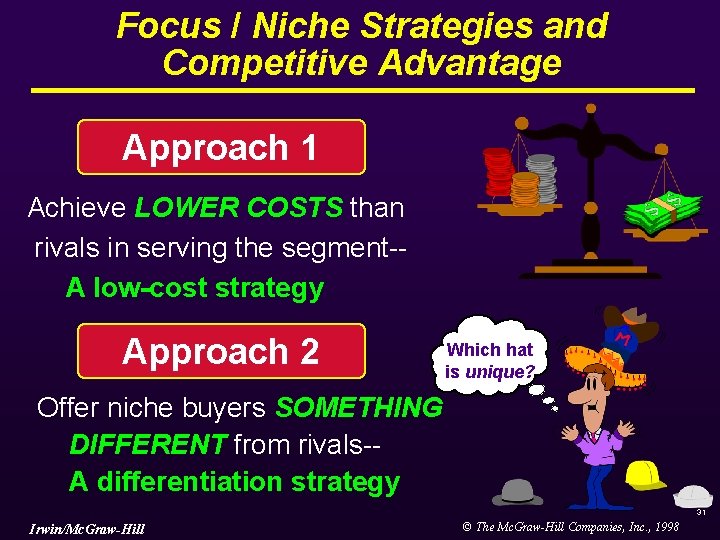
Focus / Niche Strategies and Competitive Advantage Approach 1 Achieve LOWER COSTS than rivals in serving the segment-A low-cost strategy Approach 2 Which hat is unique? Offer niche buyers SOMETHING DIFFERENT from rivals-A differentiation strategy 31 Irwin/Mc. Graw-Hill © The Mc. Graw-Hill Companies, Inc. , 1998
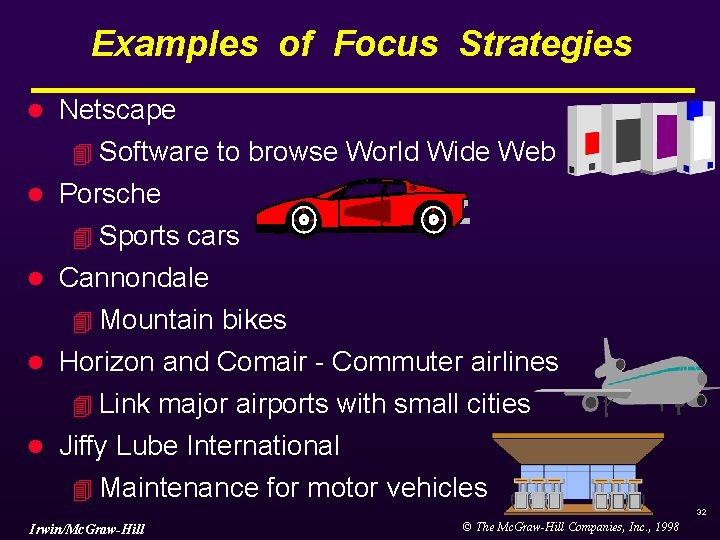
Examples of Focus Strategies l Netscape 4 Software l to browse World Wide Web Porsche 4 Sports cars l Cannondale 4 Mountain bikes l Horizon and Comair - Commuter airlines 4 Link major airports with small cities l Jiffy Lube International 4 Maintenance for motor vehicles 32 Irwin/Mc. Graw-Hill © The Mc. Graw-Hill Companies, Inc. , 1998
What Makes a Niche Attractive for Focusing? l Big enough to be profitable l Good growth potential l Not crucial to success of major competitors (making it unlikely they will compete hard in niche) l Focuser has resources to effectively serve segment l Focuser can defend against challengers via superior ability to serve buyers in segment and customer goodwill Irwin/Mc. Graw-Hill © The Mc. Graw-Hill Companies, Inc. , 1998 33
The Competitive Strength of Focus / Niche Strategies RIVAL COMPETITORS do not have matching capabilities to meet specialized needs of niche members l Focuser’s competencies/capabilities act as a barrier to POTENTIAL ENTRANTS l Focuser’s competencies/capabilities pose obstacle to sellers of SUBSTITUTES l Focuser’s unique ability to meet niche buyers’ needs can blunt bargaining leverage of powerful BUYERS l 34 Irwin/Mc. Graw-Hill © The Mc. Graw-Hill Companies, Inc. , 1998
When Does a Focus Strategy Work Best? l Costly or difficult for multi-segment rivals to serve specialized needs of target niche l No other rivals are concentrating same segment l Firm’s resources do not allow it to go after a bigger piece of market l Industry has many different segments, creating more focusing opportunities on 35 Irwin/Mc. Graw-Hill © The Mc. Graw-Hill Companies, Inc. , 1998
Risks of a Focus Strategy Competitors find effective ways to match a focuser’s capabilities in serving niche l Niche buyers’ preferences shift towards product attributes desired by majority of buyers--the niche becomes part of the overall market l Segment becomes so attractive it becomes crowded with rivals, causing segment profits to be splintered l 36 Irwin/Mc. Graw-Hill © The Mc. Graw-Hill Companies, Inc. , 1998
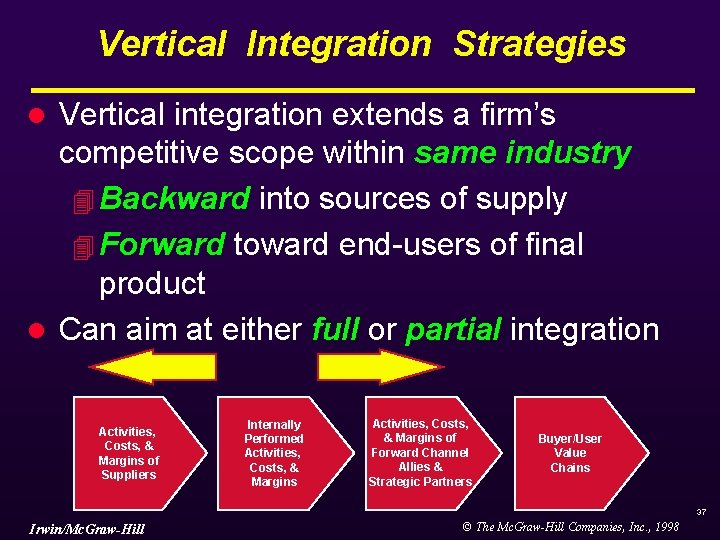
Vertical Integration Strategies Vertical integration extends a firm’s competitive scope within same industry 4 Backward into sources of supply 4 Forward toward end-users of final product l Can aim at either full or partial integration l Activities, Costs, & Margins of Suppliers Internally Performed Activities, Costs, & Margins of Forward Channel Allies & Strategic Partners Buyer/User Value Chains 37 Irwin/Mc. Graw-Hill © The Mc. Graw-Hill Companies, Inc. , 1998
Competitive Strategy Principle A vertical integration strategy has appeal ONLY if it significantly strengthens a firm’s competitive position! 38 Irwin/Mc. Graw-Hill © The Mc. Graw-Hill Companies, Inc. , 1998
Appeal of Backward Integration Generates cost savings only if volume needed is big enough to capture efficiencies of suppliers l Potential to reduce costs exists when l 4 Suppliers 4 Item have sizable profit margins supplied is a major cost component 4 Resource requirements are easily met l Can produce a differentiation-based competitive advantage when it results in a better quality part l Reduces risk of depending on suppliers of crucial raw materials / parts / components 39 Irwin/Mc. Graw-Hill © The Mc. Graw-Hill Companies, Inc. , 1998
Appeal of Forward Integration Advantageous for a firm to establish its own distribution network if 4 Undependable distribution channels undermine steady production operations l Integrating forward into distribution and retailing 4 May be cheaper than going through independent distributors 4 May help achieve stronger product differentiation, allowing escape from price competition 4 May provide better access to users l 40 Irwin/Mc. Graw-Hill © The Mc. Graw-Hill Companies, Inc. , 1998
Strategic Disadvantages of Vertical Integration Boosts resource requirements l Locks firm deeper into same industry l Results in fixed sources of supply less flexibility in accommodating buyer demands for product variety l and Poses problems of balancing capacity at each stage of value chain l May require radically different skills / capabilities l Reduces manufacturing flexibility, lengthening design time and ability to introduce new products l 41 Irwin/Mc. Graw-Hill © The Mc. Graw-Hill Companies, Inc. , 1998
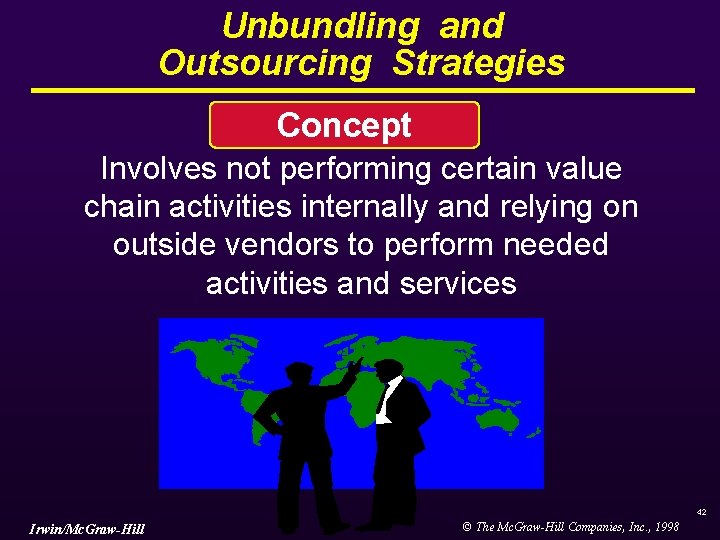
Unbundling and Outsourcing Strategies Concept Involves not performing certain value chain activities internally and relying on outside vendors to perform needed activities and services 42 Irwin/Mc. Graw-Hill © The Mc. Graw-Hill Companies, Inc. , 1998
Advantages of Outsourcing Strategies l l l Outside specialists may can perform the activity better or more cheaply Activity is not crucial to achieving competitive advantage Reduces risk exposure to changing technology and/or changing buyer preferences Streamlines operations to 4 Cut cycle time 4 Speed decision-making 4 Reduce coordination costs Allows firm to concentrate on its core business Irwin/Mc. Graw-Hill © The Mc. Graw-Hill Companies, Inc. , 1998 43
Pros and Cons of Vertical Integration l The appeal of a vertical integration strategy depends on 4 Its ability to enhance performance of strategy -critical activities by D Lowering costs or D Increasing differentiation 4 Its impact on D Resource requirements D Flexibility and response times D Administrative overhead of coordination 4 Its ability to create a competitive advantage Irwin/Mc. Graw-Hill © The Mc. Graw-Hill Companies, Inc. , 1998 44
Cooperative Strategies Companies sometimes use strategic alliances or strategic partnerships or collaborative agreements to complement their own strategic initiatives and strengthen their competitiveness. Such cooperative strategies go beyond normal company-tocompany dealings but fall short of merger or formal joint venture 45 Irwin/Mc. Graw-Hill © The Mc. Graw-Hill Companies, Inc. , 1998
Why Are Strategic Alliances Formed? To collaborate on technology development or new product development l To improve supply chain efficiency l To gain economies of scale in production and/or marketing l To fill gaps in technical or manufacturing expertise l To speed new products to market l To acquire or improve market access l 46 Irwin/Mc. Graw-Hill © The Mc. Graw-Hill Companies, Inc. , 1998
Offensive and Defensive Strategies Offensive Strategies Are undertaken to build new or stronger market positions and/or create competitive advantage Defensive Strategies Can protect competitive advantage, but rarely are the basis for creating advantage 47 Irwin/Mc. Graw-Hill © The Mc. Graw-Hill Companies, Inc. , 1998
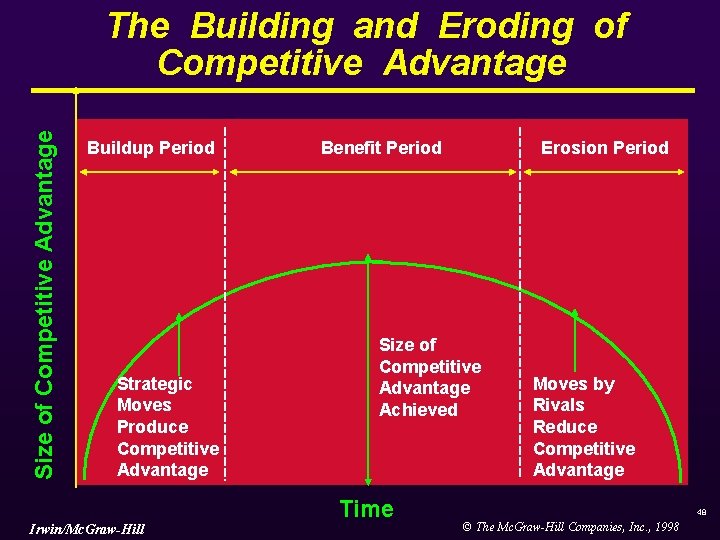
Size of Competitive Advantage The Building and Eroding of Competitive Advantage Buildup Period Strategic Moves Produce Competitive Advantage Irwin/Mc. Graw-Hill Benefit Period Erosion Period Size of Competitive Advantage Achieved Time Moves by Rivals Reduce Competitive Advantage 48 © The Mc. Graw-Hill Companies, Inc. , 1998
Options for Mounting Strategic Offensives 1. Initiatives to match or exceed rivals’ strengths 2. Initiatives to capitalize on rivals’ weaknesses 3. Simultaneous initiatives on many fronts 4. End-run offensives 5. Guerrilla warfare tactics 6. Preemptive strikes 49 Irwin/Mc. Graw-Hill © The Mc. Graw-Hill Companies, Inc. , 1998
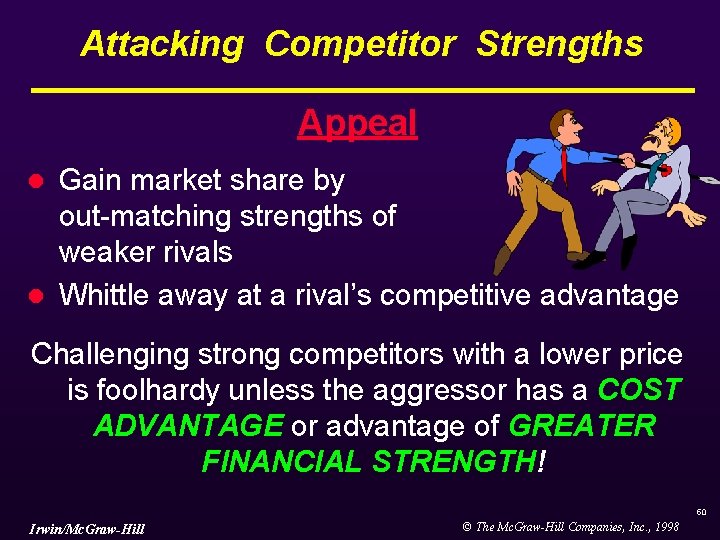
Attacking Competitor Strengths Appeal l l Gain market share by out-matching strengths of weaker rivals Whittle away at a rival’s competitive advantage Challenging strong competitors with a lower price is foolhardy unless the aggressor has a COST ADVANTAGE or advantage of GREATER FINANCIAL STRENGTH! 50 Irwin/Mc. Graw-Hill © The Mc. Graw-Hill Companies, Inc. , 1998
Attacking Competitor Strengths Possible Offensive Options l l l Under-price rivals Boost advertising Introduce new features to appeal to rivals’ customers Best Options l l Attack with equally good product & lower price Develop low-cost edge, use it to under-price rivals 51 Irwin/Mc. Graw-Hill © The Mc. Graw-Hill Companies, Inc. , 1998
Options for Attacking a Competitor’s Strengths l Offer equally good product at a lower price l Offer a better product at the same price l Leapfrog into next-generation technologies l Add appealing new features l Run comparison ads l Construct new plant capacity l Offer a wider product line l Develop better customer service capabilities 52 Irwin/Mc. Graw-Hill © The Mc. Graw-Hill Companies, Inc. , 1998
Attacking Competitor Weaknesses Basic Approach Concentrate company strengths and resources directly against a rival’s weaknesses Weaknesses to Attack l l l Geographic regions where rival is weak Segments rival is neglecting Go after those customers a rival is least equipped to serve Rivals with weaker marketing skills Introduce new models exploiting gaps in rivals’ product lines Irwin/Mc. Graw-Hill © The Mc. Graw-Hill Companies, Inc. , 1998 53
Launching Simultaneous Offensives on Many Fronts Objective l Launch several major initiatives to 4 Throw rivals off-balance 4 Splinter their attention 4 Force them to use substantial resources to defend their position Appeal A challenger with superior resources can overpower weaker rivals by out-competing them across-theboard long enough to become a market leader. 54 Irwin/Mc. Graw-Hill © The Mc. Graw-Hill Companies, Inc. , 1998
End-Run Offensives Objectives DODGE head-to-head confrontations that escalate competitive intensity or risk cutthroat competition l Attempt to MANEUVER around areas of strong competition--concentrate on those areas of market where competition is weakest l 55 Irwin/Mc. Graw-Hill © The Mc. Graw-Hill Companies, Inc. , 1998
Optional Approaches for End-Run Offensives Build presence in geographic areas where rivals have little presence or exposure l Introduce products with different attributes and features to better meet buyer needs l Introduce next-generation technologies and leapfrog rivals l Add more support services for customers l 56 Irwin/Mc. Graw-Hill © The Mc. Graw-Hill Companies, Inc. , 1998
Guerrilla Offenses Approach Use principles of surprise and hit-and-run to attack in locations and at times where conditions are most favorable to initiator Appeal Well-suited to small challengers with limited resources Irwin/Mc. Graw-Hill © The Mc. Graw-Hill Companies, Inc. , 1998 57
Options for Guerrilla Offenses Focus on narrow target weakly defended by rivals l Challenge rivals where they are overextended and when they are encountering problems l Make random scattered raids on leaders 4 Occasional low-balling on price 4 Intense bursts of promotional activity 4 Legal actions charging antitrust violations, patent infringements, or unfair advertising l 58 Irwin/Mc. Graw-Hill © The Mc. Graw-Hill Companies, Inc. , 1998
Preemptive Strikes Approach Involves moving first to secure an advantageous position that rivals are foreclosed or discouraged from duplicating! 59 Irwin/Mc. Graw-Hill © The Mc. Graw-Hill Companies, Inc. , 1998
Preemptive Strike Options l l l l Expand capacity ahead of demand in hopes of discouraging rivals from following suit Tie up best or cheapest sources of essential raw materials Move to secure best geographic locations Obtain business of prestigious customers Build an image in buyers’ minds that is unique & hard to copy Secure exclusive or dominant access to best distributors Acquire desirable, but struggling, competitor Irwin/Mc. Graw-Hill © The Mc. Graw-Hill Companies, Inc. , 1998 60
Choosing Whom to Attack l Four types of firms can be the target of an offensive: 4 Market leaders 4 Runner-up firms 4 Struggling rivals on verge of going under 4 Small local or regional firms not doing a good job for their customers 61 Irwin/Mc. Graw-Hill © The Mc. Graw-Hill Companies, Inc. , 1998
Offensive Strategy and Competitive Advantage l STRATEGIC OFFENSIVE options offering strongest basis for COMPETITIVE ADVANTAGE 4 Develop lower-cost product design 4 Make changes in production operations that lower costs or enhance differentiation 4 Develop product features that deliver superior performance or lower users’ costs 4 Give more responsive customer service 4 Escalate marketing effort 4 Pioneer new distribution channel 4 Sell direct to end-users 62 Irwin/Mc. Graw-Hill © The Mc. Graw-Hill Companies, Inc. , 1998
Defensive Strategy Objectives l Fortify firm’s present position Help sustain any competitive advantage held Lessen risk of being attacked l Blunt impact of any attack that occurs l Influence challengers to aim attacks at other rivals l l 63 Irwin/Mc. Graw-Hill © The Mc. Graw-Hill Companies, Inc. , 1998
Defensive Strategies: Approaches Approach 1 Block avenues challengers can take in mounting offensive attacks Approach 2 Make it clear any challenge will be met with strong counterattack 64 Irwin/Mc. Graw-Hill © The Mc. Graw-Hill Companies, Inc. , 1998
Blocking Avenues for Rivals’ Offensives l l l l l Broaden product line to fill gaps rivals may go after Keep prices low on models that match rivals Sign exclusive agreements with distributors Offer free training to buyers’ personnel Give better credit terms to buyers Reduce delivery times for spare parts Increase warranty coverage Patent alternative technologies Sign exclusive contracts with best suppliers Protect proprietary know-how 65 Irwin/Mc. Graw-Hill © The Mc. Graw-Hill Companies, Inc. , 1998
Signaling Defensive Toughness l l l Publicly announce management’s strong commitment to maintain present market share Publicly announce plans to construct new production capacity to meet forecasted demand Give out advance information about new products, technological breakthroughs, and other moves Publicly commit firm to policy of matching prices and terms offered by rivals Maintain war chest of cash reserves Make occasional counter-responses to rivals’ moves 66 Irwin/Mc. Graw-Hill © The Mc. Graw-Hill Companies, Inc. , 1998
First-Mover Advantages WHEN to make a strategic move is often as crucial as WHAT move to make l First-mover advantages arise WHEN 4 Pioneering helps build firm’s image and reputation 4 Early commitments to raw material suppliers, new technologies, & distribution channels can produce cost advantage 4 Loyalty of first time buyers is high 4 Moving first can be a preemptive strike l 67 Irwin/Mc. Graw-Hill © The Mc. Graw-Hill Companies, Inc. , 1998
First-Mover Disadvantages l Moving early can be a disadvantage (or fail to produce an advantage) when 4 Costs of pioneering are sizable and loyalty of first time buyers is weak 4 Rapid technological change allows followers to leapfrog pioneers 4 Achievements of pioneers are easily and quickly imitated by late movers 4 It is relatively easy for latecomers to crack the market 68 Irwin/Mc. Graw-Hill © The Mc. Graw-Hill Companies, Inc. , 1998
Timing and Competitive Advantage Principle 1 Being a first-mover holds potential for competitive advantage in some cases but not in others Principle 2 Being a fast follower can sometimes yield as good a result as being a first mover Principle 3 Being a late-mover may or may not be fatal--it varies with the situation Irwin/Mc. Graw-Hill © The Mc. Graw-Hill Companies, Inc. , 1998 69