
The Essence of Coaching 1 CONTENTS Team Building
The Essence of Coaching 1
CONTENTS • Team Building What, How & Skills • Goal Setting • Coaching Philosophy Coaching Styles Planning • • Evaluation Self Reflection 2
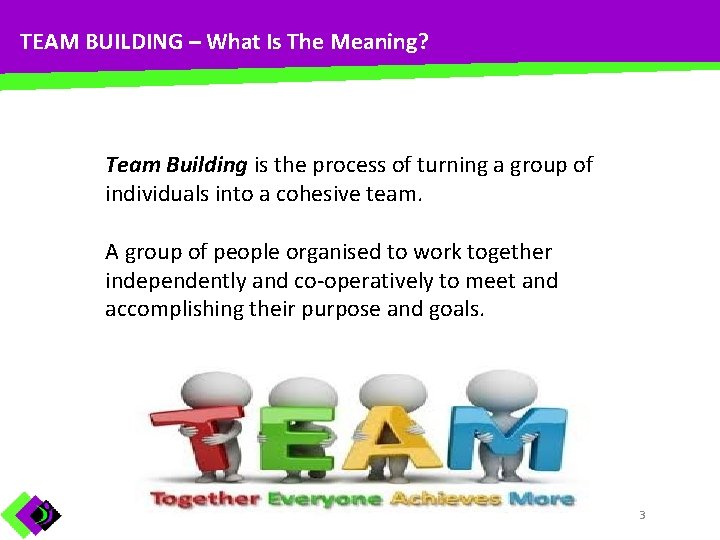
TEAM BUILDING – What Is The Meaning? Team Building is the process of turning a group of individuals into a cohesive team. A group of people organised to work together independently and co-operatively to meet and accomplishing their purpose and goals. 3
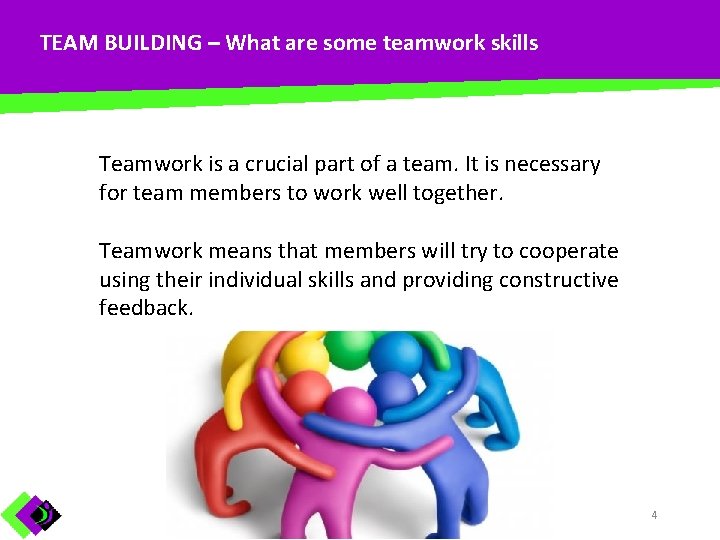
TEAM BUILDING – What are some teamwork skills Teamwork is a crucial part of a team. It is necessary for team members to work well together. Teamwork means that members will try to cooperate using their individual skills and providing constructive feedback. 4
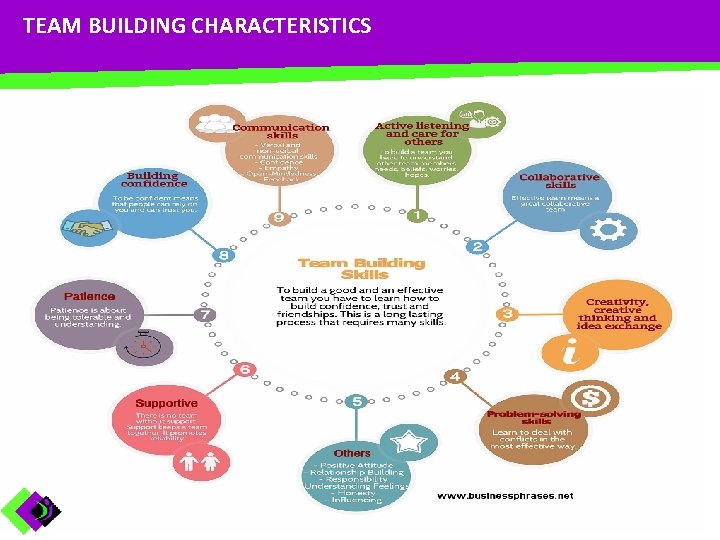
TEAM BUILDING CHARACTERISTICS 5
TEAM BUILDING – How to improve your teamwork skills • • • Lead by example Build up trust and respect Cultivate open communications Clearly outline roles and responsibilities Set defined goals Recognise good work Allow team members to actively take part in decision making Have team traditions Give frequent feedback Take time to celebrate 6
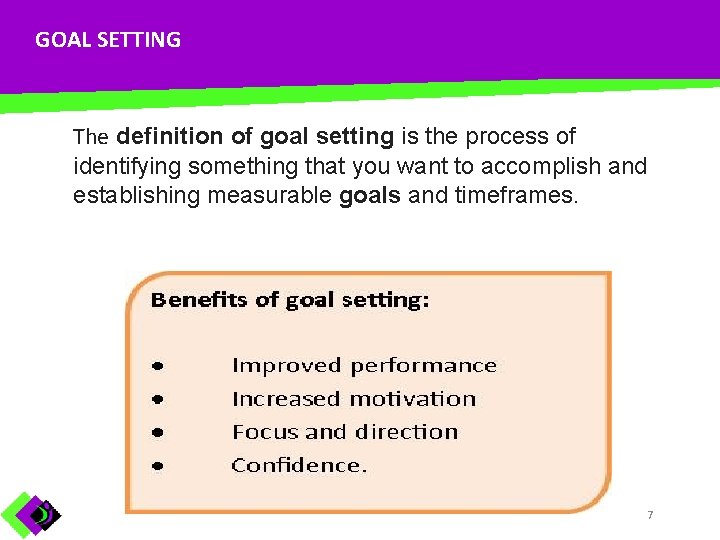
GOAL SETTING The definition of goal setting is the process of identifying something that you want to accomplish and establishing measurable goals and timeframes. 7
GOAL SETTING Set short-term as well as long-range goals. Breaking down any long-term goals into smaller more attainable goals helps to promote achievement and success. Short-term goals are GOAL members SETTIN important because they allow to see immediate improvements in performance and thereby enhance motivation. 8
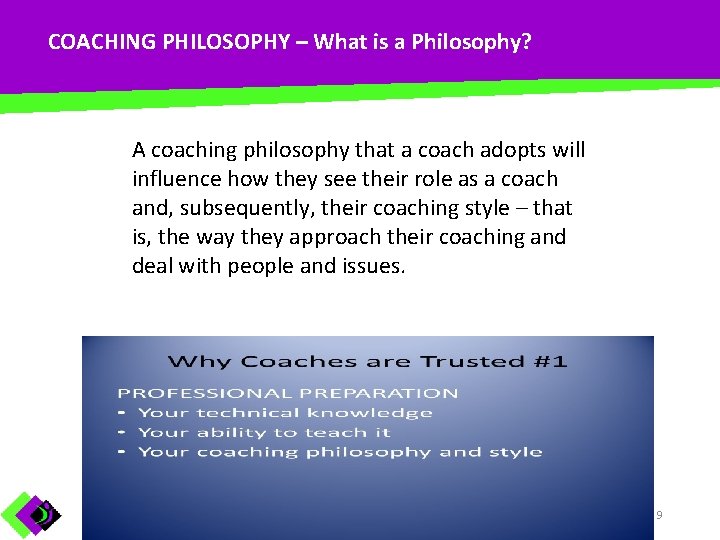
COACHING PHILOSOPHY – What is a Philosophy? A coaching philosophy that a coach adopts will influence how they see their role as a coach and, subsequently, their coaching style – that is, the way they approach their coaching and deal with people and issues. 9
COACHING PHILOSOPHY – Fundamentals of a Coaching Philosophy & Coaching Style Developing your coaching philosophy: • • Why - Identifying the purpose of your coaching What am I trying to achieve? How can I achieve my objectives? Your coaching values and choosing your coaching style. Together, these elements form your coaching philosophy. 10
COACHING PHILOSOPHY – Developing a Coaching Philosophy 1. Purpose (Why) Decide what are your reasons for coaching? • To provide a positive experience for members • Providing the opportunity for members to achieve their full potential • Use coaching as a holistic (physical, mental, social & emotional) means of individual development These should be your priority but there are more reasons you could add. 11

COACHING PHILOSOPHY – Developing a Coaching Philosophy 2. What am I trying to achieve as a coach? • The overall objective of coaching is to enable individuals and groups of individuals (teams) to broaden, develop and motivate each other to achieve improvement in their performance. • Make sure goals and objectives are clearly defined and reinforced. 12
COACHING PHILOSOPHY – Developing a Coaching Philosophy 3. Values, beliefs and principles - HOW The third element of your coaching philosophy is the “How” can I achieve my objectives? HY – Developing a Coaching Philosophy 13
COACHING PHILOSOPHY – Developing a Coaching Philosophy Different combinations of coaching philosophies and coaches’ personality will result in different coaching styles and coaches. This is beneficial, firstly because different coaches suit different members, and secondly because it would be boring if we were all clones of each other. What is important is that all coaches provide an environment that has a positive impact on their members’ performance and behaviour, both within and outside sport. 14

COACHING PHILOSOPHY – Developing a Coaching Philosophy My coaching philosophy would look something like this My coaching philosophy stresses the importance of team unity, discipline, self-confidence, sportsmanship, and a desire to compete (VALUES). My team is characterized as being very disciplined, sportsmanlike (LEADERSHIP STYLE) and highly motivated to put in effort at every training and event (PURPOSE). 15
COACHING PHILOSOPHY – Words of encouragement 16
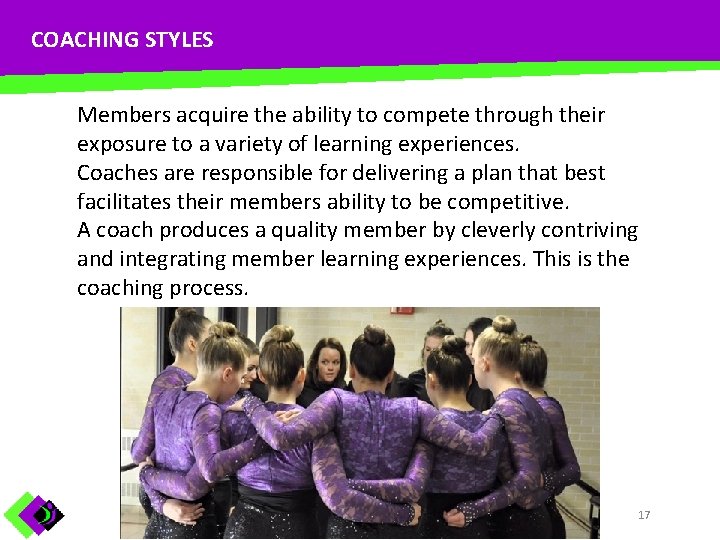
COACHING STYLES Members acquire the ability to compete through their exposure to a variety of learning experiences. Coaches are responsible for delivering a plan that best facilitates their members ability to be competitive. A coach produces a quality member by cleverly contriving and integrating member learning experiences. This is the coaching process. 17
COACHING/LEARNING STYLE EXAMPLES Coaching Methods to suit Learning styles – In most teams there will be different learning styles. Visual: Some members learn best by seeing someone other than themselves perform. Audible: Some learn best by listening to an instruction or receiving feedback comments. Kinaesthetic (Bodily): Others learn better by feeling the sensations of a movement and making adjustments until the movement feels right. When a coach has yet to determine the preferred learning style of a member, it is advisable to provide the opportunity for each learning 18 style to be engaged
COACHING –PLANNING Developing PLANNING What is a –Coaching Plan? a Coaching Plan The process of planning allows an effective coach to bring both the art and the science of the sport in a coherent and organised manner. Effective planning helps ensure that the coach • has the necessary resources ready and available when they need them • provides a safe environment • makes effective use of time available • challenges the member through progressive development • includes all members, regardless of their level of ability • maximises enjoyment for themselves and their members 19
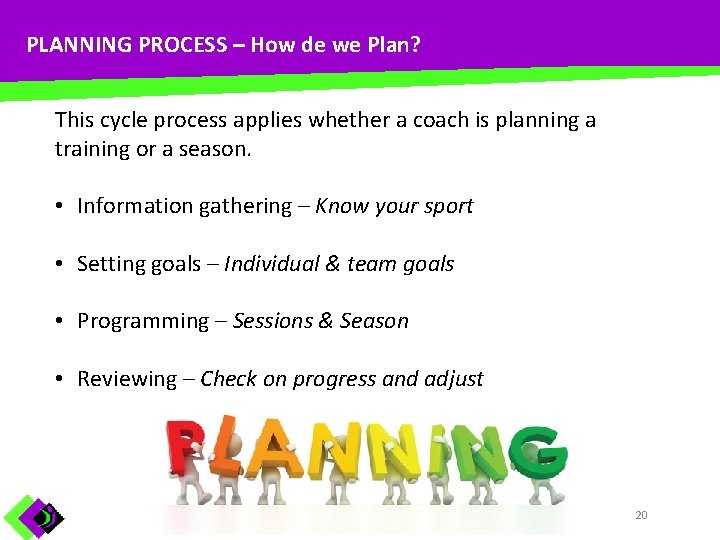
PLANNING PROCESS – How de we Plan? This cycle process applies whether a coach is planning a training or a season. • Information gathering – Know your sport • Setting goals – Individual & team goals • Programming – Sessions & Season • Reviewing – Check on progress and adjust 20
COACHING PLAN – Things to consider • Age & Physical/Emotional development of each member • Balancing other non-sport commitments • Involving the members/parents in planning • Meeting individual needs • Understanding the physical, technical, tactical and psychological demands of the sport 21
PLANNING A SEASON Most season plans are broken up into four phases The Preparation Phase (July – Nov) The purpose is to build the physical, SELF REFLECTI technical & psychological skills & abilities required to compete • Setting your goals • Weekly training plans (Plan at least one week ahead) • Attend all workshops 22
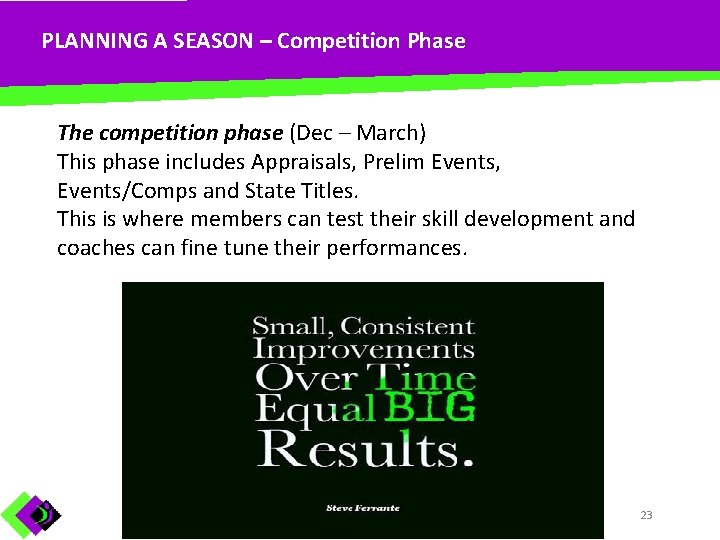
PLANNING A SEASON – Competition Phase The competition phase (Dec – March) This phase includes Appraisals, Prelim Events, Events/Comps and State Titles. This is where members can test their skill development and coaches can fine tune their performances. 23

PLANNING A SEASON – The Peak Event (April) This phase allows members to reach their peak performance. Peaking has both a physical and mental component. 24
PLANNING A SEASON – Post peak event The transition phase (Post peak event) This phase is where members take a break and coaches start to evaluate and self reflection begins. 25
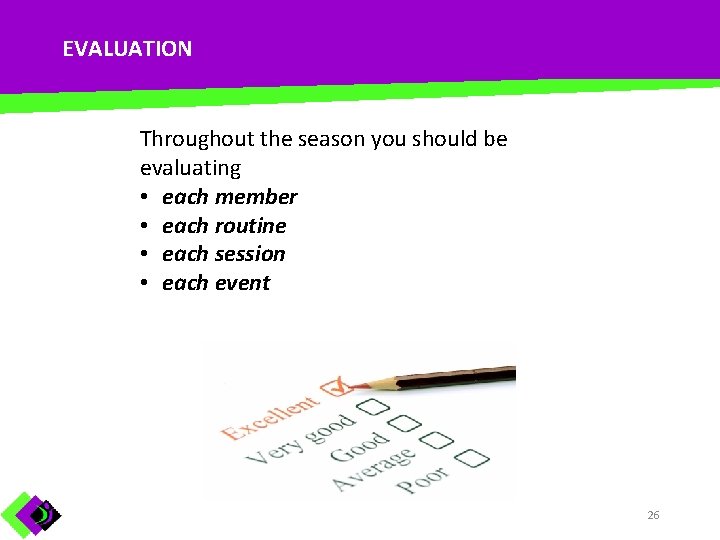
EVALUATION Throughout the season you should be evaluating • each member • each routine • each session TEAM BUILDING – How to improve your teamwork • each eventskills 26
TEAM BUILDING – How to improve your SELF REFLECTION teamwork skills 27
DDA COACHING WORKSHOP CHOREOGRAPHY
CONTENTS Constructing a Thematic Routine Music Thematic Drill Thematic Prop Thematic Dance Exhibition Drill Timeline of an Exhibition Drill/Thematic Routine • Formations • Judges Sheets (Action, Continuity, Travelling Steps, Highlights • • 029
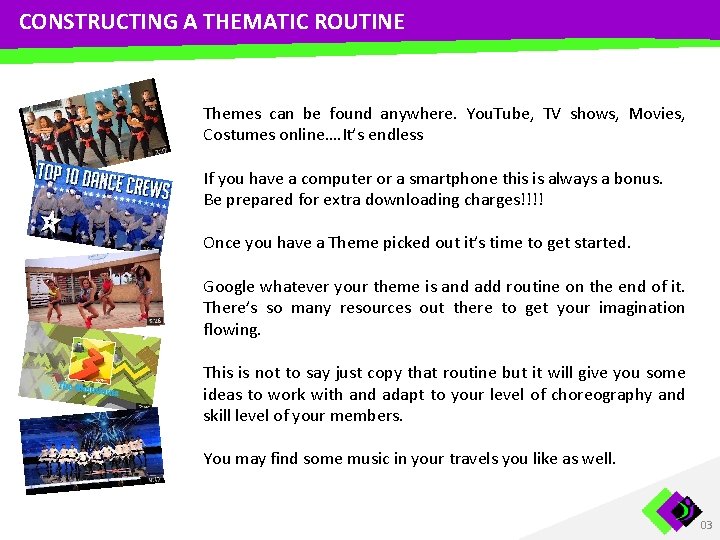
CONSTRUCTING A THEMATIC ROUTINE Themes can be found anywhere. You. Tube, TV shows, Movies, Costumes online…. It’s endless If you have a computer or a smartphone this is always a bonus. Be prepared for extra downloading charges!!!! Once you have a Theme picked out it’s time to get started. Google whatever your theme is and add routine on the end of it. There’s so many resources out there to get your imagination flowing. This is not to say just copy that routine but it will give you some ideas to work with and adapt to your level of choreography and skill level of your members. You may find some music in your travels you like as well. 03

MUSIC Firstly you need to find a piece of music that has highs, lows, and some different tempos for Thematic. Where do I find music…great music? 04
MUSIC CONTD’ • You should try to use at least a couple of pieces/cuts of music • Have your music approved as soon as you’ve decided on a piece but ensure you read through the requirements you must have for that certain routines music to be approved before sending away to Anne for approval. • Once your music has been approved listen to that piece of music wherever or whenever you can. In the car On public transport Making dinner 05
MUSIC CONTD’ Close your eyes, visualise, what is the music saying/telling you? Strong and hard? Smooth and flowing? Ripple? Staccato? For Thematic routines listen to the background, the beat, the melody. 06
CHOOSING MUSIC FOR AN EDR EXHIBITION DRILL Teams may select their music from within the following guidelines: Traditional March Classical Orchestral Symphonic May include Movie Themes Other requirements for the Exhibition Drill music are: There may only be a maximum of three pieces of music (two cuts) The music will be played in the consistent time of 120 beats per minute There will be a left/right emphasis of beat No vocals There is no requirement to register music although approval may be necessary before use. 12
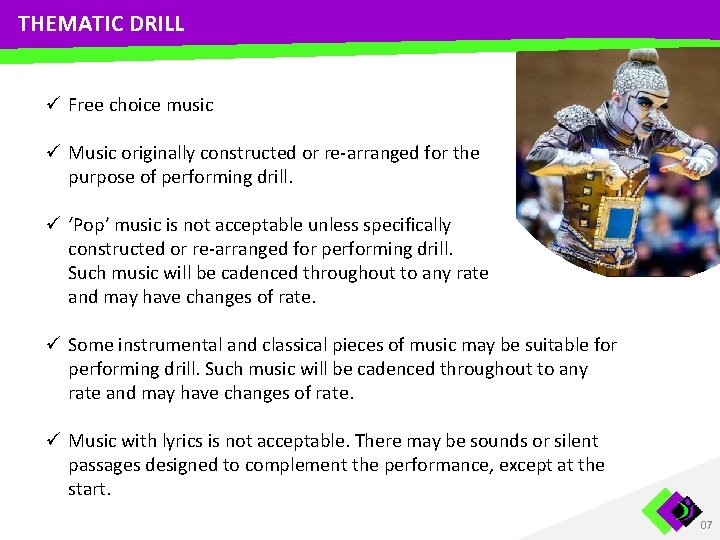
THEMATIC DRILL ü Free choice music ü Music originally constructed or re-arranged for the purpose of performing drill. ü ‘Pop’ music is not acceptable unless specifically constructed or re-arranged for performing drill. Such music will be cadenced throughout to any rate and may have changes of rate. ü Some instrumental and classical pieces of music may be suitable for performing drill. Such music will be cadenced throughout to any rate and may have changes of rate. ü Music with lyrics is not acceptable. There may be sounds or silent passages designed to complement the performance, except at the start. 07
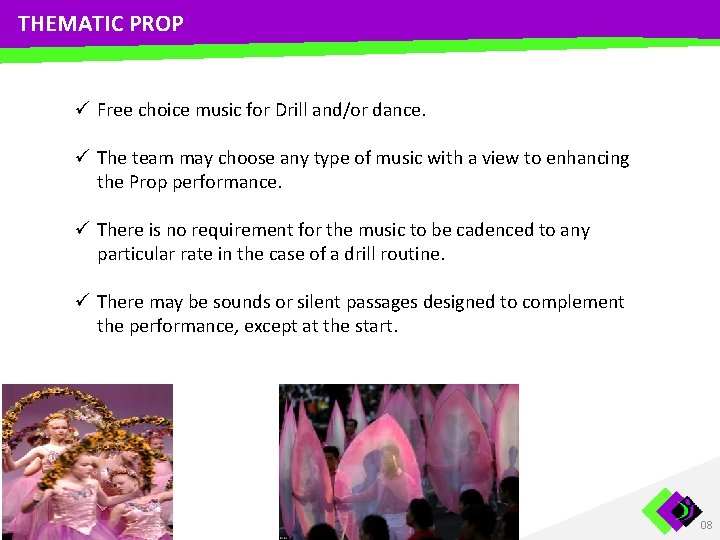
THEMATIC PROP ü Free choice music for Drill and/or dance. ü The team may choose any type of music with a view to enhancing the Prop performance. ü There is no requirement for the music to be cadenced to any particular rate in the case of a drill routine. ü There may be sounds or silent passages designed to complement the performance, except at the start. 08
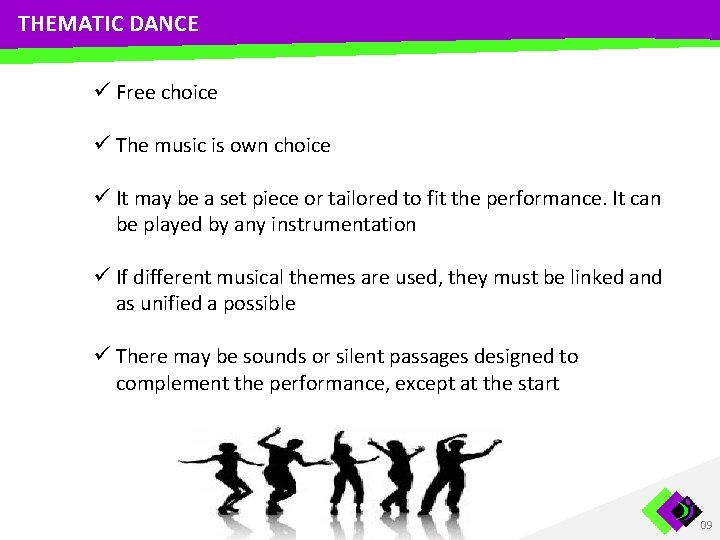
THEMATIC DANCE ü Free choice ü The music is own choice ü It may be a set piece or tailored to fit the performance. It can be played by any instrumentation ü If different musical themes are used, they must be linked and as unified a possible ü There may be sounds or silent passages designed to complement the performance, except at the start 09
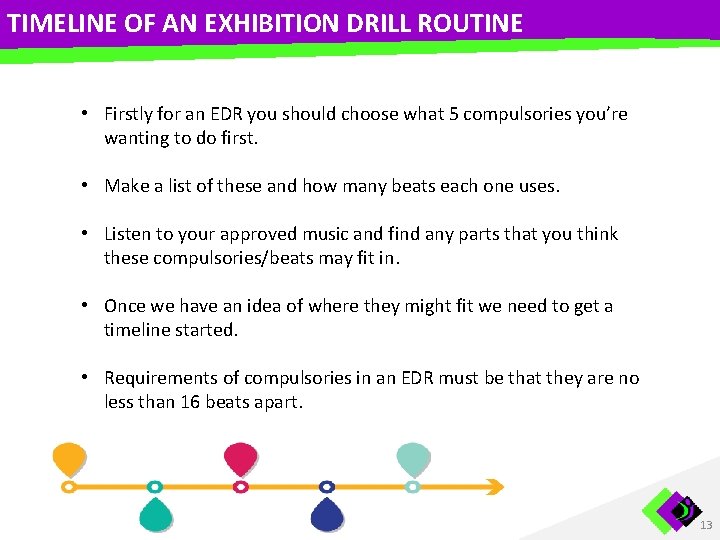
TIMELINE OF AN EXHIBITION DRILL ROUTINE • Firstly for an EDR you should choose what 5 compulsories you’re wanting to do first. • Make a list of these and how many beats each one uses. • Listen to your approved music and find any parts that you think these compulsories/beats may fit in. • Once we have an idea of where they might fit we need to get a timeline started. • Requirements of compulsories in an EDR must be that they are no less than 16 beats apart. 13
EDR CONTD’ So now we’ve worked out roughly where the compulsories should go we look at what’s left. We should have: A start An entrance 4 linkages An ending This is where we listen to the music/linkages and ask ourselves what is this piece of music telling me to do? Wheels Ripple Cross through 14
FORMATIONS Constructing a routine with formations requires graph paper, pencil and an endless eraser. You may have a program or use a corkboard and pins. Start with a basic formation but don’t stop it at that. Judges are looking for shapes, different spacing, same formation with different spacing, different directions, different elevation, logical flow to formations, complex/intricate formations. So let’s look at some basic formations and see how to transform them. 16
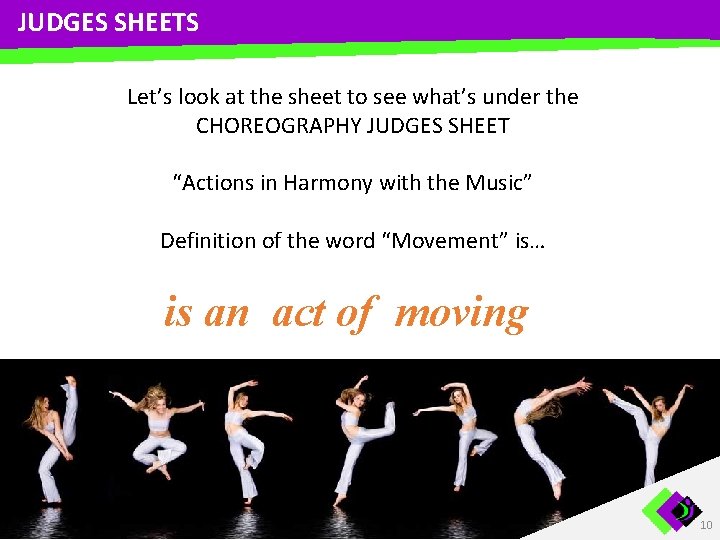
JUDGES SHEETS Let’s look at the sheet to see what’s under the CHOREOGRAPHY JUDGES SHEET “Actions in Harmony with the Music” Definition of the word “Movement” is… is an act of moving 10
ACTION “Actions sequenced to create interest” Definition of the word “Action” is, the fact or process of doing something, typically to achieve an aim. 11
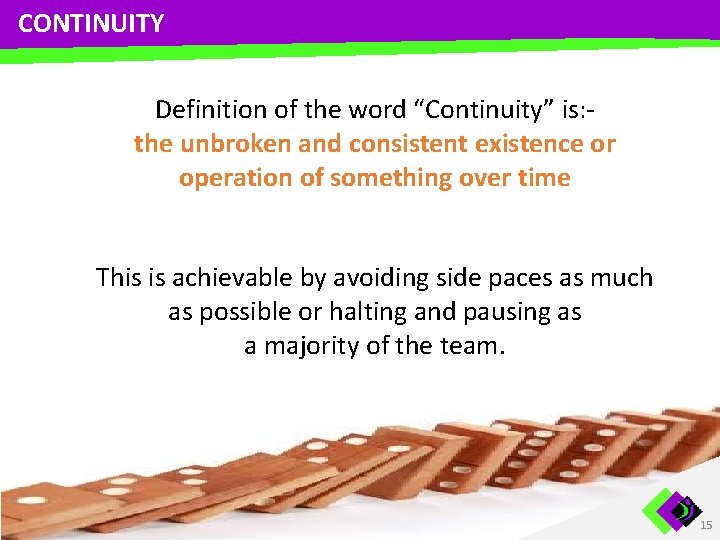
CONTINUITY Definition of the word “Continuity” is: the unbroken and consistent existence or operation of something over time This is achievable by avoiding side paces as much as possible or halting and pausing as a majority of the team. 15
TRAVELLING STEPS, PATHWAYS, DIRECTION & MANNER Travelling steps are just that. In a Thematic routine there is an endless amount to choose from. Think outside the box. They can be the same step but at a different speed, try having one file/rank/individual/group doing one step and the others doing another at the same time. Forward, backward, wheeling, sideways, diagonally, revolving and intermingling with a purpose. Get your members to all think of a different one each that is suited to your routines theme. Once your routine is finished or partially finished, video it and watch it back but only watch the lower half of the body. If you repeat a step, take another look at what you could possibly do instead. 17
HIGHLIGHTS Movements attracting attention, actions that are appealing, out of the ordinary, inspiring, stimulating, exhilarating, intriguing, striking, remarkable or compelling. Highlights are all of the above but does that mean we have to have all 10 of those? When watching a full routine the highlights should be recognisable. So having just a few of these would be more desirable to watch having a routine that has highlight after highlight that are not performed well. Does there still need to be high and lows throughout a routine? 18

19
- Slides: 46