
The ESS Target Station Eric Pitcher Head of

- Slides: 18
The ESS Target Station Eric Pitcher Head of Target Division www. europeanspallationsource. se February 19, 2016
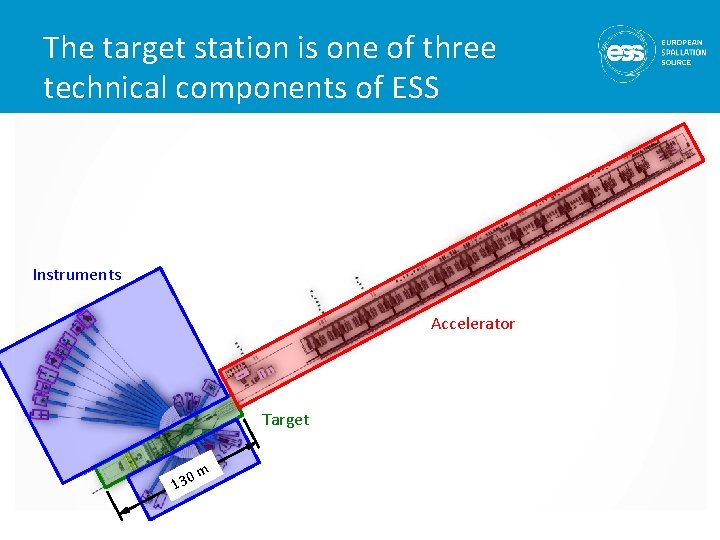
The target station is one of three technical components of ESS Instruments Accelerator Target 130 m
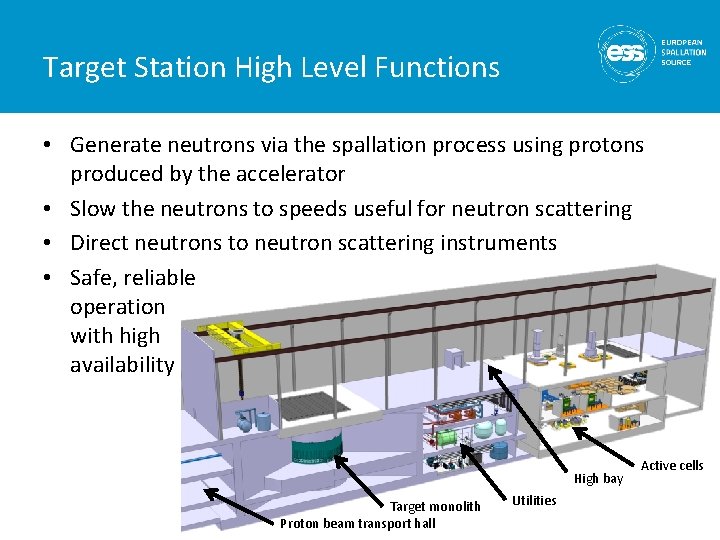
Target Station High Level Functions • Generate neutrons via the spallation process using protons produced by the accelerator • Slow the neutrons to speeds useful for neutron scattering • Direct neutrons to neutron scattering instruments • Safe, reliable operation with high availability High bay Target monolith Proton beam transport hall Utilities Active cells
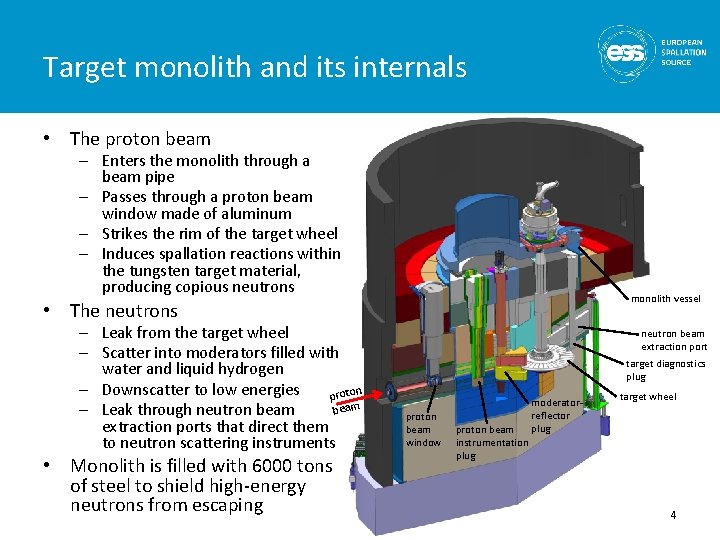
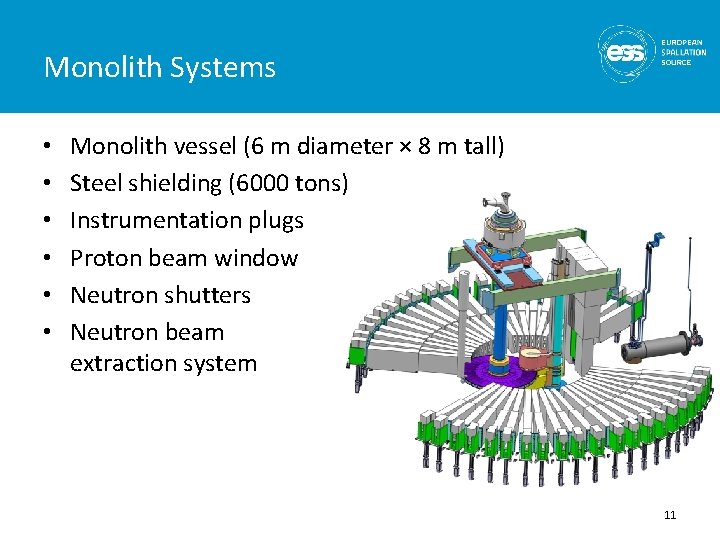
Target monolith and its internals • The proton beam – Enters the monolith through a beam pipe – Passes through a proton beam window made of aluminum – Strikes the rim of the target wheel – Induces spallation reactions within the tungsten target material, producing copious neutrons monolith vessel • The neutrons – Leak from the target wheel – Scatter into moderators filled with water and liquid hydrogen n – Downscatter to low energies proto beam – Leak through neutron beam extraction ports that direct them to neutron scattering instruments • Monolith is filled with 6000 tons of steel to shield high-energy neutrons from escaping neutron beam extraction port target diagnostics plug proton beam window proton beam instrumentation plug moderatorreflector plug target wheel 4
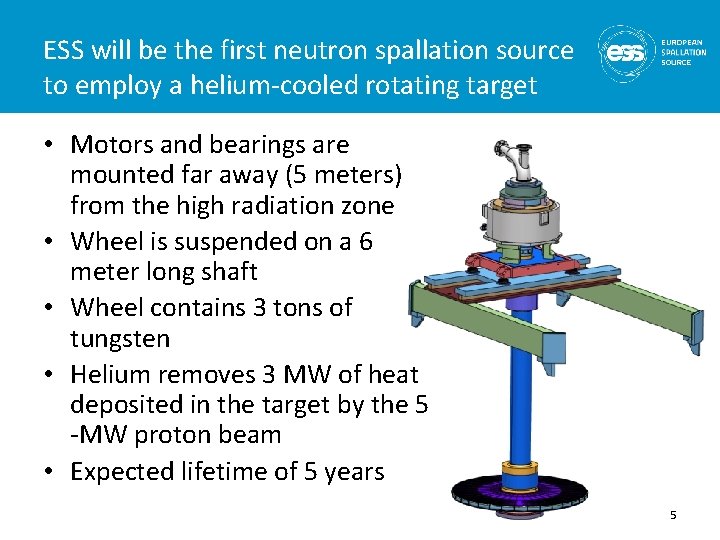
ESS will be the first neutron spallation source to employ a helium-cooled rotating target • Motors and bearings are mounted far away (5 meters) from the high radiation zone • Wheel is suspended on a 6 meter long shaft • Wheel contains 3 tons of tungsten • Helium removes 3 MW of heat deposited in the target by the 5 -MW proton beam • Expected lifetime of 5 years 5
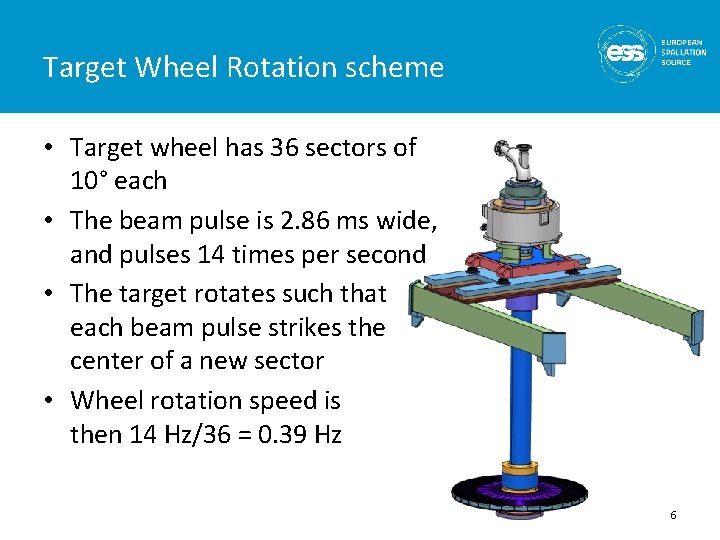
Target Wheel Rotation scheme • Target wheel has 36 sectors of 10° each • The beam pulse is 2. 86 ms wide, and pulses 14 times per second • The target rotates such that each beam pulse strikes the center of a new sector • Wheel rotation speed is then 14 Hz/36 = 0. 39 Hz 6
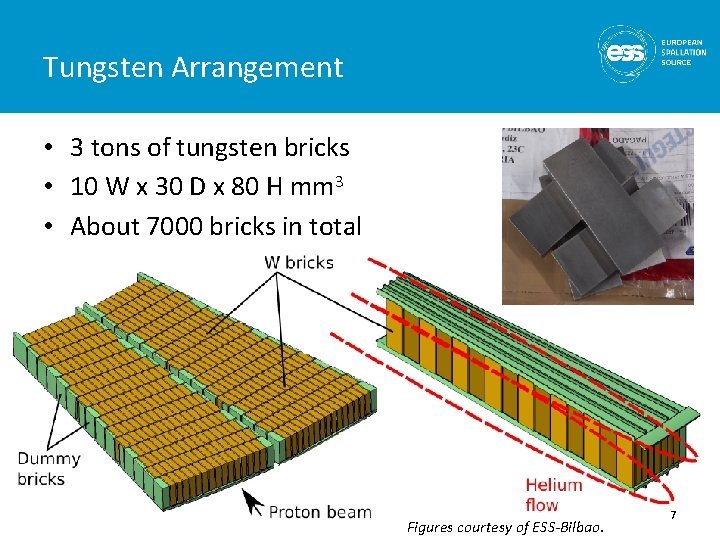
Tungsten Arrangement • 3 tons of tungsten bricks • 10 W x 30 D x 80 H mm 3 • About 7000 bricks in total Figures courtesy of ESS-Bilbao. 7
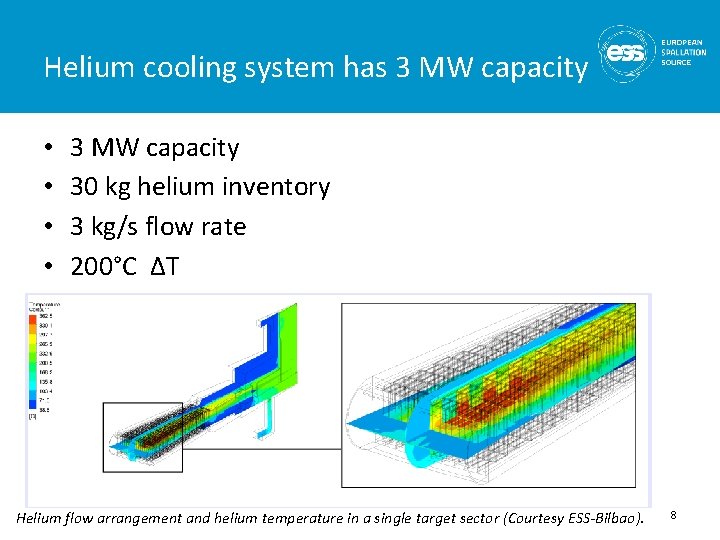
Helium cooling system has 3 MW capacity • • 3 MW capacity 30 kg helium inventory 3 kg/s flow rate 200°C ∆T Helium flow arrangement and helium temperature in a single target sector (Courtesy ESS-Bilbao). 8
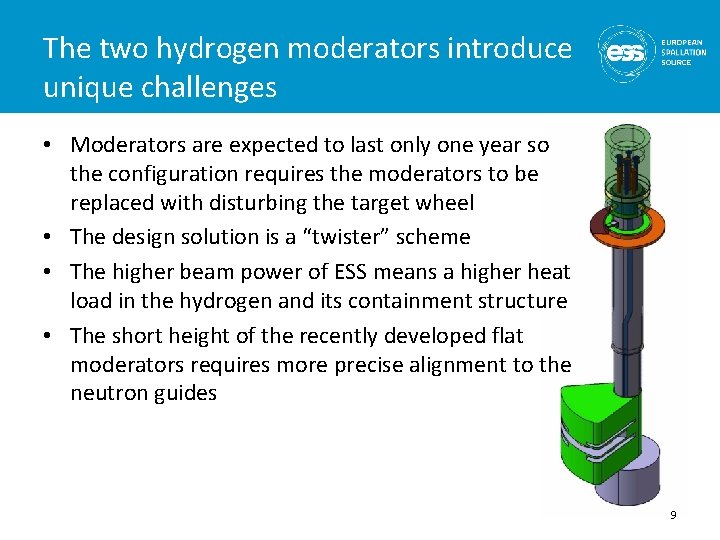
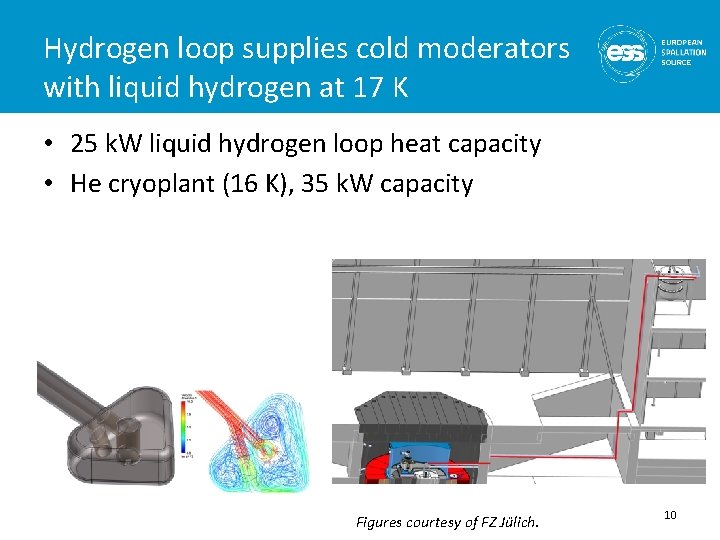
The two hydrogen moderators introduce unique challenges • Moderators are expected to last only one year so the configuration requires the moderators to be replaced with disturbing the target wheel • The design solution is a “twister” scheme • The higher beam power of ESS means a higher heat load in the hydrogen and its containment structure • The short height of the recently developed flat moderators requires more precise alignment to the neutron guides 9
Hydrogen loop supplies cold moderators with liquid hydrogen at 17 K • 25 k. W liquid hydrogen loop heat capacity • He cryoplant (16 K), 35 k. W capacity Figures courtesy of FZ Jülich. 10
Monolith Systems • • • Monolith vessel (6 m diameter × 8 m tall) Steel shielding (6000 tons) Instrumentation plugs Proton beam window Neutron shutters Neutron beam extraction system 11
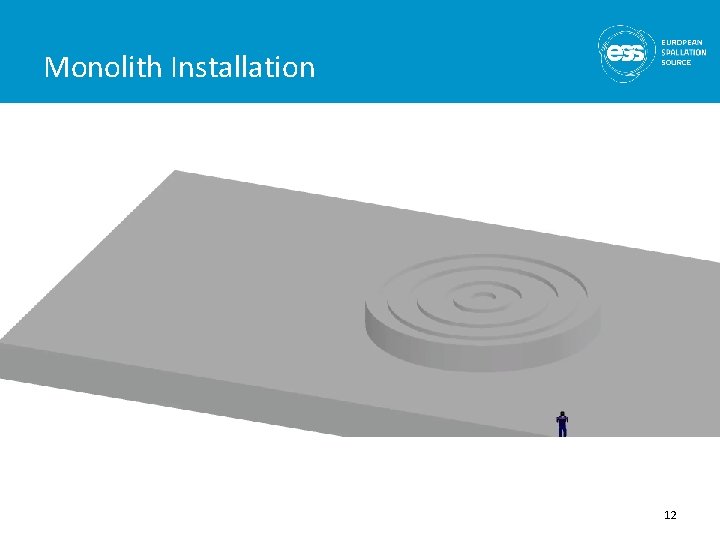
Monolith Installation 12
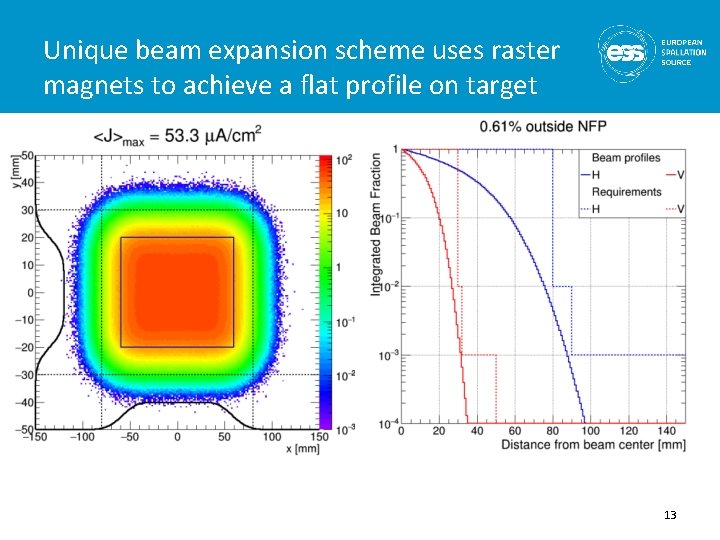
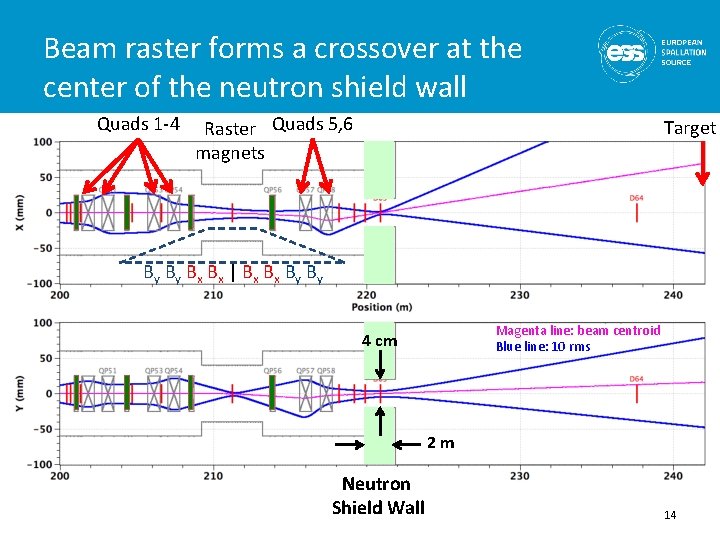
Unique beam expansion scheme uses raster magnets to achieve a flat profile on target 13
Beam raster forms a crossover at the center of the neutron shield wall Quads 1 -4 Raster Quads 5, 6 magnets Target By By Bx Bx | Bx Bx By By Magenta line: beam centroid Blue line: 10 rms 4 cm 2 m Neutron Shield Wall 14
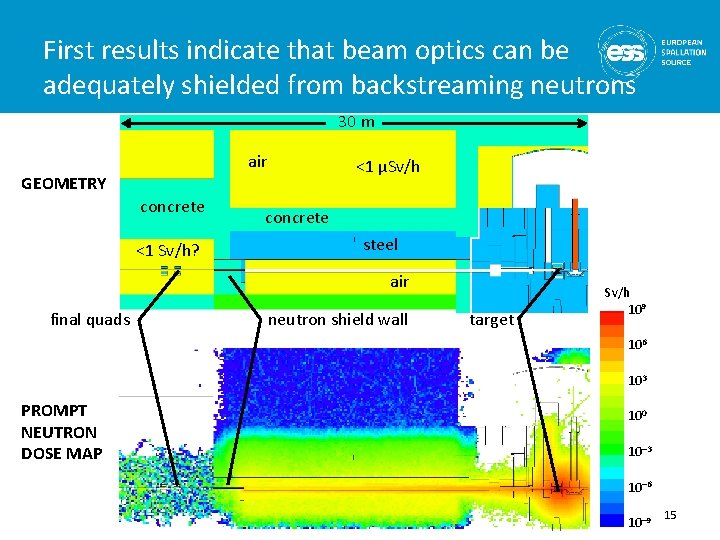
First results indicate that beam optics can be adequately shielded from backstreaming neutrons 30 m air <1 µSv/h GEOMETRY concrete <1 Sv/h? concrete steel air final quads neutron shield wall target Sv/h 109 106 103 PROMPT NEUTRON DOSE MAP 100 10– 3 10– 6 10– 9 15
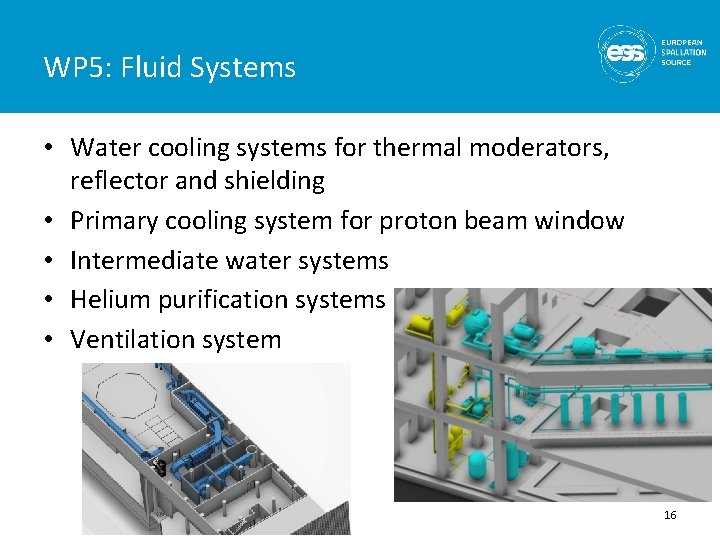
WP 5: Fluid Systems • Water cooling systems for thermal moderators, reflector and shielding • Primary cooling system for proton beam window • Intermediate water systems • Helium purification systems • Ventilation system 16
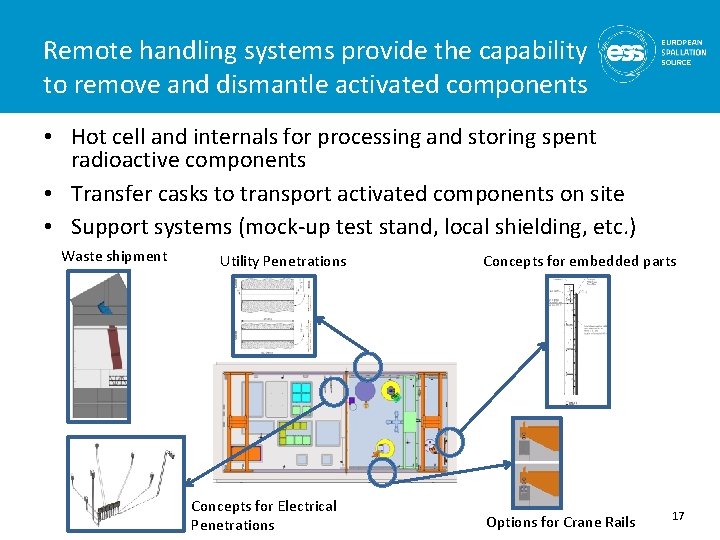
Remote handling systems provide the capability to remove and dismantle activated components • Hot cell and internals for processing and storing spent radioactive components • Transfer casks to transport activated components on site • Support systems (mock-up test stand, local shielding, etc. ) Waste shipment Utility Penetrations Concepts for Electrical Penetrations Concepts for embedded parts Options for Crane Rails 17
Summary • The ESS target station employs many innovative features: helium-cooled rotating tungsten target flat moderators proton beam expansion using raster magnets neutron beam ports that allow viewing of either the upper or lower moderator – small angular separation between beamlines, doubling the number of neutron beam ports – – • The design fully achieves the specified performance while preserving the safety of employees, the public, and the environment as the paramount design criterion