
The ESOS Ethos Whats new for the ESOS

- Slides: 19
The ESOS Ethos: What’s new for the ESOS National Code 2018 ELICOS Sector Webinar International Group Policy and Legislation Branch Department of Education and Training
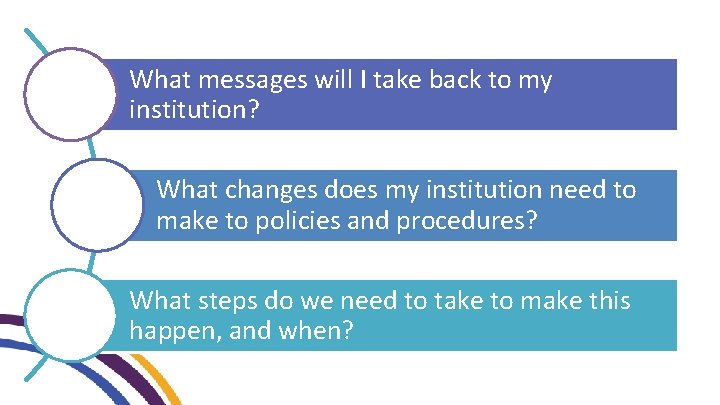
What messages will I take back to my institution? What changes does my institution need to make to policies and procedures? What steps do we need to take to make this happen, and when?
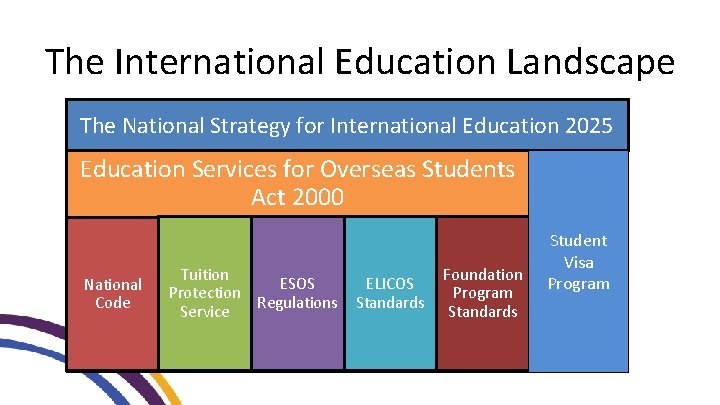
The International Education Landscape The National Strategy for International Education 2025 Education Services for Overseas Students Act 2000 National Code Tuition ESOS Protection Regulations Service ELICOS Standards Foundation Program Standards Student Visa Program
Modernising the National Code • Modernising the National Code has been a collaborative process. • A consultation draft National Code was released for public comment in February – March 2017 following initial discussions with peak bodies, state and territory regulators, and other Commonwealth agencies. • The final revised National Code was released on 14 September 2017 and will commence on 1 January 2018.
What are we seeking to achieve?
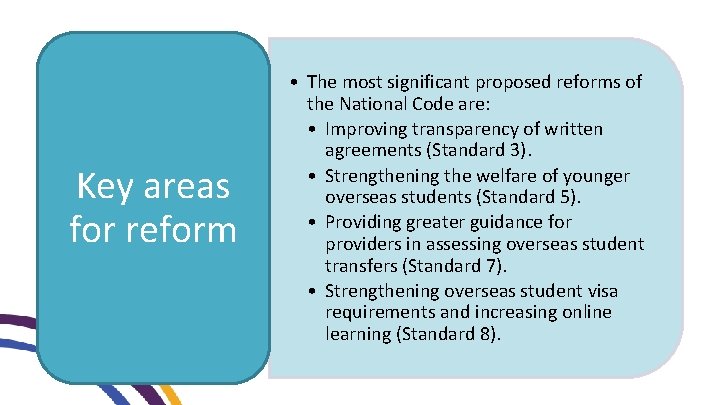
Key areas for reform • The most significant proposed reforms of the National Code are: • Improving transparency of written agreements (Standard 3). • Strengthening the welfare of younger overseas students (Standard 5). • Providing greater guidance for providers in assessing overseas student transfers (Standard 7). • Strengthening overseas student visa requirements and increasing online learning (Standard 8).
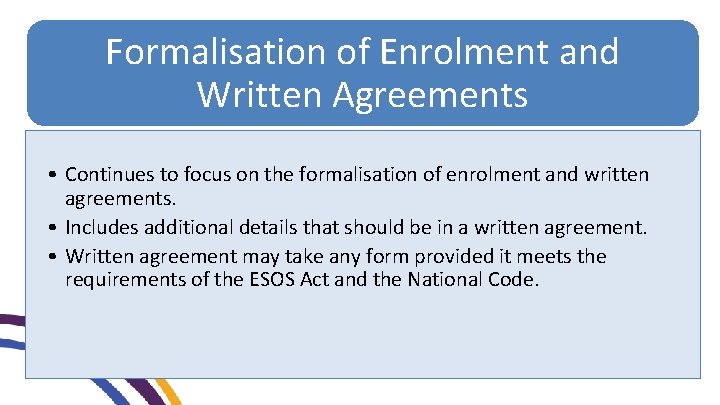
Formalisation of Enrolment and Written Agreements • Continues to focus on the formalisation of enrolment and written agreements. • Includes additional details that should be in a written agreement. • Written agreement may take any form provided it meets the requirements of the ESOS Act and the National Code.
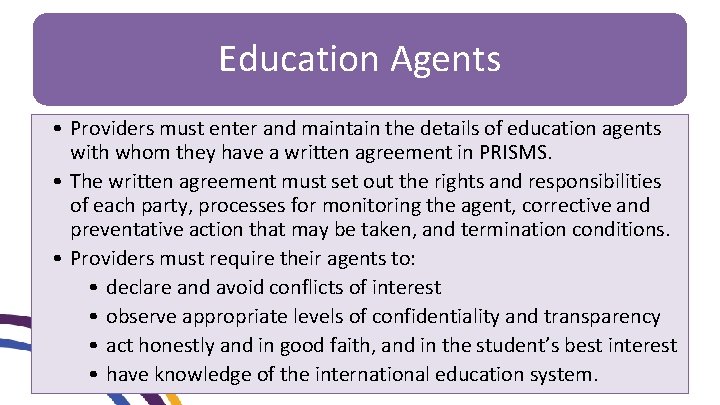
Education Agents • Providers must enter and maintain the details of education agents with whom they have a written agreement in PRISMS. • The written agreement must set out the rights and responsibilities of each party, processes for monitoring the agent, corrective and preventative action that may be taken, and termination conditions. • Providers must require their agents to: • declare and avoid conflicts of interest • observe appropriate levels of confidentiality and transparency • act honestly and in good faith, and in the student’s best interest • have knowledge of the international education system.
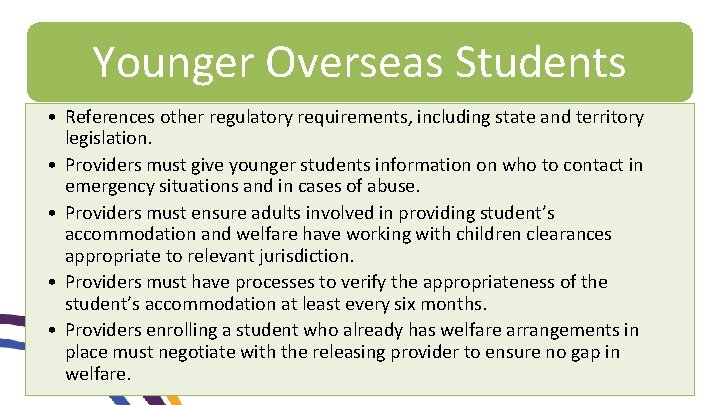
Younger Overseas Students • References other regulatory requirements, including state and territory legislation. • Providers must give younger students information on who to contact in emergency situations and in cases of abuse. • Providers must ensure adults involved in providing student’s accommodation and welfare have working with children clearances appropriate to relevant jurisdiction. • Providers must have processes to verify the appropriateness of the student’s accommodation at least every six months. • Providers enrolling a student who already has welfare arrangements in place must negotiate with the releasing provider to ensure no gap in welfare.
Student Support Services • Providers must inform students about services on employment rights and conditions, such as the Fair Work Ombudsman. • Providers must offer reasonable support to students to enable them to achieve expected learning outcomes, regardless of their mode of study. • Providers must take reasonable steps to provide a safe environment on campus and give students information on: • seeking assistance and reporting incidents impacting on their wellbeing • safety and awareness relevant to life in Australia.
Overseas Student Transfers • Schools students are only restricted for the first six months of the first school course. • Transfers will be recorded in PRISMS. • Providers must not finalise a transfer request refusal in PRISMS until the student has had a chance to access the complaints and appeals process.
Overseas Student Transfers • Transfer requests should be granted where: • the student has been reported because they are unable to achieve satisfactory course progress • there are compassionate or compelling circumstances • the registered provider is not able to deliver the course • there is evidence that current courses do not meet overseas student’s expectations • there is evidence that the overseas student was misled by the registered provider or an education agent • an appeal (internal or external) on another matter results in a decision or recommendation to release the student.
Overseas Student Visa Requirements Monitoring attendance and/or course progress Reporting student visa breaches Online learning
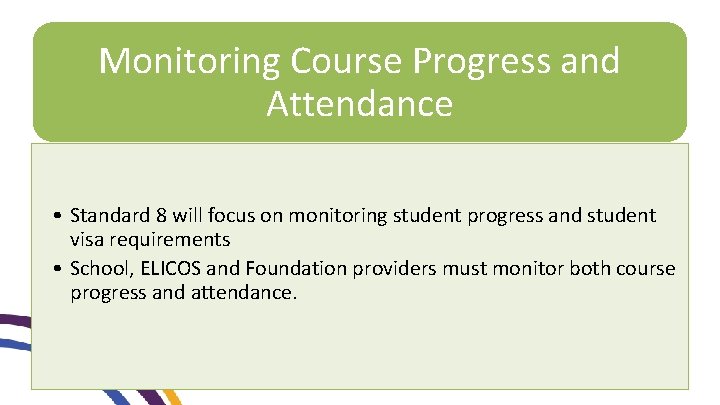
Monitoring Course Progress and Attendance • Standard 8 will focus on monitoring student progress and student visa requirements • School, ELICOS and Foundation providers must monitor both course progress and attendance.
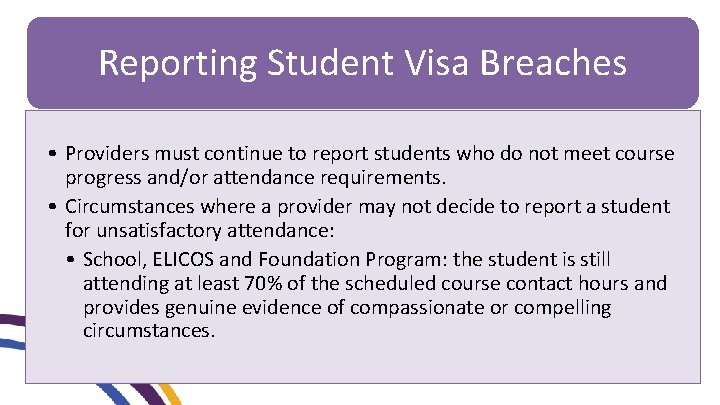
Reporting Student Visa Breaches • Providers must continue to report students who do not meet course progress and/or attendance requirements. • Circumstances where a provider may not decide to report a student for unsatisfactory attendance: • School, ELICOS and Foundation Program: the student is still attending at least 70% of the scheduled course contact hours and provides genuine evidence of compassionate or compelling circumstances.
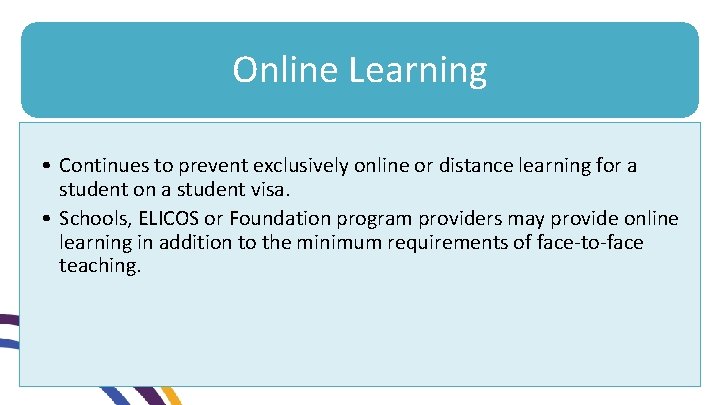
Online Learning • Continues to prevent exclusively online or distance learning for a student on a student visa. • Schools, ELICOS or Foundation program providers may provide online learning in addition to the minimum requirements of face-to-face teaching.
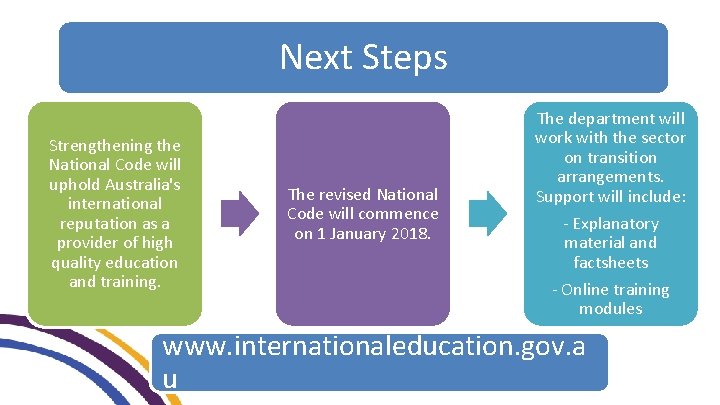
Next Steps Strengthening the National Code will uphold Australia's international reputation as a provider of high quality education and training. The revised National Code will commence on 1 January 2018. The department will work with the sector on transition arrangements. Support will include: - Explanatory material and factsheets - Online training modules www. internationaleducation. gov. a u
What messages will I take back to my institution? What changes does my institution need to make to policies and procedures? What steps do we need to take to make this happen, and when?
Thank you