
The ESC of Morris County How the Educational
- Slides: 19
The ESC of Morris County How the Educational Services Commission Can Mitigate the Pandemic's Impact on Your Budget October 22, 2020 11: 00 AM
Introduction w The COVID-19 crisis has presented new problems for districts to address in the operations of their districts w Curricular approaches had to be modified to meet these new demands. w Supportive services had to be reimagined to meet mandatory guidelines. w District responses have been formidable, but there continues to be much to do. w The Educational Services Commission can help through shared services to ease district increased responsibilities.
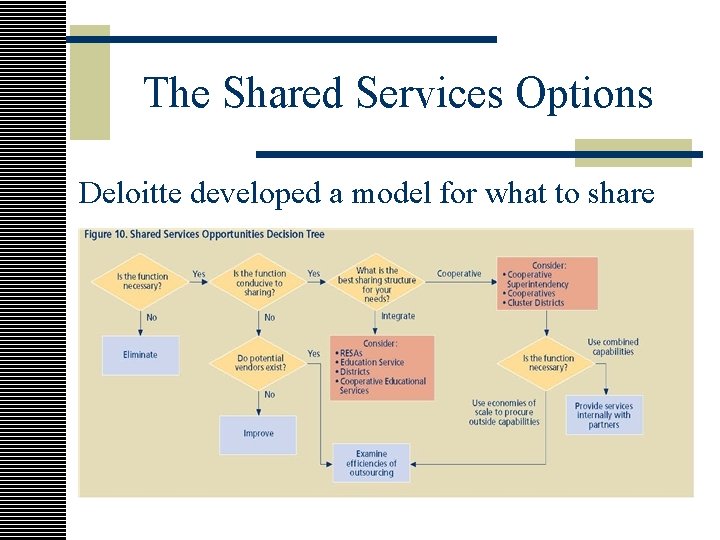
The Shared Services Options w Over the years, NJSBA has supported shared services during “normal” times. The new normal brings additional challenges. w In 1995 New Jersey School Board identified shared services in education as “any voluntary formal or informal agreement between two or more entities that enhances educational opportunities for students and/or demonstrates cost effectiveness and accountability. ” w In its 2005 study, The Promise of Shared Services, Deloitte noted that shared services may be the most effective strategy to help districts direct more money into the classroom. They developed a “decision tree” model in their report, Figure 10, which follows:
The Shared Services Options Deloitte developed a model for what to share
The Shared Services Options ² Local districts through statutory provision in NJSA 18 A and NJSA 40, have authority to enter into local agreements to provide shared services through contractual agreements. ² Districts have also joined together to form the Educational Services Commissions of Morris County through the statutory provisions of NJSA 18 A: 6 -51, et seq. ² This options gives Board members from each member district representation on the Representative Assembly and potentially the Board of Directors with direct participation in all programs and services offered by the ESC.
How is the ESC Governed w The formal organization of the ESC has some unique, yet similar structures. w The ESC in each county is governed by the local Boards of Education through their designed representatives. w Annually each district elects/appoints the Representative from their district to the ESC Representative Assembly. w The Representative Assembly meets in January to adopt Rates for Services, in March to adopt the budget and in June to elect the Board of Directors. w The Board of Directors meets each month to conduct the business of the ESC, and establish annual goals. w ESC Board meetings are conducted in a manner similar to local Boards of Education as prescribed by the law.
How the ESC is Governed w According to NJSA 18 A each ESC board can be composed of Board members or Superintendents or a combination of both. w Morris ESC has chosen the model of all elected local Board members. w While there is value in the other models of governance, the Morris ESC Board of Directors believes governance by elected Board members offers a different opportunity to examine shared services. w Board members face the same challenges in their districts, whether large or small, that involve fiscal accountability for public funds. w Board members represent their communities and have an opportunity to articulate common shared services concerns.
Board Member Guided ESC w Recently School Leader talked to our Superintendent about trends in special education, and ideas for districts looking to improve both the education program delivered to special needs students, while containing costs. w One of the perennial concerns of school districts is the cost of special education. What kinds of things can local school districts do to contain the rising cost of special education? w Board members can ask for decision making processes that include outsourcing components that regularly occur.
Board Member Guided ESC w A model promoted by the ESC is outsourcing CST evaluation. w The model enables district CST to manage the program component of each special education student with care, while outsourcing the time consuming mandated evaluations. w The result is that district personnel are freed up to engage parents and educators in the best care for each child. w The ESC Board also supports Central Park School for students with Autism and Multiple Disabilities. The highly trained dedicated staff has been committed to a full in person instructional and therapeutic program. The facility upgrades to address COVID-19 include the CASPR HVAC system, along with NJDOH guidance, to ensure and assure a safe environment.
Board Member Guided ESC w Our ESC offers part-time staff on a contract basis for districts, which may not need a full-time specialist in a field. How does that work? w Request for services for special education students are an ongoing process due to the nature and needs of the students w District staff are often pressed due to timeline constraints. w ESC staff can fill in the process on an interim or short term basis to assure quality and compliance for each student. w The economy of scale works when multiple districts use this service.
ESC Budget and Finances w The driving force behind the structure of the ESC is that there are savings that come from efficiencies and economies of scale when districts join together through a central agencies to provide services to meet their educational responsibilities. w The ESC revenue source comes from the savings that result in the delivery of shared services on a larger scale. w The ESC receives no state aid nor local property taxes. w Tuition rates and fees for services are developed by the Representative Assembly. w The ESC annually develops a budget based on proposed services. w The ESC is required to provide an annual audit (CAFR) and uses this information to evaluate the financial viability of programs and services.
Regional Transportation Services Coordinated transportation services involves the bidding, award and management of transportation contracts on behalf of our resident school districts in: • B 6 T Bidding and Processing • Public School Routes • Special Education Routes • Academy Routing • Nonpublic School Routes • Mapping and Consulting How are these services shared and how are they changed to address our current circumstances with schools open, in hybrid models and virtual?
Services to Nonpublic Schools § Nonpublic Services are provided with funds for the DOE for private schools located within public school district. § These are State Mandated and State Paid Programs: § Chapter 192: Compensatory Education in reading and math § Chapter 193: Supplemental Instruction, Speech Therapy and Child Study Team Services § Nursing Services for mandated screenings and health records. § Textbook, Technology and Security Acquisition Services § The ESC provides all of the support, personnel and services required for these mandates. § In Morris County all 34 non public schools receive services from the ESC which fulfills the districts’ obligations without administrative time or expense.
Special Education Direct and Support Services • Child Study Team Services The establishment of a Regional Testing Center addresses the requirements LDTC, Social and Psychological testing. • Speech & Language Virtual and in person services to assist districts in compliance with IEPs. • Occupational Therapy and Physical Therapy Assistance in providing equipment to students at home for virtual learning and therapy. • Home Instruction To assist potential district overload in addressing changes from in person to virtual and virtual to in person.
District Office Support Services The ESC provides services to support the business office function: § Cooperative purchasing for general, art and maintenance supplies, which include thousands of items. The current COVID-19 pandemic brought about a greater need for cooperatives to address the mandates for school reopening. Coop vendors for PPEs, partitions and ventilation upgrades are carefully vetted and approved through rigorous bids to ensure compliance. Innovated HVAC systems, like CASPR, normally only available for hospital settings are available to coop members.
District Office Support Services (Continued) § Health, safety and environmental services which include Right-To-Know, Blood Borne Pathogen training, survey and consultation services. These consultation services assisted our districts in gearing up to meet CDC and NJDOH requirements for reopening. This ongoing service assures compliance for district to consider expanding in person instruction. § Teacher evaluation services utilizing certified evaluators to assist districts in meeting the teacher evaluation mandates of TEACH 4 NJ can be expanded to meet virtual and hybrid models.
General Board Discussion w Local Board members appointed to serve on ESC board are KEY COMMUNICATORS. w Opportunities w w ESC Board meeting end with General Board Discussion. Local Boards provide opportunity for their ESC appointees to report about the ESC offerings/actions. w Two way communication = success !
General Board Discussion w Questions that have arisen in response to school closures. w How does A 3904 impact transportation contracts held by the ESC on behalf of School Districts? w How are contracts for services for short term and long term services developed? w What other areas can/should the ESC be developing to serve districts during the pandemic? . w What emerging issues have developed from operations during this pandemic? How can the ESC help?
Contact Information Educational Service Commission of Morris County Website: www. escmorris. com Angelo A. Vilardi, Ed. D. , Superintendent avilardi@escmorris. com. 973 -540 -8844, Extension 11 Central Park School Denise Moore, Principal. 973 -539 -9630 dmoore@escmorris. com www. escmorris. com/central-park-school