
The Equivalence Principle and General Relativity Some useful
- Slides: 12
The Equivalence Principle and General Relativity
Some useful definitions Frames of reference. An inertial frame of reference is one in which the velocity of the coordinate system is constant or zero (Special relativity). A non-inertial frame of reference is a coordinate system which is accelerating (General Relativity). So, it is either changing its speed by speeding up or slowing down, or it is changing its direction by traveling in a curved path, or it is both changing its speed and changing its direction.
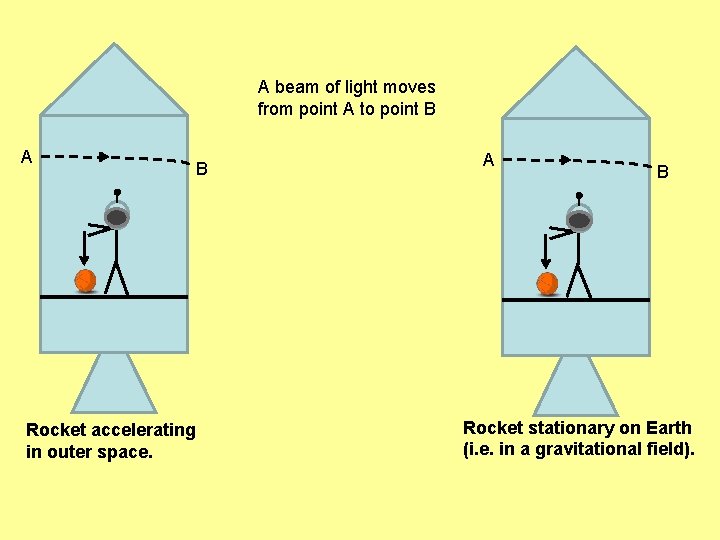
Consider an astronaut dropping a basketball inside a stationary rocket on the Earth’s surface. She will observe it accelerating downwards at 9. 8 m/s 2. If the rocket is then accelerating through interstellar space (i. e. no nearby sources of gravity) at a constant 9. 8 m/s 2 and she releases the basketball will be observed to fall at 9. 8 m/s 2. i. e. She can’t tell whether she is in a gravitational field or if the rocket has a constant acceleration. https: //www. youtube. com/watch? v=Ow 9 F 8 t. O 6 dmg
The equivalence principle states that the effects of gravity are exactly equivalent to the effects of acceleration. Hence no experiment can distinguish gravitation from accelerated motion, or freefall from constant velocity. For an object in free-fall, the object will experience weightlessness. It would appear that the forces acting on the object are balanced. This is equivalent to the same object travelling with a constant velocity.
A beam of light moves from point A to point B A B Rocket accelerating in outer space. A B Rocket stationary on Earth (i. e. in a gravitational field).
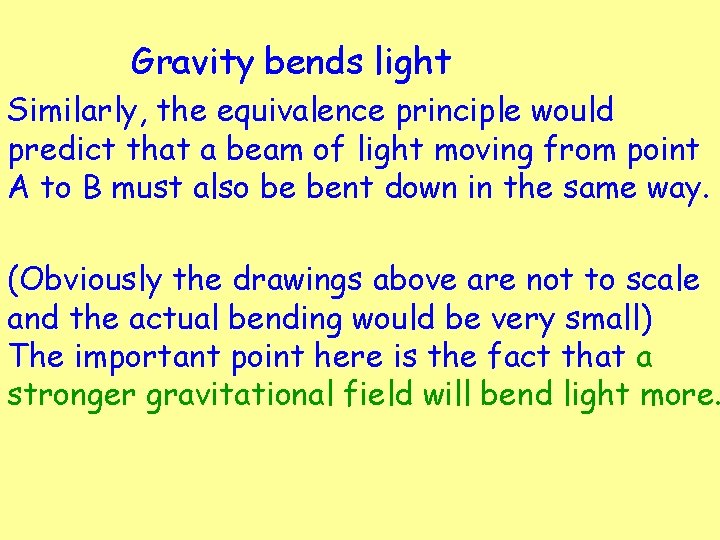
Gravity bends light Similarly, the equivalence principle would predict that a beam of light moving from point A to B must also be bent down in the same way. (Obviously the drawings above are not to scale and the actual bending would be very small) The important point here is the fact that a stronger gravitational field will bend light more.
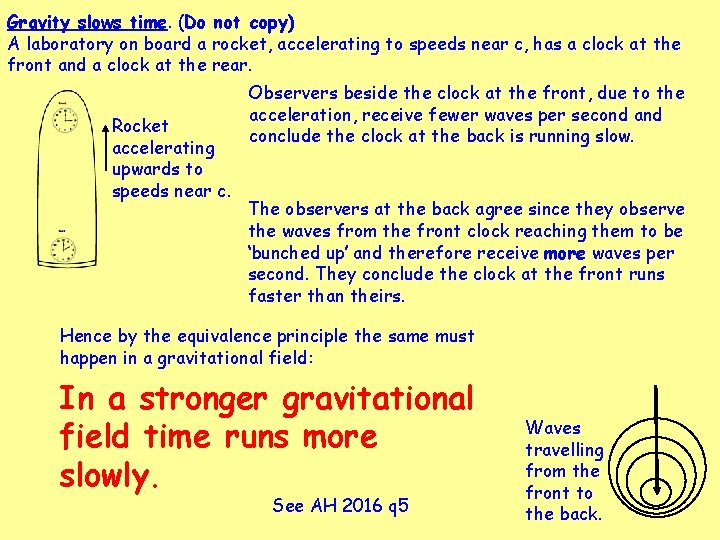
Gravity slows time. (Do not copy) A laboratory on board a rocket, accelerating to speeds near c, has a clock at the front and a clock at the rear. Rocket accelerating upwards to speeds near c. Observers beside the clock at the front, due to the acceleration, receive fewer waves per second and conclude the clock at the back is running slow. The observers at the back agree since they observe the waves from the front clock reaching them to be ‘bunched up’ and therefore receive more waves per second. They conclude the clock at the front runs faster than theirs. Hence by the equivalence principle the same must happen in a gravitational field: In a stronger gravitational field time runs more slowly. See AH 2016 q 5 Waves travelling from the front to the back.
A planet or star will cause the spacetime around them to be curved: curvature of spacetime. An object, free to move, placed into that spacetime, will experience that curvature and move accordingly and accelerate. In curved spacetime the frame of reference is non-inertial which means accelerating. Light or a freely moving object follows a geodesic (the path with the shortest distance between two points) in spacetime. Rubber Sheet analogy: https: //www. youtube. com/watch? v=MTY 1 Kje 0 y. Lg
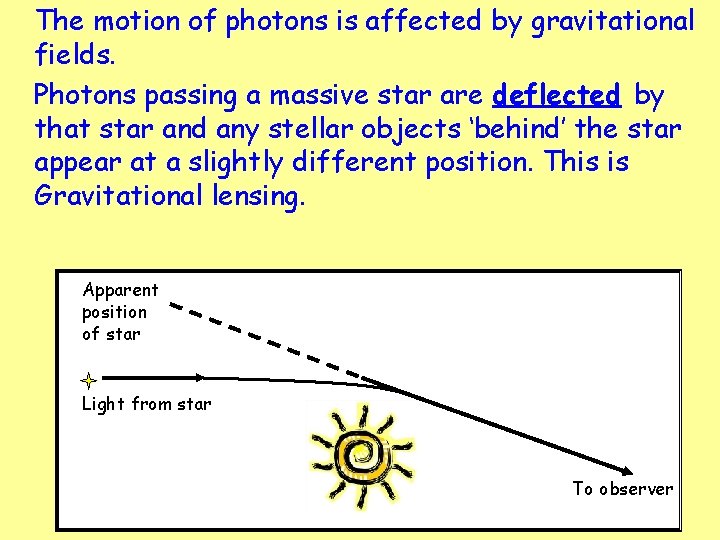
The motion of photons is affected by gravitational fields. Photons passing a massive star are deflected by that star and any stellar objects ‘behind’ the star appear at a slightly different position. This is Gravitational lensing. Apparent position of star Light from star To observer
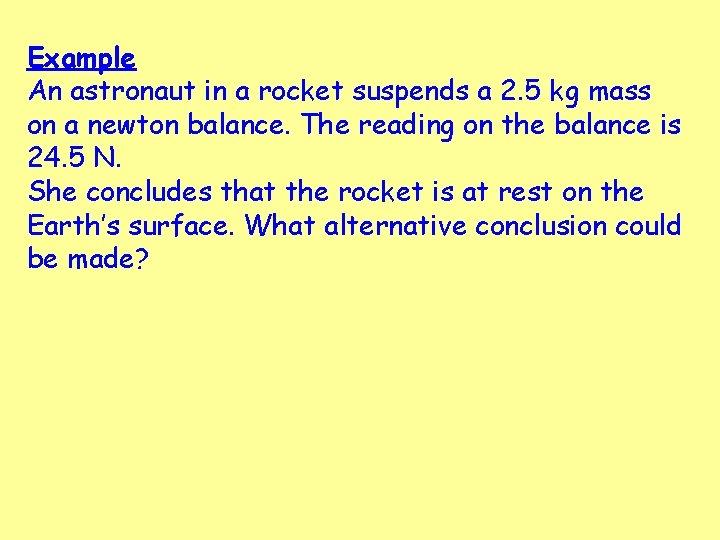
Example An astronaut in a rocket suspends a 2. 5 kg mass on a newton balance. The reading on the balance is 24. 5 N. She concludes that the rocket is at rest on the Earth’s surface. What alternative conclusion could be made?
Kepler’s Laws of planetary motion failed to predict the correct position of Mercury in the night sky over a period of time. Einstein’s theory of General relativity offered the solution. The orbit of Mercury, being close to the Sun, was being “dragged” slightly around the “fabric” of spacetime by the local presence of the Sun’s mass curving the spacetime and altering the precession of Mercury’s orbit. Explanation of precession of Mercury’s Orbit https: //www. youtube. com/watch? v=h. SXNE 0 p. Ntr 8
The greater the gravitational field strength is, the slower time runs. Therefore the higher in altitude above the planet/star the quicker time will run. e. g. GPS (Global positioning system) satellites use clocks to accurately determine the position of objects on the surface of the Earth. The effects of general relativity mean that these clocks run faster and therefore need to be constantly adjusted to give the correct time, and therefore position, on Earth.