
The equilibrium for the Prisoners dilemma Prisoner II
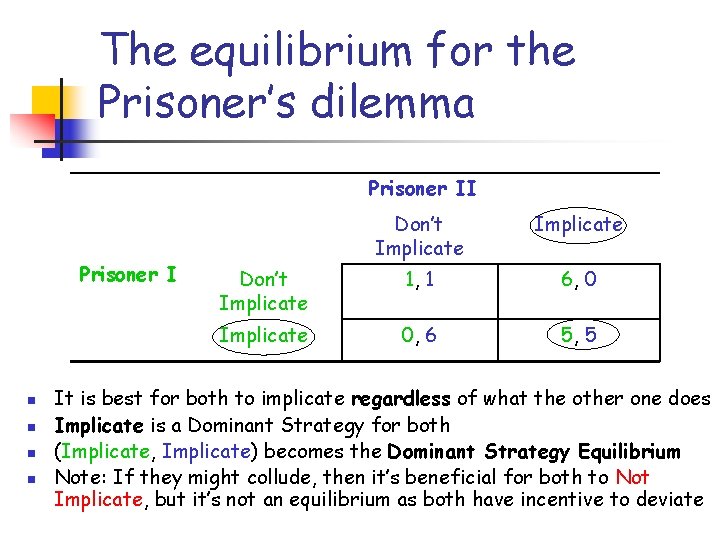
The equilibrium for the Prisoner’s dilemma Prisoner II Prisoner I n n Don’t Implicate 1, 1 6, 0 Implicate 0, 6 5, 5 It is best for both to implicate regardless of what the other one does Implicate is a Dominant Strategy for both (Implicate, Implicate) becomes the Dominant Strategy Equilibrium Note: If they might collude, then it’s beneficial for both to Not Implicate, but it’s not an equilibrium as both have incentive to deviate
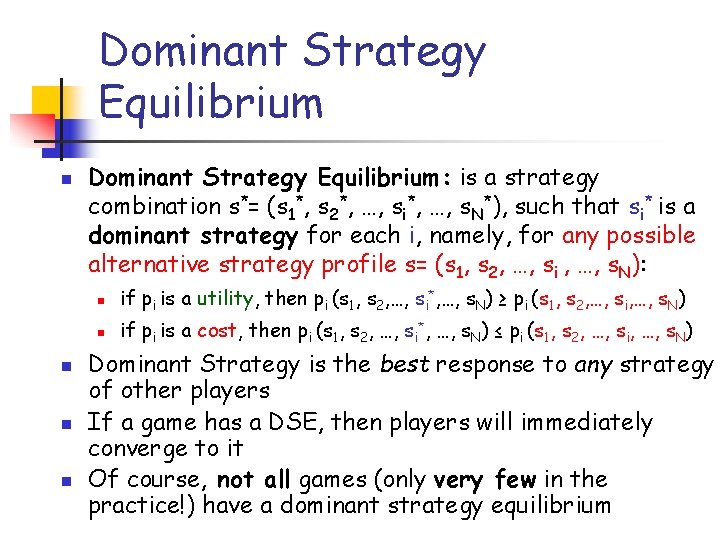
Dominant Strategy Equilibrium n n Dominant Strategy Equilibrium: is a strategy combination s*= (s 1*, s 2*, …, si*, …, s. N*), such that si* is a dominant strategy for each i, namely, for any possible alternative strategy profile s= (s 1, s 2, …, si , …, s. N): n if pi is a utility, then pi (s 1, s 2, …, si*, …, s. N) ≥ pi (s 1, s 2, …, si, …, s. N) n if pi is a cost, then pi (s 1, s 2, …, si*, …, s. N) ≤ pi (s 1, s 2, …, si, …, s. N) Dominant Strategy is the best response to any strategy of other players If a game has a DSE, then players will immediately converge to it Of course, not all games (only very few in the practice!) have a dominant strategy equilibrium
![A more relaxed solution concept: Nash Equilibrium [1951] n Nash Equilibrium: is a strategy](http://slidetodoc.com/presentation_image_h2/afabdfc37d7c1f3ba9b85c97e690d3f0/image-3.jpg "A more relaxed solution concept: Nash Equilibrium [1951] n Nash Equilibrium: is a strategy")
A more relaxed solution concept: Nash Equilibrium [1951] n Nash Equilibrium: is a strategy combination s*= (s 1*, s 2*, …, s. N*) such that for each i, si* is a best response to (s 1*, …, si-1*, si+1*, …, s. N*), namely, for any possible alternative strategy si of player i n if pi is a utility, then pi (s 1*, s 2*, …, si*, …, s. N*) ≥ pi (s 1*, s 2*, …, si, …, s. N*) n if pi is a cost, then pi (s 1*, s 2*, …, si*, …, s. N*) ≤ pi (s 1*, s 2*, …, si, …, s. N*)
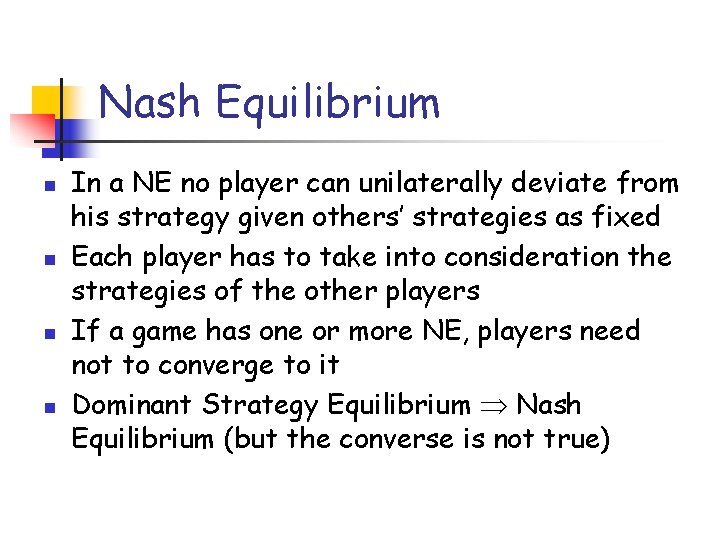
Nash Equilibrium n n In a NE no player can unilaterally deviate from his strategy given others’ strategies as fixed Each player has to take into consideration the strategies of the other players If a game has one or more NE, players need not to converge to it Dominant Strategy Equilibrium Nash Equilibrium (but the converse is not true)
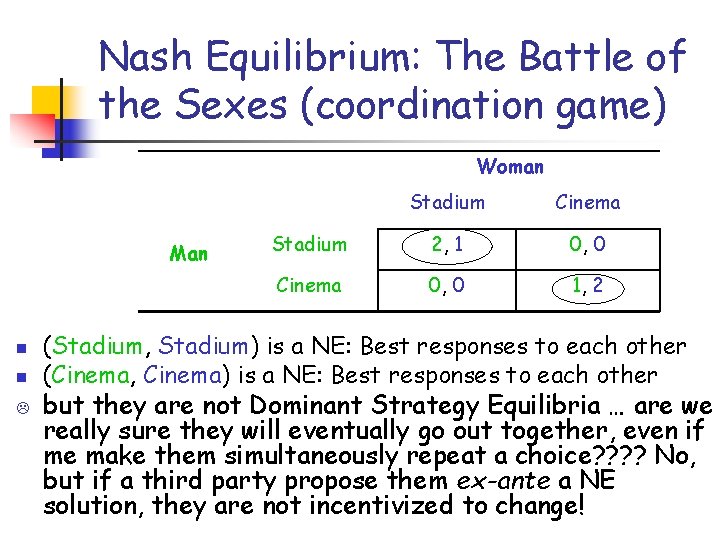
Nash Equilibrium: The Battle of the Sexes (coordination game) Woman Man n n L Stadium Cinema Stadium 2, 1 0, 0 Cinema 0, 0 1, 2 (Stadium, Stadium) is a NE: Best responses to each other (Cinema, Cinema) is a NE: Best responses to each other but they are not Dominant Strategy Equilibria … are we really sure they will eventually go out together, even if me make them simultaneously repeat a choice? ? No, but if a third party propose them ex-ante a NE solution, they are not incentivized to change!
A crucial issue in game theory: the existence of a NE n n Unfortunately, for pure strategies games (as those seen so far, in which each player, for each possible situation of the game, selects his action deterministically), it is easy to see that we cannot have a general result of existence In other words, there may be no any, just one, or many NE, depending on the game
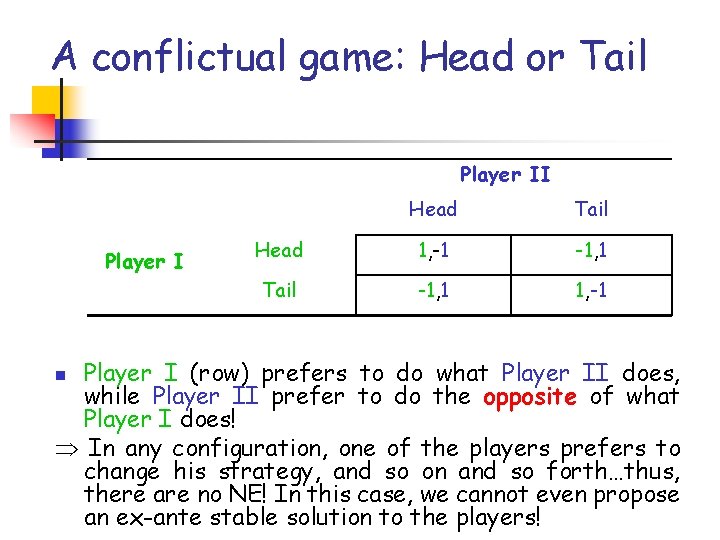
A conflictual game: Head or Tail Player II Player I Head Tail Head 1, -1 -1, 1 Tail -1, 1 1, -1 Player I (row) prefers to do what Player II does, while Player II prefer to do the opposite of what Player I does! In any configuration, one of the players prefers to change his strategy, and so on and so forth…thus, there are no NE! In this case, we cannot even propose an ex-ante stable solution to the players! n
On the existence of a NE n n n However, when a player can select his strategy randomly by using a probability distribution over his set of possible pure strategies (mixed strategy), then the following general result holds: Theorem (Nash, 1951): Any game with a finite set of players and a finite set of strategies has a NE of mixed strategies (i. e. , there exists a profile of probability distributions for the players such that the expected payoff of each player cannot be improved by changing unilaterally the selected probability distribution). Head or Tail game: if each player sets p(Head)=p(Tail)=1/2 (this is exactly as if each player tosses a coin), then the expected payoff of each player is 0 (i. e. , ½∙ 0+½∙ 0), and this is a NE, since no player can improve on this by choosing unilaterally a different randomization!
Fundamental computational issues concerned with NE 1. 2. 3. 4. Finding (efficiently) a mixed/pure (if any) NE Establishing the quality of a NE, as compared to a cooperative system, namely a system in which agents can collaborate (recall the Prisoner’s Dilemma) In a repeated game, establishing whether and in how many steps the system will eventually converge to a NE (recall the Battle of the Sexes) Verifying that a strategy profile is a NE, approximating a NE, NE in resource (e. g. , time, space, message size) constrained settings, breaking a NE by colluding, etc. . . (interested in a Thesis, or even in a Ph. D? )
Finding a NE in mixed strategies n n n It can be shown that there exist games for which finding a NE in mixed strategies is a hard computational task, but we cannot talk about NP-completeness here, since a solution is always guaranteed to exist (see next slide)! Rather, one can show that several games are PPAD (Polynomial Parity Argument – Directed case) –complete, a class of problems that are now resisting for decades to poly-time attacks (e. g. , finding Brouwer fixed points) It is strongly believed that PPAD P, but it could be PPAD=P NP (and actually also that PPAD=P=NP)
Why finding a NE in MS is likely not to be NP-hard? W. l. o. g. , we restrict ourselves to 2 -player games, let us call it 2 -NASH, and we wonder whether finding a NE in mixed strategies for 2 -NASH is NP-hard n Recall: a decision problem P is in NP (resp. , in co. NP) if all its "yes"-instances (resp. , “no”-instances) can be solved in polynomial time by a Non-Deterministic Turing Machine (NDTM) [Alternative definition for NP (resp. , co. NP): set of problems for which a "yes"-instance (resp. , a “no”-instance) can be verified in polynomial time by a DTM] n Recall also: a problem P (not necessarily a decision one) is NP-hard if one can reduce in polynomial time any decision problem P’ in NP to it (this means, P’ can be solved in polynomial time on a NDTM by transforming it to P, in such a way that “yes”-instances of P’ maps to “yes”-instances of P, while “no”instances of P’ maps to “no”-instances of P) since all the instances of NASH are “yes”-instances, one could solve in polynomial time a “no”-instance of P’ on a NDTM by just showing that it does not map to a “yes”-instance of NASH) It turns out that if NASH would be NP-hard then this would imply that NP = co. NP (very hard to believe!) n
Finding a NE in pure strategies n n n Exhaustive search: by definition, it is easy to see that an entry (p 1, …, p. N) of the payoff matrix is a NE if and only if pi is the maximum ith element of the row (p 1, …, pi-1, {p(s): s Si} , pi+1, …, p. N), for each i=1, …, N. However, with N players, an explicit (i. e. , in normal-form) representation of the payoff functions is exponential in N Exhaustive search for finding a pure NE is then exponential in the number of players (even if it is still polynomial in the input size, but the normal-form representation needs not be a minimal-space representation of the input!). Alternative cheaper methods are sought: for many games of interest, a NE can be found in poly-time w. r. t. to the number of players (e. g. , by using the powerful potential method). But the question is: does there exist a general method which guarantees to be always polynomial in N? As we will see, the answer is NO (unless P=NP): in pure strategies, finding a NE is NP-hard for many games of interest (in this case, we can talk about NP-hardness since a solution is not guaranteed to exist)
- Slides: 12