
The EPRI Groundwater Protection Program Technology RD for
- Slides: 26
The EPRI Groundwater Protection Program – Technology R&D for Groundwater Protection Karen Kim Sr. Project Engineer, EPRI kkim@epri. com, +1 -650 -855 -2659
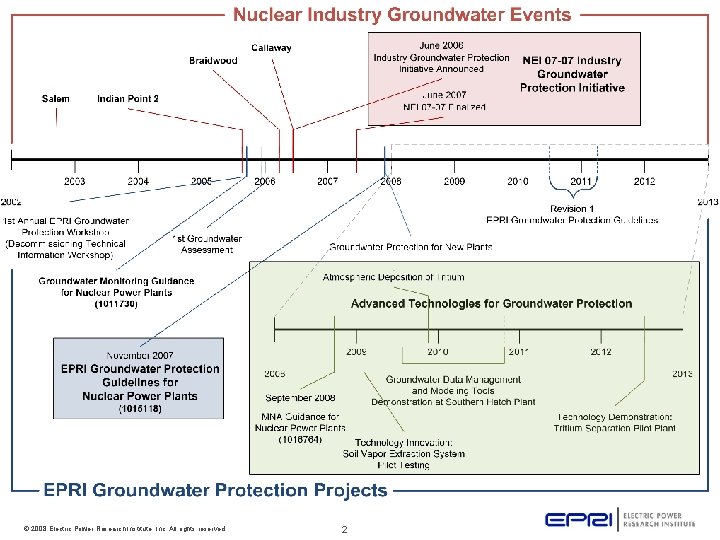
© 2008 Electric Power Research Institute, Inc. All rights reserved. 2
EPRI Advanced Technologies for Groundwater Protection EPRI Role: Collaborative nuclear industry/utility research & development for cost effective tools for implementing groundwater protection programs. © 2008 Electric Power Research Institute, Inc. All rights reserved. 3
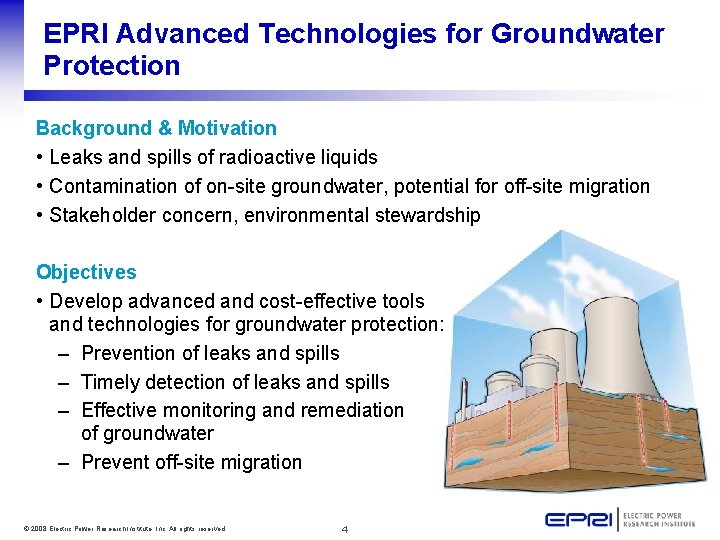
EPRI Advanced Technologies for Groundwater Protection Background & Motivation • Leaks and spills of radioactive liquids • Contamination of on-site groundwater, potential for off-site migration • Stakeholder concern, environmental stewardship Objectives • Develop advanced and cost-effective tools and technologies for groundwater protection: – Prevention of leaks and spills – Timely detection of leaks and spills – Effective monitoring and remediation of groundwater – Prevent off-site migration © 2008 Electric Power Research Institute, Inc. All rights reserved. 4
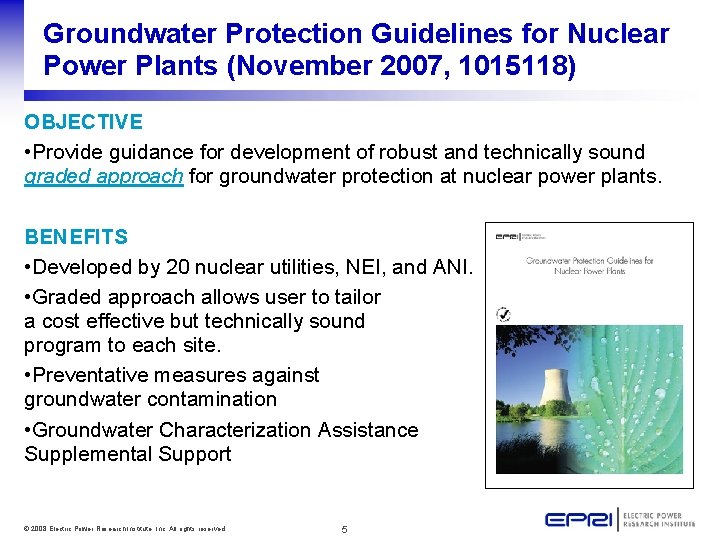
Groundwater Protection Guidelines for Nuclear Power Plants (November 2007, 1015118) OBJECTIVE • Provide guidance for development of robust and technically sound graded approach for groundwater protection at nuclear power plants. BENEFITS • Developed by 20 nuclear utilities, NEI, and ANI. • Graded approach allows user to tailor a cost effective but technically sound program to each site. • Preventative measures against groundwater contamination • Groundwater Characterization Assistance Supplemental Support © 2008 Electric Power Research Institute, Inc. All rights reserved. 5
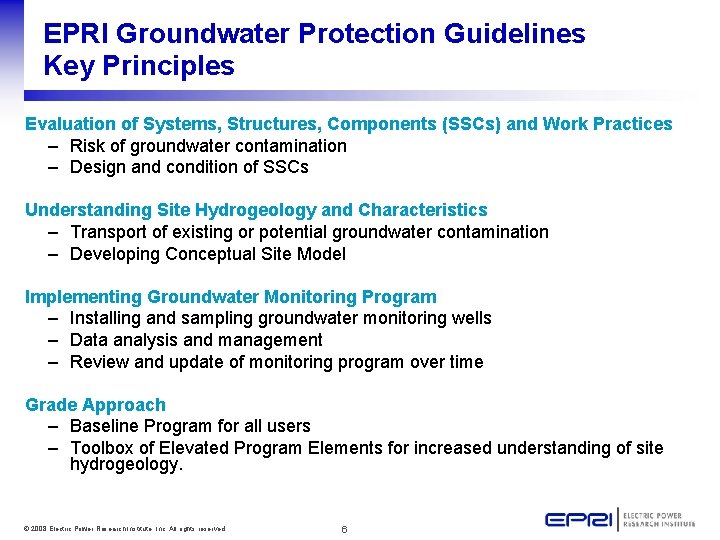
EPRI Groundwater Protection Guidelines Key Principles Evaluation of Systems, Structures, Components (SSCs) and Work Practices – Risk of groundwater contamination – Design and condition of SSCs Understanding Site Hydrogeology and Characteristics – Transport of existing or potential groundwater contamination – Developing Conceptual Site Model Implementing Groundwater Monitoring Program – Installing and sampling groundwater monitoring wells – Data analysis and management – Review and update of monitoring program over time Grade Approach – Baseline Program for all users – Toolbox of Elevated Program Elements for increased understanding of site hydrogeology. © 2008 Electric Power Research Institute, Inc. All rights reserved. 6
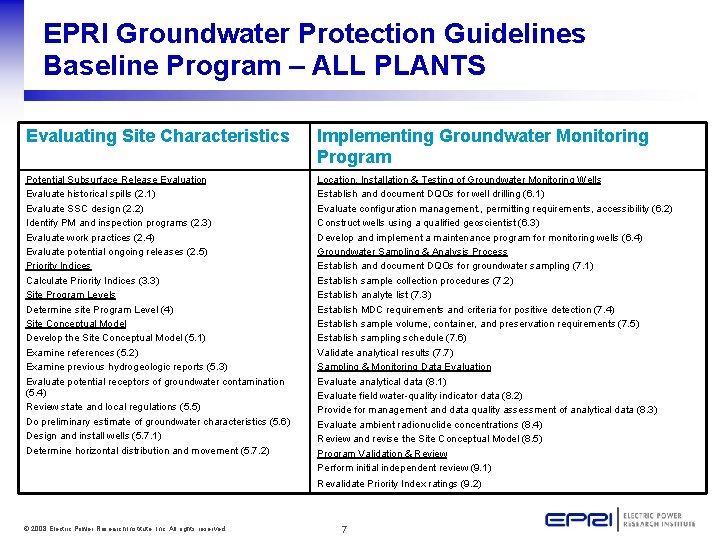
EPRI Groundwater Protection Guidelines Baseline Program – ALL PLANTS Evaluating Site Characteristics Implementing Groundwater Monitoring Program Potential Subsurface Release Evaluation Evaluate historical spills (2. 1) Evaluate SSC design (2. 2) Identify PM and inspection programs (2. 3) Evaluate work practices (2. 4) Evaluate potential ongoing releases (2. 5) Priority Indices Calculate Priority Indices (3. 3) Site Program Levels Determine site Program Level (4) Site Conceptual Model Develop the Site Conceptual Model (5. 1) Examine references (5. 2) Examine previous hydrogeologic reports (5. 3) Evaluate potential receptors of groundwater contamination (5. 4) Review state and local regulations (5. 5) Do preliminary estimate of groundwater characteristics (5. 6) Design and install wells (5. 7. 1) Determine horizontal distribution and movement (5. 7. 2) Location, Installation & Testing of Groundwater Monitoring Wells Establish and document DQOs for well drilling (6. 1) Evaluate configuration management. , permitting requirements, accessibility (6. 2) Construct wells using a qualified geoscientist (6. 3) Develop and implement a maintenance program for monitoring wells (6. 4) Groundwater Sampling & Analysis Process Establish and document DQOs for groundwater sampling (7. 1) Establish sample collection procedures (7. 2) Establish analyte list (7. 3) Establish MDC requirements and criteria for positive detection (7. 4) Establish sample volume, container, and preservation requirements (7. 5) Establish sampling schedule (7. 6) Validate analytical results (7. 7) Sampling & Monitoring Data Evaluation Evaluate analytical data (8. 1) Evaluate field water-quality indicator data (8. 2) Provide for management and data quality assessment of analytical data (8. 3) Evaluate ambient radionuclide concentrations (8. 4) Review and revise the Site Conceptual Model (8. 5) Program Validation & Review Perform initial independent review (9. 1) Revalidate Priority Index ratings (9. 2) © 2008 Electric Power Research Institute, Inc. All rights reserved. 7
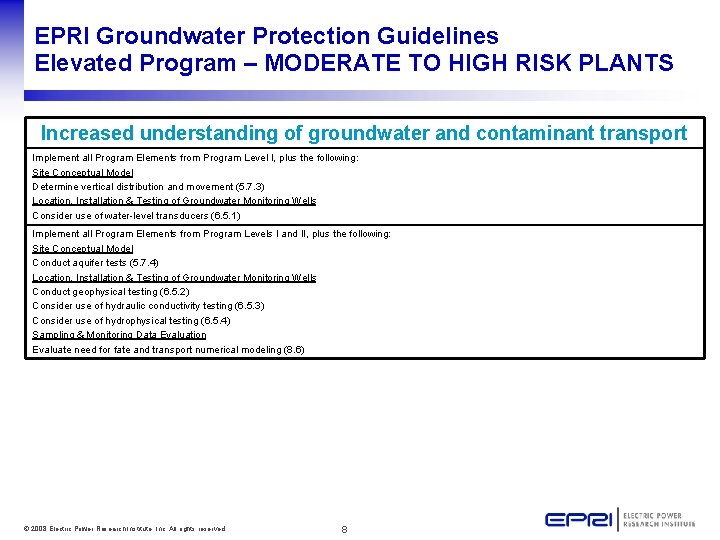
EPRI Groundwater Protection Guidelines Elevated Program – MODERATE TO HIGH RISK PLANTS Increased understanding of groundwater and contaminant transport Implement all Program Elements from Program Level I, plus the following: Site Conceptual Model Determine vertical distribution and movement (5. 7. 3) Location, Installation & Testing of Groundwater Monitoring Wells Consider use of water-level transducers (6. 5. 1) Implement all Program Elements from Program Levels I and II, plus the following: Site Conceptual Model Conduct aquifer tests (5. 7. 4) Location, Installation & Testing of Groundwater Monitoring Wells Conduct geophysical testing (6. 5. 2) Consider use of hydraulic conductivity testing (6. 5. 3) Consider use of hydrophysical testing (6. 5. 4) Sampling & Monitoring Data Evaluation Evaluate need for fate and transport numerical modeling (8. 6) © 2008 Electric Power Research Institute, Inc. All rights reserved. 8
Review and Revision of EPRI Groundwater Protection Guidelines • Biennial Review Cycle: – Review advanced technologies, experiences, lessons learned. – Review new policies and regulations – If needed, revise Guidelines. • 2009 -2010 Review: – Reconvene EPRI Groundwater Protection Guidelines Committee. – Observations from EPRI Groundwater Assessments, Peer Assessments, OE – Focus on risk assessment of systems structures. – If Committee deems necessary, revise Guidelines 2010 -2011. © 2008 Electric Power Research Institute, Inc. All rights reserved. 9
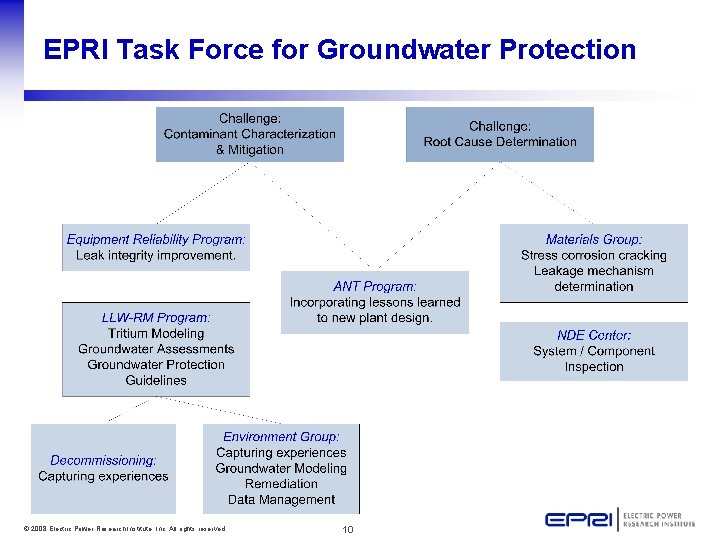
EPRI Task Force for Groundwater Protection © 2008 Electric Power Research Institute, Inc. All rights reserved. 10
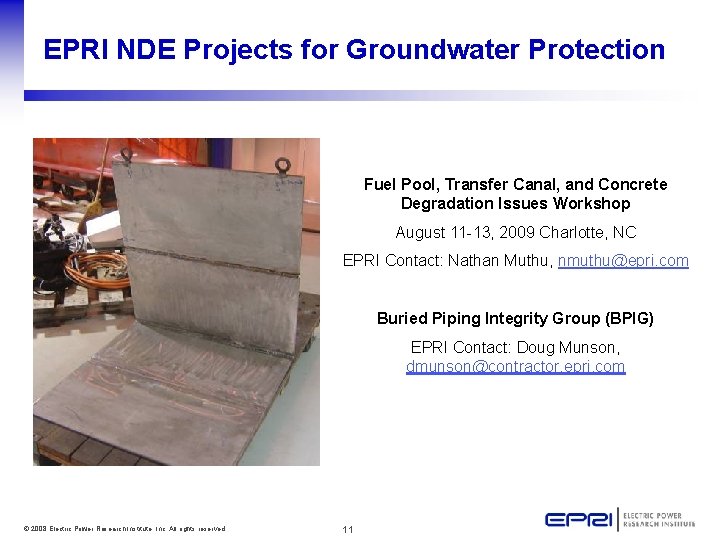
EPRI NDE Projects for Groundwater Protection Fuel Pool, Transfer Canal, and Concrete Degradation Issues Workshop August 11 -13, 2009 Charlotte, NC EPRI Contact: Nathan Muthu, nmuthu@epri. com Buried Piping Integrity Group (BPIG) EPRI Contact: Doug Munson, dmunson@contractor. epri. com © 2008 Electric Power Research Institute, Inc. All rights reserved. 11
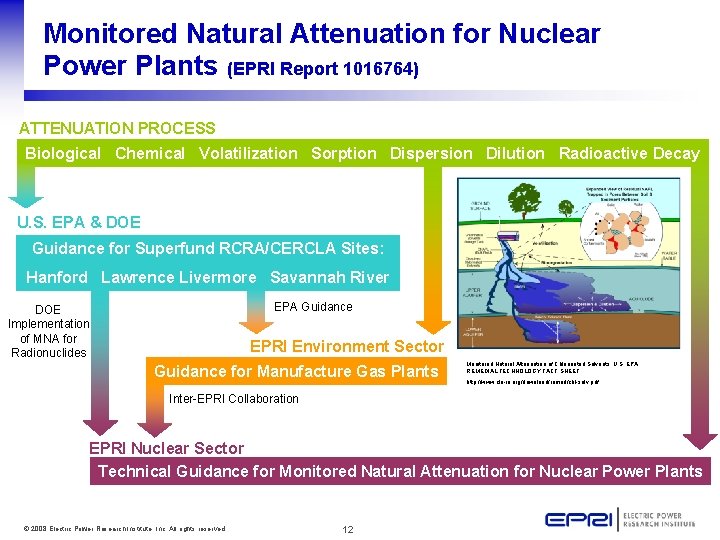
Monitored Natural Attenuation for Nuclear Power Plants (EPRI Report 1016764) ATTENUATION PROCESS Biological Chemical Volatilization Sorption Dispersion Dilution Radioactive Decay U. S. EPA & DOE Guidance for Superfund RCRA/CERCLA Sites: Hanford Lawrence Livermore Savannah River EPA Guidance DOE Implementation of MNA for Radionuclides EPRI Environment Sector Guidance for Manufacture Gas Plants Monitored Natural Attenuation of Chlorinated Solvents, U. S. EPA REMEDIAL TECHNOLOGY FACT SHEET http: //www. clu-in. org/download/remed/chl-solv. pdf Inter-EPRI Collaboration EPRI Nuclear Sector Technical Guidance for Monitored Natural Attenuation for Nuclear Power Plants © 2008 Electric Power Research Institute, Inc. All rights reserved. 12
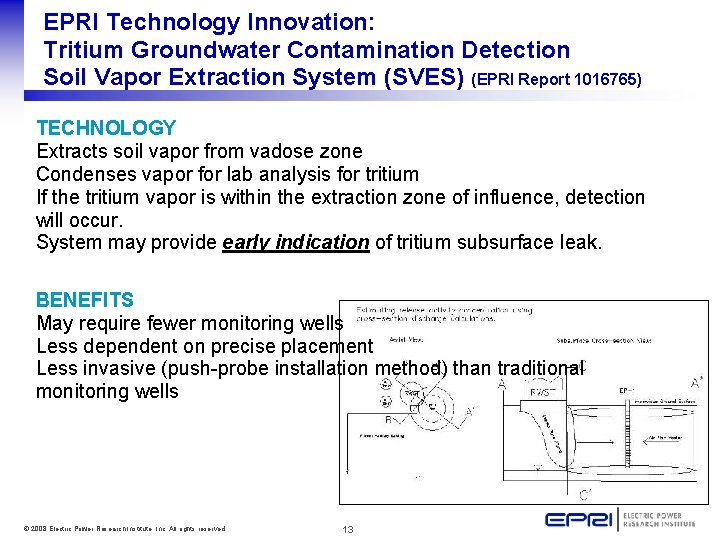
EPRI Technology Innovation: Tritium Groundwater Contamination Detection Soil Vapor Extraction System (SVES) (EPRI Report 1016765) TECHNOLOGY Extracts soil vapor from vadose zone Condenses vapor for lab analysis for tritium If the tritium vapor is within the extraction zone of influence, detection will occur. System may provide early indication of tritium subsurface leak. BENEFITS May require fewer monitoring wells Less dependent on precise placement Less invasive (push-probe installation method) than traditional monitoring wells © 2008 Electric Power Research Institute, Inc. All rights reserved. 13
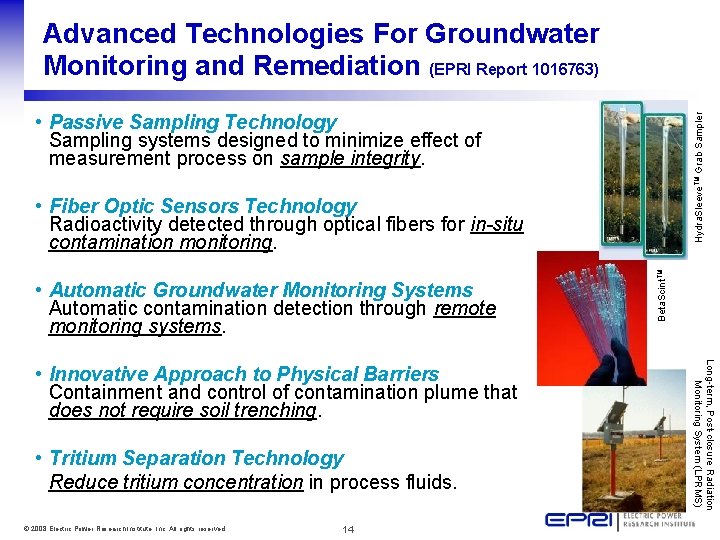
Advanced Technologies For Groundwater Monitoring and Remediation (EPRI Report 1016763) Hydra. Sleeve. TM Grab Sampler • Passive Sampling Technology Sampling systems designed to minimize effect of measurement process on sample integrity. • Automatic Groundwater Monitoring Systems Automatic contamination detection through remote monitoring systems. • Tritium Separation Technology Reduce tritium concentration in process fluids. © 2008 Electric Power Research Institute, Inc. All rights reserved. 14 Long-term, Post-closure Radiation Monitoring System (LPRMS) • Innovative Approach to Physical Barriers Containment and control of contamination plume that does not require soil trenching. Beta. Scint. TM • Fiber Optic Sensors Technology Radioactivity detected through optical fibers for in-situ contamination monitoring.
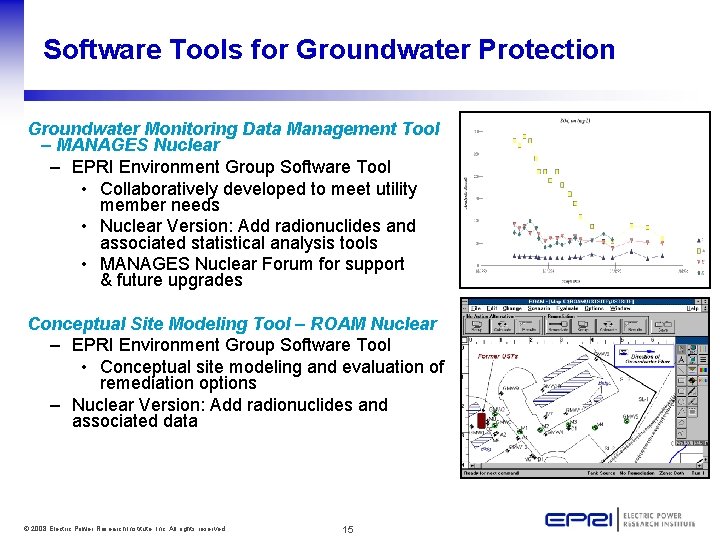
Software Tools for Groundwater Protection Groundwater Monitoring Data Management Tool – MANAGES Nuclear – EPRI Environment Group Software Tool • Collaboratively developed to meet utility member needs • Nuclear Version: Add radionuclides and associated statistical analysis tools • MANAGES Nuclear Forum for support & future upgrades Conceptual Site Modeling Tool – ROAM Nuclear – EPRI Environment Group Software Tool • Conceptual site modeling and evaluation of remediation options – Nuclear Version: Add radionuclides and associated data © 2008 Electric Power Research Institute, Inc. All rights reserved. 15
Groundwater Protection Provisions for Advanced Nuclear Plant Design EPRI UTILITY REQUIREMENT DOCUMENT Identifying design based structures, components, operating practices, and work practices that effect groundwater for incorporation into the EPRI URD (Spring 2008, Rev. 10) - http: //urd. epri. com (EPRI Member Account Login) DESIGN RECOMMENDATIONS Representatives from GE, Westinghouse, and Areva participating in ANP Groundwater Activities Include in Reviews of AP 1000, ESBWR, US EPR NRC Regulatory Guide 4. 21 Minimization of Contamination and Radioactive Waste Generation – Life Cycle Planning – Developed design recommendations to include in NRC Regulatory Guidance for the Implementing 20. 1406 – 25% EPRI Recommendations adopted in DG-4012/RG 4. 21 – Technical Support for NEI Template for 10 CFR 20. 1406 Compliance © 2008 Electric Power Research Institute, Inc. All rights reserved. 16
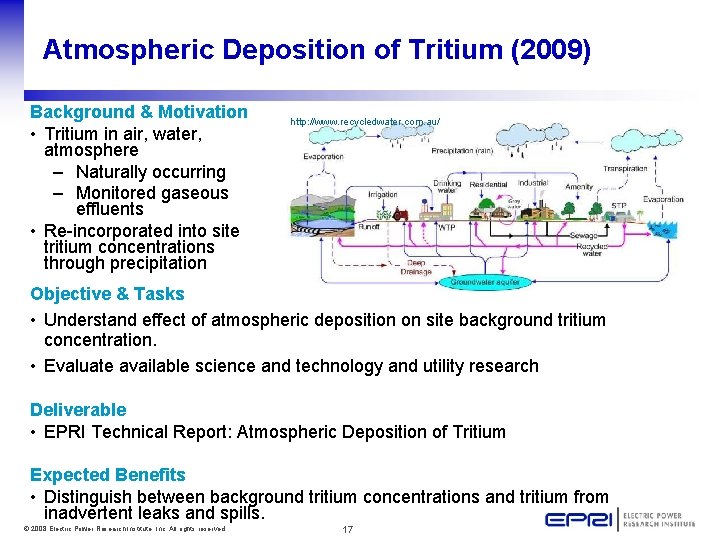
Atmospheric Deposition of Tritium (2009) Background & Motivation • Tritium in air, water, atmosphere – Naturally occurring – Monitored gaseous effluents • Re-incorporated into site tritium concentrations through precipitation http: //www. recycledwater. com. au/ Objective & Tasks • Understand effect of atmospheric deposition on site background tritium concentration. • Evaluate available science and technology and utility research Deliverable • EPRI Technical Report: Atmospheric Deposition of Tritium Expected Benefits • Distinguish between background tritium concentrations and tritium from inadvertent leaks and spills. © 2008 Electric Power Research Institute, Inc. All rights reserved. 17
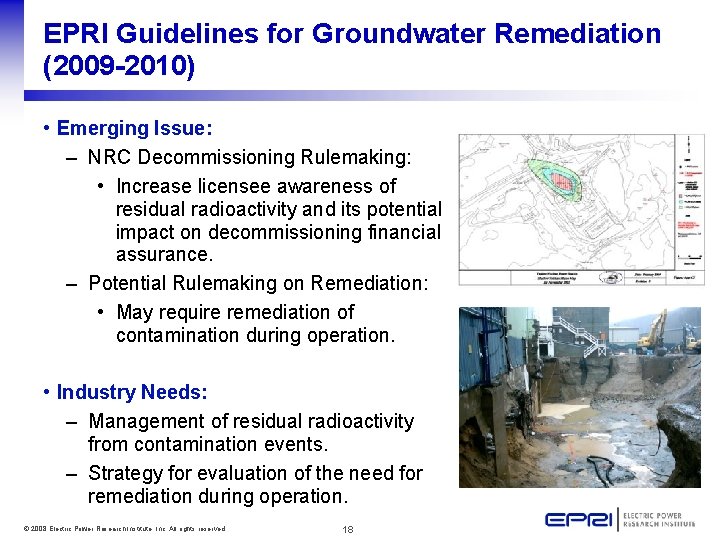
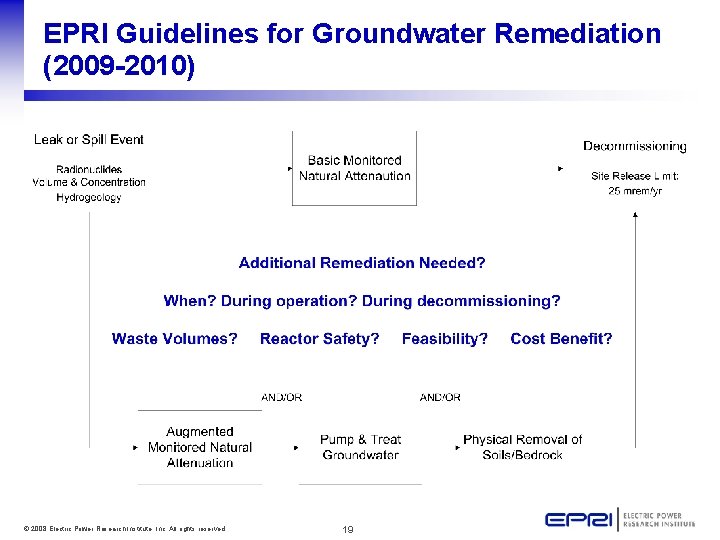
EPRI Guidelines for Groundwater Remediation (2009 -2010) • Emerging Issue: – NRC Decommissioning Rulemaking: • Increase licensee awareness of residual radioactivity and its potential impact on decommissioning financial assurance. – Potential Rulemaking on Remediation: • May require remediation of contamination during operation. • Industry Needs: – Management of residual radioactivity from contamination events. – Strategy for evaluation of the need for remediation during operation. © 2008 Electric Power Research Institute, Inc. All rights reserved. 18
EPRI Guidelines for Groundwater Remediation (2009 -2010) © 2008 Electric Power Research Institute, Inc. All rights reserved. 19
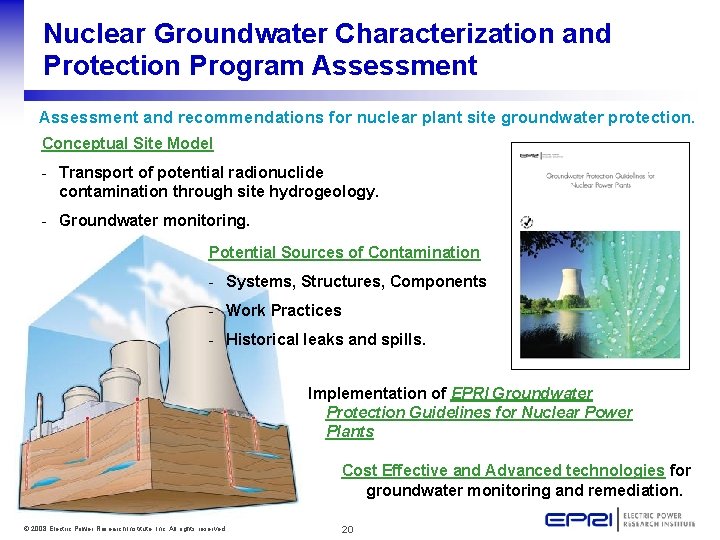
Nuclear Groundwater Characterization and Protection Program Assessment and recommendations for nuclear plant site groundwater protection. Conceptual Site Model - Transport of potential radionuclide contamination through site hydrogeology. - Groundwater monitoring. Potential Sources of Contamination - Systems, Structures, Components - Work Practices - Historical leaks and spills. Implementation of EPRI Groundwater Protection Guidelines for Nuclear Power Plants Cost Effective and Advanced technologies for groundwater monitoring and remediation. © 2008 Electric Power Research Institute, Inc. All rights reserved. 20
Nuclear Groundwater Characterization and Protection Program Assessment • Project Description: – Focus the Groundwater Assessment for specific goals of the site: • New plant • Operating plant • Decommissioning plant – One week on-site assessment by EPRI Team of groundwater experts – Participation in Groundwater User’s Group • Deliverable: – Site specific report of observations and recommendations. • Benefits: – Independent evaluation of groundwater protection programs based on the EPRI Groundwater Protection Guidelines – Supports NEI Groundwater Protection Initiative [NEI 07 -07] – Recommendations for cost effective and advanced groundwater protection methodology and technologies. © 2008 Electric Power Research Institute, Inc. All rights reserved. 21
Groundwater Technology Demonstrations (NEW) • Project Description: – Groundwater technologies identified in EPRI Report 1016763 – Provide utilities site specific technical support for demonstration & evaluating technologies for site. • Development of procedures & evaluation criteria • On-site support for deploying technologies • Evaluation based on site hydrogeology, groundwater contamination, cost and labor, robustness of technology • Deliverable: – Site specific report of observations and evaluation • Benefits: – Potential resource savings (capital cost, labor, minimization of waste) associated with implementation of advanced technology. © 2008 Electric Power Research Institute, Inc. All rights reserved. 22
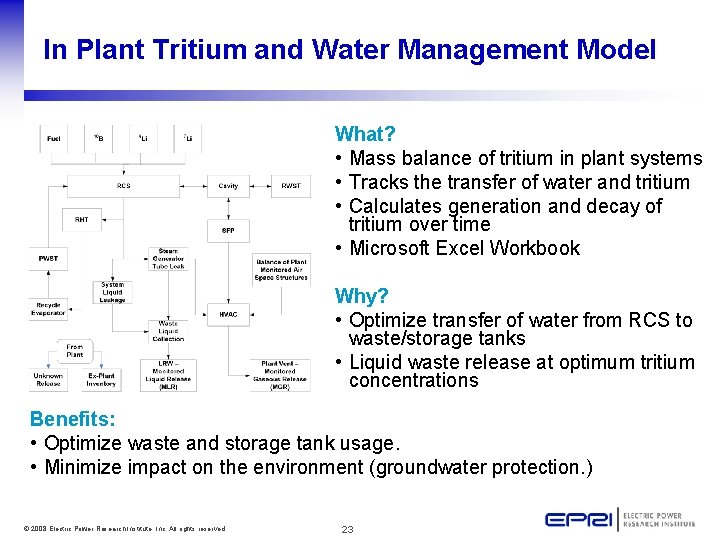
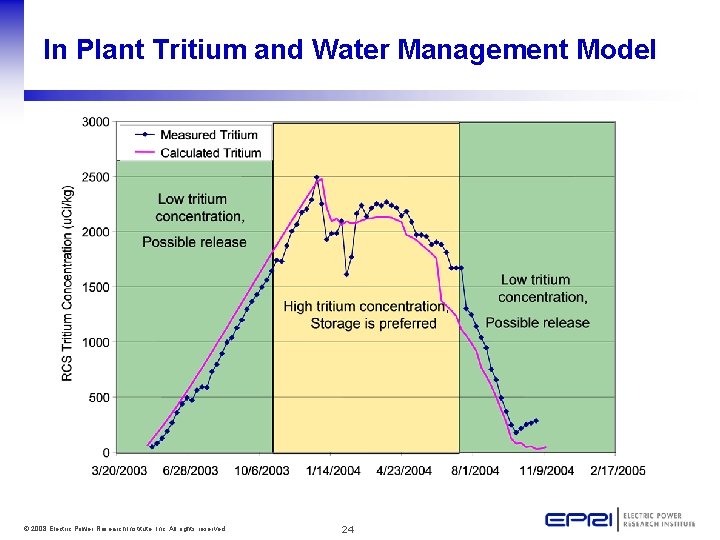
In Plant Tritium and Water Management Model What? • Mass balance of tritium in plant systems • Tracks the transfer of water and tritium • Calculates generation and decay of tritium over time • Microsoft Excel Workbook Why? • Optimize transfer of water from RCS to waste/storage tanks • Liquid waste release at optimum tritium concentrations Benefits: • Optimize waste and storage tank usage. • Minimize impact on the environment (groundwater protection. ) © 2008 Electric Power Research Institute, Inc. All rights reserved. 23
In Plant Tritium and Water Management Model © 2008 Electric Power Research Institute, Inc. All rights reserved. 24
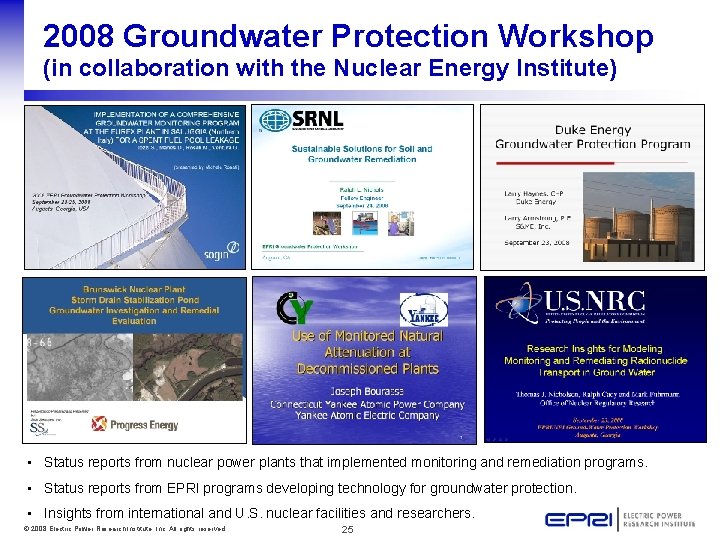
2008 Groundwater Protection Workshop (in collaboration with the Nuclear Energy Institute) • Status reports from nuclear power plants that implemented monitoring and remediation programs. • Status reports from EPRI programs developing technology for groundwater protection. • Insights from international and U. S. nuclear facilities and researchers. © 2008 Electric Power Research Institute, Inc. All rights reserved. 25
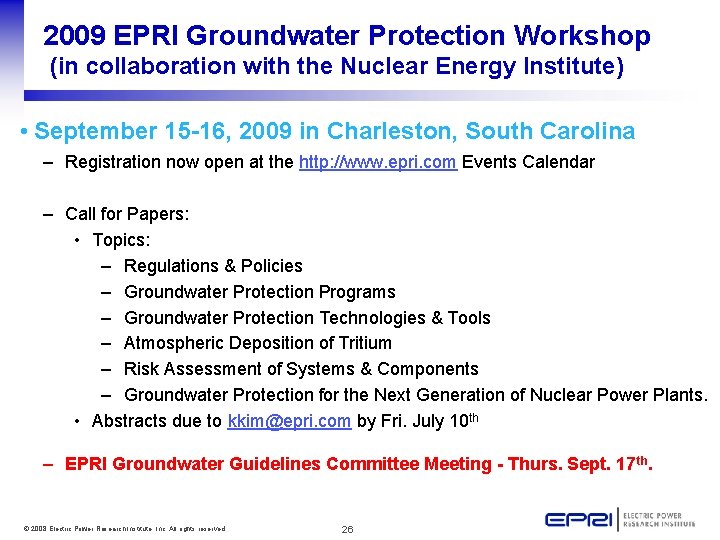
2009 EPRI Groundwater Protection Workshop (in collaboration with the Nuclear Energy Institute) • September 15 -16, 2009 in Charleston, South Carolina – Registration now open at the http: //www. epri. com Events Calendar – Call for Papers: • Topics: – Regulations & Policies – Groundwater Protection Programs – Groundwater Protection Technologies & Tools – Atmospheric Deposition of Tritium – Risk Assessment of Systems & Components – Groundwater Protection for the Next Generation of Nuclear Power Plants. • Abstracts due to kkim@epri. com by Fri. July 10 th – EPRI Groundwater Guidelines Committee Meeting - Thurs. Sept. 17 th. © 2008 Electric Power Research Institute, Inc. All rights reserved. 26