
The environmental effects to the internal structures of
![SB V[km/s] σ[km/s] • Mass distribution • Intrinsic shape • Internal orbit distribution Stellar](https://slidetodoc.com/presentation_image_h2/1ea3a6bfca1f0556a95667e38312edc1/image-5.jpg "SB V[km/s] σ[km/s] • Mass distribution • Intrinsic shape • Internal orbit distribution Stellar")
![Orbital decomposition based on stellar age Young Model σ[km/s] V[km/s] SB True medium V/σ](https://slidetodoc.com/presentation_image_h2/1ea3a6bfca1f0556a95667e38312edc1/image-18.jpg "Orbital decomposition based on stellar age Young Model σ[km/s] V[km/s] SB True medium V/σ")
- Slides: 19
The environmental effects to the internal structures of early-type galaxies Jin Yunpeng, Ling. Zhu, Shude Mao, Lan Wang, Cheng Li…
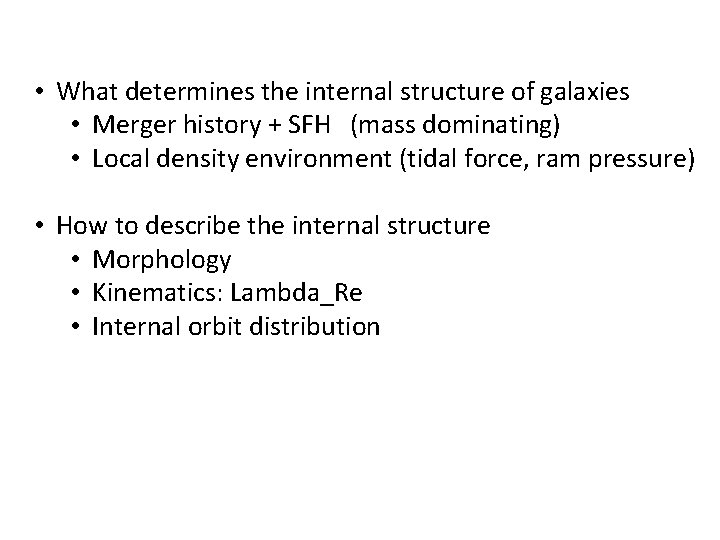
• What determines the internal structure of galaxies • Merger history + SFH (mass dominating) • Local density environment (tidal force, ram pressure) • How to describe the internal structure • Morphology • Kinematics: Lambda_Re • Internal orbit distribution
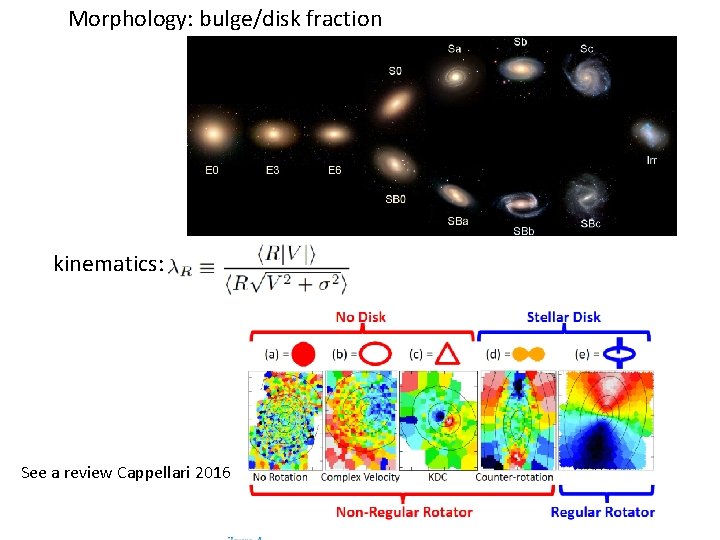
Morphology: bulge/disk fraction kinematics: See a review Cappellari 2016
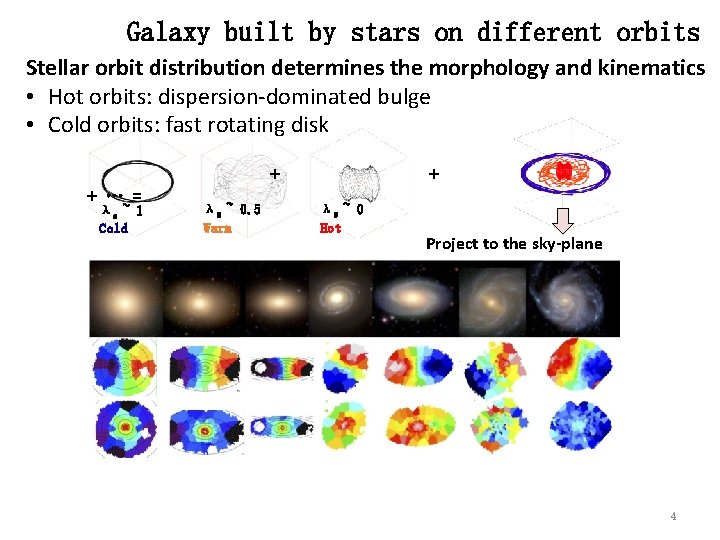
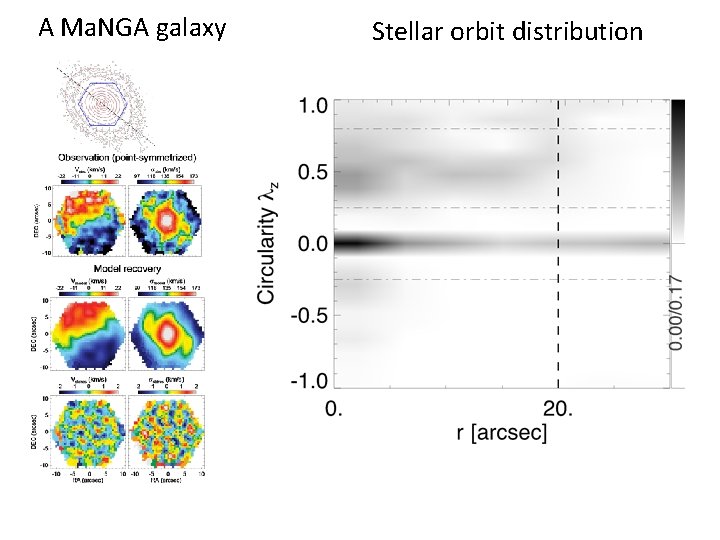
Galaxy built by stars on different orbits Stellar orbit distribution determines the morphology and kinematics • Hot orbits: dispersion-dominated bulge • Cold orbits: fast rotating disk + + … = λz ~ 1 Cold λz ~ 0. 5 Warm + λz ~ 0 Hot Project to the sky-plane 4
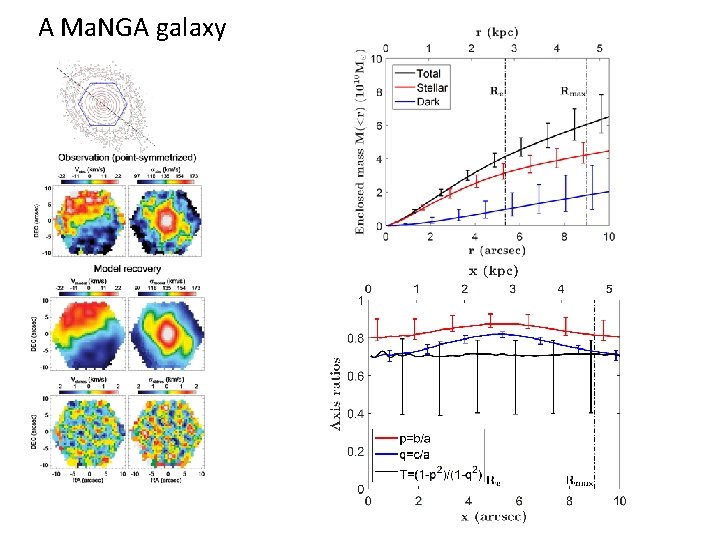
SB V[km/s] σ[km/s] • Mass distribution • Intrinsic shape • Internal orbit distribution Stellar mass + DM mass + BH… = gravitational potential Stellar M/L, DM M 200, C, viewing angles: θ, ϕ, φ. λz ~ 0 w 1 Hot λz ~ 0. 5 + w 2 Warm λz ~ 1 + w 3 A 6 D model Cold + …= Orbit library Schwarzschild 1979, Richstone & Tremaine 1988, Rix+ 1997, Gebhardt+ 2003, Remco van den Bosch+ 2008, Zhu+ 2018 a …
A Ma. NGA galaxy
A Ma. NGA galaxy Stellar orbit distribution
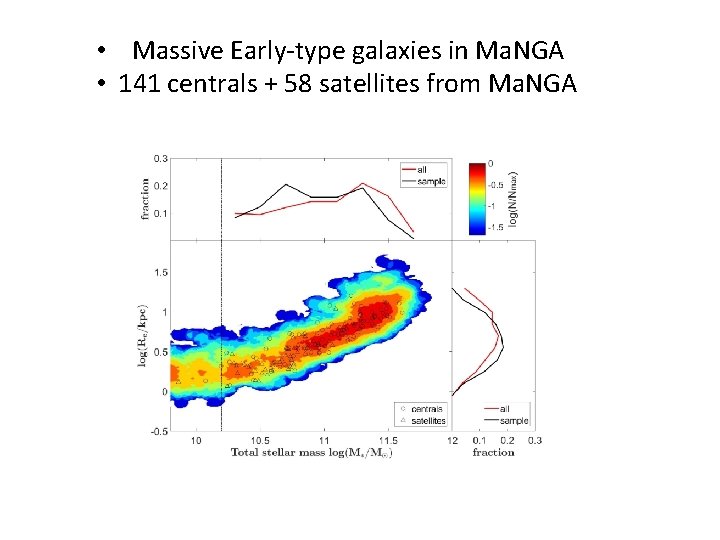
• Massive Early-type galaxies in Ma. NGA • 141 centrals + 58 satellites from Ma. NGA
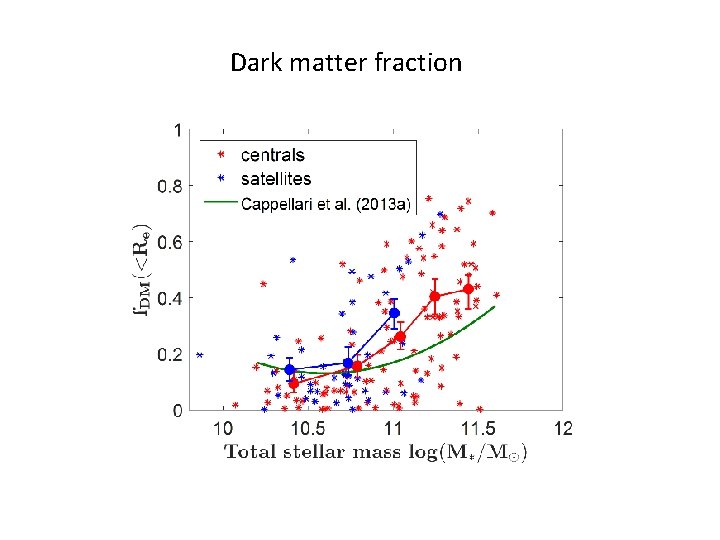
Dark matter fraction
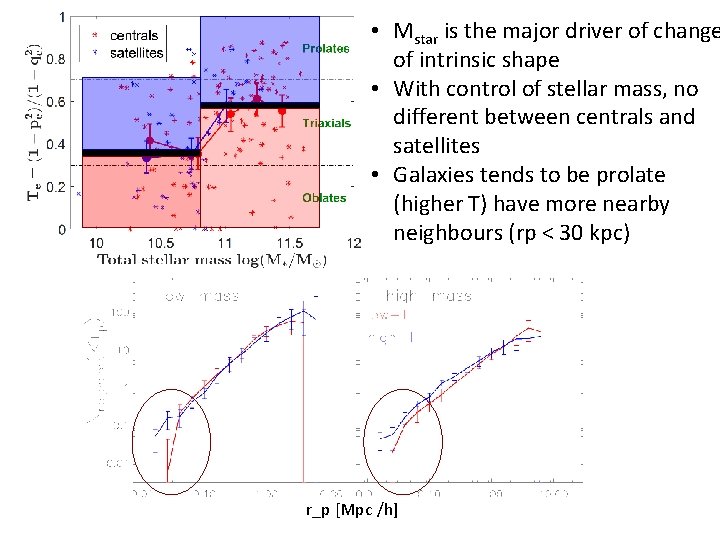
• Mstar is the major driver of change of intrinsic shape • With control of stellar mass, no different between centrals and satellites • Galaxies tends to be prolate (higher T) have more nearby neighbours (rp < 30 kpc) r_p [Mpc /h]
Internal orbit distribution • Mstar is the major driver of change of orbit distribution • With control of stellar mass, no different between centrals and satellites
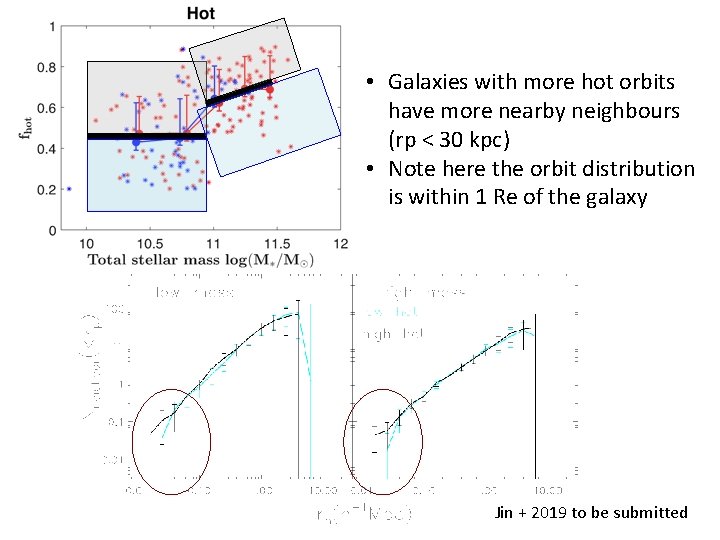
• Galaxies with more hot orbits have more nearby neighbours (rp < 30 kpc) • Note here the orbit distribution is within 1 Re of the galaxy Jin + 2019 to be submitted
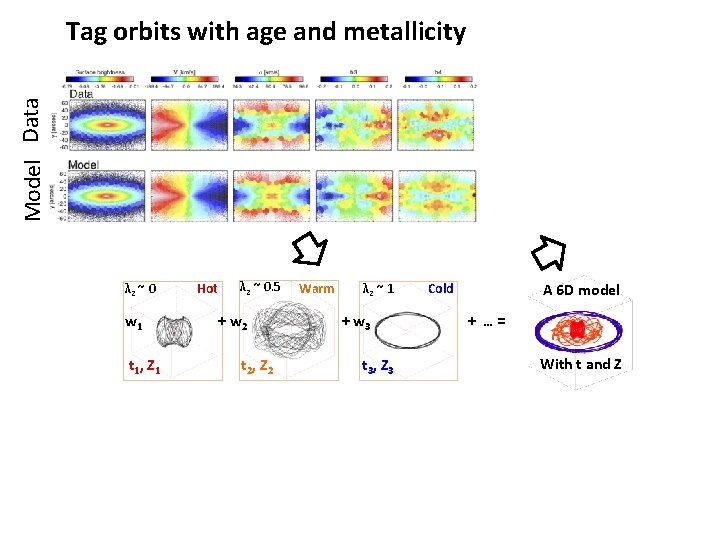
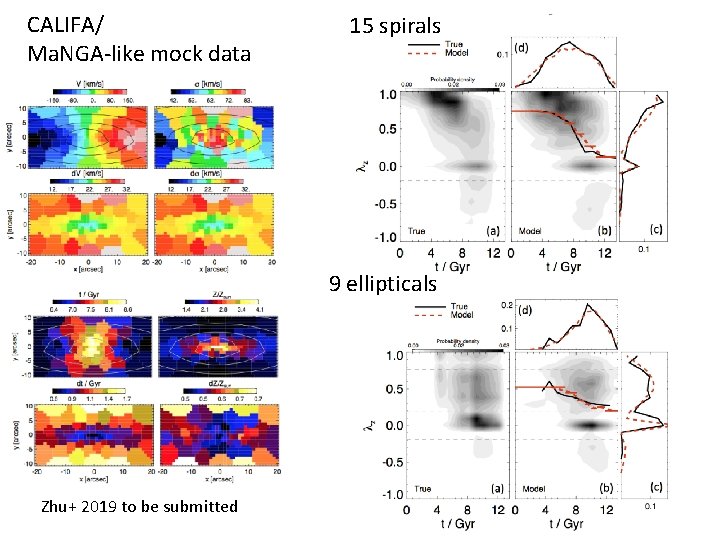
In the future Tag orbits with age and metallicity
Model Data Tag orbits with age and metallicity λz ~ 0 w 1 t 1 , Z 1 Hot λz ~ 0. 5 + w 2 t 2 , Z 2 Warm λz ~ 1 + w 3 t 3 , Z 3 A 6 D model Cold + …= With t and Z
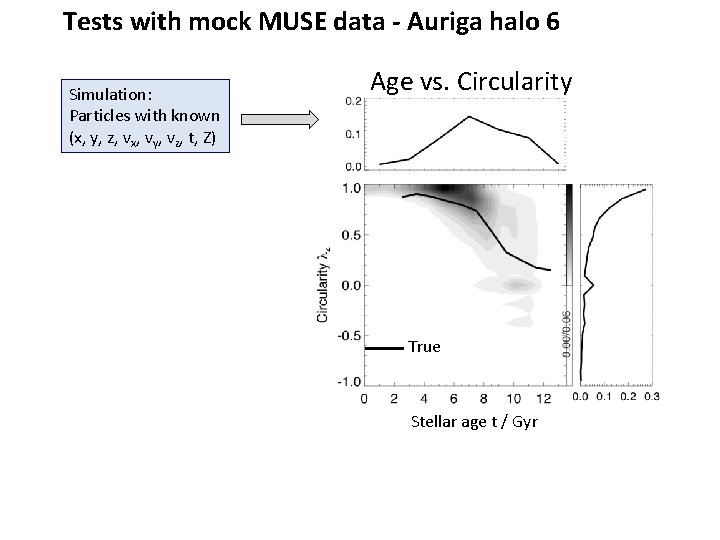
Tests with mock MUSE data - Auriga halo 6 Simulation: Particles with known (x, y, z, vx, vy, vz, t, Z) Age vs. Circularity True Stellar age t / Gyr
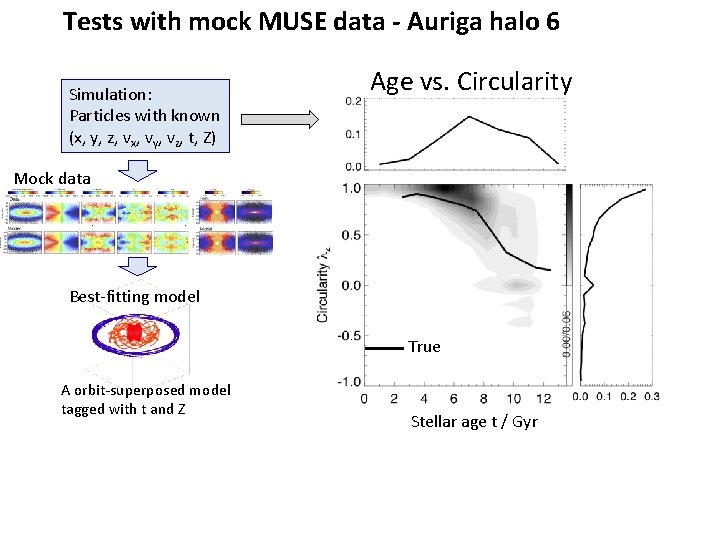
Tests with mock MUSE data - Auriga halo 6 Simulation: Particles with known (x, y, z, vx, vy, vz, t, Z) Age vs. Circularity Mock data Best-fitting model True A orbit-superposed model tagged with t and Z Stellar age t / Gyr
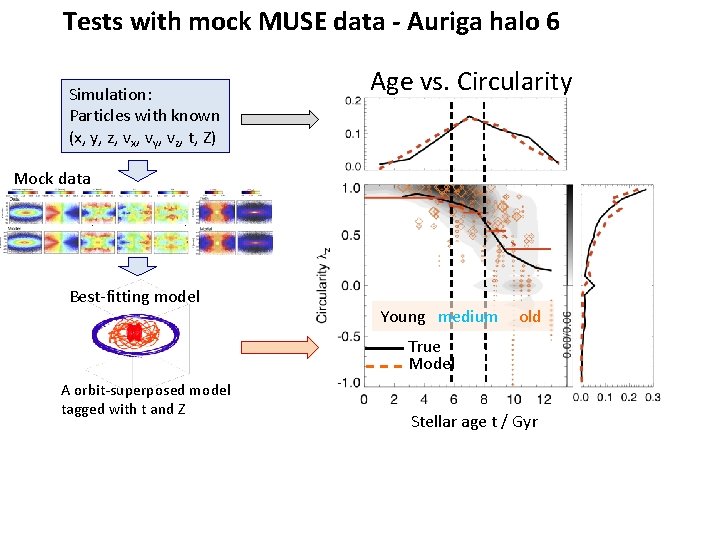
Tests with mock MUSE data - Auriga halo 6 Simulation: Particles with known (x, y, z, vx, vy, vz, t, Z) Age vs. Circularity Mock data Best-fitting model Young medium old True Model A orbit-superposed model tagged with t and Z Stellar age t / Gyr
Orbital decomposition based on stellar age Young Model σ[km/s] V[km/s] SB True medium V/σ Age vs. Circularity X[arcsec] Surface brightness and Kinematics of old, medium age and young stars Young medium old
CALIFA/ Ma. NGA-like mock data 15 spirals 9 ellipticals Zhu+ 2019 to be submitted