
The Environment Model an extension of the substitution
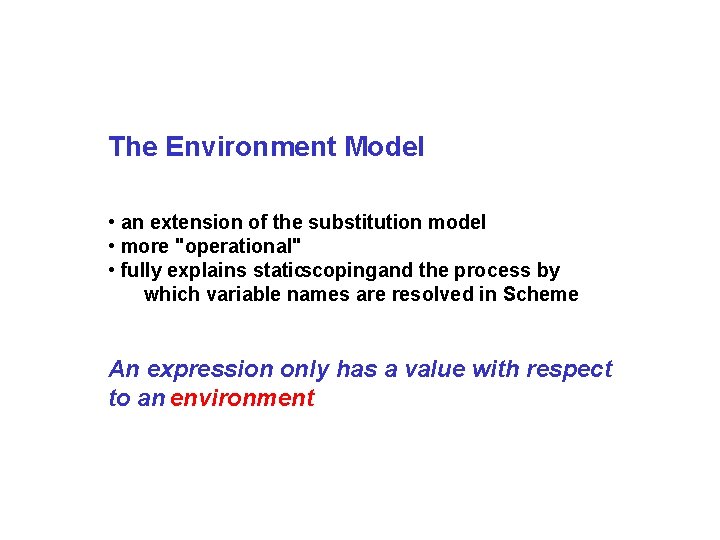
The Environment Model • an extension of the substitution model • more "operational" • fully explains staticscoping and the process by which variable names are resolved in Scheme An expression only has a value with respect to an environment
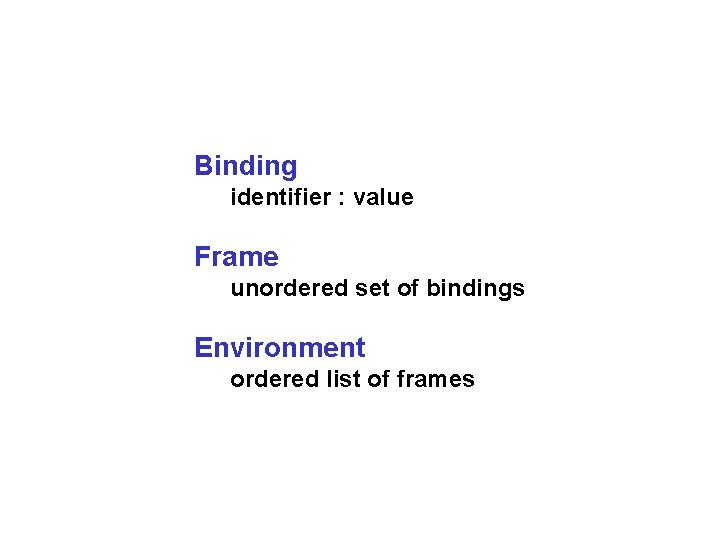
Binding identifier : value Frame unordered set of bindings Environment ordered list of frames
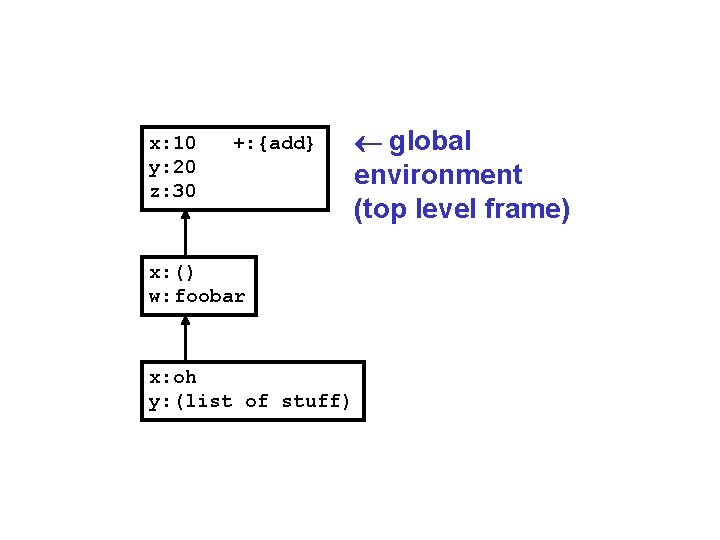
x: 10 y: 20 z: 30 +: {add} x: () w: foobar x: oh y: (list of stuff) global environment (top level frame)
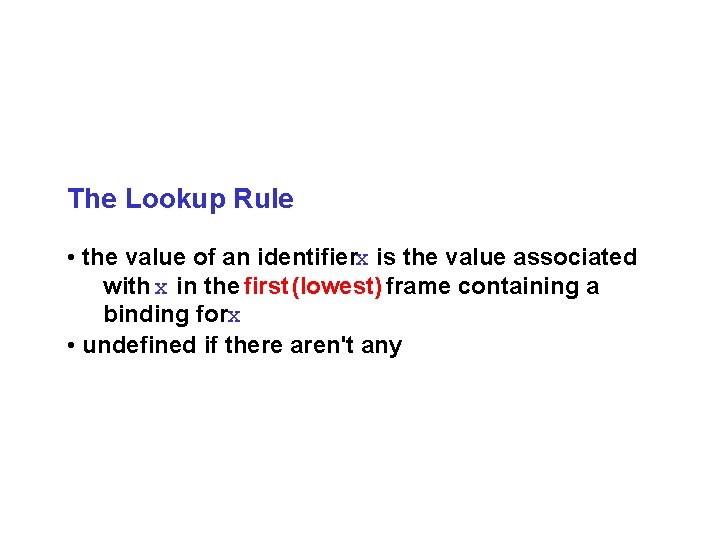
The Lookup Rule • the value of an identifierx is the value associated with x in the first (lowest) frame containing a binding forx • undefined if there aren't any
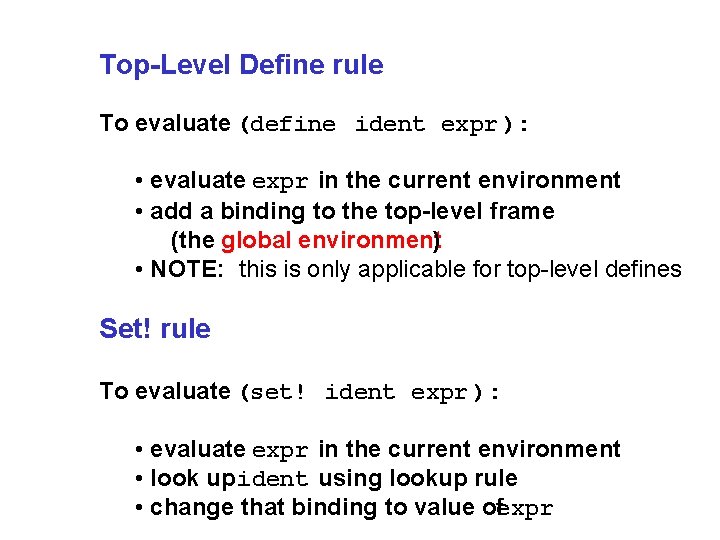
Top-Level Define rule To evaluate (define ident expr ): • evaluate expr in the current environment • add a binding to the top-level frame (the global environment) • NOTE: this is only applicable for top-level defines Set! rule To evaluate (set! ident expr ): • evaluate expr in the current environment • look up ident using lookup rule • change that binding to value ofexpr
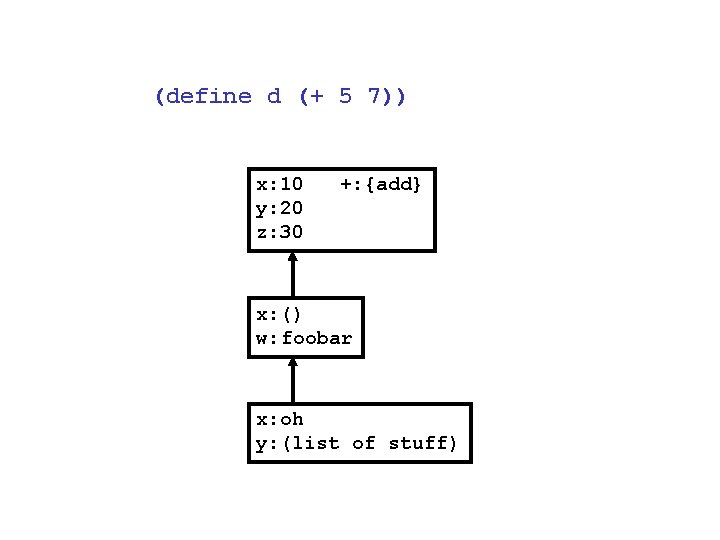
(define d (+ 5 7)) x: 10 y: 20 z: 30 +: {add} x: () w: foobar x: oh y: (list of stuff)
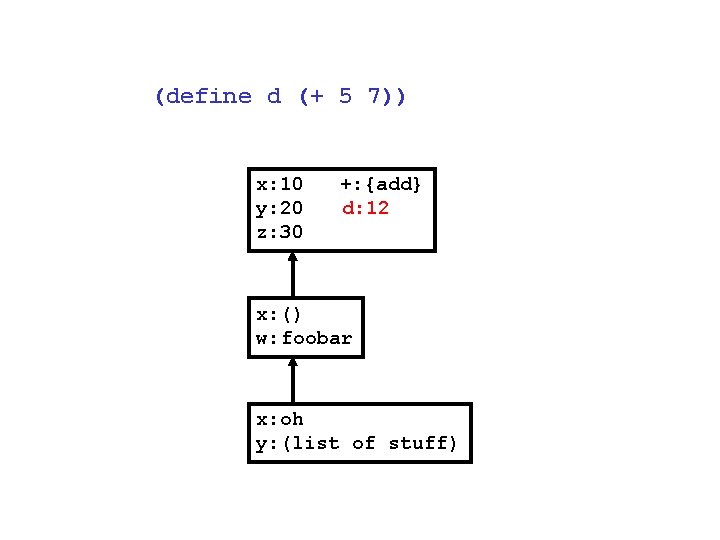
(define d (+ 5 7)) x: 10 y: 20 z: 30 +: {add} d: 12 x: () w: foobar x: oh y: (list of stuff)
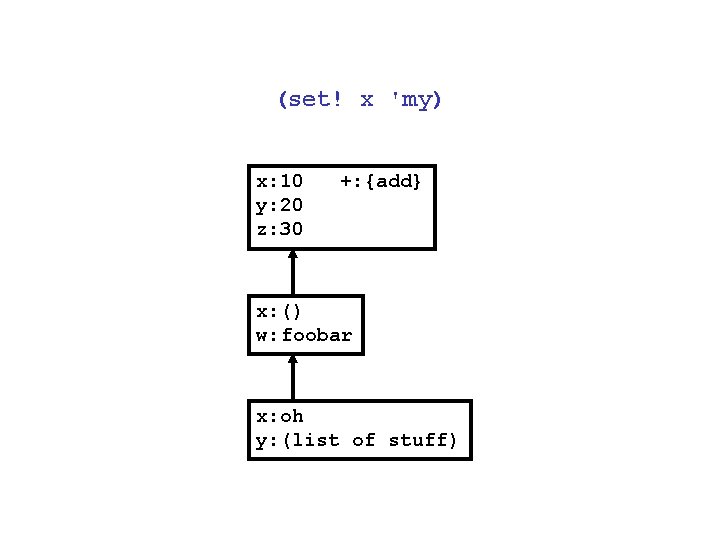
(set! x 'my) x: 10 y: 20 z: 30 +: {add} x: () w: foobar x: oh y: (list of stuff)
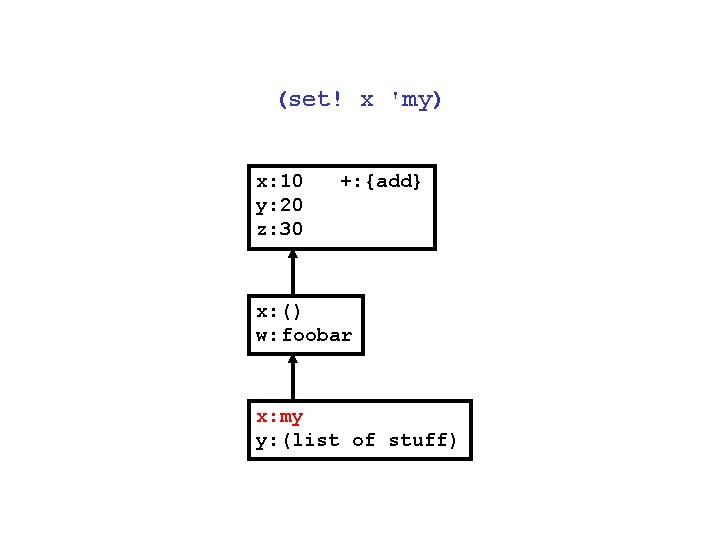
(set! x 'my) x: 10 y: 20 z: 30 +: {add} x: () w: foobar x: my y: (list of stuff)
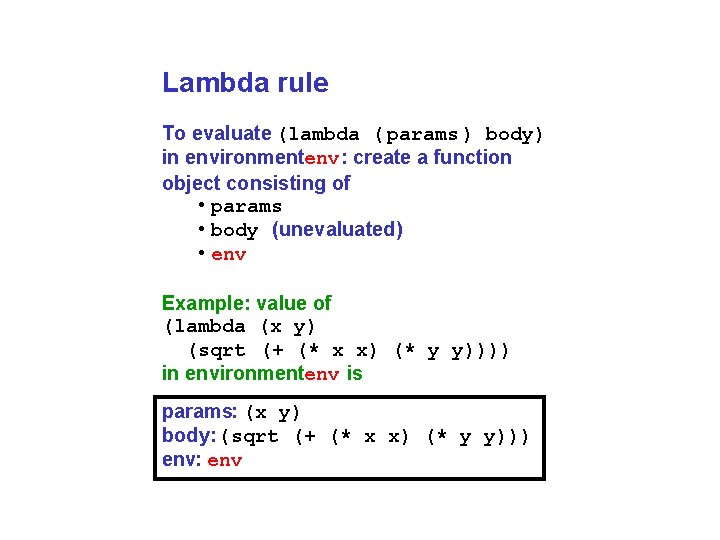
Lambda rule To evaluate (lambda ( params ) body) in environmentenv: create a function object consisting of • params • body (unevaluated) • env Example: value of (lambda (x y) (sqrt (+ (* x x) (* y y)))) in environmentenv is params: (x y) body: (sqrt (+ (* x x) (* y y))) env: env
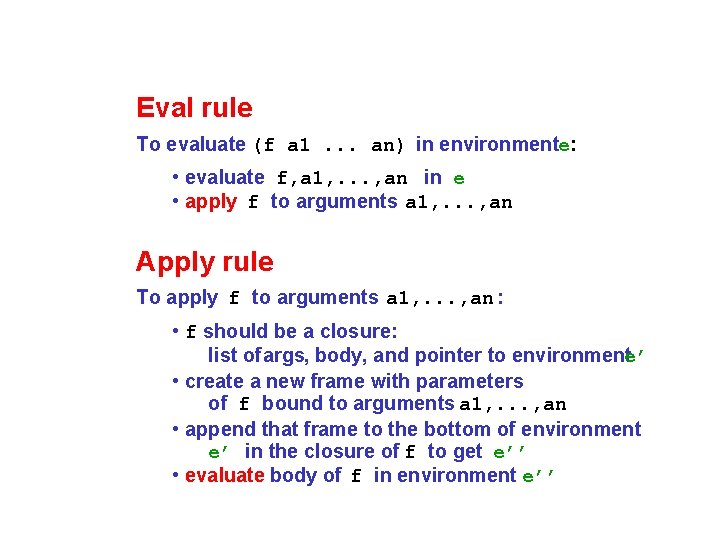
Eval rule To evaluate (f a 1. . . an) in environmente: • evaluate f, a 1, . . . , an in e • apply f to arguments a 1, . . . , an Apply rule To apply f to arguments a 1, . . . , an : • f should be a closure: list of args, body, and pointer to environmente’ • create a new frame with parameters of f bound to arguments a 1, . . . , an • append that frame to the bottom of environment e’ in the closure of f to get e’’ • evaluate body of f in environment e’’
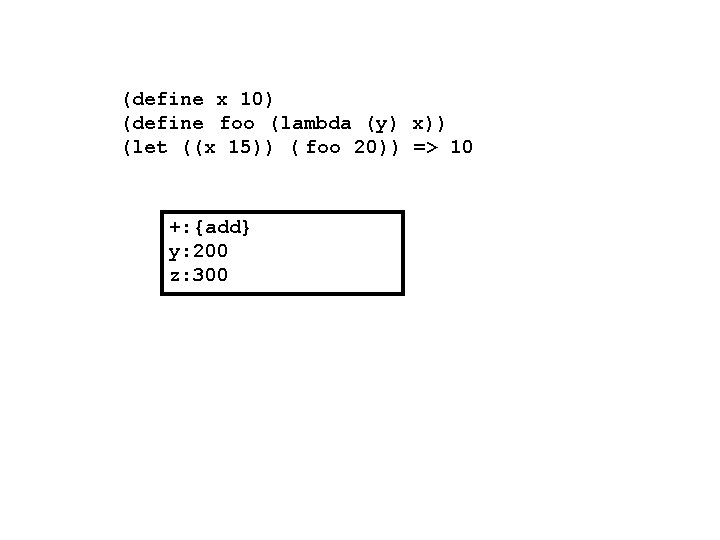
(define x 10) (define foo (lambda (y) x)) (let ((x 15)) ( foo 20)) => 10 +: {add} y: 200 z: 300
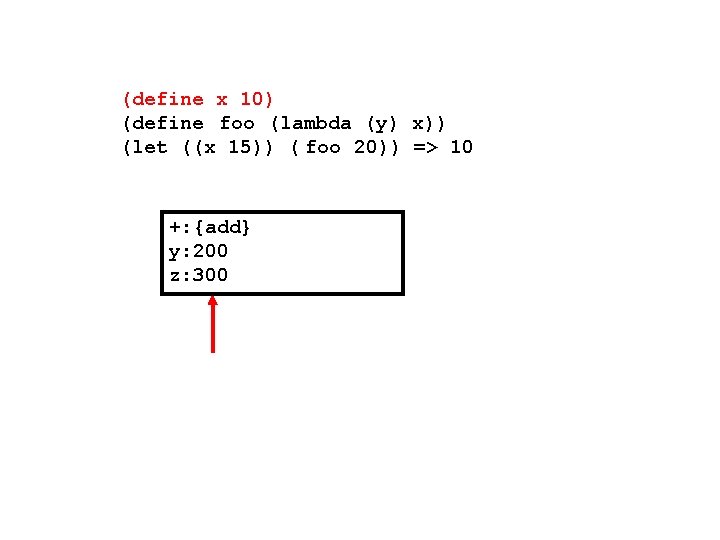
(define x 10) (define foo (lambda (y) x)) (let ((x 15)) ( foo 20)) => 10 +: {add} y: 200 z: 300
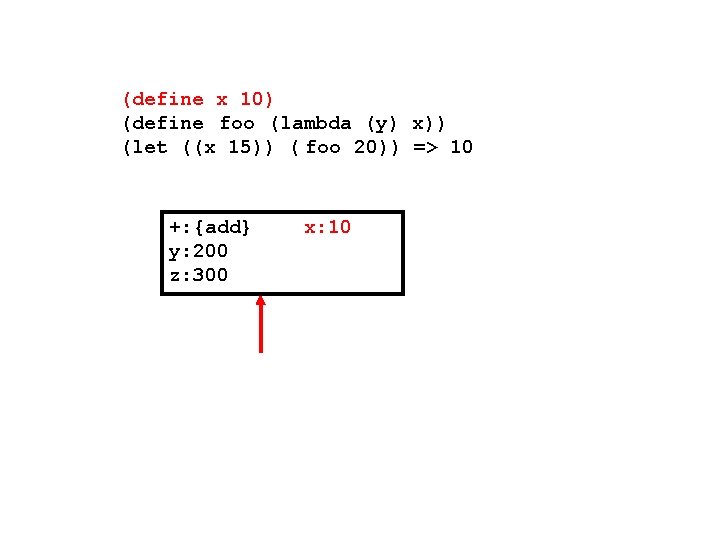
(define x 10) (define foo (lambda (y) x)) (let ((x 15)) ( foo 20)) => 10 +: {add} y: 200 z: 300 x: 10
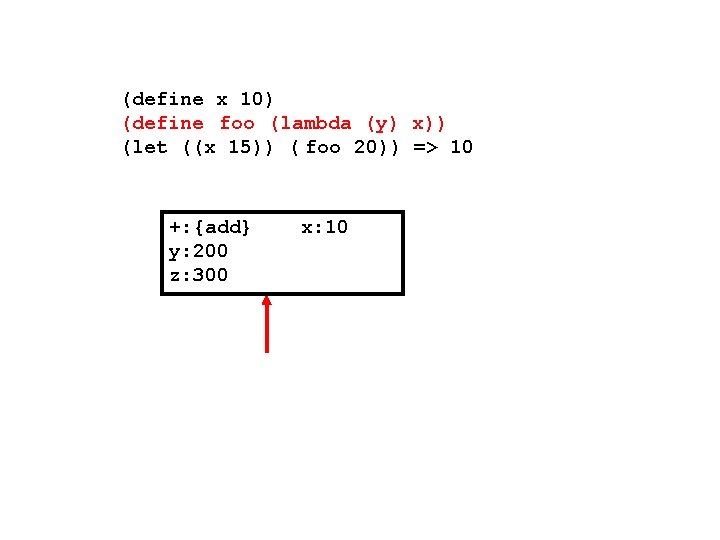
(define x 10) (define foo (lambda (y) x)) (let ((x 15)) ( foo 20)) => 10 +: {add} y: 200 z: 300 x: 10
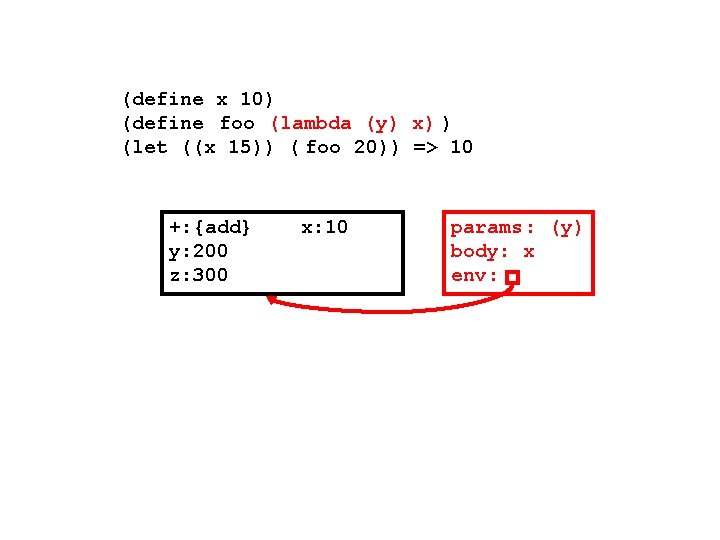
(define x 10) (define foo (lambda (y) x) ) (let ((x 15)) ( foo 20)) => 10 +: {add} y: 200 z: 300 x: 10 params : (y) body: x env:
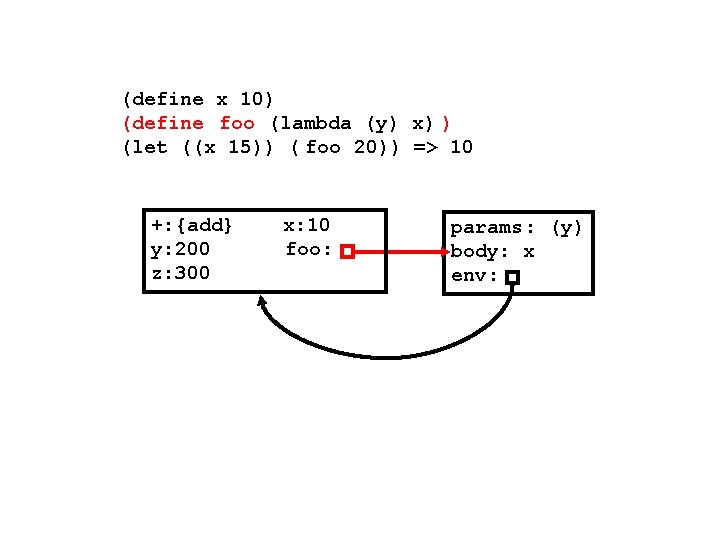
(define x 10) (define foo (lambda (y) x) ) (let ((x 15)) ( foo 20)) => 10 +: {add} y: 200 z: 300 x: 10 foo: params : (y) body: x env:
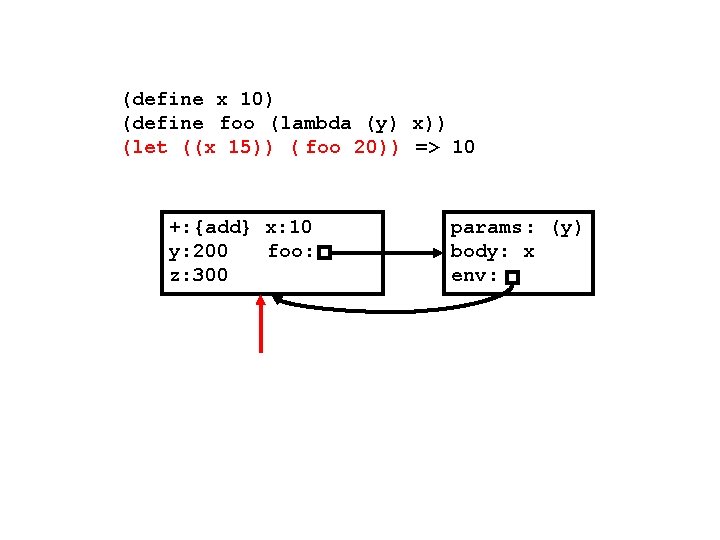
(define x 10) (define foo (lambda (y) x)) (let ((x 15)) ( foo 20)) => 10 +: {add} x: 10 y: 200 foo: z: 300 params : (y) body: x env:
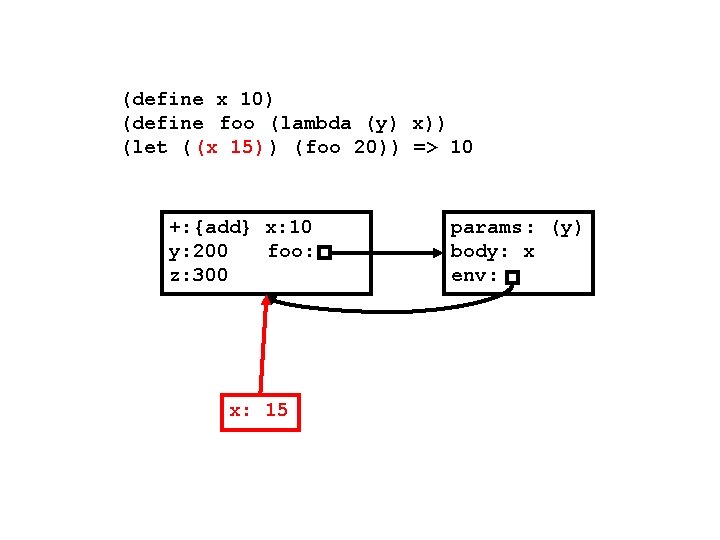
(define x 10) (define foo (lambda (y) x)) (let ( (x 15) ) (foo 20)) => 10 +: {add} x: 10 y: 200 foo: z: 300 x: 15 params : (y) body: x env:
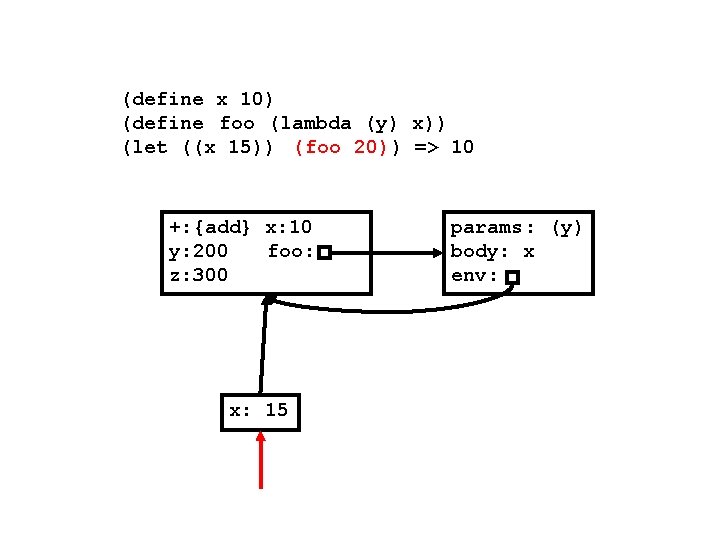
(define x 10) (define foo (lambda (y) x)) (let ((x 15)) (foo 20)) => 10 +: {add} x: 10 y: 200 foo: z: 300 x: 15 params : (y) body: x env:
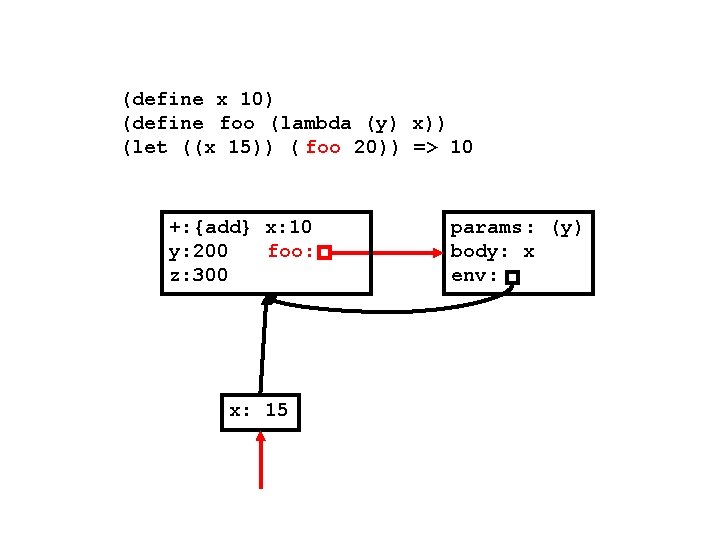
(define x 10) (define foo (lambda (y) x)) (let ((x 15)) ( foo 20)) => 10 +: {add} x: 10 y: 200 foo: z: 300 x: 15 params : (y) body: x env:
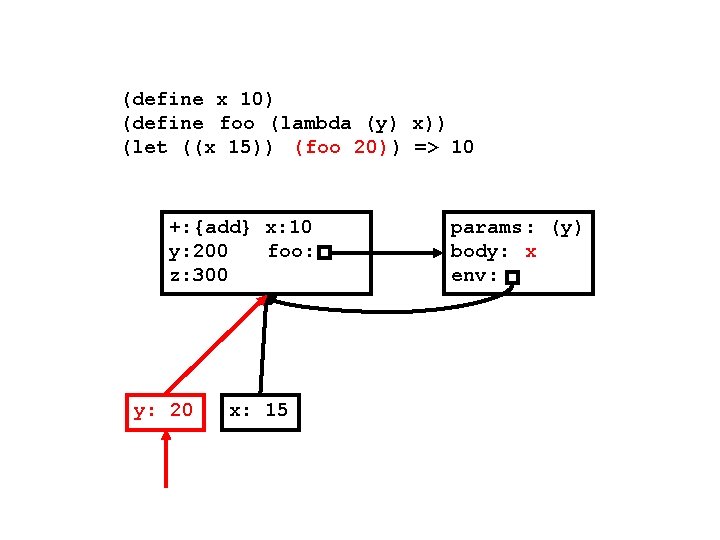
(define x 10) (define foo (lambda (y) x)) (let ((x 15)) (foo 20)) => 10 +: {add} x: 10 y: 200 foo: z: 300 y: 20 x: 15 params : (y) body: x env:
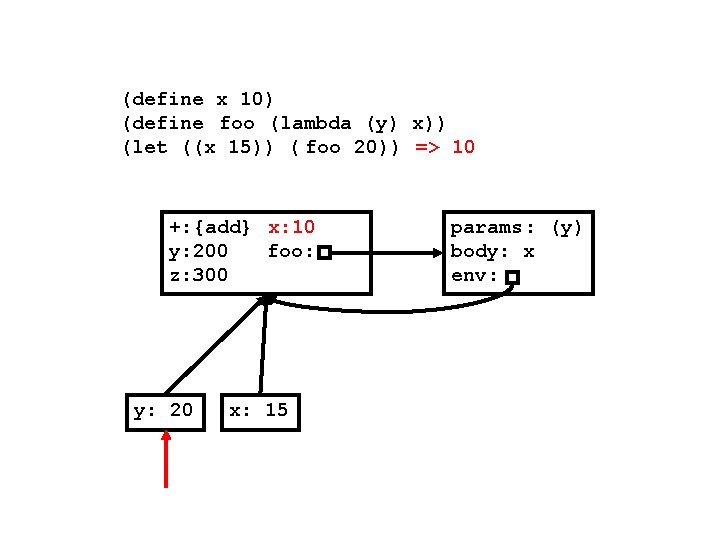
(define x 10) (define foo (lambda (y) x)) (let ((x 15)) ( foo 20)) => 10 +: {add} x: 10 y: 200 foo: z: 300 y: 20 x: 15 params : (y) body: x env:
- Slides: 23