
The Environment Defining the External Environment The forces
- Slides: 11
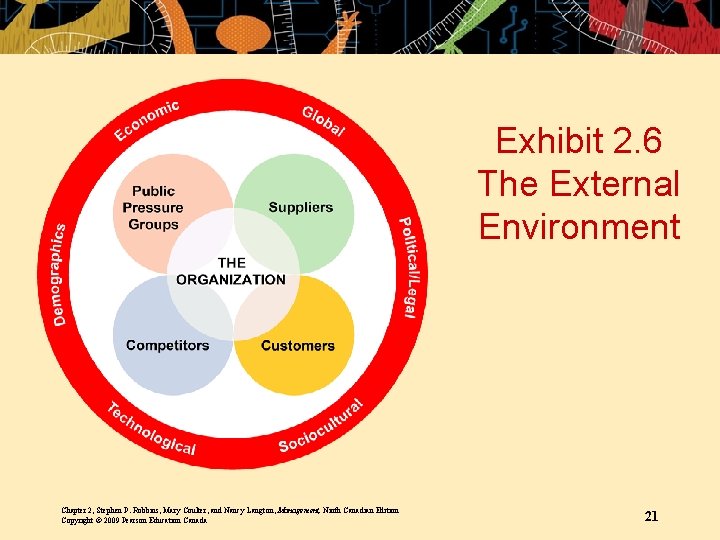
The Environment • Defining the External Environment – The forces and institutions outside the organization that potentially can affect the organization’s performance • Components of the External Environment – Specific environment: external forces that have a direct and immediate impact on the organization – General environment: broad economic, socio-cultural, political/legal, demographic, technological, and global conditions that may affect the organization Chapter 2, Stephen P. Robbins, Mary Coulter, and Nancy Langton, Management, Ninth Canadian Edition Copyright © 2009 Pearson Education Canada 20
Exhibit 2. 6 The External Environment Chapter 2, Stephen P. Robbins, Mary Coulter, and Nancy Langton, Management, Ninth Canadian Edition Copyright © 2009 Pearson Education Canada 21
The General Environment • Economic Conditions – Include interest rates, inflation rates, changes in disposable income, stock market fluctuations, and the general business cycle, among other things • Legal-Political Conditions – Include the general political stability of countries in which an organization does business and the specific attitudes that elected officials have toward business – Federal and provincial governments can influence what organizations can and cannot do. Some examples of legislation include: • • Canadian Human Rights Act Canada’s Employment Equity Act Competition Act Marketing boards Chapter 2, Stephen P. Robbins, Mary Coulter, and Nancy Langton, Management, Ninth Canadian Edition Copyright © 2009 Pearson Education Canada 22
The General Environment • Socio-Cultural conditions – Include the changing expectations of society • Demographic conditions – Include physical characteristics of a population (gender, age, level of education, geographic location, income and family composition) • Technological conditions – Include the changes that are occurring in technology • Global conditions – Include global competitors and global consumer markets Chapter 2, Stephen P. Robbins, Mary Coulter, and Nancy Langton, Management, Ninth Canadian Edition Copyright © 2009 Pearson Education Canada 23
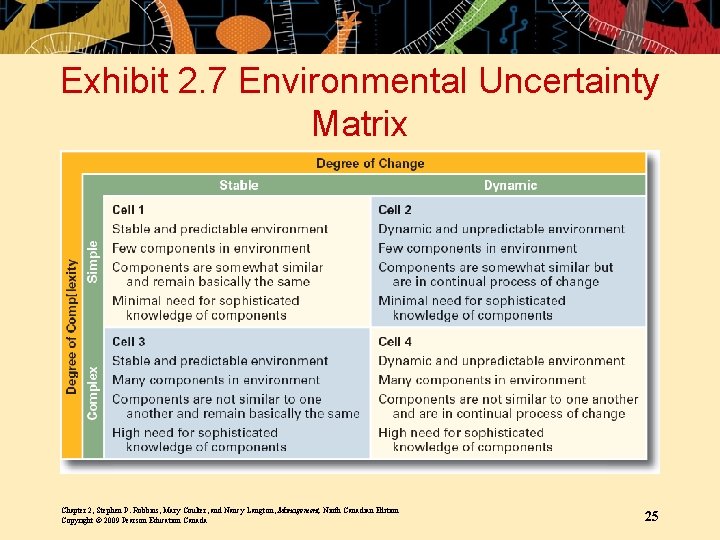
How the Environment Affects Managers • Environmental Uncertainty – The extent to which managers have knowledge of and are able to predict change. Their organization’s external environment is affected by: • Complexity of the environment: the number of components in an organization’s external environment • Degree of change in environmental components: how dynamic or stable the external environment is Chapter 2, Stephen P. Robbins, Mary Coulter, and Nancy Langton, Management, Ninth Canadian Edition Copyright © 2009 Pearson Education Canada 24
Exhibit 2. 7 Environmental Uncertainty Matrix Chapter 2, Stephen P. Robbins, Mary Coulter, and Nancy Langton, Management, Ninth Canadian Edition Copyright © 2009 Pearson Education Canada 25
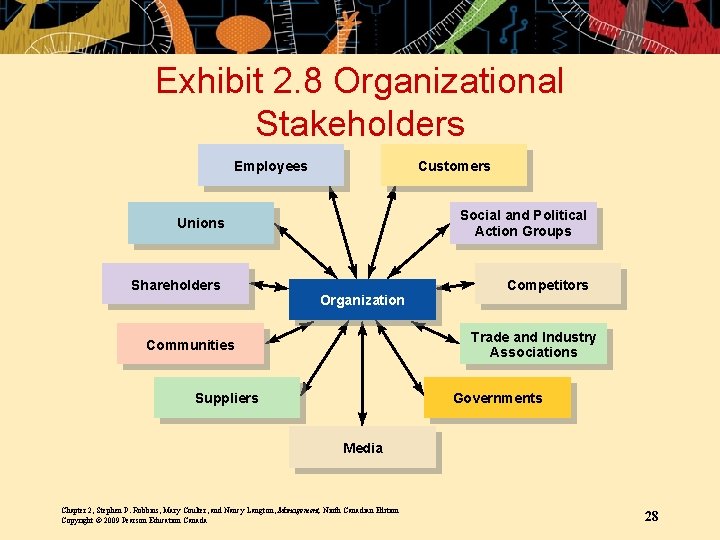
Stakeholder Relationships • Stakeholders – Any constituencies in the organization’s external environment that are affected by the organization’s decisions and actions • Why Manage Stakeholder Relationships? – Can lead to improved organizational performance – It’s the “right” thing to do given the interdependence of the organization and its external stakeholders Chapter 2, Stephen P. Robbins, Mary Coulter, and Nancy Langton, Management, Ninth Canadian Edition Copyright © 2009 Pearson Education Canada 26
Managing Stakeholder Relationships • Identify the organization’s external stakeholders • Determine the particular interests and concerns of the external stakeholders • Decide how critical each external stakeholder is to the organization • Determine how to manage each individual external stakeholder relationship Chapter 2, Stephen P. Robbins, Mary Coulter, and Nancy Langton, Management, Ninth Canadian Edition Copyright © 2009 Pearson Education Canada 27
Exhibit 2. 8 Organizational Stakeholders Employees Customers Unions Social and Political Action Groups Shareholders Competitors Organization Trade and Industry Associations Communities Suppliers Governments Media Chapter 2, Stephen P. Robbins, Mary Coulter, and Nancy Langton, Management, Ninth Canadian Edition Copyright © 2009 Pearson Education Canada 28
Summary and Implications • How much control do managers have? – The reality is probably somewhere between the omnipotent and symbolic views • What effect does culture have on managerial actions? – A strong culture supports the goals of the organization making it easier for managers to achieve goals Chapter 2, Stephen P. Robbins, Mary Coulter, and Nancy Langton, Management, Ninth Canadian Edition Copyright © 2009 Pearson Education Canada 29
Summary and Implications • What kinds of cultures can managers create? – Ethical, innovative and customer-responsive cultures • What influence does the environment have on managers? – The environment plays a major role in shaping managers’ decisions and actions Chapter 2, Stephen P. Robbins, Mary Coulter, and Nancy Langton, Management, Ninth Canadian Edition Copyright © 2009 Pearson Education Canada 30