
The Envelope System Principles of Cost Analysis and
- Slides: 29
The Envelope System Principles of Cost Analysis and Management © Dale R. Geiger 2011 1
Questions to Consider • Does “the Government” overspend its budget? • Who decides how much to spend? • How do managers make sure they don’t overspend? © Dale R. Geiger 2011 2
Terminal Learning Objective • Task: Calculate Unobligated Balance • Condition: You are a cost advisor technician with access to all PCAM course handouts, readings, and spreadsheet tools of Operational Environment (OE)/Contemporary Operational Environment (COE) variables and actors. • Standard: With at least 80% accuracy: • • Describe steps in budgetary process Explain budgetary terminology Demonstrate the purchasing process Explain “good financial management” © Dale R. Geiger 2011 3
Financial Planning and Control • You have been hired as a budget consultant by the Simmons family • Gomer, Madge, Bert, Lacy and Maddie • Gomer’s monthly paycheck is estimated to be $1000. • How should they spend it? © Dale R. Geiger 2011 4
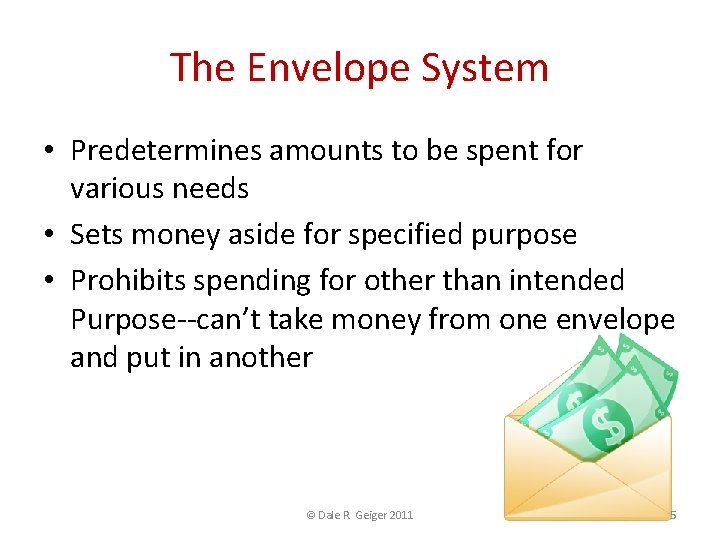
The Envelope System • Predetermines amounts to be spent for various needs • Sets money aside for specified purpose • Prohibits spending for other than intended Purpose--can’t take money from one envelope and put in another © Dale R. Geiger 2011 5
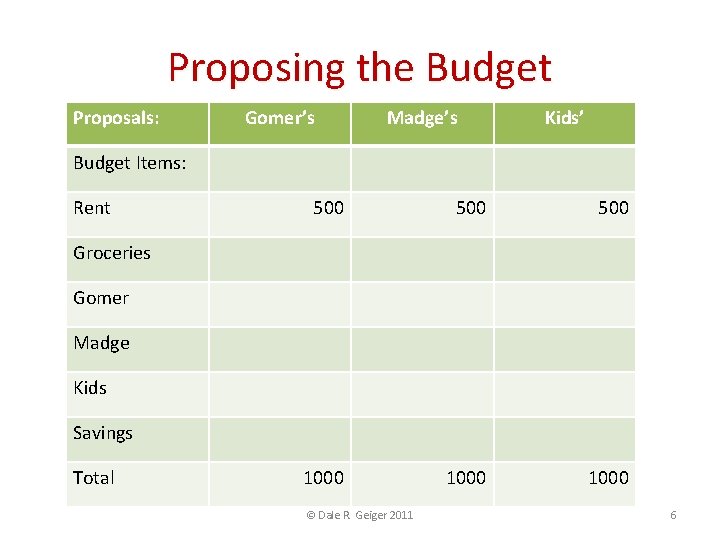
Proposing the Budget Proposals: Gomer’s Madge’s Kids’ Budget Items: Rent 500 500 1000 Groceries Gomer Madge Kids Savings Total © Dale R. Geiger 2011 6
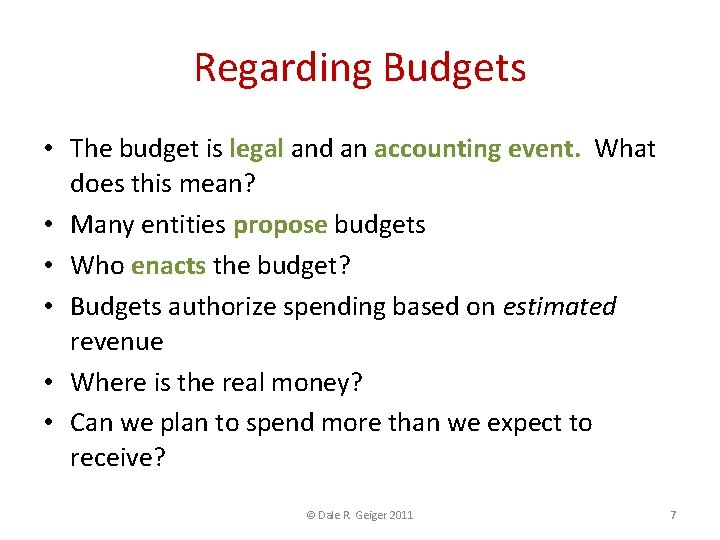
Regarding Budgets • The budget is legal and an accounting event. What does this mean? • Many entities propose budgets • Who enacts the budget? • Budgets authorize spending based on estimated revenue • Where is the real money? • Can we plan to spend more than we expect to receive? © Dale R. Geiger 2011 7
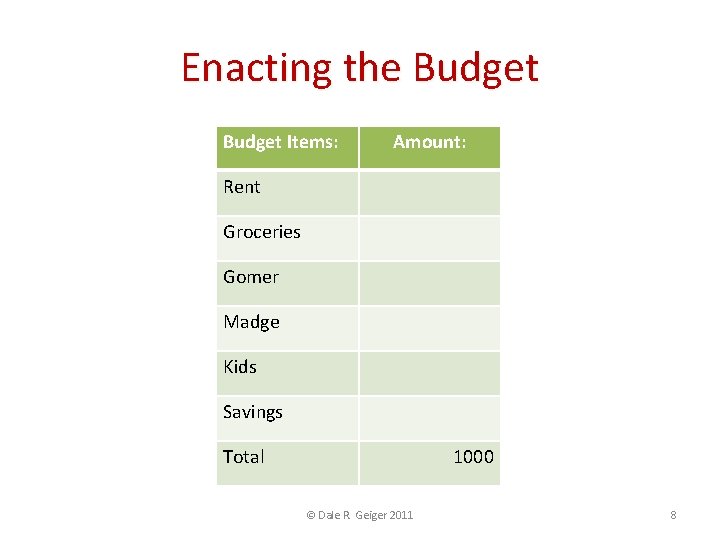
Enacting the Budget Items: Amount: Rent Groceries Gomer Madge Kids Savings Total 1000 © Dale R. Geiger 2011 8
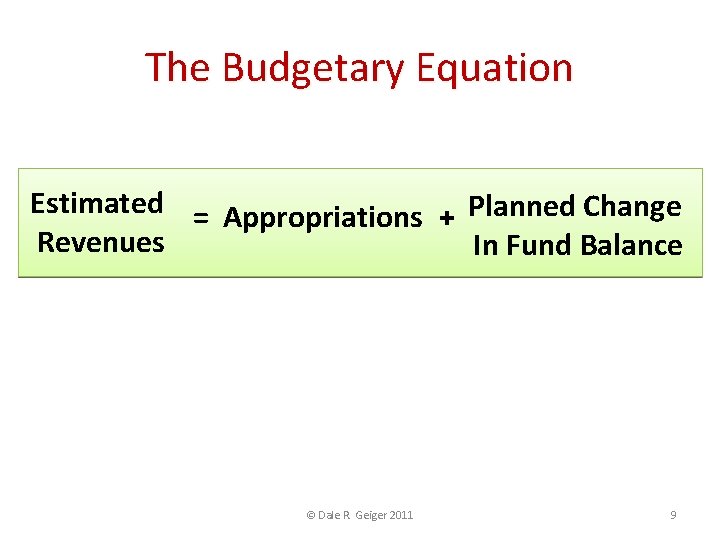
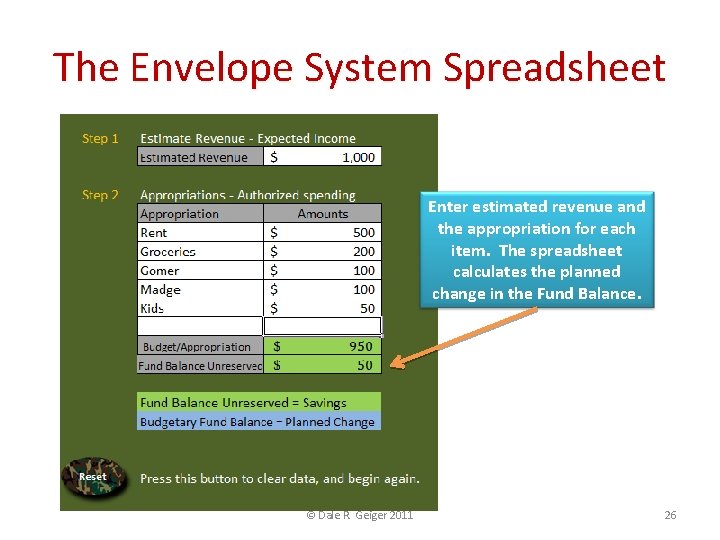
The Budgetary Equation Estimated = Appropriations + Planned Change Revenues In Fund Balance © Dale R. Geiger 2011 9
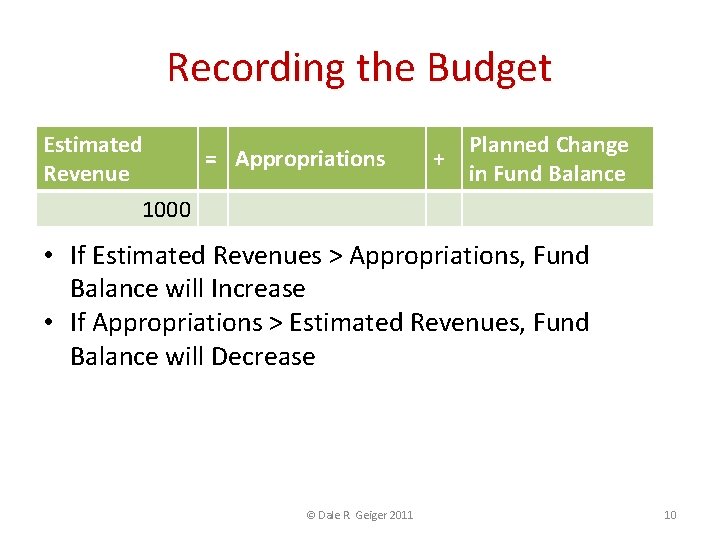
Recording the Budget Estimated = Appropriations Revenue 1000 + Planned Change in Fund Balance • If Estimated Revenues > Appropriations, Fund Balance will Increase • If Appropriations > Estimated Revenues, Fund Balance will Decrease © Dale R. Geiger 2011 10
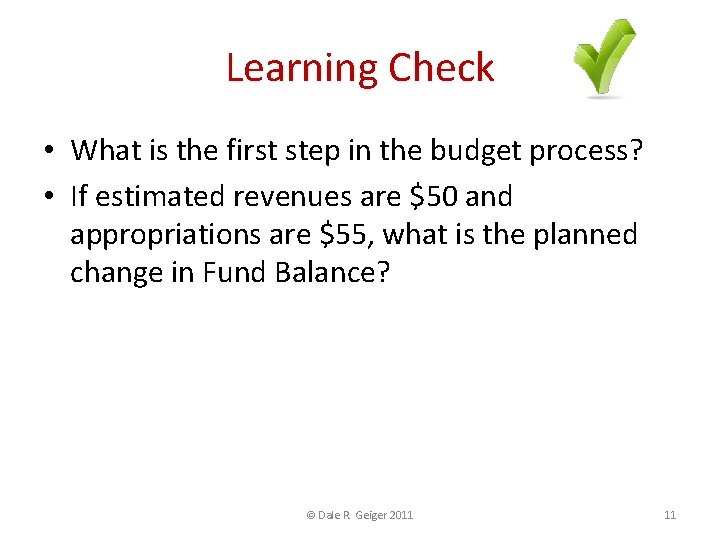
Learning Check • What is the first step in the budget process? • If estimated revenues are $50 and appropriations are $55, what is the planned change in Fund Balance? © Dale R. Geiger 2011 11
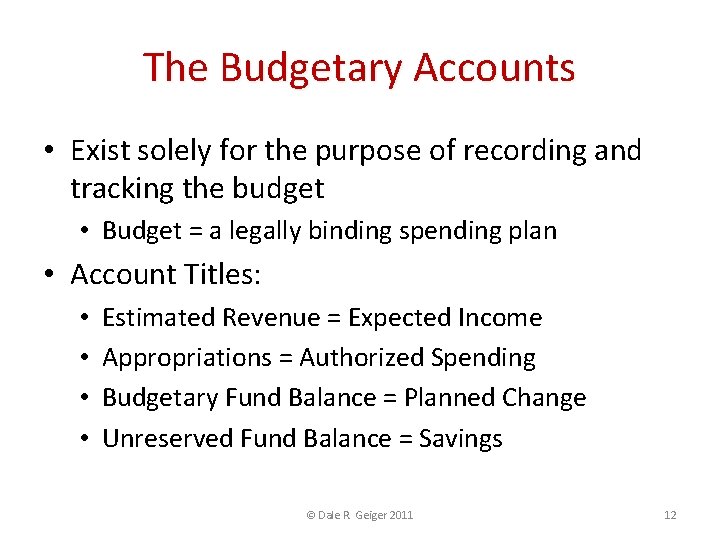
The Budgetary Accounts • Exist solely for the purpose of recording and tracking the budget • Budget = a legally binding spending plan • Account Titles: • • Estimated Revenue = Expected Income Appropriations = Authorized Spending Budgetary Fund Balance = Planned Change Unreserved Fund Balance = Savings © Dale R. Geiger 2011 12
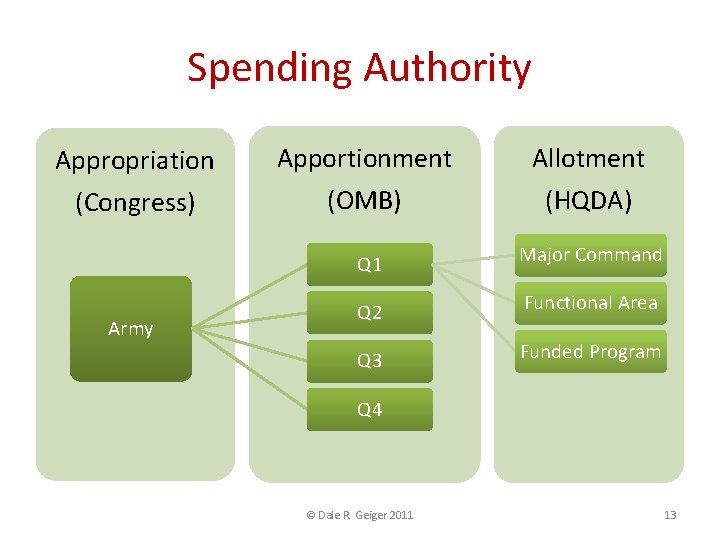
Spending Authority Appropriation Apportionment Allotment (Congress) (OMB) (HQDA) Q 1 Major Command Q 2 Functional Area Q 3 Funded Program Army Q 4 © Dale R. Geiger 2011 13
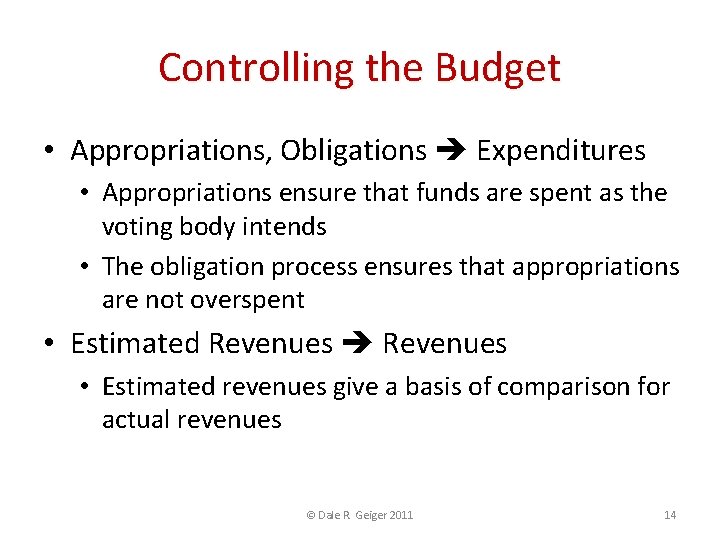
Controlling the Budget • Appropriations, Obligations Expenditures • Appropriations ensure that funds are spent as the voting body intends • The obligation process ensures that appropriations are not overspent • Estimated Revenues • Estimated revenues give a basis of comparison for actual revenues © Dale R. Geiger 2011 14
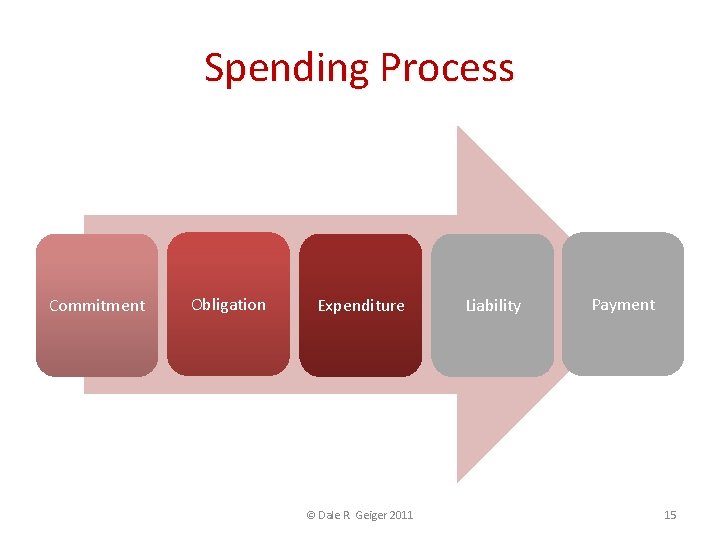
Spending Process Commitment Obligation Expenditure © Dale R. Geiger 2011 Liability Payment 15
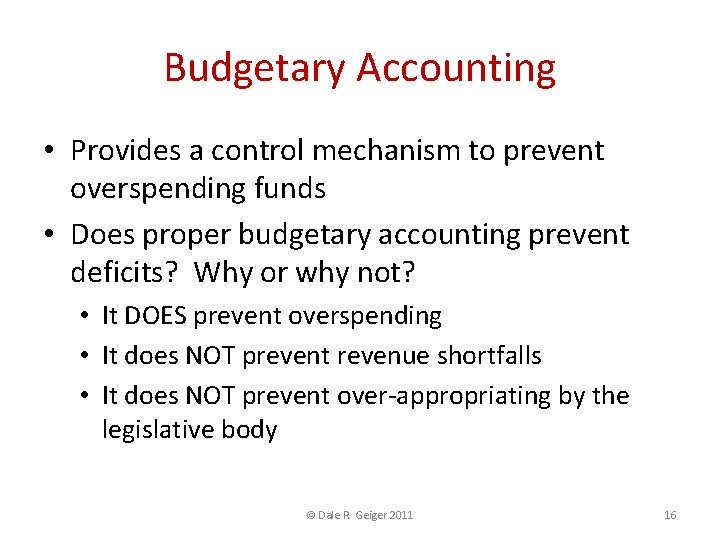
Budgetary Accounting • Provides a control mechanism to prevent overspending funds • Does proper budgetary accounting prevent deficits? Why or why not? • It DOES prevent overspending • It does NOT prevent revenue shortfalls • It does NOT prevent over-appropriating by the legislative body © Dale R. Geiger 2011 16
Learning Check • What mechanisms exist to control expenditures? • What is the step in the spending authorization process that releases funding quarter by quarter? © Dale R. Geiger 2011 17
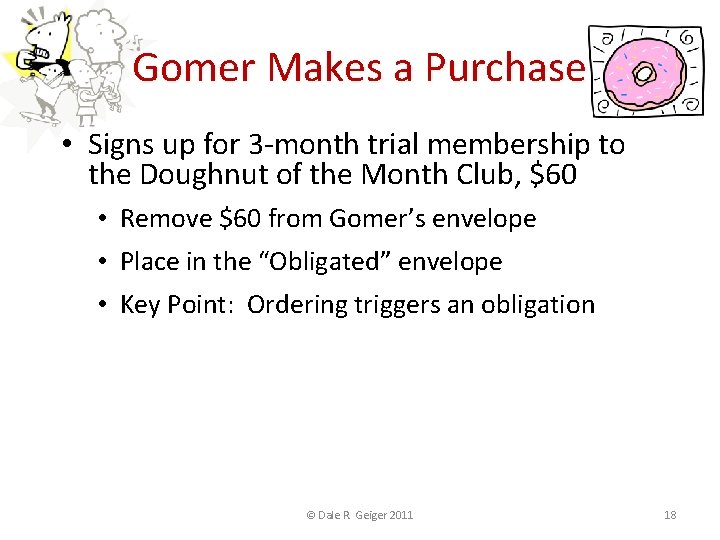
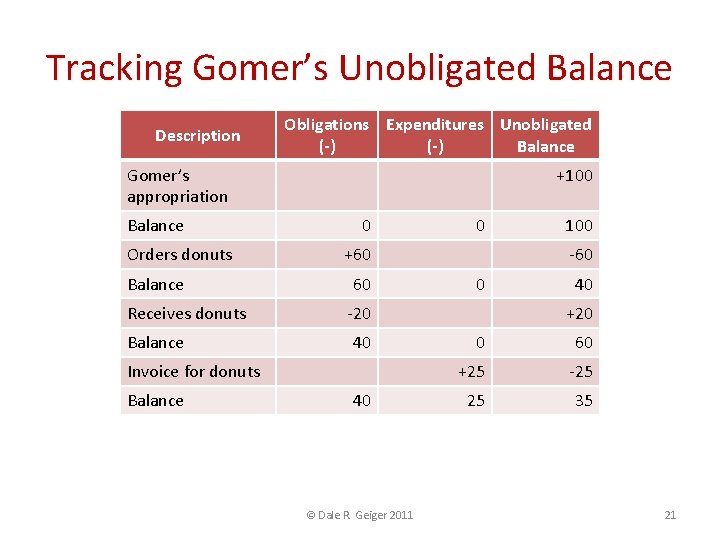
Gomer Makes a Purchase • Signs up for 3 -month trial membership to the Doughnut of the Month Club, $60 • Remove $60 from Gomer’s envelope • Place in the “Obligated” envelope • Key Point: Ordering triggers an obligation © Dale R. Geiger 2011 18
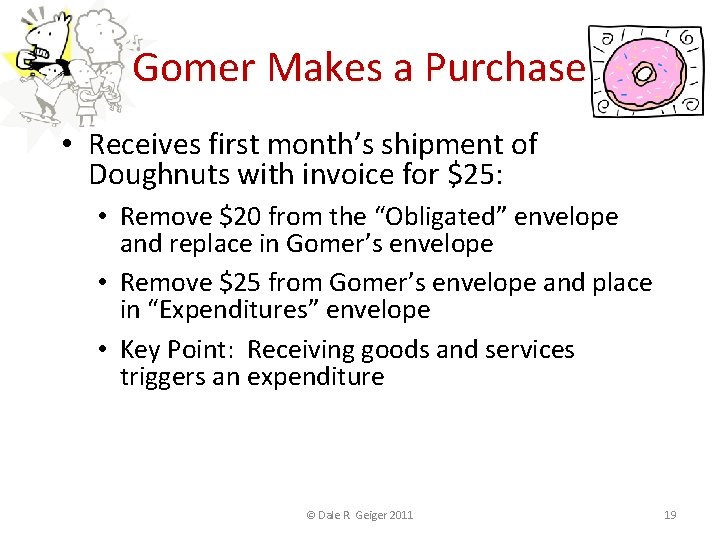
Gomer Makes a Purchase • Receives first month’s shipment of Doughnuts with invoice for $25: • Remove $20 from the “Obligated” envelope and replace in Gomer’s envelope • Remove $25 from Gomer’s envelope and place in “Expenditures” envelope • Key Point: Receiving goods and services triggers an expenditure © Dale R. Geiger 2011 19
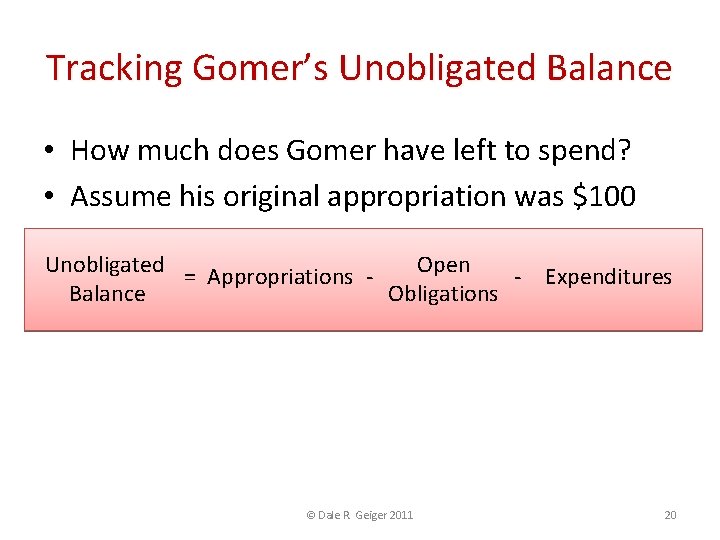
Tracking Gomer’s Unobligated Balance • How much does Gomer have left to spend? • Assume his original appropriation was $100 Unobligated Open = Appropriations - Expenditures Balance Obligations © Dale R. Geiger 2011 20
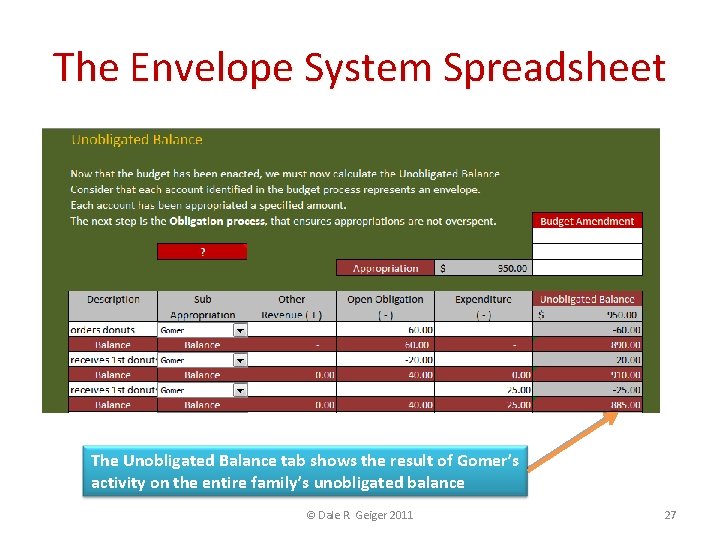
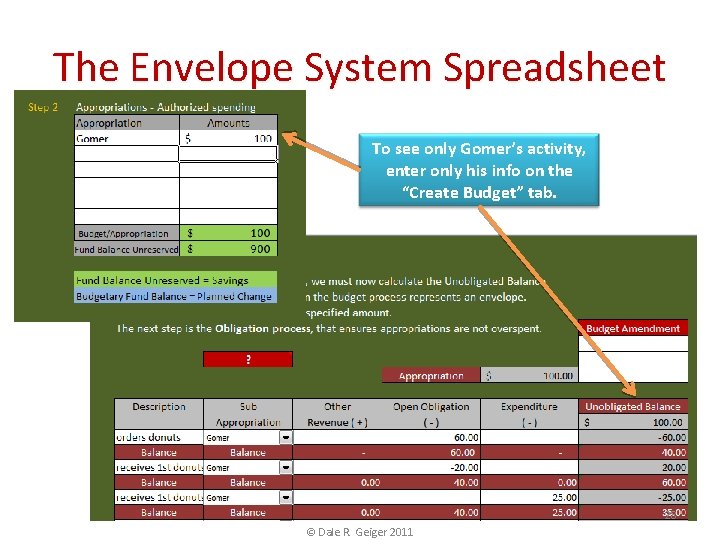
Tracking Gomer’s Unobligated Balance Description Obligations Expenditures Unobligated (-) Balance Gomer’s appropriation Balance Orders donuts Balance Receives donuts Balance +100 0 +60 60 40 40 © Dale R. Geiger 2011 100 -60 0 -20 Invoice for donuts Balance 0 40 +20 0 60 +25 -25 25 35 21
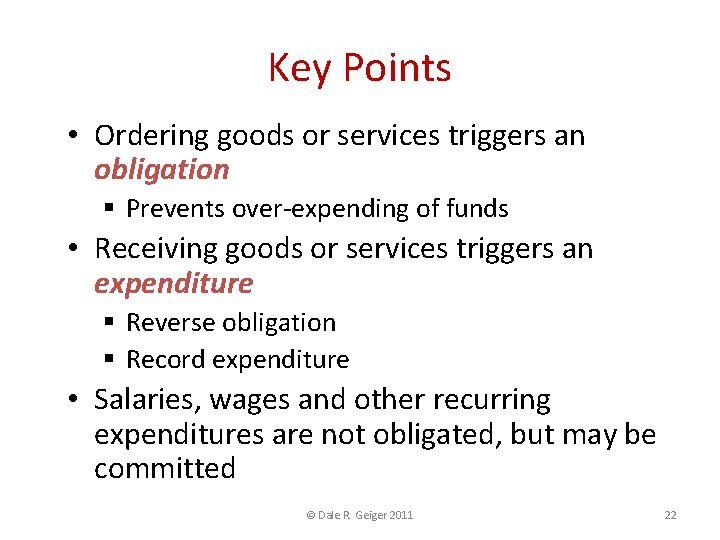
Key Points • Ordering goods or services triggers an obligation § Prevents over-expending of funds • Receiving goods or services triggers an expenditure § Reverse obligation § Record expenditure • Salaries, wages and other recurring expenditures are not obligated, but may be committed © Dale R. Geiger 2011 22
Learning Check • What is the equation to calculate unobligated balance? • What is the event that triggers and expenditure? © Dale R. Geiger 2011 23
Good Financial Management • If Gomer’s budget is $100, what happens if he spends more than $100? • What happens if he spends less? • What accounting mechanisms exist to measure the quality of Gomer’s spending? © Dale R. Geiger 2011 24
Practical Exercises © Dale R. Geiger 2011 25
The Envelope System Spreadsheet Enter estimated revenue and the appropriation for each item. The spreadsheet calculates the planned change in the Fund Balance. © Dale R. Geiger 2011 26
The Envelope System Spreadsheet The Unobligated Balance tab shows the result of Gomer’s activity on the entire family’s unobligated balance © Dale R. Geiger 2011 27
The Envelope System Spreadsheet To see only Gomer’s activity, enter only his info on the “Create Budget” tab. 28 © Dale R. Geiger 2011
Practical Exercises © Dale R. Geiger 2011 29