
THE ENTHYMEME in Contemporary Advertising A long time


- Slides: 37
THE ENTHYMEME in Contemporary Advertising
A long time ago, in a galaxy far, far away… (oops, wrong introduction - sorry about that)
Once upon a time… (dang it, I did it again - just a second)
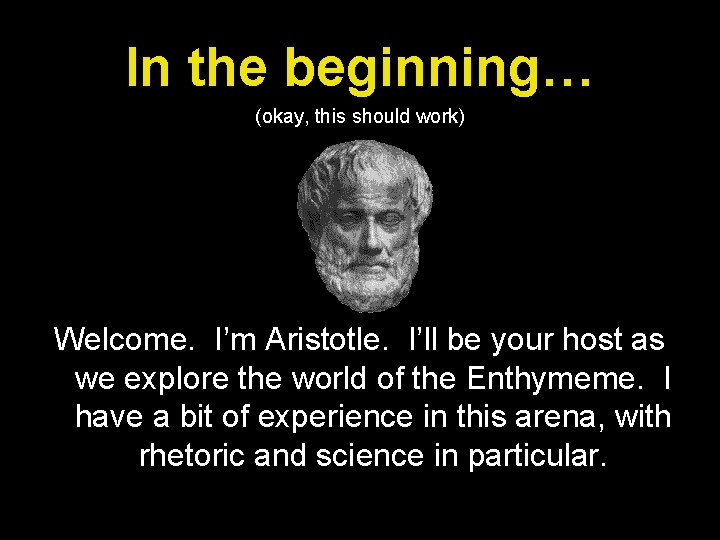
In the beginning… (okay, this should work) Welcome. I’m Aristotle. I’ll be your host as we explore the world of the Enthymeme. I have a bit of experience in this arena, with rhetoric and science in particular.
I wrote a few books in my day. You may recall Ms. Hopton mentioning them: On Rhetoric (it spent 18 weeks on the Athens Times bestseller list) The Poetics Metaphysics There a few others, but I won’t bore you with those titles. You get the idea.
Instead, I’d like to talk about Enthymemes are rhetorical syllogisms (we’ll talk about these soon), but honestly, I’m rather vague with a concrete definition. They are: “arguments in syllogistic form that use implied premises held by the audience. ”
Enthymemes are also called “truncated syllogisms” since they’re shortened. One or more premise is “held in the mind. ” I explain them like this: “the conclusion should not be drawn from far back, nor is it necessary to include everything…the latter tiresome because of stating what is obvious. ” Here a few examples…
“But Brutus says he was ambitious; And Brutus is an honorable man. ” – Mark Antony from Shakespeare’s Julius Caesar - missing link: honorable men are ambitious “If the glove doesn’t fit, you must acquit. ” – attorney Johnny Cochran in the O. J. Simpson trial - missing link: If the glove doesn’t fit the defendant, you must acquit him
I claim that a Syllogism “is wholly from propositions with the conclusion derived directly from information already present in the premises. ” I use a relatively famous historical figure to illustrate how they work. (used with permission from the Socratic Talent Agency)
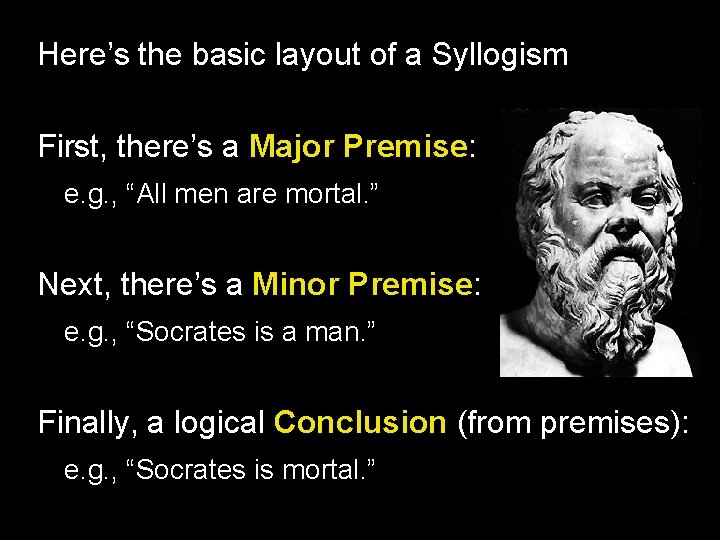
Here’s the basic layout of a Syllogism First, there’s a Major Premise: e. g. , “All men are mortal. ” Next, there’s a Minor Premise: e. g. , “Socrates is a man. ” Finally, a logical Conclusion (from premises): e. g. , “Socrates is mortal. ”
What we just saw is called a Categorical Syllogism because we logically deduced a conclusion based on a comparison of characteristics (or categories): Men and Socrates. Other types of Syllogisms include: a. Hypothetical b. Disjunctive c. Conditional
Let’s try another Syllogism, shall we? Major Premise: Bad children get spankings. Minor Premise: You’ve been bad. Conclusion: You’re going to get a spanking.
To make this an Enthymeme, one of the premises is eliminated (“held in the mind”). In this case, children know what will happen to them if they’re bad. Bad children get spankings. You’ve been bad. You’re going to get a spanking. And now, the final product: “You’ve been bad, so you’re going to get a spanking. ”
Some Enthymemes are simple, while others are rather complex. Sometimes the Major Premise is eliminated, while other times it’s the Minor Premise. Likewise, and somewhat debated, the Conclusion is “held in the mind. ” But wait! There’s more…
Oh but it gets more interesting. There are two types of Enthymemes: Demonstrative: proving an affirmative or negative proposition Refutative: disproving an affirmative or negative proposition
…Which are based on 4 kinds of Fact: 1. Probabilities what is, or supposed to be, usually true 2. Examples induction provides similar cases, state proposition, and argue deductively to a particular inference 3. Infallible Signs argue from inevitable and invariable 4. Ordinary Signs argue from some or particular universal proposition, true or false
…Which are based on 4 kinds of Fact: 1. Probabilities what is, or supposed to be, usually true 2. Examples induction provides similar cases, state proposition, and argue deductively to a particular inference 3. Infallible Signs argue from inevitable and invariable Haha. Just kidding. I wanted to see if your head would explode. We’re not going to work with these today.
Enthymemes are communal entities, created by the society in which they are spoken, written, or shown. Like language, they work only when the community knows and understands what is left unstated (“held in the mind”). In this same vein, Enthymemes can fail if the receivers do not make the connection.
Enthymemes work because the rhetor and audience share something in common. Usually this is knowledge. This knowledge can be found in: universal principles (Newtonian physics) common values (illegal acts) niche specific (html coding), or common sense (“fire is hot, don’t touch”)
The more you work with Enthymemes, the more they become obvious and clear. And addictive. And annoying. (at least to those who hear you mumble “okay, that’s the minor premise and there’s the conclusion, so the major premise must be…”) Wow. We’ve covered a lot thus far.
Let’s do a quick review: 1. I’m dead. (nothing new there) 2. Syllogisms contain a major premise, a minor premise, and a conclusion, the most common type being categorical. 3. Enthymemes are “truncated syllogisms” since one premise is “held in the mind” of the audience.
And… 4. There are two types of Enthymemes: demonstrative and refutative. 5. Enthymemes are based on four types of facts: probabilities, examples, infallible signs, and ordinary signs. 6. Enthymemes function in communities of rhetors that share similar knowledge.
Having fun yet? I am. (can’t you tell from my smile? ? ) In my time, Enthymemes were mainly used in the rhetoric (spoken word) of the day. Since this is the 21 st century, I thought it might be fun to see if we could identify Enthymemes in that curious thing you call advertising. Let’s begin with some propaganda posters from WW I and WW II.
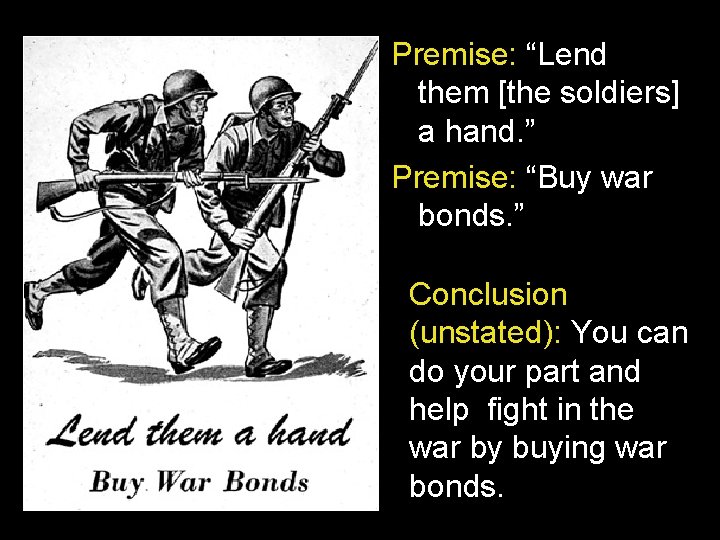
Premise: “Lend them [the soldiers] a hand. ” Premise: “Buy war bonds. ” Conclusion (unstated): You can do your part and help fight in the war by buying war bonds.
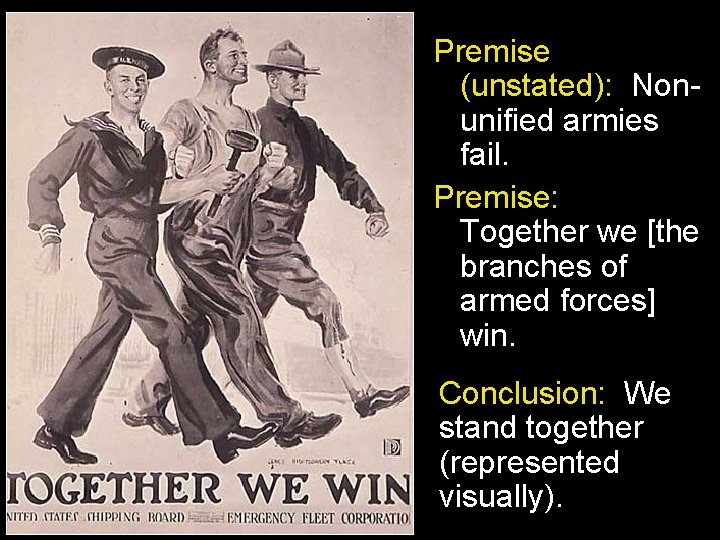
Premise (unstated): Nonunified armies fail. Premise: Together we [the branches of armed forces] win. Conclusion: We stand together (represented visually).
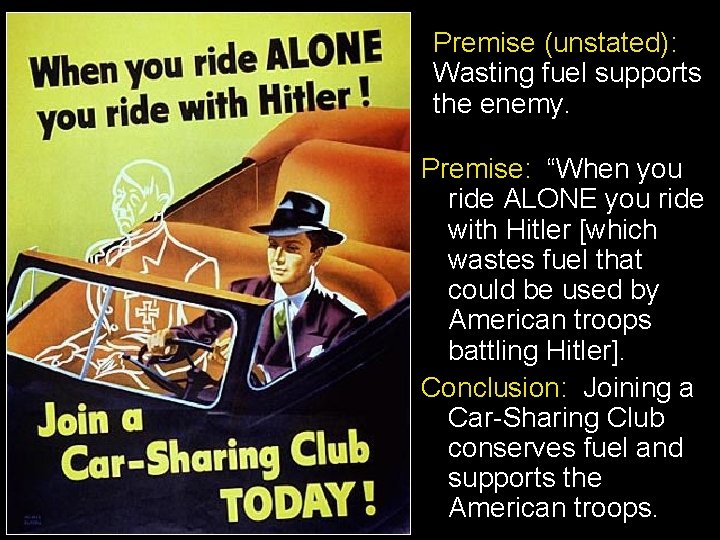
Premise (unstated): Wasting fuel supports the enemy. Premise: “When you ride ALONE you ride with Hitler [which wastes fuel that could be used by American troops battling Hitler]. Conclusion: Joining a Car-Sharing Club conserves fuel and supports the American troops.
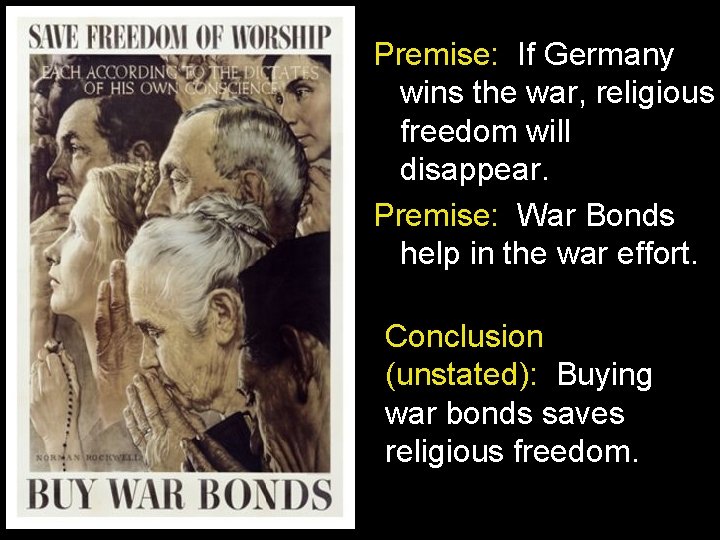
Premise: If Germany wins the war, religious freedom will disappear. Premise: War Bonds help in the war effort. Conclusion (unstated): Buying war bonds saves religious freedom.
These posters were a good introduction because they primarily relied on pathos: a. either the fear of something happening based on an action or b. the patriotism from doing “one’s part” in the war
Are you beginning to see how the interpretation of visual and verbal symbols is crucial to seeing the logic of the advertisement? Interpretation is key. Likewise, one may interpret the premises slightly differently and still end up with the same overall conclusion. That’s the power of symbols! But what happens when you can’t rely on verbal symbols to help you? …
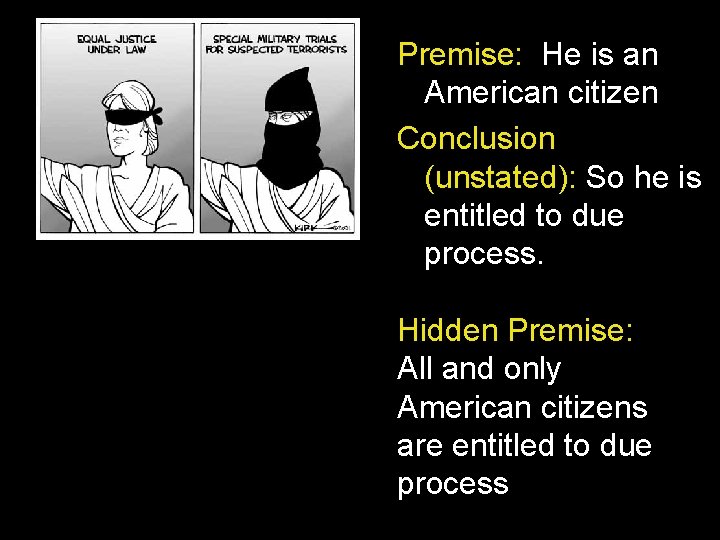
Premise: He is an American citizen Conclusion (unstated): So he is entitled to due process. Hidden Premise: All and only American citizens are entitled to due process
How might we recast this? “In your statement you assert that our actions, even though peaceful, must be condemned because they precipitate violence” ~ “Letter from a Birmingham Jail” Martin Luther King
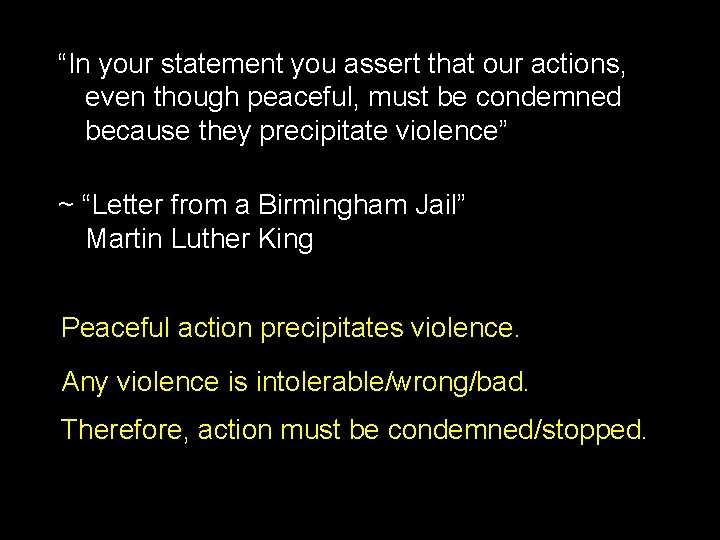
“In your statement you assert that our actions, even though peaceful, must be condemned because they precipitate violence” ~ “Letter from a Birmingham Jail” Martin Luther King Peaceful action precipitates violence. Any violence is intolerable/wrong/bad. Therefore, action must be condemned/stopped.
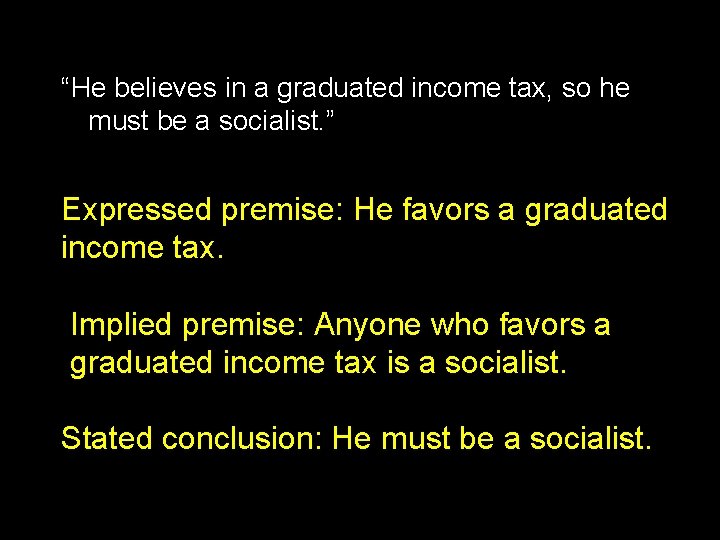
How might we recast this? “He believes in a graduated income tax, so he must be a socialist. ”
“He believes in a graduated income tax, so he must be a socialist. ” Expressed premise: He favors a graduated income tax. Implied premise: Anyone who favors a graduated income tax is a socialist. Stated conclusion: He must be a socialist.
I think my work is done here. I’m going to go ponder something now (that’s what we philosophers do). Go forthwith and become a critical information consumers. You have the tools. Don’t be afraid to use them. Hmmm…was that an enthymeme?
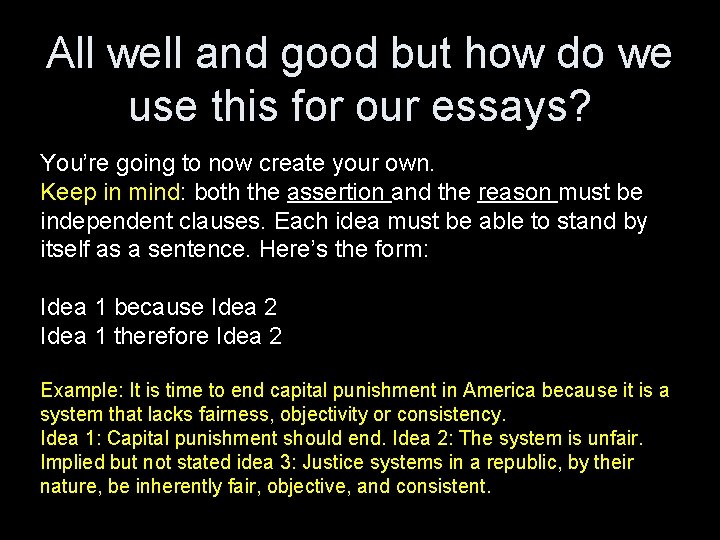
All well and good but how do we use this for our essays? You’re going to now create your own. Keep in mind: both the assertion and the reason must be independent clauses. Each idea must be able to stand by itself as a sentence. Here’s the form: Idea 1 because Idea 2 Idea 1 therefore Idea 2 Example: It is time to end capital punishment in America because it is a system that lacks fairness, objectivity or consistency. Idea 1: Capital punishment should end. Idea 2: The system is unfair. Implied but not stated idea 3: Justice systems in a republic, by their nature, be inherently fair, objective, and consistent.
Assignment: Revise your “dirty” notes on definition into an essay. The enthymeme should answer a question at issue. A "question at issue" is a question about which there is disagreement in your discourse community. We’re considering the discourse community our classroom. We’re trying to define the definition of cruel and unusual punishment. Once defined, create an enthymeme to drive/defend the definition for which you’re arguing.