
THE ENTERPRISE ARCHITECTURE JOURNEY TO A WORLD CLASS


- Slides: 25
THE ENTERPRISE ARCHITECTURE JOURNEY TO A WORLD CLASS ‘ONE’ NOAA Where We’ve Been What We’ve Accomplished Where We Need to Go Why We Need to Go There Objects in the Mirror are closer than they appear
WHY ARE WE TAKING THIS TRIP?
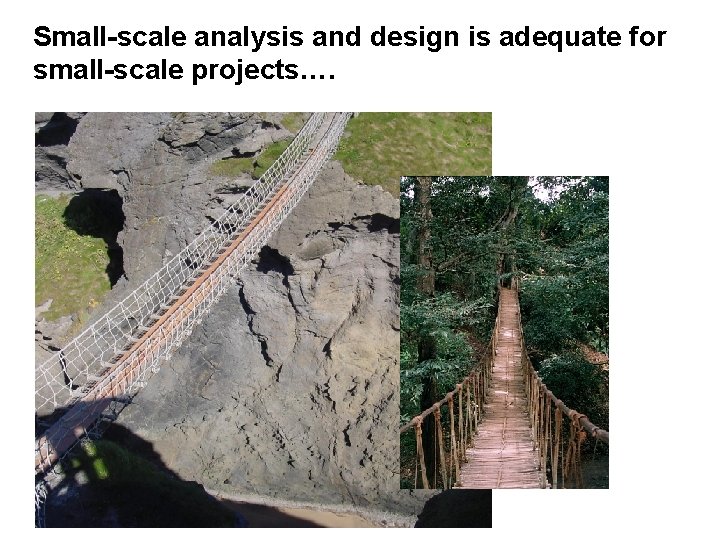
Small-scale analysis and design is adequate for small-scale projects….
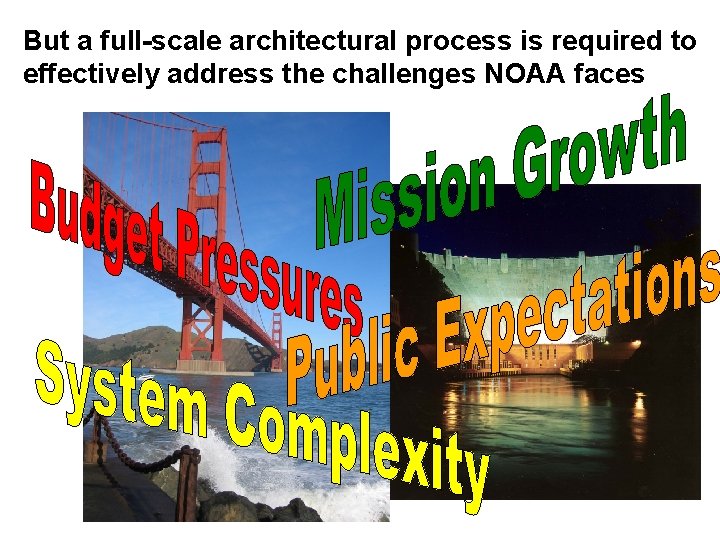
But a full-scale architectural process is required to effectively address the challenges NOAA faces
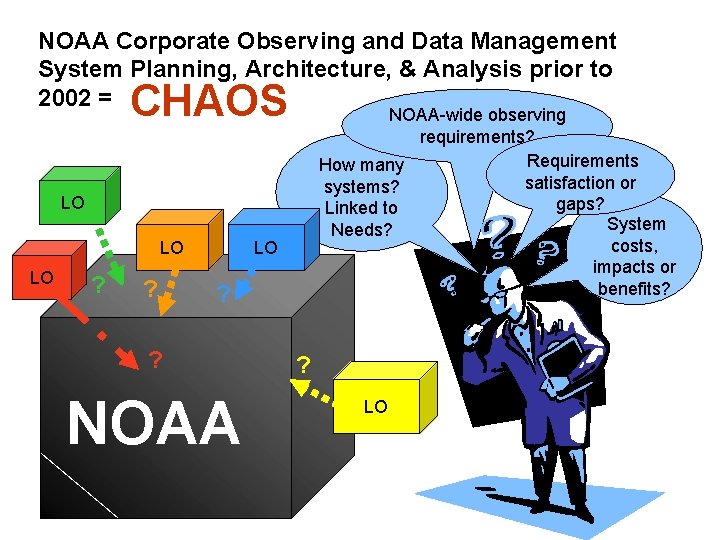
NOAA Corporate Observing and Data Management System Planning, Architecture, & Analysis prior to 2002 = CHAOS NOAA-wide observing requirements? Requirements How many satisfaction or systems? gaps? Linked to System Needs? costs, impacts or benefits? LO LO ? ? NOAA ? LO
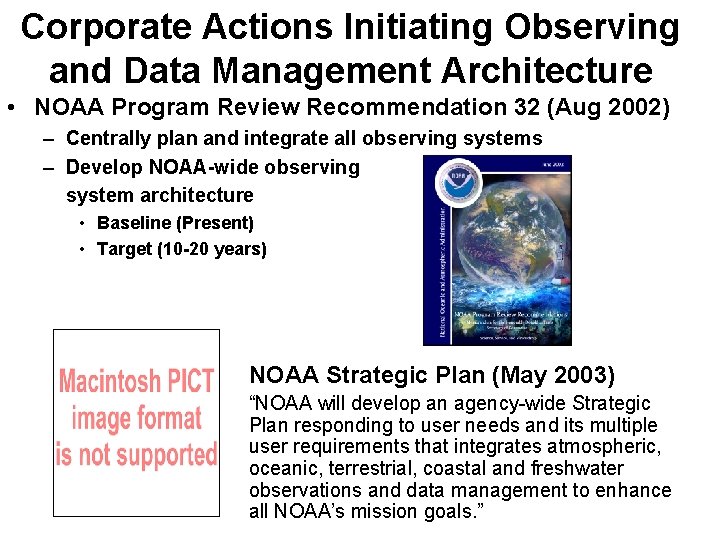
Corporate Actions Initiating Observing and Data Management Architecture • NOAA Program Review Recommendation 32 (Aug 2002) – Centrally plan and integrate all observing systems – Develop NOAA-wide observing system architecture • Baseline (Present) • Target (10 -20 years) NOAA Strategic Plan (May 2003) “NOAA will develop an agency-wide Strategic Plan responding to user needs and its multiple user requirements that integrates atmospheric, oceanic, terrestrial, coastal and freshwater observations and data management to enhance all NOAA’s mission goals. ”
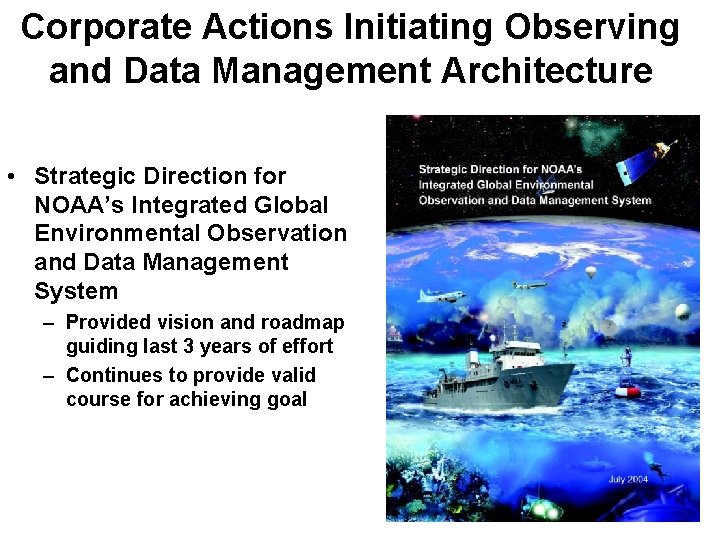
Corporate Actions Initiating Observing and Data Management Architecture • Strategic Direction for NOAA’s Integrated Global Environmental Observation and Data Management System – Provided vision and roadmap guiding last 3 years of effort – Continues to provide valid course for achieving goal
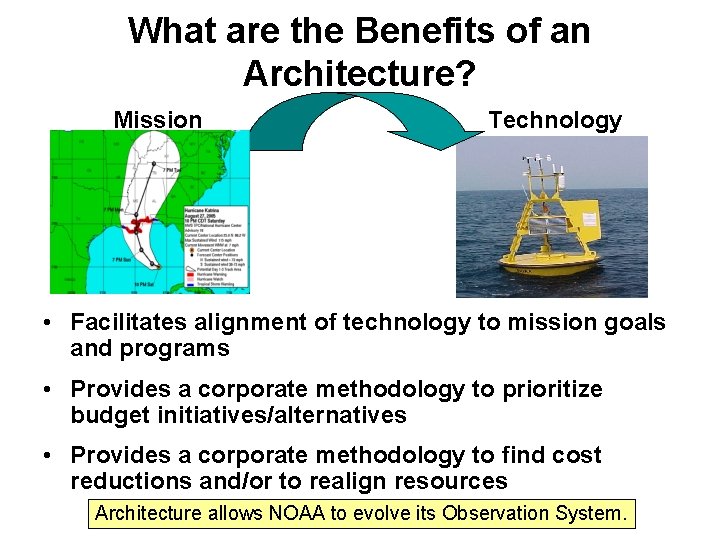
What are the Benefits of an Architecture? Mission Technology • Facilitates alignment of technology to mission goals and programs • Provides a corporate methodology to prioritize budget initiatives/alternatives • Provides a corporate methodology to find cost reductions and/or to realign resources Architecture allows NOAA to evolve its Observation System.
WHAT HAVE WE ACCOMPLISHED?
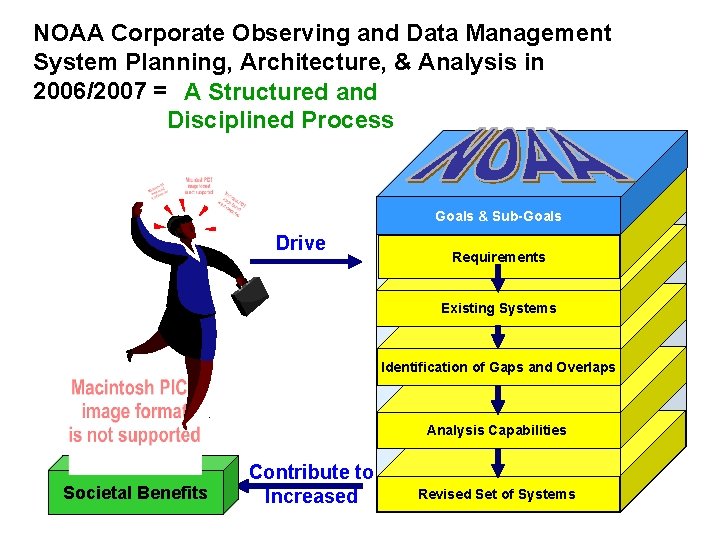
NOAA Corporate Observing and Data Management System Planning, Architecture, & Analysis in 2006/2007 = A Structured and Disciplined Process Goals & Sub-Goals Drive Requirements Existing Systems Identification of Gaps and Overlaps Analysis Capabilities Societal Benefits Contribute to Increased Revised Set of Systems
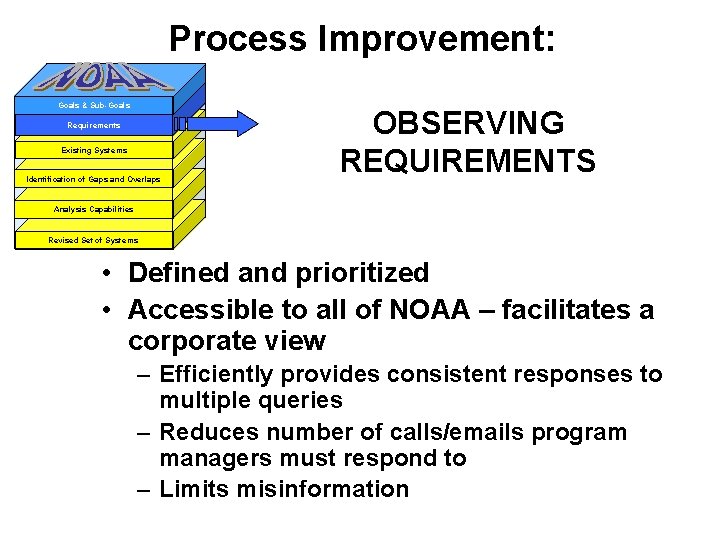
Process Improvement: Goals & Sub-Goals Requirements Existing Systems Identification of Gaps and Overlaps OBSERVING REQUIREMENTS Analysis Capabilities Revised Set of Systems • Defined and prioritized • Accessible to all of NOAA – facilitates a corporate view – Efficiently provides consistent responses to multiple queries – Reduces number of calls/emails program managers must respond to – Limits misinformation
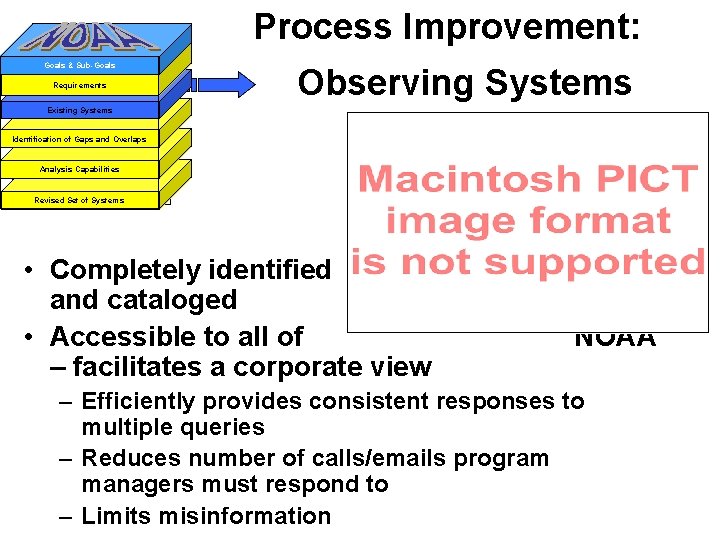
Process Improvement: Goals & Sub-Goals Requirements Observing Systems Existing Systems Identification of Gaps and Overlaps Analysis Capabilities Revised Set of Systems • Completely identified and cataloged • Accessible to all of – facilitates a corporate view NOAA – Efficiently provides consistent responses to multiple queries – Reduces number of calls/emails program managers must respond to – Limits misinformation
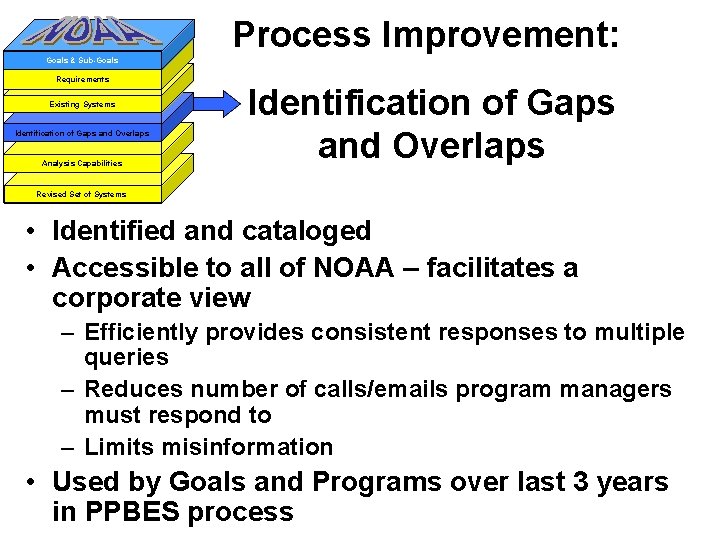
Process Improvement: Goals & Sub-Goals Requirements Existing Systems Identification of Gaps and Overlaps Analysis Capabilities Identification of Gaps and Overlaps Revised Set of Systems • Identified and cataloged • Accessible to all of NOAA – facilitates a corporate view – Efficiently provides consistent responses to multiple queries – Reduces number of calls/emails program managers must respond to – Limits misinformation • Used by Goals and Programs over last 3 years in PPBES process
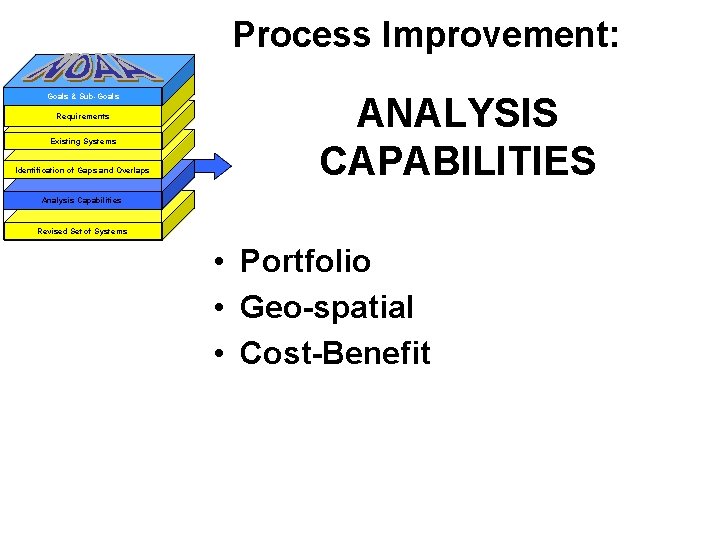
Process Improvement: Goals & Sub-Goals Requirements Existing Systems Identification of Gaps and Overlaps ANALYSIS CAPABILITIES Analysis Capabilities Revised Set of Systems • Portfolio • Geo-spatial • Cost-Benefit
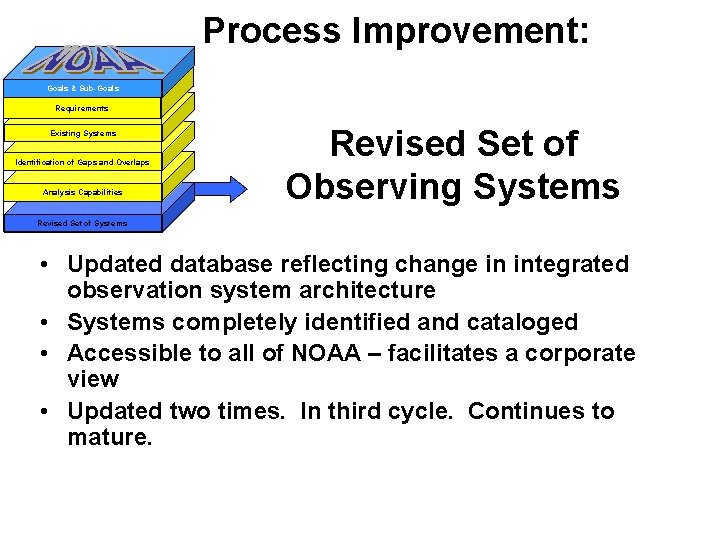
Process Improvement: Goals & Sub-Goals Requirements Existing Systems Identification of Gaps and Overlaps Analysis Capabilities Revised Set of Observing Systems Revised Set of Systems • Updated database reflecting change in integrated observation system architecture • Systems completely identified and cataloged • Accessible to all of NOAA – facilitates a corporate view • Updated two times. In third cycle. Continues to mature.
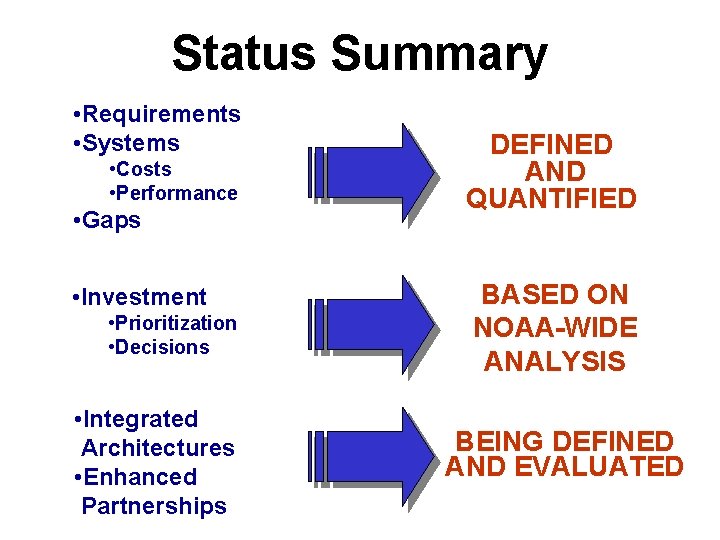
Status Summary • Requirements • Systems • Costs • Performance • Gaps • Investment • Prioritization • Decisions • Integrated Architectures • Enhanced Partnerships DEFINED AND QUANTIFIED BASED ON NOAA-WIDE ANALYSIS BEING DEFINED AND EVALUATED
Specific Results • • Dual Polarization Doppler Radar Solar Wind Mission Coronal Mass Ejection Imager Responding to Decadal Survey Report
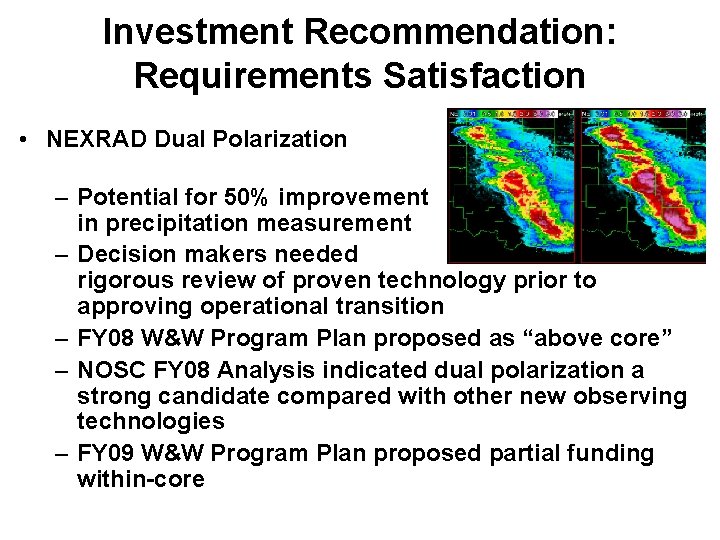
Investment Recommendation: Requirements Satisfaction • NEXRAD Dual Polarization – Potential for 50% improvement in precipitation measurement – Decision makers needed rigorous review of proven technology prior to approving operational transition – FY 08 W&W Program Plan proposed as “above core” – NOSC FY 08 Analysis indicated dual polarization a strong candidate compared with other new observing technologies – FY 09 W&W Program Plan proposed partial funding within-core
Investment Recommendation: Potential Cost Avoidance • Solar Wind Observations – SW data crucial for geomagnetic storm warnings • Aging NASA satellite is only current source of data – BAA Studies developed costs for multiple options – Total cost range of options was $222 M to $35 M – NOSC recommended lower-cost SW data-buy partnered with NASA using refurbished DSCOVR – Estimated cost avoidance ~ $150 -190 M (dependent on partnering)
Investment Recommendation: Potential Cost Avoidance • Coronal Mass Ejection Imager (CME) – CME data crucial for geomagnetic storm warnings – NASA STEREO mission is current source of data – GOES R formulation studies estimated cost of $40. 2 M for flight sensor – BAA studies identified novel concept for CME imaging that could be built commercially for $9 M and the potential for commercial data buy – NOSC questioned purchase of CME for GOES. Recommended studies to identify commercial sensor development and to define data purchase price – Estimated cost avoidance ~$30 M
Responding to the Decadal Survey Report • NOAA now has right process and tools • Complies with OSTP & OMB requirements • Consolidated Observing Requirements List (CORL), Casa. NOSA Analysis Tool (CAS) enable NOAA to implement: – Independent – Objective – Repeatable Process to evaluate the NRC recommendations
WHERE WE NEED TO GO AND WHY
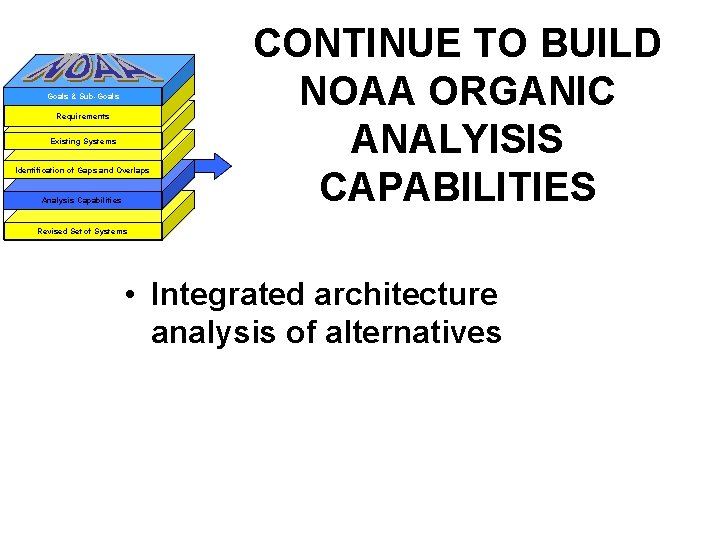
Goals & Sub-Goals Requirements Existing Systems Identification of Gaps and Overlaps Analysis Capabilities CONTINUE TO BUILD NOAA ORGANIC ANALYISIS CAPABILITIES Revised Set of Systems • Integrated architecture analysis of alternatives
The bridge to NOAA’s future is still
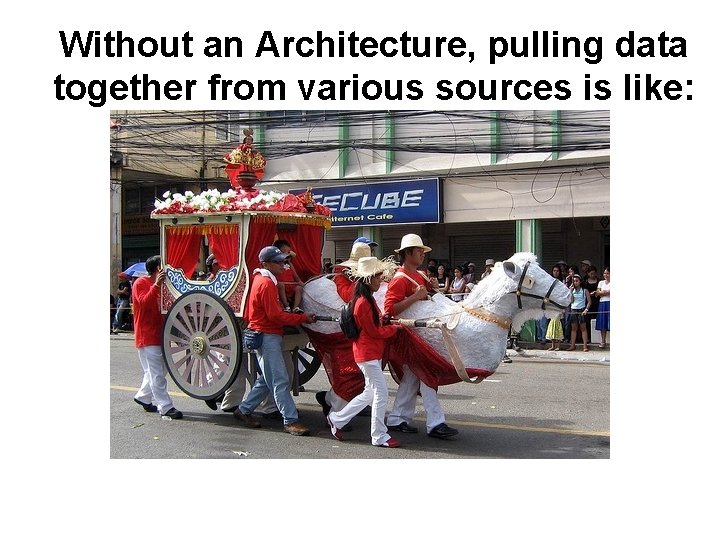
Without an Architecture, pulling data together from various sources is like: