
The Enneagram Spiritual Care Partners What is the
- Slides: 31
The Enneagram Spiritual Care Partners
What is the Enneagram? § A tool that helps us develop self-knowledge and understanding; § Helps us live as our authentic selves; § Helps us understand others in order to improve communication and strengthen relationships.
Limitations § The self is not a commodity; can’t be measured. § The self is hidden in God; can’t be “found”. § No one has actually seen “the self. ” § The Enneagram and other personality typing systems are necessary because self-knowledge is necessary but are insufficient/incomplete/not enough. - Fr. Martin Laird – Encountering Silence Podcast § Systems are at risk of serving as rationalization of or justification for bad behavior. – “Well, I just behave this way because I am a 5 on the Enneagram. ” - Cassidy Hall - Encountering Silence Podcast
A Brief History § The Enneagram system as we know it dates to the 1960’s due to the work of Oscar Ichazo (Argentina). – Synthesis of a number of ancient wisdom traditions • Judaism, Christianity, Islam, Taoism, Buddhism, and ancient Greek Philosophy – Ichazo integrated these traditions with the ancient Enneagram symbol to a create personality typing structure for the purpose of self-development.
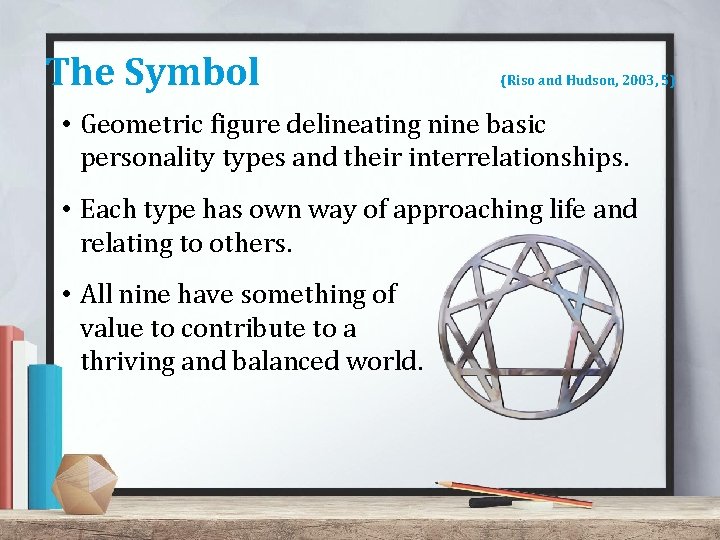
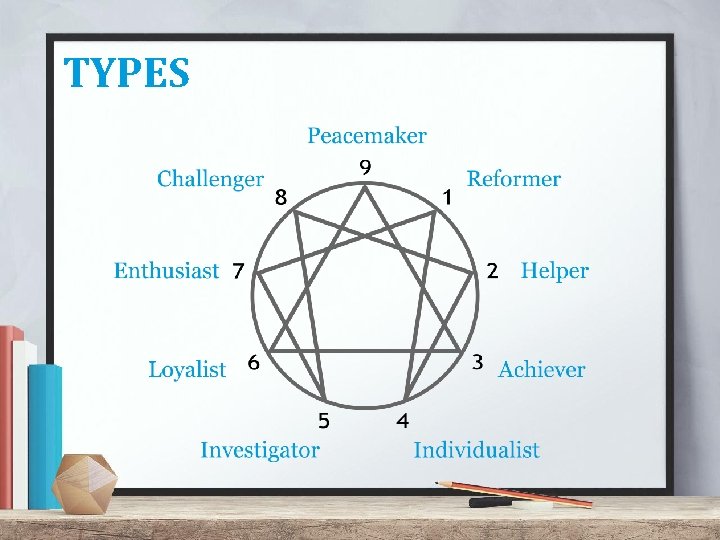
The Symbol (Riso and Hudson, 2003, 5) • Geometric figure delineating nine basic personality types and their interrelationships. • Each type has own way of approaching life and relating to others. • All nine have something of value to contribute to a thriving and balanced world.
§We have all nine types within us. §Our most dominant type is our default type. (Riso and Hudson, 2003, 9)
How Is It Useful? 1) Helps us to be fully present, frees us from living reactively due to our preoccupations. 2) Helps us recognize and understand overall patterns in human behavior: • External behaviors • Underlying attitudes • Emotional reactions • Conscious and unconscious motivations • Defense mechanisms
3) Helps us appreciate the differences in each other which helps communication and interaction. (Riso and Hudson, 2003, 10)
Helps us be authentic/true self: “The Enneagram takes us to the threshold of spirit and freedom, love and liberation, self-surrender and self-actualization. Once we have arrived at that uncharted land, we will begin to recognize our truest self, the self beyond personality, the self of essence. ” (Riso and Hudson, 2003, 11)
TYPES
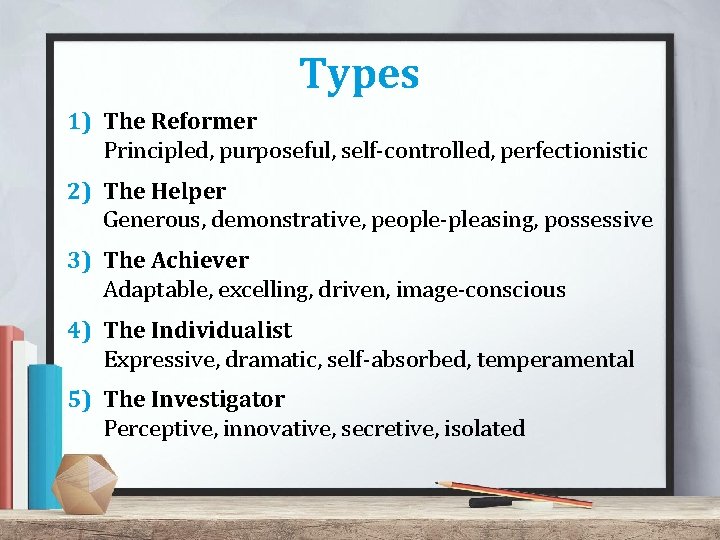
Types 1) The Reformer Principled, purposeful, self-controlled, perfectionistic 2) The Helper Generous, demonstrative, people-pleasing, possessive 3) The Achiever Adaptable, excelling, driven, image-conscious 4) The Individualist Expressive, dramatic, self-absorbed, temperamental 5) The Investigator Perceptive, innovative, secretive, isolated
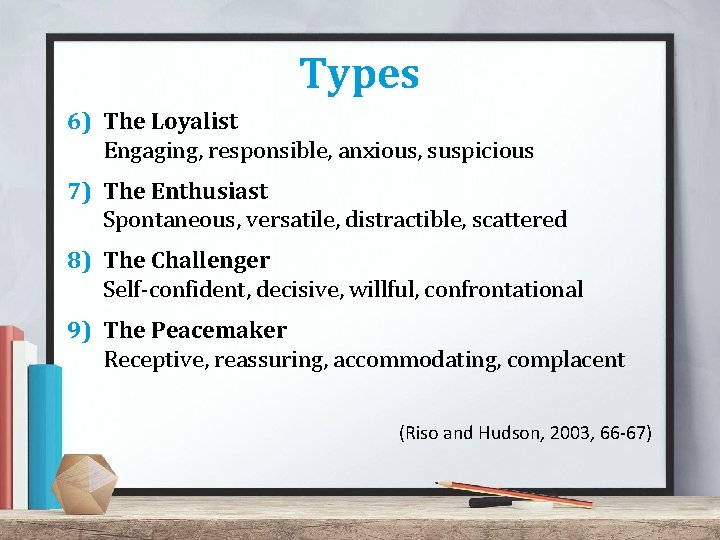
Types 6) The Loyalist Engaging, responsible, anxious, suspicious 7) The Enthusiast Spontaneous, versatile, distractible, scattered 8) The Challenger Self-confident, decisive, willful, confrontational 9) The Peacemaker Receptive, reassuring, accommodating, complacent (Riso and Hudson, 2003, 66 -67)
Video https: //www. youtube. com/watch? v=ONUGot. Sc 2 n. A
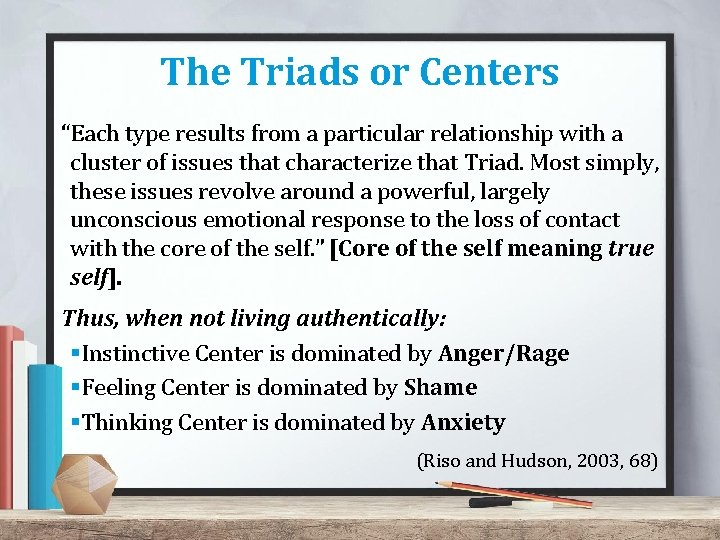
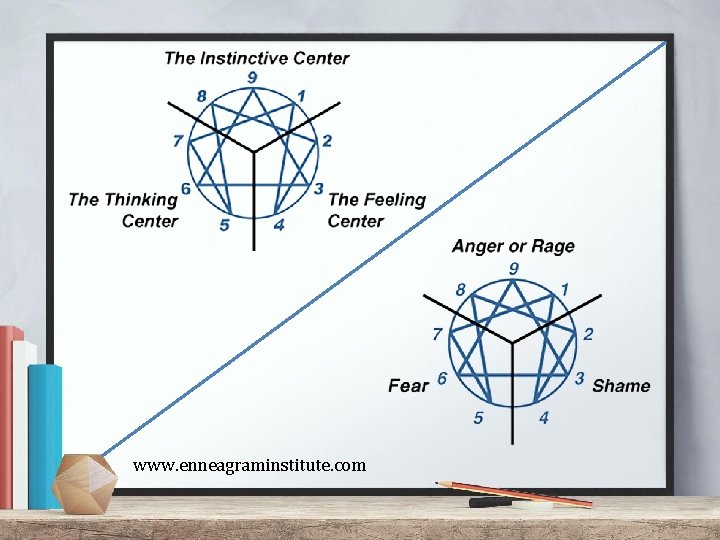
The Triads or Centers “Each type results from a particular relationship with a cluster of issues that characterize that Triad. Most simply, these issues revolve around a powerful, largely unconscious emotional response to the loss of contact with the core of the self. ” [Core of the self meaning true self]. Thus, when not living authentically: §Instinctive Center is dominated by Anger/Rage §Feeling Center is dominated by Shame §Thinking Center is dominated by Anxiety (Riso and Hudson, 2003, 68)
www. enneagraminstitute. com
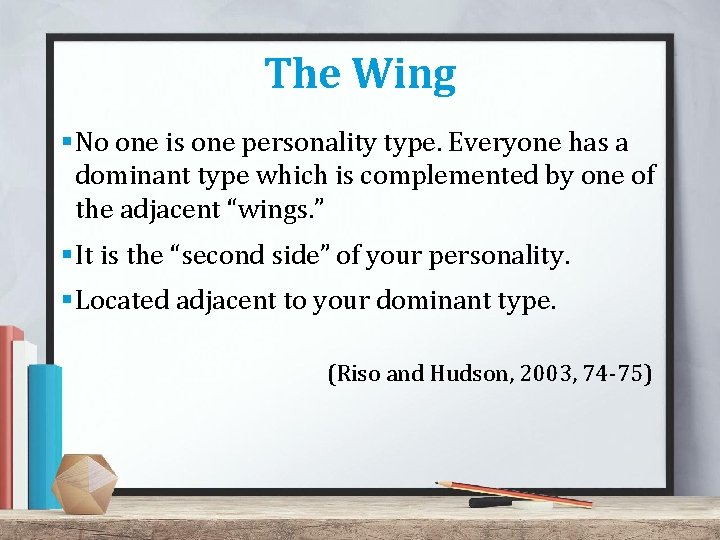
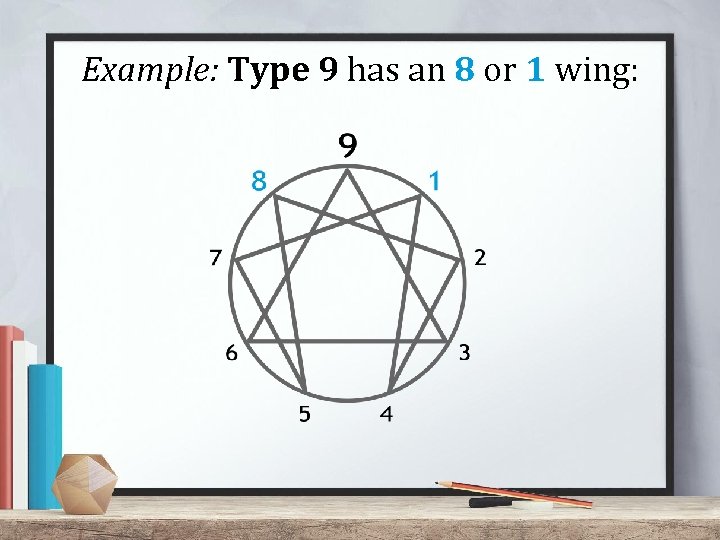
The Wing §No one is one personality type. Everyone has a dominant type which is complemented by one of the adjacent “wings. ” §It is the “second side” of your personality. §Located adjacent to your dominant type. (Riso and Hudson, 2003, 74 -75)
Example: Type 9 has an 8 or 1 wing:
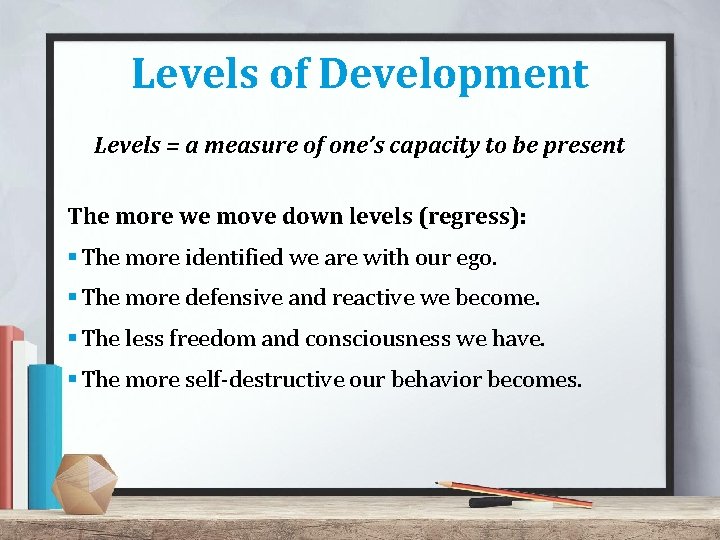
Levels of Development Levels = a measure of one’s capacity to be present The more we move down levels (regress): § The more identified we are with our ego. § The more defensive and reactive we become. § The less freedom and consciousness we have. § The more self-destructive our behavior becomes.
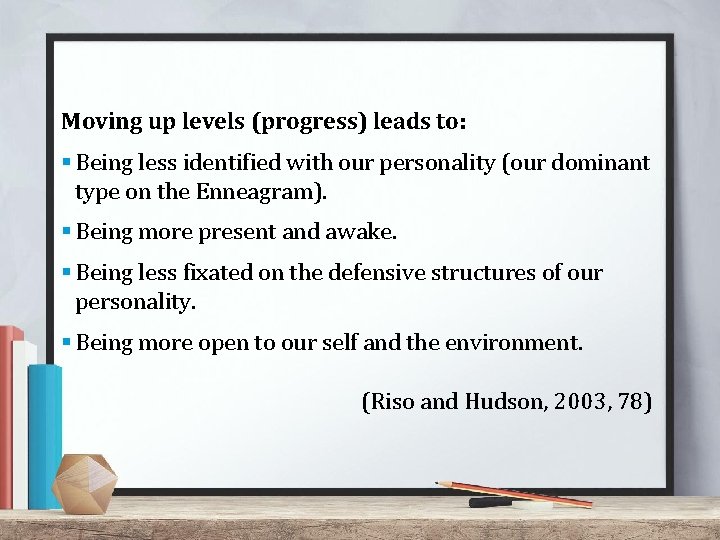
Moving up levels (progress) leads to: § Being less identified with our personality (our dominant type on the Enneagram). § Being more present and awake. § Being less fixated on the defensive structures of our personality. § Being more open to our self and the environment. (Riso and Hudson, 2003, 78)
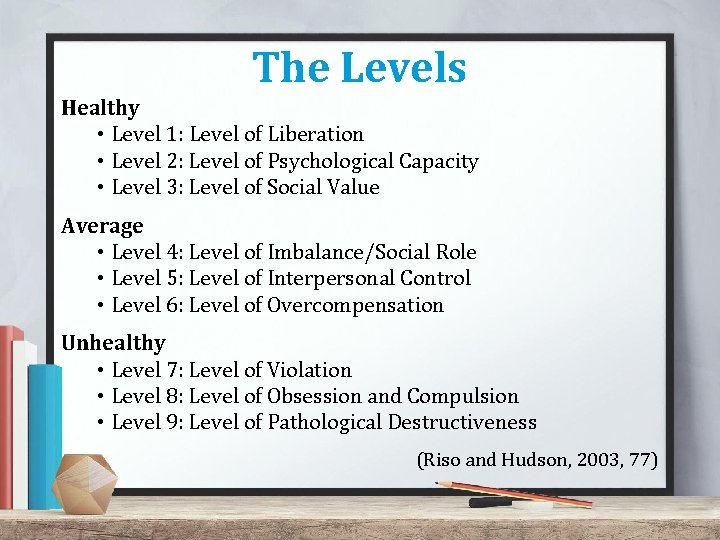
The Levels Healthy • Level 1: Level of Liberation • Level 2: Level of Psychological Capacity • Level 3: Level of Social Value Average • Level 4: Level of Imbalance/Social Role • Level 5: Level of Interpersonal Control • Level 6: Level of Overcompensation Unhealthy • Level 7: Level of Violation • Level 8: Level of Obsession and Compulsion • Level 9: Level of Pathological Destructiveness (Riso and Hudson, 2003, 77)
Actualization “When we are less identified with our personality, we find that we respond as needed to whatever life presents, actualizing the positive potentials in all nine types, bringing real peace, creativity, strength, joy, compassion, and other positive qualities to whatever we are doing. ” (Riso and Hudson, 2003, 79)
Thus, our main goal in regard to the Enneagram (and our personality) is to maintain balance by: §avoiding over-identification with our dominant type. §integrating the strengths of each type as we engage the world.
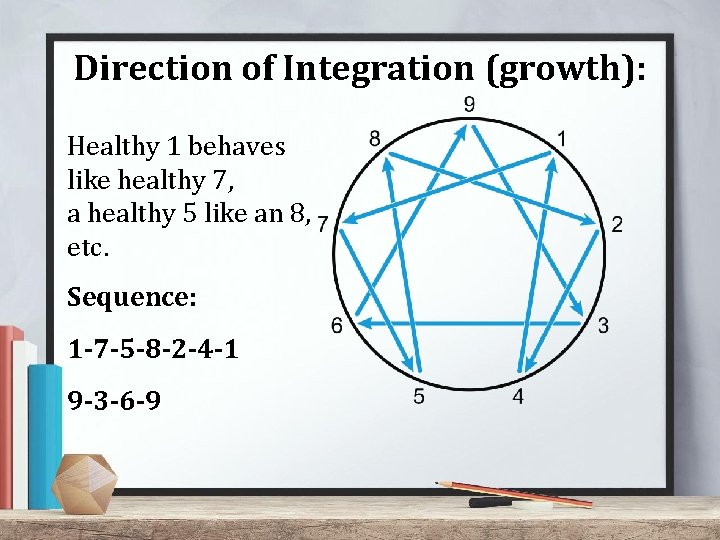
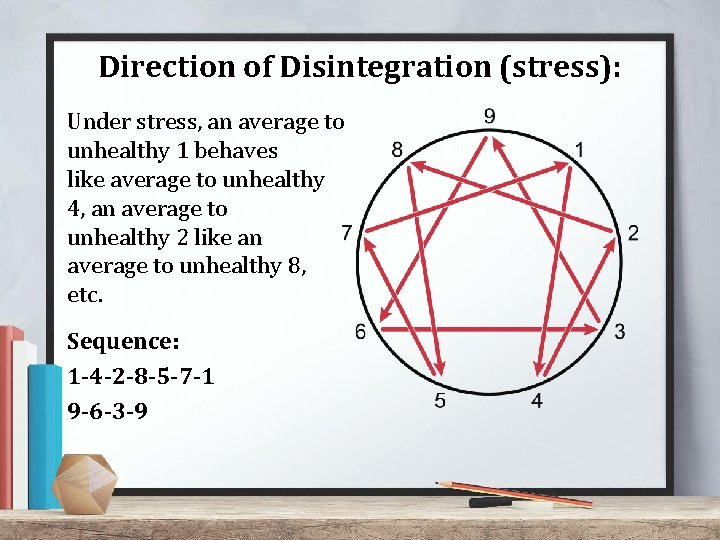
Integration/Disintegration Two lines connect to each type. Directions indicate how a person responds under times of stress or security. §Direction of Integration (growth) = Behavior when under control, secure. §Direction of Disintegration (stress) = Behavior under stress.
Direction of Integration (growth): Healthy 1 behaves like healthy 7, a healthy 5 like an 8, etc. Sequence: 1 -7 -5 -8 -2 -4 -1 9 -3 -6 -9
Direction of Disintegration (stress): Under stress, an average to unhealthy 1 behaves like average to unhealthy 4, an average to unhealthy 2 like an average to unhealthy 8, etc. Sequence: 1 -4 -2 -8 -5 -7 -1 9 -6 -3 -9
The 3 Instincts §Represent our instinctual hard-wiring §Necessary for survival as individuals and species §All 3 instincts are active in us, but we have a dominant instinct (the area of life we attend to first). “Dominant” meaning the instinct we prioritize. (Riso and Hudson, 2003, 82)
§ Self-Preservation Instinct (preserving body and its functioning) § Sexual Instinct (extending ourselves in environment and throughout generations) § Social Instinct (getting along with others, forming secure social bonds)
Full Picture of Personality Full picture of personality represented by: § Dominant Type § Centers/Triads § Wing § Levels of Development § Directions of Integration and Disintegration § Dominant Instinct
Goal Ultimate Goal = Balance §Integrate what each type symbolizes §Acquire healthy potentials of all types (“move around” the Enneagram) §Draw on power of each personality type as needed (Riso and Hudson, 2003, 82)
Balance Leads to Presence Having balance in our personality helps us to live authentically and be fully present.
Sources Riso, Don R. and Russ Hudson. Discovering Your Personality Type. New York: Houghton Mifflin Co. , 2003. www. enneagraminstitute. com Encountering Silence Podcast: www. encounteringsilence. com